The Power of Negations in Cryptography
Siyao Guo∗ Tal Malkin† Igor C. Oliveira‡ Alon Rosen§
August 25, 2018
Abstract
The study of monotonicity and negation complexity for Boolean functions has been prevalent in complexity theory as well as in computational learning theory, but little attention has been given to it in the cryptographic context. Recently, Goldreich and Izsak (2012) have initiated a study of whether cryptographic primitives can be monotone, and showed that one-way functions can be monotone (assuming they exist), but a pseudorandom generator cannot.
In this paper, we start by filling in the picture and proving that many other basic crypto-graphic primitives cannot be monotone. We then initiate aquantitative study of the power of negations, asking how many negations are required. We provide several lower bounds, some of them tight, for various cryptographic primitives and building blocks including one-way permu-tations, pseudorandom functions, small-bias generators, hard-core predicates, error-correcting codes, and randomness extractors. Among our results, we highlight the following.
• Unlike one-way functions, one-way permutations cannot be monotone.
• We prove that pseudorandom functions require logn−O(1) negations (which is optimal up to the additive term).
• Error-correcting codes with optimal distance parameters require logn−O(1) negations (again, optimal up to the additive term).
• We prove a general result for monotone functions, showing a lower bound on the depth of any circuit withtnegations on the bottom that computes a monotone functionf in terms of the monotone circuit depth off.
∗
[email protected], Department of Computer Science and Engineering, Chinese University of Hong Kong. Work partially supported by RGC GRF grant CUHK 410111. Part of this work done while visiting IDC Herzliya, supported by the European Research Council under the European Union’s Seventh Framework Programme (FP/2007-2013) / ERC Grant Agreement n. 307952.
†
[email protected], Department of Computer Science, Columbia University. Supported in part by NSF grants CCF-116702 and CCF-1423306.
‡
[email protected], Department of Computer Science, Columbia University. Supported in part by NSF grants CCF-116702 and CCF-1423306. Part of this work done while visiting IDC Herzliya, supported by the European Research Council under the European Union’s Seventh Framework Programme (FP/2007-2013) / ERC Grant Agreement n. 307952.
§
Contents
1 Introduction 3
2 Our Results 4
2.1 Cryptography is Non-Monotone . . . 4
2.2 Highly Non-Monotone Primitives . . . 5
2.3 Non-Trivial Upper Bound for Small-Bias Generators . . . 6
2.4 Lower Bounds for Boolean Circuits with Bottom Negations . . . 6
3 Preliminaries and Notation 6 3.1 Basic Notation . . . 7
3.2 Boolean Circuits and Negation Gates . . . 7
3.3 Complexity Measures for Boolean Functions . . . 7
3.4 Pseudorandom Functions and Weak Pseudorandom Functions . . . 8
3.5 Pseudorandom Generators and Small-Bias Generators . . . 8
3.6 One-Way Functions, One-Way Permutations, and Hard-Core Bits . . . 8
3.7 Extractors and Error-Correcting Codes . . . 9
4 Basic Results and Technical Background 9 4.1 Karchmer-Wigderson Communication Games . . . 9
4.2 Markov’s Upper Bound . . . 10
4.3 The Flow of Negation Gates . . . 10
4.4 Useful Inequalities . . . 11
5 Main Results 11 5.1 One-Way Functions versus One-Way Permutations . . . 11
5.2 Pseudorandom Generators and Small-Bias Generators . . . 13
5.3 Pseudorandom Functions . . . 16
5.4 Error-Correcting Codes . . . 16
5.5 Hard-Core Bits . . . 18
5.6 Randomness Extractors . . . 18
5.7 Negations at the Bottom Layer and Circuit Lower Bounds . . . 21
6 Open Problems and Further Research Directions 22 A The Flow of Negations in Boolean Circuits 26 A.1 Moving Negations to the Top of the Circuit . . . 26
1
Introduction
Why do block ciphers like AES (Advanced Encryption Standard) have so many XOR gates dispersed throughout the levels of its circuit? Can we build a universal hard-core bit alternative to the Goldreich and Levin one [GL89] that only applies a small (say, constant) number of XORs? Why does the Goldreich, Goldwasser, and Micali [GGM86] construction of a pseudorandom function (PRF) from a pseudorandom generator (PRG) heavily rely on selection functions, and calls the PRG many times? Could there be a monotone construction of a PRF from a PRG?
These are a few of the many fascinating questions related to the negation complexity of cryp-tographic primitives. The negation complexity of a boolean function f: {0,1}n → {0,1} is the
minimum number of negation gates in any fan-in two circuit with AND, OR, and NOT gates com-putingf. Note that negation gates are equivalent to XOR gates (of fan-in 2), in the sense that any circuit with tnegation gates can be transformed into an equivalent circuit witht XOR gates, and vice-versa.1 A function ismonotoneif and only if its negation complexity is 0.
In this paper, we initiate the investigation of the negation complexity of cryptographic prim-itives. We take first steps in this study, providing some surprising results, as well as pointing to some basic, intriguing problems that are still open.
This direction fits within the larger program of studying how simple basic cryptographic prim-itives can be, according to various complexity measures such as required assumptions, minimal circuit size, depth, etc (see, e.g., [AIK06]). Exploring such questions helps gaining a deeper theo-retical understanding of fundamental primitives and the relationships among them, and may provide the basis for understanding and addressing practical considerations as well.
While the study of monotone classes of functions and negation complexity has been prevalent in circuit complexity ([Hof92, AM05, Tar88, ST04, ST02, BNT98, BNT95, Mor09b, Mor09a], to name a few) and computational learning theory (see e.g. [BCO+14, BBL98, BT96, OW13, DLM+09]), little attention has been given to it in the cryptographic context.
Recently, Goldreich and Izsak [GI12] have initiated a study of “cryptography in the monotone world”, asking whether basic cryptographic primitives may be monotone. They focus on one-way functions (OWF) and pseudorandom generators, and show an inherent gap between the two by proving: (1) if any OWF exist, then there exist OWFs with polynomial-size monotone circuits, but (2) no monotone function can be a PRG. Quoting from their paper: these two results indicate that in the “monotone world” there is a fundamental gap between one-way functions and pseudorandom generators; thus, the “hardness-vs-randomness” paradigm fails in the monotone setting. This raises the following natural question:
Can other cryptographic primitives be computed by polynomial-size monotone circuits?
We consider this question for several primitives and building blocks, showing negative answers for all of them. This may suggest the interpretation (or conjecture) that in the “monotone world”, there is no cryptography except for one-way functions. We then initiate aquantitativestudy (where our main contributions lie), putting forward the question:
How many negations are required (for poly-size circuits) to compute fundamental cryp-tographic building blocks?
1¬
Markov [Mar58] proved that the negation complexity of any function h:{0,1}n → {0,1}m is
at most dlog(n+ 1)e, and Fischer [Fis75] proved that this transformation can be made efficient (see Jukna [Chapter 10, Juk12] for a modern exposition). In light of these results, is it the case that all natural cryptographic primitives other than OWFs require Ω(logn) negations, or are there primitives that can be computed with, say, a constant number of negations?
We state our results informally in the next section. Since our lower bounds hold for well-known primitives, we postpone their definitions to Section 3.
2
Our Results
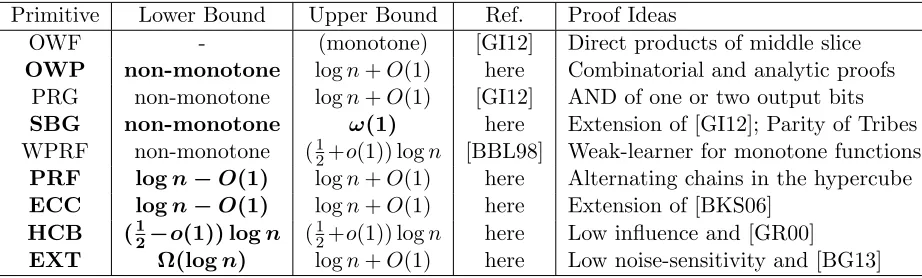
Our contributions alongside previously known results are summarized in Figure 1, together with the main idea in each proof (the definition of these primitives can be found in Section 3). We explain and discuss some interesting aspects of these results below, deferring complete details to the body of the paper.
Primitive Lower Bound Upper Bound Ref. Proof Ideas
OWF - (monotone) [GI12] Direct products of middle slice
OWP non-monotone logn+O(1) here Combinatorial and analytic proofs PRG non-monotone logn+O(1) [GI12] AND of one or two output bits
SBG non-monotone ω(1) here Extension of [GI12]; Parity of Tribes WPRF non-monotone (12+o(1)) logn [BBL98] Weak-learner for monotone functions
PRF logn−O(1) logn+O(1) here Alternating chains in the hypercube
ECC logn−O(1) logn+O(1) here Extension of [BKS06]
HCB (12−o(1)) logn (12+o(1)) logn here Low influence and [GR00]
EXT Ω(logn) logn+O(1) here Low noise-sensitivity and [BG13]
Figure 1: Summary of the negation complexity of basic cryptographic primitives and building blocks. Boldface results correspond to new bounds obtained in this paper. The logn+O(1) upper bound is Markov’s bound [Mar58] for any Boolean function. Error-correcting codes (ECC) and extractors (EXT) refer to constructions with good distance and extraction parameters.
2.1 Cryptography is Non-Monotone
As mentioned above, [GI12] proved that if OWFs exist, then they can be monotone, while PRGs cannot. We fill in the picture by considering several other cryptographic primitives, and observing that none of them can be monotone (see Figure 1).
A result of particular interest is the lower bound showing that one-way permutations (OWP) cannot be monotone. We obtain this result by proving that any monotone permutation f on n variables must satisfyf(x1, . . . , xn) = xπ(1), . . . , xπ(n)
, for some permutationπ: [n]→[n] (finding the permutation and invertingf can then be done by evaluatingf onninputs). This is surprising in light of the [GI12] construction for OWFs. In particular, our result can be seen as a separation between OWFs and OWPs in the monotone world.
2.2 Highly Non-Monotone Primitives
We show that many central cryptographic primitives are highly non-monotone. Some of our lower bounds demonstrate necessity of logn−O(1) negations, which is tight in light of Markov’s logn+O(1) upper bound [Mar58]. For some of the primitives we give less tight Ω(logn) lower bounds.
Pseudorandom Functions (PRF). We show that PRFs can only be computed by circuits containing at least logn−O(1) negations (which is optimal up to the additive term). We prove this by exhibiting an adversary that distinguishes any function that can be implemented with fewer negations gates from a random function. Our result actually implies that for any PRF family{F(w,·)}, for almost all seeds w,F(w,·) can only be computed by circuits with at least logn−O(1) negations.2
The distinguisher we construct asks for the values of the function on a fixed chain from 0nto 1n and accept if the alternating number of this chain is large. We note that the distinguisher suceeds for any function that has an implementation with fewer negations than the lower bound, regardless of the specific implementation the PRF designer had in mind. This can be considered as another statistical test to run on proposed candidate PRF implementations.
Error-Correcting Codes (ECC).As shown by Buresh-Oppenheim, Kabanets and Santhanam [BKS06], if an ECC has a monotone encoding function then one can find two codewords that are very close. This implies that there is no monotone ECC with good distance parameters.
We extend this result to show that, given a circuit with t negation gates computing the encoding function, we can find two codewords whose Hamming distance is O(2t·m/n) (for codes going from n bits to m bits). Consequently, this gives a logn−O(1) lower bound on the negation complexity of ECC with optimal distance parameters.
Hard-core Bits (HCB). Recall that a Boolean function h:{0,1}n → {0,1} is a hard-core
predicate for a function f:{0,1}n → {0,1} if, given f(x), it is hard to compute h(x). We
show that general hard-core bit predicates must be highly non-monotone. More specifically, there exists a family of one-way functions fn for which any hard-core predicate requires
Ω(logn) negations (assuming one-way functions exist).
Our result follows via the analysis of the influence of circuits with few negations, and a corresponding lower bound on hard-core bits due to Goldmann and Russell [GR00].
(Strong) Extractors (EXT). A strong extractor produces almost uniform bits from weak sources of randomness, even when the truly random seed used for extraction is revealed. We prove that any extractor functionExt:{0,1}n× {0,1}s→ {0,1}100that works for (n, n1/2−ε
)-sources requires circuits with Ω(logn) negations (see Section 3 for definitions).
This proof relies on the analysis of the noise sensitivity of circuits containing negations, together with a technique from Bogdanov and Guo [BG13].
2
2.3 Non-Trivial Upper Bound for Small-Bias Generators
The above lower bounds may suggest the possibility that, with the exception of OWFs, all cryptographic building blocks require Ω(logn) negations. We show one example of a primitive – small-bias generator (SBG) – that can be constructed with significantly fewer negations, namely, with any super-constant number of negations (for example, log∗(n) such gates).
A SBG can be thought of as a weaker version of a PRG, where the output fools linear distin-guishers (i.e., it looks random to any distinguisher that can only apply a linear test). Thus, any PRG is also a SBG, but not vice-versa. We construct our SBG with few negations by outputting the input and an additional bit consisting of a parity of independent copies of the Tribes function. Since SBGs are not quite a cryptographic primitive (these can be constructed unconditionally, and are not secure against polynomial adversaries), one may still conjecture that all “true” cryp-tographic primitives with the exception of OWFs require Ω(logn) negations. We do not know whether this is the case, and it would be interesting to determine whether other primitives not covered in this paper can be monotone.
2.4 Lower Bounds for Boolean Circuits with Bottom Negations
In addition to studying specific primitives, we investigate general structural properties of circuits with negations. We prove a theorem showing that for monotone functions, the depth of any circuit with negations at the bottom (input) level only is lower bounded by the monotone depth complexity of the function minus the number of negations in the circuit. This is connected to a result obtained by Koroth and Sarma [KS14], who proved a multiplicative rather than additive lower bound, but in a more general setting which assumes that every Boolean function computed at an internal gate of the circuit can be computed by some circuit with few negations (see their paper for more details). We consider the usual definition of Boolean circuits with negations at the bottom layer, which allows us to prove a stronger trade-off. Our proof is inspired by ideas from [KS14], and relies on a circular application of the Karchmer-Wigderson connection between boolean circuits and communication protocols.
This result suggests that negations at the bottom layer are less powerful and easier to study. In the Appendix we describe some techniques (following results of Blais et al. [BCO+14]) that
al-low one to decompose arbitrary computations into monotone and non-monotone components, and provide further evidence that negations at the bottom are less powerful (see also the discussion in Section 6).
Organization. We provide the definitions for most of the primitives mentioned in this paper in Section 3. Basic results used later in our proofs are presented in Section 4, with some proofs deferred to Appendix A. Our main results appear in Section 5. Finally, Section 6 discusses some open problems motivated by our work.
3
Preliminaries and Notation
3.1 Basic Notation
We use [n] to denote the set {1, . . . , n}. Given a Boolean string w, we use |w| to denote its length, and |w|1 to denote the number of 1’s in w. Unless explicitly stated, we assume that the underlying probability distribution in our equations is the uniform distribution over the appropriate set. Further, we let U` denote the uniform distribution over {0,1}`. We use logx to denote a
logarithm in base 2, and lnx to refer to the natural base. Given stringsx, y∈ {0,1}n, we writexyifx
i ≤yi for everyi∈[n]. Achain X = (x1, . . . , xt)
is a monotone sequence of strings over {0,1}n, i.e., xi xi+1 for every i∈[1, t−1]. We say that
a chain X = (x1, x2, . . . , xt) isk-alternating with respect to a functionf:{0,1}n→ {0,1} if there
exist indexes i0 < i1 < . . . < ik such that f(xij) 6= f(xij+1), for every j ∈ [0, k−1]. If this is
true for every pair of consecutive elements of the chain, we say that the chain is proper (with respect tof). We leta(f,X) be the size of the largest set of indexes satisfying this condition. The alternating complexity of a Boolean function f is given by a(f) def= maxXa(f,X), where X is a chain over {0,1}n. A function f:{0,1}n→ {0,1} is monotone iff(x)≤f(y) whenever x y. A
functiong:{0,1}n→ {0,1}m is monotone if every output bit ofgis a monotone Boolean function.
Moreover, we say that a Boolean functionf:{0,1}n→ {0,1}isanti-monotone iff is the negation
of a monotone Boolean function.
3.2 Boolean Circuits and Negation Gates
Every Boolean circuit mentioned in this paper consists ofAND,ORandNOT gates, where the first two types of gates have fan-in two. Recall that a Boolean function f:{0,1}n → {0,1} is
monotone if and only if it is computed by a circuit withAND and ORgates only.
For convenience, the size of a circuit C will be measured by its number of AND and ORgates, and will be denoted by size(C). The depth of a circuit C, denoted by depth(C), is the largest number of AND and ORgates in any path from the output gate to an input variable. The depth of a Boolean function f is the minimum depth of a Boolean circuit computing f. Similarly, the depth of amonotone functionf, denoted bydepth+(f), is the minimum depth among allmonotone circuits computing f. We will also consider multi-output Boolean circuits that compute Boolean functions f: {0,1}n → {0,1}m. We stress that whenever we say that a function of this form is
computed by a circuit with t negations, it means that there exists a single circuit (with multiple output gates) containing at most tnegations computing f.
We say that a circuit contains negation gates at the bottom layer only if any NOTgate in the circuit gets as input an input variablexi, for somei∈[n]. We will also say that circuits of this form
are DeMorgan circuits. Put another way, a circuit C(x) of size s with t negations at the bottom layer can be written as D(x,(x⊕β)), where D is amonotone circuit of size s, β ∈ {0,1}n with
|β|1 =tencodes the variables that appear negated in C, and x⊕β ∈ {0,1}n is the string obtained
via the bit-wiseXOR operation. This notation is borrowed from Koroth and Sarma [KS14], which refers toβ as the orientation vector.
3.3 Complexity Measures for Boolean Functions
Given a Boolean function f:{0,1}n → {0,1} and an index i∈[n], we useI
i(f) to denote the
influence of thei-th input variable on f, i.e., Ii(f) def
string obtained from x by flipping itsi-th coordinate. The influence of f (also known as
average-sensitivity) is defined as I(f) def= P
i∈[n]Ii(f). We say that a Boolean function f is balanced or
unbiased if Prx[f(x) = 1] = 1/2. We use NSp(f) to denote the noise sensitivity of f under noise
rate p∈[0,1/2], which is defined as Pr[f(X⊕Y)6=f(X)], where X is distributed uniformly over
{0,1}n, andY is thep-biased binomial distribution over{0,1}n, i.e., each coordinate ofY is set to
1 independently with probability p.
3.4 Pseudorandom Functions and Weak Pseudorandom Functions
LetFnbe the set of all Boolean functions onnvariables, andF:{0,1}m× {0,1}n→ {0,1}. We
say that F is an (s, ε)-securepseudorandom function (PRF) if, for every (non-uniform) algorithm
A that can be implemented by a circuit of size at mosts,
Pr
w∼{0,1}m h
AF(w,·) = 1i− Pr
f∼Fn
h
Af = 1i ≤ε,
whereAh denotes the execution of Awith oracle access to a Boolean function h:{0,1}n→ {0,1}
(circuits with access to oracle gates are defined in the natural way).
A weak pseudorandom function (WPRF) is defined similarly, except that the distinguisher only has access to random examples of the form (x, F(w, x)), where x is uniformly distributed over
{0,1}n. In particular, any (s, ε)-secure pseudorandom function is an (s, ε)-secure weak
pseudoran-dom function, while the other direction is not necessarily true.
3.5 Pseudorandom Generators and Small-Bias Generators
A functionG:{0,1}n→ {0,1}mis an (s, ε)-securepseudorandom generator (PRG) withstretch
`def= m−nif for every circuitC(z1, . . . , zm) of size s,
Pr
x∼Un[C(G(x)) = 1]−y∼UmPr [C(y) = 1] ≤ε.
We say that a function g: {0,1}n → {0,1}m is an ε-secure small-bias generator (SBG) with
stretch`=m−n if, for every nonempty setS ⊆[m],
Pr
x∼Un, y=g(x)
h X
i∈S
yi ≡1 (mod 2)
i
−1
2 ≤ε.
Observe that small-bias generators can be seen as weaker pseudorandom generators that are re-quired to be secure against linear distinguishers only. We refer the reader to Naor and Naor [NN93] for more information about the constructions and applications of such generators.
3.6 One-Way Functions, One-Way Permutations, and Hard-Core Bits
We say that a function f:{0,1}n→ {0,1}m is an (s, ε)-secureone-way function (OWF) if for
every circuitC of size at mosts,
Pr
x∼Un, y=f(x)[C(y)
Ifm=n, we say that f islength-preserving. If in additionf is a one-to-one mapping, we say that f is an (s, ε)-secureone-way permutation (OWP).
We say that a function h: {0,1}n → {0,1} is an (s, ε)-secure hard-core bit for a function
f:{0,1}n→ {0,1}m if, for every circuit C of size s,
Pr
x∼Un[C(f(x)) =h(x)]− 1 2 ≤ε.
3.7 Extractors and Error-Correcting Codes
The min-entropy of a random variable X, denoted by H∞(X), is the largest real number k such that Pr[X = x] ≤ 2−k for every x in the range of X. A distribution X over {0,1}n with
H∞(X) ≥k is said to be an (n, k)-source. Given random variablesX and Y with range{0,1}m,
we let
δ(X, Y)def= max
S⊆{0,1}m
Pr[X∈S]−Pr[Y ∈S]
denote their statistical distance. We say that X and Y areε-close ifδ(X, Y)≤ε.
We say that a function Ext:{0,1}n× {0,1}s→ {0,1}m is a (strong) (k, ε)-extractor (EXT) if,
for any (n, k)-source X, the distributions Us+m and (Us,Ext(X,Us)) areε-close.3 Given strings y1, y2 ∈ {0,1}m, we let
∆(y1, y2)def= |{i∈[m]|y
1
i 6=yi2}|
m
be their relative Hamming distance. Given a function E:{0,1}n → {0,1}m, we say that E has
relative distanceγ if for every distinct pair of inputsx1, x2∈ {0,1}n, we have ∆(E(x1), E(x2))≥γ.
As a convention, we will refer to a function of this form as anerror-correcting code (ECC) whenever we are interested in the distance between its output strings (also known as “codewords”).
4
Basic Results and Technical Background
4.1 Karchmer-Wigderson Communication Games
Karchmer-Wigderson games [KW88] are a powerful tool in the study of circuit depth complexity. We focus here on games for monotone functions. Letf:{0,1}n→ {0,1}be a monotone function,
and consider the following deterministic communication game between two players named Alice and Bob. Alice gets an input x ∈f−1(1), while Bob receives y ∈f−1(0). The goal of the players is to communicate the minimum number of bits (using an interactive protocol), and to output a coordinatei∈[n] for which xi= 1 andyi = 0. The monotonicity assumption onf guarantees that
such coordinate always exists.
Proposition 4.1 (Karchmer and Wigderson [KW88]). Let f: {0,1}n → {0,1} be a monotone
function. There exists a monotone circuit Cf of depth d that computes f if, and only if, there
exists a protocol Πf for the (monotone) KW-game of f with communication cost d.
3
4.2 Markov’s Upper Bound
The following result was obtained by Markov [Mar58].
Proposition 4.2 (Markov [Mar58]). Let f:{0,1}n→ {0,1}m be an arbitrary function. Then f is
computed by a (multi-output) Boolean circuit containing at most dlog(n+ 1)e negations.
This result implies that many of our lower bounds are tight up to an additive term independent ofn. Some of our proofs also rely on the following relation between negation complexity and alternation.
Proposition 4.3 (Markov [Mar58]). Let f:{0,1}n→ {0,1} be a Boolean function computed by a
circuit with at most t negations. Then a(f) =O(2t).
4.3 The Flow of Negation Gates
It is useful in some situations to decompose the computation of a function into monotone and non-monotone components. This idea has been applied successfully to obtain almost optimal bounds on the learnability of functions computed with few negation gates (Blais et al. [BCO+14]). An important lemma used in their paper can be stated as follows.
Lemma 4.4 (Blais et al. [BCO+14]). Let f:{0,1}n→ {0,1} be a Boolean function computed by
a circuit C with at most t negations. Then f can be written as f(x) =h(g1(x), . . . , gT(x)), where
each function gi is monotone, T =O(2t), and h is either the parity function, or its negation.
A drawback of this statement is that the computational complexity of each gi is not related
to the size of C. Roughly speaking, the proof of this result uses a circuit for f in order to gain structural information about f, and then rely on a non-constructive argument. We observe that, by relaxing the assumption onh, we can prove the following effective version of Lemma 4.4.4
Lemma 4.5. Let f: {0,1}n → {0,1} be a Boolean function computed by a circuit C of size s
containing t negation gates. Then f can be written as f(x) = h(g1(x), . . . , gT(x)), where each
function gi is computed by a monotone circuit of size at most s, T = 2t+1−1, and h:{0,1}T →
{0,1} is computed by a circuit of size at most 5T.
We state below a more explicit version of Lemma 4.5 for circuits with a single negation gate and several output bits. The proof of this result follows from the same argument used to derive Lemma 4.5, whose proof we give in Section A.
Lemma 4.6. Letf:{0,1}n→ {0,1}ube computed by a circuit of sizescontaining a single negation
gate. Assume that the j-th output bit of f is computed by the function fj:{0,1}n→ {0,1}. Then,
there exist monotone functions m:{0,1}n→ {0,1} and m
j,`: {0,1}n→ {0,1}, where j ∈[u] and
`∈ {0,1}, which are computed by monotone circuits of size at mosts, and a function h:{0,1}3 →
{0,1}, such that:
(i) For every j∈[u], fj(x) =h(m(x), mj,0(x), mj,1(x)).
(ii) For every j∈[u] and x∈ {0,1}n, m
j,0(x)≤mj,1(x).
(iii) The function h is defined as h(z, y1, y0) def
= yz.
4
From a programming perspective, Lemma 4.6 shows that a single negation gate in a Boolean circuit can be interpreted as anif-then-elsestatement involving monotone functions. Conversely,
the selection procedure computed by h can be implemented with a single negation.
For convenience of the reader, we sketch the proof of these results in Section A, where we also discuss the expressiveness of negations at arbitrary locations compared to negations at the bottom layer of a circuit. Lemmas 4.4 and 4.5 can be used interchangeably in our proofs.
4.4 Useful Inequalities
Some of our proofs rely on the following results for Boolean functions.
Proposition 4.7(Fortuin, Kasteleyn, and Ginibre [FKG71]). If g:{0,1}n→ {0,1}andf:{0,1}n→
{0,1} are monotone Boolean functions, then
Pr
x[f(x) = 1∧g(x) = 1] ≥ Prx [f(x) = 1]·Prx[g(x) = 1].
The same inequality holds for anti-monotone functions. In particular, for monotonef, g:{0,1}n→
{0,1}, following inequality holds
Pr
x[f(x) = 0∧g(x) = 0] ≥ Prx [f(x) = 0]·Prx[g(x) = 0].
A stronger version of this inequality that will be used in some of our proofs is presented below.
Proposition 4.8(Talagrand [Tal96]). For any pair of monotone Boolean functionsf, g:{0,1}n→
{0,1}, it holds that
Pr
x[f(x) = 1∧g(x) = 1] ≥ Prx[f(x) = 1]·Prx[g(x) = 1] +ψ
X
i∈[n]
Ii(f)·Ii(g)
,
where ψ(x)def= c·x/log (e/x), and c >0 is a fixed constant independent ofn.
Proposition 4.9(Kahn, Kalai, and Linial [KKL88]). Letf:{0,1}n→ {0,1}be a balanced Boolean
function. Then there exists an index i∈[n] such thatIi(f) = Ω
logn n
.
Finally, we will make use of the following standard concentration bound (cf. Alon and Spencer [AS08]).
Proposition 4.10. Let X1, . . . , Xm be independent {0,1} random variables, where each Xi is 1
with probability p∈[0,1]. In addition, set Xdef= P
iXi, and µ def
= E[X] =pm. Then, for any fixed ζ >0, there exists a constant cζ >0 such that
Pr[|X−µ|> ζµ] < 2e−cζµ.
5
Main Results
5.1 One-Way Functions versus One-Way Permutations
Proposition 5.1. Let f: {0,1}n → {0,1}n be a one-to-one function. If f is monotone, then
there exists a permutation π: [n]→ [n] such that, for every x ∈ {0,1}n, f(x) = x
π(1). . . xπ(n). In
particular, there exists a (uniform) polynomial size circuit that inverts f on every input y=f(x).
Proof. Let fi:{0,1}n→ {0,1} be the Boolean function corresponding to thei-th output bit of f.
Sincef is monotone, each functionfi is monotone. Consider now functionsf` andfk, where`6=k.
By Talagrand’s inequality (Proposition 4.8),
Pr
x [f`(x) = 1∧fk(x) = 1] ≥ Prx [f`(x) = 1]·Prx[fk(x) = 1] +ψ
X
i∈[n]
Ii(f`)·Ii(fk)
. (1)
Since f is a permutation, Prx[f`(x) = 1∧fk(x) = 1] = 1/4 and Prx[f`(x) = 1] = Prx[fk(x) = 1] =
1/2. Consequently, it follows from Equation 1 and the definition ofψ that
X
i∈[n]
Ii(f`)·Ii(fk) = 0.
In other words, f` and fk depend on a disjoint set of input variables. Since this is true for every
pair ` and k with ` 6= k, and every output bit of f is non-constant, there exists a permutation π: [n]→[n] such that, for everyi, j∈[n], if Ii(fj)>0 theni=π(j). Moreover, asf is monotone
and one-to-one, we must have fj(x) =xπ(j), for everyj ∈[n]. The corresponding permutation can
be easily recovered fromf by evaluating this function on every indicator stringei∈ {0,1}n, where
eij = 1 if and only ifi=j. This completes the proof of our result.
We remark that a simple extension of this proof allows us to rule out monotone one-way functions f:{0,1}n → {0,1}n−k where each pre-image set f−1(x) has size exactly 2k (i.e., regular OWFs),
and some relaxations of this notion.
Proposition 5.1 implies that any circuit computing a one-way permutation contains at least one negation gate. It is not clear how to extend its proof to obtain a stronger lower bound on the negation complexity of one-way permutations, as Talagrand’s inequality holds for monotone functions only. Although we leave open the problem of obtaining better lower bounds, we give next an alternative proof of Proposition 5.1 that does not rely on Talagrand’s result.
Proof. Let Sk def
= {x ∈ {0,1}n | |x|
1 =k}, where k ∈[0, n]. In other words, Sk is simply thek-th
slice of then-dimensional Boolean hypercube. Initially, we prove the following claim: For every set Sk,f(Sk) =Sk. In other words,f induces a permutation over each set of inputs Sk. We then use
this result to establish Proposition 5.1.
First, observe that f(0n) = 0n. Otherwise, there exists an inputx 6= 0n such that f(x) = 0n. Since 0nx and f is monotone, we get that f(0n)f(x), which contradicts the injectivity of f. This establishes the claim for S0. The general case follows by induction on k. Assume the result
holds for any k0 < k, and consider an arbitrary y ∈Sk. Since f is one-to-one, there exists x ∈S`
such that f(x) =y, where `≥k. If`6=k, there exists x0 ≺x such that x0 ∈Sk. Let y0 def
Now let π: [n] → [n] be the permutation such that f−1(ei) = eπ(i), where ej ∈ {0,1}n is the
input with 1 at thej-th coordinate only. Clearly, for everyx∈S0∪S1,f(x) =xπ(1). . . , xπ(n). On
the other hand, for every x∈Sk withk >1, it follows from the monotonicity of f that
_
i:xi=1
f(ei) f(x),
where the disjunction is done coordinate-wise. Finally, it follows from our previous claim that we must also havef(x)∈S|x|1. Therefore,
_
i:xi=1
f(ei) = f(x).
Consequently, for every x ∈ {0,1}n, it follows that f(x) = x
π(1). . . xπ(n), which completes the
proof.
5.2 Pseudorandom Generators and Small-Bias Generators
In contrast to the situation for one-way functions, Goldreich and Izsak [GI12] presented an elegant proof that pseudorandom generators cannot be monotone. More specifically, their result shows that the output distribution of a monotone function G:{0,1}n → {0,1}n+1 can be
distin-guished from random either by the projection of one of its output bits, or via the conjunction of two output bits.
Recall from Section 3 that small-bias generators can be seen as restricted pseudorandom gen-erators that are only required to be secure against linear tests. We prove next that the techniques from [GI12] can be used to show that there are no (1/nω(1))-secure monotone small-bias generators
with 1 bit of stretch. We observe later in this section that such generators can be constructed with any super-constant number of negation gates.
Proposition 5.2. For any monotone functionG:{0,1}n→ {0,1}n+1, there exists a (non-uniform)
linear test D:{0,1}n+1→ {0,1} such that
xPr∼Un[D(G(x)) = 1]− 1 2
= Ω
1 n2
.
Proof. The proof follows closely the argument in [GI12], combined with an appropriate applica-tion of the FKG inequality (Proposiapplica-tion 4.7). Let Gi:{0,1}n → {0,1} be the Boolean function
corresponding to thei-th output bit ofG, wherei∈[n+ 1]. Observe that if there existsisuch that
Pr
x∼Un[Gi(x) = 1]− 1 2 = Ω
1 n2
,
then there is a trivial linear distinguisher forG.
Assume therefore that, for every i∈[n+ 1],Gi is almost balanced. In particular, each function
Gi is δ(n)-close under the uniform distribution to an unbiased function Gei:{0,1}n+1 → {0,1}, whereδ(n) =o((logn)/n). It follows from Proposition 4.9 that each function Gei has an influential variable. More precisely, there existsγ: [n+ 1]→[n] such that
Iγ(i)(Gei) = Ω
logn n
for everyi∈[n+ 1]. As each Gi is δ(n)-close toGei, it follows thatIγ(i)(Gi) = Ω logn n as well.
By the pigeonhole principle, there exist distinct indexesiandj such thatγ(i) =γ(j). It follows from Proposition 4.8 that
Pr
x[Gi(x) = 1∧Gj(x) = 1] ≥ Prx[Gi(x) = 1]·Prx [Gj(x) = 1] +ψ
X
k∈[n]
Ik(Gi)·Ik(Gk)
≥ Pr
x[Gi(x) = 1]·Prx [Gj(x) = 1] + Ω
ψlog
2n
n2
≥ Pr
x[Gi(x) = 1]·Prx [Gj(x) = 1] + Ω
logn n2
.
On the other hand, Proposition 4.7 implies that
Pr
x[Gi(x) = 0∧Gj(x) = 0] ≥ Prx [Gi(x) = 0]·Prx[Gj(x) = 0].
Combining both inequalities, and using the assumption that each output bit ofGis almost balanced, we get that:
Pr
x [Gi(x) +Gj(x) = 0] = Prx[Gi(x) = 1∧Gj(x) = 1] + Prx[Gi(x) = 0∧Gj(x) = 0]
≥ Pr
x[Gi(x) = 1]·Prx[Gj(x) = 1] + Prx [Gi(x) = 0]·Prx[Gj(x) = 0] + Ω
logn n2
≥ 1
2 −O
1 n2
+ Ωlogn n2
= 1 2 + Ω
logn n2
.
Therefore, the linear functionD(y) def= yi+yj can distinguish the output of G from random with
the desired advantage, which completes the proof.
In contrast, we show next that there are small-bias generators with super-polynomial security that can be computed withanysuper-constant number of negations. LetTribess,t:{0,1}s·t→ {0,1}
be the (monotone) Boolean function defined as
Tribess,t(x1, . . . , xs·t) = s−1
_
i=0 t
^
j=1
xi·t+j.
Further, we use Tribesm: {0,1}m → {0,1} to denote the function Tribess,t, where sis the largest
integer such that 1−(1−2−t)s ≤1/2, and t =m/s (i.e., we try to make Tribes as balanced as possible as a function overm variables).
Proposition 5.3. Let f: {0,1}n → {0,1} be defined as f(x) def= ⊕k
i=1Tribesn/k(x(i)), where x(i)
denotes thei-th block of xwith length n/k. Let1≤k(n)≤n/logn, and G:{0,1}n→ {0,1}n+1 be
defined byG(x)def= (x, f(x)), Then, there exists a constant C >0 such that, for any linear function D:{0,1}n+1→ {0,1},
Pr
x∼Un[D(G(x)) = 1]− 1 2
≤ (C·(k/n)·log(n/k))
k
In particular, whenk=ω(1), we can get a small-bias generator with negligible error that can be computed with roughly logknegations (via Proposition 4.2). Interestingly, for k= 2 we obtain an SBG computed with asingle negation and security ˜Θ(n−2), essentially matching the lower bound formonotone SBGs given by Proposition 5.2.
Proof. We assume the reader is familiar with basic concepts from analysis of Boolean functions (cf.
O’Donnell [O’D14]). Suppose that D(y) def= P
i∈Syi (mod 2), where S ⊆ [n+ 1] is nonempty. If
n+ 1∈/ S, using that the firstnoutput bits ofGare uniformly distributed over{0,1}n, we get that
|Prx[D(G(x)) = 1]−1/2|= 0. Assume therefore thatn+ 1∈S, and letS0 def
= S\{n+ 1}. Then,
Pr
x∼Un
D(G(x)) = 1 i −1 2 = Pr x∼Un h
f(x) +X
i∈S0
xi ≡1 (mod2)
i −1 2 = Pr x∼Un h X
i∈S0
xi 6≡f(x) (mod2)
i −1 2 def = p.
Let f−:{−1,1}n → {−1,1} be the corresponding version of f where we map 0 to 1, and 1 to
−1, as usual. Observe that, under this correspondence,
X
i∈S0
xi 6≡ f(x) (mod2) ⇐⇒ χS0(x)·f−(x) = −1.
Therefore, p = 1 2 − 1
2·Ex∼{−1,1}n
χS0(x)·f−(x) −1 2 = 1 2 − 1 2·fc
−(S0 ) −1 2 = 1 2· |fc
−(S0)|.
In other words, in order to upper bound the distinguishing probability p, it is enough to upper bound |fc−(S0)|, where S0 ⊆ [n]. Using f−(x) = Qi∈[k]Tribes−
n/k(x
(i)) and that x(i) and x(j) are
disjoint for i 6= j, it follows that fc−(S0) is a product of Fourier coefficients of the corresponding Tribes functions. It is known that
max
T⊆[m]
Tribes\−m(T) =O logm m
asm→ ∞ (see e.g. O’Donnell [O’D14]). Consequently, since we havem=n/k, we get that
p = 1 2· |fc
−(S0)| ≤ 1
2 ·Tmax⊆[n/k]
Tribes\−
n/k(T)
k
≤ (C·(k/n)·log(n/k))k,
for an appropriate constantC.
5.3 Pseudorandom Functions
In this section we prove that a pseudorandon function is a highly non-monotone cryptographic primitive. For simplicity, we will not state the most general version of our result. We discuss some extensions after its proof.
Proposition 5.4. If F:{0,1}m× {0,1}n → {0,1} is a (poly(n),1/3)-secure pseudorandom
func-tion, then any Boolean circuit computing F contains at least logn−O(1) negation gates.
Proof. Consider the following algorithm Dh that has membership access to an arbitrary function h: {0,1}n → {0,1}, and computes as follows. Let X def= (e0, e1, . . . , en) be the chain over {0,1}n
with ei def= 1i0n−i. After querying h on each input e0, . . . , en and computinga(h,X), D accepts h if and only ifa(h,X) ≥n/4. This completes the description of D. Clearly, this algorithm can be implemented in polynomial time.
Observe that if f ∼ Fn is a random Boolean function over nvariables, thenEf[a(f,X)] =n/2.
In addition, it follows from a standard application of Proposition 4.10 that |a(f,X) −n/2| ≤
n/4 with probability exponentially close to 1. Therefore, under our assumption that F is a (poly(n),1/3)-secure pseudorandom function,
1 3 ≥
Pr
w∼{0,1}n[D
F(w,·) = 1]− Pr f∼Fn
[Df = 1]
≥
Pr
w∼{0,1}n[D
F(w,·) = 1]−(1−o(1)) ,
which implies in particular that Pr[DF(w,·)= 1]≥2/3−o(1). Therefore, there must exist some seed w∗ for which the resulting function Fw∗ def= F(w∗,·) over n-bit inputs satisfiesa(Fw∗,X)≥n/4. It follows from Proposition 4.3 that ifC is a circuit withtnegations computing Fw∗, then
n/4 ≤ a(Fw∗,X) ≤ a(Fw∗) ≤ c·2t,
where c is a fixed positive constant. Consequently, t ≥logn−O(1). Finally, it is clear that any circuit forF also requires logn−O(1) negations, which completes the proof.
Note that we can replace 1/3 with any constant in [0,1). The proof of Proposition 5.4 also implies that if F is a sufficiently secure pseudorandom function, then for most choices of the seed w∈ {0,1}m, the resulting function F(w,·) over ninput variables requires logn−O(1) negations.
Further, observe that our distinguisher is quite simple, and makes n+ 1non-adaptive queries. The same proof does not work for weak pseudorandom functions. In this case, most random examples obtained from the oracle are concentrated around the middle layer of the hypercube, and one cannot construct a chain. We remark, however, that weak pseudorandom functions cannot be monotone, as there are weak learning algorithms for the class of monotone functions (cf. Blum, Burch, and Langford [BBL98]). We discuss the problem of obtaining better lower bounds for WPRFs in Section 6. (The upper bound on the negation complexity of WPRFs follows via standard techniques, see Section 5.5 and Blais et al. [BCO+14].)
5.4 Error-Correcting Codes
Proposition 5.5. Let E: {0,1}n → {0,1}m be an error-correcting code with relative distance
γ >0. If C is a circuit witht negations that computes E, then t≥logn−log(1/γ)−1.
Proof. Assume that E:{0,1}n→ {0,1}m is computed by a (multi-output) circuitC0 witht
nega-tion gates, and let x1, . . . , xn be its input variables. For convenience, we write Ci0 to denote the
Boolean function computed by the i-th output gate ofC0. We proceed as in the proof of Lemma 4.5. More precisely, we remove one negation gate during each step, but here we also inspect the be-havior of the error-correcting code on a particular set of inputs of interest. LetX def= (e0, e1, . . . , en) be the chain over {0,1}n withei def= 1i0n−i.
It follows from an easy generalization of Lemma 4.6 that there exist functions f:{0,1}n →
{0,1}, h:{0,1}3 → {0,1}, and g
i,b:{0,1}n → {0,1}, where i∈[m] and b∈ {0,1}, for which the
following holds.
• f is monotone;
• h is the addressing functionh(a, d0, d1) def
= da;
• for everyx∈ {0,1}nand i∈[m],
E(x)i =h(f(x), gi,0(x), gi,1(x)).
• there exist (multi-output) circuitsC1,0 andC1,1 over input variablesx1, . . . , xn such that, for
everyi∈[m] and b∈ {0,1},
C1,b(x)i =gi,b(x).
• each circuit C1,b contains at mostt−1 negations.
Since e0 ≺e1 ≺. . .≺en and f is monotone, there exists k∈[0, n] such that f(e`) = 0 if and only if` < k. By the pigeonhole principle, f is constant on a (continuous) subchainX1⊆ X of size
at least (n+ 1)/2, and there exists a constant b∈ {0,1}such that
E(ei) =g1,b(ei). . . gm,b(ei),
whenever ei ∈ X1. Consequently, there exists a (multi-output) circuit C1 computed with at most
t−1 negations that agrees withE on everyei ∈ X1.
Observe that this argument can be applied once again with respect to X1 and C1. Therefore,
it is not hard to see that there must exist a chain Xt⊆ X of size w≥(n+ 1)/2t and a monotone
(multi-output) circuit Ct such that
Ct(ei) =E(ei),
for everyei ∈ Xt.
Assume that Xt = (ej, ej+1, . . . , ej+w−1), and let Y def= (yj, . . . , yj+w−1), where yi def= E(ei).
Since Ct is monotone and Xt is a chain over {0,1}n, we get that Y is a chain over {0,1}m. By
the pigeonhole principle, there exists an index k ∈ [j+ 1, j +w−1] for which yj−1 yj and
|yj|
1 − |yj−1|1 ≤ (m + 1)/w. Now using that E computes an error-correcting code of relative
distance at leastγ, it follows that
γ ≤ ∆(yj, yj−1) ≤ m+ 1
w · 1 m ≤
2t
n+ 1· m+ 1
m ,
It is possible to show via a simple probabilistic construction that there is a sequence of error-correcting codes En:{0,1}n→ {0,1}O(n) with relative distance, say, γ = 0.01 (see e.g. Arora and
Barak [AB09]). Proposition 5.5 implies that computing such codes requires at least logn−O(1) negation gates, which is optimal up to the additive term via Markov’s upper bound (Proposition 4.2).
5.5 Hard-Core Bits
We prove in this section that general hard-core predicates must be highly non-monotone. This result follows from a lower bound on the average-sensitivity of such functions due to Goldmann and Russell [GR00], together with structural results about monotone Boolean functions and Lemma 4.4. Roughly speaking, our result says that there are one-way functions that do not admit hardcore predicates computed with less than (1/2)·lognnegations (assuming that one-way functions exist).
Proposition 5.6. Assume that there exists a family f ={fn}n∈N of (poly(n), n−ω(1))-secure one-way functions, where each fn:{0,1}n→ {0,1}n. Then, for everyε >0, there exists a family gε=
{gn}n∈N of (length-preserving) (poly(n), n
−ω(1))-secure one-way functions for which the following
holds. Ifh={hn}n∈N is a(poly(n), n−ω(1))-secure hard-core bit forgε, then for everynsufficiently large, any Boolean circuit computinghn contains at least (1/2−ε) logn negations.
Proof. It follows from the main result of Goldmann and Russell [GR00] that under the existence of one-way functions, there exists a one-way function familygδ={gn}n∈Nthat only admits hard-core
bit predicates with average-sensitivity Ω(n1−δ). Our result follows easily once we observe that the average-sensitivity of Boolean functions computed witht negations isO(2t·√n).5
First, if f: {0,1}n → {0,1} is a monotone Boolean function, then I(f) = O(√n) (see e.g.
O’Donnell [O’D14]). On the other hand, it follows from Lemma 4.4 that any Boolean func-tion h: {0,1}n → {0,1} computed by a circuit with t negation gates can be written as h(x) =
P(m1(x), . . . , mT(x)), where T =O(2t), each function mi is monotone, and P is either the parity
function or its negation. Therefore, using the definition of influence,
I(h) = I(P(m1, . . . , mT)) ≤
X
i∈[T]
I(mi) ≤ T ·O(
√
n) = O(2t·√n),
which completes the proof.
This result is almost optimal, as any functionf:{0,1}n→ {0,1}can be (1/nω(1))-approximated
by a Boolean function computed with (1/2 +o(1)) lognnegations (check Blais et al. [BCO+14] for more details). More precisely, ifh is a hard-core bit forf, its approximatorehis also hard-core for f, as the inputsf(x) given to the distinguisher are produced withx∼ Un.
5.6 Randomness Extractors
In this section, we show in Proposition 5.8 that strong (n0.5−ε,1/2)-extractors can only be computed by circuits with Ω(logn) negation gates, for any constant 0 < ε ≤ 1/2. We proceed as follows. First, we argue that such extractors must have high noise sensitivity. The proof of this result employs a technique from Bogdanov and Guo [BG13]. We then upper bound the noise
5
sensitivity of circuits with few negations. Together, these claims provide a trade-off between the parameters of the extractor, and the minimum number of negations in any circuit computing the extractor.
For convenience, we view the extractorExt:{0,1}n× {0,1}s→ {0,1}m as a family of functions
HExt def= {hw:{0,1}n→ {0,1}m |hw =Ext(·, w), wherew∈ {0,1}s},
i.e., the family of functions obtained from the extractor by fixing its seed. Similarly, every such family can be viewed as a strong extractor in the natural way.
Lemma 5.7. Let 0 ≤p≤1/2, 0 ≤γ ≤1/4, and H ⊆ {h | h:{0,1}n → {0,1}m} be a family of
functions. Assume thatNSp(hi)≤γ for every function hi:{0,1}n→ {0,1} that computes the i-th
output bit of some function in H, where i∈ [m]. Then there exists a distribution D over {0,1}n
with min-entropy H∞(D) =n·log(1−1p) such that the statistical distance between (H,H(D)) and (H,Um) is at least(1−2
√
γ−2−0.1m)(1−2√γ).
Proof. For a fixedy∈ {0,1}n, letD
ydenote a random variable distributed according toy⊕X, where
X is the p-biased binomial distribution over{0,1}n. Sincep ≤1/2, observe that the min-entropy
of Dy is precisely
H∞(Dy) = −log max
z∈{0,1}nPr[y⊕X=z] = −log Pr[y ⊕ X=y]
=−log (1−p)n=n·log
1 1−p
.
We will need the following result.
Claim. For any fixed h∈ H,
Ey∼{0,1}n[δ(h(Dy),Um)] ≥ (1−2
√
γ−2−0.1m)(1−2√γ). (2)
We use this claim to complete the demonstration of Lemma 5.7, then return to its proof. Observe that, for any fixedy ∈ {0,1}n,
δ((H,H(Dy)),(H,Um)) = Eh∼H[δ(h(Dy),Um)]. (3)
It follows from Equation 3 that
Ey∼{0,1}n[δ((H,H(Dy)),(H,Um))] = Ey∼{0,1}n[Eh∼H[δ(h(Dy),Um)]] = Eh[Ey[δ(h(Dy),Um)]]
(Using Equation 2) ≥ Eh[(1−2
√
γ−2−0.1m)(1−2√γ)] = (1−2√γ−2−0.1m)(1−2√γ).
In particular, there exists y∈ {0,1}n such that
δ((H,H(Dy)),(H,Um))≥(1−2
√
γ−2−0.1m)(1−2√γ),
We proceed now to the proof of our initial claim. Fix a function h ∈ H. By the definition of noise sensitivity and our assumption on H, for every functionhi:{0,1}n→ {0,1}obtained from a
functionh∈ H as the projection of the i-th output bit, we have
Pr
y [hi(Dy)6=hi(y)] = Pry [hi(y⊕X)6=hi(y)] ≤ γ.
Using the linearity of expectation, we obtain
Ey[∆(h(Dy), h(y))] ≤ γ.
By Markov’s inequality,
Pr
y [∆(h(Dy), h(y))≤1/4] ≥ 1−4γ.
Using an averaging argument, with probability at least 1−√4γ over the choice ofy, we have that
Pr[∆(h(Dy), h(y))≤1/4] ≥ 1−
p
4γ. (4)
For any fixed y, consider the following statistical test,
Ty def
= {z∈ {0,1}m |∆(z, h(y))≤1/4}.
The probability that Um ∈Ty can be upper bounded via a standard inequality by
Pr
z∼Um[z∈Ty] ≤
2m·H2(1/4) 2m ≤ 2
−0.1m, (5)
where H2: [0,1] → [0,1] is the binary entropy function, and we use the fact that H2(1/4)≤ 0.9.
Combining Equations 4 and 5, we get
Pr
y
(Pr
X[h(Dy)∈Ty]−z∼UmPr [z∈Ty]) ≥ 1− p
4γ−2−0.1m
≥ 1−p 4γ,
which implies that
Pr
y [δ(h(Dy),Um)≥1−2
√
γ−2−0.1m] ≥ 1−2√γ.
Finally, sinceδ(·) is non-negative andγ ≤1/4, it follows that
Ey[δ(h(Dy),Um)] ≥ (1−2
√
γ−2−0.1m)(1−2√γ),
which completes the proof of the claim.
We are now ready to prove a lower bound on the negation complexity of strong extractors.
Proposition 5.8. Let 0 < α < 1/2 be a constant, and m(n) ≥ 100. Further, suppose that H ⊆ {h |h:{0,1}n→ {0,1}m} is a family of functions such that each output bith
i:{0,1}n→ {0,1} of
a functionh∈ H is computed by a circuit withtnegations. Then, if His an(n12−α,1/2)-extractor,
Proof. It is known that for any monotone functiong:{0,1}n→ {0,1}andp(n)∈(0,1/2),NS p(g) =
O(√n·p) (see e.g. O’Donnell [O’D14]). Using an argument similar to the one employed in the proof of Proposition 5.6, it follows from Lemma 4.4 that iff:{0,1}n→ {0,1}is a Boolean function
computed by a circuit withtnegations, then
NSp(f) ≤ C1·2t
√
n·p def= γ,
whereC1 >0 is a fixed constant. In other words, this upper bound on the noise sensitivity and our
assumption onHallow us to apply Lemma 5.7 with an appropriate choice of parameters, which we describe next.
We choose a 0≤p≤ 1
2 such thatn·log 1 (1−p) =n
1
2−α. Observe that we can takep≤C2n− 1 2−α,
for an appropriate constantC2 >0. LetC3 be a sufficiently large constant such thatC1C22−C3 <
1/64, and suppose that t < αlogn−C3. For this setting of parameters, we obtain
γ = C1·2t·
√
n·p < 1 64.
By Lemma 5.7, there exists a distributionDof min-entropy H∞(D) =nlog1−1p =n12−α for which
δ((H,H(D)),(H,Um)) ≥ (1−2√γ−2−0.1m)(1−2√γ)
> (3 4−2
−0.1m)·3
4 ≥ 1 2,
which contradicts our assumption thatH is an (n12−α,1/2)-extractor. Therefore,
t ≥ αlogn−C3 = αlogn−O(1),
as desired.
Observe that Proposition 5.8 provides an almost tight lower bound on the number of negations for extractors with rather weak parameters: in order to extract from reasonable sources only 100 bits that are not ridiculously far from uniform, the corresponding circuits need Ω(logn) negations.
5.7 Negations at the Bottom Layer and Circuit Lower Bounds
In this section we investigate the power of a restricted number of negations at the bottom layer. As discussed in Section 5.7, our proof relies on an idea from Koroth and Sarma [KS14]. Our main contribution is the following general proposition.
Proposition 5.9. Let f: {0,1}n → {0,1} be a monotone Boolean function, and C be a circuit
computing f with negation gates at the bottom layer only. Then,
depth(C) +negations(C)≥depth+(f).
Recall that in the monotone Karchmer-Wigderson game forf, Alice is given a stringx∈f−1(1), Bob is giveny∈f−1(0), and their goal is to agree on a coordinateisuch thatx
i= 1 andyi= 0. Let
T ⊂[n] be the set of variables that occur negated in C, where|T|=t. Given a stringx∈ {0,1}n,
we writexT to denote the substring ofxobtained by concatenating the bits indexed by T. During
the first round of the protocol, Alice sendsxT to Bob.
Bob defines a new input y0 ∈ {0,1}nfor him as follows: y0
j def
= xj ifj∈T and xj = 0, otherwise
yj0 def= yj. For convenience, Alice setsx0 def= x. It is not hard to see thatf(y0)≤f(y) = 0, since f is
monotone andy0 ≤y.
Note that the circuit C defines amonotone circuit ˜C over n+tvariables z1, . . . , zn+t. We use
z(x0) to denote the inputs to ˜C when C is given inputs x0. Alice and Bob simulate together the standard Karchmer-Wigderson protocol Π granted by Proposition 4.1 with circuit ˜C, inputsz(x0) and z(y0), and obtain an index j ∈ [n+t] for which zj(x0) = 1 and zj(y0) = 0. In particular, it
implies that Alice and Bod find an indexi∈[n] such thatx0i = 1 andyi0 = 0 or their negated values are x0i = 1 and y0i = 0. For negated variables, it holds that x0i =y0i = 1 by the definition of x0i and yi0. Therefore, only x0i = 1 andyi0 = 0 can happen.
Observe that this stage can be executed with communication cost depth( ˜C) ≤ depth(C) = d. Since x agrees with x0 on every bit indexed by [n], and yi agrees with yi0 on every bit whenever
xi = 1, it follows thatxi = 1 andyi= 0. Put another way, Alice and Bob have solved the monotone
Karchmer-Wigderson game forf with communication at most t+d, which completes the proof of our result.
An interesting aspect of this proof is that it relies on both directions of the Karchmer-Wigderson connection. Proposition 5.9 and previous work on monotone depth lower bounds provide a trade-off between circuit depth and negation complexity for DeMorgan circuits solving the clique problem.
Proposition 5.10 (Raz and Wigderson [RW92]). Let k-Clique:{0,1}(n2) → {0,1} be the Boolean
function that is 1 if and only if the input graph G contains a clique of size k. If C is a monotone circuit that computes k-Clique for k=n/2, then depth(C)≥γ·n, where γ >0 is a fixed constant.
Corollary 5.11. There exists a fixed constant γ > 0 for which the following holds. If δ+ε≤ γ, then any DeMorgan circuit of depthδnsolving the(n/2)-Cliqueproblem onn-vertex graphs contains at least εn negation gates.
This result indicates that negation gates at the bottom layer are much easier to handle from the point of view of complexity theory than negations located at arbitrary positions of the circuit (see also Proposition A.2 in Section A).
6
Open Problems and Further Research Directions
While our results provide some strong (indeed, optimal) bounds, they also leave open surpris-ingly basic questions.
bits, then the work of Applebaum, Ishai, and Kushilevitz [AIK06] provides strong evidence that there are PRGs computed with a constant number of negations.
Having negation gates at the bottom level may be easier to study, and with some work we can show (in results omitted from the current paper) that no function with large enough stretch computed with a single negation at the bottom layer can be a small-bias generator (and thus not a pseudorandom generator either).
Another important open problem relates to the negation complexity of WPRF (weak pseudoran-dom functions, cf. Akavia et al. [ABG+14]), or, viewed from the learning perspective, weak-learning functions computed with a single negation. While for strong PRFs, even non-adaptive ones, we have obtained an Ω(logn) lower bound, as far as we know, there may exist WPRFs computed by circuits with a single negation gate. Again, when restricting ourselves to negations at the bottom, we can prove some partial results (it is not hard to prove that a function computed by a circuit with a constant number of negations at the bottom layer cannot be a WPRF).
Finally, we have not imposed additional restrictions on the structure of Boolean functions computing cryptographic primitives. For instance, due to efficiency concerns, it is desirable that such circuits have depth as small as possible, without compromising the security of the underlying primitive. It is known that Markov’s upper bound ofO(logn) negations fails under restrictions of this form (cf. Santha and Wilson [SW93]; see also Hofmeister [Hof92]). In particular, this situation sheds some light into why practical implementations have far more negations (or XORs) when compared to the theoretical lower bounds described in our work. Here we have not investigated this phenomenon, and it would be interesting to see if more specific results can be obtained in the cryptographic context.
Acknowledgements
We would like to thank Ilan Orlov for helpful conversations during an early stage of this work, Rocco Servedio for suggesting an initial construction in Proposition 5.3, Andrej Bogdanov for helpful discussions that allowed us to extend some results and Stasys Jukna for asking a question regarding Proposition 5.9 that led to a simpler proof, and which in addition fixed a minor issue with a previous argument. We also thank the referees for several suggestions that allowed us to improve the presentation.
References
[AB09] Sanjeev Arora and Boaz Barak. Complexity Theory: A Modern Approach. Cambridge University Press, 2009.
[ABG+14] Adi Akavia, Andrej Bogdanov, Siyao Guo, Akshay Kamath, and Alon Rosen. Candidate weak pseudorandom functions in AC0◦ MOD2. InInnovations in Theoretical Computer
Science (ITCS), pages 251–260, 2014.
[AIK06] Benny Applebaum, Yuval Ishai, and Eyal Kushilevitz. Cryptography in NC0. SIAM J. Comput., 36(4):845–888, 2006.
computing the clique function with at most 1/6 log lognnegation gates.SIAM J. Com-put., 35(1):201–216, 2005.
[AS08] Noga Alon and Joel H. Spencer. The Probabilistic Method. Wiley-Interscience, 2008.
[BBL98] Avrim Blum, Carl Burch, and John Langford. On learning monotone boolean functions. InSymposium on Foundations of Computer Science (FOCS), pages 408–415, 1998.
[BCO+14] Eric Blais, Clement C. Canonne, Igor C. Oliveira, Rocco A. Servedio, and Li-Yang Tan. Learning circuits with few negations. Preprint, 2014.
[BG13] Andrej Bogdanov and Siyao Guo. Sparse extractor families for all the entropy. In Innovations in Theoretical Computer Science (ITCS), pages 553–560, 2013.
[BKS06] Joshua Buresh-Oppenheim, Valentine Kabanets, and Rahul Santhanam. Uniform hard-ness amplification in NP via monotone codes. Electronic Colloquium on Computational Complexity (ECCC), 13(154), 2006.
[BNT95] Robert Beals, Tetsuro Nishino, and Keisuke Tanaka. More on the complexity of negation-limited circuits. In Symposium on Theory of Computing (STOC), pages 585– 595, 1995.
[BNT98] Robert Beals, Tetsuro Nishino, and Keisuke Tanaka. On the complexity of negation-limited boolean networks. SIAM J. Comput., 27(5):1334–1347, 1998.
[BT96] Nader H. Bshouty and Christino Tamon. On the fourier spectrum of monotone func-tions. J. ACM, 43(4):747–770, 1996.
[DLM+09] Dana Dachman-Soled, Homin K. Lee, Tal Malkin, Rocco A. Servedio, Andrew Wan, and Hoeteck Wee. Optimal cryptographic hardness of learning monotone functions. Theory of Computing, 5(1):257–282, 2009.
[Fis75] Michael J. Fischer. The complexity of negation-limited networks - A brief survey. In Automata Theory and Formal Languages, pages 71–82, 1975.
[FKG71] Cees M. Fortuin, Pieter W. Kasteleyn, and Jean Ginibre. Correlation inequalities on some partially ordered sets. Communications in Mathematical Physics, 22(2):89–103, 1971.
[GGM86] Oded Goldreich, Shafi Goldwasser, and Silvio Micali. How to construct random func-tions. J. ACM, 33(4):792–807, 1986.
[GI12] Oded Goldreich and Rani Izsak. Monotone circuits: One-way functions versus pseudo-random generators. Theory of Computing, 8(1):231–238, 2012.
[GL89] Oded Goldreich and Leonid A. Levin. A hard-core predicate for all one-way functions. InSymposium on Theory of Computing (STOC), pages 25–32, 1989.
[GR00] Mikael Goldmann and Alexander Russell. Spectral bounds on general hard-core pred-icates. In Symposium on Theoretical Aspects of Computer Science (STACS), pages 614–625, 2000.
[Hof92] Thomas Hofmeister. The power of negative thinking in constructing threshold circuits for addition. InStructure in Complexity Theory Conference, pages 20–26, 1992.
[Juk12] Stasys Jukna. Boolean Function Complexity - Advances and Frontiers. Springer, 2012.
[KKL88] Jeff Kahn, Gil Kalai, and Nathan Linial. The influence of variables on Boolean functions. InSymposium on Foundations of Computer Science (FOCS), pages 68–80, 1988.
[KN97] Eyal Kushilevitz and Noam Nisan. Communication Complexity. Cambridge University Press, 1997.
[KS14] Sajin Koroth and Jayalal Sarma. Depth lower bounds against circuits with sparse ori-entation. In International Conference on Computing and Combinatorics (COCOON), pages 596–607, 2014.
[KW88] Mauricio Karchmer and Avi Wigderson. Monotone circuits for connectivity require super-logarithmic depth. InSymposium on Theory of Computing (STOC), pages 539– 550, 1988.
[Mar58] A. A. Markov. On the inversion complexity of a system of functions. J. ACM, 5(4):331– 334, 1958.
[Mor09a] Hiroki Morizumi. Limiting negations in formulas. In International Colloquium on Automata, Languages and Programming (ICALP), pages 701–712, 2009.
[Mor09b] Hiroki Morizumi. Limiting negations in non-deterministic circuits. Theoretical Com-puter Science, 410(38-40):3988–3994, 2009.
[NN93] Joseph Naor and Moni Naor. Small-bias probability spaces: Efficient constructions and applications. SIAM J. Comput., 22(4):838–856, 1993.
[O’D14] Ryan O’Donnell. Analysis of Boolean Functions. Cambridge University Press, 2014.
[OW13] Ryan O’Donnell and Karl Wimmer. KKL, Kruskal-Katona, and monotone nets. SIAM J. Comput., 42(6):2375–2399, 2013.
[RW92] Ran Raz and Avi Wigderson. Monotone circuits for matching require linear depth. J. ACM, 39(3):736–744, 1992.
[ST02] Shao Chin Sung and Keisuke Tanaka. An exponential gap with the removal of one negation gate. Inf. Process. Lett., 82(3):155–157, 2002.
[ST04] Shao Chin Sung and Keisuke Tanaka. Limiting negations in bounded-depth circuits: An extension of Markov’s theorem. Inf. Process. Lett., 90(1):15–20, 2004.