Randomized Honey Bee Load Balancing
Algorithm in Cloud Computing System
Monika Rathore, Sarvesh Rai, Navdeep Saluja Infinity Management and Engineering College
Sagar (M.P.)
Abstract— ThisLoad balancing is that the task of distribution of application tasks to whole all different processors to reduce program execution time. Effective implementation of load balancing can build cloud computing plenty of smart and it conjointly improves user satisfaction. Load balancing distributes workloads across multiple computing resources like computers, a laptop pc cluster, network links, central methodology units or disk drives. Load balancing aims to optimize the resource use, maximize the makespan extra on minimize the latency. A load balancing algorithmic program tries to bolster the latency of user’s submitted applications by guaranteeing largest utilization of accessible resources. Load balancing ensures that each one the processors within the system extra as inside the network do around the equal quantity of labour at any instant of your time. To appreciate best machine utilization, tasks from overload virtual machines unit of measurement transferred to the neighbour Virtual machine whose load worth is below threshold. The planned algorithmic rule improves the honey bee forage technique by guaranteeing that no virtual machines keep idle. Once the virtual machine is idle, the algorithmic rule can build multiple tries to steal jobs from a random Virtual machine. This paper, the foremost contribution of Cloud Sim is to produce a holistic code framework for modelling. Whenever some below loaded virtual machines unit of measurement given then no. of tasks do not appear to be to be inflicting to full VMs they are going to be gone to below loaded VMs. For optimize answer and higher latent amount the load ought to be balanced among full and below loaded virtual machines. Throughout this thesis, algorithmic rule is projected named irregular Honey Bee Behaviours based load balancing those targets to appreciate well balanced load across virtual machine.
Keywords— VM- Virtual Machine, ABC- Artificial Bee Colony, QoS-Quality Of Service, HBB_LB- Honey bee behaviour load balancing , HBB_R- Honey Bee Behaviour Randomization.
I. INTRODUCTION
Cloud Computing is that the way forward for technology same by varied executive of IT business. It works on the principle that the user should pay according the time that it's victimisation the resources from varied cloud suppliers. it's customary that it's onerous to handle giant resources. It’s really expensive in terms of money equally. so Cloud Computing is that the best answer to those tough problems. Cloud Computing is answer to just about every disadvantage aged by many Industries that area unit directly or indirectly related to the knowledge Technology. This field is growing in no time as several of the massive players among the data Technology field like Microsoft, Google, Amazon, SAP area unit finance uncountable
money to induce improved results. They feel that it's the long term of technology
Clusters [1] area unit distributed systems below the superintendence of single body domain. Grid [1] could be a geographically distributed assortment of distributed systems. Cloud could be a assortment of parallel and distributed system wherever the nodes area unit virtualized whereby one physical server will run multiple virtual servers, so reducing the resources also because the price. A cloud is public, personal or hybrid [2]. Personal clouds area unit setup by enterprises for his or her internal use solely. Public clouds are unit setup for public use by the enterprises. The users of a public cloud should comply with the Service Level Agreement (SLA) such that by the cloud supplier. Hybrid cloud could be a combination of personal and public cloud. Open Stack is one the foremost standard computer code accustomed setup a cloud, others being Eucalyptus, OpenNebula, etc. There are unit 3 major sorts of services provided on a cloud: Infrastructure as a Service (IaaS), Platform as a Service (PaaS), computer code as a Service (SaaS)[3].
II. PROBLEM STATEMENT
Until recently the most works on load balancing assumed solid nodes. Usually | this can be} often clearly surrealistic for several instances of Cloud computing, as printed herein, where dynamic and heterogeneous systems are necessary to provide on demand resources or services. New instances of the platform ar started once the load can increase on the way facet predefined thresholds. Therefore, combos of rules impose the circumstances and declare load balancing. as a result of the systems increase in size and quality, these rule sets become unwieldy and it mustn't be potential to require care of a viable observation and response cycle to manage the procedure work. In short, the scale of these systems might exceed the capabilities of connected meta systems to require care of a sufficiently agile and efficiently organized load balancing (or general management) rule set. Load balancing system is required that self regulates the load at intervals the Cloud’s entities whereas not basically having to possess full info of the system. Such self organized regulation might even be delivered through distributed algorithms.
tasks are to be send to the under loaded machine and like forage bee consecutive tasks are also sent there to Virtual Machine till the machine gets full as flower patches exploitation is completed by scout bees. Honey bee behaviour galvanized load balancing, improves the overall turnout of method and priority based mostly balancing focuses on reducing the build span , time a task should facilitate a queue of the VM. Thus, it reduces the response of sometime of VMs.
III. HONEY BEE BEHAVIOUR IN LOAD BALANCING OF
TASKS
Effective implementation of load balancing can build cloud computing a lot of sensible and it together improves user satisfaction. inside the planned methodology, a honey bee forage technique is used for task allocation and loading levelling. Once tasks area unit assigned to the VMs, current load is calculated. If the VM becomes full the task is transferred to the neighbourhood VM whose load price is below threshold [4]. Honey Bee forage technique employs decentralised load balancing methodology and task transfer area unit disbursed on the fly. The algorithmic program ensures performance of the system and avoid system imbalance.
A) BEE FORAGE BEHAVIOUR
The artificial bee colony formula (ABC) algorithmic rule supported the intelligent forage behaviour of honey bee swarm and was planned by Karaboga in 2005 [5]. The formula is completely galvanized by natural forage behaviour of honey bees.
B) Initialization technique
Artificial Bee Colony algorithmic rule starts by correlating all the bees with every which way created food sources. sure food sources area unit indiscriminately elect by bees and their nectar amount is ready. These bees come onto the hive and share the data with bees waiting in dance house [6]. Initialize the population of the scout bees, generate indiscriminately scout bees into the food sources and calculate the fitness values.
C) Algorithm
Repeat:
every the utilized bees search round the food sources and update the new fitness, if the new fitness is best than the previous values.
choose utilized bees and recruit on looks bees to go looking round the food sources and calculate on their fitness worth.
select the onlookers bees with have the most effective fitness worth.
Send scout bees into the food sources to get new food sources.
Until (Stopping criterion isn't met)
End At the start, the initial n scout bees are placed indiscriminately in VM on Cloud computing and n is that the range of scout bees.
E) EMPLOYED BEE SECTION
Employed bees be the food offer and provide the neighbourhood of the provision in its memory. once sharing the information among the dance area, used bees attend food provide visited by its previous cycle and choose new
food offer by victimization the information among the neighbourhood. Then spectator prefers a food provide looking forward to nectar information provided by used bees.
F) ONLOOKER BEE SECTION
Onlooker bees get the information regarding food sources from used bees in hive and select
one altogether the sources. Spectator bee is anticipating a dance to determine on a food provide. Waggle/tremble/Vibration dances are performed by the bees to relinquish a plan regarding quality and quantity of food and its distance from bee hive.
G) SCOUT BEE SECTION
Scout bee disbursed random search. once the nectar provide is abandoned by the bees, a current food provide is
indiscriminately determined by a scout bee.
IV.RANDOMIZED HONEY BEE LOAD BALANCING
ALGORITHM
In Honey bee behaviour galvanized load balancing (HBB_LB), the simplest way of task allocation and cargo balancing is place forth. It ignores the idle condition of virtual machine then finishes up within the wastage of interval. Therefore the worldwide best answer can’t be detected at intervals a quick span of some time. inside the planned methodology, accumulated honey bee forage technique with random stealing is used for task allocation and load levelling. Once tasks area unit assigned to the VMs, current load is calculated. If the VM becomes overloaded the task is transferred to the neighbourhood Virtual machine whose load value is below threshold. Honey Bee forage technique employs decentralized load balancing methodology and task transfer area unit disbursed on the fly. The formula thus ensures performance of the system and avoid system imbalance.
Additionally, rudiment consists of three management parameters:
• Population size (SN) is that vary of food sources (or solutions) inside the population. Metal is capable the number of used bees or spectator bees.
• Most Cycle vary (MCN) refers to the foremost vary of generations.
• Limit is utilized to diversify the search, to examine the amount of allowable generations that each non-improved food offer is to be abandoned.
Let= {VM1, VM2, VM3… VMN} is a set of N virtual machines and Task= {task1,2, task3, … ,K} of K task to be regular and processed in VM. All the machines are unrelated however are paralleled. Programming is non-preemptive which suggests that the process of the tasks on VMs can’t be interrupted.
Algorithm
1 Get the available virtual resources from data center.ie, VM1, VM2… VMm, list of tasks T=T1,
T2…Tn by the user.
2 When a request comes, the scheduler finds the Expected computing capacity for tasks
4 Find the load of VM
5 Compute the average system load 6 Compute Load
The probability value is checked for confinement within the range 0 to 1 as,
i. If (0< P()<1)
1. Underloaded_list[]= VMi
ii. else
1. Overloaded_list[]= VMi
7 Select Under loaded VMs and compare its Average computing capacity with Expected computing power of tasks.
Check if (ACAP< =ECAP), then VMs are marked as Fittest and tasks are allocated to it
8 After task allocation to VMs, some VMs remains underutilized. This leads to wastage of processor time Check
If (system load < = TRS_LOW) Perform Randomization
Select VMs with (system load > TRS_HIGH)
Randomly Select jobs from those VMs and allocate to VMs with system load < = TRS_LOW If there are “N‟ VMs, the algorithm will make N-1 / N attempts on an average to steal a job.
Fig: 1. Flow chart of VM programming and cargo balancing victimization rudiment.
V. EXPERIMENTAL RESULTS
According to the algorithmic rule pictured quite, the simulation victimization CloudSim-3.0.3 Tools unit of measurement addressed . There unit of measurement four servers unit used here. The parameter setting of rudiment algorithmic rule is as follows. The experiment is shown at
intervals the graph that consists of comparison of resource usage to the servers. The bar diagram shows the entire memory and then the used memory. The comparison of build span for load balancing pattern honey bee galvanized load reconciliation algorithmic rule (HBB_LB) and randomised honey bee algorithmic rule with organization (HBB_RS) is illustrated in Fig.1 Makespan could also be made public as a result of the general task completion time. We have a tendency to tend to denote completion time of task Ti on VMj as Ctij.
Make span= max{CTij |i
}
Fig: 2. of Make span for Load balancing mistreatment Honey Bee rule
The axis represents the amount of tasks and axis represents Makespan in milliseconds. With load balancing pattern honey bee galvanized load balancing (HBB_LB), the makespan is reduced considerably. Once vary of tasks can increase, the excellence in create span is extra and increased honey bee rule with randomised is further economical. The comparison is in addition created in terms of latency. Fig.2 shows the latency in milliseconds for HBB_LB and HBB_R and. The axis represents vary of tasks and axis represents the latency in milliseconds. It is the range of sometime taken between submission of asking and thus the first response that is created. The reduction in waiting time is beneficial in up the responsiveness of the VMs. From this graph, it’s clear that accumulated honey bee hunt technique with randomisation is a lot of sensible and provides higher performance.
Fig. 3 illustrates the degree of imbalance in load in terms of range of tasks. The coordinate axis represents the quantity of tasks and coordinate axis represents the imbalance degree. Imbalance degree is outlined in equation give below,
Degree of imbalance= ( Thigh –Tlow )/T avg
Where Thigh is that the best task, Tlow is the lowest task
among all the virtual machines and Tavg is that the common
task of virtual machines. From Fig. 5.5, it’s clear that imbalance degree could be a smaller quantity for enlarged honey bee galvanized load reconciliation of tasks with organization and so its performance is further compared to ancient honey bee hunt load balancing technique.
Fig: 4. Degree of Imbalance
An important parameter employed in this work to investigate the load balancing strategy of the projected rule is that the average resource utilization and is expressed in share.
Resource Utilization =VM demand / range of tasks
Fig 5. Resource Utilization
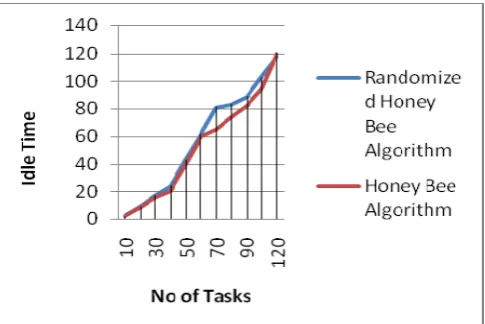
Fig.5 shows the resource utilization rate of projected technique with random stealing that is comparatively high compared to existing honey bee load balancing technique. With randomization technique, tasks area unit purloined from a random Virtual machine once a VM is idle. It therefore saves the idle time of the process parts within the Virtual machine.
Fig.6. Idle Time (ns)
Idle time is that the time between the days at that task is arrived on a virtual machine and time of task to be assigned to at least one sure virtual machine. The comparison is formed in terms of range of tasks and therefore the idle time and therefore the results area unit shown in Fig. 6 of these results verifies that the projected honey bee hunt technique with random stealing performs higher than the prevailing honey bee randomizes load balancing algorithm.
VI. CONCLUSION
Rudiment algorithm is suitable for the cloud computing atmosphere as a results of the formula is in a position to successfully build use of the exaggerated system resources and reduce makespan. This application has experimentally proves that the planned algorithm for cloud load management supported particle randomisation algorithm scale back issues and improvement with random algorithms. the foremost goal of the plan need algorithm is minimizing the complete execution time of giving tasks. The algorithms in applications with the number of tasks varied from fifty to k evaluated. The experimental results illustrated that the planned ways in which of rudiment performed effective results than all ways in which and its performance could be a ton of outstanding in quantify ability. It together accustomed inhibit the system crash. It aims at achieving the upper programming conservation throughout the semi permanent operation of a cloud information centre, and protects the performance of a VM running. For any studies, the preventative Virtual machine hardware is accessed by multiple user at constant time area unit focused.
VII. FUTURE WORK
REFERENCES
[1] I. Foster, Y. Zhao, I. Raicu and S. Lu, Cloud computing and grid computing: 360-degree compared, in: IEEE Grid Computing Environment Workshops, 2008.
[2] Q. Zhang, L. Cheng and R. Boutaba, Cloud computing: State-of-the-art and research challenges, in: Journal of Internet Services and Applications, 2010.
[3] Adeel Hashmi” Cloud Computing: VM placement & Load Balancing” International Journal Of Engineering And Computer Science ISSN:2319-7242 Volume 3 Issue 11 November, 2014 Page No. 9197-9200
[4] Bharti Mohali, Akhil Goyal “A Study of Load Balancing in Cloud Computing using Soft Computing Techniques” Int. Journal of Computer Applications (0975 8887)Volume 92 – No.9, April 2014 [5] Dinesh Babu L.D, P.Venkata Krishna , “Honey Bee inspired Load
Balancing of tasks in cloud computing environments”, Applied soft computing 13,2292-2303,2013
[6] Tejinder Sharma, Vijay Kumar Banga, “Efficient and Enhanced Algorithm in Cloud Computing”,IJSCE,ISSN:2231-2301,2013 [7] Dhinesh Babu L.D. P. Venkata Krishna (2013), ‘Honey bee behavior
inspired Load Balancing of tasks in cloud computing environments’, ELSEVIER, vol.13, pp 2292- 2303.
[8] Chun-Cheng Lin,Hui-Hsin Chin, and Der-Jiunn Deng, IEEE members, “Dynamic Multiservice Load balancing in Cloud –Based Multimedia System”, IEEE Systems Journal,2013.
[9] Hung Chang, Hsueh-Yi Chung, Haiying Shenand Yu-Chang Chao , “ Load Rebalancing for Distributed File System in clouds”, IEEE Transactions on Parallel And Distributed Systems.2013,vol.24, pp951-961.
[10] Belabbas Yabougi, Meriem Meddeber, “Distributed Load balancing model”, ARIMA journal, Vol 12,pp 43-60,2010
[11] Erik Cuevas, Daniel Zaldívar, Marco Pérez-Cisneros, Humberto Sossa, Valentín Osuna, “Block matching algorithm for motion estimation based on ABC”, Applied soft computing,2012
[12] Guopu. Zha, Sam Kwong ,“Gbest-guided Artificial bee Colony algorithm for numerical function optimization”, Elsevier 3166-3173,2010
[13] Pei-Wei Tsai, Jeng-Shyang Pan, Bin-Yih Liao, and Shu-Chuan Chu, “Enhanced Artificial Bee Colony Optimization”, International journal of innovative computing,vol 5, no 12,2009