
Intention
and
Reactivity
A
thesis submitted to the University
of London for the degree of Doctor of
Philosophy
Katharine Tamsin Astor
2001
ProQuest Number: U643871
All rights reserved
INFORMATION TO ALL USERS
The quality of this reproduction is dependent upon the quality of the copy submitted.
In the unlikely event that the author did not send a complete manuscript and there are missing pages, these will be noted. Also, if material had to be removed,
a note will indicate the deletion.
uest.
ProQuest U643871
Published by ProQuest LLC(2016). Copyright of the Dissertation is held by the Author.
All rights reserved.
This work is protected against unauthorized copying under Title 17, United States Code. Microform Edition © ProQuest LLC.
ProQuest LLC
789 East Eisenhower Parkway P.O. Box 1346
ABSTRACT
The evolution of the human brain, including the ability to make intentional actions, has resulted in our motor system being activated via either our own intentions or
external stimuli. It is important that a balance is maintained between these internal and external drives. This thesis investigates the relationship between these two systems. Evidence supporting a distinction between them is considered and hypotheses are examined, specifically: are they independent, unitary, facilitatory, inhibitory, or is there a switching mechanism?
Intentional action is studied using (i) objective paradigms: the generation of intentional actions and how this interacts with stimulus-driven actions, and (ii) subjective paradigms: the perceived time of stimuli and actions. A novel
experimental paradigm investigated the relationship between the putative internally- generated and externally-triggered motor systems. The “truncation” paradigm involves subjects preparing an intentional action, which is interrupted by a randomly occurring stimulus requiring a response. Truncation, therefore, involves a balance between intention and reactivity.
Seven experiments produced a reliable difference (averaging 51 ms) in reaction time between simple RT and truncated reaction time (TRT). This difference was termed the RT cost o f intention. The neural basis o f the process responsible for this RT cost was investigated using two physiological techniques (pupil dilation and
electroencephalography) in two separate experiments. Alternative causes of the RT
cost, such as delayed stimulus processing in truncation, were examined and rejected.
ACKNOWLEDGEMENTS
I would like to thank my supervisor Patrick Haggard for inspiring me to continue at UCL, where I did my BSc, and pursue a PhD as his first PhD student. His ceaseless support, commitment, and recognition of my strengths and weaknesses meant that even when I thought I could not do something, I found that I was able to. The hours we spent discussing ideas were always enjoyable, thanks to his willingness to let me vent my latest thoughts about life and the PhD!
Godolphin and Latymer, my secondary school, where I spent 7 years taught me to enjoy intellectual pursuits and gave me the freedom and support to pursue them, particularly in my final years. I would like to thank my parents for having the foresight to send me there. My parents have always believed in me and I want to thank them for their unfailing love and support throughout my life, particularly during the last three years during which I moved out of home, met and married my husband and bought a house, whilst doing this PhD. Their presence, along with that of my grandparents, brother Toby, cousins Mark and Gemma, and aunt Pam and uncle Diccon, has always been a big part of my life and I hope will always be.
My friends, including those that I have met through my husband, but particularly Anna, Ant, Clare and Harri who have put up with my moaning, allowed me to rant about my experiments, theories and computer troubles and have even been subjects for me, during the last three years - thank you so much.
I would like to thank my research group, particularly Sukh for being an awesome office-mate and friend during the last three years, and Rob for his help with
MATLAB and Excel. Thank you Hugo for being a good friend and lunch partner at the ICN, and Mark for computer help when I was at the end of my tether!
TABLE OF CONTENTS
Chapter 1...18
INTRODUCTION TO THESIS...18
L i OUTLINE... 18
12 INTENTIONAL ACTION... 19
L3 PHILOSOPHICAL TREATMENTS OF INTENTION... 24
1.3.1 F re e w ill... 24
1.3.2 Mind-Brain Interaction...24
1.3.1.1 Cartesian dualism... 25
1.3.2.2 John Locke (1632-1704)...26
1 3 2 .3 William James (1842-1910)... 27
1.4 Mental Chronometrv, The Psychological Refractory Period and Task Switching... 28
1.4.1 Mental Chronometrv...28
1.4.2 The Psychological Refractory Period (PRP)...30
1.4.3 Task Switching...30
L5 NEUROSCIENTIFIC APPROACHES TO INTENTIONAL ACTION... 32
1.5.1 The Bereitschaftspotential (BP)... 32
1.5.2 Electrophysiology o f Intention: Evidence that the Bereitschaftspotential is the Neural Correlate o f Intention...34
1.5.3 The Anatomical Substrate of Intention...35
1.5.3.1 Hierarchies in the motor system...37
L6 ANATOMICAL EVIDENCE IN SUPPORT OF TWO MOTOR SYSTEMS... 40
1.6.1 The Supplementary Motor A rea... 41
1.6.1.1 Role ofSM A in the initiation o f action... 44
1.6.1.2 Role ofSM A in the control o f bimanual actions...45
1.6.1.3 Role ofSMA in the retrieval o f complex patterns from motor memory... 45
1.6.2 Pre-Motor Cortex... 45
1.6.3 Pronto-striatal Circuits...48
L7 NEUROPHYSIOLOGICAL EVIDENCE IN SUPPORT OF TWO MOTOR SYSTEMS .50 1.7.1 Direct Methodologies... 51
1.7.2 Indirect Methodologies... 53
1.72.1 The autonomic nervous system...53
1.72.2 Pupil dilation... 54
1.72.3 Pupil dilation as a measure o f cognitive load...55
1.72.4 Early pupillometrv...56
1.72.5 Pupil dilation and movement... 57
1.7.2.12 Externally-triggered movements... 58
L8 EVIDENCE FROM CLINICAL DISORDERS OF INTENTIONAL ACTION... 59
1.8.1 Alien Hand Syndrome or Anarchic H and... 60
1.8.2 Utilisation Behaviour... 60
1.8.3 Parkinson’s Disease... 61
1.8.4 Schizophrenia... 61
L9 THIS THESIS... 65
Chapter 2 ... 66
THE INTER-RELATION BETWEEN THE HYPOTHESISED REACTIVE AND INTENTIONAL MOTOR SYSTEMS... 66
2A INTRODUCTION... 66
2.1.1 Five Possible Hypotheses Regarding the Inter-relation of the Internally Generated and Externally Triggered Motor Systems... 67
2.1.2 Pre-movement Processes... 68
2.1.3 The Truncation Condition...70
2.1.4 The Use o f Variable Foreperiods... 72
2.1.5 Switch Costs... 74
2.1.6 Locking Stimulus-Response Codes... 76
2.1.7 Aim s... 77
2.1.7.1 Hypotheses... 77
2.1.7.2 Pre-movement processes... 78
2 2 METHOD...81
2.2.1 Subjects and Design... 81
2.2.2 Apparatus... 82
2.2.3 Trial Structure and Stim uli... 82
2.2.4 Experimental Conditions... 82
2.2.5 Design and Procedure... 84
2 3 RESULTS...85
2.3.1 SRT and CRT analyses... 86
2.3.2 RT Costs... 88
2.32.1 Comparisons between reactive and truncated SRT conditions...89
2.32.2 Comparisons between reactive and truncated CRT conditions...89
2 3 2 3 Planned comparisons between RT costs o f intention... 90
2.3.3 Analysis o f Wrapper Conditions... 90
2.3.4 Error Analyses... 90
2.3.4.1 Methodological reason... 91
23.4.3 Relationship between the internally-generated and externally-triggered systems 93
2.3.5 Foreperiod Analyses... 98
M DISCUSSION...104
2.4.1 SRT vs CRT...104
2.4.2 The RT Costs o f Intention...105
2.4.3 The RT Cost o f Intention and Switch in Efifector...105
2.4.4 Truncation Conditions...106
2.4.5 Errors... 107
2.4.6 Hypotheses... 108
2.4.6.1 The unitary, facilitatory and independent hypotheses...108
2.4.6.2 The separate but competing systems and direct inhibition hypotheses...109
2.4.7 Pre-moyement Processes... 110
2.4.8 Conclusions... 110
Chapter 3 ... 113
FOREPERIOD CONTROL EXPERIMENT: IS THE RT COST OF INTENTION AN ARTEFACT OF FOREPERIOD?... 113
M INTRODUCTION... 113
3.1.1 Yoking... 114
3.1.2 Hypothesis... 115
3 2 METHOD...115
3.2.1 Subjects and Design...115
3.2.2 Apparatus...115
3.2.3 Design and Procedure...116
3 2 3 .1 The truncation condition... 116
3.2.3.2 The yoked SRT condition...116
33 RESULTS...116
M DISCUSSION...118
Chapter 4 ... 119
THE EXAMINATION OF PRE-MOVEMENT PROCESSES USING PUPIL DILATION...119
43 INTRODUCTION...119
4.1.1 Pupil Dilation and Processing Demands...120
4.1.2 Pupil Dilation and R T ... 120
4.1.3 Using Attentional Theories as a Means o f Conceptualising Cognitiye Effort 121 4.1.4 Aims... 123
4.1.5 Experimental Hypotheses... 123
4 2 METHOD...124
4.2.2 Apparatus: Novel Pupil Recording Equipment..
4.2.3 Design and Procedure...
42.3.1 SRT condition...
42.3.2 Intentional action condition...
4 2 3 .3 Truncation condition...
4 3 RESULTS...
4.3.1 Reaction Time Data...
4.3.2 Pupil Dilation Data...
4.32.1 SRT versus TRT...
4 3 2 .2 Intentional action versus SRT.
4.32.3
4.32.4
4.3.3
Intentional action versus T IN ,
124 126 126 126 126 127 127 127 132 133 134 135 136 TRT versus TIN...
Stimulus-locked Comparison...
4.3.4 Post Hoc Foreperiod Analvses... 140
4.3.4.1 Expectation o f stimulus...140
43.4.2 Withhold-go hvpothesis...142
4.4.1 Hvpotheses... 144Hvpotheses...
4.4.2 Stimulus-locked Analvses...
4.4.3 Foreperiod Analvses...
4.43.1 Expectation o f the stimulus
4.43.2 Withhold-go hvpothesis
4.4.4 Conclusion...
145
146
146
146
147
Chapter 5 ...
DOES STIMULUS EXPECTANCY AFFECT PUPIL DILATION AND THE RT COST OF
INTENTION?...
53 INTRODUCTION...
5.1.1 Stimulus Expectancv and Pupil Dilation...
5.1.2 Stimulus Expectancv and the RT Cost o f Intention...
5.1.3 Hvpotheses ... .
148
5 2 METHOD...
5.2.1 Subjects...
5.2.2 Apparatus...
5.2.3 Design and Procedure....
52.3.1 SRT condition...
5 2 3 .2 50% SRT condition...
5.2.3.3 Truncation condition...151
5 J RESULTS...152
5.3.1 Reaction Time Analvses... 152
5.3.2 Pupil Analvses...153
5.32.1 SRT versus TRT...156
5.32.2 SRT versus 50% SR T...157
5.32.3 TRT versus 50% SRT...157
5 3 2 .4 TRT versus TIN...158
5.3.3 Stimulus-locked Analvses... 158
53.3.1 SRT versus TRT...161
5 3 3 .2 SRT versus 50% SR T...161
53.3.3 TRT versus 50% SRT...162
5A DISCUSSION...162
5.4.1 Stimulus Expectancv and Pupil Dilation... 162
5.4.2 Stimulus Expectancv and RT cost of Intention... 163
Chapter 6 ... 165
IS THE STIMULUS PROCESSING DELAYED IN THE TRUNCATION CONDITION? FURTHER EXAMINATION OF THE COMPONENTS OF THE TRUNCATION CONDITION AND CONTRIBUTORS TO THE RT COST OF INTENTION... 165
^ INTRODUCTION...165
6.1.1 Introduction o f New Experimental Conditions... 167
6.1.2 Switching or Inhibition... 169
6.1.3 Aims and Hypotheses... 170
M METHOD...171
6.2.1 Subjects... 171
6.2.2 Apparatus... 171
6.2.3 Procedure...172
6.2.4 Conditions... 172
62.4.1 Listen condition...173
62.4.2 SRT condition...173
62.4.3 Intend condition... 173
62.4.4 Truncation...173
62.4.5 Intend iznore condition... 174
62.4.6 Intend stop condition...174
M RESULTS... 174
6.3.2 EEG Data... 175
6.32.1 First stage processing... 175
6 3 2 .2 MATLAB processing... 175
6.3.2.3 Stimulus-locked grand average montages... 177
6.3.3 Statistical Analvses o f Features o f ERPs...181
6.3.3.1 SRT versus listen... 183
6 3 3 .2 SRT versus TRT... 185
6.3.3.3 Listen versus intend iznore... 188
6 3 3 .4 TRT vs intend stop... 190
6.3.5 Further Examination of the Switching and Inhibitory Hypotheses...192
63.5.1 Comparing EMG in TRT. TIN, SRT and intend trials... 192
63.5.2 SRT versus TRT movement-locked analysis...196
M DISCUSSION... 198
6.4.1 Reaction Time Data... 198
6.4.2 ERP Data: Montages... 198
6.42.1 SRT versus TRT... 198
6.42.2 SRT versus Listen... 199
6.42.3 TRT versus intend stop... 199
6.42.4 Listen versus intend iznore... 200
6.4.3 Switching or Inhibition... 200
6.4.4 Conclusion...200
Chapter 7 ...203
SUBJECTIVE ASPECTS OF INTENTION AND REACTIVITY... 203
7T INTRODUCTION...203
7.1.1 Conscious Awareness... 203
7.1.1.1 A brief overview o f abnormalities in the perception of action awareness... 206
7.1.1.2 The conscious awareness o f intention... 206
7.1.2 Awareness of Action...207
7.12.1 Judgements and localisation of intentional actions... 207
7.12.2 Judgements and localisation o f reactive actions... 210
7.1.3 Awareness of Stimuli... 211
7.1.4 Experiments...213
7.1.4.1 Hypotheses/proposals for action awareness experiment... 214
7.1.4.2 Hypotheses/proposals for stimulus awareness experiment... 215
72 METHOD...215
7.2.1 Subjects...215
l l l . K Procedure o f action experiment... 215
7.2.2.1 .A SRT condition (SRT Al...216
1 1 1 1 A Truncation condition (TRT A)...216
1 1 1 3 A Intentional action condition...217
l l l . S Procedure of stimulus experiment...217
7.2.2.1 .S SRT condition (SRT S )...217
m i s The truncation condition, stimulus judgement (TRT S )... 218
7.2.2.3 .S Listen... 218
L3 RESULTS... 218
7.3.1 R T D ata...219
7.3.1.1 Attentional components o f the judgement tasks...221
7.3.2 Awareness Data...222
73 2 .1 Action awareness data...223
1 3 1 1 Stimulus awareness data...230
1_A DISCUSSION... 237
7.4.1 Brief Summary o f Results... 237
7.4.1.1 Hypotheses... 237
7.4.1.2 Main findings...238
7.4.2 Efferent Binding... 240
7.4.3 Conclusions...241
Chapter 8 ... 243
SUMMARIES. CONCLUSIONS AND THE WIDER CONTEXT OF RESEARCH INTO INTENTION AND REACTIVITY...243
M SUMMARY...243
82 THE OBJECTIVE STUDY OF INTENTION AND REACTIVITY...244
8.2.1 Summary of Chapter 2 ... 245
8.2.2 Summary o f Chapter 3 ... 246
8.2.3 Summary o f Chapter 4 ... 246
8.2.4 Summary of Chapter 5 ... 247
8.2.5 Summary o f Chapter 6 ... 247
O THE SUBJECTIVE STUDY OF INTENTION AND REACTIVITY...248
8.4 Conclusions... 249
8.4.1 Relationship Between the Intentional and Reactiye Motor Systems... 249
8.4.2 Exclusion o f Altematiye Causes of the RT Cost o f Intention... 250
8.4.3 Location o f the Switch Process... 250
M FURTHER RESEARCH... 254
8.5.1 Clinical Applications...254
8.6 FINAL COMMENT...255
TABLE OF FIGURES
CHAPTER 1
Figure 1.1. Scalp potentials associated with making a voluntary movement. This schematic illustrates
the terminologies and their waveform components. BP = bereitschaftspotential ; RP =
readiness potentional; PMP = pre-motion positivity; MP = motor potential; MCP= motor
cortex potential. Adapted from McCallum (1988)...29
Figure 1.2. Schematic of the main motor associated projections into the primary motor area, via the
SMA and PMC. BG = basal ganglia, SMA = supplementary motor area, PMC = pre-motor
cortex, M l= primary motor cortex... 33
Figure 1.3. Diagram to show the pre-motor cortex,the supplementary motor area and the primary
motor cortex. Adapted from Bear, Connors and Paradiso (2001)... 37
Figure 1.4. The motor loop: one of the circuits from the frontostriatal network; adapted from
Alexander, DeLong and Strick's diagram (1986). SMA = supplementary motor area, vl-Gpi =
ventrolateral internal segment o f the globus pallidus, cl-SNr = caudolateral substantia nigra
pars reticulata, Vlo = ventralis lateralis pars oralis, VLm = ventralis lasteralis pars
medialis... 45
Figure 1.5. Pupil dilation associated with an internally generated action, where 2 = flexor EMG and
activation of the response key. Adapted from Richer and Beatty (1985)... 54
Figure 1.6. Pupil dilation associated with Go/No Go reaction time tasks, where 0 = response and the
foreperiod is 1 second. Adapted from Richer et al (1983)...55
CHAPTER 2
Figure 2.1. This schematic shows a trace of some hypothetical level of activation of an intentional
action. It is initially inhibited when the subject is in the ‘withhold’ phase and the line is below
0. As the subject moves into the putative ‘go’ phase, the activation of the intentional action
increases. After the action has been performed the activation dies down again...65
Figure 2.2. A simple schematic of the processes occurring within SRT and CRT...65
Figure 2.3. In the slow route there is an arbitrary stimulus-response relationship: SI —> R I, S2 R2.
In the direct route, there is only one stimulus and only one response (equivalent to a standard
SRT). The fast route assumes that the stimulus and the response are spatially and modally
identical, i.e. tactile stimulus on finger that responds. Adapted from Frith and Done
(1986)... 66
Figure 2.4. Schematics representing the simple reaction time, the intentional action and the truncation
Figure 2.5. This schematic shows the activation of the intentional action in the truncation condition.
As the foreperiod duration increases, the subject should be moving from the ‘withhold’ to the
‘go’ phase, and therefore the activation of the intentional action should increase...75
Figure 2.6. The mean RTs including standard error bars for the left and right SRT conditions and the left and right simple truncation conditions... 82
Figure 2.7. The mean RTs including standard error bars for the left and right CRT conditions and the left and right choice truncation conditions... 82
Figure 2.8. The RT costs of intention of the left and right hand for the SRT and CRT conditions 83 Figure 2.9. A schematic assuming unitary motor activation levels for the externally-triggered and internally-generated systems...89
Figure 2.10. A schematic assuming separate motor activation levels for the internally-generated and externally-triggered systems and the left and right hand...90
Figure 2.11. SRT : early and late FP RTs for the left and right hands...96
Figure 2.12. Truncated SRT: early and late FP RTs for the left and right hands... 96
Figure 2.13. CRT: early and late FP RTs for the left and right hands... 97
Figure 2.14. Truncated CRT: early and late FP RTs for the left and right hands... 97
CHAPTER 4 Figure 4.1. Experimental set-up. E = experimenter, S = subject, LED = light emitting diode, X = fixation point...120
Figure 4.2. A randomly selected trial in which a subject had blinked. The overplot is a corrected trial, after linear interpolation... 123
Figure 4.3. Simple reaction time condition (SRT): movement-locked. 0 = time of movement 124 Figure 4.4. Intentional action condition: movement-locked. 0 = time of movement... 125
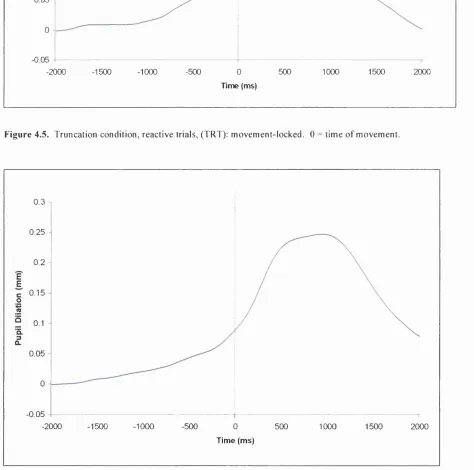
Figure 4.5. Truncation condition, reactive trials, (TRT): movement-locked. 0 = time of movement...125
Figure 4.6. Truncation condition, intentional action trials (TIN): movement-locked. 0 = time of movement...126
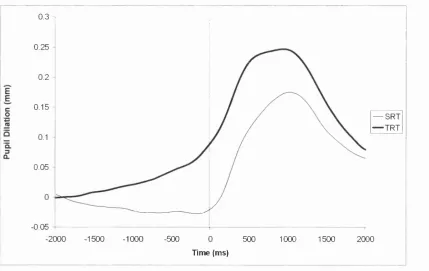
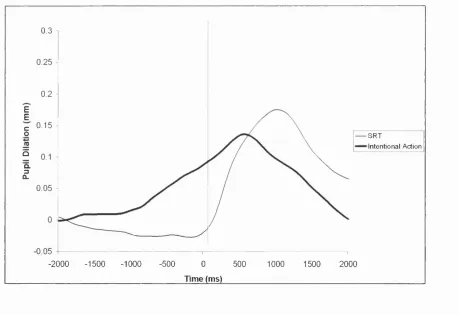
Figure 4.7. The overplot of the SRT and TRT pupillograms. 0 = time of movement... 128
Figure 4.8. The overplot of the SRT and intentional action pupillograms. 0 = time of m ovem ent...129
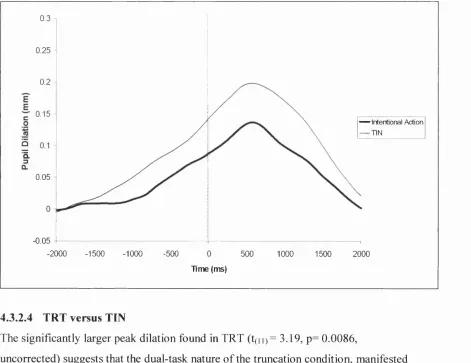
Figure 4.9. The overplot of the intentional action and TIN pupillograms. 0 = time of movement...130
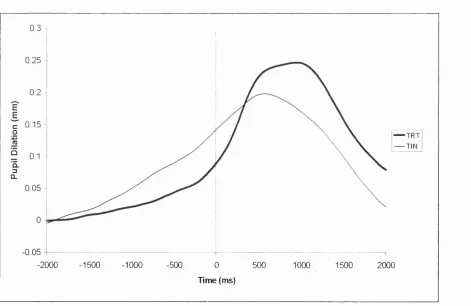
Figure 4.10. The overplot o f the TRT and TIN pupillograms. 0 = time of movement... 131
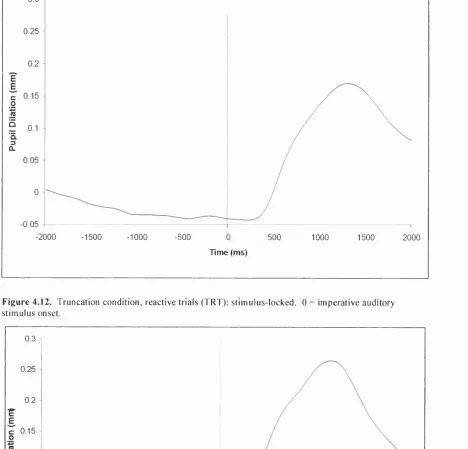
Figure 4.12. Truncation condition, reactive trials (TRT): stimulus-locked. 0 = imperative auditory
stimulus onset... 133
CHAPTER 5
Figure 5.1. SRT condition: movement-locked. 0 = time of movement... 148
Figure 5.2. 50% SRT condition, reactive trials (50% SRT), movement-locked. 0 = time of
movement...149
Figure 5.3. Truncation condition, intentional action trials (TIN), movement-locked. 0 = time of
movement...149
Figure 5.4. Truncation condition, reactive trials (TRT), movement-locked. 0 = time of movement..l50
Figure 5.5. SRT condition, stimulus-locked. 0 = imperative auditory stimulus onset...153
Figure 5.6. 50% SRT condition, reactive trials, (50% SRT), stimulus-locked. 0 = imperative auditory
stimulus onset... 153
Figure 5.7. 50% SRT condition, no stimulus or movement trials (50% no SRT), median
foreperiod-locked. 0 = median foreperiod...154
Figure 5.8. Truncation condition, reactive trials (TRT), stimulus-locked. 0 = imperative auditory
stimulus onset... 154
CHAPTER 6
Figure 6.1. Schematic to show the forking of the Truncation, the intend stop and the intend ignore
conditions and their names... 162
Figure 6.2. Schematic of the electrode sites... 166
Figure 6.3. Schematic of forked outcomes for the truncation, intend stop and intend ignore conditions, indicating trial names and whether the trials produced are movement-locked and/or stimulus-
locked...170
Figure 6.4. The grand average montage of the listen condition. Task-irrelevant or passive stimulus processing. 0 = imperative auditory stimulus onset...171
Figure 6.5. The grand average montage of the SRT condition. Task-relevant or active stimulus
processing, requiring a response. 0 = imperative auditory stimulus onset... 172
Figure 6.6. The grand average montage of TRT. Task-relevant or active stimulus processing,
requiring a response. 0 = imperative auditory stimulus onset...173
Figure 6.7. The grand average montage of intend ignore after. Task-irrelevant stimulus, requiring a movement, but no overt response. 0 = imperative auditory stimulus onset... 174
Figure 6.9. The overplot of grand average ERPs for SRT and listen. 0 = imperative auditory stimulus onset... 177
Figure 6.10. The overplot of grand average ERPs for SRT and TRT. 0 = imperative auditory stimulus
onset... 179
Figure 6.11. The overplot of grand average ERPs for listen and intend ignore. 0 = imperative auditory stimulus onset... 182
Figure 6.12. The overplot of grand agverage ERPs for TRT and intend stop. 0 = imperative auditory stimulus onset... 184
Figure 6.13. The grand average EMGs o f the four conditions, SRT, intend, TRT and TIN... 187
Figure 6.14. Grand average overplot of SRT and TRT, at electrode Cz. 0 = movement onset... 191
CHAPTER 7
Figure 7.1. A schematic based on Libet et al (1983) to demonstrate the temporal relationship between
the BP, the urge to move (W), the reported awareness of the movement (M) and the actual
movement (Movement)... 198
Figure 7.2. A schematic of the stimulus (S), it’s percept (S'), the movement (M) and its percept (M^,
based on the results from Johnson and Haggard (2001)... 207
Figure 1 3 . Schematic to show the control condition, SRT (A), the prediction of the RT cost of intention not entering awareness (B), and the prediction of the RT cost of intention entering
awareness (C). I = intention, S = stimulus, SRT = simple reaction time, SRT = judged SRT,
TRT = truncated reaction time, TRT = judged truncated reaction time... 208
Figure 7.4. Graph of judgement error regressed on to reaction time (RT) in ms for the SRT action
judgement condition (SRT A )...223
Figure 7.5. Graph of judgement error regressed on to reaction time (RT) in ms, for the TRT action
judgement condition (TRT A )...224
Figure 7.6. Graph of judgement error regressed on to reaction time (RT) in ms, for the SRT stimulus
judgement condition (SRT S)...229
Figure 7.7. Graph of judgement error regressed on to reaction time (RT) in ms, for the TRT stimulus
judgement condition (TRT S)...230
Figure 7.8. Schematic to show actual reaction times (SRT A, TRT A, SRT S and TRT S) and
subjects judged awareness (SRT_A', TRT_A', SRT_S'and TRT_S'), and judgement errors (JEs) in
TABLE OF TABLES
C HAPTER 2
Table 2.1. The conditions and their constituent number o f trials... 83
Table 2.2. The mean (s.d.) RTs for the six conditions... 86
Table 2 J . Percentage of left should have been right and right should have been left errors at three limits o f RT acceptability for trim cation and reactive movements... 91
Table 2.4. The mean (s.d.) RTs for the early and late foreperiods... 99
C HAPTER 3
Table 3.1. The number of trials in the yoked SRT condition...117
Table 3.2. The mean (s.d.) RTs for the yoked SRT and reactive trials from the truncation condition
(TRT)...117
CHAPTER 4
Table 4.1. Mean (s.d.) RTs for the SRT and truncated SRT conditions in ms...127
Table 4.2. The mean (s.d.) peak dilation, latency of peak dilation and pre-movement mean dilation
(PMMD) of the four conditions...132
Table 4 3 . The mean (s.d.) peak dilation, latency o f peak dilation and pre-stimulus mean dilation of
the two conditions with stimuli: SRT and TRT... 137
Table 4.4. Early and late foreperiods mean pre-movement mean dilations (s.d) in mm of SRT and
TRT conditions...141
Table 4.5. Early and late foreperiods mean (s.d.) RTs of the SRT and TRT conditions in m s... 143
CHAPTER 5
Table 5.1. Mean (s.d.) RT for the SRT condition, the 50% SRT condition and the reactive trials from
the truncation condition (TRT), in ms... 152
Table 5.2. The means (s.d.) of the peak, latency o f peak and pre-movement mean dilation for the SRT,
50% SRT, truncated reactive trials (TRT) and truncated intentional trials (TIN)...156
Table 5.3. The means (s.d.) of the peak, latency o f the peak and pre-stimulus mean dilation (PSMD)
for SRT, 50% SRT and TRT... 161
C HAPTER 6
Table 6.1. T-tests between SRT and listen of the peak amplitude, latency of peak amplitude and the mean amplitude, in three different time windows... 184
Table 6.2. T-tests between SRT and TRT o f the peak amplitude, latency o f peak amplitude and the
mean amplitude, in three different time windows... 186
Table 6.4. T-tests between TRT and intend stop of the peak amplitude, latency o f peak amplitude and the mean amplitude, in three different time windows...191
Table 6.5. Mean (s.d.) amplitude, in (pV) of SRT, intend, TRT (truncated reactive trials) and TIN (truncated intentional trials), in three time windows...194
Table 6.6. The mean (s.d.) peak amplitude and latency of the peak amplitude in the -200 to 200 ms
time window of SRT, intend, TRT and TIN...195
CHAPTER 7
Table 7.1. Conditions and their relevant abbreviations... 219
Table 7.2. Mean (s.d.) reaction times for SRT and TRT, action and stimulus judgements conditions
(SRT A, SRT S, TRT A and TRT S)...219
Table 7.3. Mean (s.d.) judgement errors for SRT and TRT in action and stimulus judgement
conditions (SRT A, SRT S, TRT A and TRT S)...222
Table 7.4. Mean (s.d.) judgement errors for SRT A, TRT A, TIN A and intentional action
conditions... 223
Table 7.5. Mean (s.d.) judgement errors for the SRT A and TRT A conditions (and the differences) in
which subjects judge stimulus time, in ms... 225
Table 7.6. The Pearson correlation coefficient, r, the regression equation for judgement error (JE) and
reaction time (RT), the ANOVA results for the regression line, by subject, and the mean (s.d.)
correlations, slopes and one-sample t-tests of slopes, for SRT and TRT action awareness
judgements... 227
Table 7.7. Mean (s.d.) judgement errors for listen, SRT S and TRT S conditions... 230 Table 7.8. Mean (s.d.) judgement errors for the SRT S and TRT S conditions (and the differences) in
which subjects judge stimulus time, in ms... 231
Table 7.9. The Pearson correlation coefficient, r, the regression equation for judgement error (JE) and
reaction time (RT), the ANOVA results for the regression line, by subject, and the mean (s.d.)
correlations, slopes and one-sample t-tests of slopes, for SRT and TRT stimulus awareness
judgements... 233
CHAPTER 8
Chapter 1: Introduction to thesis
Chapter 1
INTRODUCTION TO THESIS
1.1 OUTLINE
The introductory chapter is divided into four main divisions. Division one (section 1.2) presents the idea of intention: what it is, the importance of agency, and
observation of the current lack of scientific studies. Behaviourism is also discussed due to its influence on psychological research in the early part of the twentieth century.
The second division (1.3) discusses the work of philosophers who were the first to tackle the problem of intention, mainly in the contexts of (i) fi-ee will (1.3.1), and (ii)
the mind-brain problem (1.3.2). Descartes, Locke and James are examined in detail (sections 1.3.2.1, 1.3.2.2, and 1.3.2.3 respectively).
The third division (1.4) briefly reviews mental chronometry (1.4.1), task switching (1.4.2) and the psychological refractory period (PRP) [1.4.3]. The fourth division (1.5) begins by introducing the bereitschatspotential (BP) [1.5.1] and includes a chronological review of the relevant neurophysio logical studies of intention. The BP as a neural correlate of intention is also examined (1.5.2). The anatomical substrate of intention is discussed (1.5.3) and possible hierarchies in the motor system are
postulated (1.5.3.1).
Most of the movements that we make in every day life are a composite of intentions, and external stimuli. For example, getting up to close an open window (intentional action), when a cold gust of wind blows in (stimulus). To study intention in
Chapter 1: Introduction to thesis
1.2 INTENTIONAL ACTION
One philosophical definition of an intentional action is those actions to which a particular kind of the question ‘why?’ is appropriate (Anscombe, 1963). Translating this into psychological terms, an intentional action is one that is goal-directed. There must be an agent and a goal, and the goal must be the reason why the agent performed the action. Intentions are characteristics of volitional actions and are pre-cursors of internally-driven movements. A voluntary action may be conceived of as consisting
of a volition or desire to do something, in this case perform an action. This volition then becomes an intention, which in turn results in preparation for the desired action and physical movement of the body itself. Voluntary actions, therefore, may be thought of as being preceded by an internal mental event, an intention. The ability to intend to do something and then act on that intention is a fundamental part of human existence.
Jahanshahi and Frith (1998) postulate three criteria for defining willed actions in the absence of any convincing physiological data. These criteria are: (i) attention and conscious awareness, (ii) choice and control, and (iii) intentionality. Willed action is a psychologist’s synonym for intentional action. They define willed action as the “formulation of a goal and an intention to a c t,... response selection, programming, and initiation that precede the production and execution of an action.” This thesis largely focuses on intentionality, although some of the experiments also invoke the related concepts of attention and conscious awareness.
In this thesis, the operational concept of intention is an action that is internally- generated rather than being a direct response to a stimulus. This is intended as an operational definition and does not imply any commitment to a philosophical
standpoint. Historically the concept o f ‘intentionahty’ has been problematic and has
Chapter 1: Introduction to thesis
way we think and talk about the mind, and thus there is a natural tendency to assume that any similar distinction also implies a commitment to dualism.
Behaviourism took this tendency to an extreme. Behaviourists basically argued that there are no internal states, only behaviour, and all behaviour is reactive, that is, a conditional response to stimuli. In effect, the behaviourists accepted Descartes distinction between the physical and the mental, and simply ruled that the mental lay beyond the limits of science. Behaviourists, therefore refused to consider internal mental states, such as intentions. Despite the demise of behaviourism, there remains a
strong tendency for researchers to dismiss discussions of consciousness and intentionality as non-scientific (Bisiach, 1988).
The concept of intention used here is not, and should not, be confused with the Cartesian notion of free will. The concepts of intention and free will both arise from the experience of performing actions ‘intentionally’ or ‘of our own free will’. These concepts are familiar to all of us and do not require an understanding of philosophy or science. The difference between the two concepts arises when one considers what it is like to do an action ‘from the inside’. That is, the initial experience of intention is subjective. This is the standpoint from which Descartes remained, thus his
philosophical concept of free will is not scientifically useful.
However, just because out initial comprehension of intention is subjective, does not preclude the examination of intention objectively. Basically, actions that are
internally-generated feel different to actions that result directly from a stimulus. Only the former are called intentional actions. The scientists’ job is to examine and
qualitatively distinguish between them. As will be presented in sections 1.5-1.7, there
is mounting evidence to suggest that two different systems are involved in these two types of action. For instance, there is evidence that different areas of the brain are involved in intentional actions (the supplementary motor area) as opposed to reactive
Chapter 1: Introduction to thesis
The main focus of this thesis is to examine the relationship between the two
hypothesised motor systems, which underlie intentional and stimulus-driven actions. This task neither presupposes an exact understanding o f ‘intentionality’, nor the workings of the system supposed to underlie intentional action. Considering that within the philosophical conceptual framework, intentionality appears to lie wholly beyond the reach of scientific understanding, it is problematical to adopt another
framework, in which intentionality can be fully explained in scientific terms from the start. Moreover, for the purposes of this thesis a full explanation is not necessary - a clear and operational definition is all that is required. It is hoped that a better
scientific understanding of intentionality will gradually emerge from investigations o f this sort.
The paragraphs above aim to clarify to some extent long-standing confusions
regarding intention and provide a theoretical background to the thesis. However, some doubt may remain. Two further questions will be briefly addressed. First, is it necessary to talk about ‘intention’ at all? Second, is it valid to assume a simple dichotomy between ‘intentional’ and ‘stimulus-driven’ actions?
Well-established topics of research, such as ‘planning’ and ‘prospective memory’, appear to depend on some notion of intentionality. Planning would be a meaningless pursuit if it did not result in the formation of an intention to act. Prospective memory
involves the formation of an intention that will be executed at some point in the friture - a point at which the subject must recall their previously formed intention to act. For instance, I might form the intention to tell my friend Clare about my conversation with a mutual friend, the next time I see her. It would seem that intentions are an important part of human mental fife and need to be examined to fully comprehend the interesting complexities o f human behaviour.
Some support for the two-way classification between ‘stimulus-driven’ and ‘intentional’ comes from its use in other fields of study, such as long-term or
Chapter 1: Introduction to thesis
recall an episode, and recall that is ‘intentional’ - where the subject makes a deliberate effort to remember information relevant to the stimulus.
It is important to note that, like most simple dichotomies, the distinction between intentional and stimulus-driven actions can be too simplistic. There are two points relating to this issue that are important: first, there are frequently aspects of
intentional actions that are stimulus-driven and; second, there are frequently aspects of stimulus-driven actions that are intentional.
The first of these points is illustrated by work on affordances (Ellis and Tucker, 2000). These are discussed in more detail in chapter 8. In brief, this work shows that intentional actions may have stimulus-driven components. For instance, your action to reach for your cup of coffee may be intentional, however the manner in which you
move your arm and alter your grasp in order to complete this action is likely to be stimulus-driven.
In this thesis, the actions involved are physically simple keypresses. The principal measures used examine the times at which the action and the physiological
concomitants of that action take place. Thus, for the purposes of this thesis, the critical feature of the action that determines whether it is classified as intentional or not is its INITIATION. If an action is initiated at a time of the subject’s choosing, then it is classified as intentional, and if it is initiated in direct response to a stimulus, then it is classified as stimulus-driven. Consideration of other components of action, including whether those aspects are intentional or stimulus-driven, lies beyond the scope of this thesis.
Second, there are aspects of stimulus-driven actions that are intentional. Intentional action can be defined as any action that the subject can stop himself or herself from making. It is unusual for us to find that we are incapable o f preventing an action. However, there is a more important sense in which the ‘stimulus-driven’ actions
Chapter 1: Introduction to thesis
an intention to comply with these instructions, before any action is likely to be
‘driven’ by the stimulus. Thus it appears that even stimulus-driven actions involve an
intentional component. One could also claim that the intentional actions performed by an experimental subject are stimulus-driven, since they are ultimately driven by the presentation of the experimental instructions. Again, it is clear that we must be careful
to specify the aspect of the action that is important. As was stated above, for the purposes of this thesis, the critical aspect of the action is its INITIATION.
Stimulus-driven actions are therefore defined for current purposes as actions whose exact time of performance is determined by a stimulus. Intentional actions are actions whose exact time of performance is determined by the subject. There are clearly important processes that take place at the moment that experimental instructions are given to the subject, and these processes are responsible for putting the subject in a particular ‘task set’. However, as the task switching literature demonstrates, these processes become irrelevant once the first few trial have been performed (Rogers & Monsell, 1995). Understanding what happens when subjects listen to and attempt to follow experimental instructions is clearly important for psychology, yet it is a complex problem and lies outside the scope of this thesis.
Given that intention is so important to human existence, it is surprising that so few scientists have studied it. In addition to the conceptual issues touched on above, there are practical reasons for this neglect. Intention is easily trivialised in experimental settings: in general it is pushed into the background to allow the topic of investigation to take the foreground. Asking people to be prescient about their intentions and to actively have intentions can be problematic. A related experimental problem is the
difficulty in controlling the timing of the intervention on the intentional activity within the experimental design. A third reason was the lack of agreed scientific
Chapter 1: Introduction to thesis
1.3 PHILOSOPHICAL TREATMENTS OF INTENTION
The main role for intention as a philosophical concept has been in the free will debate in which intention is defined as a mental state supposedly causing body movement by a yet-to-be-explained mind-body causation process. Issues relating to free will and intentionality have been a central concern of philosophers for centuries. These ideas continue to shape and influence scientific approaches. Therefore, it Avill be useful to begin with a brief overview of some o f the central philosophical ideas relating to
intention and free will.
1.3.1 Free Will
The concept o f intention and volition is a vital part o f human life. The majority of
humans believe that they can do what they want, whenever they want, and however they want. People go to extraordinary lengths to preserve this notion.
Civilisation, particularly the legal aspects of it, is built around the notion of agency: the concept of “I” and ovmership of actions. Inherent in the concept o f free will, entailing moral responsibility is the proposition that when humans do something, they could have chosen to do something else. Can I be held criminally responsible for an action if “I” didn’t cause it? Libet (1999), incorporating his earlier findings on the timing of the awareness of intentions, observes that only the completion of the act itself can be consciously controlled, not the occurrence of the intention. That is, ethically, people should not be blamed for having inappropriate intentions, but should only be held responsible for allowing the resultant act to occur. Thus, if Tibet’s (1999) observation that we are consciously able to veto our acts before fruition is
incorporated with the phenomenological experiences of independent action, it can then be suggested that we are consciously able to “causatively control [by using free will] some brain processes” (Libet, 1994).
1.3.2 Mind-Brain Interaction
The mind-brain ‘problem’ has been approached in many ways. Dualists consider the mind to be somewhat like the traditional soul, an entity without physical basis, and the
Chapter 1: Introduction to thesis
believed that this question could not be answered; so arguing about the fundamental constituents of mind and brain is a pointless exercise. The following section will review a selection of the dominant approaches to the mind-brain problem.
1.3.1.1 Cartesian dualism
Descartes (1596-1650) was a rationalist, meaning that he believed that the faculty of reason has precedence over other ways of acquiring knowledge, for example the
senses. The senses were considered to provide faulty information, which therefore resulted in sensory qualities being mistaken for real qualities of physical matter. A good example of incorrect information from the senses is what we see when we put a straight rod into a beaker of water. The rod looks bent when it is placed in the beaker, and when it is removed it looks straight. The laws of physics provide an explanation of this illusion based on the way in which water refracts light.
Dualism suggests that the mind and body are separate: the mind is immortal and conscious (like the soul in religious parlance) and the body is mortal and physical matter, occupying external space. Descartes’ argument for dualism can be
summarised as follows:
That I exist is indubitable That I have a body is dubitable
So, my existence is independent of my body
So, I can’t be certain that I exist when I’m not thinking So, my existence depends on my thinking.
Robinson and Garratt (1998).
There are two key problems for dualism: the first is the validity of Descartes’ argument. The problem with his reasoning is the use of doubt as a proof: “That I have a body is dubitable” is not really strong enough to be succeeded by the suggestion that we do not exist unless we are thinking. The second problem with dualism is that mind (non-extended matter) and body (extended matter) must be able to influence each other (mind-body problem), but by their very nature they are distinct
Chapter 1: Introduction to thesis
considered to be co-extensive (rather than non-extended) and was able to interact with
the body via the brain in a two-way direction.
1.3.2.2 John Locke (1632-1704)
Locke, an empiricist, challenged the two-substance ontology of extended and non-
extended matter that Descartes used. He explicitly stated at the beginning of Essay Concerning Human Understanding (1690) that he would . .not examine wherein the essence of mind consists” (Locke, 1690). However, he did argue that thinking is not the essence of mind, but is an action of mind. This was because there are different levels of thinking and essence, by its very nature, does not alter.
Locke later went on to suggest that he did not think it was possible to discover the unchanging essences of either extended or non-extended substances. Combining this suggestion and the following quotation, it seems that Locke hmited his opinion about the mind-brain interaction.
Volition or willing is an act of the mind directing its thought to the production of any action, and thereby exerting its power to produce it... He that shall turn his thoughts inwards upon what passes in his mind when he will, shall see that the will or power of volition is conversant about nothing but our own actions', terminates there and reaches no further; and that volition is nothing but that particular determination of the mind, whereby, barely by a thought the mind endeavours to give rise, continuation, or stop, to any action which it takes to be in its power.
Locke (1690).
Locke places the key component in the action (the effect) rather than the intention (the cause). This allows him to sidestep the mind-body causation issue. He clearly
identifies volition as something, which is “conversant about nothing but our own
Chapter 1: Introduction to thesis
1.3.2.3 William James (1842-1910)
William James suggested an alternative way of conceiving of volitional actions. James (1890) made a distinction between “ideo-motor” and “willed” acts: ideo-motor acts are those that wherever movement follows unhesitatingly and immediately from the notion of it in the mind... we are then aware of nothing between the
conception and the execution.” Willed acts are those where “an additional conscious element in the shape of a fiat, mandate, or expressed consent” is involved (James, 1890). Willed actions, therefore, are those movements that are preceded by the idea (or representation) of the movement. He also observed that conscious attention is a
key component of willed actions.
James considered volitional movements to be a learned consequence of reactive movements; that is, willed acts can only occur once a mental representation of the movement has been formed. He conceived of reaction as being the basic mode, which results in representations of the movements being formed and stored in the brain. Through associative learning these internal representations are accessed to make voluntary movements. James therefore extended the ideas of Hume who postulated that we observe and experience reactive and reflex movements and, based on these observations/experiences, we can initiate volitional movement.
... it follows that no creature not endowed with divinatory power can perform an act voluntarily for the first time... so we must wait for the movements to be performed involuntarily, before we can frame ideas o f what either of these things are.
James (1890).
James discusses the problem o f how the idea of a movement can arouse the movement itself in terms o f the education o f the will. The ‘narrow sense’ of the education of the will is defined as the acquisition of the abilities to inhibit irrelevant impulses and to initiate the movements that are required to complete the desired goal. Alternatively, he suggests that the involuntary act may occur instinctively, by reflex or by random execution. In an involuntary movement, the motor discharge occurs first and the
Chapter 1: Introduction to thesis
action, but that it can only occur when there is a representation for that action in our brain. Moreover, this representation is basically sensory. This view removes
humans’ ability to be creative and therefore limits the definition of intentional action.
Experimental psychologists had not previously studied will and intention, primarily
because the main type of evidence was subjective introspection, which was not
wholly reliable; and as previously mentioned, behaviourism was the dominant force in psychology in the early twentieth century. Stout (1906) observed that:
... [the] view among experimental psychologists is distinctly adverse to the existence of any peculiar kind of immediate experience distinctively characteristic of conation. What we have called ‘felt tendency’ seems to elude introspection as carried out under the test conditions of the
laboratory. The experimental psychologist when he looks for this finds only motor sensations and the qualities of affective consciousness - pleasure and pain.
He then went on to suggest that the experimental psychologists viewed the “real mind” as just a “sensation-complex”, where sensations are considered to be modifications of the individuals’ immediate experience and exist only at the given moment of experience. Their methodology and idea of the mind are designed to ignore conation, which “... by its intrinsic nature involves a mental reference to something which is not part of the actual experience of the individual at the moment when he actually experiences the conation.”
1.4 Mental Chronometry, The Psychological Refractory Period
and Task Switching
1.4.1 Mental Chronometry
Mental chronometry involves the study of subject’s reaction times (RTs).
Chapter 1: Introduction to thesis
The mental chronometry approach is based on the discovery by Helmholtz that mental operations take measurable time, (Helmholtz, 1850, 1853). The typical paradigm of mental chronometry is the RT paradigm familiar to all psychologists. The trial starts with a warning stimulus, after which an imperative stimulus is presented. The time between the warning and imperative stimulus is known as the foreperiod and allows the subject time to prepare the appropriate response(s). The reaction time (RT) is the
time taken to respond to the imperative stimulus. Subjects are occasionally provided with their data in order to improve performance and are often encouraged to be as fast and as accurate as possible, in order that neither speed nor accuracy are compromised.
Mental chronometry assumes that there are distinct component processes involved in the production of an overt response to a stimulus. Psychologists have striven to qualitatively and quantitatively define these stages, and to examine whether they occur in a serial, parallel or temporally overlapping fashion. However, studying the RT alone may not be able to answer these questions alone, hence RT is fi-equently used in concert with other measures of the processes involved in producing an overt response. Functional magnetic resonance imaging (fMRI), electroencephalography (EEG) and pupil dilation are a few such measures (these are reviewed in sections 1.7.1 and 1.7.2).
Following the introduction of the SRT paradigm, much research ensued, such as that
of Woodworth (1899) who plotted speed-accuracy trade-off curves and Donders (1868, 1969) who introduced the choice reaction time and the subtraction method. The subtraction method involved task A, an SRT, task B, a CRT (where there are multiple stimuli and corresponding multiple responses) and task C, a go/no go procedure with multiple stimuli and only one response. By subtracting the RTs produced in each task, he suggested that the different stages could be quantified. For example, subtracting A from B would result in the time taken to discriminate and select a response.
Chapter 1 : Introduction to thesis
and response selection are strictly serial, the chronometric method and the ensuing methodologies are still in use today by the majority o f psychologists.
1.4.2 The Psychological Refractory Period (PRP)
The chronometric method specifically studies seriality o f processing. An example in which the seriality of processing is prevalent is PRP, where the effect on response time to two consecutive stimuli of the presentation of two stimuli is tested. The psychological refractory period (PRP) was originally suggested by Telford (1931). Its effect occurs when subjects are instructed to react to one stimulus followed by a second stimulus, as much as two seconds later: the RT to the second stimulus is markedly reduced. Attempts to eliminate the PRP have been made, such as the use of ideo-motor compatible stimuli and responses. That is, if the stimulus is similar to the output of the response, for example, auditory stimulus and vocal response, then the RTs to the second stimulus are reduced (Greenwald, 1970).
Alternative explanations for the delayed response to stimulus two have been
proposed, such as lack of preparation (Gottsdanker, 1979). In a paradigm involving responses to SI and S2, he inserted a number o f ‘catch’ trials in which subjects were instructed not to react to SI, but only to S2. Long RTs were still found, implying that due to their being no involvement in SI, the delayed RT must be due to the lack of preparation.
1.4.3 Task Switching
Chapter 1; Introduction to thesis
However, a stimulus is presented at random which requires the subjects to make a response. Thus, subjects either make the first action or the second action, never both. Hence, although there are surface similarities with task-switching, there are also important differences.
As the study of human information processing progressed throughout the last century, and certain characteristics of the stages involved in producing overt responses were discovered, the study o f task switching became prevalent. Task switching involves subjects performing one task, followed by another. The temporal, perceptual and
executive features of the tasks are varied and conclusions regarding the processing required for each task are inferred. The study of attention produced many theories, for example the bottleneck theory (Broadbent, 1952, reviewed in chapter 4), in an attempt to explain the distribution of cognitive resources amongst the different task components. Task switching is further reviewed in the introduction to the first experimental chapter.
First, the switch in the present paradigm is temporally unpredictable, whereas in most task-switching experiments it is highly predictable. Second, in the task switching literature, the concept of a task (and therefore, the psychological entity that is
supposed to be ‘switched’ is loosely speaking a way o f mapping stimuli to responses. The main experimental effect in this thesis (the RT cost of intention) can be obtained even for simple responses without any S-R mapping at all (experiment 1, chapter!). Thus, while this thesis agrees in the end in a switching process, existing concepts of task-switching can be of only restricted value in explaining what is switched in the truncation paradigm studied here.
Chapter 1: Introduction to thesis
1.5 NEUROSCIENTIFIC APPROACHES TO INTENTIONAL ACTION
1.5.1 The Bereitschaftspotential (BP)
In a presentation entitled “The Electric Currents of the Brain” to the 43^^ Annual Meeting of the British Medical Association, held in Edinburgh, August 1875, Dr Richard Caton gave an account of his experiments on the brains of rabbits and monkeys. “In every brain hitherto examined, the galvanometer has indicated the existence of electric currents. ..When any part of the grey matter is in a state of functional activity, its electric current wholly exhibits negative variation.” (Caton,
1875). This negative variation of “the electric currents of the grey matter” was noted in the absence of external stimulation. However, it was not until the 1960s that research into electrical pre-movement activity reached a scientifically viable stage. The main problem encountered by early researchers was the dearth of equipment to measure this activity.
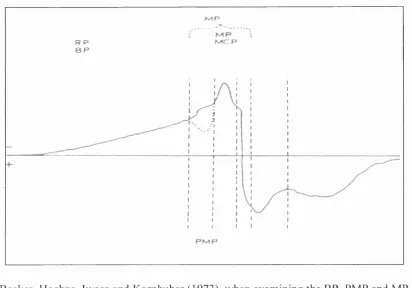
The BP, discovered in the 1960s by Komhuber and Deecke marked a new era in the study of intentional movements (e.g. Komhuber and Deecke, 1965). The BP or readiness potential (RP) is a slow negative potential beginning up to 2000 milliseconds (ms) before the intentional movement and peaking just prior to its initiation. This activity can be further subdivided into distinct components, although researchers classify these components differently.
Chapter 1: Introduction to thesis
Figure 1.1. Scalp potentials associated with making a voluntary movement. This schematic illustrates the terminologies and their waveform components. BP = bereitschaftspotential ; RP = readiness potential; PMP = pre-motion positivity; MP motor potential; MCP= motor cortex potential. Adapted from McCallum (1988).'
R p
B P
Becker, Hoehne, Iwase and Komhuber (1973), when examining the BP, PMP and MP prior to voluntary saccades, concluded that the BP was an indicator of “general preparation of premeditated voluntary acts and that it is only indirectly related to the initiation and the motor control of movements.” That is, the BP is the first observable stage of the intention to make an action. Due to the different classifications regarding the timings of these components (McCallum, 1988), a different set of classifications is now generally used. These are, for example, the P200, P300, NlOO and N200; or PI, P2 etc where the P signifies positivity, the N, negativity, and the numbers signify the time in milliseconds or the number of the trough or the peak, respectively. These times vary hugely between researchers.
Initially the BP is bilaterally symmetrical over the frontocentral midline, which is believed to indicate activity from the SMA. If the movement is unilateral, the BP
' Certain labels have been removed for simplicity, specifically the skilled performance positivity (SPP), the electromyogram (EMG), the alternative names for N 1 (N 1 A) and N2 (N2A, N2B and N 1B); and the breakdown of different periods; premotor, motor sensory, motor completion and postmotor.
Chapter 1: Introduction to thesis
becomes asymmetric in the contralateral hemisphere in the latter stages. This is appropriately named the lateralised readiness potential (LRP) and is calculated by
subtracting the differences in activation between the left and right SMA
(approximated to C3’ and C4’ sites on the scalp), [e.g. Haggard and Eimer, 1999].
1.5.2 Electrophysiology of Intention: Evidence that the Bereitschaftspotential is
the Neural Correlate of Intention
Walter (1967), following the discovery of the BP carried out experiments in which he used the subjects’ BP or “intention wave” to trigger the event which the subject was intending to do. Subjects prepared to press a button (the intentional action), which would cause a picture to be presented. Ingeniously, the equipment was designed such that the BP triggered the computer and the relevant stimulus generator, so the
outcome of the intended event occurred without the subject having to actually press the button. He called this process “auto-start”, and observed that it was vital that the “subject should really ‘want’ the event to occur and [must] concentrate on evoking this particular event.” Unsurprisingly, subjects found the experience of the outcome of their intended event occurring without their having to make the required operant action, “a very peculiar experience sometimes accompanied by signs of suppressed excitement” and, in two of the subjects, resulted in marked diuresis (excessive excretion of urine).
Walter’s experiments provide clear evidence that the BP (or “intention wave”) is the neural correlate of intention. This is because subjects manipulated their intention, which had a direct causal effect on the BP and thus, on the triggering of the operant event.
Using a paradigm similar to Walter (1967), Elbert, Rockstroh, Lutzenberger and Birbaumer (1979) tested subjects’ abilities to instrumentally control slow cortical potentials (SCP) and ascertained how these self-regulated changes in the SCP alter with respect to autonomic and behavioural responses. SCPs are equivalent to BPs.
Chapter 1: Introduction to thesis
shift their cortical negativity (compared with baseline) to one target; and the other to
positively shift their cortical negativity (compared with baseline) to the other target. The actual direct current (DC) shift in the six-second flight of the rocket to the target governed which target the rocket hit. Thus, subjects received visual feedback at six- second intervals o f their “actual cortical shift”. The experiment was also performed without feedback.
Subjects were capable of intentionally (in response to a stimulus) changing their cortical potential, most significantly in the second session in the positive shift trials. This experiment, therefore, also provides evidence that the BP is a neural correlate of intention, because subjects were able to alter their BPs using intention.
The discovery of the BP as detailed above heralded a major turning point in the study of intention and volitional movements. It provides an objective and quantitative method for studying intentional preparation in the pre-movement phase o f intentional action.
1.5.3 The Anatomical Substrate of Intention
Until relatively recently, intention was the domain of philosophers. However, with the discovery of the bereitschaftspotential (BP) and other physiological pre-cursors to willed action, intention could be studied empirically by scientists.
These techniques generally agree on the activation of a distinct network of brain regions in a specific and hierarchical order during intentional actions. This network centres on the supplementary motor area (SMA) and also includes the basal ganglia, the preft-ontal cortex and the motor cortex.
Tibet and colleagues performed some interesting, if highly contentious, experiments in the early 1980s using the BP (e.g. Tibet, Gleason, Wright and Pearl, 1983). His
Chapter 1 : Introduction to thesis
Neuropsychologists and philosophers have continued to postulate on and experiment
with intention in an effort to identify and quantify intention in a scientific way. Recently, neuroscientists have discovered areas o f the brain (e.g. the supplementary motor area,), which seem to be primarily concerned with intentional action, and other
areas (e.g. pre-motor cortex), which are active when the movement is reactive. The localisation o f relevant brain areas makes the study o f intention a more empirically scientific endeavour.
One useful way to consider intentional action is to compare it with reaction. Therefore, it is worth investigating whether or not the brain systems for these two classes of action overlap. The notion that there are two distinct motor systems, one responsible for internally-generated movements and the other responsible for externally-triggered movements, is a contentious issue in contemporary cognitive psychology. As mentioned by Deecke (1987):
For the human brain it makes a great difference whether we make movements in response to stimuli from the outer world - re-actions - or whether we perform purely ‘endogenous’ movements, which are really voluntary in nature and deserve the term actions.
Deecke (1987) is a proponent of the view that there is a structure in the brain, crucial for initiating voluntary action, which he identified as the supplementary motor area (SMA). The SMA is situated underneath the frontocentral midline where the first signs of cortical activity are seen during voluntary movements. In contrast, the pre
Chapter 1: Introduction to thesis
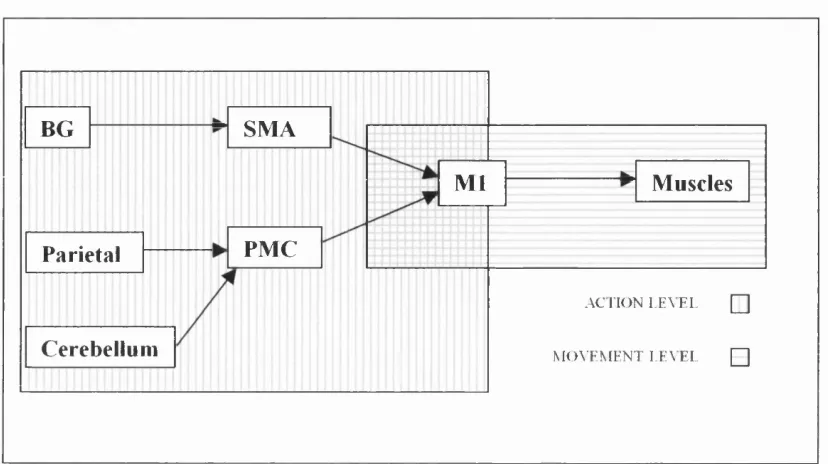
Figure 1.2. Schematic of the main motor associated projections into the primary motor area, via the SMA and PMC. BG = basal ganglia, SMA = supplementary motor area, PMC = pre-motor cortex, M l= primary motor cortex.
BG SMA
Ml Muscles
PMC Parietal
.AC TION LEA E L [ ]
Cerebellum M O V E M E N T EEA EL [ ]
Before presenting evidence in support of these two hypothesised motor systems, it is useful to briefly consider the brain systems that control and generate movement. The notion of hierarchies of function or levels of organisation is a convenient way to do this (Thompson, 1993), particularly when considering at what level of the hierarchy this dichotomy might exist.
1.5.3.1 Hierarchies in the motor system
Many of the structures in the central nervous system (CNS) are concerned with movement, for example, the cerebellum, the basal ganglia, the Ml, the PMC and the SMA, (see Figure 1.2). Fittingly, more than half the neurons in the brain are involved in the control of action, either directly or indirectly (Haggard, 2001).
At a broad level, it is clear that these structures are arranged hierarchically. Figure f.2 schematises the two main levels of movement control: the action level and the motor level. The division between the action and motor level is based on the anatomy of the human body. Thus, a simple model of a hierarchical relationship within the motor system constitutes (i) the higher level consisting of the brain; and (ii) the muscles (and the spinal reflexes which exercise rudimentary control over the muscles).
Chapter 1: Introduction to thesis
The spinal cord is complex in humans, containing the motor neurons that are connected to all the body’s muscles below the head (Thompson, 1993). The spinal cord can be activated by the brain’s motor systems (the higher level), which results in movement, for example, internally-generated and externally-triggered actions. The spinal cord also produces reflex actions, for example the knee-jerk reflex (a stretch reflex). Therefore, the lower level o f the motor system can produce actions that are
controlled from the higher level (brain —> spinal cord -> muscles) and those that are
not (e.g. the stretch reflex, extensor muscle spinal cord flexor muscle).
Information also passes from the lower levels to the higher levels o f the motor system, particularly via sensory receptors, which can be visual, auditory, or tactile, for
example. However, this thesis is primarily concerned with the motor output associated with the processes that start in the brain.
The action level, the higher level, is wholly located in the brain. The motor level consists of the muscular output and the neural pathways leading immediately to the muscles, i.e. the spinal cord and possibly the M l. There is some controversy over the Ml and its functions, hence the overlap of action and motor level in Ml in Figure 1.2. These issues are briefly considered below.
The controversy concerns the Ml and what is represented there. Traditional views, espoused by Sherrington (1906) and Penfield and colleagues (e.g. Penfield and Kristiansen, 1951) suggest that the musculature o f the body is represented in the Ml and is organised somatotopically. That is, the musculature of the body is represented in an orderly fashion, with the body parts that are next to each other represented next to each other in the brain. For example, Penfield and Rasmussen (1950), by
stimulating the cortex of fully conscious epileptic patients using local anaesthetic, were able to produce motor maps from the pre-central gyrus or M l. These maps showed, the thumb next to the index finger, which is next to the middle finger and so on.
Chapter 1: Introduction to thesis
and Roberts (1959) considered the Ml to be “an arrival platform and a departure platform. Its function is to transmit and possibly to transmute ... the patterned stream of impulses which arises in the centrencephalic system and passes on out to the target in voluntary muscles.” Sherrington (1906) called the “ultimate conductive link to an effector organ,” the ''final common p a th ” That is, Penfield and Roberts (1959) and Sherrington (1906) imply that the Ml is the beginning of the "final common path” to the muscles. Anatomically, this notion is supported: the pyramidal tract, one of the two major systems, which descends from the motor cortex and controls movement, contains neurons, the majority of which make monosynaptic connections with the spinal motor neurons (Thompson, 1993). Hence, many Ml cells are only one synapse away from the muscle. Therefore, the Ml could be considered to be part of the motor, or muscle, level of movement control.
On the other hand, more recent neurophysio logical evidence suggested that the Ml represents actions or tasks at quite a high level. This research, using the techniques of intracortical stimulation in conscious animals (e.g. Cheney and Fetz, 1985) and
‘spike-triggered averaging’ (e.g. Lemon, Muir and Mantel, 1987) has suggested that the Ml contains an overlap in representations of the musculature of the body, and is therefore, more likely to represent movements rather than muscles. Most
corticomotoneuronal (CM) cells are involved in activating more than one muscle, for example many o f the CM cells that project to the forearm muscle groups are
organised reciprocally, e.g. facilitating extensors and inhibiting flexors, (e.g. Cheney and Fetz, 1985).
Spike-triggered averaging involves “averaging the rectified EMG recorded from
different hmb muscles with respect to the discharges of a single cortical neurone” (Lemon, 1988). These techniques have, therefore shown, that large and discontinuous areas of the cortex can activate single muscles or movements (e.g. Cheney and Fetz, 1985).


![(E) 2 [(4 Fluorophenyl)iminomethyl] 5 methoxyphenol](data:image/gif;base64,R0lGODlhAQABAIAAAP///wAAACH5BAEAAAAALAAAAAABAAEAAAICRAEAOw==)