Topology-Hiding Computation
Tal Moran∗ Ilan Orlov† Silas Richelson‡
January 1, 2015
Abstract
Secure Multi-party Computation (MPC) is one of the foundational achievements of modern cryptog-raphy, allowing multiple, distrusting, parties to jointly compute a function of their inputs, while revealing nothing but the output of the function. Following the seminal works of Yao and Goldreich, Micali and Wigderson and Ben-Or, Goldwasser and Wigderson, the study of MPC has expanded to consider a wide variety of questions, including variants in the attack model, underlying assumptions, complexity and composability of the resulting protocols.
One question that appears to have received very little attention, however, is that of MPC over an underlying communication network whose structure is,in itself, sensitive information. This question, in addition to being of pure theoretical interest, arises naturally in many contexts: designing privacy-preserving social-networks, private peer-to-peer computations, vehicle-to-vehicle networks and the “in-ternet of things” are some of the examples.
In this paper, we initiate the study of “topology-hiding computation” in the computational setting. We give formal definitions in both simulation-based and indistinguishability-based flavors. We show that, even for fail-stop adversaries, there are some strong impossibility results. Despite this, we show that protocols for topology-hiding computation can be constructed in the semi-honest and fail-stop models, if we somewhat restrict the set of nodes the adversary may corrupt.
∗
Efi Arazi School of Computer Science, IDC Herzliya. Email:[email protected]
†
Efi Arazi School of Computer Science, IDC Herzliya. Email:[email protected]
‡
1
Introduction
Secure multi party computation (MPC) has occupied a central role in cryptography since its inception in the ’80s. The unifying question can be stated simply:
Can mutually distrusting parties compute a function of their inputs, while keeping their inputs private?
Classical feasibility results [26, 18, 4, 23] paved the way for a plenitude of research which has over time simplified, optimized and generalized the original foundational constructions. Some particularly rich lines of work include improving the complexity (round/communication/computation) of MPC protocols (e.g., [3, 15, 12, 11] and many more) and striving to achieve security in the more difficult (but realistic) setting where the adversary may execute many instantiations of the protocol along with other protocols (e.g., [22, 20, 8, 6] and many more).
Common to nearly all prior work, however, is the assumption that the parties are all capable of exchang-ing messages with one another. That is to say, most work in the MPC literature assumes that the underlyexchang-ing network topology is that of a complete graph. This is unrealistic as incomplete or even sparse networks are much more common in practice. Moreover, the comparably small body of MPC work that deals with incom-plete networks concerns itself with the classical goal of hiding the parties’ inputs. In light of the growing impact of networking on today’s world, this traditional security goal is insufficient. Consider, for example, the graph representing a social network: nodes representing people, edges representing relationships. Most computation on social networks today is performed in a centralized way—Facebook, for example, performs computations on the social network graph to provide popular services (e.g., recommendations that depend on what “similar” people liked). However, in order to provide these services Facebook must “know” the entire graph.
One could imagine wanting to perform such a computation in a distributed manner, where each user communicates only with their own friends, without revealing any additional information to third parties (there is clearly wide interest in this type of service—Diaspora*, a project that was expressly started to provide “Facebook-like” functionality in a more privacy-preserving manner [2], raised over $200,000 in 40 days via Kickstarter).
Another motivating example is the recent push by US auto safety regulators towards vehicle-to-vehicle communication [1], which envisions dynamic networks of communicating vehicles; many “global” compu-tations seem to be interesting in this setting (such as analysis of traffic patterns), but leaking information about the structure of this network could have severe privacy implications.
The rise of the “internet of things”, connected by mesh networks (networks of nodes that communicate locally with each other) is yet another case in which the topology of the communication network could reveal private information that users would prefer to hide.
It is with such applications in mind that we initiate the study of topology-hiding MPCin the computa-tional setting. We consider the fundamental question:
Can an MPC protocol computationally hide the underlying network topology?
1.1 Our Contributions
of the parties inAresulting from the execution of the protocol onGb. The adversary outputsb0and wins if
b0 =b. We say a protocol issecure against chosen topology attack(IND-CTA−secure) if no PPT adversary can win the above game with probability negligibly greater than if it simply guessesb0.
We then give a simulation-based definition of security using the UC framework. We define an ideal functionality Fgraph and say that a protocol is “topology hiding” if it is UC secure in the Fgraph−hybrid model. The functionality Fgraph models a network with private point-to-point links (private in the sense that the adversary does not know the network topology). It receivesG as input, and outputs to each party a description of its neighborhood. It then acts as an “ideal communication channel” allowing neighbors to send messages to each other. For more details onFgraphand the motivations behind our definition see the discussion below. Finally, we relate the two new notions by proving that simulation-based security implies game-based security.
Feasibility of topology-hiding MPC against semi-honest adversary:
Theorem 1. Assume trapdoor permutations exist. Let G be the underlying network graph and d a bound on the degree of every vertex in G. Then every multiparty functionality may be realized by a topology hiding MPC protocol which is secure against a semi-honest adversary who does not corrupt all parties in any k−neighborhood of the underlying network graph where k is such that dk=poly(n).
We point out that many naturally occurring graphs satisfydD = poly(n) whereDis the diameter. Exam-ples of such graphs include binary trees, hypercubes, expanders, and generally graphs with relatively high connectivity such as those occurring from social networks. For such graphs theorem 1 is a feasibility result against a general semi-honest adversary.
Impossibility in fail-stop model:
Theorem 2. There exists a functionalityF and a network graph G such that realizingF while hiding G is impossible.
Our proof uses the ability of the adversary to disconnectGwith his aborts; we then prove this is inherent.
Sufficient conditions in fail-stop model:
Theorem 3. Assume TDP exist. Every multiparty functionality may be realized by a topology hiding MPC protocol which is secure against a fail-stop adversary who does not corrupt all parties in any neighborhood of the underlying network graph and who’s aborts do not disconnect the graph.
1.2 Related Work
MPC on Incomplete Network Topologies One line of work which is in exception to the above began with Dolev’s paper [13] proving impossibility of Byzantine agreement on incomplete network topologies with too low connectivity. Dwork et. al. [14] coined the term “almost everywhere Byzantine agreement” to be a relaxed variant of Byzantine agreement where agreement is reached by almost all of the honest parties. Garay and Ostrovsky [16] used this to achieve almost everywhere (AE) MPC. Recently [9] gave an improved construction of AE Byzantine agreement translating to an improved feasibility result for AE MPC. These works are all in the information theoretic setting. We refer the curious reader to [9] and the references therein for more details.
the cryptographic setting and they give a meaningful upper bound on the locality and overall communication complexity. Their work does not address the notion of hiding the graph. Moreover they employ techniques such as leader election which seem inherentlynotto hide the graph.
Finally, we mention the two classical techniques ofmix-netandonion routing. The mix-net technique introduced by Chaum [10] uses public key encryption to implement a “message transmit” scheme allowing a sender and receiver to using in a message transmit using an additional shuffling mechanism. The onion routing technique [25, 24] and its extensions is a useful technique for anonymous communication over the Internet. Its basic idea is establishing paths of entities called proxies that know the topology in order to transmit massages.
Topology-Hiding MPC: While most of the cryptographic MPC literature disregards the interplay between multiparty computation and networking, the above works give a relatively satisfactory view of the landscape. Hiding the topology of the network in secure computation, on the other hand, is somewhat of a novel goal. The only work in the MPC literature of which we are aware that has considered this question is that of Hinkelmann and Jakoby [19] who focused on the information theoretic setting. Their main observation can be summarized:
If vertices v and w are not adjacent in G then Pv cannot send a message to Pw without some
intermediate Pzlearning that it sits between Pvand Pw.
They use this observation to prove that any MPC protocol in the information theoretic setting must inherently leak information about G to an adversary. They do, however, prove a nice positive result: given some minimal amount of network information to leak (formalized as a routing table of the network), one can construct an MPC protocol which leaks no further information.
Their work leaves open the interesting possibility that, using cryptographic techniques, one could con-struct an MPC protocol which (computationally) hides the network topology. In this work we explore this possibility.
Organization of the Rest of the paper The rest of the paper is organized as follows. In section 2 we go over the background and general definitions which are required to understand the technical portions which follow. In section 3 we formally define our new notions of “topology hiding” computation. This includes our game-based and simulation-based definitions as well as a proof that simulation-based security implies game-based security. In section 4 we consider achieving topology-hiding MPC against a semi-honest adversary. Our basic protocol is secure as long as the adversary does not corrupt any whole neighborhoods of the network graph. We then lessen this requirement showing how to transform a protocol which is secure against an adversary who doesn’t corrupt an entirek−neighborhood into one secure as long asAdoes not corrupt any (k+1)−neighborhood. This proves theorem 1. In section 5 we consider a fail-stop adversary and give a somewhat complete picture of the landscape in this setting, proving theorem 2 and theorem 3.
2
Preliminaries
2.1 General Definitions
We model a network by a directed graphG=(V,E) that is not fully connected. We consider a system with m=poly(n) parties, denotedP1, . . . ,Pm. We often implicitly identifyVwith the set of parties{P1, . . . ,Pm}.
deviate from the protocol according to the corruption model. Through this work, we consider mostly semi-honest and fail-stop adversaries, though we discuss the implications of our fail-stop impossibility result on the hope of achieving topology-hiding MPC in the malicious model. In addition, we assume that the adversary is rushing; that is, in each round the adversary sees the messages sent by the honest parties before sending the messages of the corrupted parties for this round. For general MPC definitions including descriptions of the adversarial models we consider see [17].
2.2 Definitions of Graph Terms
Let G = (V,E) be an undirected graph. For v ∈ V we let N(v) = {w ∈ V : (v,w) ∈ E} denote the neighborhood of vby; and similarly, theclosed neighborhood of v, N[v] = N(v)∪ {v}. We sometimes refer to N[v] as the closed 1−neighborhood ofv, and fork≥1 we define thek−neighborhood ofvas
Nk+1[v]= [
w∈Nk(v)
N[w].
2.3 UC Security
We employ the UC model [7] in order to abstract away many of the implementation details and get at the core of our definition. Our protocol for hiding the topology in MPC is local in nature, and our final protocol is the result of composing many local subprotocols together. This motivates the need for using subprotocols which are secure under some form of composition. UC security offers strong composability guarantees and thus is well suited to our setting. One of the appealing features of our definition is that it fits entirely within the existing UC framework, hence the UC composition theorem can be applied directly.
The downside of the UC model is that it requires setup [7] and opponents argue that it is “unrealistic”. We have two responses to this. First, we encapsulate our setup into realizing theFgraph functionality. This functionality (defined formally in the next section) models the underlying communication network and so we think of the setup required in order to realize it as an implementation issue. Second, we point out that our subroutines need only be secure against bounded self-composition in order to obtain stand-alone security in
theFgraph−hybrid model, corresponding to a stand-alone variant of topology hiding security. This allows
us to instantiate our protocol in the plain model on top of (for example) [20] in order to obtain stand-alone topology hiding MPC.
3
Our Model of Security
3.1 Topology Hiding—The Simulation-Based Definition
In this section, we propose a simulation-based definition for topology hiding computation in the UC frame-work. Generally, in the UC model, the communication between all parties passes through the environment, so it seems the environment implicitly knows the structure of the underlying communication network. We get around this by working in theFgraph−hybrid model. TheFgraphfunctionality (shown in Figure 1) takes as input the network graph from a special “graph party”Pgraphand returns to each other party a description of their neighbors. It then handles communication between parties, acting as an “ideal channel” function-ality allowing neighbors to communicate with each other without this communication going through the environment.
Participants/Notation:
This functionality involves all the partiesP1, . . . ,Pmand a special graph partyPgraph. Initialization Phase:
Inputs:Fgraphwaits to receive the graphG=(V,E) fromPgraph. Outputs:Fgraphoutputs NG[v] to eachPv.
Communication Phase:
Inputs:Fgraphreceives from a partyPva destination/data pair (w,m) wherew∈N(v) andmis the
messagePvwants to send toPw.
Output:Fgraphgives output (v,m) toPwindicating thatPvsent the messagemtoPv.
Figure 1: The functionalityFgraph.
Since Fgraph provides local information about the graph to all corrupted parties,any ideal-world ad-versary must have access to this information as well (regardless of the functionality we are attempting to implement). To capture this, we define the functionalityFgraphInfo, that is identical toFgraphbut contains only the initialization phase. For any functionalityF, we define a “composed” functionality (FgraphInfo||F) that adds the initialization phase ofFgraphtoF. We can now define topology-hiding MPC in the UC framework:
Definition 3.1. We say that a protocolΠsecurely realizes a functionalityF hiding topologyif it UC-realizes (FgraphInfo||F)in theFgraph-hybrid model.
Note that this definition can also capture protocols that realize functionalities depending on the graph (e.g., find a shortest path between two nodes with the same input, or count the number of triangles in the graph).
3.2 Topology Hiding - The Indistinguishability-based Security Definition
In this section, we propose another definition for topology-hiding security that is not restricted to secure multi-party computation. The definition is formalized using a security game between an adversaryAand a challengerC. In addition, we prove that this definition is implied by the simulation-based definition from subsection 3.1. The basic structure of the game fits several types of adversarial behaviors, e.g., semi-honest, fail-stop, and malicious, thus, we do not emphasize the exact behavior of the adversary during the execution of the protocol.
• Setup: LetGbe a set of graphs. LetΠbe a protocol capable of running over any of the communication graphs inGaccording to the adversarial model ofA(semi-honest, fail-stop, or malicious). Each Pi
gets an inputxi∈Xi.
• Achooses a corrupt subsetS, inputsxjfor the corrupted partiesPj∈S and, fori∈ {0,1}, two graphs
Gi = (Vi,Ei) ∈ G, such that S ⊂ V0 ∩V1 and NG0[S] = NG1[S] (equality of graphs). It outputs S;G0,G1;{xj}. IfS 1V0∩V1or if some inputxjis invalidCwins automatically.
• NowCchooses a randomb∈ {0,1}and runsΠin the communication graphGb, where each honestPi
getsxiand each dishonest party gets the input prescribed byA. Areceives the collective view of all
parties inS during the protocol execution.1
1In the semi-honest model, the joint view of the corrupted parties is given toAby the end of the execution ofP
• FinallyAmust outputb0 ∈ {0,1}. Ifb0=bwe say thatAwins the security game. OtherwiseAloses.
Definition 3.2. We say that an MPC protocolΠisIndistinguishable under Chosen Topology Attack( IND-CTA secure) overGif for any PPT adversaryAthere exists negligible functionµ(·), such that for everynit
holds
PrAwins − 1
2
≤µ(n).
We prove below that IND-CTA security is weaker than security with respect to the simulation-based security definition (Definition 3.1); thus, our impossibility results (in subsection 5.1) imply impossibility of the simulation based definition as well.
Claim 3.3. For every functionality F that does not depend on the communication graph structure, if Π securely realizesF with topology-hiding security (under Definition 3.1) thenΠis IND-CTA secure.
Proof Sketch. LetΠbe a topology-hiding secure-computation protocol with respect to Definition 3.1 and let G0 andG1 be two graphs. We consider two specific executions ofΠ on network topologies G0 and G1 with corrupt parties given the same inputs. We define random variables HYBRIDG0,IDEALG0
and HYBRIDG1,IDEALG1
as usual. We observe that IDEALG0 are IDEALG1 are identically distributed, as in both cases the adversary gets the same final output, in addition to the same set of local closed neighbor-hoods. It follows that ifΠrealizesF with topology hiding security then HYBRIDG0 and HYBRIDG1 are indistinguishable. It follows thatAcannot win the IND-CTA game with probability that is noticeably better than 1/2. SoΠmeets also the IND-CTA security definition.
4
Topology Hiding MPC Against a Semi-Honest Adversary
In this section we describe a protocol for topology-hiding MPC against a semi-honest adversary. This construction is the heart of the main positive result in the paper:
Theorem 4. Let d be a bound on the degree of any vertex in G. Then for every k satisfying dk = poly(n), there exists a protocolΠthat securely realizes the broadcast functionality hiding topology against a semi-honest adversaryAthat does not corrupt all parties in any closed k−neighborhood of G.
Note that this gives us security against a general semi-honest adversary when the graph has constant degree and a logarithmic bound on the diameter (by settingkto be anything larger than the graph diameter). We point out that many natural families of graphs are of this sort, including binary trees, hypercubes, expanders and more. Theorem 1 follows from theorem 4 by standard methods for compiling broadcast into MPC.
4.1 High-Level Protocol Overview of Our Basic Protocol
Below we give a top-down description of our basic broadcast protocol: one that is secure against adversaries that do not corrupt any complete 1-neighborhood in the graph (i.e., in every star there is at least one honest node). This basic protocol can then be used to construct a broadcast protocol that tolerates larger corrupt neighborhoods (more details of this transformation appear in section 4.6).
A Na¨ıve Broadcast Protocol
To understand the motivation for the construction, first consider a na¨ıve broadcast protocol for a single bit:
2. In each successive round, every party computes the OR of all bits received from their neighbors in the previous round, and sends this bit to all neighbors.
After jrounds, every party at distance jor less from the broadcaster will be sending the bitb(this can be easily shown by induction); afterdiam(G) rounds all parties will agree on the bitb. This protocol realizes the broadcast functionality, but it is not topology-hiding: a party can tell how far it is from the broadcaster by counting the number of rounds until it receives a non-zero bit (assumeb= 1 for this attack). It can also tell in which direction the broadcaster lies by noting which neighbor first sent a non-zero bit.
Using Local MPC to Hide Topology
Our construction hides the sensitive information by secret-sharing it among the nodes in a local neigh-borhood. Essentially, our basic protocol replaces each node in the na¨ıve protocol above with a secure computation between the node and all of its direct neighbors in the graph.
In order to communicate a bit between one local neighborhood and another, without revealing the bit to the vertex connecting the two neighborhoods, each local neighborhood generates a public/private key pair, for which the private key is secret-shared between the parties in the neighborhood. The input to each local MPC includes the private key shares. The output to each party is encrypted under the public key of the neighborhood represented by that party (i.e., of which the party is the center node).
Since no local neighborhood is entirely corrupted, the adversary does not learn any of the plaintext bits. In the final round (at which point the broadcast bit has “percolated” to all the neighborhoods in the graph). a secure computation is used to decrypt the bits and output the plaintext to all the parties.
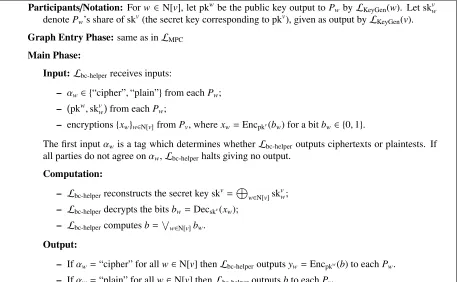
The protocol is formally specified as two separate functionalities, each instantiated using a local se-cure computation: the KeyGen functionality (LKeyGen), handles the generation and distribution of the pub-lic/private key-pair shares in each local neighborhood, and the “broadcast-helper” functionality (Lbc-helper), handles the encryption/decryption and ORing of the bits. The details of the construction are in section 4.4.
Implementing Local MPC
To implementLKeyGenandLbc-helper, the basic protocol uses a general MPC functionality,LMPC, that allows the local neighborhoods to perform secure computation protocols (i.e., among parties connected in a star graph). RealizingLMPC ammounts to constructing a compiler which transforms a standard MPC protocol which runs on a complete graph into one which runs on a star graph. We achieve this by having players in the star who are not connected pass messages to each other through the center. The messages are encrypted to ensure privacy. One subtle point is that the protocol must not leak how many players are in the local neighborhood, as parties are not supposed to learn the degrees of their neighbors. We sidestep this issue by having the center node “invent” fake nodes so that parties learn only that the degree is at mostd, some public upper bound on the degree of any node inG. The functionalityLMPCis shown in Figure 2.
4.2 Formal Protocol Construction and Proofs of Security
Below, we give the formal protocol definitions and sketch their proofs of security in the UC framework.
Notation
The protocols and functionalities in the remainder of this section involve parties P1, . . . ,Pmand a special
graph partyPgraph whose role is always simply to pass his input,G, toFgraph. Forv ∈ V we let Pv be the
are executed by the parties in a local neighborhood ofG. We will use repeated parallel executions of local MPCs to realize global functionalities. We reserve the letter L for local functionalities realized by local MPCs, and useF for global functionalities. For simplicity when describing a local functionality or local MPC protocol, we will describe only the singular execution running in N[v] (involvingPvand{Pw}w∈N(v)), even though the same process is occurring in every closed neighborhood inGsimultaneously.
4.3 RealizingLMPCin theFgraph−hybrid Model
The local MPC functionalityLMPC is shown in Figure 2. As we have already mentioned, it is sufficient to securely realize message passing between all parties in N[v] in theFgraph−hybrid model. This is because, once all parties can send messages to each other, they can simply run their favorite UC secure MPC protocol as if the network topology is that of a complete graph. Note that as we are in the semi-honest model here, UC secure MPC does not require setup. We will use the constant round, protocol of [21], as it is UC secure against a semi-honest adversary (against general adversaries it is bounded concurrent secure).
Graph Entry Phase:
Input:LMPCreceives the graphGfromPgraph. Output:LMPCoutputs N[v] toPv.
MPC Phase:
Input:LMPCreceives fromPvad−party protocolΠand inputxwfromPw, for eachw∈N[v]. Computation:LMPCsimulatesΠwith inputs{xw}wobtaining outputs{yw}w.
Output:LMPCgivesywto eachPw.
Figure 2: The functionalityLMPC.
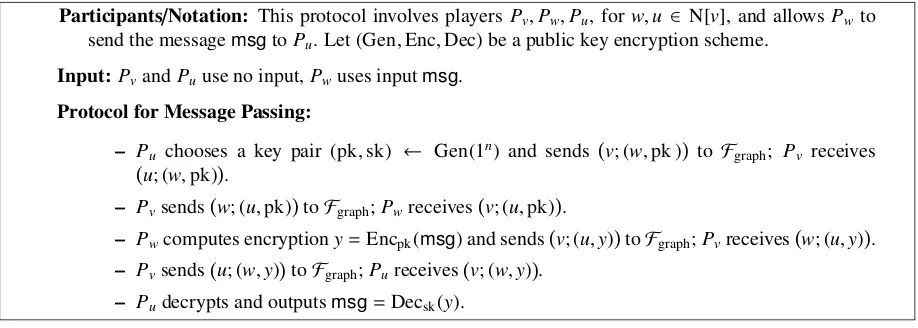
For simplicity we describe the protocol allowingPwto securely send a message toPuforw,u∈N[v].
1. Pugenerates a key pair and sends the public key toPwthroughPv;
2. Pwencrypts its message and sends the ciphertext back toPuthroughPv.
Such a protocol naturally extends to allow all parties in N[v] to exchange messages with each other (as long as Pv invents enough nodes to ensure that his neighbors do not learn his degree, but just the preselected
boundd). As we mention above, this is sufficient for securely realizingLMPCin theFgraph−hybrid model.
Security ofLMPC. The proof is very simple so we suffice it to briefly describeS, and leave checking that it accurately emulatesA’s view in the real world to the reader. SinceΠis a UC secure MPC protocol on a complete graph, there exists a simulator S0 who can replicate any adversaryA’s real-world view in the ideal world. The only difference between the viewS0 outputs and the view we need to output is that we must take into account that our messages are encrypted and passed throughPv. Therefore,Sgenerates key
pairs{(pkw,u,skw,u)}w,u∈N[v], wherePw will use pkw,u to send messages toPu and computes encryptions of
the messages in the view output byS, and distributes them accordingly to the players. Security follows from the security of the encryption scheme.
4.4 The FunctionalitiesLKeyGenandLbc-helper
compromis-Participants/Notation: This protocol involves playersPv,Pw,Pu, forw,u ∈ N[v], and allowsPwto
send the messagemsgtoPu. Let (Gen,Enc,Dec) be a public key encryption scheme. Input:PvandPuuse no input,Pwuses inputmsg.
Protocol for Message Passing:
– Pu chooses a key pair (pk,sk) ← Gen(1n) and sends v; (w,pk ) to Fgraph; Pv receives
u; (w,pk).
– Pvsends w; (u,pk)toFgraph;Pwreceives v; (u,pk).
– Pwcomputes encryptiony=Encpk(msg) and sends v; (u,y)toFgraph;Pvreceives w; (u,y). – Pvsends u; (w,y)toFgraph;Pureceives v; (w,y).
– Pudecrypts and outputsmsg=Decsk(y).
Figure 3: TheFgraph−hybrid protocolΠmsg-transmit.
ing the security ofΠ, and also without leaking any information about the topology. We will be interested in two specific local functionalities,LKeyGenandLbc-helper. These can be securely realized in theFgraph−hybrid model by simply instantiatingLMPCwith two specific MPC protocols.
Recall that our underlying idea is to replace the role ofPvin a usual broadcast protocol with an MPC to
be performed by the parties inPv’s neighborhood. This will hide each player’s distance from the broadcaster
because even though the bit might have been received byPv’s neighborhood, it will not be known to any
individual player. Our first functionality, LKeyGen, is useful towards this end. Intuitively, it generates a key pair (pk,sk) for the neighborhood N[v] and gives pk to Pv and distributes secret shares of the secret
key amongPv’s neighbors. Our second functionality,Lbc-helper will allow the broadcast bit to spread from neighborhood to neighborhood once the neighborhoods have keys distributed according to LKeyGen. The functionalitiesLKeyGenandLbc-helperare shown in Figure 4 and Figure 5, respectively. LetLKeyGen(v) and Lbc-helper(v) denote the copies ofLKeyGenandLbc-helper, respectively, which take place in N[v]
Participants/Notation:Let (Gen,Enc,Dec ) be a public key encryption scheme.
Graph Entry Phase:same as inLMPC KeyGen Phase:
– LKeyGengenerates a key pair (pk,sk)←Gen(1n). – LKeyGencomputes random shares{skw}w∈N[v]such that
L
wskw=sk.
Output:LKeyGengives outputs pk,skvtoPv, and skwto eachPwsuch thatw∈N[v].
Figure 4: The functionalityLKeyGen.
4.5 RealizingFbroadcastinLMPC−hybrid model
Our LMPC−hybrid protocol for broadcast, Πbroadcast uses the ideal functionalities LKeyGen and Lbc-helper described above. As mentioned in the previous section, these functionalities are obtained from LMPC by instantiatingLMPCwith specific MPC protocols. A description ofΠbroadcastis given in Figure 11. Note that
Πr
Participants/Notation:Forw∈N[v], let pkwbe the public key output to PwbyLKeyGen(w). Let skvw
denotePw’s share of skv(the secret key corresponding to pkv), given as output byLKeyGen(v). Graph Entry Phase:same as inLMPC
Main Phase:
Input:Lbc-helperreceives inputs:
– αw∈ {“cipher”,“plain”}from eachPw; – pkw,skvwfrom each
Pw;
– encryptions{xw}w∈N[v]fromPv, wherexw=Encpkv(bw) for a bitbw∈ {0,1}.
The first inputαwis a tag which determines whetherLbc-helper outputs ciphertexts or plaintests. If
all parties do not agree onαw,Lbc-helperhalts giving no output. Computation:
– Lbc-helperreconstructs the secret key skv=Lw∈N[v]skvw;
– Lbc-helperdecrypts the bitsbw=Decskv(xw); – Lbc-helpercomputesb=W
w∈N[v]bw. Output:
– Ifαw=“cipher” for allw∈N[v] thenLbc-helperoutputsyw=Encpkw(b) to eachPw. – Ifαw=“plain” for allw∈N[v] thenLbc-helperoutputsbto eachPw.
Figure 5: The functionalityLbc-helper.
Claim 4.1. The protocolΠrbroadcastUC securely realizesFbroadcastin theFgraph−hybrid model as long as the
network topology graph G is such that
1. Diameter(G)<r;
2. Adoes not corrupt any entire closed neighborhood of G.
Simulator. Consider a corrupt partyPv.SsimulatesPv’s view as follows:
1. KeyGen: Sgenerates (pkv,skv) ←Gen(1n). When the parties callLKeyGen,Sreturns pkvtoPvand
random stringsrwv to eachPwsuch thatw∈N[v], instead of shares ofPw’s secret key.
2. Main Computation:As output to each of the firstr−1 calls toLbc-helper,Sgives output{xcv,w}w,cto
Pv, wherexcv,w=Encpkv(0n) toPv. To compute the output of the last call ofLbc-helper,Sinputsbvand
all other corrupt parties’ input bits toFbroadcastreceivingb∗which it returns toPv.
Hybrid Argument.
H0− This is the real execution ofΠrbroadcast. Namely, each environment first runsLKeyGen, after which each Pv has key data pkv,{skwv}w∈N[v]. Then parties enter the loop, runningLbc-helper r times. Initially, parties enter their secret bit and the key data received from LKeyGen. In each subsequent call to
Lbc-helper, the output from the previous call is also given as input. Finally, Pv receives many copies
of the same bitb∗v as output from the last call toLbc-helper, and Pv outputs this bit. The view of Pv
Input:Pgraphinputs the graphG, eachPvinputs a bitbv∈ {0,1}.
KeyGen: Parties callLKeyGen and eachPvreceives N[v] and (pkv,skvv) fromLKeyGen(v) and skvw
fromLKeyGen(w) for eachw∈N[v]. Main Computation:
– EachPvsetsx0v,w=Encpkv(bv) for eachw∈N[v]. – Forc=1, . . . ,r−1, parties callLbc-helper:
∗ Pvgives input“cipher”; pkv,skvv
; {xc−1
v,w}w∈N[v] toLbc-helper(v);
∗ For eachw∈N[v],Pvgives input“cipher”; pkv,skwv toLbc-helper(w);
∗ Pvreceives outputxcv,wfromLbc-helper(w) for allw∈N[v]. – Finally, parties callLbc-helper:
∗ Pvgives input“plain”; pkv,skvv; {xvr−,w1}w∈N[v] toLbc-helper(v);
∗ For eachw∈N[v],Pvgives input“plain”; pkv,skwv toLbc-helper(w);
∗ Pvreceives the bitb∗v,was output fromLbc-helper(w). Output:Pvoutputsb∗v=Wwb∗v,w.
Figure 6: The (LKeyGen||Lbc-helper)-hybrid protocolΠrbroadcast.
1. inputbv∈ {0,1}, outputb∗v ∈ {0,1};
2. key data pkv,{(skwv)}w∈N[v]; 3. encryptions
xvc,w cw=∈0N[,...,v]r−1.
LetB⊂Vbe the set of bad parties corrupted byA. The view of the adversary is
n
bv,b∗v; pk v,
skwv w∈N[v];
xcv,w w,co
v∈B.
H1− This is the same as the above experiment except the secret key shares are replaced by random strings. The resulting view is
n
bv,b∗v; pk v,
{rwv}w;{xcv,w}w,c
o
v∈B.
As the secret key skv is secret shared among N[v] using a N[v]
−out−of− N[v]
secret sharing scheme, andAdoes not corrupt all of N[v], we have thatH1 ≈H0.
H2− This is identical to H1 except that all of the encryptions xcv,w are changed to encryptions of 0. The resulting view is exactly the view of the ideal world adversary, and is indistinguishable from the view inH1by semantic security of the encryption scheme.
4.6 Allowing for Corruption of Whole Neighborhoods
Our protocol Πrbroadcast from the previous section successfully realizes the broadcast functionality while hiding the topology of the graph so long asAdoes not corrupt any entire neighborhood ofG. IfAwere to corrupt N[v] for somev, our protocol immediately becomes insecure, asAwould possess all of the shares of skv and so could simply decrypt all of the encrypted bitsPv receives and learn when the broadcast bit
reachesPv. In this section, we show how, given a protocolΠthat is secure as long asAdoes not corrupt
be a constant times the round complexity ofΠand so one can only repeat this process logarithmically many times.
The main ideas of this section are essentially the same as those in the previous section; showing that the technique of using local MPC to hide information as it spreads to all parties in the graph is quite general. Like
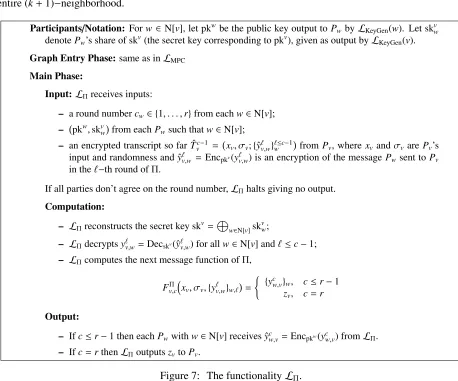
Πbroadcast, our protocolΠ0will be given in theLMPC−hybrid model, where we will use the ideal functionality LKeyGen. However, instead of using Lbc-helper, we will use a similar but different local functionality, LΠ, shown in Figure 7. Essentially,LΠallows the role ofPvinΠto be computed using a local MPC by all of the
parties in N[v]. Then the protocolΠ0usesLΠto executeΠexcept that each party’s role inΠis computed using local MPC by its local neighborhood inΠ0. This ensures that ifΠis such that any adversary wishing to attackΠmust corrupt an entirek−neighborhood, then any adversary wishing to attackΠ0must corrupt an entire (k+1)−neighborhood.
Participants/Notation:Forw∈N[v], let pkwbe the public key output to PwbyLKeyGen(w). Let skvw
denotePw’s share of skv(the secret key corresponding to pkv), given as output byLKeyGen(v). Graph Entry Phase:same as inLMPC
Main Phase:
Input:LΠreceives inputs:
– a round numbercw∈ {1, . . . ,r}from eachw∈N[v]; – pkw,skvwfrom eachPwsuch thatw∈N[v];
– an encrypted transcript so far ˆTvc−1 = xv, σv;{yˆ`v,w}`≤wc−1fromPv, wherexvandσvarePv’s
input and randomness and ˆy`v,w =Encpkv(y`v,w) is an encryption of the messagePw sent toPv
in the`−th round ofΠ.
If all parties don’t agree on the round number,LΠhalts giving no output.
Computation:
– LΠreconstructs the secret key skv=Lw∈N[v]skvw;
– LΠdecryptsy`v,w=Decskv(ˆy`v,w) for allw∈N[v] and`≤c−1; – LΠcomputes the next message function ofΠ,
FΠv,cxv, σv,{y`v,w}w,`=
(
{ycw,v}w, c≤r−1
zv, c=r
Output:
– Ifc≤r−1 then eachPwwithw∈N[v] receives ˆywc,v=Encpkw(ycw,v) fromLΠ. – Ifc=rthenLΠoutputszvtoPv.
Figure 7: The functionalityLΠ.
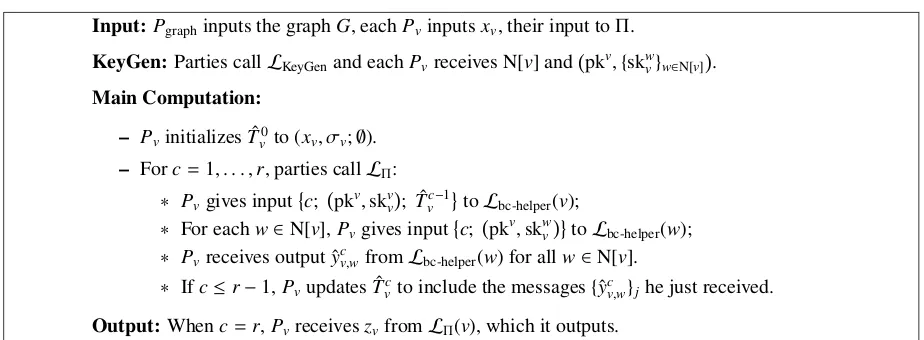
Our hybrid protocolΠ0is described in Figure 8. Our statement and construction of simulator are below. We leave out the hybrid argument as it is very similar to the one in subsection 4.5
Claim 4.2. The protocolΠ0 realizes the same functionality asΠ. Moreover ifΠrealizes the functionality UC securely in theFgraph−hybrid model as long asAdoes not corrupt an entire k−neighborhood of G, then Π0
is UC secure in theFgraph−hybrid model as long asAdoes not corrupt an entire(k+1)−neighborhood
Input:Pgraphinputs the graphG, eachPvinputsxv, their input toΠ.
KeyGen:Parties callLKeyGenand eachPvreceives N[v] and pkv,{skwv}w∈N[v]. Main Computation:
– Pvinitializes ˆTv0to (xv, σv;∅). – Forc=1, . . . ,r, parties callLΠ:
∗ Pvgives inputc; pkv,skvv
; ˆTc−1
v toLbc-helper(v);
∗ For eachw∈N[v],Pvgives inputc; pkv,skwv toLbc-helper(w);
∗ Pvreceives output ˆycv,wfromLbc-helper(w) for allw∈N[v].
∗ Ifc≤r−1,Pvupdates ˆTvcto include the messages{yˆcv,w}jhe just received. Output:Whenc=r,PvreceiveszvfromLΠ(v), which it outputs.
Figure 8: The (LKeyGen||LΠ)-hybrid protocolΠ0.
Simulator. We construct a simulatorS0which will make use of the simulatorSforΠ. Consider a corrupt partyPv.S0simulatesPv’s view as follows:
1. KeyGen:S0generates (pkv,skv)←Gen(1n) and random shares{skv
w}w∈N[v]such that
L
wsk v w=sk
v.
When the parties callLKeyGen,S0returns (pkv,skvv) toPvand skvwtoPw.
2. Main Computation:In order to simulatePv’s view we consider two cases:
Case 1−(Pvhas at least one honest neighbor):In this caseS0simulatesPv’s view by replacing all the
messagesPvwould receive with encryptions of 0n.
Case 2−(all of N[v] is corrupt): In this caseAcan reconstruct skvand so will be able to distinguish if S0sends encryptions of zero. However,Adoes not corrupt an entire (k+1)−neighborhood ofG which means the set{v∈V : N[v] is corrupt}does not contain anyk−neighborhood. Moreover, since each neighborhood inΠ0 plays the role of a player inΠ, we can simulate the view of such Pv using the simulatorSforΠ. Specifically,S0internally runsSin order to simulatePv’s view
inΠ, and encrypts with pkvto obtainPv’s view inΠ0.
5
Topology Hiding MPC Against a Fail-Stop Adversary
In this section we consider a stronger adversarial model: the stop adversary. A party controlled by a fail-stop adversary must follow the honest protocol exactly, except that they may abort if the adversary instructs them to.
We have two main results in this section. In section 5.1 we give a general impossibility result, showing that any protocol that implements even a weak version of the broadcast functionality is not IND-CTA secure against fail-stop adversaries. Our proof crucially relies on the ability of the adversary to disconnect the communication graph by aborting with well-placed corrupt parties. In Section 5.2 we show that this is inherent by transforming our broadcast protocol from the previous section into one which is secure against a fail-stop adversary who does not disconnect the graph with his aborts, and who does not corrupt (even semi-honestly) anyk−neighborhood. We give a high level overview of our techniques of this section before proceeding to the details.
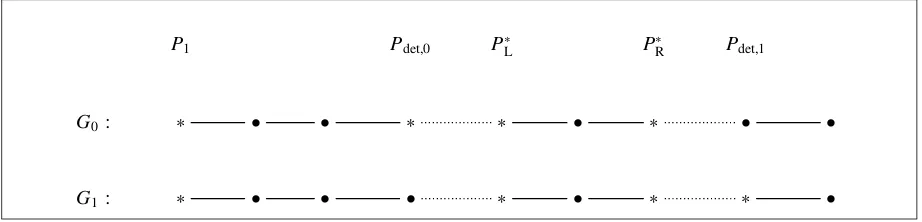
in the protocol then honest parties’ outputs cannot depend onb. Clearly, ifP∗aborts before the information aboutbhas reached him, then no information aboutbwill reach the honest parties on the other side ofP∗. This means that the outputs ofallhonest parties must be independent ofb, otherwise an adversary would be able to corrupt another partyPdetto act as a detective. Namely,Awill instructPdetto play honestly and based onPdet’s output,Awill be able to guess which side ofP∗Pdetis on. Second, ifP∗aborts near the end of the protocol then all parties (other thanP∗’s neighbors) must ignore this abort and output what they would have output had nobody aborted. Indeed, if P∗ aborts with onlyk rounds remaining in the protocol, then there simply isn’t time for honest parties of distance greater thankfromP∗to learn of this abort. Therefore, all honest parties’ outputs must be independent of the fact thatP∗aborted, lest anAwould be able to employ Pdetto detect whether is within distancekofP∗or not. This difference in honest parties’ outputs whenP∗ aborts early versus late means there is a roundi∗such that the output distribution ofPdetwhenP∗aborts in roundi∗is distinguishable fromPdet’s output distribution whenP∗aborts in roundi∗+1. We take advantage of this by having two abortersP∗1andP∗2who abort in roundsi∗andi∗+1. We prove thatAwill be able to distinguish the cases from whenPdetis to the left ofP∗1with the case when he is to the right ofP∗2allowing Ato win the IND-CTA game with non-negligible advantage.
In Section 5.2 we modify our broadcast protocol of section 4 to be secure against a fail-stop adversary who does not disconnect the graph with his aborts. The idea is to run the semi-honest protocol 2m−1 times. Since the adversary can corrupt and abort with at mostm−1 parties we are guaranteed that the majority of the executions have no aborts. We ensure thatAlearns nothing from the outputs of the executions with aborts by holding offon giving any output until all 2m−1 executions have occurred. Then we use a final local MPC protocol to compute all outputs, select the majority and output this to all parties.
5.1 Impossibility Result
Definition 5.1. We say that a protocolΠweakly realizes the broadcast functionalityifΠis such that when all parties execute the protocol honestly, all parties outputW
xiwhere xiis Pi’s input.
Note that in weak broadcast, there are no guarantees on the behavior of honest parties if any of the parties deviates from the honest protocol.
Theorem 5. There does not exist an IND-CTA secure protocolΠthat weakly realizes the broadcast func-tionality in the fail-stop model.
LetGbe a line with mvertices. Namely,G = (V,E) withV = {P1, . . . ,Pm}andE = {(Pi,Pi+1)}i=1,...,m−1. LetΠbe a protocol executed onGthat weakly realizes the broadcast functionality whereP1(the left most node) is the broadcaster (P1has inputb, and the inputs to all other nodes is 0). SupposeΠhasrrounds. We will show thatΠcannot be IND-CTA secure.
Claim 5.2. LetHv,bbe the event thatPv’s output after executingΠmatches the broadcast bitb. LetEi be
the event that the first abort occurs in roundi. Then eitherΠis not IND-CTA secure, or there exists a bit b∈ {0,1}such that
PrHv,b
Er−1
−Pr Hv,b
E1
≥
1
2−negl(n) for all honestPvwhose neighbors do not abort.
Proof. If someP∗ aborts during the first round ofΠthen he disconnects the graph, making it impossible for the parties separated fromP1to learn aboutb. These parties’ outputs therefore must be independent of b, which implies that there exists ab ∈ {0,1}such that Pr Hb
E1
adversary could use the correlation betweenband a party’s output to deduce that this party is in the same connected component asP1.
Formally, consider a fail-stop adversaryAwho corrupts three parties: the broadcasterP1, aborterP∗=Pbm2c and detective Pdet. A then submits (G0,G1,S), to the challenger where G0 = G andG1 is constructed fromGby exchanging the labels of the nodes (P3,P4,P5) with (Pm−2,Pm−1,Pm). That is, inG1, the nodes P3,P4,P5 appear at the end of the line. We call Pdet = P4the “detective” node. The setS consists of the nodesP1,P∗andPdet. Note thatA’s neighborhoods are the same inG0andG1(form≥12).
Ainstructs P∗to abort during the first round and observes Pdet’s output. Since Pm−1’s output must be independent ofb, ifP4’s output depends in a non-negligible way onb, this will translate into an advantage forAin the CTA game.
Finally, note that Pr Hv,b
Er−1
=
Pr Hv,b
no aborts =
1 for allPvwhich are not neighbors ofP∗. The claim
follows.
Proof of Theorem 5. It follows from Claim 5.2 that there exists a pair (i∗,b)∈ {1, . . . ,r} × {0,1}such that
Pr Hv,b
Ei∗
−PrHv,b
Ei∗+1
≥
1
2r −negl(n). (1)
for all honestPvwho do not have an aborting neighbor. Furthermore, assume without loss of generality that
Pr Hv,b
Ei∗
>
Pr Hv,b
Ei∗+1
. We construct a fail-stop adversaryA who can leverage this fact to win the CTA game with non-negligible advantage.
Our adversaryAcorrupts four parties: the broadcaster P1, two aborters P∗L,P∗R =
Pbm2c−1,Pbm2c+1, and the detectivePdet.Athen submits (G0,G1,S) to the challenger whereG0 =G,G1is constructed fromGby exchanging (P3,P4,P5) with (Pm−2,Pm−1,Pm) andS ={P1,P∗L,P∗R,Pdet= P4}. These graphs are shown in Figure 9. Note that these adversary structures have identical neighborhoods form≥14.
Now Aguesses (i∗,b) ∈ {1, . . . ,r} × {0,1}. With non-negligible probability, (i∗,b) is such that inequality (1) is satisfied. Agivesbas input toP1and instructsP∗Lto abort on roundi∗,P∗R to abort on roundi∗+1. Notice that since the two aborting parties are at distance 2 from each other, the information aboutP∗L’s abort does not reachP∗Rby the time he aborts one round later. Therefore, the information aboutP∗L’s abort does not reach any of the parties to the right ofP∗R at any point during the protocol. This means that ifG0 was chosen by the challenger, Pdet’s output will be consistent withEi∗ whereas ifG1 was chosen,Pdet’s output will be consistent withEi∗+1. Aconcludes by comparingPdet’s output bit to the broadcast bitb. If they are equal,Asends 0 to the challenger, otherwise he sends 1. The noticeable difference in output distributions ensured byi∗translates to a noticeable advantage forA.
P1 Pdet,0 P∗L P
∗
R Pdet,1
G0: ∗ • • ∗ ∗ • ∗ • •
G1: ∗ • • • ∗ • ∗ ∗ •
Figure 9: Graphs used byAin proof of theorem 5.
5.2 Feasibility Result
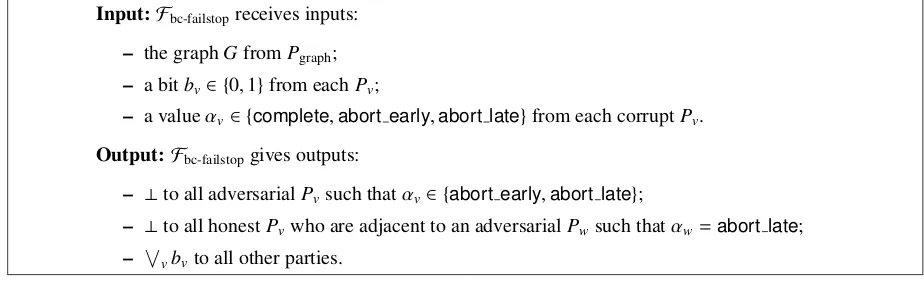
In this section we show how to modify the broadcast protocol from section 4 which is secure against a semi-honest adversary who doesn’t corrupt any k−neighborhood into one which is secure against a fail stop adversary, who doesn’t corrupt ak−neighborhood and whose aborts don’t disconnect the graph. For simplicity in describing the protocol we take k to be 1, and point out what would have to be changed to accomodate k = O(logn). Our protocol, Πfstop-bcast, is shown in Figure 11, it makes use of another local functionalityLmajshown in Figure 12.Πfstop-bcast realizes the fail-stop broadcast functionality shown in Figure 10
The main idea of our protocol is to run the semihonest protocol many times, ensuring that the majority of the executions contain no aborts. The correctness of the semi-honest protocol guarantees that these exe-cutions with no aborts result in correct output. However, to prevent parties from learning which exeexe-cutions contain an abort, we change our protocol so that the outputs of the individual executions are given to the parties in encrypted form, and only after all of them have been completed, N[v] runs a local MPC realizing Lmaj to compute the majority of the outputs it has received. This ensures that all parties will receive the correct output.
We comment that an adversary who aborts during the final majority MPC will stop each local neighbor-hood he is a part of from being able to reconstruct the output. However, sinceAknows which parties he is connected to, forcing them to output⊥does not tell him anything about the graph. If a corrupt party aborts during the main part of the protocol then he ruins the local MPCs running in all closed neighborhoods to which he belongs, but does not affect anything else. Neighbors of the aborting party will get an output of⊥ for the current run of the semi-honest protocol, but now that this corrupt party has aborted he cannot ruin any other repititions. The majority at the end will ensure that this abort does not upset the output ofΠfstop-bcast.
Finally, we comment that if the local MPC run at the end to compute the majority is executed by the parties in N[v], then the resulting protocol will only be secure ifAdoes not corrupt any closed neighborhood inG. However, we can compile a protocol which is secure against a semi-honestAwho does not corrupt all parties in ak−neighborhood ofGinto one that is secure against a fail-stopAsimply by having the last MPC be computed by all the parties in thek−neighborhood ofv. This involves implementing a message passing protocol between all parties in thek−neighborhood ofvwhich may be done similarly toΠmsg-transmit.
Input:Fbc-failstopreceives inputs: – the graphGfromPgraph; – a bitbv∈ {0,1}from eachPv;
– a valueαv∈ {complete,abort early,abort late}from each corruptPv. Output:Fbc-failstopgives outputs:
– ⊥to all adversarialPvsuch thatαv∈ {abort early,abort late};
– ⊥to all honestPvwho are adjacent to an adversarialPwsuch thatαw=abort late;
– W
vbvto all other parties.
Input:Pgraphinputs the graphG, eachPvinputs a bitbv∈ {0,1}. KeyGen: Parties callLKeyGenand eachPvreceives N[v], pkv,skvv
fromL
KeyGen(v) and skwv from
LKeyGen(w) for allw∈N[v]. If a party aborts during this phase then start again, ignoring that party
for the remainder of the protocol.
Main ComputationFor j=1, . . . ,2m−1 do:
– EachPvsets ˆx0v,w=Encpkv(bv) for eachw∈N[v]. – Fori=1, . . . ,r, parties callLbc-helper:
∗ Pvgives input
n
“cipher”; pkv,{skwv}w; {xˆiv−,w1}w
o ;
∗ Pvreceives output{xˆvi,w}w.
– Pvpicksw∈N[v] randomly and sets ˆyvj=xˆrv,w.
– If a party aborts during this computation all of his neighbors set ˆyvj =Encpkv(⊥) and ignore
the aborting party for the remainder of the protocol.
Output:
– Parties callLmaj:
∗ Pvgives input
n
pkv,{skwv}w; {yˆj
v}j
o ;
∗ Pvreceives outputb∗v – EachPvoutputsb∗v.
Figure 11: The protocolΠfstop-bcast(in theLMPC−hybrid model).
Graph Entry Phase:same as inLMPC
Main Phase:
Input:Lmajreceives inputs: – pkv,{skwv}w∈N[v]−the dataP
vreceives fromLmaj – {yˆ1v, . . . ,yˆ2mj −1} −encryptions ˆy
j
v=Encpkv(bvj) of valuesbvj∈ {0,1} ∪ {⊥}
from eachPv. Computation:
– Lmajreconstructs the secret key skv=
L
w∈N[v]sk v
wfor eachv∈V. – For eachv∈V,Lmajdecrypts the bitsbvj=Decskv(ˆy
j
v) for j=1, . . . ,2m−1. – Lmajcomputesbv=MAJj(bvj), where MAJ is the majority function. Output:LmajgivesPvthe outputbv.
6
Discussion and Open Questions
Malicious Model. The most basic question we leave open in this work is the situation in the malicious model. Clearly, our impossibility results for the fail-stop model also apply here. Our positive results do not carry over, however. This is because a malicious adversary can “pretend” to be connected to an entire graph; in this fake graph, the adversary can corruptanysize neighborhood, violating our security assumptions.
General Graphs in the Semi-Honest Model. A second natural question that arises from this work is whether the restriction to graphs of logarithmic diameter is a necessary one, even in the semi-honest model. Does there exist a protocol for topology-hiding secure computation in arbitrary graphs?
Hiding the Identities of Neighbors. Another open problem we leave is whether topology-hiding security can be realized while hiding fromPvthe identities of his neighbors. This would involve changing theFgraph functionality to give as output a local identity for each of the parties inPv’s neighborhood, and this identity
would differ in other closed neighborhoods. One interesting application would be that adversaries in the same local neighborhood would not learn that they are distance 2 from each other. Even our semi-honest protocol revealed this information as parties at distance 2 had to communicate in local MPCs.
References
[1] http://www.its.dot.gov/research/v2v.htm.
[2] http://www.nytimes.com/2010/05/12/nyregion/12about.html.
[3] D. Beaver, S. Micali, and P. Rogaway. The round complexity of secure protocols (extended abstract). InSTOC, pages 503–513. ACM, 1990.
[4] M. Ben-Or, S. Goldwasser, and A. Wigderson. Completeness theorems for non-cryptographic fault-tolerant distributed computation (extended abstract). InSTOC, pages 1–10. ACM, 1988.
[5] E. Boyle, S. Goldwasser, and S. Tessaro. Communication locality in secure multiparty computation -how to run sublinear algorithms in a distributed setting. InTCC, pages 356–376, 2013.
[6] R. Canetti. Universally composable security: A new paradigm for cryptographic protocols. Cryptology ePrint Archive, Report 2000/067, 2000.http://eprint.iacr.org/2000/067.
[7] R. Canetti. Universally composable security: A new paradigm for cryptographic protocols. InFOCS, pages 136–145. IEEE Computer Society, 2001.
[8] R. Canetti, Y. Lindell, R. Ostrovsky, and A. Sahai. Universally composable two-party and multi-party secure computation. Cryptology ePrint Archive, Report 2002/140, 2002. http://eprint.iacr. org/2002/140.
[9] N. Chandran, J. A. Garay, and R. Ostrovsky. Edge fault tolerance on sparse networks. In A. Czumaj, K. Mehlhorn, A. M. Pitts, and R. Wattenhofer, editors,ICALP (2), volume 7392 ofLecture Notes in Computer Science, pages 452–463. Springer, 2012.
[11] I. Damgård, Y. Ishai, and M. Krøigaard. Perfectly secure multiparty computation and the computational overhead of cryptography. In H. Gilbert, editor, EUROCRYPT, volume 6110 of Lecture Notes in Computer Science, pages 445–465. Springer, 2010.
[12] I. Damgård and J. B. Nielsen. Scalable and unconditionally secure multiparty computation. In A. Menezes, editor, CRYPTO, volume 4622 ofLecture Notes in Computer Science, pages 572–590. Springer, 2007.
[13] D. Dolev. The byzantine generals strike again.J. Algorithms, 3(1):14–30, 1982.
[14] C. Dwork, D. Peleg, N. Pippenger, and E. Upfal. Fault tolerance in networks of bounded degree.SIAM J. Comput., 17(5):975–988, 1988.
[15] M. K. Franklin and M. Yung. Communication complexity of secure computation (extended abstract). InSTOC, pages 699–710. ACM, 1992.
[16] J. Garay and R. Ostrovsky. Almost-everywhere secure computation. In N. P. Smart, editor, EURO-CRYPT, volume 4965 ofLecture Notes in Computer Science, pages 307–323. Springer, 2008.
[17] O. Goldreich. Foundations of Cryptography: Basic Applications, volume 2. Cambridge University Press, New York, NY, USA, 2004.
[18] O. Goldreich, S. Micali, and A. Wigderson. How to play any mental game or a completeness theorem for protocols with honest majority. InSTOC, pages 218–229. ACM, 1987.
[19] M. Hinkelmann and A. Jakoby. Communications in unknown networks: Preserving the secret of topology. Theor. Comput. Sci., 384(2-3):184–200, 2007.
[20] R. Pass. Bounded-concurrent secure multi-party computation with a dishonest majority. In L. Babai, editor,STOC, pages 232–241. ACM, 2004.
[21] R. Pass. Bounded-Concurrent Secure Multi-Party Computation with a Dishonest Majority. In Pro-ceedings of the 36th Annual ACM Symposium on Theory of Computing, STOC ’04, pages 232–241, 2004.
[22] R. Pass and A. Rosen. Bounded-concurrent secure two-party computation in a constant number of rounds. InFOCS, pages 404–413. IEEE Computer Society, 2003.
[23] T. Rabin and M. Ben-Or. Verifiable secret sharing and multiparty protocols with honest majority (extended abstract). InSTOC, pages 73–85. ACM, 1989.
[24] M. G. Reed, P. F. Syverson, and D. M. Goldschlag. Anonymous connections and onion routing. IEEE Journal on Selected Areas in Communications, 16(4):482–494, 1998.
[25] M. K. Reiter and A. D. Rubin. Anonymous web transactions with crowds. Commun. ACM, 42(2):32– 38, 1999.