Client-Server Concurrent Zero Knowledge with Constant Rounds
and Guaranteed Complexity
∗Ran Canetti† Abhishek Jain‡ Omer Paneth§
Abstract
The traditional setting for concurrent zero knowledge considers a server that proves a statement in zero-knowledge to multiple clients in multiple concurrent sessions, where the server’s actions in a session areindependentof all other sessions. Persiano and Visconti [ICALP 05] show how keeping a limited amount of global state across sessions allows the server to significantly reduce the overall complexity while retaining the ability to interact concurrently with an unbounded number of clients. Specifically, they show a protocol that has only slightly super-constant number of rounds; however the communication complexity in each session of their protocol depends on the number of other sessions and has no a-priori bound. This has the drawback that the client has no way to know in advance the amount of resources required for completing a session of the protocol up to the moment where the session is completed.
We show a protocol that does not have this drawback. Specifically, in our protocol the client obtains a bound on the communication complexity of each session at the start of the session. Additionally the protocol isconstant-rounds. Our protocol is fully concurrent, and assumes only collision-resistant hash functions. The proof requires considerably different techniques than those of Persiano and Visconti. Our main technical tool is an adaptation of the “committed-simulator” technique of Deng et. al [FOCS 09].
1
Introduction
Concurrent security of a protocol means that security is preserved even when many copies of the protocol may be executed concurrently with each other and with other, potentially unknown protocols. Concurrent security is essential for protocols designed for modern networks, such as the Internet. However, it often imposes a cost on the complexity of the protocol. For example, stand-alone zero-knowledge protocols can be implemented in a constant number of rounds based on any one way function, while constant-round concurrent zero-knowledge protocols are not known without relying on non-standard assumptions or trusted setup.
Concurrent Zero Knowledge. Theconcurrent zero knowledgetask [DNS98] considers a natural and spe-cial case of concurrent security. Here there is a server that wants to prove theorems in zero-knowledge [GMR89] to multiple clients (verifiers). For that purpose, the server runs an instance (i.e., asession) of a protocol with each client. There may be an unbounded (albeit polynomial) number of sessions, and sessions may execute concurrently with adversarially controlled delay and ordering of messages. Furthermore, the prover side of each session should execute without knowledge of any other session. This simplifies the
∗
This paper is supported by the NSF EAGER grant, and NSF Algorithmic Foundations grant no. 1218461.
†
Boston University and Tel-Aviv [email protected] ‡
Boston University and MIT,[email protected] §
design for the server and allows the prover side to be executed on separate machines without coordina-tion. Still, for security we only consider two cases: one where all or some provers are corrupted, and one where all or some of the verifiers are corrupted. While the concurrent zero-knowledge setting is a substan-tial restriction of general composition it distills an important aspect of the general challenge of concurrent security. Indeed, this setting was extensively studied, with special attention to minimizing the number of rounds [RK99, KP01, PRS02, CKPR02, GS12, CLP13b, PPS13]. Furthermore, techniques developed for concurrent zero knowledge have been found useful in the study of more general concurrent systems (see e.g., [CLOS02]).
The state of the art for protocols based on standard assumptions is Ω(logn) rounds, where n is the security parameter. Furthermore, for protocols with black-box simulation we know thatΩ(log˜ n)is the best possible.
Correlated Provers.Persiano and Visconti [PV05] consider a relaxed variant of the classic concurrent zero knowledge model, where the server is allowed to somewhat correlate its strategies in the different sessions. Here one has to make sure that the correlation is on the one hand effectively implementable by the server, and on the other hand preserves the overall efficiency and performance from the point of view of the client. Specifically, they present a zero-knowledge protocol where the server keeps track of thenumberof currently open sessions at any time. It then starts off each session to have a constant number of messages whose length depends polynomially on the number of currently open sessions. If the number of sessions increases beyond some threshold before the session is over, the session has to be “re-done” with longer messages. Overall, it is guaranteed that ifncsessions are executed concurrently to a session, then the protocols of [PV05] requires
O(c)rounds andnO(c)communication for that session.
The global state to be kept by the server in this protocol is indeed minimal and reasonable. Additionally, the number of rounds in every session grows very slowly with the number of sessions, significantly improv-ing the best known “pure” concurrent zero-knowledge protocols (as long as the total number of sessions is polynomial). However, this protocol has the strong disadvantage that a client has no way of knowing, at any point during the protocol execution, how much communication it will need in order to complete the session.
This work. We present a new concurrent zero-knowledge protocol where, like the [PV05] protocol, the server keeps track of the number of sessions currently open. Our protocol improves upon the protocol of [PV05] in two ways:
• Constant rounds.Our protocol takes six messages, regardless of the number of concurrent sessions.
• Guaranteed complexity. In our protocol, the server announces in the beginning of every session the communication complexity of the session. The server cannot dynamically increase the communica-tion complexity of a session to accommodate new clients that arrive during the session’s execucommunica-tion.
The importance of guaranteed complexity. The advantage of having guaranteed complexity is best ex-plained by an analogy: Consider a customer that is placing a call to a call center and is being put on hold. The customer’s waiting is likely to become more endurable and efficient if the call center commits to (or estimates) the required waiting time at the beginning of the call. In our setting, the client’s resource is communication rather than waiting time. Clearly, clients benefit from knowing ahead of time how much communication is required from them to participate in the protocol. For example, a client with limited com-munication resources would prefer to learn ahead of time that its resources are insufficient to complete the protocol, rather than during the session after all its resources have already been spent.
that depends on the communication complexity of the protocol. Very roughly, Persiano and Visconti show that it is possible to add rounds to the protocol and increase its communication “on-the-fly” as new occurrent sessions start. However, as a result, the round complexity of their protocol must depend on the number of sessions, and the server cannot guarantee the complexity of any session ahead of time.
It may seem that bounded concurrency is of no use for designing protocols with guaranteed complexity. Indeed, when the server commits the communication complexity of, say, the first session, it has no bound on the number of sessions that will be started concurrently to the first session.
Our protocol. Counter to the above intuition, our protocol does leverage bounded concurrency techniques of Barak. However, our approach departs from [PV05] in the following manner: we set the communication complexity of every session only based on the order in which the sessions start. The firstn sessions to start execute a bounded concurrent protocol that is secure fornconcurrent session. The followingn2−n
sessions execute a bounded concurrent protocol that is secure forn2 session, and so on. Importantly, the communication complexity of a session is not affected by sessions that startafterit. This in particular means that the [Bar01, PV05] simulation technique is inadequate in our setting. Indeed, our security proof differs significantly from that in [Bar01, PV05].
1.1 Our Techniques
We start by recalling Barak’s zero-knowledge protocol and its simulation. Barak’s protocol starts with a preamble phase where the prover sends a commitmentcand the verifier responds with a random challenge
r. Any prover that can commit to a program that predictsrcan obtain a “trapdoor” and cheat in the proof phase. The zero-knowledge simulator will be able to obtain a trapdoor by committing to the code of the verifier itself. Next we discuss two approaches for extending Barak’s protocol to the concurrent setting.
Bounded concurrency. In the concurrent setting, the simulator cannot simply commit to the code of the verifier. Indeed, the verifier’s code eventually predictsr, but might only do so after receiving convincing proofs in other sessions. Furthermore, when the simulator sends the commitmentcin some session, it did not yet compute the proofs in upcoming sessions (in fact, these proofs might depend on c); therefore it cannot commit to such proof together with the verifier’s code.
The approach in [Bar01] is to change the protocol as follows: to obtain a trapdoor, the simulator must commit to a program that predictsrgiven some auxiliary informationz(that may be chosen afterris sent). To maintain soundness,zmust be much shorter thenr. The simulator can now encode the simulated proofs in a bounded number of other sessions intoz. This results in a bounded concurrent protocol. As argued above, this technique, on its own, is inadequate for our setting.
Committed simulator. A different approach, that we will refer to as the “committed simulator” approach, is as follows: even if the number of concurrent sessions is unbounded, the simulated proofs in all these sessions still have a short description, which is the code of the simulator itself. Concretely, in every session, the simulator will commit to a version of itself that simulates the interaction with the verifier in all other sessions until the verifier sends the challengerin that session.
Our approach. Our simulation combines these two approaches to obtain a protocol with constant rounds and guaranteed complexity, assuming only collision resistant hashing. In a nutshell, we leverage the bounded concurrent simulation technique to “flatten” the recursion tree, avoiding the blowup in the simulator’s run-ning time. A more detailed description follows.
We start by assigning alevelto each session. All sessions that execute a bounded concurrent protocol for
nisessions, are assigned leveli. Our protocol is defined such that for everyi, the total number of sessions at all levels≤iis at mostni. It follows that in every session at leveli, the verifier’s challenge is long enough to account for all the messages received by the verifier in sessions at levels at mosti.
To deal with the messages sent in sessions at levels larger than i, we turn to the committed simulator approach. The main idea is that we can avoid the exponential blowup in the running time of the simulator by committing only to specificpartsof the simulator that are in charge of simulating the sessions at levels larger thanirather than the entire code of the simulator.
The simulator. The simulatorSimis divided into multiple components{Simi}where thei’th component
Simi is in charge of simulating sessions at leveli. To simulate a session at leveli,Simi will commit to a programΠi that contains the verifier’s code together with the code of all the simulator’s componentsSimj forj > i. We can think of the programΠias a new verifier that simulates all sessions at levels> iinternally and forwards externally the messages in sessions at level≤ i. Since sessions at leveliexecute a bounded concurrent protocol fornisessions, and the total number of sessions at levels< iis at mostni, we have that
Simican encode all the messages sent toΠi as auxiliary input.
Finally, we argue that the running time of the simulator is polynomial. Using the analysis of the bounded concurrent protocol, we have that the running time of the componentSimiis polynomial in the running time of the programΠi. SinceΠisimply emulates all the simulator componentsSimj forj > i, we have that the running time ofSimiis only polynomially larger than the total running time of all the componentsSimj for
j > i. Since the total number of concurrent sessions started by an efficient adversary is bounded by some polynomialnc, we get that the total number of levels is constant and therefore the running time of all the simulator’s components is bounded by a polynomial.
Avoiding circular use of randomness. We note that by using the above leveled simulation strategy we do not only avoid the blowup in the simulator’s running time, but also avoid some of the technical complications that arise when the simulator commits to its own code. For example, in [CLP13a, Goy13, CLP13b], the simulator needs to commit to its own code together with the randomness that it will use to simulate the rest of the protocol. The aforementioned works develop additional techniques to deal with this problem. In our setting, since every component only commits to the randomness used by thehigherlevel component, such circular use of randomness is avoided, resulting in simpler protocol and analysis.
1.2 Related Work
Concurrent zero-knowledge in the Plain Model. Improving the round-complexity of concurrent zero-knowledge proofs in the plain model has been an active area of research. The round complexity of concur-rent zero-knowledge with black-box simulation was studied in [RK99, KP01, PRS02], resulting in proto-cols with logarithmic round-complexity (which is essentially optimal [CKPR02]). Constant-round protoproto-cols with non-black-box simulation where constructed based on different non-standard assumption such as in-teractive knowledge assumptions [GS12], statistically sound P-certificates [CLP13b] and differing input (or extractable) obfuscation [PPS13].
Optimistic concurrent zero-knowledge. The work of Rosen and Shelat [RS10] also studies the round complexity of concurrent zero-knowledge proofs with a correlated prover in the client-server setting. Their focus is on improving the round complexity of concurrent zero-knowledge with respect to “optimistic” adversarial schedules. That is, the round complexity of their protocol significantly decreases when the scheduling of messages does not include too many nested sessions. However, for a worst-case adversarial schedules, [RS10] give no improvement over logarithmic round-complexity of [PRS02] while our protocol has constant rounds in the worst cast. However, unlike in our protocol, the communication complexity in [RS10] has a fixed upper bound that is independent of the adversary.
2
The Guaranteed Complexity Model
In this section we formally define a protocol in the guaranteed complexity model. We start by describing the general syntax and the model of communication. We then consider the specific case of zero-knowledge proof systems in the guaranteed complexity model and present a security definition for the same.
Let Server be interactive PPT machine that interacts with multiple clients in concurrent sessions and let {hS`,C`i}`∈
N be a family of protocols parameterized by a load parameter `where for every ` ∈ N,
S` andC` are PPT machines. A protocol in the guaranteed complexity model is defined by the tupleΠ = (Server,{hS`,C`i}).
(Honest) Protocol Execution. The execution of a protocol Π = (Server, {hS`,C`i}) consists of a single server executing the algorithmServerwhile interacting with multiple clients concurrently. To initiate a new session a client sends a specialsession initiation messageto the server. In response to the session initiation message, the server chooses a load parameter`for the session and sends it to the client. In the rest of the session we require that the algorithmServerfollows the strategyS`while the client follows the strategyC`. An execution of the protocolΠwithp(n)sessions is defined by the randomness of all the clients and the schedule of messages across all the sessions. Even though for every fixed load parameter`, the strategies S`,C` are efficient, the server algorithm may choose`to be very large, increasing the running time of the concurrent execution. Therefore we explicitly require the efficiency of a concurrent execution.
Definition 2.1. A protocol(Server,{hS`,C`i})in the guaranteed complexity model is efficient if for every polynomialpthere exists another polynomialqsuch that the running time ofServerin every execution with
p(n)sessions is bounded byq(n).
Zero Knowledge in the Guaranteed Complexity Model. LetΠ = (Server,{hS`,C`i})be a protocol in the guaranteed complexity model and letLbe an NP language with witness relationRL. We say thatΠis
LetΠbe an interactive proof for languageLin the guaranteed complexity model. Letnbe the security parameter. Consider a concurrent adversaryV∗that startm(n)concurrent session with the server for some polynomialm. Let~x ∈ Lm be the vector of instances used in the different session and letw~ be a vector of the corresponding witnesses used by the server. We allowV∗ to control the scheduling of the messages across all the sessions. LetViewV∗(~x, ~w, ~z)be the random variable describing the output ofV∗in the above experiment when executed with auxiliary inputz.
Definition 2.2(Concurrent Zero-Knowledge in the Guaranteed Complexity Model). LetΠ = (Server,{hS`,C`i})
be an interactive proof system for languageLin the guaranteed complexity model. We say thatΠiszero knowledgeif for every polynomialm, and for every PPT concurrent adversaryV∗startingm(n)sessions there exists a PPT algorithmS, such that for every instances vector~x ∈ Lm(n), every witnesses vectorw~
such that(xi, wi) ∈ RLfor all i ∈ [m(n)], and for every auxiliary inputz ∈ {0,1}poly(n) the following
ensembles are computationally indistinguishable,
{ViewV∗(~x, ~w, z)}
n∈N≈c{S(x, z)}n∈N.
3
Constant-Round Zero-Knowledge in the Guaranteed Complexity Model
In this section we describe a constant-round ZK protocol Πzk = (Server,{hP`, V`i}) in the guaranteed complexity model. We start by defining a family of protocols{hP`, V`i}`∈Nwhere, roughly speaking, the
protocolhP`, V`iis simply Barak’s bounded-concurrent ZK protocol [Bar01] withn` as the a priori bound on the number of sessions. We then define the server algorithmServerto complete the description ofΠzk.
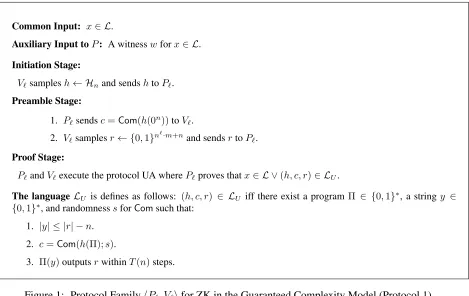
The protocol hP`, V`i. The protocol will make use of the following primitives: a statistically binding commitmentCom, a familyH = {Hn}n∈
Nof collision-resistant hash functions such thath ∈ Hnmaps
strings in {0,1}∗ to strings in {0,1}n, and a witness-indistinguishable universal argument UA for an
NTIME(T(n))-complete language whereT : N → N is a “slightly” super-polynomial function, for ex-ampleT(n) =nlog logn[BG08]. In the description of the protocol, the length of the verifier’s messages will depend on a parametermthat denotes the total length of theprover’smessages in the protocol.
Remark3.1. The relationLU presented in Protocol 1 is slightly oversimplified. For this relation, we can prove the security of Protocol 1 when H is collision-resistant against “slightly” super-polynomial sized circuits. For simplicity of exposition, in this manuscript, we will work with this assumption. We stress, however, that as discussed in several prior works (see e.g., [BG08]), this assumption can be removed by using an appropriate error-correcting code.
The server algorithmServer.We start by describing a simple server algorithm that only assigns monoton-ically increasing values of the load parameter to new sessions. In Section 3.2, we describe a better server algorithm that decreases the load parameter when some of the concurrent sessions terminate.
The algorithmServermaintains a variableSessionCountthat counts the number of concurrent sessions started so far. Whenever a client initiates a new session,Serverincreases the value ofSessionCount. When a new clients sends a session initiation message to the server,Serversets the load parameter`for that session such thatn`−1≤SessionCount≤n`.
In the next section we prove the following theorem:
Theorem 3.1. Assuming h is a hash function ensemble that is collision-resistent against circuits of size
nlogn, Comis a statistically binding commitment, and UA is a witness-indistinguishable universal argu-ment forNTIME(nlog logn), the protocolΠzk = (Server,{hP`, V`i}) is concurrent zero-knowledge in the
Common Input: x∈ L.
Auxiliary Input toP: A witnesswforx∈ L.
Initiation Stage:
V`samplesh← Hnand sendshtoP`.
Preamble Stage:
1. P`sendsc=Com(h(0n))toV`.
2. V`samplesr← {0,1}n
`·m+n
and sendsrtoP`.
Proof Stage:
P`andV`execute the protocol UA whereP`proves thatx∈ L ∨(h, c, r)∈ LU.
The languageLU is defines as follows: (h, c, r) ∈ LU iff there exist a programΠ ∈ {0,1}∗, a stringy ∈ {0,1}∗, and randomnesssforComsuch that:
1. |y| ≤ |r| −n.
2. c=Com(h(Π);s).
3. Π(y)outputsrwithinT(n)steps.
Figure 1: Protocol FamilyhP`, V`ifor ZK in the Guaranteed Complexity Model (Protocol 1)
3.1 Proof of Theorem 3.1
The proof that for every ` ∈ N, the protocol hP`, V`i is complete and sound, follows directly from the analysis of the bounded-concurrent ZK protocol in [Bar01]. In this section we first show that for every
` ∈ N, Protocol 1 is efficient according to Definition 2.1. We then show that Πzkis ZK in the guaranteed complexity model.
Protocol 1 is efficient. Let p be a polynomial and let `max be such that for large enough values of n,
p(n) < n`max. By the definition of the server algorithmServer, in an execution withp(n)sessions, the load
parameter of every session is at most`max. Since the running time ofP`only grows with`, we have that the running time ofServerin every session is at most the running time ofP`maxand therefore the total running
time ofServeris bounded by a polynomial that depends only onp.
ProtocolΠzkis ZK in the guaranteed complexity model.LetV∗be a malicious verifier that starts at most
n`max sessions for some constant`
max. By the definition of the server algorithmServer, the load parameter of every session in an honest execution is at most`max. We construct a simulatorSim= (Simload,{Sim`}) consisting ofSimloadand`maxother components{Sim`}`∈[`max]. Roughly speaking, the componentSimload
simulates the servers responses to the clients session initiation message in all sessions. The componentSim` simulates all the executions ofhP`, V`iin sessions with load parameter`. We now give more details.
The componentSimload. This component simulates the server’s responses to the clients session initiation message in all sessions. This simulation involves assigning a load parameter for every session started by
of these messages.
The componentSim`.This component simulates the interaction ofhP`, V`iin all the sessions with load pa-rameter`. At a high-level, the simulation will follow the simulation strategy of Barak’s bounded-concurrent ZK protocol [Bar01]. According to this strategy, the simulator sends a commitmentc to the code of the verifier and then uses this code as a trapdoor witness, proving thatcis commitment to a codeΠthat outputs the random stringrsent by the verifier. All the messages simulated in concurrent sessions are given toΠas auxiliary input. The main problem is that in order to guarantee that the protocol is sound, the programΠis only allowed to get an auxiliary input of bounded length; however, the number of concurrent sessions in our setting are not bounded.
We fix this problem in the following manner. Instead of simply committing to the code of V∗, Sim` will commit to a programV`∗that includes the code ofV∗as well as the code of the simulation components
SimloadandSim`+1, . . . ,Sim`max. Roughly speaking, the programV
∗
` will simulate all the sessions with load parameter`0 > `internally, and thereforeSim`will need to provide as auxiliary input only the messages of concurrent sessions where the load parameter is at most`. It follows from the description ofServerthat the number of concurrent sessions where the load parameter is at most`is bounded by some polynomial (that depends on`). Therefore, it is possible to include all of these messages as an auxiliary input toV`∗.
Next we formally describe the simulator component Sim`, starting with the definition of the program
V`∗.
The program V`∗. V`∗ is an interactive algorithm that includes the code of V∗ together with the code of the simulation componentsSimload andSim`+1, . . ., Sim`max. V
∗
` uses the same randomness asSimto executeV∗and all the other simulation components.V`∗will emulate the execution ofV∗, and will use the mentioned simulator components to internally simulate the responses to the session initiation messages in all sessions as well the prover messages of the protocolshP`0, V`0iexecuted in the sessions with load parameter
`0 > `. In the sessions with load parameter`0 ≤`,V`∗will forward the messages of the protocolhP`0, V`0i externally.
In every session with load parameter`,Sim`will simulate the execution ofhP`, V`ias follows:
1. Sim`receives the description of a hash functionhfromV∗.
2. Sim` sends a commitmentc to the hash of the code of a programΠ that given auxiliary inputy =
(m1, . . . , mt), emulates an execution of V`∗ when receiving the messages m1, . . . , mt, and outputs
V`∗’s next message.
3. Sim`receives the the random stringrfromV∗.
4. Sim` sends a UA proof using a trapdoor witness that contains the code of the program Π and an appropriate auxiliary input stringy. The stringyis a list of all the prover messages that were simulated bySimin all sessions with load parameter at most`and sent before V∗ sent the random stringrin the present session.
This completes the description of the simulator. Next, we turn to its analysis.
3.1.1 Analysis ofSim
is at mostT(n). We will show that the last statement is correct when we analyze the running time of the simulation. Finally, we will prove the indistinguishability of the adversary’s view in the real and ideal world.
Proof thatΠ(y)outputsr. The programΠ(y)outputs the next message ofV`∗given the external messages iny. V`∗ emulatesV∗ using the same randomness asSim. It is left to show that the messages sent to V∗
emulated byV`∗and bySimare identical. Recall that the messages sent toV∗in the execution emulated by
V`∗ are as follows: in sessions with load parameter larger than`, the messages are generated by the internal simulation ofV`∗, and the messages sent in sessions with load parameter at most`are specified iny. For sessions with load parameter larger than `, the messages sent to V∗ in the emulation of V`∗ and of Sim
are identical since they are generated using the same simulation algorithm and using the same randomness (by the construction ofV`∗). For sessions with load parameter at most`, the messages sent to V∗ in the emulation ofV`∗ and ofSimare identical by the way the auxiliary input stringyis constructed.
Proof that|y| ≤ |r| −n. The auxiliary input stringy constructed bySim`contains only prover messages in sessions with load parameter at most`. By the definition of the server algorithmServer there could be at mostn` such sessions, and the total length of all the prover messages in every session is bounded by the parameterm. Therefore we have|y| ≤n`·m. SinceV`samplesr∈ {0,1}n
`·m+n
we have that|y| ≤ |r|−n.
Proof that the simulation is polynomial time. It is enough to show that all components ofSimare poly-nomial time. SinceSimloadjust follows the honest server algorithm, the efficiency ofSimloadfollows from the efficiency of the protocol. For every`∈[`max]we show that the running time ofSim` is bounded by a polynomial in the security parameter (that depends on`and onV∗). SinceSim`constructs the programV`∗, commits to its code, and provides a UA proof of its execution, the running time ofSim`is polynomial in the size and running time ofV`∗. Additionally, sinceSim`reads the entire transcript of the execution and uses it to construct the auxiliary inputyin every session it simulates, the running time ofSim`is polynomial in the total length of the transcript. Note that the total length of the transcript is always bounded by the running time ofV∗which is polynomial in the security parameter.
We start by bounding the running time ofSim`max. The programV
∗
`max only consists of the code ofV
∗
and the code ofSimloadand therefore, the running time ofV`∗maxis a polynomial. It follows that the running time ofSim`maxis also a polynomial. Now, for every`∈[`max], the programV
∗
` only consists of the code of
V∗, the code ofSimload, and the code ofSim`0 for every`≤`0 < `max. Since`maxis a constant depending only onV∗, and assuming that for all` ≤ `0 < `max the running time of everySim`0 is polynomial, the running time ofV`∗ and therefore also of Sim` must be polynomial. By induction we have that for every
` ∈ [`max]the running time of Sim` is bounded by a polynomial, and therefore the entire simulation is polynomial time.
Using the above proof, we complete the proof that Sim` constructs a valid trapdoor witness. Sim` constructs a programΠand auxiliary inputy, and we need to show that the running time ofΠ(y)is bounded by some super-polynomial functionT(n). The running time analysis above implies that for every`∈[`max], the running time of V`∗ and the size of the auxiliary input y constructed by Sim` are polynomial. The simulator componentSim`constructs a programΠthat simulatesV`∗sending it messages fromy. It follows that the running time ofΠ(y)is polynomial and therefore bounded byT(n).
Proof that the simulated view and the real view are indistinguishable. For0 ≤ ` ≤ `max, letHi be the hybrid experiment that is identical to the execution ofSimexcept that every session executing the the protocolhP`0, V`0ifor`0 ≤`follow the honest prover strategy using the valid witnesswj for the statement
messages perfectly we have that:
H`max=ViewV∗(~x, ~w, z), H0=S(~x, z) .
It is therefore sufficient to prove that for every0≤` < `max,H` ≈cH`+1. By the definition of the server algorithmServer, the number of sessions with load parameter`is at mostn`. For0 ≤i≤ n`, letH`,i be the hybrid experiment that is identical toH`except that the firstisessions executing of the protocolhP`, V`i follow the honest prover strategy using a the valid witnesswj for the statementxj ∈ Lin that session. It follows that:
H`,n`=H`+1, H`,0 =H` .
It is therefore sufficient to prove that for every0≤i < n`,H`,i≈cH`,i+1.
LetH`,i0 be the hybrid experiment that is identical to theH`,iexcept that the execution of the witness-indistinguishable universal argument UA in the proof stage of the ith execution of the protocol hP`, V`i uses a valid witness wj for the session’s statementxj ∈ L instead of the trapdoor witness. Note that in an execution ofSim, the randomness of the componentSim` used for the UA prover executed in the proof stage of the protocol hP`, V`i is also used by the components Sim`0 for `0 < `in the construction of the programV`∗0. However, in the experimentH`,i, all the simulator componentsSim`0 for`0 < `are replaced by executions of the honest prover. Since the randomness of the componentSim` used for the simulation of the UA prover in the protocolhP`, V`iis not used in any other part of the simulation, it follows from the indistinguishability property of UA thatH`,i≈cH`,i0 .
Note that the experimentH`,i+1is identical to the experimentH`,i0 except that in the experimentH`,i+1, the prover commitment c given in the preamble stage of the i’th execution of the protocol hP`, V`i is a commitment to the all zero string, following the honest prover strategy. As before, the randomness of the componentSim`used for the simulation ofcsent in the protocolhP`, V`iis not used in any other part of the simulation and therefore it follows from the computational-hiding property ofComthatH`,i+1 ≈cH`,i0 .
Overall we have that for every 0 ≤ ` ≤ `max,0 ≤ i ≤ n`, H`,i ≈c H`,i+1. Since ` ≤ `max is a constant,n`is a polynomial and therefore we have that for every0≤`≤`max,H`+1 ≈c H` and also that
H`max≈cH0 as required.
3.2 Decreasing the Load Parameter
In this section, we describe a different server algorithm that takes into account the termination of sessions and decreases the load parameter for new sessions accordingly. We start by describing the new server algorithmServer0, and then describe the required changes to the simulation.
We identify the technical condition required for the simulation to work, and design a server algorithm
Using the above notation, the algorithmServer0is easy to describe: Server0will set the load parameter of a new session to be the minimal value` such that for every session iwith`i ≥ `we have ti < n`i. While the behavior of the server algorithmServer0is not obvious, we can prove that it satisfies some natural conditions. For example we can show that if no sessions with load parameter`are currently active, then the load parameter assigned to the next session to start cannot exceed`.
Modifying the simulator.Next we discuss the necessary changes to the simulator. In the current description of the simulator, every programV`∗thatSimcommits to, internally emulatesV∗starting from its initial state. As a result, we must giveV`∗auxiliary inputzthat consists of the messages in all concurrent sessions with load parameter at most ` starting from the beginning of the concurrent execution. The problem is that the definition of the server algorithm Server0 does not guarantee that such auxiliary inputz is sufficiently short. Instead it only gives a bound on the number sessions with load parameter at most`that are executed
concurrentlyto the current session. In particular,Server0 does not guarantee anything about the number of sessions that terminated before the current session had started. The solution is based on the observation that providingV`∗auxiliary inputzthat contains messages sent before the current session had started is wasteful. Instead,Simcan commit the a programV˜∗
`that already contains these messages hardwired into it.
References
[Bar01] Boaz Barak. How to go beyond the black-box simulation barrier. In FOCS, pages 106–115, 2001.
[BG08] Boaz Barak and Oded Goldreich. Universal arguments and their applications.SIAM J. Comput., 38(5):1661–1694, 2008.
[CKPR02] Ran Canetti, Joe Kilian, Erez Petrank, and Alon Rosen. Black-box concurrent zero-knowledge requires (almost) logarithmically many rounds. SIAM J. Comput., 32(1):1–47, 2002.
[CLOS02] Ran Canetti, Yehuda Lindell, Rafail Ostrovsky, and Amit Sahai. Universally composable two-party and multi-two-party secure computation. InSTOC, pages 494–503, 2002.
[CLP13a] Ran Canetti, Huijia Lin, and Omer Paneth. Public-coin concurrent zero-knowledge in the global hash model. InTCC, pages 80–99, 2013.
[CLP13b] Kai-Min Chung, Huijia Lin, and Rafael Pass. Constant-round concurrent zero knowledge from p-certificates. InFOCS, 2013.
[DGS09] Yi Deng, Vipul Goyal, and Amit Sahai. Resolving the simultaneous resettability conjecture and a new non-black-box simulation strategy. InFOCS, pages 251–260, 2009.
[DNS98] Cynthia Dwork, Moni Naor, and Amit Sahai. Concurrent zero-knowledge. In STOC, pages 409–418, 1998.
[GJO+13] Vipul Goyal, Abhishek Jain, Rafail Ostrovsky, Silas Richelson, and Ivan Visconti. Concurrent zero knowledge in the bounded player model. InTCC, pages 60–79, 2013.
[Goy13] Vipul Goyal. Non-black-box simulation in the fully concurrent setting. InSTOC, pages 221– 230, 2013.
[GS12] Divya Gupta and Amit Sahai. On constant-round concurrent zero-knowledge from a knowledge assumption. IACR Cryptology ePrint Archive, 2012:572, 2012.
[KP01] Joe Kilian and Erez Petrank. Concurrent and resettable zero-knowledge in poly-loalgorithm rounds. InSTOC, pages 560–569, 2001.
[PPS13] Omkant Pandey, Manoj Prabhakaran, and Amit Sahai. Obfuscation-based non-black-box sim-ulation and four message concurrent zero knowledge for np. IACR Cryptology ePrint Archive, 2013:754, 2013.
[PRS02] Manoj Prabhakaran, Alon Rosen, and Amit Sahai. Concurrent zero knowledge with logarithmic round-complexity. InFOCS, pages 366–375, 2002.
[PRT13] Rafael Pass, Alon Rosen, and Wei-Lung Dustin Tseng. Public-coin parallel zero-knowledge for np. J. Cryptology, 26(1):1–10, 2013.
[PV05] Giuseppe Persiano and Ivan Visconti. Single-prover concurrent zero knowledge in almost con-stant rounds. InICALP, pages 228–240, 2005.
[RK99] Ransom Richardson and Joe Kilian. On the concurrent composition of zero-knowledge proofs. InEUROCRYPT, pages 415–431, 1999.