F
OREST
P
ROTECTED
A
REA
S
YSTEMS
AND
B
IODIVERSITY
C
ONSERVATION IN
B
ANGLADESH
Sharif Ahmed Mukul
1,2,3,*, A. Z. M. Manzoor Rashid
4and Niaz Ahmed Khan
51Tropical Forests and People Research Centre, University of the Sunshine Coast,
Maroochydore, QLD, Australia
2Tropical Forestry Group, School of Agriculture and Food Sciences, The University
of Queensland, Brisbane, QLD, Australia
3School of Geography, Planning and Environmental Management, The University
of Queensland, Brisbane, QLD, Australia
4Department of Forestry and Environmental Science, School of Agriculture and Mineral
Sciences, Shahjalal University of Science and Technology, Sylhet, Bangladesh
5Department of Development Studies, University of Dhaka, Dhaka, Bangladesh
A
BSTRACTDespite of being an exceptionally biodiversity rich country, the forest coverage of Bangladesh is declining at an alarming rate. Declaration and management of protected areas in this regard is one of the efforts from government side to tackle the loss of biodiversity. The limited numbers of forest-protected areas (FPA), established to conserve the dwindling forest biodiversity of the country with high pressure on them for timber, non-timber forest products, and fuelwood - makes their management challenging. Moreover, most of the FPAs of the country declared only in the recent decades with very limited infrastructure, manpower and policy support for monitoring and governance. Some people-centred approaches for the management of FPAs and alternative livelihood and income generation subsidies although made available through a few project interventions, their number are still inadequate and performance remains less than satisfactory. This chapter provides a critical review of the FPAs of Bangladesh looking at their role in biodiversity conservation, management challenges, and key lessons from previous management interventions with recommendations for the future. It has been revealed that the FPA system of Bangladesh still poorly represents the diverse forest ecosystems with relatively small forest size and lack of corridors for the movement of wildlife. There are ample
opportunities to render co-management of FPAs an effective strategy to minimize the conflicts in FPAs management in the country. It is, however, important to ensure the access of local forest-dependent people to different alternative income generating options that may adequately support their livelihoods.
Keywords: biodiversity conservation, livelihood, co-management, stakeholder, law enforcement
I
NTRODUCTIONTropical forests are the home to about 70 percent of the world’s plants and animals and are important for providing critical ecosystem goods and services (Gardner et al. 2009; Laurance 2007). More than 500 million people live in tropical forests and are somehow dependent on it for their livelihood (Byron and Arnold 1999). Despite the significant role of tropical forests in people’s life and environment, deforestation rates are high in the tropical region resulting in a rapid loss of biodiversity and wild habitats (Geist and Lambin 2002). Tropical deforestation is also one of the main sources of greenhouse gas emission (GHG), accounting for almost 20 percent of the total anthropogenic GHG emission and a major contributor to global warming (Baccini et al. 2012; Houghton 2012).
Establishment of protected area (PA) is one of the key global strategies that aimed to reverse tropical forests and biodiversity loss (Geldmann et al. 2013; Laurance et al. 2012; Andam et al. 2008; DeFries et al. 2007). Globally, PA networks are expanding rapidly and they now cover nearly 15% of the earth’s surface (UNEP-WCMC 2016; Geldmann et al. 2015). Ideally, PA systems are designed to restrict or reduce the anthropogenic pressures in areas of high biological diversity (Venter et al. 2014; Watson et al. 2014; Saout et al. 2013). Other than their key role as a refuge of declining level of forests and biodiversity they are also efficient in providing important ecosystem services like climate regulation, groundwater recharge, erosion control, pollination, etc. (Gray et al. 2016; Beaudrot et al. 2016; Sohel et al. 2015; Mukul 2014). In many parts of the tropics, only by establishing PAs, however, does not bring the desired conservation outcome making the PAs system ineffective (Geldmann et al. 2015, 2013; Clark et al. 2013). This is largely due to the exclusion of local people in PA governance and absence of alternative income generation opportunities to people who have traditionally been dependent on forests for sustaining their livelihoods (Mukul et al. 2016, 2014, 2012a). Further to that, land-use change around PAs, agricultural expansion, illegal logging, fuelwood, and fodder collection making many PAs vulnerable particularly in the developing tropics (Mondal and Nagendra 2011; Karanth and DeFries 2010; DeFries et al. 2007; Ervin 2003).
Bangladesh, despite being exceptionally endowed with rich biological resources, has one of the lowest per capita forest lands in the world (Mukul and Quazi 2009). The country has also experienced one of the highest rates of deforestation in south Asia (Poffenberger 2000). High population density, rich biological diversity, limited forest cover and rural people’s dependence on forests are some of the major challenges of biodiversity conservation in Bangladesh (Mukul et al. 2012a).
perspectives. We then discuss the present management of FPAs in the country, threats to FPA’s and their management challenges. We finally provide some recommendations and guidelines for better management of FPA’s in Bangladesh. Our study builds on the experiences and outcomes of the previous study of Mukul et al. (2008) by providing more updated information and analysis. We also reviewed relevant recent literature covering various aspects of FPA’s management in Bangladesh. We believe that our study is important for the diverse stakeholders dealing with forests and protected areas management and biodiversity conservation in the country.
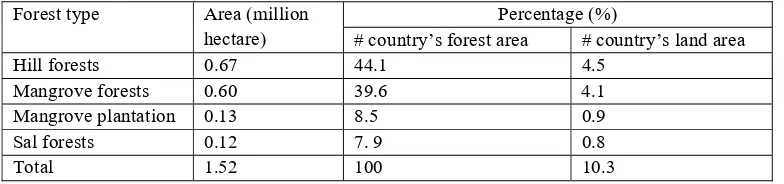
Table 1. Forests areas under the jurisdiction of Bangladesh Forest Department
Forest type Area (million hectare)
Percentage (%)
# country’s forest area # country’s land area Hill forests 0.67 44.1 4.5
Mangrove forests 0.60 39.6 4.1 Mangrove plantation 0.13 8.5 0.9 Sal forests 0.12 7. 9 0.8
Total 1.52 100 10.3
F
ORESTE
COSYSTEMS ANDB
IODIVERSITY OFB
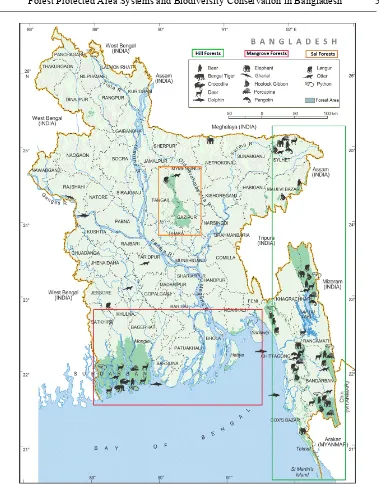
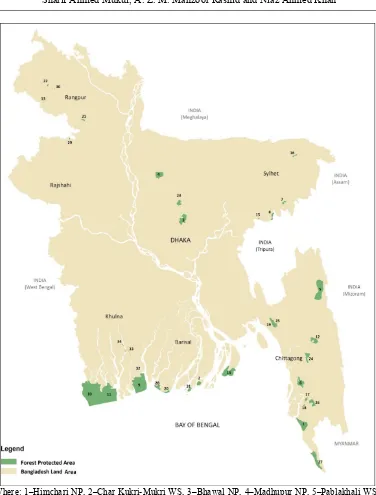
ANGLADESHBangladesh has a total forest area of about 2.6 million hectares, of which 1.52 million hectares are managed by the country’s Forest Department (FD) (Mukul et al. 2014a). Table 1 below shows the major forest types of Bangladesh with their share to country’s forest land managed by the FD and total land area. Hill forests comprise majority of the country’s forests area, followed by mangrove forests and plain land sal (Shorea robusta) forests (Khan et al. 2007). Hill forests are located in the eastern part of the country, evergreen to semi-evergreen in nature and dominated by dipterocarps (Figure 1). The mangrove forests of the Sundarbans and mangrove plantations are located mainly in the southern coastal part of the country. The dominant species here are sundri (Heritiers fomes), gewa (Excoecaria agallocha), goran
(Ceriops decandra) and keora (Sonneratia apetala) (Mukhopadhyay et al. 2015). The majority
of the hill and Sal forests in the country, however, are severely degraded and is without any true vegetation cover (Rahman et al. 2009).
the home of Asian elephant (Elephas maximus) - the largest terrestrial animal in Asia (Alamgir et al. 2015). These forests are also very rich in avifaunal diversity. Several endangered primate species including the western hoolock gibbon (Hoolock hoolock) are also common here. Patchy vegetation and lack of corridors, however, making these forest ecosystems unfavorable for country’s remaining wildlife.
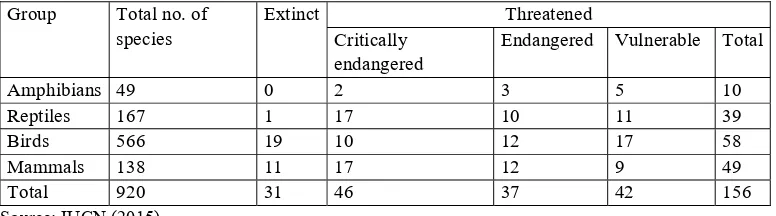
In the country, a large number of wildlife species are currently threatened with extinction (Table 2). Already, 19 species of birds, 11 species of mammals and one reptile species went extinct from the country (IUCN 2015). In addition, Bangladesh National Herbarium identified 106 vascular plant species with risks of various degrees of extinction (Khan et al. 2001).
F
ORESTP
ROTECTEDA
REAS OFB
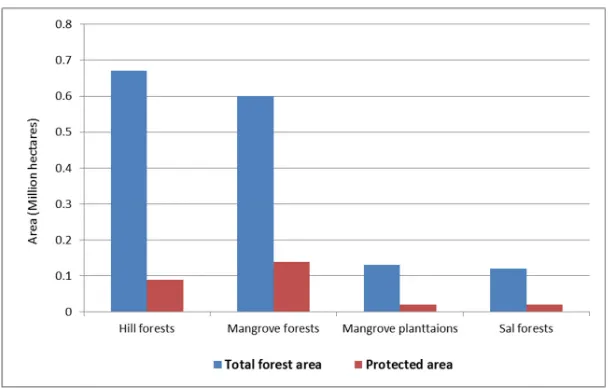
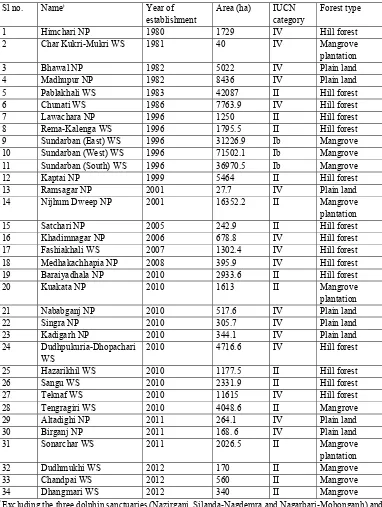
ANGLADESHThe history of forest protected areas in Bangladesh is rather recent, started only in 1980’s (Chowdhury and Koike 2010). Currently, there are 34 FPAs covering nearly 0.27 million hectares of forests land managed by country’s FD (Table 3). This estimate, however, excludes 4 marine and coastal protected areas that were aimed at protecting the marine and/or aquatic biodiversity of the country. The FPAs of the country represents 17.5% of Bangladesh’s forest lands and approximately 1.8% of country’s total land area. These figures are below the global standard of FPA coverage.
Most of the FPAs of Bangladesh established only during the recent decade. Figure 2 and 3 shows the temporal changes in FPA’s in country in terms of their number and coverage. About 55% of the FPAs of the country started their journey only in the present decade. This is largely due to growing focus and consensus on conservation in the country. In terms of coverage, there has been a large increase in FPA between 1996-2000 although it was due to the deceleration of three wildlife sanctuaries in the Sundarbans mangrove forests of Bangladesh. Among the existing forest protected areas, 17 are national parks and 17 are wildlife sanctuaries, representing respectively 17% and 83% of the total area under the FPA’s system in the country.
Table 2. Present status of inland and resident vertebrates in Bangladesh
Group Total no. of species
Extinct Threatened Critically
endangered
Endangered Vulnerable Total
Amphibians 49 0 2 3 5 10
Reptiles 167 1 17 10 11 39
Birds 566 19 10 12 17 58
Mammals 138 11 17 12 9 49
Total 920 31 46 37 42 156
Figure 1. Major forest types of Bangladesh with location specific wildlives.
Figure 2. Temporal changes in the number of forests protected areas of Bangladesh.
Figure 3. Temporal changes in forests protected area coverage of Bangladesh.
Table 3. Details of the forest protected areas in Bangladesh*
Sl no. Nameǂ Year of
establishment
Area (ha) IUCN category
Forest type
1 Himchari NP 1980 1729 IV Hill forest
2 Char Kukri-Mukri WS 1981 40 IV Mangrove
plantation
3 Bhawal NP 1982 5022 IV Plain land
4 Madhupur NP 1982 8436 IV Plain land
5 Pablakhali WS 1983 42087 II Hill forest
6 Chunati WS 1986 7763.9 IV Hill forest
7 Lawachara NP 1996 1250 II Hill forest
8 Rema-Kalenga WS 1996 1795.5 II Hill forest
9 Sundarban (East) WS 1996 31226.9 Ib Mangrove
10 Sundarban (West) WS 1996 71502.1 Ib Mangrove
11 Sundarban (South) WS 1996 36970.5 Ib Mangrove
12 Kaptai NP 1999 5464 II Hill forest
13 Ramsagar NP 2001 27.7 IV Plain land
14 Nijhum Dweep NP 2001 16352.2 II Mangrove
plantation
15 Satchari NP 2005 242.9 II Hill forest
16 Khadimnagar NP 2006 678.8 IV Hill forest
17 Fashiakhali WS 2007 1302.4 IV Hill forest
18 Medhakachhapia NP 2008 395.9 IV Hill forest
19 Baraiyadhala NP 2010 2933.6 II Hill forest
20 Kuakata NP 2010 1613 II Mangrove
plantation
21 Nababganj NP 2010 517.6 IV Plain land
22 Singra NP 2010 305.7 IV Plain land
23 Kadigarh NP 2010 344.1 IV Plain land
24 Dudhpukuria-Dhopachari WS
2010 4716.6 IV Hill forest
25 Hazarikhil WS 2010 1177.5 II Hill forest
26 Sangu WS 2010 2331.9 II Hill forest
27 Teknaf WS 2010 11615 IV Hill forest
28 Tengragiri WS 2010 4048.6 II Mangrove
29 Altadighi NP 2011 264.1 IV Plain land
30 Birganj NP 2011 168. 6 IV Plain land
31 Sonarchar WS 2011 2026.5 II Mangrove
plantation
32 Dudhmukhi WS 2012 170 II Mangrove
33 Chandpai WS 2012 560 II Mangrove
34 Dhangmari WS 2012 340 II Mangrove
* Excluding the three dolphin sanctuaries (Nazirganj, Silanda-Nagdemra and Nagarbari-Mohonganh) and
Where: 1–Himchari NP, 2–Char Kukri-Mukri WS, 3–Bhawal NP, 4–Madhupur NP, 5–Pablakhali WS, 6–Chunati WS, 7–Lawachara NP, 8–Rema-Kalenga WS, 9–Sundarban (East) WS, 10–Sundarban (West) WS, 11–Sundarban (South) WS, 12–Kaptai NP, 13–Ramsagar NP, 14–Nijhum Dweep NP, 15–Satchari NP, 16–Khadimnagar NP, 17–Fashiakhali WS, 18–Medhakachhapia NP, 19– Baraiyadhala NP, 20–Kuakata NP, 21–Nababganj NP, 22–Singra NP, 23–Kadigarh NP, 24– Dudhpukuria-Dhopachari WS, 25–Hazarikhil WS, 26–Sangu WS, 27–Teknaf WS, 28–Tengragiri WS, 29–Altadighi NP, 30–Birganj NP, 31–Sonarchar WS, 32–Dudhmukhi WS, 33–Chandpai WS, 34–Dhangmari WS.
Photo credits: Sharif A. Mukul.
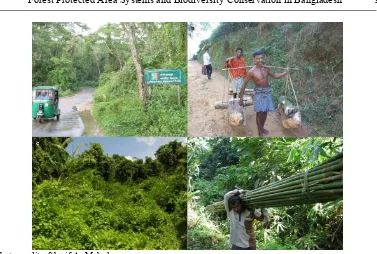
Figure 6. Some threats to forest protected areas of the country: a) road network within the national park, b) illegal logging, c) invasive alien species and d) NTFPs collection from inside the national park.
M
ANAGEMENT OF THEF
ORESTP
ROTECTEDA
REASBangladesh Forest Department is responsible for the management of country’s forest protected areas. Purely ecological focus and exclusion of local forest-dependent people from the management of the FPAs, however, has been one of the major issues in the country (Mukul et al. 2012a). Poor recognition of local and indigenous people’s traditional forests rights and practices has in many cases led conflicts and mistrust between forests protected area managers and local forest users (Mukul 2008). In recent years, some people-centred approaches commonly known as co-management have been promoted in several FPA of the country. The aim of co-management is to improve the management effectiveness of FPAs by involving local people in its governance. Apart from enabling active participation of people in FPAs governance, co-management also offers some direct and indirect benefits to the local people that help to sustain their livelihoods (Rashid et al. 2013a; Chowdhury et al. 2014a, 2009; Uddin et al. 2007).
and cattle rearing, small enterprise development, training for ecotour guide, etc. (Mukul et al. 2012a). Livelihood supports includes buffer zone management, support for improved cooking stove for domestic use, etc. In certain cases, local community members were also engaged in forest patrolling. These initiatives, although very limited in terms of support and beneficiaries, substantially reduce the local dependency on forests and illegal forest activities like illegal logging (Mukul et al. 2014b, 2012a).
T
HREATS TOF
ORESTP
ROTECTEDA
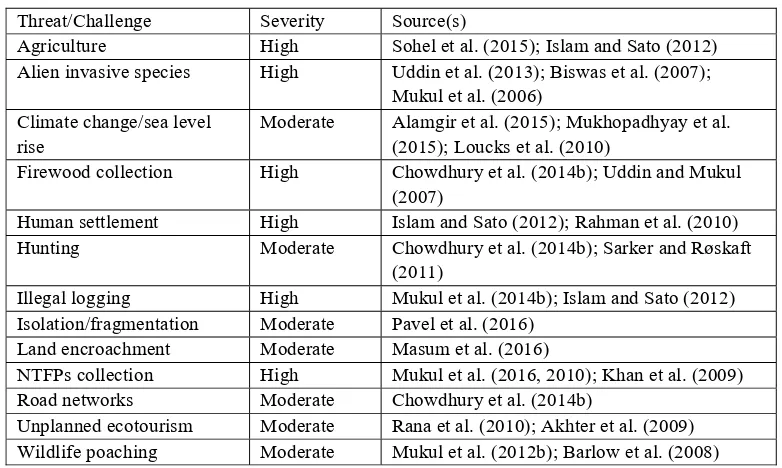
REASThe major challenges and/or threats to forest protected areas in Bangladesh are being listed in Table 4. Like other South Asian countries, the high population density creates immense pressure on country’s forest protected areas (Clark et al. 2013). A large number of people in the country live near or within the FPAs and largely depends on various forests products. Land encroachment for settlements and agriculture is is also quite common and one of the direct threats imposed by the growing population (Masum et al. 2016; Rahman et al. 2016; Sohel et al. 2015; Islam and Sato 2012). The high requirement of firewood for domestic cooking also causing forests degradation in country’s FPAs (Chowdhury et al. 2014b; Uddin and Mukul 2007). Illegal logging, hunting of wild animals for dietary consumption, wildlife poaching, and collection of non-timber forest products (NTFPs) are some other threats to FPAs of the country (Mukul et al. 2016, 2014b, 2010; Chowdhury et al. 2014b; Islam and Sato 2012; Khan et al. 2009) (Figure 6). Climate change and resulting sea level rise, alien invasive species, unplanned ecotourism, road networks within the forests are some indirect threats to FPA’s of the country (Alamgir et al. 2015; Mukhopadhyay et al. 2015; Uddin et al. 2013; Rana et al. 2010; Biswas et al. 2007; Mukul et al. 2006).
Table 4. Major challenges and threats to forest protected areas of Bangladesh
Threat/Challenge Severity Source(s)
Agriculture High Sohel et al. (2015); Islam and Sato (2012) Alien invasive species High Uddin et al. (2013); Biswas et al. (2007);
Mukul et al. (2006) Climate change/sea level
rise
Moderate Alamgir et al. (2015); Mukhopadhyay et al. (2015); Loucks et al. (2010)
Firewood collection High Chowdhury et al. (2014b); Uddin and Mukul (2007)
Human settlement High Islam and Sato (2012); Rahman et al. (2010) Hunting Moderate Chowdhury et al. (2014b); Sarker and Røskaft
(2011)
Illegal logging High Mukul et al. (2014b); Islam and Sato (2012) Isolation/fragmentation Moderate Pavel et al. (2016)
Land encroachment Moderate Masum et al. (2016)
NTFPs collection High Mukul et al. (2016, 2010); Khan et al. (2009) Road networks Moderate Chowdhury et al. (2014b)
C
ONCLUSIONThe conservation effectiveness of protected areas depends on the effective management of surrounding landscapes of which they are a part (Chazdon et al. 2008; Hansen and DeFries 2007). The majority of the lands inside South Asia’s forest protected areas are somehow altered by human activities and habitat conversions has not been adequately contained even after the legal initiatives taken by forest department through the declaration of protected areas (Clark et al. 2013). Many of the forest protected areas are also established in locations which are away from strategically important sites for biodiversity conservation (Barnes et al. 2016; Venter et al. 2014; Saout et al. 2013). The Convention on Biological Diversity (CBD) Aichi Target 11 recently calls for a substantial increase in global protected area coverage by the year 2020, and to make a realistic progress towards this goal there is an urgent need to substantially enhance the management of existing protected areas with systematic conservation planning and management (Watson et al. 2014; Wilson et al. 2007).
Overall, we found that the current extent of forest protected areas in Bangladesh, both in terms of number and coverage is, inadequate to protect the rapidly dwindling biodiversity of the country. The forest protected areas also do not sufficiently represent the different forest ecosystems needing conservation. The lack of infrastructure and capacity of the Bangladesh Forest Department, limited involvement of, and support to local people (mainly through some project interventions) also obscuring the long-term sustainability and success of country’s forest protected area systems.
To make the forest protected area systems efficient in conserving Bangladesh’s unique biodiversity and ecosystems, strategical development is necessary with appropriate representation of critical wildlife habitats and corridors within the forest protected area network. A separate institutional body for FPA’s management under the FD, standardized indicators for monitoring the success of FPAs, improvement in local capacity and funding, and effective involvement of local people in FPA’s governance are crucial. Transboundary management and monitoring of forest protected areas are also necessary since the majority of the country’s forest areas are bordered with neighboring India and Myanmar. Incorporation of ecosystem services (e.g., carbon sequestration, flood protection, etc.) framework in the FPA management and payments for ecosystem services could be some other avenues for future expansion and development in the country.
R
EFERENCESAkhter, S., Rana, M.P., Sohel, M.S.I. 2009. Protected area an efficacy for ecotourism development: a visitors’ valuation from Satchari National Park, Bangladesh. Tigerpaper, 36: 1-7.
Alamgir, M., Mukul, S.A., Turton, S. 2015. Modelling spatial distribution of critically endangered Asian elephant and Hoolock gibbon in Bangladesh forest ecosystems under a changing climate. Applied Geography, 60: 10-19.
Aziz, A., Paul, A.R. 2015. Bangladesh Sundarbans: present status of the environment and biota.
Diversity, 7: 242-269.
Baccini, A., Goetz, S.J., Walker, W.S., Laporte, N.T., Sun, M., Sulla-Menashe, D., Hackler, J., Beck, P.S.A., Dubayah, R., Friedl, M.A., Samanta, S., Houghton, R.A. 2012. Estimated carbon dioxide emissions from tropical deforestation improved by carbon-density maps.
Nature Climate Change, 2: 182-185.
Barlow, A.C.D., Ahmed, M.I.U., Rahman, M. M., Howlader, A., Smith, A.C., Smith, J.L.D. 2008. Linking monitoring and intervention for improved management of tigers in the Sundarbans of Bangladesh. Biological Conservation, 141: 2031-2040.
Barnes, M.D., Craigie, I.D., Harrison, L.B., Geldmann, J., Collen, B., Whitmee, S., Balmford, A., Burgess, N.D., Brooks, T., Hockings, M., Woodley, S. 2016. Wildlife population trends in protected areas predicted by national socio-economic metrics and body size. Nature
Communications, 7: 12747.
Beaudrot, L., Ahumada, J.A., O’Brien, T., Alvarez-Loayza, P., Boekee, K., Campos-Arceiz, A., Eichberg, D., Espinosa, S., Fegraus, E., Fletcher, C., Gajapersad, K., Hallam, C., Hurtado, J., Jansen, P.A., Kumar, A., Larney, E., Lima, M.G.M., Mahony, C., Martin, E.H., McWilliam, A., Mugerwa, B., Ndoundou-Hockemba, M., Razafimahaimodison, J.C., Romero-Saltos, H., Rovero, F., Salvador, J., Santos, F., Sheil, D., Spironello, W.R., Willig, M.R., Winarni, N.L., Zvoleff, A., Andelman, S.J. 2016. Standardized assessment of biodiversity trends in tropical forest protected areas: The end is not in sight. PLoS Biology, 14: e1002357.
Biswas, S.R., Choudhury, J.K., Nishat, A., Rahman, M.M. 2007. Do invasive plants threaten the Sundarbans mangrove forest of Bangladesh? Forest Ecology and Management, 245: 1-9.
Byron, N., Arnold, M. 1999. What futures for the people of the tropical forests? World
Development, 27: 789-805.
Chazdon, R.L., Harvey, C.A., Komar, O., Griffith, D.M., Ferguson, B.G., Martínez-Ramos, M., Morales, H., Nigh, R., Soto-Pinto, L., Breugel, M.V., Philpott, S.M. 2008. Beyond reserves: a research agenda for conserving biodiversity in human-modified tropical landscapes. Biotropica, 41: 142-153.
Chowdhury, M.S.H., Koike, M., Muhammed, N. 2009. Embracing collaborative protected area management for conservation: an analysis of the development of the forest policy of Bangladesh. International Forestry Review, 11: 359-374.
Chowdhury, M.S.H., Koike, M. 2010. An overview on the protected area system for forest conservation in Bangladesh. Journal of Forestry Research, 21: 111-118.
Chowdhury, M.S.H., Gudmundsson, C., Izumiyama, S., Koike, M., Nazia, N., Rana, M.P., Mukul, S.A., Muhammed, N., Redowan, M. 2014a. Community attitudes toward forest conservation programs through collaborative protected area management in Bangladesh.
Environment, Development and Sustainability, 16: 1235-1252.
Chowdhury, M.S.H., Nazia, N., Izumiyama, S., Muhammed, N., Koike, M. 2014b. Patterns and extent of threats to the protected areas of Bangladesh: the need for a relook at conservation strategies. Parks, 20: 91-104.
DeFries, R., Hansen, A., Turner, B.L., Reid, R., Liu, J. 2007. Land use change around protected areas: management to balance human needs and ecological function. Ecological
Applications, 17: 1031-1038.
Ervin, J. 2003. Rapid assessment of protected area management effectiveness in four countries.
BioScience, 53: 833-841.
Firoz, R., Mobasher, S.M., Waliuzzaman, M., Alam, M.K. 2004. Proceedings of the Regional Workshops on National Biodiversity Strategy and Action Plan. IUCN Bangladesh Country Office, Dhaka, Bangladesh.
Gardner, T.A., Barlow, J., Chazdon, R., Ewers, R.M., Harvey, C.A., Peres, C.A., Sodhi, N.S. 2009. Prospects for tropical forest biodiversity in a human-modified world. Ecology
Letters, 12: 561-582.
Geist, H.J., Lambin, E.F. 2002. Proximate causes and underlying driving forces of tropical deforestation. BioScience, 52: 143-150.
Geldmann, J., Barnes, M., Coad, L., Craigie, I.D., Hockings, M., Burgess, N.D. 2013. Effectiveness of terrestrial protected areas in reducing habitat loss and population declines.
Biological Conservation, 161: 230-238.
Geldmann, J., Coad, L., Barnes, M., Craigie, I.D., Hockings, M., Knights, K., Leverington, F., Cuadros, I.C., Zamora, C., Woodley, S., Burgess, N.D. 2015. Changes in protected area management effectiveness over time: A global analysis. Biological Conservation, 191: 692-699.
Gray, C.L., Hill, S.L.L., Newbold, T., Hudson, L.N., Borger, L., Contu, S., Hoskins, A.J., Ferrier, S., Purvis, A., Scharlemann, J.P.W. 2016. Local biodiversity is higher inside than outside terrestrial protected areas worldwide. Nature Communications, 7: 12306.
Hansen, A.J., DeFries, R. 2007. Ecological mechanisms linking protected areas to surrounding lands. Ecological Applications, 17: 974-88.
Houghton, R. 2012. Carbon emissions and the drivers of deforestation and forest degradation in the tropics. Current Opinion in Environmental Sustainability, 4: 597-603.
Islam, K.K., Sato, N. 2012. Deforestation, land conversion and illegal logging in Bangladesh: the case of the Sal (Shorea robusta) forests. iForest, 5: 171-178.
IUCN (International Union for Conservation of Nature). 2015. Red List of Bangladesh – a brief on assessment result 2015. IUCN Bangladesh Country Office, Dhaka.
Karanth, K.K., DeFries, R. 2010. Conservation and management in human-dominated landscapes: Case studies from India. Biological Conservation, 143: 2865-2869.
Khan, M.A.S.A., Uddin, M.B., Uddin, M.S., Chowdhury, M.S.H., Mukul S.A. 2007. Distribution and status of forests in the tropic: Bangladesh perspective. Proc. Pakistan
Acad. Sci., 44: 145-153.
Khan, M.A.S.A., Mukul, S.A., Uddin, M.S., Kibria, M.G., Sultana, F. 2009. The use of medicinal plants in health care practices by Rohingya refugees in a degraded forest and conservation area of Bangladesh. International Journal of Biodiversity Science and
Management, 5: 76-82.
Khan, M.S., Rahman, M.M., Ali, M.A. 2001. Red data book of vascular plants of Bangladesh. Bangladesh National Herbarium, Dhaka, Bangladesh.
Laurance, W.F. 2007. Have we overstated the tropical biodiversity crisis? Trends in Ecology
Laurance, W.F., Useche, D.C., Rendeiro, J., Kalka, M., Bradshaw, C.J. A., Sloan, S.P. et al. 2012. Averting biodiversity collapse in tropical forest protected areas, Nature, 489: 290-294.
Loucks, C., Barber-Meyer, S., Hossain, M.A.A., Barlow, A., Chowdhury, R.M. 2010. Sea level rise and tigers: predicted impacts to Bangladesh’s Sundarbans mangroves, A letter.
Climatic Change, 98: 291-298.
Masum, K.M., Islam, M.N., Saha, N., Hasan, M.Z., Mansor, A. 2015. Assessment of land grabbing from protected forest areas of Bhawal National Park in Bangladesh. Landscape
Research, 41: 330-343.
MoEF (Ministry of Environment and Forest). 1993. Forestry Master Plan-Main Report, ADB (TA No. 1355-BAN), UNDP/FAO BGD 88/025. MoEF, Dhaka, Bangladesh.
Mondal, P., Nagendra, H. 2011. Trends of forest dynamics in tiger landscapes across Asia.
Environmental Management, 48: 781-794.
Mukhopadhyay, A., Mondal, P., Barik, J., Chowdhury, S.M., Ghosh, T., Hazra, S. 2015. Changes in mangrove species assemblages and future prediction of the Bangladesh Sundarbans using Markov chain model and cellular automata. Environ. Sci.: Processes
Impacts, 17: 1111-1117.
Mukul, S.A., Uddin, M.B., Tito, M.R. 2006. Study on the status and various uses of invasive alien plant species in and around Satchari National Park, Sylhet, Bangladesh. Tigerpaper, 33: 28-32.
Mukul, S.A., Uddin, M.B., Uddin, M.S., Khan, M.A.S.A., Marzan, B. 2008. Protected areas of Bangladesh: current status and efficacy for biodiversity conservation. Proc. Pakistan Acad. Sci., 45: 59-68.
Mukul, S.A. 2008. The role of traditional forest practices in enhanced conservation and improved livelihoods of indigenous communities: case study from Lawachara National Park, Bangladesh. Proceedings of the 1st international conference on ‘Forest Related Traditional Knowledge and Culture in Asia’ held in Seoul, Korea during 5-10 October, 2008. 24-28 pp.
Mukul, S.A., Quazi, S.A. 2009. Communities in Conservation: Changing protected area management and enhanced conservation in Bangladesh. In: Leslie, R.N. (ed.), The Future of Forests in Asia and the Pacific: Outlook for 2020. Food and Agriculture Organization of the United Nations, Bangkok, Thailand (FAO-RAP Publication no 2008/3), 143-159 pp. Mukul, S.A., Uddin, M.B., Rashid, A.Z.M.M., Fox, J. 2010. Integrating livelihoods and conservation in protected areas: understanding role and stakeholders’ views on the prospects of non-timber forest products, A Bangladesh case study. International Journal
of Sustainable Development and World Ecology, 17: 180-188.
Mukul, S.A., Rashid, A.Z.M.M., Quazi, S.A., Uddin, M.B., Fox, J. 2012a. Local peoples’ response to co-management in protected areas: A case study from Satchari National Park, Bangladesh. Forests, Trees and Livelihoods, 21: 16-29.
Mukul, S.A., Rashid, A.Z.M.M., Uddin, M.B. 2012b. The role of spiritual beliefs in conserving wildlife species in religious shrines of Bangladesh. Biodiversity, 13: 108-114.
Mukul, S.A., Biswas, S.R., Rashid, A.Z.M.M., Miah, M.D., Uddin, M.B., Kabir, M.E., Khan, N.A., Alamgir, M., Sohel, M.S.I., Chowdhury, M.S.H., Rana, M.P., Khan, M.A.S.A., Rahman, S.A., Hoque, M.A. 2014a. A new estimate of carbon in Bangladesh forest ecosystems, with their spatial distribution and REDD+ implications. International Journal
of Research on Land-use Sustainability, 1: 33-41.
Mukul, S.A., Herbohn, J., Rashid, A.Z.M.M., Uddin, M.B. 2014b. Comparing the effectiveness of forest law enforcement and economic incentive to prevent illegal logging in Bangladesh.
International Forestry Review, 16: 363-375.
Mukul, S.A., Rashid, A.Z.M.M., Uddin, M.B., Khan, N.A. 2016. Role of non-timber forest products in sustaining forest-based livelihoods and rural households’ resilience capacity in and around protected area: a Bangladesh study. Journal of Environmental Planning and
Management, 59: 628-64.
Pavel, M.A.A., Mukul, S.A., Uddin, M.B., Harada, K., Khan, M.A.S.A. 2016. Effect of stand characteristics on tree species richness in and around a conservation area of Bangladesh.
Journal of Mountain Science, 13: 1085-1095.
Poffenberger, M. 2000. Communities and forest management in South Asia. IUCN, DFID, and Asia Forest Network, Philipppines.
Rahman, M.F., Mahmud, M.A.A., Shahidullah, M. 2016. Socioeconomics of biodiversity conservation in the protected areas: a case study in Bangladesh. International Journal of
Sustainable Development and World Ecology, doi: 10.1080/13504509.2016.1169453.
Rahman, M.M., Mahmud, M.A.A., Shahidullah, M., Nath, T.K., Jashimuddin, M. 2016. The competitiveness of the phytosociological attributes of the protected areas in Bangladesh with that in the other tropical countries. Journal of Sustainable Forestry, 35: 431-450. Rahman, M.M., Nishat, A., Vacik, H. 2009. Anthropogenic disturbances and plant diversity of
the Madhupur Sal forests (Shorea robusta C.F. Gaertn) of Bangladesh. International
Journal of Biodiversity Science and Management, 5: 162-173.
Rahman, M.M., Rahman, M.M., Guogang, Z., Islam, K.S. 2010. A review of the present threats to tropical moist deciduous Sal (Shorea robusta) forest ecosystem of central Bangladesh.
Tropical Conservation Science, 3: 90-102.
Rana, M.P., Sohel, M.S.I., Mukul, S.A., Chowdhury, M.S.H., Akhter, S., Alam, M., Chowdhury, Q., Koike, M. 2010. Implications of ecotourism development in protected areas: a study from Rema-Kalenga Wildlife Sanctuary, Bangladesh. iForest, 3: 23-29. Rashid, A.Z.M.M., Craig, D., Mukul, S.A., Khan, N.A. 2013a. A journey towards shared
governance: status and prospects of collaborative management in the protected areas of Bangladesh. Journal of Forestry Research, 24: 599-605.
Rashid, A.Z.M.M., Craig, D., Jeffery, M.I., Khan, N.A. 2013b. Forest protected area governance in Bangladesh: a focus on the legal and policy framework. Chinese Journal of
Population Resources and Environment, 11: 345-351.
Saout, S.L., Hoffmann, M., Shi, Y., Hughes, A., Bernard, C., Brooks, T.M., Bertzky, B., Butchart, S.H.M., Stuart, S.N., Badman, T., Rodrigues, A.S.L. 2013. Protected areas and effective biodiversity conservation. Science, 342: 803-805.
Sarker, A.H.M.R., Røskaft, E. 2011. Human attitudes towards the conservation of protected areas: a case study from four protected areas in Bangladesh. Oryx, 45: 391-400.
Sohel, M.S.I., Mukul, S.A., Burkhard, B. 2015. Landscape’s capacities to supply ecosystem services in Bangladesh: A mapping assessment for Lawachara National Park. Ecosystem
Uddin, M.B., Mukul, S.A. 2007. Improving forest dependent livelihoods through NTFPs and home gardens: A case study from Satchari National Park. pp 13-35. In: Fox, J., Bushley, B., Dutt, S., Quazi, S.A. (eds.). Making Conservation Work: Linking Rural Livelihoods and
Protected Areas in Bangladesh. East-West Center, Hawaii and Nishorgo Support Project
of Bangladesh Forest Department, Dhaka.
Uddin, M.B., Steinbauer, M.J., Jentsch, A., Mukul, S.A., Beierkuhnlein, C. 2013. Do environmental attributes, disturbances, and protection regimes determine the distribution of exotic plant species in Bangladesh forest ecosystem? Forest Ecology and Management, 303: 72-80.
Uddin, M.S., Mukul, S.A., Khan, M.A.S.A., Asif, C.A.A., Alamgir, M. 2007. Comparative evaluation of co-management impacts on protected area: A case study from Lawachara National Park, Maulvibazar, Sylhet. Journal of Forestry and Environment, 5: 103-110. UNEP-WCMC. 2016. The world database on protected areas (WDPA) [On-line]. Cambridge,
UK: UNEP-WCMC. Available online at: www. protectedplanet.net.
Venter, O., Fuller, R.A., Segan, D.B., Carwardine, J., Brooks, T., Butchart, S.H.M., Marco, M.D., Iwamura, T., Joseph, L., O’Grady, D., Possingham, H.P., Rondinini, C., Smith, R.J., Venter, M., Watson, J.E.M. 2014. Targeting global protected area expansion for imperiled biodiversity. PLoS Biology, 12: e1001891.
Watson, J.E.M., Dudley, N., Segan, D.B., Hockings, M. 2014. The performance and potential of protected areas. Nature, 515: 67-73.
Wilson, K.A., Underwood, E.C., Morrison, S.A., Klausmeyer, K.R., Murdoch, W.W., Reyers, B., Wardell-Johnson, G., Marquet, P.A., Rundel, P.W., McBride, M.F., Pressey, R.L., Bode, M., Hoekstra, J.M., Andelman, S., Looker, M., Rondinini, C., Kareiva, P., Shaw, M.R., Possingham, H.P. 2007. Conserving biodiversity efficiently: What to do, where, and when. PLoS Biology, 5: e223.