Integrating Disaster Mitigation with Planning – A Technological Utopia Ar. Ankita Sood & Prof. R. Shankar Page 416
Integrating Disaster Mitigation with Planning – A
Technological Utopia
Ar. Ankita Sood1 & Professor R. Shankar2
Abstract:
India, a developing nation is under the threat of 33 identified hazards which can anytime turn into disaster owing to lack of preparation to deal with these. Envisioning a society (India) where we achieve an ideal state that no person gets killed because of these disasters seems just a dream today – a utopia. With the advancement in technology, judicious planning and better resource management we will achieve the target set and realize this utopia.
Keywords
: Disaster Mitigation, Technological Utopia1
Masters in Urban and Rural Planning Indian Institute of Technology Roorkee (IIT-R)
Department of Architecture and Planning Roorkee, India
2
Professor, Indian Institute of Technology Roorkee (IIT-R) Department of Architecture and Planning
Introduction:
Through this paper the author intends to establish the need of better disaster mitigation and management strategies in India and envisioning it (the country) as a society where natural hazards just come and pass by with minimal damage, and no one dies of these. The author contains herself of giving any concrete solutions in this paper as the research is still going on.
A thin line between the hazard and the disaster is management. Hazards can be any undesired chaos or calamity either natural or man-caused but when the government is unable to control the situation then it leads to disaster. These situations can be
cloud-burst, landslides, cyclones, tsunami,
earthquake or terrorist attacks, fire etc. For developed nations, the situation is far different than India as they have been successfully limiting these hazards before these turn into a disaster. Japan deals efficiently with recurring earthquakes, The United States have been handling the frequent cyclones but still limiting the death toll to single digit. While in India a single disaster causes a lot of damage in terms of lives lost, property and others. This stark difference can be attributed to technological advancement and resource management of developed nations as they forecast fairly well, manage to evacuate the entire city and
that advances in
science and
technology will eventually bring about a utopia or at least help to fulfil one or another utopian ideal.
The research is Developmental one which ought to seek the answers to the following queries:
° Why hundreds of people die in India in
any disaster in contrary to very few in developed countries?
° What is the difference between disaster
mitigation planning strategies of India and western countries?
° In India, what are the contradictions in
city plans prepared by Town and Country Planning boards (TCP) and disaster mitigation plan by State
Disaster Mitigation Authorities
(SDMA), for the same city? And Why?
° What should be the strategies to prepare
an integrated development plan for a city/town/region without compromising the fragility of the area?
thrust is on making the disaster mitigation an integral part of city planning.
The typical mind-set in India seems very tolerant towards disasters because of lack of knowledge that this is not the destiny and is evitable. People need to be aware enough to demand for their right to live peacefully and for that there is a serious need of reality check and then creating awareness. If we compare Indian scenario with a developed nation then a lot of conclusions can be drawn.
In 2004, December 26, tsunami hit the south - eastern coast of India and there was a huge damage in terms of lives, economy and property. Tamilnadu state and Andaman and Nicobar islands were severely hit. 11,000 people died in India and 5,000 went missing. 3,80,000 Indians have been displaced by the disaster and reconstruction is expected to cost more than 1.2 billion US dollars. For the after economics of the disaster – 125 million dollars required to repair the damaged sea vessels (only 3 out of 15,000 were saved). No employment for the fishermen, huge decline in demand of fish further jeopardising the local economy. This scenario from India gives a picture of nature’s furry which took its toll on innocent people living on sea shores. But this is not what it seems. The picture could be different if there was a forecasting mechanism and on time evacuation. This might sound very vague in Indian context but this is exactly
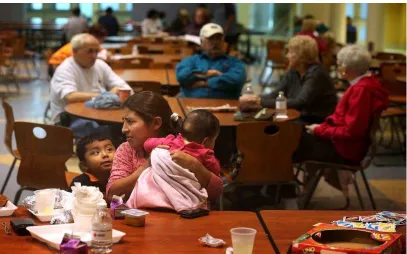
what happened in the United States when cyclone ‘Sandy’ hit the coasts in 2012.
22 October’2012 ‘Sandy’ developed from a tropical wave in the western Caribbean Sea, quickly strengthened and was upgrades to tropical storm. It gradually intensified and became a hurricane on October 24. It affected 24 states in the United States and total damage in US was $ 71 billion. But looking further deep, the human life loss data is strikingly different and surprising for any common man from India. In Jamaica – 1 person killed - $ 100 million damage, in Cuba – 11 persons killed, in Dominican Republic – 2 died - $ 2 billion damage, in Bahamas – 2 died - $ 700 million damage, in Canada – 2 killed - $ 100 million loss.
Figure 1: Evacuees sit out the storm in Lewes, Delaware, as Hurricane Sandy approaches the US east coast on October 29, 2012 (Source: ABC NEWS)
Some might argue that India being a developing nation cannot afford to spend in disaster preparedness like western countries when so many people are still below poverty line and do not even have food or shelter. Then this is not fully true. Disaster management in India has always been marginalized as an issue of providing relief and rehabilitation to the people affected by natural calamities. For this the Indian government has already been spending millions of rupees annually for relief and rehabilitation of the disaster victims. Now the question here is can we spend the same amount of money on preparedness instead of post disaster operations? The answer seems
effort. A huge change in Government’s preparation could be seen just in four years when tsunami hit India in December’04. This time no or very little international aid was sought from India. In fact it has now become a donor country and also sent relief to Sri Lanka. Moreover, the Government of India (GoI) enacted the ‘Disaster Mitigation Act’ in 2005 for the holistic and integrated approach towards disaster mitigation. There is a shift from ‘relief centric management’ approach to ‘proactive disaster management’ approach. For this, National Disaster management Authority (NDMA) was set up
at central level and State Disaster
Figure 2: Relief centric disaster management approach
Figure 3: Proactive disaster management approach
Shift in Indian government’s approach on disaster mitigation
and management
In order to come up with good results – findings, solutions and strategies; the research work has to be structured and systematic. The research work starts with the study of relevant literature regarding disasters in India and their socio-economic impacts, disasters in developed nations and their management strategies etc. To have a deeper insight in Indian government’s approach towards disaster mitigation and management, study of the vision documents of National Disaster Management Authority (NDMA) and State Disaster Management Authorities (SDMA) is must. As the management is also about making policies and strategies for the region/city therefore study of the city development plans to see whether the CDP’s are in line with disaster management policies/ strategies or there are some conflicts. If conflicts are found in CDP and disaster mitigation plans then to look for the probable reasons and solutions.
After thorough analysis of data and understanding of Indian situation, develop the planning guidelines which incorporate disaster mitigation measures. For better results the author intends to develop a model for integrated development plans. Finally to check for the feasibility of the model/
guidelines/ strategies apply all these in developing a CDP for one of the Himalayan towns. The reason why Himalayan town is chosen is because the Himalayas are very fragile and prone to various natural hazards like landslides, cloudbursts, earthquakes forest fires etc and thus provide a good base for rigorous checking of the model. Thus validation of model is a must so that the research does not prove to be a feudal exercise.
The conventional planning procedure in India is to consider the area as a system of seven interacting sub systems. These sub-systems are: Physical, social, economic, ecology, environment, infrastructure and institutions. The findings from the literature study and its analysis suggest that the
‘disaster mitigation’ should also be
considered in planning as eighth sub-system. By doing so we are making it an integral part of planning and hence nullifying or at least reducing its chances of being
neglected. The micro level planning
approach is required which thoroughly deals with the various aspects of mitigation, preparedness, prevention and relief along with physical planning. Physical planning must include the ban on construction in
fragile areas, placement of adequate
Figure 4: The proposed approach towards planning
Conclusion:
The vision is making India a society where disasters are not demons but are just natural phenomena which come and pass by without taking their toll on human lives and livestock. For far long developed nations have been managing the situation fairly well therefore lessons can be learnt from them. Technology can be bought and efforts should be made to develop our own technology which is location specific and demand specific. Citizens should be made alert and prepared. In short, instead of
spending and allocating money for rescue operations, the investments should be made in preparedness in terms of science and
technological advancements, citizen
preparedness, well equipped and efficient public services, research etc. It is time to break the notion that a developing country’s utopia is the reality of developed nations. India has all the potential to do this as it has rising economy and sees a lot of hope in its youth as resource. If everyone dreams so, it will just be a matter of time to see this utopia realising. Aptly said ‘where there is a
will there is a way’.
5. (2012) Mass evacuations as US prepares for mega-storm Hurricane Sandy. [online] http://www.news.com.au/news/growing-fears-as-frankenstorm-approaches/story-fncvfxcm-1226504397684 [2014, April 04]
6. (2012) People take shelter in evacuation centre. [online] http://www.abc.net.au/news /2012-10-30/evacuees-sit-out-the-hurricane-sandy/4341070 [2014, January 24]