The prediction of gambling behaviour and problem gambling from attitudes and perceived norms1
Susan M. Moore & Keis Ohtsuka
Department of Psychology
Victoria University of Technology
1 Moore, S. M., & Ohtsuka, K. (1999). The prediction of gambling behavior and problem
ABSTRACT
The aim of this study was to characterise attitudes and social norms with respect to gambling among a population of adult Australians. A further aim was to evaluate whether gambling behaviour (as measured by its frequency) and problem gambling (as measured by its negative social effects on an individual) could be predicted by a model combining attitudes and social influences. With a sample of 215 late
adolescents and adults, the Theory of Reasoned Action was found to significantly predict gambling frequency and problem gambling, with intentions predicting actual behaviour in both cases. Subjective norms only indirectly affected behaviour
(through intention) in the case of problem gambling, but had both direct and indirect effects on gambling frequency, while attitudes to gambling predicted intentions, rather than directly predicting behaviour. Males were likely to gamble more often than females, and to judge their behaviour as a problem. Across the sample,
although most had gambled at some time (89 per cent), gambling frequency and problem gambling were low, and attitudes and subjective norms with respect to gambling were a complex mixture of acceptance and rejection.
Gambling is an entrenched leisure pastime in Australian culture, with the whole nation stopping annually for a horse race. In 1993, Australians spent six billion dollars gambling on horse racing, gaming machines, and lotteries (Buchanan, 1994). There are casinos in all Australian capital cities. Many sporting clubs, social clubs and hotels now have legal poker machines. Apart from poker machines and the more sophisticated forms of gambling found in casinos, both horseracing and several state or nationwide lotteries provide ample opportunity for Australians to spend money on gambling. Some states in fact receive a large amount of revenue from these sources and they are advertised freely, so there is more than tacit official approval of their existence. Disapproval of ‘excessive’ gambling is occasionally expressed by politicians, community workers, and through various media sources, but this disapproval tends to be for the individuals who lack control rather than for the gambling activity per se.
Kallick-Kaufmann (1979) collected data from a national probability sample in the United States which suggested that most adults gamble at least to the extent of small, occasional wagers, and that childhood/youth exposure to gambling increased its likelihood among adults. Around 68 per cent of the population had participated in some form of gambling, but less than 1 per cent were pathological gamblers. Youth gambling does, however, appear to be at a high level in Western countries. Fisher (1993) surveyed 460 secondary school students (ages 11 - 16) in the United Kingdom to explore the prevalence of fruit machine gambling. She found that 62 percent of the sample had gambled on these machines, 17 percent did so at least weekly, and 6 percent to a point she defined as pathological. Arcuri, Lester and Smith’s (1985) study of over 1000 American high school students also indicated that over 60 percent had gambled, as did a survey of gambling habits of 702 15 to 18 year-olds in
Minnesota, U.S.A. (Winters et al., 1993). Nine percent of these young people were classified by the authors as problem gamblers. Hraba, Mok, and Huff’s (1990) stratified random telephone sample of 2000 Iowa residents suggested that while gambling behaviour was relatively common, the relationship of such behaviour to perceived loss of control or the experience of negative consequences was quite moderate, indicating that gambling need not be associated with undesirable outcomes or feelings.
Among Australians, folklore and data on amount spent on legal gambling
this information is usually inferred from monitoring numbers of people who seek help for problems (eg., Coman, 1996), rather than from population surveys. Walker (1996) claims that reported estimates of problem gambling in Australia are currently unreliable, ranging from 0.1 per cent to 13 per cent depending on the methodologies and samples used. The recent rapid increase in legal gambling possibilities in
Australia make normative data even more difficult to ascertain. Indeed, stability in rates of general population gambling and associated problems are unlikely to occur in such a changing context, nevertheless it is important that research into such norms continues so that change can be monitored over time. One aim of the current study was to assess the link between frequency of gambling behaviours and reported problem gambling.
Within the Australian context, social acceptance of gambling appears high. Gambling opportunities are readily available, often in venues which provide opportunities for pleasant socialising, eating, and drinking. A further aim of the current study was to characterise these attitudes and social norms, and assess their role in the prediction of gambling behaviour.
A potentially useful theoretical framework from which to begin such an
investigation is provided by Ajzen and Fishbein's (1980) Theory of Reasoned Action (TRA). Cummings and Corney (1987) argue that this model may have good
explanatory power for gambling phenomena, as well as providing a methodological framework for measurement of social factors likely to affect gambling behaviour. The TRA postulates relationships between engaging in a behaviour and attitudes toward it, knowledge/ beliefs about its likely outcomes, and intentions with respect to carrying out the behaviour in question. In this model, intention to perform a behaviour is the immediate antecedent of that behaviour. Intention is predicted by two factors, the individual's attitude to the behaviour and his or her 'subjective norms'. Attitudes are determined by beliefs (or knowledge - both correct and incorrect, explicit and implied) about the behaviour, and the perceived costs and benefits of engaging in it (outcome evaluations), while subjective norms are a function of beliefs that significant others (for example, family and/or friends) think that the behaviour in question is appropriate, together with the individual's
motivation to comply with these perceived norms. With respect to gambling, the model would predict that intention to gamble would be a function of an
shown to successfully predict behaviours ranging from voting choice (Bowman and Fishbein, 1978) to wearing safety helmets (Allegrante et al., 1980).
In the current study, the major aim was to test the Theory of Reasoned Action as a model for predicting both intentions to engage in gambling, and actual gambling behaviour, as measured by frequency. The central hypotheses were that attitudes and subjective norms would predict intentions, and intentions would predict behaviour. In addition, problem gambling was assessed by a modified version of the Lesieur and Blume South Oaks Gambling Screen (1987). This measure reflects subjective responses to an individual’s gambling, such as amount of guilt felt, extent to which others have commented, and perceived loss of productivity as a result of this activity. The role of attitudes and norms in predicting perceived problem gambling, as well as frequency of gambling, could therefore be assessed. A medical or addictive model of problem gambling would predict that the processes of rational decision-making are inadequate for the explanation of behaviour once it is ‘out of control’ in the sense of causing anxiety to the individuals engaging in it, and concern to their significant others. Blaszczynski and McConaghy (1989) argue however that in the case of gambling, criteria for the use of the medical model are not met. They state that occasional, regular, and pathological gambling are distributed in the population as a continuum, with researchers failing to find categorical psychosocial features of problem or pathological gamblers. Brown (1987) also discusses the limitations of the medical model in both categorising problems gamblers and
providing a guide to treatment. The value of a social psychological model, the theory of reasoned action, for predicting both gambling frequency and gambling problems, is a focus of the current study.
METHOD
Participants
There were 215 participants in the study, ranging in age between 17 and 55 years (mean age 22.0, standard deviation = 7.1). The were 58 males and 157 females in the sample.
Procedure
mostly being completed by new/prospective students and their parents. All students in a first year psychology group (N=157) also completed the survey. The
preponderance of females in the sample was a result of their larger numbers as both prospective and actual Psychology students, not a response bias.
Measures
The survey consisted of subsections designed to measure (a) gambling attitudes, (b) subjective norms with respect to gambling (beliefs about the attitudes and
behaviours of significant others) plus motivation to comply with those norms, (c) gambling intentions and (d) gambling behaviour. These subsections were developed from the guidelines available in the TRA literature (Ajzen and Fishbein, 1980). In addition, problem gambling was assessed using a modified version of the South Oaks Gambling Screen (Lesieur and Blume, 1987) adapted to Australian conditions and to a standard answer format. Data on age and sex was also collected.
(a) Gambling Attitudes. This measure consisted of 12 statements with which
participants were asked to strongly agree (5), agree (4), check ‘not sure’ (3), disagree (2), or strongly disagree (1). Item content is indicated in Table 1. With appropriate reversals, items were summed to produce a scale for which scores could range between 12 and 60, and high scores represented positive attitudes to gambling. The Cronbach alpha reliability of the scale was 0.79.
(c) Gambling intention. Seven statements on intention to gamble in the future were rated as for the attitudes and subjective norms scales. Scores on the summed items could range between 7 and 35, with high scores reflecting strong intentions to gamble. Examples are: In the next 2 weeks I intend to play poker machines; In the next 2 weeks I intend to go to buy a lottery ticket. The Cronbach alpha reliability for this scale was 0.80.
(d) Gambling behaviour. This was assessed through two measures, the first
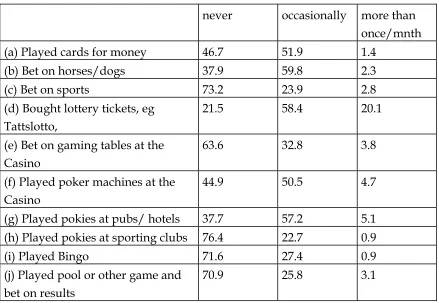
concerning frequencies of 10 different types of gambling, for example, playing cards, using poker machines, buying lottery tickets, and the second requesting information on the largest amount of money the participant had ever gambled in one week (through $0, less than $10, between $10 and $99, between $100 and $499, between $500 and $999, between $1000 and $4999, more than $5000). For the frequency measure, which was used in later regression analyses, the rating scale for each type of gambling ranged through 0=never participated, 1= once a year, 2= more than once/year. less than once/month, 3= more than once/month, less than once/week, to 4= once a week or more. The range of scores was 0 to 40, with high scores representing higher frequencies of gambling. The Cronbach alpha reliability coefficient for the scale was 0.71. See Table 3.
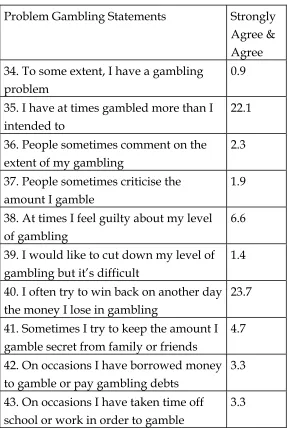
(e) Problem Gambling. A modified version of the South Oaks Gambling Screen (Lesieur and Blume, 1987) was used as the measure of problem gambling, with statements in the screen adapted to Australian idiom. The rating scale used for the attitudes, intentions and subjective norms scales above was applied to the problem gambling statements, to maintain consistency across the whole questionnaire. Ratings across the 10 items were added to form a measure with a possible range of scores of 10 to 50, high scores representing higher levels of perceived problem gambling. Items are shown in Table 4. The Cronbach alpha for this modified scale was 0.87.
RESULTS
Descriptive analysis
endorsed, indicating, for example, beliefs that there is too much gambling today and that the law needs to set limits on gambling opportunities. The mean score on the attitude scale was 36.5, (sd=6.5), reflecting a ‘not sure’ or neutral attitude overall, but when seen in conjunction with response frequencies, reflecting a complex,
simultaneous acceptance and rejection of gambling activities.
Insert Table 1 about here
Table 2 indicates that a large percentage of respondents believed that their family and friends approved of gambling, and that gambling occurs among most of the families and friendship groups of the individuals surveyed. Few would suffer disapproval from their friends if they gambled, and while a greater percentage would suffer disapproval from their families, the proportion is still quite low (about 20 per cent). The mean score across the 12 items is 36.4, representing, as with the attitude scale, a neutral or ‘not sure’ perceived social norm overall, with the
individual item percentages indicating a mix of perceived approval among family and friends for respondent gambling behaviour.
Insert Table 2 about here
at least one occasion. Thus the sample could be classified as moderate and occasional gamblers on the whole, rather than regular or high spending gamblers.
Insert Table 3 about here
Table 4 shows percentage of the sample who strongly agreed or agreed with each of the problem gambling items. Clearly, very few individuals in this population
perceived themselves to have a gambling problem (0.9 per cent, or 2 people), even though about one-fifth admitted to having, at times, spent more money than they intended on gambling. Almost one-quarter indicated that they often tried to win back money lost in gambling, but other items in the scale received assent from very few individuals. The mean score on the scale was 14.7 (sd=5.8) indicating that on the average, there was disagreement or strong disagreement with most of the items.
Insert Table 4 about here
The correlation between gambling frequency and problem gambling was, as expected, moderately high (r=0.53, p<.001), but the two scales do not completely correspond, that is, some individuals with moderately high frequencies of gambling do not assess their gambling as a problem, and vice versa.
Prediction of intention to gambling, gambling behaviour, and problem gambling
Insert Table 5 about here
Table 5 shows the results of three regression analyses for which gambling intention, gambling frequency, and problem gambling respectively were the independent variables. The potential predictors (independent variables) were sex, age, attitudes to gambling, subjective norms with respect to gambling, and in the case of the
regressions attempting to predict behaviour, intention to gamble. All regression equations were statistically significant.
Behaviour was more strongly predicted than intention, with 30 per cent of the variance of gambling behaviour accounted for by a combination of sex, intentions to gamble and subjective norms. Males with strong intentions to gamble and positive subjective norms were more likely to take engage in this activity.
Problem gambling was also predicted by sex and intention, but not in this case, subjective norm. As with the previous regression, 30 per cent of the variance of behaviour was accounted for by the predictor variables. Thus males were more likely to be problem gamblers, and to intend to gamble. However the norms of significant others were not associated with problem gambling directly, as was the case for gambling frequency. They were only associated indirectly through intentions.
DISCUSSION
In a sample of adults and older adolescents drawn from non-gambling venues, there was an interesting mixture of acceptance and rejection of the gambling ethos. The majority of people perceived this pastime as a relatively harmless leisure activity if kept within limits, and had friends and families who gambled sometimes. Most had gambled themselves, with a majority having at some time bet on horses/dogs, played poker machines, been to the Casino, and bought lottery tickets. On the other hand, many also thought that gambling should be controlled and that there is too much gambling today.
In terms of behaviour, almost 90 per cent had gambled at some time, a percentage rather higher than those indicated in studies of American adults and youth (eg., Arcuri et al., 1985). However, few individuals disclosed a high or even a moderate frequency of gambling, most spent very little on the activity and reported that their friends and family also spent very small amounts. Acknowledgment of problem gambling was rare (0.9 per cent, similar to the US National probability sample). Although the sample in the current study was quite small and not necessarily representative, it covered a wide age range and included many young people about whom concern has been expressed regarding their uptake of intemperate gambling. Our data do not support concern about widespread intemperance, suggesting as they do that most individuals are able to keep gambling in perspective, viewing it as an occasional leisure activity on which little money is spent. An awareness of the perils of excessive gambling is also evident from the attitudinal data reported here. Whether there needs to be concern about the almost universal frequency of
The TRA was moderately supported by these data. Regression analyses indicated that, as predicted, more positive attitudes and stronger social norms significantly predicted a stronger intention to gamble in the future, although the R2 was small,
with the predictor variables accounting for only 12 per cent of the variance in intention. Clearly other factors are at work in shaping intentions, possibilities being personality factors, motivation, and opportunity. Stronger support for the model came from the regressions predicting behaviour from intention, each of which produced regression equations accounting for 30 per cent of the variance of behaviour.
Intentions and gender predicted actual gambling behaviour, both frequency and problem acknowledgment, with men more likely to gamble and to worry about it than women. These data and the moderately strong correlation between problem gambling score and gambling frequency suggest that gambling behaviour is not occurring in spite of intentions to the contrary, but in line with intentions. Problems occur when the activity goes further than the individual wished, that is, more is spent than intended as attempts are made to recoup losses. This is somewhat different to the findings from another risk-taking area, that of non-condom use during sexual intercourse with partners of unknown HIV status. Here, there may be strong intentions to use condoms, but these intentions are not carried out due to the features of the social environment, such as perceptions about a partner’s likely infection, high sexual arousal, loss of restraint due to alcohol, non-availability of a condom, and other such variables (Boldero et al., 1992; Galligan and Terry, 1993). The advent of HIV has changed people’s perceptions about the importance of
condoms (Moore and Rosenthal, 1991), their value is recognised but resulting beliefs about safe sex are always not put into practice. For gambling on the other hand, intentions to participate are good predictors of actual behaviour, with problems occurring when that participation goes too far. It may appear from this data that an obvious strategy for public eduction is to change gambling intentions, discouraging those with potential problems from even beginning the process. This is the ‘gamblers anonymous’ strategy, similar to that used by alcoholics anonymous for assisting those who cannot control their drinking - the message being not to start in the first place. Such a strategy would involve changing public attitudes toward gambling, an approach which may not be welcomed by the financial vested interests of
and preparing for gambling outings by only carrying limited amounts of money, may be more useful.
One difference between prediction of gambling frequency and problem gambling was that social norms were influential in the former but not the latter. This suggests that once gambling activity ‘gets out of hand’, the perceived attitudes of family and friends are no longer salient -- the activity has taken on a life of its own, so that censure from others may have less effect. This result lends some support to an addiction model of problem gambling. However it needs to be interpreted in the light of the other study findings, which suggest that most gambling is probably non-addictive and can be predicted by a model of rational decision-making, that is, by a combination of attitudes, social norms and intentions. In fact, Brown’s (1987)
REFERENCES
Ajzen, I and Fishbein, M. (1980). Understanding Attitudes and Predicting Social Behavior, Prentice-Hall, New Jersey.
Ajzen, I. and Madden, T. J. (1986). ‘Prediction of goal-directed behavior: Attitudes, intentions, and perceived behavioral control’, Journal of Experimental Social Psychology, 22, 453-474.
Allegrante, J. P., Mortimer, R. G. and O’Rourke, T. W. (1980). ‘Social psychological factors in motorcycle safety research: Implications for public policy’, Journal of Safety Research, 12, 115-126.
Arcuri, A. F., Lester, D., and Smith, F. O. (1985). ‘Shaping adolescent gambling behavior’, Adolescence, 20, 935-938.
Blaszczynski, A. and McConaghy, N. (1989). ‘The medical model of pathological gambling: Current shortcomings’, Journal of Gambling Behavior, 5, 42-52.
Bowman, C. H. and Fishbein, M. (1978). ‘Understanding public reactions to energy proposals: An application of the Fishbein model’, Journal of Applied Social Psychology, 8, 319- 340.
Brown, R. I. F. (1987). ‘ Models of gambling and gambling addiction as perceptual filters’, Journal of Gambling Behavior, 3, 224-236.
Buchanan, R. (16-7-1994). ‘How gambling is changing us’, The Age, pps. 16, 18.
Coman, G. (1996). ‘G/Line: The year in review’. Paper presented at Seventh National Conference of the National Association for Gambling Studies, Glenelg, South Australia (November).
Cummings, W. T. and Corney, W. (1987). ‘ A conceptual model of gambling behavior: Fishbein’s Theory of Reasoned Action’, Journal of Gambling Behavior, 3, 190-201.
Galligan, R. and Terry, D. (1993). ‘ Romantic ideals, fear of negative implications, and the practice of safe sex’, Journal of Applied Social Psychology, 23, 1685-1711.
Hraba, J., Mok, W., and Huff, D. (1990). ‘Lottery play and problem gambling. Special Issue: Lotteries’, Journal of Gambling Studies, 6, 355-377.
Kallick-Kaufmann, M. (1979). ‘The micro- and macro-dimensions of gambling in the United States’, Journal of Social Issues, 35, 7-26.
Lesieur, H. R. and Blume, S. B. (1987). ‘The South Oaks Gambling Screen (SOGS): A new instrument for identification of pathological gamblers’, American Journal of Psychiatry, 144, 1184-1188.
Moore, S. M. and Rosenthal, D. A. (1991). ‘Condoms and coitus: Adolescent attitudes to AIDS and safe sex behaviour’, Journal of Adolescence, 14, 211-27.
Walker, M. (1996). ‘The prevalence of problem gambling in Australia: Another lottery?’. Paper presented at Seventh National Conference of the National Association for Gambling Studies, Glenelg, South Australia (November).
Table 1: Percentage of respondents who agree or strongly agree with attitude statements
Attitudes Statements Strongly
Agree & Agree 1. Gambling is a fun activity 55.8 2. Moderate gambling is harmless 66.8 3. Gamblers need counselling 36.0 4. Gambling should be illegal 8.8 5. There is too much gambling today 67.1 6. Gambling destroys families 54.9 7. Gambling is just another hobby 34.3 8. Most people can control their
gambling
40.0
9. Gambling is a social evil 22.9 10. I approve of some gambling being
legal
80.9
11. Gambling should be controlled by law so people don’t overdo it
67.9
Table 2: Percent of respondents who agreed or strongly agreed with norm statements
Perceived Norm Statements Strongly Agree & Agree 13. Most of my friends approve of
gambling
58.0
14. Most of my friends gamble sometimes
66.9
15. My friends often go out to places where gambling occurs
40.0
16. My family approves of gambling 40.6 17. People in my family gamble
sometimes
67.4
18. People in my family often go to places where gambling occurs
35.9
19. My family members spend $20 or more/week on gambling
28.0
20. My family members spend $100 or more/week on gambling
8.4
21. My friends would disapprove of me playing pokies
5.6
22. My family would disapprove of me playing pokies
21.9
23. My friends would disapprove of me buying a lottery ticket
6.1
24. My family would disapprove of me buying a lottery ticket
Table 3: Frequency of gambling behaviours (N=215)
never occasionally more than
once/mnth
(a) Played cards for money 46.7 51.9 1.4
(b) Bet on horses/dogs 37.9 59.8 2.3
(c) Bet on sports 73.2 23.9 2.8
(d) Bought lottery tickets, eg Tattslotto,
21.5 58.4 20.1
(e) Bet on gaming tables at the Casino
63.6 32.8 3.8
(f) Played poker machines at the Casino
44.9 50.5 4.7
(g) Played pokies at pubs/ hotels 37.7 57.2 5.1 (h) Played pokies at sporting clubs 76.4 22.7 0.9
(i) Played Bingo 71.6 27.4 0.9
(j) Played pool or other game and bet on results
Table 4: Percent of respondents who agree or strongly agree with problem gambling statements
Problem Gambling Statements Strongly Agree & Agree 34. To some extent, I have a gambling
problem
0.9
35. I have at times gambled more than I intended to
22.1
36. People sometimes comment on the extent of my gambling
2.3
37. People sometimes criticise the amount I gamble
1.9
38. At times I feel guilty about my level of gambling
6.6
39. I would like to cut down my level of gambling but it’s difficult
1.4
40. I often try to win back on another day the money I lose in gambling
23.7
41. Sometimes I try to keep the amount I gamble secret from family or friends
4.7
42. On occasions I have borrowed money to gamble or pay gambling debts
3.3
43. On occasions I have taken time off school or work in order to gamble
Table 5: Predicting intention to gamble, gambling frequency, and problem gambling
Predictor Beta Weights
Intention to
Gamble
Gambling Frequency
Problem Gambling
Sex -.04 -.18** -.21***
Age -.08 .0 -.03
Subjective Norm .13+ .14* -.04
Attitudes .27*** .03 .01
Intentions --- .47*** .49***
F 6.84*** 17.31*** 15.71***
R2 .12 .30 .30