Realization of Maxwell’s Hypothesis
An Experiment of Heat-Electric Conversion
in Contradiction to the Kelvin Statement
Xinyong Fu & Zitao Fu
Shanghai Jiao Tong University July 29, 2020
[email protected] [email protected] Key Words
Maxwell’s demon magnetic demon
entropy decrease entropy elimination
Abstract
In a vacuum tube two identical and parallel Ag-O-Cs emitters A and B
(work function 0.8eV) ceaselessly emit thermal electrons at room
temperature. The thermal electrons are controlled by a static uniform
magnetic field so that the number of electrons migrate from A to B
exceeds the one from B to A (or vice versa). The net migration of thermal
electrons from A to B quickly results in a charge distribution of A charged
positively and B negatively, and a potential difference between A and B
emerges, enabling a continuous output current and a stable power to an
external load (e.g., a resistor). Thus, the tube cools down (slightly). The
(slightly) cooled tube extracts heat from ambient air, and all the heat is
converted into electric energy without other effect. We believe the
experiment is in contradiction to the Kelvin statement of the second law.
Experiment Videos
We recommend here two videos on YouTube showing the main
measuring process of our experiments, about 5 and 28 minutes,
respectively:
http://www.youtube.com/watch?v=FCCPeEKIVvQ
https://www.youtube.com/watch?v=PyrtC2nQ_UU.
1. Fundamental Concept
Let us first imagine an ideal vacuum tube containing two identical and parallel Ag-O-Cs thermal electron emitters, A and B, as shown in Fig.1. The work function of Ag-O-Cs is only 0.8eV, so A and B eject thermal electrons ceaselessly at room temperature (the main constituent of the “dark current” in a phototube or a photomultiplier.)
Fig.1 A vacuum tube containing two identical and parallel Ag-O-Cs thermal electron
emitters, A and B. The central vertical green piece is a separation of mica sheet.
Fig.2 (a) illustrates the motion of the thermal electrons emitted from
two symmetric points on A and B when no magnetic field is applied to the
tube. The electrons ejected from A fly straight forward to hit the glass
ejected from B fly straight forward to hit the glass wall and bounce back,
and finally fall into A or B. The collisions of the electrons with the
remnant gas molecules in the tube happen scarcely. So,A and B like two
islands, the electrons may migrate from A to B, or from B to A. Since the
system is in a thermal equilibrium state at a constant temperature,
statistically, the electron migrations from A to B and the one from B to A
cancel each other. There is no net electron migration between A and B,
hence, no electric potential between A and B emerges, and, no output
current to the exterior resistor.
Fig.2 Thermal electrons’ motion with or without a magnetic field
Now, if a static uniform magnetic field is applied to the electron tube in
the direction parallel to the tube axis (the Z-axis), and, firstly, directed
into the plane of the figure, as shown in Fig.2 (b), all the thermal
electrons will fly clockwise along circles in the XOY plane with different
radii according to u, their component speeds in the XOY plane [1] [2]
u
eB
m
R
, 2 2y
x
v
v
For simplicity, we omit here the discussion about the thermal electrons’
Z-component motion, which is easy, and not important.
The velocities of the thermal electrons, as discovered by Sir Owen
Williams Richardson in the early years of last century with his famous
retarding-potential experiments, are governed by Maxwell’s speed
distribution law, as shown by equation (2) and Fig.3. [3] [4][5]
e v dv
kT m n
dv v
f kT v
m 2 2 2 3 2 ) 2 ( 4 ) (
(2)
Fig.3 The speed distribution of the thermal electrons is governed by Maxwell’s speed distribution law. 99.7% of the thermal electrons are concentrated in the speed range (the blue part) from 0.125 vp to 2.75 vp.
At a room temperature of t = 20oC, the most probable speed of the
thermal electrons is vp = 94.3km/s. If we choose the magnetic induction
intensity of the field to be B = 1.34 ×10⁻⁴tesla = 1.34 gauss, the
corresponding radius of the thermal electrons with a special component
speed u= vp = 94.3km/s is R = 4mm (more precisely, 4.002mm). And, for
of u= 2vp, the corresponding radius is R = 8mm. The rest may de deduced
by analogy.
The inner diameter of the glass tube is 28mm.
Due to the magnetic field, there are numerous various circular
trajectories of electrons of different exiting angles , different speeds u
different radii R, and from different exiting spots on A or B.
As a representative group of all these numerous various trajectories, we
showed in Fig.4 (a) ~ (d) all of the trajectories of thermal electrons
ejected vertically from A or B ( = 0o) with a special component speed u
= vp = 94.3km/s, and from all the spots on A and B, i.e., from every point
of EO and OF as shown in the figure. According to Lambert’s law, normal
is the direction of strongest emission.
(1) The electrons of( = 0o, u = vp)ejected from A consists of two parts,
EO = EM + MO.
As shown in Fig.4 (a), thermal electrons ejected from EM directly
rotate back to A (from EM to PO), and they result in no migration
between A and B.
(directly means that the electrons have no collision with the glass wall.)
And as shown in Fig.4 (c), 57% of the thermal electrons ejected from
MO directly rotate back and fall into B (from MO to ON). They all
(a) A-directly-A & B-directly-B (b) B-glass-B These three parts of thermal electrons (ejected from EM, OC and CD, respectively) result in no electron migration between A and B.
(c) A-directly-B (d) B-glass-A
(from M to O, P to Q, S to T, O to N) (ejected from DF, collide several times with (red) the glass wall, and finally fall into A, blue)
PO/EO = 40/70 = 0.57 DF/OF = 35/70 = 0.50
57% of the electrons of (0o, u = vp ) 50% of the electrons of (0o, u = vp ) emitted from A migrate into B. emitted from B migrate into A.
Fig.4 Contributions of all the electrons of(= 0o, u = vp, R = 4mm)to the output current.
(2) The electrons of( = 0o, u = vp)ejected from B consists of three
parts, OF = OC + CD + DF.
As shown in Fig.4 (a), thermal electrons ejected from OC directly
As shown in Fig.4 (b), thermal electrons ejected from CD rotate to hit
the glass wall and bounce back to B (from CD to FU).
As shown in Fig.4 (d), 50% of the thermal electrons ejected from DF
rotate to hit the glass wall and bounce repeatedly for once or several times
and finally fall into A. They all migrate from B to A.
For all the electrons of( = 0o, u = vp), migration A-B exceeds
migration B-A, and the difference is their net migration between A and B,
57% - 50% = 7%.
Their contribution to the output current is 7% of the emission of thermal
electrons of(0o, vp)of each emitter (A or B).
In the above discussion, we found a strange thing: a part of thermal
electrons ejected from A may easily rotate and fall directly into B, but all
of the thermal electrons ejected from B are absolutely impossible to fall
directly into A.
It is easy to find that this peculiar conclusion is not only valid for
thermal electrons of ( = 0o, u = vp), but also valid for all the thermal
electrons ejected from A and B of any ejecting angle, any speed, and any
ejecting point.
Such a peculiar phenomenon is explicitly in contradiction to
Boltzmann’s principle of detailed balance. So, the electron tube with its
thermal electrons in the magnetic field is an unconventional
Intuitively, the trajectories of migrations of electrons from A to B are of
totally different geometrical patterns from the ones from B to A, and
that naturally leads to a net electron migration from A to B, as shown in
Fig.2 (b).
A more detailed graphical survey over all the various trajectories of the
thermal electrons in the tube showed that for different ejecting angles the
net electron migration from A to B are different, some are positive,
others are negative. Nevertheless, put all these contributions together, the
positive ones exceeds a little bit more than the negative ones. In other
words, for the whole tube, there is a net general electron migration
from A to B. [6]
The net general electron migration from A to B rapidly results in a
charge distribution on A and B, with A charged positively and B
negatively. A potential difference between A and B emerges, enabling a
continuous output current and a stable power to a load outside the tube,
for example, a resistor or a reversible battery.
If the intensity of the static uniform magnetic field is different from B =
1.34 gauss, all the radii of the thermal electrons will follow to be different.
Hence, all the trajectories and the net electron migration between A and B
will follow to be different, and so will the output current. By trying and
choosing the magnetic induction intensity, we may find a maximum
If the direction of the static magnetic field is opposite, leaving out the
paper, as shown in Fig.2 (c), all the thermal electrons will rotate
anticlockwise. And all the electron trajectories will be changed
mirror-reflection symmetrically(left-right symmetrically). Thus, the
direction of the output current will be reversed. This operation is simple
and easy, but of course very significant for the experiment.
A question arises here: Where does the obtained electric energy in this
experiment come from? Or, what is the origin of the output electric
power?
It is the heat extracted by the electron tube from ambient air. We
explain this heat-electric conversion process as follows.
As emitter A charged positively and B negatively, a static electric field
between them is immediately established, mainly concentrated in the
region above the mica sheet (i.e., above the border between A and B). The
Fig. 5 An electron is shown in the upper part of this figure: u is
rightward,F is leftward, F resists the electron’s motion from A to B.
electrons to fly from A to B. As shown in Fig.5,at the middle of the upper
part within the tube, we have an electron with a velocity u flyingright-
ward, and the force F exerted on it by the static electric field is
left-ward. So, the flying electron is decelerated by the force.
Nevertheless, a certain part of the electrons emitted from A (especially
part of the faster ones), relying on their kinetic energy, may overcome the
resistance of the static electric field and fly across the border and finally
fall into B. On arriving at B, each electron has obtained a certain amount
of electric potential energy, which is derived in exchange with the loss of
an equal amount of its kinetic energy. Thus these electrons “cool down”.
Consequently the two emitters and then the whole electron tube follow to
cool down, may be very slightly. The slightly cooled tube extracts heat
from ambient air automatically, resisting the tendency of cooling down.
In our practical experiment, with the help of a highly sensitive
electrometer Keithley 6514, we may see obviously a stable electric
current flow out from the tube to the resistor. The current may be
stable for several minutes, several hours, even longer. Beyond doubt, the
current is showing that the tube is losing its internal energy
continuously. So, the tube tends to cool down (slightly), and
automatically extracts heat continuously from ambient air to
compensate its loss of internal energy.
single-temperature heat reservoir, the ambient air, and all the heat is
converted into electric energy without producing other effect. We
maintain that the process is in contradiction to the Kelvin-Planck
statement of the second law of thermodynamics.
As is well known, in 1871, to challenge the absoluteness of Clausius
and Kelvin’s second law of thermodynamics, James Clerk Maxwell
came up with a famous hypothesis — Maxwell’s demon (so called first
by Kelvin, but Maxwell insisted on his original term “an intelligent
being”). According to Maxwell, Ehrenburg,et al, a demon may work in
either of the two following modes [7] ~ [12].
a) In the first mode, the demon produces a (b) In the second mode, the demon produces a difference in temperature between A and B. difference in pressure between A and B.
Fig.6 Temperature demon and pressure demon [5]
In the first mode, as shown in Fig.6 (a), the demon allows only swifter molecules to pass through a small door to move from A to B, and slower molecules to pass the small door and move from B to A, causing a difference in temperature between A and B.
In the second mode, as shown in Fig.6 (b), the demon only allows molecules (whether fast or slow) to pass through the door from A to B, causing a difference in pressure between A and B.
In our present design and experiment, the static uniform magnetic field
plays the role of a demon. It is a magnetic demon. Itworks in the second
mode, allowing thermal electrons to fly only from A to B (the actual
situation is that the number of electrons migrate from A to B exceeds the
one from B to A, resulting in a net migration of electrons from A to B).
That immediately leads to a charge distribution on A and B, with A
charged positively and B negatively. A difference in electric potential
between A and B emerges, causing a continuous output current and a
stable electric power to the resistor outside the tube.
Everybody knows that applying a static magnetic field in such a
way does not need expenditure of work.
The following is an actual experiment we performed in the recent two
decades (1998 ~ 2020), showing how thermal electrons in a vacuum tube
behave under a static magnetic field, causing an electric potential
difference and an output current.
2. The Actual Electron Tube Used in Our Experiment
We choose Ag-O-Cs as the thermal electron emitters. Ag-O-Cs has the
lowest work function among all the known thermal electron materials,
about 0.8 eV, and is currently optimum in maximizing thermal electron
emission at room temperature [11] [12] [13]. We adopted this material and let
the tube and the closed circuit (Fig.2) under the same room temperature,
nowadays widely used in photoelectric tubes and photo multipliers, and
their emission of thermal electrons is usually referred to as dark current.
Manufacturers adjust technology and craft to produce Ag-O-Cs cathodes
of high photo-electric sensitivity. Meanwhile, the cathodes should also be
of weak-dark-current, usually kept in the range of 10-11 to 10-14 A/cm2. In
our experiment, on the contrary, what we need are Ag-O-Cs emitters of
strong-dark-current, the stronger the better. We adjusted the technology
and craft repeatedly over the past 20 years and succeeded in producing
Ag-O-Cs emitters with a dark current in the range from 10-7 to 10-10
A/cm2.[13] [14] [15] [16]
(a) Emitters A and B, (b) Sketch of the structure (c) A photograph of FX12-51 a mica sheet (green), of electron tube FX12-51 i.e., FX51 (12)
rods P, M, N,
two glass supports (yellow)
Fig.7 Electron tube FX12-51
Its structure was shown in Fig.7. It is similar to but differs partly from the
above discussed ideal tube of Fig.1. Its envelope was of glass. A and B
were two identical and parallel Ag-O-Cs thermal electron emitters coated
on the upper surfaces of two copper bars (light brown in Fig.7 (a) ), each
with an area of 4×40mm2. Actually the two side surfaces of the copper
bars were often also covered with Ag-O-Cs. Between the two copper bars
there was a piece of mica sheet (green in Fig.7 (a)), keeping A and B
mutually insulated. Under the bottom of the copper bars, the mica sheet
stretched out to reach the bottom glass wall of the tube, so as to prevent
electrons from rotating back from B to A through the space of the lower
half of the tube. M, N and P were three molybdenum support rods. M and
N were also used as electric leads connecting A and B to a resistor, the
load, outside the tube. P was 6 mm above the border between A and B,
and was used as a temporary anode in the tube manufacture process to
oxidize the silver films coated on the copper bars by thin-oxygen
discharge. After the manufacture of the tube, P was again used as a
temporary anode to measure the dark current (thermal electron current) of
either of the two emitters to check the quality of the tube. The typical
thermal electron current of each emitter of FX12 type tubes was 300 ~
300,000 pA.
The thermal electron emission was the main constituent of the dark
dark current was the leakage current, also between P and A or P and B. There was usually a leakage current between A and B. According to our experience, the resistance between A and B should be greater than 100MΩ, otherwise, the tube was not good for our experiment. The value of this leakage resistance depended chiefly on the input amount of cesium during the manufacture.
3. The Magnetic Field Applied
The magnetic field used to deflect the orbits of the thermal electrons
was produced by a permanent magnet of 150 x 100 x 25mm3 (Ceramic 8,
MMPA Standard), weighing about 1.8kg. Fig.8 shows the magnetic
induction intensity B at point O on the axis of the magnet a distance d
apart. The B ~ d relation was measured in advance by a magnetometer
and the results were list in Table 1. In our experiment of thermo-electric
conversion, the testing electron tube FX12-51 was put at point O, within a
copper shielding box, with the tube axis parallel to the magnetic field.
Fig.8 The magnetic field B at point O produced by the magnet
d (cm) 60 50 40 35 30 25 20 15 10
B↑(N)(gauss) 0.3 1.1 2.1 2.9 4.4 7.2 13.1 25.5 59.7
B↓(S)(gauss) -0.8 -0.7 -1.6 -2.5 -4.0 -6.7 -12.7 -24.9 -58.8
B(abs , mean) 0.6 0.9 1.9 2.7 4.2 7.0 13 25 60
The influence of the earth magnetic field to this experiment was small, for convenience, we just neglected it. The destination of the experiment was to realize heat-electric conversion. First, we were interested to confirm that there was an output current when an appropriate static magnetic field was applied to the tube. Second, we were interested to trial with different magnetic induction intensities, so as to find a possible maximum output current. As to the highly accurate relation between the
output current and the magnetic induction intensity, we think it was not very important.
4. The Experiment
Fig.9 (a) is a photograph of the set up of the experiment, from left to right: a Keithley 6514 electrometer (grey), highest current sensitivity 1×10-16A = 0.1fA; a copper shielding box (brown), containing electron tube FX12-51; and a magnet (black), 1.8kg. Fig.9 (b)
(a) a Keithley 6514, a shielding box and a magnet (b) How the tube lay within the box
shows how the electron tube FX12-51 lay within the copper shielding box. The anticipated output current of the tube caused by the magnetic field was transferred to electrometer 6514 through a specific accessory cable. Fig.9 (c) is the corresponding circuit diagram.
First, chose a room temperature, which should be finely uniform and stable. Switch on the electrometer and wait a period.
Then, as the magnet was at that time far away from the tube, d ≈ ∞,
B ≈ 0, the tube should produce no output current, I ≈ 0. Nevertheless,
actually, there was usually a background current in the circuit at that time. The whole measuring circuit was under the same room temperature, e.g., 20oC, however, small differences in temperature along the closed circuit still exist (ranging 0.1oC ~ 1.0oC, or, 0.01oC ~ 0.10oC). Hence there was usually a small current chiefly caused by Seeback effect in the closed circuit. In our practice, the background current changed from day to day, even from hour to hour. Fortunately, if it was changing, the change was usually small, and slow. In most cases, both the background current and its change were obviously smaller than the electron tube’s output current produced by the magnetic field. So, the “signal to noise ratio” of the experiment was fine. Sometimes, the background current might keep finely stable for several hours, and such a situation was optimum for our experiment.
We then applied a weak positive magnetic field to the tube (supposed to be northward), as shown in Fig.2 (b), and denoted it by B↑, for
example, d = 60cm, and B↑= 0.6 gauss. The compass placed on the top
that the tube finally output a weak but stable current. For example, in table 3 (b) on page 12 of this paper, at temperature t = 22oC, the
background current Io = 3.0fA, and, for B= 0.6 gauss, the stable output
current was I = 45fA.
The magnetic induction intensity of the field was then increased in
steps by reducing the distance d of the magnet from the electron tube.
For each step, we let the magnet remain stationary for an enough
period, so as to exclude disturbance of Faraday’s electromagnetic
induction. We observed that, for each step, the output current first
changed irregularly as the magnet has just been arriving at a new place,
then the current quickly or gradually reached a stable value. After the
current reached the stable value, we might keep it unchanged as long
as we wished, just by keeping the magnet stationary. And, as the
experiment going on step by step, we found, from the beginning of B↑≈
0 and I ≈ 0, as B↑ increased in steps, the output current I (I
represented the stable values of each step) first followed to increase,
until it reached a maximum value. After that, I decreased as the magnetic
field increased further. This drop down of the output current accorded
with our anticipation: after the maximum current, as the magnetic field
became stronger and stronger, all the radii of the thermal electrons
became smaller and smaller, causing the output current to progressively
reduce.
and rotated through 180o around its central vertical axis. The direction of the magnetic field in the copper shielding box consequently reversed. The
magnetic field was now negative and might be denoted by B↓(supposed
to be southward). As we anticipated, the direction of the output current also reversed, as intuitively shown in Fig.2 (c). We then again reduced the distance d in steps to increase the magnetic induction intensity of the field
B↓. The stable negative output current I for each step first increased, and
then decreased after reaching a maximum value, the situation was similar
to that with the positive magnetic field B↑.
We emphasize here: further experiment showed that, in each step, provided the magnetic field remained stable (i.e., the magnet kept stationary), the output current I would remain stable, with a period as
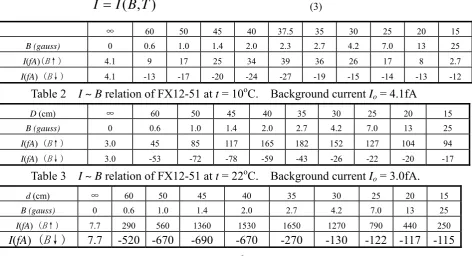
long as we wished, several minutes, several hours, even several days. We call the output current Maxwell’s current. In general, the Maxwell’s current I for a given FX tube depends on two factors, temperature T and
the magnetic induction intensity of the field B
I I(B,T) (3)
∞ 60 50 45 40 37.5 35 30 25 20 15
B (gauss) 0 0.6 1.0 1.4 2.0 2.3 2.7 4.2 7.0 13 25
I(fA)(B↑) 4.1 9 17 25 34 39 36 26 17 8 2.7
I(fA) (B↓) 4.1 -13 -17 -20 -24 -27 -19 -15 -14 -13 -12
Table 2 I ~ B relation of FX12-51 at t = 10oC. Background current Io = 4.1fA
D (cm) ∞ 60 50 45 40 35 30 25 20 15
B (gauss) 0 0.6 1.0 1.4 2.0 2.7 4.2 7.0 13 25
I(fA) (B↑) 3.0 45 85 117 165 182 152 127 104 94
I(fA) (B↓) 3.0 -53 -72 -78 -59 -43 -26 -22 -20 -17
Table 3 I ~ B relation of FX12-51 at t = 22oC. Background current Io = 3.0fA.
d (cm) ∞ 60 50 45 40 35 30 25 20 15
B (gauss) 0 0.6 1.0 1.4 2.0 2.7 4.2 7.0 13 25
I(fA) (B↑) 7.7 290 560 1360 1530 1650 1270 790 440 250
I(fA) (B↓) 7.7 -520 -670 -690 -670 -270 -130 -122 -117 -115
Table 4 I ~ B relation of FX12-51at t = 33oC. Background current Io = 7.7fA.
temperatures, 10oC, 22oC and 33oC. From t = 10oC to t = 33oC (i.e., from
283K to 306K), the temperature rose only 23oC, nevertheless, the output current increased from 40fA to 1600fA, 40 times! This can be finely
(a)
(b)
explained by Richardson’s equation: thermal electron emission rises very rapidly as the temperature rises,
kT W
e
AT
J
2 (4) Fig.10 (a), (b) and (c) were the corresponding I ~ B graphs.In addition to the output current, electrometer Keithley 6514 together
with the circuit could also be used to measure the output voltage of the
electron tube, as shown in Fig. 11. The highest voltage sensitivity of
Keithley 6514 is 1×10⁻⁵V = 0.01mV. The voltage here is actually the
open-circuit voltage of the electron tube, or the electric motive force of
the electron tube.
Fig.11 The output voltage (e.m.f.) measuring circuit.
The following were the output voltages we measured with electron tube FX12-51 in a test at room temperature of t = 25oC (298K):
Background voltage B≈ 0, Uo = 5.6 mV.
When a magnetic field was applied to the tube, the maximum output
voltage (corresponding to an optimum distance d) was also stable
provided the magnet kept stationary. Each maximum output voltage was
B↑≈ 3.5 gauss Umax = 20 21 20 21 mV,
B↓≈ 3.5 gauss Umax = -16 -18 -16 -17 mV。
This output voltage depends on the average kinetic energy of the
thermal electrons of the emitters, that is, depends on the room
temperature. According to Boltzmann’s law of equi-partition of energy,
the average kinetic energy of the thermal electrons at 25oC (298K) is
emV eV
J
kT 1.38 10 298 0.0385 38.5
2 3 2
3 23
(5)
In expression , the factor 38.5mVis of the same magnitude order
with the output voltage we derived in our measurement (Umax ≈ 17 ~
20mV). That reminded us that the output voltages were surely resulted
from the conversion of part of the kinetic energy of the thermal electrons. emV
5 . 38
We noticed in our tests that the value of the output voltage may be affected considerably by the current leakage between the two emitters. Some of our tubes had very fine insulation between A and B, they might produce higher output voltage, even of 50 ~ 100 mV. We think, such higher voltage was due to the contribution of the thermal electrons of
higher kinetic energy. For example, for electrons of u = 2vrms= 2 v2 , its
kinetic energy is 4×38.5emV = 154 emV.
Both the output current and output voltage of our experiment were very weak. Nevertheless, beyond doubt, they were DC current and DC
voltage, both being macroscopic physical quantities. They were
and in series to increase the output voltage, so as to build up a much greater output power.
Another way to increase considerably the output power of a tube at room temperature is to find new thermal electron emission materials of much lower work functions then Ag-O-Cs.
High temperature cathode materials, such as Ba-Sr-Ca oxides and Cs-Tungsten, etc., may also be used to do such experiments. It needs more skill, money and efforts, but tremendously greater output voltage, current and power will be obtained. In all such experiments, only a single heat reservoir at high temperature is needed, that means, no condenser is needed. Carnot’s principle for the limit of heat engine efficiency will no longer be meaningful. The highest or theoretical possible efficiency of such an apparatus (a new energy converter) is of course one hundred percent. [17]
5. Conclusions
In the above experiment, the heat extracted by electron tube FX12-51 from ambient air converted completely into electric energy without producing other effect. The process proved that the second law of thermodynamics was not absolutely valid, just as Maxwell and Planck
had imagined or predicted in 1871 and 1897, respectively.
The authors maintain: in ordinary thermodynamic processes, just as Clausius and Kelvin pointed out, entropy always increases, never decreases. Nevertheless, in some unconventional or extraordinary thermodynamic processes, such as our experiment of thermal electrons in a magnetic field, entropy does decrease.
REFERENCES
[1] Xinyong Fu, An Approach to Realize Maxwell’s Hypothesis,
Energy Conversion and Management, Vol.22 pp1-3 (1982).
[2] Xinyong Fu and Zitao Fu, Realization of Maxwell’s Hypothesis,
arxiv.org/physics/0311104v1-v3.
[3] Richardson and Brown, Phil. Mag., 16,353 (1908).
[4] Richardson,Phil. Mag., 16,890 (1908); 18, 681 (1909).
[5] L.H.Germer, The Distribution of Initial Velocities among Thermionic
Electrons, Initial Velocities of Thermionic Electrons p. 795 (1925).
[6] Xinyong Fu and Zitao Fu, A Graphical Survey of the Various
Trajectories of Thermal Electrons and Their Contribution to the
Output Current in Fu & Fu’s Heat-Electric Conversion (awaiting
publication)
[7] James Clerk Maxwell, Theory of Heat, Longmans, Green, And Co.
(1888),P.328
[8] Max Planck, Forlesungen Uber Thermodynamik (Erste auflage,1897;
Siebente auflage,(1922), §116 &§136. English Version: Treatise On
Thermodynamics, Dover Publications Inc. (1926), §116 & §136.
[9] W. Ehrenberg, Maxwell’s Demon, Scientific American, pp 103-110
(1967).
[10] Harvey Leff & Andrew Rex, Maxwell’s Demon: Entropy,
Hilger/British Institute of Physics (1990)
[11] Harvey Leff & Andrew Rex, Maxwell’s Demon 2: Entropy, Classical
and Quantum Information, Computing, Institute of Physics Bristol (2003)
[12] Harvey Leff, Energy and Entropy, A Dynamic Duo, Section 9.5.3,
CRC/Taylor & Francis Group in England (2020)
[13] Koller, L. R., Phys. Rev., 36, 1639 (1930).
[14] Campbell, N. R., Phil. Mag., 12, 173 (1931).
[15] A. H. Sommer, PHOTOEMISSIVE MATERIALS, Preparation,
Properties, and Use, John Wiley & Sons, Section 10.7.1, Chapter 10,
(1968).
[16] John E. Davey, Thermionic and Semiconducting Properties of〔Ag〕
- Cs2O3, Ag, Cs, Journal of Applied Physics, Volume 28, Number 9,
p.1031 (1957).
[17] Kamarul Aizat Abdul Khalid, Thye Jien Leong and Khairudin
Mohamed, Review on Thermionic Energy Converters,