BREXIT AND STOCK RETURN PERFORMANCE: EMPIRICAL ANALYSIS FROM THE INDIAN IT SECTOR
Dr. DHANRAJ SHARMA Dr. RUCHITA VERMA
Assistant Professor Assistant Professor
Department of Commerce Department of Commerce
Central University of Rajasthan Central University of Rajasthan
ABSTRACT
The event “Brexit” has unprecedented impact over globalized economy and India is not far away from this effect. India is one of the largest exporters of IT-enabled services and the sector has significant exposure to the European market especially the UK. The main objective of the study is to reveal the impact referendum of Brexit on Indian Information & Technology sector. In this paper, event study is performed to find out whether there is any significant Average Abnormal Return (AAR) and Cumulative Average Abnormal Return (CAAR) in the stock of Indian IT sector on the event day. To serve the purpose, event window is taken as -10 to +10 days while estimation period is 250 days. The study found the negative abnormal return and cumulative abnormal return on the event of Brexit referendum, signifies the adverse effect of the event on Indian IT sector.
Keywords- Brexit, Event study, Abnormal Return, Cumulative Abnormal Return and IT sector.
INTRODUCTION
The Brexit referendum on June 23, 2016 has an unprecedented significance in the global development. The United Kingdom (UK) voted for the exit from the European Union (EU) is expected to have considerable socio economic and political implications in the years ahead. The decision assumes greater significance in context of the changing global order which is moving towards greater multilateralism and where countries are striving to lower their boundaries. In the referendum held on June 23, 2016, the United Kingdom voted to leave the European Union by a margin of 51.9 percent to 48.1 percent. Since becoming a member of the European Union (EU) in 1973, GDP per capita in the United Kingdom (UK) has doubled, outpacing other affluent non-EU English-speaking countries. Dhingra S.,Ottaviano G., Sampson T., & Reenen J.V. (n.d.).India is one of the largest exporters of IT-enabled services and the sector has significant exposure to the European market especially the UK. UK accounts for about 17% of India’s total IT exports. India’s IT exports to other European countries is at about 11%. The IT companies thus are expected to face the heat in light of the Brexit. Given the risk of further moderation in growth in the UK and EU, there is an increased probability that the companies lower their IT budgets. This would have an impact on the domestic software companies. Further, the depreciation of Pound does not augur well for the sector and can negatively impact the growth in the sector. Majority of the costs by the IT companies are incurred in INR owing to the off-shoring model deployed by the Indian IT services player. So a sustained depreciation of Pound might call for a renegotiation of the contract, as the profitability of these contracts might fall below the expected levels. Uncertainty on account of pricing of contracts spanning European Union which currently enjoys zero tariffs cannot be ruled out. Skilled labour mobility issues can arise as the mutli-location contracts will get deferred on account of lack of clarity at present. Further, the overhead expenses are likely to increase if restrictions are imposed on the mobility of professionals between UK and EU as the companies might have to open an additional office in the EU. Besides, the Indian IT sector has had some issues with the EU data security policies, including rules on transferring personal data. So, on the positive side the UK could look at abandoning the stringent stance on data management post Brexit. Also, UK would be under no obligation to adhere to restrictive localization norms adopted by EU.
This paper consists of five sections. First section deals with the introduction followed by review of earlier studies (second) and research methodology (third). The forth section is empirical analysis of impact of Brexit on Indian IT sector, end with conclusion and implication of the study.
REVIEW OF LITERATURES
In the context of consequences of Brexir, very few studies have been performed. Oehler, Horn and Wendt (2017) conduct event analysis study analysis to determine short-term abnormal stock returns following the Brexit referendum. They also examined whether firm-level internationalization helps in explaining abnormal returns. The study found that stock with higher proportions of domestic sales realized more negative abnormal returns than stocks of firms with more sales abroad. Irwin G. (2015) seeks to assess the evidence on the impact of Brexit on the both UK and the rest of Europe. He analyzed the different channels such as Trade with Europe, FDI, liberalization and regulation, Industrial policy, Immigration, Financial services, Trade policy, International influence, Budget and Uncertainty. This report concluded that the biggest impact would be on the UK as compared to EU. Dhingra, Ottaviano, Sampson, and Reenen (n.d.) concluded that economic consequences of leaving EU will depend on what policies the UK adopts following Brexit. They also revealed that Brexit will lower trade with EU and this cost to UK economy will far more than gain from lower contributions to the EU budget. Reenen (2016) predicted that leaving the EU would reduce FDI inflows by around twenty two per cent and Brexit is likely to have the effect of significantly lowering FDI coming to UK. In another study of Reenen (2016), he evaluated the long rung economic effects of the UK’s decision to leave the EU. He concluded that trade cost will arise with the rest of Europe resulted from some combination of tariff and non-tariff barriers. This study used standard multi country, multi sector, computable general equilibrium model which shows the welfare losses of 1.3 to 2.6 percent where dynamic models revealed the incorporate productivity effects suggests that these could rise to 6.3 to 9.5 percent. Miller (2016) discussed in his briefing paper various consequences in the different areas of Brexit such as Trade relations, economic impact, employment, agriculture, environment, Fisheries policy, energy and climate change, transport, Immigration, Human right and social security. He concluded that Brexit is favourable from the point of view of social security, freedom in policy making, employment but there will be negative consequences of Brexit in the form of Trade, inflows of foreign direct investment, communication and mutual international development. From the earlier studies, it was found that so many studies have been done to evaluate the consequences of Brexit on UK and EU but very few studies are carried out to evaluate the impact of Indian economy especially in the context of IT sector. This study tries to fill the gap in the existing literature. Indian IT sector has been chosen for the research because India is one of the largest exporters of IT-enabled services and the sector has significant exposure to the European market.
RESEARCH METHODOLOGY Sample Selection
Table-1 Sample Profile
Company's Name Weight (%) Industry Symbol
Infosys Ltd. 25.28 IT INFY
Tata Consultancy Services Ltd. 25.18 IT TCS
HCL Technologies Ltd. 19.28 IT HCLTECH
Wipro Ltd. 13.23 IT WIPRO
Tech Mahindra Ltd. 9.5 IT TECHM
Oracle Financial Services Software Ltd. 3.05 IT OFSS
MindTree Ltd. 2.36 IT MINDTREE
Tata Elxsi Ltd. 0.89 IT TATAELXSI
KPIT Technologies Ltd. 0.64 IT KPIT
Justdial Ltd. 0.58 IT JUSTDIAL
Source: NSE. (2017).
Hypotheses of the Study
There is no significant abnormal return in the stock of Indian IT sector on the date of referendum of BREXIT. Ho1: AAR=0
There is no significant cumulative abnormal return in the stock of Indian IT sector on the date of referendum of BREXIT. Ho2: CAAR=0
Table-2 Time Frame used for Event Study
Period Starting from End Period No. of days
Estimation period 08-June-2015 08-June-2016 250
Pre-Event Period 09-June-2016 22-June-2016 10
Event Day (date of referendum) 23-June-2016 1
Post- Event Period 24-June-2016 08-July-2016 10
The time frame of the event study is divided into four phases. First is the estimation period which consists of 250 days. On the basis of estimation period equation (y = a+bx) is framed with the help of least square regression. Then event window is taken as -10 to +10 days. Pre event period is the period of 10 days before referendum of Brexit (event). The event day is the date of referendum i.e. June 23, 2016 when voting was done for Brexit. The post-event comprises 10 days after event. The daily stock return for the above mentioned time frame is collected from the website of National Stock Exchange of India. NSE 50 index is taken as a market proxy for the computation of expected return of the stock.
Event Study
To test the market efficiency in responding to stock split announcements, Event study was originated by Fama et al (1969). In the event study individual Abnormal Return is calculated as:
ARit = Rit – E(Rit)
where:
ARit = Abnormal return of the company i in the period t. Rit = Actual return for the company i in the period t. E(Rit) = Expected return for the company i in the period t.
Expected return for the company i in the period t is computed as-
E(Rit) = αi + βi Rmt
αi = Intercept term βi = Regression constant
Rmt = Return of the market in the period t Average Abnormal Return (AAR) is computed as
𝐴𝐴𝑅𝑡 = 1
𝑛∑ 𝐴𝑅𝑖𝑡 𝑛
𝑖=1
In order to ascertain the magnitude of abnormal returns over the entire event window, firm specific Cumulative Abnormal Return (CAR) and Cumulative Average Abnormal Return (CAAR) computed as follows:
CARt = CARt-1 + ARt CAARt = CAARt-1 + AARt
To ascertain the significance of the average abnormal returns and cumulative abnormal return for each day in the window period, testing is performed with t-statistics computed as follow:
𝑡𝐴𝑅=
𝐴𝐴𝑅𝑡
𝛿𝐴𝑅 √𝑛
⁄ 𝑡𝐶𝐴𝑅 =
𝐶𝐴𝐴𝑅𝑡
𝛿𝐶𝐴𝑅
√𝑛 ⁄
EMPIRICAL ANALYSIS
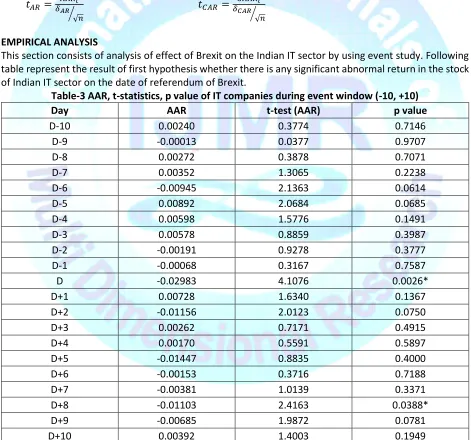
This section consists of analysis of effect of Brexit on the Indian IT sector by using event study. Following table represent the result of first hypothesis whether there is any significant abnormal return in the stock of Indian IT sector on the date of referendum of Brexit.
Table-3 AAR, t-statistics, p value of IT companies during event window (-10, +10)
Day AAR t-test (AAR) p value
D-10 0.00240 0.3774 0.7146
D-9 -0.00013 0.0377 0.9707
D-8 0.00272 0.3878 0.7071
D-7 0.00352 1.3065 0.2238
D-6 -0.00945 2.1363 0.0614
D-5 0.00892 2.0684 0.0685
D-4 0.00598 1.5776 0.1491
D-3 0.00578 0.8859 0.3987
D-2 -0.00191 0.9278 0.3777
D-1 -0.00068 0.3167 0.7587
D -0.02983 4.1076 0.0026*
D+1 0.00728 1.6340 0.1367
D+2 -0.01156 2.0123 0.0750
D+3 0.00262 0.7171 0.4915
D+4 0.00170 0.5591 0.5897
D+5 -0.01447 0.8835 0.4000
D+6 -0.00153 0.3716 0.7188
D+7 -0.00381 1.0139 0.3371
D+8 -0.01103 2.4163 0.0388*
D+9 -0.00685 1.9872 0.0781
D+10 0.00392 1.4003 0.1949
In can be observed form the table that values of Average Abnormal Return (AAR) were negative for 11 days (52 per cent) and positive for 10 days (48 per cent) within event window of -10 to +10 days. As far as p value is concerned, it was significant on the day of Brexit (D) when referendum was conducted where p value is less than 0.05 and after eight days of the Brexit. The p values were showed insignificant result for the remaining days as the values were more than 0.05. There was an significant average abnormal return in Indian IT sector on the date of referendum of Brexit which leads to rejection of the null hypothesis and acceptance of the alternate hypothesis. The AAR was 2.98 per cent which denote to highest minimum value during event window.
Figure-1 Average Abnormal Return (AAR) during Event Window
Source: Researcher’s own compilation.
This graph shows the trend of average abnormal return during event window. The trends show that AAR is negative and minimum on the date of event depicts the negative return of 2.98 per cent in Indian IT sector. The trend was quite fluctuated which presented the negative value in second day, fifth day to ninth day in post event era.
Table-4 CAAR, t-statistics, p value of IT companies during event window (-10, +10)
Day CAAR t-test (AAR) p value
D-10 0.00240 0.37745 0.71459
D-9 0.00227 0.24060 0.81526
D-8 0.00258 0.60392 0.56081
D-7 0.00624 0.75576 0.46911
D-6 -0.00593 1.39486 0.19652
D-5 -0.00053 0.08415 0.93478
D-4 0.01490 3.22309 0.01044*
D-3 0.01177 1.88548 0.09200
D-2 0.00388 0.63851 0.53905
D-1 -0.00258 0.71872 0.49055
D -0.03051 3.35156 0.00850*
D+1 -0.02255 4.00348 0.00309*
D+2 -0.00428 0.51362 0.61989
D+3 -0.00894 1.23530 0.24799
D+4 0.00432 1.14231 0.28280
D+5 -0.01276 0.78517 0.45253
D+6 -0.01600 0.80941 0.43915
D+7 -0.00534 1.10873 0.29629
D+8 -0.01484 2.13668 0.06135
D+9 -0.01788 3.25058 0.00999*
D+10 -0.00293 0.58894 0.57039
Source: Researcher’s own compilation, * Significant at 5% Level of Significance
This table shows the result of second hypothesis. Form the table it can be observed that Cumulative average abnormal return shows the negative values for the 13 days (61 per cent) and positive value for 8 days (39 per cent). On the date of referendum of Brexit, CAAR was negative 3.05 per cent which is highly negative value during event window. The p value on the event date shows the significant value denotes to acceptance of alternate hypothesis and rejection of null hypothesis. The results depicts that there was significant negative CAAR on the event date in Indian IT sector leads to adverse influence of Brexit in Indian IT sector.
Figure-2 Cumulative Average Abnormal Return (CAAR) during Event Window
Source: Researcher’s own compilation.
The graph shows the trends of CAAR during the event window of -10 to +10 days. The value of CAAR was highly negative i.e. 3.0 per cent during the event window. The CAAR values were maximum positive in pre event era and these values were maximum negative on post event era. It signifies the adverse impact of Brexit in Indian sector.
Table-5 Summary of Event Study Mean
(Pre-Event Period)
S.D. (Pre-Event Period)
Mean (Post-Event Period)
S.D. (Post-Event Period)
AAR 0.0172 0.0515 -0.0337 0.0740
CAAR 0.0350 0.0625 -0.1012 0.0815
This table depicts the AAR and CAAR of Indian IT sector in pre event period and post event period. The event window is taken as 10 days for per event period and 10 days for post event period (-10 to +10 days). The mean of Average Abnormal Return (AAR) and Cumulative Average Abnormal Return (CAAR) is positive where higher variability is shown in the CAAR in pre event period. The mean of AAR and CAAR is negative in post event era where higher variability is found in case of CAAR in post event period. The negative mean values witnessed the adverse impact of Brexit on Indian IT sector.
CONCLUSION
This study tried to evaluate the effect of the leaving of United Kingdom (UK) form European Union (EU) called as Brexit on Indian Information & Technology Sector (IT). The referendum of Brexit was took place on June 23, 2016 where 51.9 per cent voting was casted in favour and 48.1 per cent in against of Brexit. India is one of the largest exporters of IT-enabled services where UK accounts for about 17% of India’s total IT exports and other European countries accounts for 11%. To achieve the objective of the study, top ten companies of IT sector are taken as a sample of the study which constitute NSE IT index. Nifty 50 index is the proxy of market. The event study with event window of -10 to +10 days and reference period of 250 days is applied to test the hypothesis whether there is any significant Abnormal Return (AR) and Cumulative Abnormal Return (CAR) in the stock price of Indian IT sector on the event of Brexit. This study found that there is significant negative AAR of 2.9 per cent and significant CAAR of 3.0 per cent on the event day. The majority of the days in event window show the negative return in the stock of Indian IT sector implies the adverse effect of leaving of UK from the EU on Indian IT sector.
REFERENCES
Dhingra S., Ottaviano G., Sampson T., and Reenen J. V. (n.d.). The consequences of Brexit for UK trade and living standards. Centre for economic performance. London school of Economics and Political Science (LSE).
Dhingra S.,Ottaviano G., Sampson T., & Reenen J.V. (n.d.). The consequences of Brexit for UK trade and living standards. Fama E., Fisher L., Jensen M. and Roll R. (1969). The adjustment of stock prices to new information. International Economic
Review, 10, 1-21.
FICCI. (2016). BREXIT- Views and suggestions from Indian Inc. Retrieved from ficci.in/Sedocument/20369/BREXIT-July-2016.PDF Irwin G. (2015). Brexit: The impact on the UK and the EU. Global Counsel, 1-44
Miller V. (2016). Brexit: Impact across policy areas. House of Commons Library (Briefing Paper), Retreived from www.parliament.uk/commons-library | intranet.parliament.uk/commons-library
NSE. (2017). NSE Indexogram. Retreived from https://www.nseindia.com/ content/indices/ind_nifty_it.pdf as on June 06, 2016 Oehler A., Horn M., & Wendt S. (2017). Brexit: Short-term stock prices effects and the impact of firm-level internationalization.
Finance Research Letters, 1-7, Retrieved form http://dx.doi.org/10.1016/j.frl.2016.12.024
Reenen J. V. (2016). Brexit 2016: Policy analysis. Centre for Economic Performance. London school of Economics and Political Science (LSE).