Article 1
A Structural Equation Model for Measuring the Impact of Human
2Resource Management Practices and Organizational Loyalty on Employee
3Retention: An Indian Perspective
45
Dr. Deepa Naidu 1, * , Prof. Devi Rajesh 2† 6
1.Assistant Professor, KLU-Business School, K L University,Green Fileds, Vaddeswaram, Andhra Pradesh 7
9
2. Assistant Professor, Department of Management Studies, Indira Institute of Engineering and Technology, 10
Chennai, Tamil Nadu. 11
13
* Correspondence: [email protected]; Tel.: +91 7871573719 14
15
Abstract: The role of human resource management practices and organizational loyalty dealing 16
with employee retention has been widely explored and examined in the existing literature. The 17
majority of human resource management researchers have focused on the role of policies and 18
practices in different sectors related to employee retention. However, less attention has been 19
given to identifying the practices and procedures common across all industries and sectors. The 20
present study attempts to determine and examine the most important constructs like HR 21
practices and organizational loyalty of employee retention management and proposes a 22
comprehensive structural equation model to measure the impact of these constructs on 23
employee retention. After an extensive review of the literature, organizational loyalty, and 24
human resources management practices like recruitment and selection, compensation and 25
benefit, training and development, supervision and evaluation have been identified as four 26
essential practices dealing with employee retention and are common across all industries. These 27
practices constitute the component factors of an employee retention management predicting 28
employee’s turnover intentions. The survey method was adopted, and the original data obtained 29
through the self-administered questionnaire. The valid one hundred and eighty-nine (189) 30
respondents analyzed by using Lisrel 8.7, Structural equation model (SEM) analysis results 31
shows that human resource management practices and organizational loyalty have strong 32
positive impact on employee retention. This study tends to assist human resource managers and 33
decision makers in selecting the appropriate motivating factors to retain and satisfy their 34
employees 35
Keywords: Organizational loyalty, human resource management practices, structural equation 36
modeling, employee turnover and employee retention 37
1. Introduction
38
There is a significant problem of turnover in any of the organization. It is a misperception that 39
all turnovers are awful, and that must evade. But actually if an organization does not have a 40
balanced level of turnover, it will result in the monotonous system, and that organization will 41
not have access to new ideas, change dynamism and creativity. Turnover influences 42
profitability and customer satisfaction (Koys, 2001). Our concern is that the required 43
turnover must exist, but the unwanted voluntary turnover should be reduced or avoided. In 44
today’s competitive environment employees leave their organization for various reasons. As 45
the knowledge of employees have become highly critical in gaining competitive advantage in 46
today's business climate (Hall, 1993). The organizations are trying to retain the best 47
employees. The Importance of human resource management practices and organizational 48
loyalty and their retention is recognized. Initially, because resources are scarce and secondly 49
because the competition by businesses to have the best and most talented employees for their 50
organization (Chambers et al., 1998) and finally because Turnover also destroys the 51
customer confidence in the company (Koys, 2001). Customers don’t want to teach about 52
their needs to the new employees. So it is better to retain employees that can keep customers. 53
In the competitive environment, the retention of skilled employees is terrible. Top 54
management & HR department put in an extensive time, financial resources and effort to find 55
out the way to retain their employees and gain competitive advantage (Bartlett & Ghoshal, 56
2013). Training efforts are also use to maintain employees (Chen, 2014). 57
The research in this area is segmented, and either one or few variables have been understudy 58
e.g. one researcher worked on the impact of human resource management training on 59
retention, and the other investigator worked on how promotion, awards, and supervision 60
significance's employee retention. Work has done on the organizational citizenship 61
behavior; that leads to retention. Career opportunities, work-life policies, job characteristics, 62
etc. however, no work of literature has tried to integrate and consolidate the various factors 63
that have been studied empirically in a single body of work. This paper incorporates all this 64
segmented work into an integrated conceptual model which will help organizations to take 65
care of all factors that influence employee retention instead of one or two of them. Next in 66
this paper, the literature review of all variables mentioned above is discussed in detail 67
followed by the conceptual model. Finally, you will see the conclusion section in which 68
suggestions are given for organizations to retain the employee. Impending research 69
directions also proposed in the paper. 70
2. Research Gap Addressed
This study aimed to rectify the gap in the existing literature and provide valuable insights that 72
may clarify the differences in HRM practices and the importance of organizational loyalty 73
that affect employee retention and also check the mediation role of organizational loyalty 74
between hr practices and employee retention. Therefore the study captures all essential 75
information and more amenable to estimation and discussion. As a result, the retention 76
approach considered the most efficient research design to effectively explore the broad 77
objectives of the study 78
3. Literature Review:
79
Taylor (2002) introduces two perspectives on retention. The first one states that reducing the 80
employee turnover rate is desirable for all organizations and that the fact it should be the aim 81
of initiatives in the employee retention. It also suggests that improving retention /turnover 82
rates in general is or should be a central objective of human resource management policy. 83
According to this perspective, high levels of turnover are often seen as evidence of failing in 84
human resource functions. The author also introduces another perspective on the matter: after 85
a “new world of work” has emerged, the retention rates have raised because of the flexibility 86
of labor market. It said that this is desirable, and the organizations should focus their efforts 87
on the retention of the most outstanding performers, those few people in each section who 88
can make a difference in the business. 89
After this, the author states his perspective, that even though he thinks that both of the 90
perspectives are right in their way, in his opinion the employee turnover is always damaging 91
the organization, and none of the employees should be as no important. According to him, 92
most of the employees at different levels of organizations are so called average workers, but 93
they, in fact, ensure that the show goes on and take care of the fundamental objectives of the 94
organization leaving room for the excellent performers to shine. This researcher reminds that 95
there is a cost in every “departure” of even the below average performers of Taylor’s (2002), 96
The Three Rs of Employee Retention. Hausknecht et al., 2009, listed 12 most important 97
retention factors that have published in the journals over the last 60 years which helped in 98
Employee retention consists of 3 R’s which helps in retaining valuable employees. To keep 100
such employees and maintain high in satisfaction, you have to implement each of the three Rs 101
of employee retention. The three R’s are; Respect, Recognition, and Rewards 102
Respect is value, particular consideration or special regard given to employees. The first R, 103
respect is the foundation of maintaining your employees. Recognition and rewards will have 104
modest effect if you don’t recognize your employees. 105
Recognition is referred as “special observe or attention” and “the act of perceiving clearly.” 106
various problems with retention and confidence occur because management is not paying 107
attention to employee’s needs and reactions. 108
Rewards are the extra perks that a company offers beyond the basics of respect and 109
recognition that makes it worth employee’s while to work hard and to take care of their job. 110
3.1 Human Resource Management Factors Influencing Employee Retention
111
There are rising facts that HRM can play a significant role in retaining skilled professional at 112
any organization. Researchers of progressive HRM practices in training and development, 113
supervision, and evaluation, recruitment and selection, compensation and benefits have 114
revealed that these can lead to reducing employee turnover and absenteeism (Arthur1994; 115
Huselid M,A. 1995 and Delaney and Huselid 1996). According to Fitz-enz (1990), 116
managing retention of employees is influenced by many factors, which should lead 117
congruently; recruitment and selection, compensation and benefits, training and development 118
and employee support programs. Similarly, Compensation affects the recruitment and 119
retention of employees and therefore playing an important role in managing people (Rynes 120
and Barber 1990; Williams and Dreher 1992 Highhouse.et al., 1999; Parker and Wright 121
2001). In 2003, there was a study conducted by Mercer; he stated that employees remain 122
with the present organization if they rewarded. Usually, workers are paid when they 123
performed better in their work, and they perform better due to their loyalty towards the 124
organization. Employees tend to remain with the current team when they feel their efforts and 125
performance, abilities contributed are renowned and valued by the organization (Davies, R 126
2001). There are also studies that have highlighted the rewarding practices of workers will 127
Perrin 2003). In today’s organization finding to get the more skilled employees, the more 129
likely they are to remain. Indeed, when the training ends, the turnover tends to begin (Jamrog 130
2002; Wien-Tuers and Hill 2002). 131
3.2 Organizational Loyalty Influences Employee Retention
132
Loyalty, as a general term signifies a person’s devotion or sentiment of attachment to the 133
organization. Workers who felt that the organization failed to treat them challenging and 134
interesting work, opportunities to develop their skills and autonomy were more likely 135
negatively and lacked loyalty towards the organization and greater level of intention to quit 136
the job (Phillips 1997). The loyalty of employee can be determined through direct 137
questioning no one can assume whether employees today work efficiently (Angle, 1983). 138
(Streers, 1977) believes that organizational loyalty is the strength of the competition (link) 139
between the individual with his organization and his association with it. (Allen & Meyer, 140
1990) showed that loyalty is a psychological condition reflects the relationship of the person 141
in the organization in which it operates by Porter, et al., 1979 and also identified the loyalty 142
as the strength of correlation of the individual with its organization, and that the person who 143
shows a high level of organizational loyalty in the organization. In which it operates it has a 144
strong belief to accept the goals and values of the organization, ready to make every possible 145
effort to serve the organization, and has a strong desire to continue working in such 146
organization 147
The following research objectives were developed to guide the study
148
149
1. Is there a relationship between human resource management practices and employee 150
retention? 151
2. Is there a relationship between organizational loyalty and employee retention? 152
3. Does organizational loyalty acts as a mediator between human resource management 153
practices and employee retention? 154
1. Hypotheses of the study:
155
H1: There is a relationship between human resource management practices and 156
H2: Organizational loyalty mediates the relation between human resources management 158
practices and employee retention 159
160
2. Research Model/Theoretical framework of the study
161
This study assessed organizational loyalty and human resource practices and how it helps 162
retaining employees in health care sectors. 163
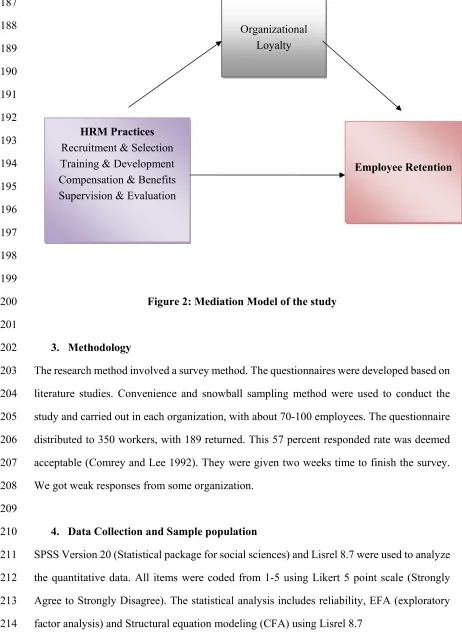
As shown in figure 1, organizational loyalty and human resource management practices are 164
the observed variables under the independent construct. 165
Based on the above hypotheses, the theoretical framework has been framed in figure 1 and 166
figure2. 167
The independent variables in this study are human resource management practices and 168
organizational loyalty, and the dependent variable is employee retention. 169
170
Figure 1: shows the independent variables that influence the dependent variable. 171
Figure 2: shows the mediation effect of loyalty between HRM practices and employee 172
retention. 173
174
175
176
177
178
179
180
181
182
183
184
Figure 1: Theoretical framework of the study
185
186
HRM practices
Organizational loyalty
187
188
189
190
191
192
193
194
195
196
197
198
199
Figure 2: Mediation Model of the study
200
201
3. Methodology
202
The research method involved a survey method. The questionnaires were developed based on 203
literature studies. Convenience and snowball sampling method were used to conduct the 204
study and carried out in each organization, with about 70-100 employees. The questionnaire 205
distributed to 350 workers, with 189 returned. This 57 percent responded rate was deemed 206
acceptable (Comrey and Lee 1992). They were given two weeks time to finish the survey. 207
We got weak responses from some organization. 208
209
4. Data Collection and Sample population
210
SPSS Version 20 (Statistical package for social sciences) and Lisrel 8.7 were used to analyze 211
the quantitative data. All items were coded from 1-5 using Likert 5 point scale (Strongly 212
Agree to Strongly Disagree). The statistical analysis includes reliability, EFA (exploratory 213
factor analysis) and Structural equation modeling (CFA) using Lisrel 8.7 214
HRM Practices
Recruitment & Selection Training & Development Compensation & Benefits Supervision & Evaluation
Organizational Loyalty
The population sample used in this study consisted of health care professionals from Tamil 215
Nadu and Andhra Pradesh. The participating organization was from hospital sectors, 216
manufacturing sectors and also included industry sectors. 217
5. Measurement
218
Multiple items adopted and modified from various studies have been used to measure the 219
employee retention and the constructs of this study. Human resource management practices 220
and organizational loyalty, employee retention have been measured with 14 and 21 items 221
each by following Nelson McCann(2010), Fischer (2011) and Spreitzer (1995) where all 222
the elements have acceptable and reliability above the acceptance level. i.e., human resource 223
management practices (0.88), organizational loyalty (0.89) and employee retention (0.72). 224
6. Data Analysis
225
We present in the following the results of reliability analysis (spss), linear regression (spss), 226
hierarchical linear modeling (spss) and confirmatory factor analysis model (Lisrel-8.7) and 227
additional analyses. 228
6.1 Reliability of the Instruments
229
An alpha of 0.70 or above is considered to be reliable as suggested by many researchers 230
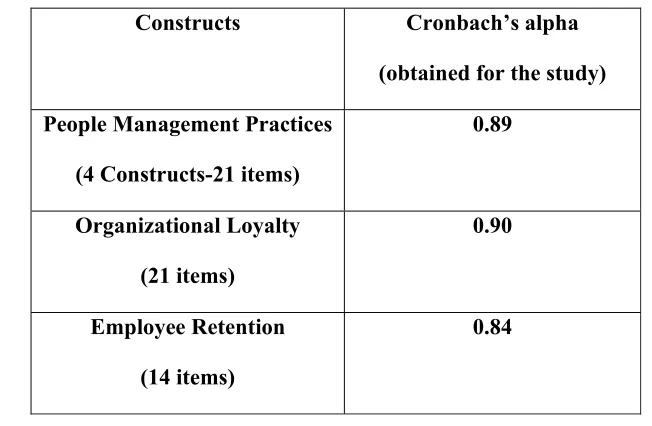
(Nunnally 1978 and Davis 1996). It is seen from the below table that all constructs in the 231
study have reliability above the suggested alpha value. 232
Constructs Cronbach’s alpha
(obtained for the study)
People Management Practices
(4 Constructs-21 items)
0.89
Organizational Loyalty
(21 items)
0.90
Employee Retention
(14 items)
0.84
Table 1: Reliability of the Instruments
233
6.2 Regression Analysis
Regression analysis of human resource management practices on employee retention
235
Model Summary
Model R R Square Adjusted R
Square
Std. Error of the Estimate
1 .795a .632 .630 5.62917
a. Predictors: (Constant), HRM
236
Coefficientsa
Model Unstandardized Coefficients Standardized
Coefficients
t Sig.
B Std. Error Beta
1 (Constant) 12.436 1.789 6.951 .000
HRM .513 .029 .795 17.907 .000
a. Dependent Variable: ER
237
Regression analysis of organizational loyalty on employee retention
238
Model Summary
Model R R Square Adjusted R
Square
Std. Error of the Estimate
1 .714a .510 .507 6.49373
a. Predictors: (Constant), OL
239
Coefficientsa
Model Unstandardized Coefficients Standardized
Coefficients
t Sig.
B Std. Error Beta
1 (Constant) 14.485 2.142 6.762 .000
OL .450 .032 .714 13.945 .000
a. Dependent Variable: ER
240
Hypothesis1: There is a positive significant impact of HRM practices and organizational 241
loyalty on employee retention. 242
243
6.3 Hierarchical Regression Analysisfor Mediation analysis
244
Hierarchical Regression analysis of HRM practices, organizational loyalty on
245
employee retention
246
Model Summary
Model R R Square Adjusted R
Square
Std. Error of the Estimate
2 .807b .652 .648 5.48701
a. Predictors: (Constant), PMP b. Predictors: (Constant), PMP, OL
247
Coefficientsa
Model Unstandardized Coefficients Standardized
Coefficients
t Sig.
B Std. Error Beta
1 (Constant) 12.436 1.789 6.951 .000
HRM .513 .029 .795 17.907 .000
2
(Constant) 10.152 1.877 5.408 .000
HRM .396 .045 .613 8.713 .420
OL .146 .044 .231 3.289 .001
a. Dependent Variable: ER
248
Hypothesis 2: organizational loyalty mediates the relation between HRM Practices and 249
employee retention. 250
The first hypothesis of the study was that HRM practices and organizational loyalty influence 251
the employee retention. According to the table of regression, Analysis p-values show the 252
significant relationship between the HRM practices and organizational loyalty and employee 253
retention. Hence, hypothesis stood true. The R-square values of 63% and 50% are the 254
variance of employee retention that is explained by the constructs. 255
The second hypothesis stated that organizational loyalty positively influences the HRM 256
practices and employee retention. 257
According to the table of regression Analysis p-values shows the significant relationship 258
between the HRM practices and employee retention in the enter method when we added the 259
second construct that is mediating variable (organizational loyalty) the significance value of 260
HRM practices that becomes non-significant, which proving the hypothesis correct. The 261
impact of the organizational loyalty as per Beta value, i.e., 0.146 on Employee Retention is 262
found almost 66%. 263
6.3.1 Mediation Analysis
264
Mediation analysis has been used to see the impact of independent variable (human resource 265
mediating variable (organizational loyalty). The method suggested by Baron and Kenny 267
(1986) has been used to find out the effect of the mediating variable. These results show that 268
organizational loyalty fully mediated the relationship between HRM practices and employee 269
retention. All steps are used as described by Baron and Kenny (1986) and Judd and Kenny 270
(1981). 271
7. Structural Equation Modeling
272
SEM-Confirmatory factor analysis Human resource management practices, organizational 273
loyalty, and Employee retention 274
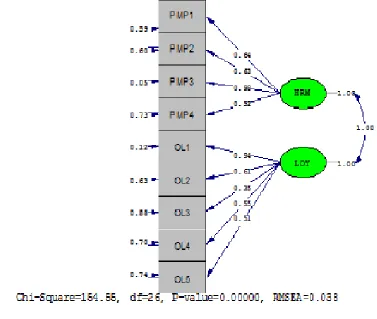
From the below figures it can be seen that all the items that have fallen under respective 275
constructs and also having the value of above .4 and the table shows the GFI, NFI, NNFI, 276
RMSEA and all the values are met acceptable fit indices as suggested by Joreskog and 277
Sorbom (1984).Confirmatory Factor Analysis (CFA) is a type of analysis in contrast with 278
Exploratory Factor Analysis (EFA). This study conducts CFA on the two independent 279
variables and dependent variable (figure 3) and also the CFA has done for all the constructs 280
in the study (human resource management practices and organizational loyalty) in figure 4. 281
282
Figure 3: shows the CFA of the independent constructs and related with employee retention 284
in the study 285
286
Figure 4: shows the CFA of the independent constructs in the study 287
Overall Fit Certification After the literature review and the factor analysis on sampled data, 288
this study constructs the overall model and, as suggested by Hair, Anderson, Tatham, , and 289
Black (1998) classifies the measurement of the overall model fit into three categories, i.e. 290
measures of absolute fit, increment fit and parsimonious fit. 291
Constructs Chi
Square
value
NFI CFI/TLI GFI NNFI AGFI RMSEA
HRM 74.54 0.97 0.92 0.91 0.91 0.86 0.053
OL 69.65 0.90 0.95 0.94 0.83 0.89 0.078
ER 62.71 0.96 0.90 0.93 0.99 0.80 0.035
292
Table 2 : shows the results of the overall fit test 293
8. Conclusion
The primary objective of this study is to identify the impact of human resource management 295
practices and organizational loyalty on employee retention. Two hypotheses have framed in 296
this study and they both are accepted. Results of the survey revealed that human resources 297
management practices and organizational loyalty have a positive significant impact on 298
employee retention. Secondly, organizational loyalty plays an important mediating role 299
between human resource practices and retaining the employees in any organization. 300
Organization should take responsible for recruiting people, practices, training, compensation 301
and supervision to their employee so that they can improve their behavior and must loyalty 302
with their organization. Both the hypotheses accepted in the study that there is a significant 303
positive influence of human resource management practices and organizational loyalty on 304
employee retention, and organizational loyalty plays a mediation role in human resource 305
management and employee retention. 306
Recommendations for future research
307
It is found that organizational loyalty has a significant role in mediating human resource 308
management practices and retaining of employees, but there needs to be an improvement in 309
the area of Training & Development, Compensation, and benefit. To avoid such gaps, 310
Organization must have to take care of Employees Training & Development, Compensation 311
and benefits which create loyalty among employees. Apparently, it has to be on a normal 312
interval which not only progresses & enhance their skills but also increases the productivity 313
of any organization. It is also important to retain resources while offering other benefits like 314
wellbeing, encouragement, skill development, participative approach, two-way interactions, 315
etc. 316
9. References
317
1. Allen and Meyer (1990), “The Measurement and Antecedents of Affective, 318
Continuance and Normative Commitment to the Organization”, Journal of 319
Occupational Psychology, Vol. 63,1-18. 320
2. Angle (1983). Organizational commitment: Individual and organizational influences. 321
3. Arthur, J. (1994). Effects of human resource systems on manufacturing performance 323
and Turnover. Academy of Management Journal, Vol: 37, 670-687 324
4. Baron, R. M., & Kenny, D. A. (1986). The moderator–mediator variable distinction 325
in social psychological research: Conceptual, strategic, and statistical considerations. 326
Journal of Personality and Social Psychology, 51, 1173–1182. 327
5. Bartlett, C., & Ghoshal, S. (2013). Building competitive advantage through people. 328
Sloan Mgmt. Rev, Vol: 43(2). 329
6. Chambers, E., Foulon, M., Handfield-Jones, H., Hankin, S., Michaels III, E., 1998. 330
The war for talent. The McKinsey Quarterly,Vol: 3(1), 44–57. 331
7. Chen, M. (2014, January). The Effect of Training on Employee Retention. In 2014 332
International Conference on Global Economy, Commerce and Service Science 333
(GECSS-14). Atlantis Press. 334
8. Comrey & Lee (1992). A first course in factor analysis. Hillsdale, NJ: Erlbaum. 335
9. Davies, R. (2001). How to boost staff retention. in people anagement.Vol:7(8):54-56. 336
10. Davis (1996). Business Research for Decision Making,, Fourth Edition, Belmont, 337
California: Duxbury Press, 86-113, 338
11. Delaney, J.T. & Huselid, M.A. (1996). The impact of human resource management 339
practices on perceptions of organizational performance in for - profit and non - profit 340
organizations. Academy of Management Journal, Vol:39, 949-969 341
12. Fischer, R. (2011). Cross-cultural training effects on cultural essentialism beliefs and 342
cultural intelligence. International Journal of Intercultural Relations, \Vol: 35, 343
767-775. 344
13. Fitz enz, J. (1990).Getting and keeping good employees. In personnel.Vol: 67(8): 345
25-29. 346
14. Hair, J. F. Jr., Anderson, R., Tatham, R., and Black, W. C. (1998). Multivariate Data 347
15. Hall, R. (1993). "A framework linking intangible resources and capabilities to 349
sustainable competitive advantage." Strategic management journal,Vol: 350
14(8):607-618. 351
16.Hausknecht, J. P., Rodda, J., & Howard, M. J. (2009). Targeted employee retention: 352
Performance-based and job-related differences in reported reasons for staying. 353
Human Resource Management,Vol: 48(2), 269-88. 354
17. Highhouse, S, Stierwalt, S.L, Bachiochi, P, Elder, A.E and Fisher, G, (1999), Effects 355
of advertised human resource management practices on attraction of African 356
American applicants”, Personnel Psychology, Summer, Vol:52(2),425(1). 357
18. Huselid, M. A. (1995). “The impact of human resource management practices on 358
turnover, productivity, and corporate financial performance”, Academy of 359
Management Journal, Vol: 38, 635-672. 360
19. Jamrog, J. J. (2002) The coming decade of the employee. Human Resource Planning, 361
Vol: 25 (3), 5–11. 362
20. Judd, C. M., & Kenny, D. A. (1981). Process analysis: Estimating mediation in 363
treatment evaluations. Evaluation Review, 5, 602–619. 364
21. Koys (2001), The Effects Of Employee Satisfaction, Organizational Citizenship 365
Behavior, And Turnover On Organizational Effectiveness: A Unit-Level, 366
Longitudinal Study, International journal of personnel psychology, vol: 54(1), 367
101-114. 368
22. Mercer Report, (2003). Mercer study raises red flags for employer pay and benefits 369
plans (findings of the 2002 people at work survey). In human resource department 370
management report, 8-15. 371
23. Nelson, K., McCann, J. E., 2010. Designing for knowledge worker retention & 372
organization performance. Journal of Management and Marketing Research, Vol: 373
1,1-18 374
24. Nunnally (1978). Psychometric Theory, McGraw-Hill Book Company, 190-255. 375
25. Parker, O & Wright, L, (2001), “Pay and Employee Commitment: the missing link”, 376
26. Phillips, J. J. (1997a). Handbook of training evaluation and measurement methods 378
(3rd edition.).Boston: Butterworth-Heinemann. 379
27. Porter, Steers, R., Mow day, R. & An Ban lain, P. (1979). Organizational 380
Commitment, Job Satisfaction and Turnover among Psychiatric Technicians. Journal 381
of Applied Psychology. Vol: 59. 382
28. Rynes and Barber (1990). “Applicant attraction strategies: An organizational 383
perspective”, Academy of Management Review, Vol: 15, 286-310 384
29. Spreitzer (1997) an empirical examination of a comprehensive model of 385
psychological empowerment in the workplace, American Journal of community, 386
23(5), 601-629. 387
30. Steers (1977) Antecedents and consequences of organizational commitment. 388
Administrative Science Quarterly, Vol: 22, 46-56 389
31. Taylor, S. (2002). Occupational Pensions and Employee Retention: Debate and 390
Evidence. Employee Relations, Vol: 22(3), 246-259. 391
32. Tower Perrin, (2003). Rewards: the not so secret ingredient for managing talent. 392
(Retention). HR focus, Vol: 80 (1):3-10. 393
33. Watson, Wyatt. (1999). Work USA 2000: Employee commitment and the bottom 394
line. Bethesda, MD: Watson Wyatt, 43-58. 395
34. Wiens-Tuers, B. & Hill, E. (2002) Do They Bother? Employer Training of 396
Temporary Workers. Review of Social Economy, Vol: 60 (4), 543–566. 397
35. Williams and Dreher (1992), “Compensation systems attributes and applicant pool 398