A THING IS WHAT WE SAY IT IS:
REFERENTIAL COMMUNICATION AND INDIRECT CATEGORY LEARNING
by
John Konstantinos Voiklis
Dissertation committee:
Professor James E. Corter, Sponsor Professor Deanna Kuhn
Professor Robert O. McClintock, Chair Professor Peter T. Coleman
Professor Oded Koenigsberg
Submitted in partial fulfillment of the
requirements for the degree of Doctor of Philosophy under the Executive Committee of the Graduate
School of Arts and Sciences COLUMBIA UNIVERSITY
A Thing Is What We Say It Is:
Referential Communication and Indirect Category Learning
John Konstantinos Voiklis
Submitted in partial fulfillment of the requirements for the degree of Doctor of Philosophy
under the Executive Committee of The Graduate School of Arts and Sciences
A Thing Is What We Say It Is:
Referential Communication and Indirect Category Learning
John Konstantinos Voiklis
Professor James E. Corter, Sponsor
Submitted in partial fulfillment of the requirements for the degree of Doctor of Philosophy
under the Executive Committee of The Graduate School of Arts and Sciences
ABSTRACT
A THING IS WHAT WE SAY IT IS:
REFERENTIAL COMMUNICATION AND INDIRECT CATEGORY LEARNING John Konstantinos Voiklis
This study investigates the interaction of referential communication and the structure of perceptual features on the joint processes of inventing a referential lexicon for novel objects and discovering the functional significance of those objects during an indirect category learning activity. During the learning task, participants worked either individually or as cooperative dyads to learn four combinations of orthogonal functional features—nutritive vs. not nutritive and destructive vs. not destructive—that defined four categories of fictional extra-terrestrial creatures. These categories were not specifically identified or labeled; rather, participants had to infer them indirectly as they predicted the functions. Also, these functionally defined categories exhibited a complex perceptual structure: a unidimensional (simple) rule predicted one function, while a family
resemblance (complex) sub-structure predicted the other function. The function-learning task yielded function prediction data. In addition, each learner worked individually to sort the creatures (pre- and post-function learning) and to predict their functions in an individual function prediction posttest that also yielded selective attention data.
i
TABLE OF CONTENTS
List of Tables...v
List of Figures...vi
Acknowledgements...ix
Dedication ...x
I. Introduction ...1
Background...1
Joint Activity & Referential Communication...1
An Example of Coordination Through Referential Communication...1
“Public” Categorization...2
Shareability ...3
Structural Constraints...4
Purpose...5
Structure of the Dissertation...6
II. Literature review ...8
Plausible Constraints on Human Category Learning...8
Structural Constraints...9
Informational & Biological Constraints ...10
Structural & Cognitive Constraints...12
Structure, Cognition, and Activity ...13
ii
Language Constraints ...15
Category labels as conceptual cues ...16
Category labels as conceptual manipulatives ...16
Category labels as conceptual manipulators...17
Summary of Plausible Constraints...18
Conceptual Coordination Via the Processes of Referential Communication ...19
Referential Games...19
Coordination of Attention and Intention in Referential Games...20
From Private to Public Categories…...20
Joint Attention, Joint Intention, and Joint Reference ...21
From Joint Reference to Referential Convention ...22
From Public to Private Categories ...23
Conclusion and Hypotheses ...25
III. method...28
Purpose & Overview...28
Participants ...29
Design ...29
Materials...31
The Design of the Category Structure...31
The Design of the Stimuli...32
Tasks ...33
The Function Prediction Task...33
iii
The Attention Allocation Task...36
Procedure...36
Data Analysis...37
Deriving measures of prediction accuracy ...37
Deriving measures of attention allocation...38
Deriving types of sorting explanations & measures of structural similarity .39 IV. Results...41
Referential communication enhances indirect category learning...41
Functional-category prediction accuracy...41
Posttest category prediction accuracy and attention allocation ...44
The structure of post-learning sort clusters ...46
Referential communication generates conceptual homogeneity ...47
Within-Dyad and Between-Dyad Sorting Homogeneity...47
Within-Dyad Referential Homogeneity ...49
Referential communication enhances simple-rule learning more than complex-rule learning...51
Function prediction accuracy...51
Posttest function prediction accuracy and attention allocation...52
Structural similarity of post-learning sort clusters to the rule-defined clusters ...55
V. Discussion...57
Referential communication enhances indirect category learning...58
iv
Explanation of dyadic advantage ...59
Implications of dyadic advantage...63
Further exploration of dyadic advantage...64
Referential communication enhances simple-rule learning more than complex-rule learning...65
Summary of Results ...65
Explanation of simplicity advantage ...65
Implications of simplicity advantage ...67
Further exploration of simplicity advantage...68
Referential communication generates conceptual homogeneity ...69
Summary of Results ...69
Explanation of conceptual homogeneity ...69
Implications of conceptual homogeneity...71
Further exploration of conceptual homogeneity ...71
References ...73
Appendix A ...83
Descriptive and Point-Based Feedback...83
Appendix B...85
Examples of Stimuli...85
Appendix C...86
v
LIST OF TABLES
Table 1. Category Structure represented in binary notation. ...31 Table A1. Descriptive Feedback for the Function Prediction and Attention Allocation
Tasks. ...83 Table A2. Energy Meter: Rewards and Penalties for the Function Prediction and
vi
LIST OF FIGURES
Figure 1. Compares the rate of functional-category prediction accuracy of dyadic learners vs. individual learners (both individuals who completed 160 learning trials and
individuals who completed 320 learning trials). Error bars indicate confidence interval. ...42 Figure 2. Compares the rate of functional-category prediction accuracy of dyadic learners
vs. individual learners (both individuals who completed 160 learning trials and individuals who completed 320 learning trials) during the Attention Allocation task. Error bars indicate confidence interval...43 Figure 3. Compares the average number of features per stimulus that dyadic learners vs.
individual learners (both individuals who completed 160 learning trials and individuals who completed 320 learning trials) uncovered during the Attention Allocation task. Error bars indicate confidence interval...44 Figure 4. Compares the structural similarity of the post-learning sort clusters produced
by dyadic learners and individual learners (both individuals who completed 160 learning trials and individuals who completed 320 learning trials) to the “true” category clusters. Error bars indicate confidence interval. ...45 Figure 5. Compares the probability of citing a category (whether functionally-defined or
vii
trials) explained their post-learning sort clusters. Error bars indicate confidence interval. ...46 Figure 6. Compares the mean pair-wise similarity of the post-learning sort clusters
produced by actual dyads vs. between-dyad pairings and pairs of individual learners. Error bars indicate confidence interval...48 Figure 7 A-C. Compare the simple-rule function prediction accuracy rates vs.
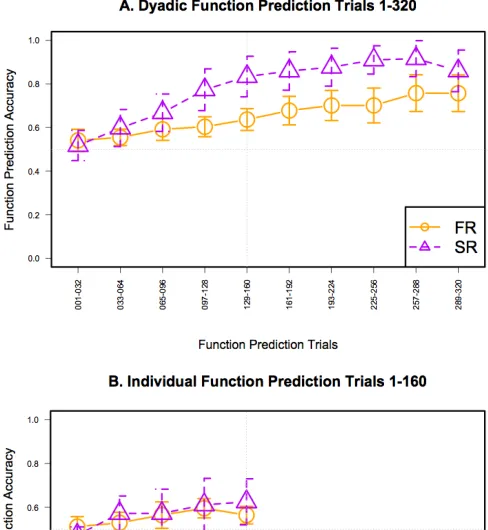
family-resemblance function prediction accuracy rates of dyadic learners vs. individual learners who completed 160 learning trials vs. individual learners who completed 320 learning trials. Error bars indicate confidence interval. ...50 Figure 8. Compares the simple-rule function prediction accuracy rates vs. simple-rule
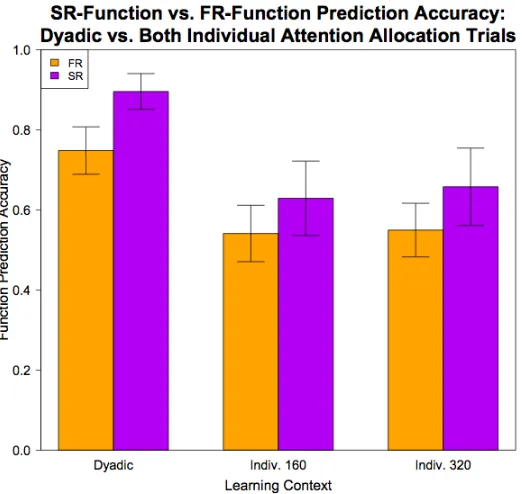
function prediction accuracy rates of dyadic learners vs. individual learners (both individuals who completed 160 learning trials and individuals who completed 320 learning trials) during the Attention Allocation task. Error bars indicate confidence interval. ...53 Figure 9. Compares the probability that a dyadic learner vs. individual learner (both
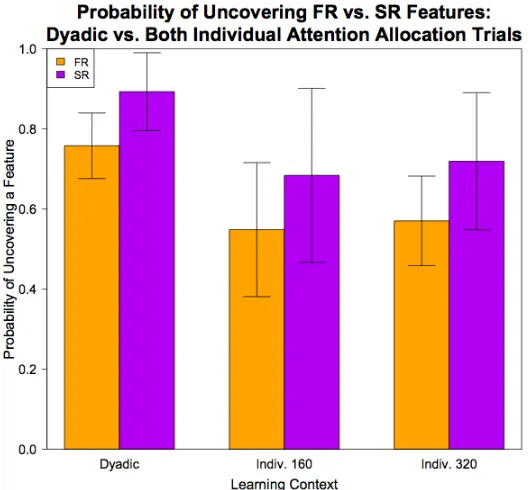
individuals who completed 160 learning trials and individuals who completed 320 learning trials) would uncover a family-resemblance related versus simple-rule related feature on any Attention Allocation task trial. Error bars indicate confidence interval. ...54 Figure 10. Compares the structural similarity of the post-learning sort clusters produced
viii
clusters defined by one or another type of rule. Error bars indicate confidence
interval. ...55 Figure 11. Compares the probability that dyadic learners vs. individual learners (both
individuals who completed 160 learning trials and individuals who completed 320 learning trials) mentioned features relating to one or another type of rule when explaining their post-learning sorts. Error bars indicate confidence interval. ...56 Figure B1. Examples of the binary feature values that instantiate the stimuli and the
perceptual structure of the functional categories...85 Figure C1. Describes the scenario for the game tasks and provides instruction on how to
execute function-prediction related actions. ...86 Figure C2 A & B. Spotter’s Function Prediction Task Interface. A (top) = Single Player,
and B (bottom) = Two Player...87 Figure C3 A & B. Function Prediction Task Instructions. A (top) = Single Player, and B
(bottom) = Two Player...88 Figure C4. Two-Player Beamer Function Prediction (FP) Task Interface...89 Figure C5. Interface for the PRE-sort and POST-sort tasks...90 Figure C6 A & B. Instructions for the PRE-sort (top) and POST-sort tasks (bottom). ....91 Figure C7. Attention Allocation Task Interface...92 Figure C8. Instructions for Attention Allocation Task, including how to execute
ix
ACKNOWLEDGEMENTS
First, I need to thank my advisor and collaborator, Professor James Corter, whose generous contribution of time, energy, and intellect helped me bring this project to fruition. I look forward to our continued collaboration.
Also, I thank the members of my dissertation committee—Professors Robert McClintock, Deanna Kuhn, Peter Coleman, and Oded Koenigsberg—who as teachers and interlocutors variously helped me to prepare for my current and future endeavors.
I must acknowledge the support of the Ben and Grace Wood Fellowship, which, for the first three years of my graduate school career, afforded me the freedom to pursue learning beyond the confines of any curriculum and research beyond the confines of any disciplinary commitments.
In the same breath, I must thank Manu Kapur (now Professor Kapur) and Professor Charles Kinzer; our research collaboration and our coffee klatch contributed immeasurably to my development as a thinker and as a scientist.
I must also thank Professor John Black, who believed that a poet, erstwhile hacker, and dabbler in artificial life and artificial intelligence had something to contribute to the cognitive study of education and learning technologies.
x
DEDICATION
I. INTRODUCTION
Background
Joint Activity & Referential Communication
Human beings engage in myriad joint activities: a parent and child jointly build a Lego robot; two families jointly plan and execute a wedding celebration; a far-flung group of scholars and researchers jointly develop a domain of knowledge. The successful performance of these and other joint activities requires the coordination of actions
(Schelling, 1960); the coordination of actions presupposes the coordination of intentions, assumptions, and beliefs that drive those actions (Lewis, 1969; Stalnaker, 1978, 2002; Clark, 1996). Referential communication can facilitate these multiple levels of
coordination (cf., Bangerter & Clark, 2003; Sacks, Schegloff, & Jefferson, 1974).
An Example of Coordination Through Referential Communication
I’m at it?” While the conversation between Alpha and Beta could continue in this way over multiple pages, this much of the exchange suffices to illustrate how referential communication helps them coordinate their culinary seduction of Bonita and Belle.
“Public” Categorization
Referential communication serves as a form of externalized or “public” cognition (cf., Wittgenstein, 2001 [1958]), including “public” processes of categorization (see Russell, 1905; Brown, 1958; Grice, 1975; Cruse, 1977; Barr & Kronmüller, 2006 for various formulations of the conceptual function of reference). In the scenario, Alpha performs three such “public” categorizations: “aromatics” are a category of vegetables— onions, carrots, celery, et al.—used to flavor a dish, while “tagine” and “dutch oven” are subcategories of braisers—shallow, tightly-lidded pots used for slowly cooking a dish in its own condensation. By using a particular reference at a particular level of reference, communicating actors direct each other's attention (Kronmüller & Barr, 2007; Metzing & Brennan, 2003) to those features that allow each of them to differentiate the target referent from other possible referents (E.V. Clark, 1987; Mervis & Crisafi, 1982; Murphy
1958; Corter & Gluck, 1992). The tagine originates from Morocco; so, Beta infers from that feature that Alpha has proposed that they prepare a Moroccan dish and confirms that joint intention by asking if he should boil water for couscous. Beta’s confirmatory question completes the “public” categorization of the tagine. The successful use of a particular reference at a particular level of reference should elicit an action that confirms the joint construal of both the target and its significance to the activity (Austin, 1976; Krauss & Weinheimer, 1966; Wilkes-Gibbs & Clark, 1992; Clark & Schaefer, 1989).
Shareability
Cooking is a recurring, often institutionalized, coordination problem; therefore Alpha and Beta can rely heavily on conventions of referential communication—a repertoire of mutually-known, mutually-salient, and mutually-expected associations between reference and concept. Adherence to referential conventions can minimize the cognitive effort of directing joint attention, confirming joint construal, and executing joint intentions (Clark, 1996, Lewis, 1969). In this way, referential conventions convey conceptual information in a highly shareable form (cf., Freyd, 1983). Nevertheless, when faced with a new or unfamiliar activity, communicating actors often rely on ad hoc referential conventions (Garrod & Anderson, 1987; Brennan & Clark, 1996; et al.).
Isaacs & Clark, 1987; Clark & Krych, 2004), and executing joint intentions (Clark & Lucy, 1975; Francik & Clark, 1985). The use of “mini-bulb” directs Alpha’s attention to a small glass object, containing a fine metal element. Alpha responds, “yeah, the filament has melted,” confirming his joint construal of “mini-bulb.” Moreover, these ad hoc conventions may affect how each actor later sorts conventionally named objects (Markman & Makin, 1998) and how each actor later judges the similarity and/or typicality of objects to a conventionally named category (Malt & Sloman, 2004). For example, one might expect Alpha or Beta to search for glass cartridge fuses in the lighting aisle of the hardware store rather than the circuitry aisle.
Nevertheless, ad hoc referential conventions can vary in shareability. The mini-bulb category ultimately fails. It does not enable either Alpha or Beta to infer the functional significance of the fuse—a device for protecting circuits from the power surges that today burned a fuse and tomorrow might burn their building. For Alpha and Beta this failure will not persist; the hardware clerk will likely provide the necessary knowledge. In an entirely novel activity, communicating actors lack both prior
knowledge and access to third-party experts. They must invent a referential lexicon for the objects, actions, and events in the activity environment as they discover the
differentiating and significant features of those objects, actions, and events. Under such conditions, shareability may vary with more basic factors, such as feature structure.
Structural Constraints
significance more easily than complex relationships (cf., Feldman, 2003b). Imagine Bonita, a bee researcher, trying to diagnose colony collapse. She easily diagnoses parasite infestation, based on the presence or absence of mites; diagnosing vanishing bee
syndrome, with its varying constellation of symptoms and uncertain causes, requires more effort and yields tentative results. Then again, simply labeling a privately learned category can enhance an individual’s ability to infer the category’s significance to the activity despite fairly complex, even contradictory, featural information (Yamauchi & Markman, 2000). Even a tentative diagnosis of a “syndrome” should prompt Bonita to suspect factors that cause general disruptions in the immune systems of the bees. What happens, though, when Bonita invites Belle, a designer of agent-based models, to collaborate on a simulation of colony collapse; will their conversation bog down in the complexities of vanishing bee syndrome, or will their emerging convention of referential labels enhance their joint reasoning? How structural complexity affects the shareability of ad hoc conventions remains uncertain.
Purpose
individually or as cooperative1 dyads to learn four combinations of orthogonal functional features—nutritive vs. not nutritive and destructive vs. not destructive—that defined four categories of fictional extra-terrestrial creatures. These categories were not specifically identified or labeled; rather, participants had to infer them indirectly as they predicted the functions. Also, these functionally defined categories exhibited a complex perceptual structure: a unidimensional (simple) rule predicted one function, while a family
resemblance (complex) sub-structure predicted the other function. This function-learning task yielded function prediction data. In addition to the main function-learning task, each learner worked individually to sort the creatures (pre- and post-function learning) and to predict their functions in an individual function prediction posttest that also yielded selective attention data. Together, the prediction data, sort data, and selective attention data demonstrated the overall affects of referential communication on the extra-linguistic aspects of concept learning and the differing affects of communication on the learning of simple versus complex relationships between perceptual and latent features.
Structure of the Dissertation
What follows is a detailed report of this investigation, organized into four chapters. In the Literature Review chapter, I attempt to integrate findings and constructs from two research traditions: cognitive research on category learning, both in general and with an explicit focus on lexically labeled categories, and psycho-linguistic research on conversation and referential communication. From this integrated review, I glean three
1 Dyads had positively interdependent goals: the success of each actor depended on the
hypotheses: referential communication generates conceptual homogeneity (H3) and enhances indirect category learning (H1), though simple rules are better learned than complex relationships (H2). The Method chapter provides details on the experimental design that I used to test these hypotheses, as well as on how and why I collected and analyzed the various data. Next, in the Results chapter, I highlight how the learning data and the linguistic data supported the hypotheses. Finally, I interpret the major findings in the Discussion chapter. In particular, I focus on how referential communication directs attention to relationships between features (perceptual and functional) and action. In addition, I argue that referring expressions may render such relationships more
II. LITERATURE REVIEW
When faced with a new or unfamiliar joint activity, communicating actors quickly converge on ad hoc referential conventions (Garrod & Anderson, 1987; Brennan & Clark, 1996; et al.). These ad hoc conventions entail a system of shared or “public” categories of the objects, actions, and events in the activity environment. The shareability of a convention derives from the extent to which it minimizes the joint cognitive effort of sharing attention and intentions towards those objects, actions, and events (cf., Freyd, 1983). In the wild, shareable conventions emerge from the coupled evolution of both the linguistic and extra-linguistic aspects of the various “public” categories during
conversationally driven joint activity. I consider this evolution from the perspective of two research traditions: cognitive research on “private” category learning, both in general and with an explicit focus on lexically labeled categories; and psycho-linguistic research on conversation and referential communication. Integrating these traditions yields hypotheses about the “public” category learning entailed in the emergence of shareable conventions that one could not derive from either tradition alone.
Plausible Constraints on Human Category Learning
the human conceptual system. Some constraints originate from outside human beings. For example, both the natural and artificial worlds exhibit structural regularities (e.g., Berlin, Breedlove, & Raven, 1966; Simon, 1956). Other constraints originate from within human beings. These include, limits on memory and selective attention (e.g., Shepard, Hovland, and Jenkins, 1961), the limits of embodiment (e.g., Gallese & Lakoff, 2005), and the limits of personal experience (e.g., Murphy & Medin, 1985), among others.
Structural Constraints
Among the various constraints addressed by the categorization and decision-making literature, the structure of the features defining categories of objects, actions, and events appears to exert the most pervasive or, at least, most discernible influence on category learning and use (Rosch, Mervis, Gray, Johnson, & Braem, 1976; Corter & Gluck, 1992; Simon, 1956; Todd & Gigerenzer, 2007). For example, population-wide regularities in how individuals name and classify various natural kinds, including colors (e.g, Kay et al., 2007 [2003]), kinship (e.g, Goodenough, 1965; Romney & D’Andrade, 1964; Romney, Boyd, Moore, Batchelder, & Brazill, 1996), as well as plants and animals (e.g, Berlin, Breadlove & Raven, 1973; Diamond, 1966; Bulmer, 1967; Hunn, 1977), appear to reflect statistical regularities in the environment (Berlin et al., 1966; Rosch et al., 1976). This concordance holds even after one accounts for the arbitrary distinctions
within any particular population-wide convention (Malt, Sloman, & Gennari, 2003a, 2003b; Malt, Sloman, Gennari, Shi, & Wang, 1999).
Smith, 1982), actions (Tomasello & Merriman, 1995; Vallacher & Wegner, 1987), and events (Morris & Murphy, 1990; Rifkin, 1985) at a level of abstraction—the so-called basic level—that permits the average person to infer the maximal number of
differentiating features of those objects, actions, and events (Gluck & Corter, 1985). For example, if Alpha, the imaginary character from the Introduction, were talking to Bonita, a culinary novice, he would likely refer to the tagine as “the pot with the conical lid” instead of using the category label tagine or even braiser. Similar tendencies in the naming and identification of experimenter-designed categories suggest that statistical regularities in the environment may push human conception towards the most
informative level (Corter, Gluck, & Bower, 1988; Murphy & Smith, 1982; Hoffmann & Ziessler, 1983). In fact, various analytical models (e.g, Gosselin & Schyns, 2001; Gluck & Corter, 1985; Rosch et al., 1976; Jones, 1983) can approximate the observed primacy of basic-level categorization as a function of featural information.
Informational & Biological Constraints
Phenomena like basic-level primacy appears so pervasive that one might
beings and other primates (Hauser, 2005). Nevertheless, many primate species exhibit homologous understandings of various concepts, such as small quantities (Dehaene, 2001; Hauser, 2000; Hauser et al., 2000, 1996), gravity (Hood, Hauser, Anderson, & Santos, 1999), distinctions between living and artifactual kinds (Hauser, 1997), and functional distinctions among artifactual kinds (ibid.). Moreover, non-human primates trained to use arbitrary symbols can make abstract judgements that are seldom recognized in the wild (Thompson, Oden, & Boysen, 1997).
For the most part, the differences between the human and non-human conceptual systems appear quantitative rather than qualitative (Deacon, 2000). A coupling of a quantitatively different conceptual system with quantitatively different capacities for opportunistic learning suffices to produce qualitatively different results (Wagner & Wagner, 2003). Add to that, a quantitatively different capacity for sharing mental states (e.g., Meltzoff & Andrew, 2007; Saxe, 2006; Tomasello, Carpenter, Call, Behne, & Moll, 2005; Bloom, 2002) via heritable media (e.g., language and artifacts; cf.; Hutchins & Hazelhurst, 1992; Cavalli-Sforza & Feldman, 1983; Vygotsky, 1978), and strongly adaptionist accounts of the human conceptual system appear, at best, unnecessary (Gould & Lewontin, 1979).
At most, one might argue that comparable sensori-motor capacities among human beings may yield comparable experiences and, thus, comparable conceptions of a
Structural & Cognitive Constraints
Cognitive constraints, such as limits on working memory and selective attention, represent a less controversial expression of biology. Structural and cognitive constraints appear to intermingle in the oft-cited study by Shepard, Hovland, and Jenkins (1961), where varying the number and combination of diagnostic dimensions of artificial category structures varied the time and effort required to learn those structures (see also Nosofsky, Gluck, Palmieri, Mckinley, & Glauthier, 1994; Love, 2002). Assuming that category learners attempt to optimize selective attention across diagnostic dimensions, one could attribute the increasing cognitive effort directly to increasing demands on selective attention and working memory (e.g, Nosofsky et al., 1994). More often, though, category learners rely on satisficing solutions (Simon, 1955), inferring categories from the simplest description derivable from known exemplars (Feldman, 2003b; Chater & Vitányi, 2003). For example, in the Introduction, Beta relies on the diagnostic features of the familiar category light bulb—glass object containing a filament—to identify the unfamiliar fuse as a “mini bulb.” This sort of “fast and frugal” reasoning conserves cognitive resources (e.g, Todd & Gigerenzer, 2001; Gigerenzer & Goldstein, 1996) and has been observed in categorical decision-making (Matsuka & Corter, In Press; Medin et al., 1987).
the category structure with three diagnostic and nonlinearly separable dimensions
compresses no smaller than ten bits of information. In other words, the simplest heuristic for learning the latter category structure would require nothing short of memorizing each category exemplar (e.g, Allen & Brooks, 1991). In the Introduction, Bonita’s difficulty in diagnosing Vanishing Bee Syndrome attests to the excessive cognitive effort required in learning and using an incompressible category structure.
Structure, Cognition, and Activity
The increasing effort required for learning increasingly complex structures may stem, in part, from the particular activity—classification—that dominates laboratory studies on categorization (for review, see Markman & Ross, 2003). The interplay
between structural, cognitive, and activity-related constraints becomes obvious when one contrasts alternative uses of categories (ibid.)—e.g., classifying an object versus inferring its uncertain features. Whereas classification focuses attention on between-category featural information, those engaged in feature inference appear to allocate attention to category featural information, especially to specific feature values and the within-category correlations among these values (Yamauchi & Markman, 1998, 2000a, 2000b). For example, if one needed to classify a particular brazier as either a tagine or a dutch oven, one would attend to the category differentiating features—ceramic vs. cast iron,
complex category structures (ibid.). Those engaged in an inference task learn both simple and complex category structures with comparable effort (ibid.).
Activities that involve the indirect learning of categories—e.g, looking for patterns among stimuli or rating their pleasantness—appear similar to inference tasks in attentional strategy and the effort expended in learning simple versus complex category structures (Love, 2002, 2003). Minda & Ross (2004) serves as a noteworthy example of indirect category learning. Participants predicted the food allotment for a sequence of imaginary animals. Successful predictions required the learning of a complex category structure, where both a unidimensional rule and family resemblance (multidimensional rule) predicted the food allotment. While participants could rely on either or both rules, attentional strategies varied with whether or not a classification task (direct category learning) preceded the prediction task (indirect category learning). Those who classified animals before predicting food allotments relied on the simple rule; those who only predicted food allotment distributed their attention across multiple dimensions (see also Ross, 1997, 1999).
Person-Related Constraints
expectations of how the objects, actions, and events of a new, rare, or unfamiliar activity relate to one another (c.f., Murphy & Medin, 1985). Moreover in trying to induce the actual relationships among the objects, actions, and events, differing individuals might
use different heuristics (Lin & Murphy, 1997). In this way, person-related constraints can enhance or impede the learning of novel categories. For example, when Bonita and Belle build their computational simulation of Vanishing Bee Syndrome, they are likely to model complex interactions among variables like microwaves and genetically modified crops based on their prior expectations of a syndrome. Likewise, they are likely to exclude simple factors like mite infestation, which might account for many symptoms of the syndrome. Usually, when faced with contrary evidence, the category learner abandons misapplied prior hypotheses (Livingston & Andrews, 1995). The absence of glass
cartridge fuses in the lighting aisle of the hardware store will prod Alpha and Beta towards the circuitry aisle. When prior hypotheses bear some resemblance to the
observed evidence, though, mistaken hypotheses can persist and impede learning (ibid.). A simulation that includes microwaves and genetically modified crops but excludes mite infestation will not help beekeepers.
Language Constraints
1991). Category labels appear to serve three interrelated functions: (1) as conceptual cues, (2) as conceptual manipulatives, (3) and as conceptual manipulators.
Category labels as conceptual cues
By the principle of contrast (E.V. Clark, 1987), different category labels signal different concepts. For example, labeling objects by different names can help children individuate those objects (Xu, 2002) and often leads them to look for differences among differently-labeled objects (Katz, 1963; Landau & Shipley, 2001) and for similarities among objects with the same name (Loewenstein & Gentner, 2005; Smith, Jones, & Landau, 1996; Waxman & Markow, 1995). Similarly, adults learn event categories better when verbs and/or syntax covaries with the events (Cabrera & Billman, 1996). Also, children often treat unknown labels as category labels for unknown objects and as feature labels for known objects (Markman & Wachtel, 1988). Finally, the mere presence of category labels can cue the category learner to look for meaningful patterns in what he or she perceives. Children tend to pay more attention to labeled categories than to unlabeled categories (Balaban & Waxman, 1997; Waxman & Booth, 2001) and adults learn labeled categories more quickly than unlabeled categories (Lupyan, Rakison, & McClelland, 2007). In all, category labels appear to make abstractions concrete and implicit judgements explicit (A. Clark, 2006, Vygotsky, 1986 [1962]).
Category labels as conceptual manipulatives
labels, category learners may have offloaded burdensome feature comparisons onto the category labels between which differences and similarities are easy to discern (A. Clark & Karmiloff-Smith, 1993). Beyond differentiation, children rely more on category labels than perceptual similarity when inferring unknown features (Gelman & Markman, 1986), and use labels to simplify relational judgements (Kotovsky & Gentner, 1996). Moreover, labels anchor abstract concepts like large (Gordon, 2004) and exact numerosities
(Gellman & Gallistel, 2004) as well as conceptual manipulations like exact mental arithmetic (Beller & Bender, 2008; Pica, Lemer, Izard, & Dehaene, 2004). Finally, labeling categories enhances visual search by reducing the search space to the category-relevant features (Lupyan, 2008), or, put another way, by maximizing attention to diagnostic features.
Category labels as conceptual manipulators
Engstler-Schooler, 1990) or a particular wine (Melcher & Engstler-Schooler, 1996) can impair later recognition of that face or that wine. Surprisingly, describing a face in terms of prototypical features does not distort memory (MacLin, 2002). In all, category labels appear to manipulate the conceptual system via a top-down activation of category
features that attracts attentional processes and colors or ocludes memory and perception.
Summary of Plausible Constraints
Structure, complexity, language, and activity (along with embodiment and person-related constraints) represent an A-list rather than a catalog of all plausible
Conceptual Coordination Via the Processes of Referential Communication
Referential Games
In new or rare or unfamiliar joint activities, actors often coordinate their actions through conversation (Clark, 1996). Since Wittgenstein (2001 [1958]), the processes of conversation, in general, and referential communication, in particular, have often been formulated as a game (cf., Higgins, 1981; Crawford & Sobel, 1982; Blume, Dejong, Kim, & Sprinkle, 1998; Pietarinen, 2006). The players, as speaker and addressee, set the rules of play and keep score through their ongoing joint construal of the various referents and their significance to the activity (Lewis, 1979). Coordination proceeds through a turn-taking process where, at any iteration, a speaker will refer to some object, action or event in the activity environment. The speaker’s use of a particular reference at a particular level of reference functions as a public categorization of the referent, differentiating the referent and highlighting its significance to the activity (see Russell, 1905; Brown, 1958; Grice, 1975; Cruse, 1977; Barr & Kronmüller, 2006 for various formulations of the conceptual function of reference). In reply, the addressee can ratify the proposed
Coordination of Attention and Intention in Referential Games
To illustrate such a game, imagine Bonita and Belle collaborating in what for them is a novel activity, cooking. Rummaging in the pantry for ingredients, Bonita requests, “could you sharpen the big knife?” Grasping a carving knife, Belle asks, “this long one?” “Is it big?” Bonita checks, to which Belle insists, “long is big.” “Fine, the wide one,” clarifies Bonita. Carrying shallots from the pantry, Bonita finds a sharpened cleaver on her cutting board and responds, “well, you can use that to hack apart the rib chops, but that’s not a dicing tool.” “It’s wide,” persists Belle. “I need the one that widens from a point to a round belly,” Bonita further clarifies. “Oh, this one,” pulling the chef’s knife from the block; “it’s like half a bow” she counter proposes. “Yes,” Bonita confirms, “the half-bow knife.”
From Private to Public Categories…
Early in conversation, each actor is likely to propose and/or counter-propose relatively idiosyncratic or private categorizations of the objects, actions, and event in the activity environment (Horton & Keysar, 1996; Keysar, Barr, Balin, & Brauner, 2000; Keysar, Barr, Balin, & Paek, 1998; Kronmüller & Barr, 2007; Furnas, Landauer, Gomez, & Dumais, 1987). Like Bonita and Belle, they may differ in perspective (Barsalou & Sewell, 1984; Keysar, Lin, & Barr, 2003), intentions (Barresi & Moore, 1996),
example, Bonita uses the heuristic big => wide, while Belle uses the heuristic big => long. With each iteration of proposal/counter-proposal and ratification/clarification, each actor relies increasingly on publicly available information, shifting from private to public categories (cf., Fussell & Krauss, 1989; Krauss & Fussell, 1991; Clark & Brennan, 1991).
Joint Attention, Joint Intention, and Joint Reference
From Joint Reference to Referential Convention
Often, over the course of a conversation, these referential precedents develop into mutually-known, mutually-salient, and mutually-expected associations between reference and concept—i.e. a referential convention. Such ad hoc conventions derive from
opportunistic and/or pre-conscious learning coupled with the dynamics of conversation. In the scenario, Bonita ratifies Belle’s proposed conceptualization “it’s like half a bow” with the name-like reference “the half-bow knife.” This might represent opportunistic learning, where Bonita exploits the opportunity for repeated success in referring to the chef’s knife. This might also represent pre-conscious learning, where Bonita speaks what she hears due either to the common coding of comprehension and production or some other priming mechanism (see Pickering & Garrod, 2004, 2006 on pre-conscious
linguistic coordination; also see Prinz, 1990, and Liberman & Whalen, 2000 on common coding). In either case, a recently used reference is frequently reused, and a frequently used reference is mutually available and mutually expected for further reuse (Brennan & Clark, 1996). This process drastically reduces the lexical variability between
communicating actors, often leading to referential conventions that one could not predict from common usage patterns and/or normative theories (Barr & Keysar, 2002; Brennan & Clark, 1996; W. Deutsch & Pechmann, 1982; Pechmann, 1989).
subordinate-level precedent—e.g., tagine—communicating actors expect each other to adhere to that precedent even when a basic-level reference—e.g., brazier or pot—would convey information sufficient for the joint activity (Brennan & Clark, 1996; Barr & Keysar, 2002). Moreover, these over-specified references usually persist into subsequent conversations with different conversational partners (ibid.).
From Public to Private Categories
A phenomenon like persistent over-specification seems unremarkable if one accepts that reference does more than label or index objects, actions, and events. In fact, a “public” category can persist beyond the confines of a conversation. Communicating actors often continue to use the “public” categories even in extra-linguistic activities that each performs in private. Studies by Markman & Makin (1998) and by Malt & Sloman (2004) illustrate this phenomenon more forcefully than would another imaginary scenario with Alpha and Beta or Bonita and Belle talking to each other.
Dyads generally adhered to their negotiated referential conventions. Also, while each dyadic lexicon differed in its particulars, they shared similar mappings between lexical references and the structural hierarchy of Lego blocks. The lexemes tended to refer to basic-level categories of blocks, and modified lexemes tended to refer to
subordinate categories of those blocks. More importantly, “public” categorizations appear to percolate into private conceptualizations.
Absent the model-building context or any conversation, the sort-only group sorted blocks differently from one another. The experience of building the Lego model
moderated variability in the sorts produced by the build-sort group. Adding referential communication to the building process reduced both within-dyad and between-dyad variability most of all; participants in the joint-build group sorted blocks much like their partners and much like members of other dyads.
speaker, they usually attempted to transfer the referential conventions established in conversation with the previous speaker to conversations with subsequent addressee.
Following the collaborative card sorting, participants provided individual preference, typicality, and similarity ratings for each of the name pairs and the various target objects. Malt & Sloman found that, both when engaged in the joint activity and following the joint activity, participants overwhelmingly preferred to use the names introduced by the confederate over the other equally valid and equally common artifact names. Further, participants judged activity-related artifacts as more typical of categories named in conformity with the referential convention. Finally, participants judged activity-related artifacts as more similar to imagined prototypes of categories named in
conformity with the referential convention. Again, “public” categorizations appear to percolate into “private” conceptualizations.
Conclusion and Hypotheses
interaction of referential communication and the structure of perceptual features on the joint processes of inventing a referential lexicon for novel objects and discovering the functional significance of those objects during a novel activity. Specifically, I test three hypotheses:
H1. Referential communication enhances indirect category learning
This hypothesis is original to the present study. Previous research (Markman & Makin 1998) comparing “public” versus “private” category learning used stimuli for which there were multiple potential category configurations. So, one could not discern whether “public” categorizations were in any way better than “private” categorizations, only whether “public” and “private categorizations were different from one another.
Nevertheless, referential communication directs the joint attention and joint actions of communicating actors. Moreover, reference can be used to cue and compress concepts. Thus one should expect those engaged in a “public” categorization activity to learn unlabeled categories better than those engaged in a “private” categorization activity.
H2. Referential communication enhances the learning of simple rules more than complex rules
Nevertheless, communicating actors may articulate and comprehend simple relationships between the referent's features and its significance to the activity more quickly and easily than complex relationships. Moreover, they may more quickly and easily cue and compress those concepts. Thus, one should expect those engaged in a “public” categorization activity to learn simple relationships more quickly and easily than complex relationships.
H3. Referential communication generates conceptual homogeneity
III. METHOD
Purpose & Overview
With the present study, I investigated the interaction of referential communication and the structure of perceptual features on the joint processes of inventing a referential lexicon for novel objects and discovering the functional significance of those objects during an indirect category learning activity. To that end, participants worked either individually or as cooperative2 dyads to learn four combinations of orthogonal functional features—nutritive vs. not nutritive and destructive vs. not destructive—that defined four categories of fictional extra-terrestrial creatures. These categories were not specifically identified or labeled; rather, participants had to learn them indirectly as they predicted the functions. Also, these functionally defined categories possessed a complex perceptual structure: a unidimensional (simple) rule predicted one function, while a family
resemblance (complex) sub-structure predicted the other function. This function-learning task yielded function prediction data. In addition to the main function-learning task, each learner worked individually to sort the creatures (pre- and post-function learning) and to predict their functions in an individual function prediction posttest that also yielded selective attention data.
2 Dyads had positively interdependent goals: the success of each actor depended on the
Together with data extracted from the transcripts of the dyadic conversations, the prediction data, sort data, and selective attention data demonstrate the extent to which:
H1. referential communication enhances indirect category learning;
H2. the learning advantages of dyadic learners vary with the complexity of the category structure; and
H3. referential communication generates conceptual homogeneity.
Participants
Thirty-five male and thirty-seven female students (mean age 25.1) from throughout the Columbia University community participated in this study for a cash payment.
Participants were recruited using flyers posted widely across the university campus. The flyer promised a cash payment for participation and a digital audio player for the best performing participant. All participants were native speakers of the English language, with an average of four years of post-secondary schooling during which they devoted an average of two (or fewer) hours per week to computer games.
Design
Three independent variables were manipulated in the design of this study.
Learning context served as a between-subjects factor with three levels—dyadic learning (N=32) versus individual learning with 160 trials (N=16) versus individual learning with 320 trials (N=24). The two individual learning conditions were created in response to
learner described stimuli on 160 learning trials and heard descriptions of stimuli on an additional 160 learning trials. Moreover, they received corrective feedback on predictions for all 320 trials. One could debate whether acting on a verbal description of an unseen stimulus leads to the same learning as both seeing and acting on a stimulus. So, the two individual learning conditions each represent the two boundary conditions: 160 versus 320 learning trials. Learning trials were divided into blocks of thirty-two trials. Block served as a within-subjects factor with either five or ten levels, depending on which learning conditions were compared. Finally, type of rule served as a within-subjects factor with two levels—simple rule versus family resemblance.
Log files generated during each task for each participant provided data on the effects these manipulations had on four dependent variables that capture aspects of category learning:
1. the accuracy with which participants predicted the functional features;
2. the structural similarity of participant sorts to the "true" category structure, its sub-structures, or the sorts of other participants;
3. the type of explanation participants cited for their sorts, and
4. the attention allocated to surface features when making predictions.
Materials
The Design of the Category Structure
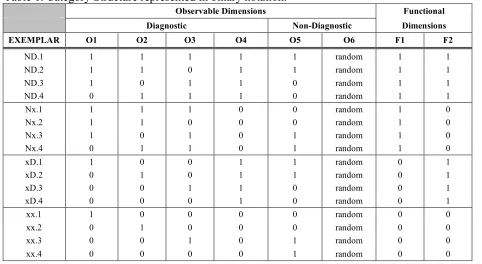
Six observable dimensions (O1-O6) and two functional dimensions (F1 and F2) defined the category structure used in this study (Table 1). The four combinations of binary values on F1 and F2 defined four categories, while sixteen combinations of binary values on O1-O5 defined the sixteen exemplars. The distribution of exemplar-defining value combinations met several criteria: each category entailed four unique exemplars, among which similar value combinations on O1-O3 predicted the value on F1 (family
resemblance rule type), the value on O4 predicted the value on F2 (simple rule type),
while the value on the O5 did not predict the value on any other dimension. Adding a modicum of naturalistic noise, O6 varied randomly across a range of possible values. The values on O6 did not predict the value on any other dimension.
Table 1. Category Structure represented in binary notation.
Observable Dimensions Functional
Diagnostic Non-Diagnostic Dimensions
EXEMPLAR O1 O2 O3 O4 O5 O6 F1 F2
ND.1 1 1 1 1 1 random 1 1
ND.2 1 1 0 1 1 random 1 1
ND.3 1 0 1 1 0 random 1 1
ND.4 0 1 1 1 0 random 1 1
Nx.1 1 1 1 0 0 random 1 0
Nx.2 1 1 0 0 0 random 1 0
Nx.3 1 0 1 0 1 random 1 0
Nx.4 0 1 1 0 1 random 1 0
xD.1 1 0 0 1 1 random 0 1
xD.2 0 1 0 1 1 random 0 1
xD.3 0 0 1 1 0 random 0 1
xD.4 0 0 0 1 0 random 0 1
xx.1 1 0 0 0 0 random 0 0
xx.2 0 1 0 0 0 random 0 0
xx.3 0 0 1 0 1 random 0 0
Observable dimensions O1-O3 jointly predict functional dimension F1. Observable dimension O4 predicts functional dimension F2. The assignment of the perceptual features of stimuli to O1-O4 and the functional features to F1-F2 was counterbalanced.
The Design of the Stimuli
Computer graphics of fictional extra-terrestrial creatures instantiated this category structure (using the Squeak variant of Smalltalk, in a 32-bit graphical environment). Each creature possessed four diagnostic observable features—tentacles (T), fins (F), torso animation (A), and eyes (E)—which varied between two levels (Figure B1 illustrates the two levels for each physical feature). Four permutations of these physical features—(1) TFAE, (2) ETFA, (3) AETF, (4) FAET—were assigned to dimensions O1-O4 in order to counterbalance any effects due to prior expectations of physical/functional correlations. The fill colors and border colors (dimension O5) assigned to these physical features remained either stable (one of two non-predictive values) or constant. Also, the size (dimension O6) of each rendered creature varied in scale, from 90 to 110 percent (in increments of 1%) of the basic creature size. This subtle source of variation was meant to add a modicum of naturalistic noise to the category structure.
participants to learn how to discriminate between four functionally-defined creature categories—nutritive & destructive (ND), nutritive only (NX), destructive only (XD), or no functional significance (XX). The counterbalanced assignment of functional features to dimensions F1 and F2 was meant to account for any effects due to function/rule-type pairings.
Tasks
The Function Prediction Task
Across learning contexts, participants used the Function Prediction task to learn the functional combinations that defined the four unlabeled categories of creatures (see Minda & Ross, 2004, and Monos, 1997, for similar tasks). Participants could learn the four categories indirectly by learning the functional combinations. A time-stamped log of their predictions provided data on both their prediction accuracy. The Function
Prediction task entailed two separable roles: the spotter, who saw the creature; and the beamer, who performed the prediction-related action. In the dyadic learning context, each
participant’s initial role was assigned randomly on the first Function Prediction trial and alternated on each subsequent trial. In each of the individual learning contexts, each participant played both roles.
second marked by a tone) to decide which functional combination—ND, NX, XD, or XX—the creature entailed and take the functionally-appropriate action—respectively, stun & capture, stun, capture, or pass. Across learning contexts, the beamer executed
these actions with keystrokes on a standard computer keyboard. Individually, the <CTRL> key meant “activate tractor beam,” the <OPTION> key meant “activate stun beam,” and the <SPACE> key meant “fire” (execute the selected action). Thus, <CTRL-OPTION-SPACE> executed stun & capture, <<CTRL-OPTION-SPACE> executed stun,
<CTRL-SPACE> executed capture, and <SPACE> executed pass. An instructions screen offered participants detailed descriptions of key combinations (Figure C3 A & B); a color-coded summary of key combinations (Figure C2 A & Figure C4) appeared along the bottom of the beamer’s Function Prediction interface.
provided additional positive or negative feedback, namely a five to fifteen unit (pixel) increase or decrease in energy (length). As with the descriptive feedback, the energy meter reinforced even partially correct predictions, either granting partial points or dampening penalties. Table A specifies the rewards and penalties for each
function/prediction pairing. The Function Prediction task continued for either five or ten blocks of trials (depending on learning context), during which each of the sixteen creatures appeared twice in random order.
The Sorting Tasks
container, an explanation field appeared in the container, into which participants were instructed to provide a short explanation of why the creatures in the container belonged together. Participants could explain or edit that explanation at any time during the sorting process. Participants were free to create as many or as few categories (from one to sixteen) as they deemed necessary.
The Attention Allocation Task
The Attention Allocation task captured data on the attention participants allocated to the various physical features when deciding which functional combination—ND, NX, XD, or XX—the creatures entailed. The Attention Allocation task replicated the single-player Function Prediction task in all aspects except that each creature appeared with its various physical features hidden by graphical blinds (Figure C7). In order to uncover a feature, participants mouse-clicked its blind. Participants were instructed to uncover as many parts as they needed in order to decide each creature’s functional significance— ND, NX, XD, or XX—and whether to stun & capture, stun, capture, or pass (for instructions, screen see Figure C8). Also unlike the Function Prediction task, the
Attention Allocation task lasted for a single block of thirty-two trials, during which each of the sixteen creatures appeared twice in random order.
Procedure
assigned one of the four physical permutations and one of the two functional permutations. After granting informed consent, participants completed a short
questionnaire, providing their age, gender, years of post-secondary schooling, and the number of hours per week devoted to computer-game play. They were then seated at a computer terminal on either side of a 5’x5’ barrier, beyond which each participant could hear but not see the other. There, each observed a demonstration of the “game” interface and was given time to practice the use of the keyboard and mouse. Participants then proceeded through each of the four tasks: PRE-sort, function prediction, POST-sort, and attention allocation. Before each task, participants were permitted to seek clarification of the on-screen instructions. After completion of all tasks, each participant was debriefed.
Data Analysis
Deriving measures of prediction accuracy
For each individual learner, the Function Prediction task logs recorded the stimulus (represented as a vector of values on dimensions O1-O4 and F1-F2) that was presented on each trial along with the functional combination—nutritive & destructive, nutritive only, destructive only, or no functional significance—with which the learner
Averaging correct responses (correctly predicted functional combinations) across blocks of thirty-two trials (two presentations of each stimulus) yielded the functional-category prediction accuracy rates for individuals, dyads3, and, during the Attention Allocation task, for individual dyadic learners. The same procedure for correct predictions of each function yielded function-prediction accuracy rates.
Deriving measures of attention allocation
In addition to the prediction data, the Attention Allocation task logs recorded what features each learner uncovered before responding with a function prediction. For each learner, these data yielded the average number of features uncovered per stimulus. Further, these data were converted into two probabilities: the probability of uncovering a family resemblance feature and the probability of uncovering a simple rule feature. Specifically, the number of family resemblance features uncovered by each learner was summed across Attention Allocation trials then normalized by the maximum number of family resemblance features the learner could have uncovered. The probability of uncovering a simple rule feature was derived in the same way.
3 The responses of dyad members are dependent on one another during the Function
Deriving types of sorting explanations & measures of structural similarity
The logs recorded during the sorting tasks that preceded (PRE) and followed (POST) the Function Prediction task provided data on which creatures were sorted together as well as the explanations participants used to justify these creature clusters.
The explanations were segmented and coded as either function/behaviorally related (citing ± nutritive and ± destructive and/or ± capture and ± stun) or perceptually related (citing the surface features). Additionally, both function-related and perceptually-related explanations were coded as either family resemblance perceptually-related (citing a feature or function related to the family resemblance substructure) or simple rule related (citing a feature or function related to the simple rule substructure). Normalizing the frequency of each type of explanation by the number of creature clusters times the number of
explanation types yielded the probability of mentioning that type of feature. Similarly, normalizing the frequency of explanations that cited functional/behavioral combinations by the number of creature clusters yielded the probability of mentioning a functional category.
IV. RESULTS
Overall, the results demonstrate that dyadic learners learned the functionally defined categories more quickly and more accurately than individual learners. Also, dyadic learners exhibited greater conceptual homogeneity than individual learners. Nevertheless, the dyadic advantage in learning functions appeared earlier and was greater for the simple-rule predicted function than for the family-resemblance predicted function.
Referential communication enhances indirect category learning
Functional-category prediction accuracy
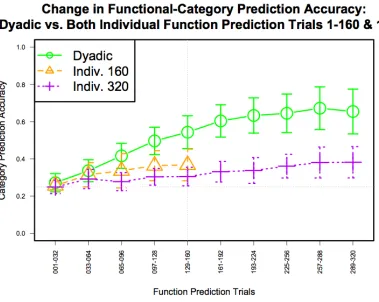
Dyadic learners predicted functionally defined categories with greater accuracy than did individual learners. Participants in the two individual learning contexts were similarly accurate in predicting functional categories during the initial five blocks of learning trials (1-160)4. This dyadic advantage is evident in Figure 1 (below), where three accuracy curves compare functional-category prediction accuracy rates by learning context across the initial five blocks of learning trials (1-160) and across the final five
blocks of learning trials (161-320).
Moreover, this early dyadic advantage was corroborated by a repeated-measures ANOVA on the functional-category prediction accuracy rate with learning context as a
4 Unless otherwise noted, data from the two individual learning conditions were
between-subjects factor and block (the five blocks that entailed learning trials 1-160) as a within-subjects factor. The interaction of learning context and block was significant—
!
F(4,216)=10.522,
!
p<.000,
!
ˆ
"2=.163—as were the main effects of learning context—
!
F(1,54 )=14.839,
!
p<.000,
!
ˆ
"2 =.216—and block—
!
F(4,216)=21.021,
!
p<.000,
!
ˆ
"2 =.280.
On average across the first 160 learning trials, dyadic learners predicted functional categories with an accuracy rate that increased more steeply than the accuracy rate of individual learners.
Figure 1. Compares the rate of functional-category prediction accuracy of dyadic learners vs. individual learners (both individuals who completed 160 learning trials and
The continued dyadic advantage was also corroborated by a repeated-measures ANOVA on the functional-category prediction accuracy rate with learning context5 as a between-subjects factor and block (the five blocks that entailed learning trials 161-320) as a within-subjects factor. Again, the interaction of learning context and block was
significant—
!
F(4,152)=8.980,
!
p<.000,
!
ˆ
"2=.191—as were the main effects of learning context—
!
F(1,38)=30.858,
!
p<.000,
!
ˆ
"2 =.448—and block—
!
F(4,152)=23.804,
!
p<.000,
!
ˆ
" 2=.328. On average across the final 160 learning trials, dyadic learners predicted
functional categories with an accuracy rate that continued to increase more steeply than the accuracy rate of individual learners.
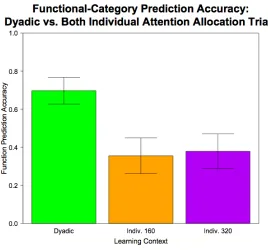
Figure 2. Compares the rate of functional-category prediction accuracy of dyadic learners vs. individual learners (both individuals who completed 160 learning trials and
individuals who completed 320 learning trials) during the Attention Allocation task. Error bars indicate confidence interval.
5 Unless otherwise noted statistical tests relating to learning trials 161-320 compared
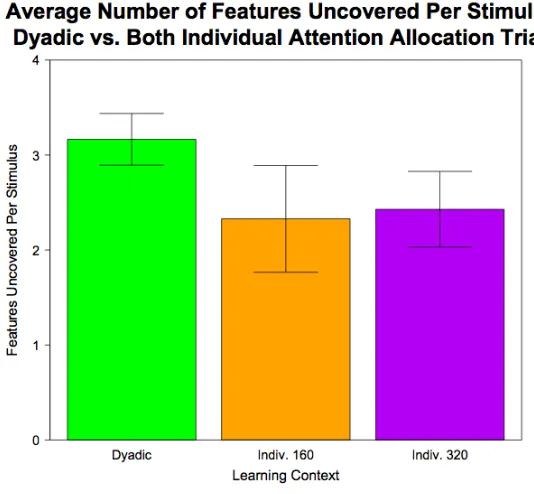
Figure 3. Compares the average number of features per stimulus that dyadic learners vs. individual learners (both individuals who completed 160 learning trials and individuals who completed 320 learning trials) uncovered during the Attention Allocation task. Error bars indicate confidence interval.
Posttest category prediction accuracy and attention allocation
The dyadic advantage persists into the attention allocation task (Figure 2). Not surprisingly, attention allocation—as represented by the average number of features uncovered per stimulus (Figure 3)—correlated with functional-category prediction accuracy—
!
r(acc.,attend)=.471,
!
p<.000. A MANOVA on the functional-category prediction
accuracy rate and attention allocation (features per stimulus) with learning context6 as a between-subjects factor yielded a significant multivariate effect—
!
F(2,69)=26.669,
!
p<.000,
!
ˆ
"2=.249—as well as significant univariate effects on functional-category
prediction accuracy—
!
F(1,70)=51.022,
!
p<.000,
!
ˆ
"2=.422—and on attention allocation—
6 Unless otherwise noted, data from the two individual learning conditions were
!
F(1,70)=14.275,
!
p<.000,
!
ˆ
"2=.169. On average, during the attention allocation task,
dyadic learners predicted functional categories with greater accuracy than individual learners—
!
M(dyad)=.697 (
!
SD=.192) vs.
!
M(indiv.)=.370 (
!
SD=.195)—while uncovering a greater number of perceptual features than individual learners—
!
M(dyad)=3.165
(
!
SD=.743) vs.
!
M(indiv.)=2.388 (
!
SD=.954).
Further, participants needed to uncover at least three features to determine the functional category of a stimulus. The mean number of features uncovered by dyadic learners, 3.165 (
!
SD=.743), did not differ significantly from that minimum—
!
t(31)=1.256,
!
p=.219. The mean number of features uncovered by individual learners,
2.388 (
!
SD=.954), fell short of the minimum—
!
t(39)=-4.057,
!
p<.000.
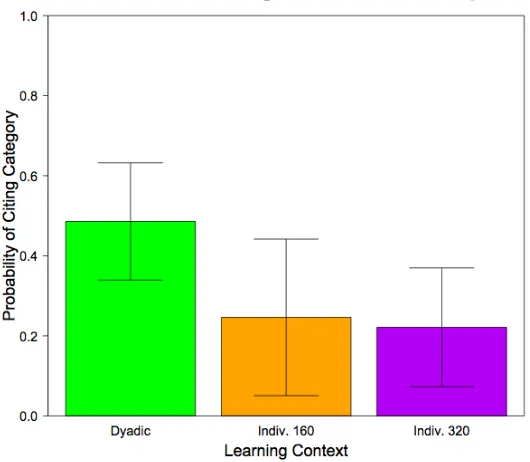
Figure 5. Compares the probability of citing a category (whether functionally-defined or behaviorally-defined) when dyadic learners vs. individual learners (both individuals who completed 160 learning trials and individuals who completed 320 learning trials)
explained their post-learning sort clusters. Error bars indicate confidence interval.
The structure of post-learning sort clusters
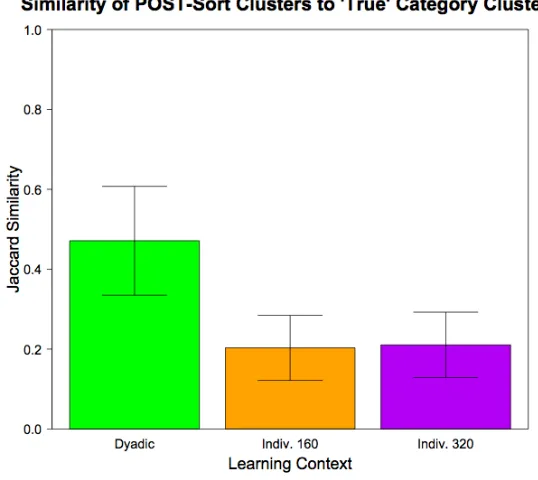
The dyadic learning advantage was also evident in how participants sorted creatures after the function prediction task. As described in the Data Analysis section of the Method chapter, post-learning sort clusters and the “true” category clusters were converted into binary co-occurrence matrices, each of which was rearranged as a vector. The jaccard similarity between each of the various co-occurrence vectors served as an indicator of structural similarity between clusters. As apparent in Figure 4, the post-learning sort clusters of dyadic learners were more similar to the “true” category clusters than were the post-learning sort clusters of individual learners—
!
M(dyad)=.471
(
!
SD=.372) vs.
!
M(indiv.)=.207 (
!
response to stimuli) with greater likelihood than did individual learners—
!
M(dyad)=.486
(
!
SD=.399) vs.
!
M(indiv.)=.231 (
!
SD=.344). The similarly of the post-learning sort
clusters and the “true” category clusters correlated with the reliance on category-related explanations of those clusters—
!
r(sim.,explain) =.614,
!
p<.000.
The differences between learning contexts were corroborated by a MANOVA on structural similarity (jaccard similarity of sorted co-occurrence vectors to the “true”
category co-occurrence vectors) and type of explanation was run with learning context as a between-subjects factor. The multivariate effect of learning context was significant—
!
F(2,69)=8.169,
!
p<.000,
!
ˆ
"2=.563—as was its univariate effect on structural
similarity—
!
F(1,70)=15.881,
!
p<.000,
!
ˆ
"2 =.185—and on type of explanation—
!
F(1,70)=8.4183,
!
p=.005,
!
ˆ
"2 =.107. In all, dyadic learners, more than individual learners,
sorted in accordance with the normative (experimenter-designed) category clusters.
Referential communication generates conceptual homogeneity
Within-Dyad and Between-Dyad Sorting Homogeneity
Dyadic learners sorted the stimuli in ways that closely resembled the “true” category clusters and, to varying degrees, the sort clusters of other learners. Figure 6 compares the pair-wise jaccard similarities between the co-occurrence vectors of dyadic learners paired with their partners (
!
M=.454,
!
SD=.395) vs. pair-wise jaccard similarities between the co-occurrence vectors of various pseudo-dyads, including: dyadic learners paired randomly (
!
M=.274,
!