Deep Convolution Neural Network With Logistic
Regression Based Image Retrieval And
Classification Model For Recommendation
System
R.P. Jaia Priyankka, Dr. S. Arivalagan, Dr. P. Sudhakar
Abstract: In recent days, the surplus of e-commerce products poses a severe challenge for customers while looking for a related product details. It results to the development of recommendation system (RS) which has the ability to find out related shopping commodities which fulfils the expectations of the customer. Classification is a machine learning model which assists in the creation of adaptive customer profile, improves scalability and greatly enhances the recommendation accuracy. But, heterogeneity, restricted content examination and high dimensionality of existing e-commerce dataset make it a challenging issue. This study introduces a new deep convolution neural network (DCNN) with logistic regression (LR) called DCNN-LR model for classifying the products. The presented DCNN-LR model comprises several sub processes namely pre-processing, DCNN based feature extraction and LR based classification. The presented model is tested using a Corpus dataset and the attained results showcased the enhanced results under numerous aspects.
Index Terms: DCNN; Product recommendation; LR; Corpus dataset.
—————————— ——————————
1.
INTRODUCTION
The acceptance of e-commerce in recent days results in high profits to the sellers and better fulfillment to the buyers [1]. It leads to a positive impact on the country’s global economy through enhancing the Gross Domestic Product (GDP). The Price waterhouse Coopers (PwC) in South Africa made a study and reported that there is a massive increase in online retail shopping observed in the year of 2013]. Besides, it also revealed that due to the international rush in e-commerce, the cooperative GDP of Africa continent is likely to increase by 1trillion USD by the year 2020. Furthermore, the Economist Intelligence Unit (EIU) had foreseen a definite GDP growth of 4.9% from 2012 to 2016 for African continent that is considerably higher than the average global growth. E-commerce plays a vital part in the worldwide economy development and the requirement to seamlessly fulfilling the buyers could not be over emphasized. But, the plenty of e-commerce details presently poses a crucial issue for buyers, due to the implicit limitation to explore the details.
It results to the rise of the recommendation system (RS) for assisting the customer to explore the details. A content-based image RS is a purpose which makes use of the image characteristics for extracting the details from every existing source and offers the proper details depending upon the personal fondness which are placed in the customer profiles. The source of RS comes from the information retrieval, cognitive concepts and approximation theory which are employed to various human efforts. In e-commerce application
domains, several models and concepts are employed for the realization of RS where classifier models are appeared as an essential element. The classification of products involving the association of classes with relevant products from numerous sellers is an essential process for content based RS. Distant from user profiling [2], classifier models finds useful in several RS like product image retrieval, product taxonomy browsing, and improved accuracy of RS. At the same time, much accuracy derived from the classifier model is mainly based on text tags, a classifiable way of representing products [3-5]. However, product classification using textual tags faces diverse limitations like overlapping text across product classes, labor, inconsistency in vocabulary handling, spell errors [6] and undisruptive character of text. Though enhancements are attained using novel models which make use of textual features [7, 8], present studies moves towards the image based product classifier models with numerous application is distinct domains. Based on pattern recognition theories, identification and filtration of the features acts as a significant role in the classifier procedure. Since accuracy is a widespread evaluation parameter, numerous works in RS takes place to improve the results of the products classification. Alike to text tags, image based product classification make use of the images to represent and classify the products. The high dimensionality of filtering the characteristics of the images, restricted content investigation, heterogeneity and various factors frequently slow down the outcome of the image-based classifier model [9]. Numerous studies have been made to analyze this problem and it is yet to be developed for applicable in real time. During the acknowledgement of the problem complexities, a starting point to resolve an easier sub-problem of image content-based RS via presenting improved product image classifier design. This study introduces a new deep convolution neural network (DCNN) with logistic regression (LR) called DCCN-LR model for classifying the products. The presented DCNN-LR model comprises several sub processes namely pre-processing, DCNN based feature extraction and LR based classification. The presented DCNN-LR model is utilized for classifying the ————————————————
Research Scholar, Department of Computer Science, Annamalai University, Chidambaram, India. [email protected] Assistant Professor, Department of Computer Science and
Engineering, Annamalai University Chidambaram, India.
Associate Professor, Department of Computer Science, Annamalai University, Chidambaram, India.
1138
is tested using a Corpus dataset and the attained results showcased the enhanced results under numerous aspects. The upcoming portions of the study are mapped as follows. Section 2 introduces the presented DCNN-LR model. The validation part is elaborated in Section 3. The conclusions are drawn in Section 4.
1
PROPOSED
METHOD
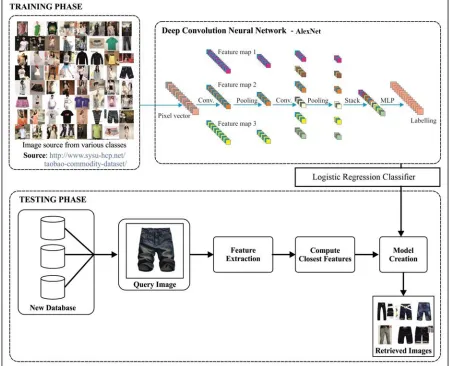
The process involved in the presented DCNN-LR model is shown in Fig. 1. The presented model comprises several stages namely preprocessing, DCNN based feature extraction, and LR based classification model. Initially, preprocessing on the applied input images takes place. Then, the set of input images from the database are employed into the DCNN for training the model. AlexNet handles the computation results with dense
matrices as well as intensives the sparsity of CNNs structure. Then, LR classifier is applied to classifying the images. Once the model is created by the use of DCNN model and LR, then the testing of images takes place
1.1 Preprocessing
Initially, the applied images undergo pre-processing step to enhance the images earlier to the computation. Under various ways of image investigation, the preprocessing step mainly generates the gathering of images [10]. It converts the applied image to a new one basically identical to the applied image; however, it varies in few dimensions. Some of the preprocessing functions are resizing, masking, segmentation, normalization, elimination of noise, and so on. This study performs the preprocessing operation on the applied product images by resizing the images and filtering the noises present in the image. For resizing the images, every image is converted to a default size of 300x300 pixels. For obtaining better outcome from the product images, resized images are passed to the filtering procedure. It is essential due to the fact that many
issues arise based on the noise present in the image. An image is assumed as noisy when the value is highly varied from rest of the nearby values.
When the noise data remains unhandled, the classifier results are highly degraded. Here, median filter is applied to remove the noise from the applied images.
1.2 Feature Extraction Based on DCNN
We assume the applications image retrieval in this work which should be used in systems with limited resources by mean of computational power and memory like robots, other embedded systems, and smart phones. There are limitations by means of computational power and memory in these cases as compactness and energy efficiency is a main problem. In those applications, for the above reasons, the presented DL model which employ massive parameters are not suitable to be employed even when the training process is carried out in offline. For instance, with the media coverage context of particular drones event, an expected operation will be derived and establish the relative images to the captured by certain points of interest. This application will provide rapid and small frameworks which can be used simply.
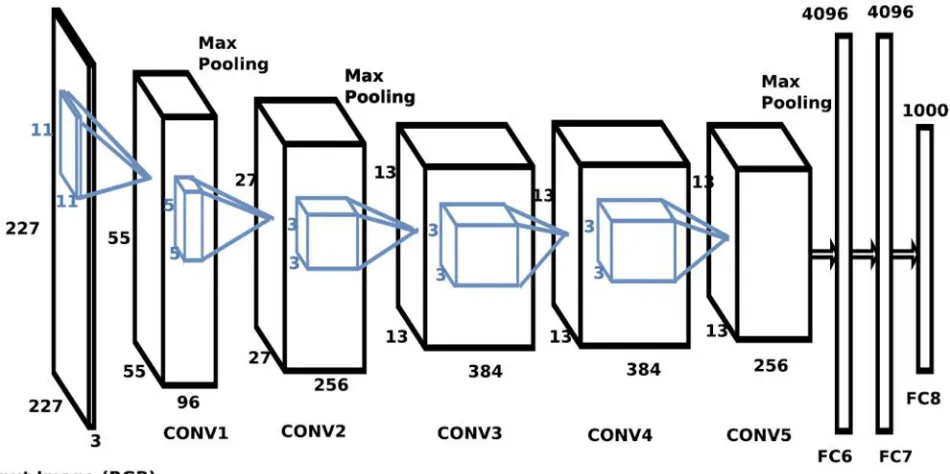
To alternate the internal structure, we use the deep CNN ability and we project a technique for model retraining which recommends three methods based on data available with a aim to produce effective representation of low-dimensional image for retrieval task, that enhance both memory and retrieval performance. For the classification of numerous images towards diverse classes, we used the model of BVLC Reference CaffeNet that is an AlexNet model trained implementation over ImageNet Large Scale Visual Recognition Challenge (ILSVRC) 2012. The eight trained layers of NN are comprised by the model and the rest of them are entire associated. The layers of Max-pooling follows the second, first, and fifth convolutional layers, whereas the ReLU non-linearity (f(x) = max(0, x)) is given towards each convolutional and entirely associated layer excluding final fully connected layer. The FC8 layer output is a distribution on classes of 1000 ImageNet. While in training, the softmax loss is employed. The CaffeNet framework overview is offered in Fig. 2.
Fig. 2. Overview of the CaffeNet architecture
The three dimensional tensor W1 × H1 × D1 is accepted through the RGB image in common. Next, the three dimensional filters are learned are used in every layer wherever convolution is carried out, and it provides W2 × H2 × D2 dimensional output, wherever the D2 is equivalent to filter counts. At each spatial position, W2 × H2 is the two-dimensional feature maps which comprise every filter responses. To derive directly the feature representations from a particular convolutional layer, we use a CaffeNet model. The activations are considered after the layer of ReLU. Through changing the model weights, the representations derived from a CNN framework for input set images are adjustable; we also retrain point of interest parameters depending on the data available. We use a pretrained model to do this through eliminating the layers subsequent to convolutional layer used for extraction of feature and we use additional pooling layers known as Maximum Activations of Convolutions (MAC) layer that executes the operations of max-pooling over output volume height and width for every D2 feature maps. To construct the novel target
1140
therefore enables image of low-resolution that might be highly helpful to create the application to deal with restriction of different embedded systems as it might additionally limit the computational cost. The standard techniques of object detection task should be discussed such as SSD and YOLO9000 and employ entire convolutional framework to enhance the detection speed. We employ either final convolutional layer given as CONV5 and CONV4 which is the forth convolutional layer in the
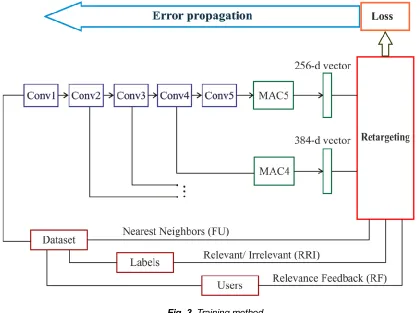
experiments. 13 × 13 × 256 features are the CONV5 layer dimension whereas 13 × 13 × 384 features are the CONV4 layer dimension. For every image, the MAC layer produces either 256-dimensional coarse detailed feature representation otherwise 384- dimensional fine-detailed one depending on the used convolutional layer. Fig. 3 demonstrates the projected retraining technique.
Fig. 3. Training method
In the projected method, we can use different pooling technique. For combining the convolutional features towards compact descriptors, we use sum-pooling whereas others employ max-pooling. When comparing with sum-pooling, this is consistent that describes that max-pooling attains superior performance, whereas sum-pooling perform well while the feature descriptors are PCA-whitened. Three fundamental projected retraining methods are demonstrated in the following subsections [11].
2.2.1 Fully unsupervised retraining
We focus to use the initial retrieval presumption in FU method which the relative image representations are near towards particular feature space query representation. Focusing to maximize the cosine similarity among every image representation and its n closest representations, we retrain the CNN model that is pretrained by means of cosine distance. We denote through 𝐼 = *𝐼, 𝑖 = 1, . . . , 𝑁+, the 𝑁 images set to be searched through 𝒳 = *𝑋, 𝑖 = 1, . . . , 𝑁+ its respective feature representations given in 𝐿 layer, 𝑛 ∈ *1, . . . , 𝑁 − 1+ 𝜇 the mean vector closest representations to 𝑋, by denoting 𝒳 = *𝑋 , 𝑙 = 1, . . . , 𝑁 − 1+ which is expressed as
𝜇 =1
𝑛∑ 𝑋
(1)
Through resolving the below issue of optimization, the novel target images representations of 𝐼 might be denoted.
max 𝒥
𝑋 ∈ 𝒳=
max 𝒥
𝑋 ∈ 𝒳 ∑
𝑋 𝜇
||𝑋||||𝜇||
(2)
By employing gradient descent, we resolve the optimization problem. The primary-order objective function 𝒥 gradient is expressed through.
𝜕𝒥
𝜕𝑋 =
𝜕
𝜕𝑋 (∑
𝑋 𝜇
||𝑋||||𝜇||
) = 𝜇
||𝑋||||𝜇||−
𝑋 𝜇
||𝑋|| ||𝜇||𝑋 (3)
For every image, the vth iteration update rule might be given as
𝑋( )= 𝑋( )+ 𝜂 ( 𝜇 ||𝑋( )|| ||𝜇||−
𝑋( ) 𝜇
||𝑋( )|| ||𝜇||
𝑋( )) , 𝑋
∈ 𝒳 (4)
𝑋( )= 𝑋( )+ 𝜂 ||𝑋( )|| ||𝜇|| ( 𝜇 ||𝑋( )|| ||𝜇|| − 𝑋 ( ) 𝜇 ||𝑋( )|| ||𝜇||
𝑋( )) , 𝑋 ∈ 𝒳 (5)
The Euclidean loss is employed in the training process of the regression process. Therefore, the integration of the process takes place through providing the whole dataset to the input layer of the retrained adapted models and attaining newer representation. By the use of back-propagation, the process of NN regression is formulated and utilizing point of interest layer targets representations.
2.2.2 Retraining with relevance information
Through using the relevant data extracted from class labels available, we project to improve the deep CNN performance in this method. We assume a labeled representation (𝑋, 𝑦𝑖) to attain this objective wherever image representation is denoted through 𝑋 and respective image label is denoted through 𝑦, and we use CNN model neural layers employed for extraction of feature which we focus to enhance the cosine similarity among m nearest relevant and 𝑋 representations and to reduce the cosine similarity among 𝑙 nearest irrelevant and 𝑋
representations by means of cosine distance. We described that the irrelevant image depends on various class and relevant images depends on to similar class. Let 𝑁 images set of search set is represented through *𝐼, 𝑖 = 1, . . . , 𝑁+ that offers relevant data and input image 𝐼 pretrained CNN model is demonstrated as 𝑋 = 𝐹(𝐼). Through ℛ = *𝑟, 𝑘 = 1, . . . , 𝐾 + we denote the
𝑁 set feature representations given by L layer through ℛ = *𝑟 , 𝑘 = 1, . . . , 𝐾 + which is the 𝐾 relevant representations set through 𝐶 = *𝑐, 𝑗 = 1, . . . , 𝐿 + of 𝑖 image. We estimate the
𝑅 mean vector of the 𝑚 nearest representations towards particular representation 𝑋, and 𝑙 nearest representations of 𝐶
to 𝑋 mean vector through 𝜇 and 𝜇 correspondingly. Through resolving the below optimization problems, a novel images target representations of 𝐼 might be denoted.
max 𝒥 𝑋 ∈ 𝒳 = 𝑚𝑎𝑥 𝑋 ∈ 𝒳 ∑ 𝑋 𝜇 ||𝑋|| ||𝜇 || (6) min 𝒥 𝑋 ∈ 𝒳= 𝑚𝑖𝑛 𝑋 ∈ 𝒳∑ 𝑋 𝜇
||𝑋||||𝜇 || (7)
For vth iteration, the normalized update rules might be given as
𝑋( )= 𝑋( )+ 𝜁 ||𝑋( )|| ||𝜇 || × ( 𝜇 ||𝑋( )|| ||𝜇 || − 𝑋 ( ) 𝜇 ||𝑋( )|| ||𝜇 || 𝑋( )) , 𝑋
∈ 𝒳 (8)
and 𝑉( )= 𝑋( )+ 𝛽 ||𝑋( )|| ||𝜇 || × ( 𝜇 ||𝑋( )|| ||𝜇 ||− 𝑋( ) 𝜇 ||𝑋( )|| ||𝜇 || 𝑋( )) , 𝑋
∈ 𝑥 (9)
Using the Eqs. (8) and (9), the combinatory normalized update rule can be derived subsequently.
𝑋( )= 𝑋( )+ 𝜁 ||𝑋( )|| ||𝜇 || × ( 𝜇 ||𝑋( )|| ||𝜇 ||− 𝑋( ) 𝜇 ||𝑋( )|| ||𝜇 || 𝑋( )) − 𝛽 ||𝑋( )|| ||𝜇 || × ( 𝜇 ||𝑋( )|| ||𝜇 ||− 𝑋( ) 𝜇 ||𝑋( )|| ||𝜇 || 𝑋( )) , 𝑋
∈ 𝒳 (10)
By employing back propagation, we retrain the image of NN using above target representations in this approach.
2.2.3 Relevance feedback based retraining
In the relevance feedback philosophy, the projected approach concept is emerged. The user capability to use judgment with regard to search result relevance is known as relevance feedback of the system. To improve the performance, the system uses this data. We assume data from various users’ feedback in this projected retraining method. This data comprise of queries that are irrelevant and relevant images. To enhance the cosine similarity among certain query and the relative image and reduce the cosine similarity among it is the major goal. Through 𝒬 = *𝑄𝑘, 𝑘 = 1, . . . , 𝐾+, 𝐼 = *𝐼, 𝑖 = 1, . . . , 𝑍+ a relative image set and 𝒬 = *𝑄𝑘, 𝑘 = 1, . . . , 𝐾+ as queries set and through irrelevant images set of 𝐼 = *𝐼, 𝑗 = 1, . . . , 𝑂+
through 𝑥 = 𝐹(𝐼) over a query. We represent through
𝒳 = *𝑋, 𝑖 = 1, . . . , 𝑍+ feature representations set emerged in 𝑍 images 𝐿 layer have been given as relevant by a user, and through 𝒳 = *𝑋, 𝑖 = 1, . . . , 𝑂 + of 𝑂 irrelevant feature representations set.
The novel target representations for irrelevant and relevant images might be determined through resolving the below optimization issues correspondingly.
max 𝒥 𝑋 ∈ 𝒳 = 𝑚𝑎𝑥 𝑋 ∈ 𝒳 ∑ 𝑋 𝑞 ||𝑋||||𝑞 || (11) max 𝒥 𝑋 ∈ 𝒳 = 𝑚𝑎𝑥 𝑋 ∈ 𝒳 ∑ 𝑋 𝑞 ||𝑋||||𝑞 || (12)
For 𝑣 iteration, the normalized update rules can be expressed as 𝑋( )= 𝑋( )+ 𝛼 ||𝑋( )|| ||𝑞 || ( 𝑞 ||𝑋( )|| ||𝑞 || − 𝑋 ( ) 𝑞 ||𝑋( )|| ||𝑞 ||
𝑋( )) , 𝑋 ∈ 𝒳 (13)
and 𝑋( )= 𝑋( )− 𝛼 ||𝑋( )|| ||𝑞 || ( 𝑞 ||𝑋( )|| ||𝑞 || − 𝑋 ( ) 𝑞 ||𝑋( )|| ||𝑞 ||
𝑋( )) , 𝑋 ∈ 𝒳 (14)
1.3 LR Based Classification
1142
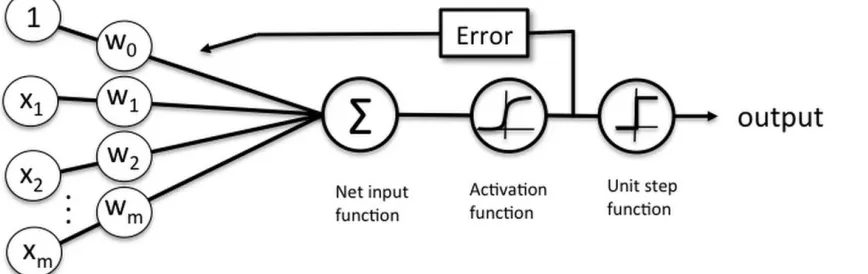
define the relativity present among the dependent parameters and one/ many explanatory parameters. The aim of LR is the prediction of the possibility 𝑝 in which the dependent parameter falls under which class depending upon the independent variables (continuous or categorical variables) [52] and the schematic diagram is illustrated in Fig. 4. Since LR is exhibited as a special case of generalized linear model, the linear element
is related to some functions of the possibility of a provided outcome of the dependant variable. The function is the logit transform. For the estimation of LR variables, the least squares employed in linear regression does not have the capability to give low variance unbiased estimators for parameters. Hence, maximum likelihood estimation is applied to estimate the LR variables with Newton-Raphson model [50].
Fig. 4. LR classifier model
2
PERFORMANCE
EVALUATION
2.1 Dataset Description
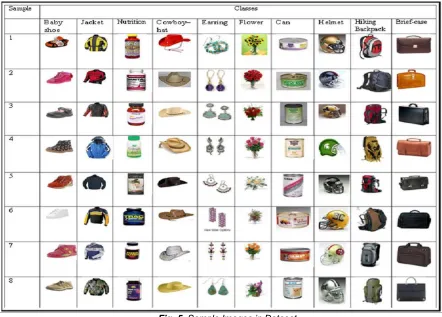
The presented DCNN-LR model is tested against the Corpus dataset which comprises of 10000 low resolution color images of e-commerce products which comes under a set of hundred classes [12]. Every image has the important objects in stable form which is identical to the way the product images displays in the shopping websites like Flipkart, Amazon, and so on. A collection of sample 80 images are shown in Fig. 5 from the PI100 dataset. The produces appears under every class looks identical in shape as well as appearance, however, a slight difference is presented in terms of color, size or any other
aspects.
2.2 Results analysis
Fig. 5. Sample Images in Dataset
Table 1 Sample confusion matrix for multiple classes
Since the applied dataset involves a set of 100 classes, the
1144
Table 2 Confusion Matrix for 100 Classes in PI100 Dataset
Labels/ Target 1 2 3 4 5 … … … 100
Label 1 1 0 0 0 0 0 0 0 0
Label 2 0 1 0 0 0 0 0 0 0
Label 3 0 0 1 0 0 0 0 0 0
Label 4 0 0 0 1 0 0 0 0 0
Label 5 0 0 0 0 1 0 0 0 0
… 0 0 0 0 0 1 0 0 0
… 0 0 0 0 0 0 1 0 0
… 0 0 0 0 0 0 0 1 0
Label 100 0 0 0 0 0 0 0 0 1
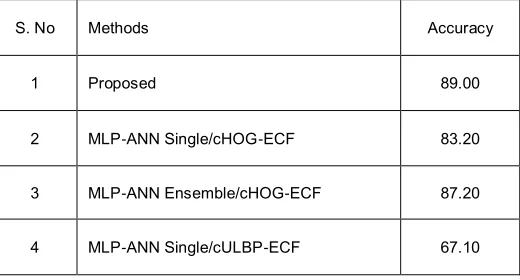
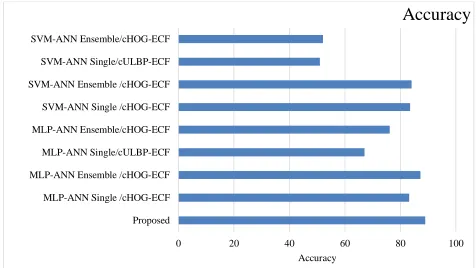
Next, a detailed comparative results analysis with existing models interms of accuracy is made to validate the outstanding performance of the applied DCNN-LR model. Table 1 and Fig. 6 show that the presented model exhibits maximum classification by attaining the highest accuracy of 89.00%. At the same time, the MLP-ANN Ensemble/cHOG-ECF model shows competitive outcome by attaining a higher accuracy of 87.20%. Though this value outperforms the other classifier rates, it does not outperform the presented model.
Table 3 Comparative Accuracy analysis of diverse models
S. No Methods Accuracy
1 Proposed 89.00
2 MLP-ANN Single/cHOG-ECF 83.20
3 MLP-ANN Ensemble/cHOG-ECF 87.20
4 MLP-ANN Single/cULBP-ECF 67.10
5 MLP-ANN Ensemble/cHOG-ECF 76.14
6 SVM-ANN Single /cHOG-ECF 83.50
7 SVM-ANN Ensemble /cHOG-ECF 84.00
8 SVM-ANN Single/cULBP-ECF 51.00
9 SVM-ANN Ensemble/cHOG-ECF 52.11
Fig. 6. Comparative Accuracy analysis of diverse models
3
4
CONCLUSION
This paper presented a new DCNN-LR model for the classification of images for recommending the products. The
presented model comprises several stages namely
preprocessing, DCNN based feature extraction, and LR based classification model. Initially, preprocessing on the applied input images takes place. Then, the set of input images from the database are employed into the DCNN for training the model. AlexNet handles the computation results with dense matrices as well as intensives the sparsity of CNNs structure. Then, LR classifier is applied to classifying the images. Once the model is created by the use of DCNN model and LR, then the testing of images takes place. The presented DCNN-LR model is tested against the Corpus dataset. The presented model exhibits maximum classification by attaining the highest accuracy of 89.00%.
REFERENCES
[1] Baier D, Daniel I, Frost S, Naundorf R. Image data analysis and classification in marketing. Adv Data Anal Classif 2012;6:253–76.
[2] Han Y, Choi SM. A content recommendation system based on category correlations. Fifth international multi-conference on computing in the global information technology; 2010. p. 66–70.
[3] Pohs W. Building taxonomy for auto-classification. Bull Am Soc Inform Sci Technol 2013;39(2):34–8.
[4] Jain YK, Wadekar S. Classification-based retrieval methods to enhance information discovery on the web. Int J Manag Inform Technol (IJMIT) 2011;3(1):33–44.
[5] Kannan A, Talukdar PP, Rasiwasia N, Ke Q. Improving product classification using images. In: ICDM; 2011. p. 310:319.
[6] Chang R, Lin S, Ho J, Fann C, Wang Y. A novel content based image retrieval system using k-means/KNN with
feature extraction. ComSIS 2012;9(4).
[7] Lee SJ, Cho S. Tagged web image retrieval re-ranking with wikipedia-based semantic relatedness. J Korea Multimedia Soc. 2011;1(11):1491–9.
[8] Kweon DH, Hong JH, Cho S. Web image retrieval using prior tags based on word net semantic information. J Korea Multimedia Soc 2009;12(7):1032–42
[9] Ma Z, Pant G, Sheng ORL. Interest-based personalised search. ACM Trans Inform Syst (TOIS) 2007;25(1):1–38. [10]Philbin, J., Chum, O., Isard, M., Sivic, J. and Zisserman,
A., 2008, June. Lost in quantization: Improving particular object retrieval in large scale image databases. In 2008 IEEE conference on computer vision and pattern recognition (pp. 1-8). IEEE.
[11]Tzelepi, M. and Tefas, A., 2018. Deep convolutional
learning for content based image
retrieval. Neurocomputing, 275, pp.2467-2478.
[12]https://www.sciencedirect.com/science/article/pii/S111086 6517303225
0 20 40 60 80 100
Proposed MLP-ANN Single /cHOG-ECF MLP-ANN Ensemble /cHOG-ECF MLP-ANN Single/cULBP-ECF MLP-ANN Ensemble/cHOG-ECF SVM-ANN Single /cHOG-ECF SVM-ANN Ensemble /cHOG-ECF SVM-ANN Single/cULBP-ECF SVM-ANN Ensemble/cHOG-ECF
Accuracy