Towards an Understanding of
Facets and Exemplars of Big Data
Applications
20 Years of Beowulf: Workshop to Honor Thomas Sterling's 65th Birthday
Annapolis October 14 2014
Geoffrey Fox
http://www.infomall.org
School of Informatics and Computing Digital Science Center
SPIDAL: Scalable Parallel Interoperable
Data Analytics Library
• I sort of left HPC in 1990 but I now returning to do parallel computing for large scale data analytics – SPIDAL
– More data scientists than computational scientists so HPC implications of data analytics could be influential on simulation software and hardware
– Certainly Beowulf just fine!
• Analyze Big Data applications to identify analytics needed and generate benchmark applications
• Analyze existing analytics libraries (in practice limit to some application domains) – catalog library members available and performance
– Apache Mahout low performance and not many entries; R largely sequential and missing key algorithms; Apache MLlib just starting
• Identify big data computer architectures
• Identify software model to allow interoperability and performance
• Design or identify new or existing algorithms including parallel implementation
In 1980-1985 I wondered around Caltech
seeing what people where using computers
for and thinking of parallel simulation
algorithms. Now lets repeat for Big Data.
Get applications from NIST study this time
NIST Big Data Initiative
Use Case
Template
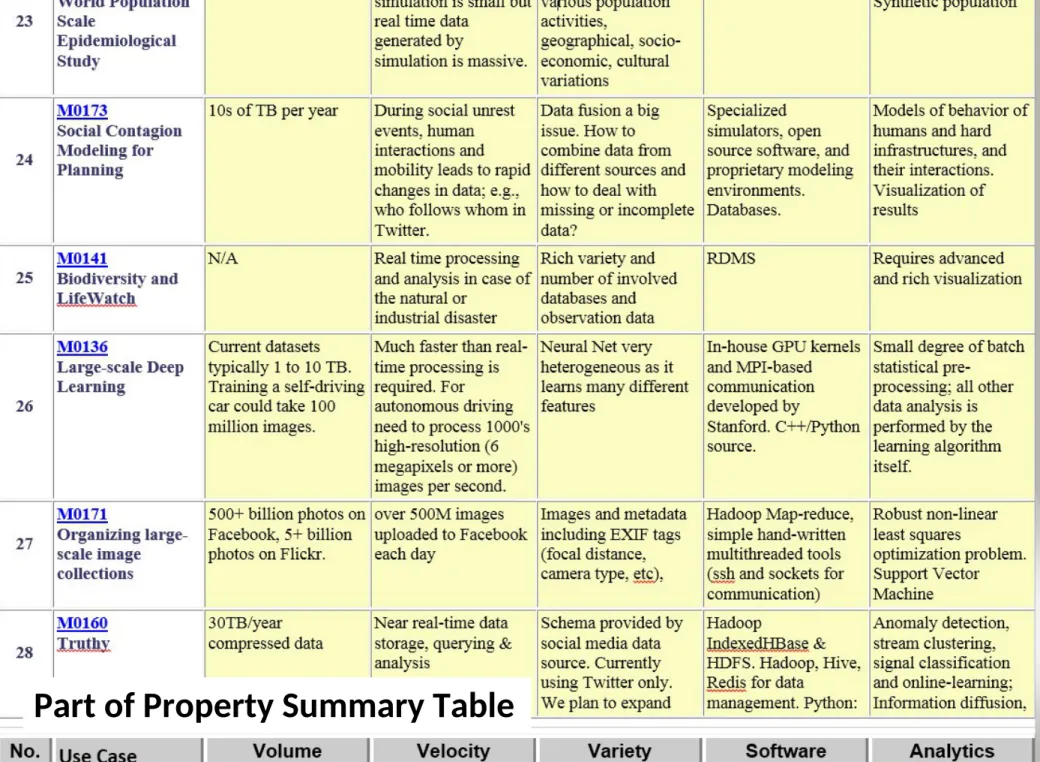
• 26 fields completed for 51 areas
• Government Operation: 4
• Commercial: 8
• Defense: 3
• Healthcare and Life Sciences: 10
• Deep Learning and Social Media: 6
• The Ecosystem for Research: 4
• Astronomy and Physics: 5
• Earth, Environmental and Polar Science: 10
• Energy: 1
51 Detailed Use Cases:
Contributed July-September 2013
Covers goals, data features such as 3 V’s, software,
hardware
• http://bigdatawg.nist.gov/usecases.php
• https://bigdatacoursespring2014.appspot.com/course (Section 5)
• Government Operation(4): National Archives and Records Administration, Census Bureau
• Commercial(8): Finance in Cloud, Cloud Backup, Mendeley (Citations), Netflix, Web Search, Digital Materials, Cargo shipping (as in UPS)
• Defense(3): Sensors, Image surveillance, Situation Assessment
• Healthcare and Life Sciences(10): Medical records, Graph and Probabilistic analysis, Pathology, Bioimaging, Genomics, Epidemiology, People Activity models, Biodiversity
• Deep Learning and Social Media(6): Driving Car, Geolocate images/cameras, Twitter, Crowd Sourcing, Network Science, NIST benchmark datasets
• The Ecosystem for Research(4): Metadata, Collaboration, Language Translation, Light source experiments
• Astronomy and Physics(5): Sky Surveys including comparison to simulation, Large Hadron Collider at CERN, Belle Accelerator II in Japan
• Earth, Environmental and Polar Science(10): Radar Scattering in Atmosphere, Earthquake, Ocean, Earth Observation, Ice sheet Radar scattering, Earth radar mapping, Climate
simulation datasets, Atmospheric turbulence identification, Subsurface Biogeochemistry (microbes to watersheds), AmeriFlux and FLUXNET gas sensors
• Energy(1): Smart grid
5 26 Features for each use case
Table 4: Characteristics of 6 Distributed Applications Application
Example Execution Unit Communication Coordination Execution Environment Montage Multiple sequential and
parallel executable Files Dataflow(DAG) Dynamic processcreation, execution
NEKTAR Multiple concurrent
parallel executables Stream based Dataflow Co-scheduling, datastreaming, async. I/O
Replica-Exchange Multiple seq. andparallel executables Pub/sub Dataflow andevents Decoupledcoordination and messaging
Climate Prediction (generation)
Multiple seq. & parallel
executables Files andmessages Master-Worker, events
@Home (BOINC)
Climate Prediction (analysis)
Multiple seq. & parallel
executables messagesFiles and Dataflow Dynamics processcreation, workflow execution
SCOOP Multiple Executable Files and
messages Dataflow Preemptive scheduling,reservations
Coupled
Fusion Multiple executable Stream-based Dataflow Co-scheduling, datastreaming, async I/O
6
HPC Benchmark Classics
•
Linpack
or HPL: Parallel LU factorization for solution of
linear equations
•
NPB
version 1: Mainly classic HPC solver kernels
–
MG: Multigrid
–
CG: Conjugate Gradient
–
FT: Fast Fourier Transform
–
IS: Integer sort
–
EP: Embarrassingly Parallel
–
BT: Block Tridiagonal
–
SP: Scalar Pentadiagonal
13 Berkeley Dwarfs
•
Dense Linear Algebra
•
Sparse Linear Algebra
•
Spectral Methods
•
N-Body Methods
•
Structured Grids
•
Unstructured Grids
•
MapReduce
•
Combinational Logic
•
Graph Traversal
•
Dynamic Programming
•
Backtrack and Branch-and-Bound
•
Graphical Models
•
Finite State Machines
First 6 of these correspond to Colella’s original.
Monte Carlo dropped.
N-body methods are a subset of Particle in Colella.
Note a little inconsistent in that MapReduce is a programming model and spectral method is a numerical method.
7 Computational Giants of
NRC Massive Data Analysis Report
1) G1:
Basic Statistics (see MRStat later)
2) G2:
Generalized N-Body Problems
3) G3:
Graph-Theoretic Computations
4) G4:
Linear Algebraic Computations
5) G5:
Optimizations e.g. Linear Programming
6) G6:
Integration e.g. LDA and other GML
51 Use Cases: What is Parallelism Over?
• People: either the users (but see below) or subjects of application and often both • Decision makers like researchers or doctors (users of application)
• Items such as Images, EMR, Sequences below; observations or contents of online store
– Imagesor “Electronic Information nuggets”
– EMR: Electronic Medical Records (often similar to people parallelism)
– Protein or Gene Sequences;
– Material properties, Manufactured Object specifications, etc., in custom dataset
– Modelled entities like vehicles and people • Sensors – Internet of Things
• Events such as detected anomalies in telescope or credit card data or atmosphere
• (Complex) Nodes in RDF Graph
• Simple nodes as in a learning network
• Tweets, Blogs, Documents, Web Pages, etc.
– And characters/words in them
• Files or data to be backed up, moved or assigned metadata • Particles/cells/mesh points as in parallel simulations
Features of 51 Use Cases I
• PP (26) “All” Pleasingly Parallel or Map Only
• MR (18) Classic MapReduce MR (add MRStat below for full count)
• MRStat (7) Simple version of MR where key computations are
simple reduction as found in statistical averages such as histograms and averages
• MRIter (23) Iterative MapReduce or MPI (Spark, Twister)
• Graph (9) Complex graph data structure needed in analysis
• Fusion (11) Integrate diverse data to aid discovery/decision making; could involve sophisticated algorithms or could just be a portal
• Streaming (41) Some data comes in incrementally and is processed this way
• Classify (30) Classification: divide data into categories
Features of 51 Use Cases II
• CF (4) Collaborative Filtering for recommender engines
• LML (36) Local Machine Learning (Independent for each parallel entity) – application could have GML as well
• GML (23) Global Machine Learning: Deep Learning, Clustering, LDA, PLSI, MDS,
– Large Scale Optimizations as in Variational Bayes, MCMC, Lifted Belief
Propagation, Stochastic Gradient Descent, L-BFGS, Levenberg-Marquardt . Can call EGO or Exascale Global Optimization with scalable parallel algorithm • Workflow (51) Universal
• GIS (16) Geotagged data and often displayed in ESRI, Microsoft Virtual Earth, Google Earth, GeoServer etc.
• HPC (5) Classic large-scale simulation of cosmos, materials, etc. generating (visualization) data
4 Forms of MapReduce
(1) Map Only MapReduce(2) Classic (3) Iterative Map Reduceor Map-Collective Map-Communication(4) Point to Point or
Input map reduce Input map reduce Iterations Input Output map Local Graph
PP MR MRStat MRIter Graph, HPC
BLAST Analysis Local Machine Learning
Pleasingly Parallel
High Energy Physics (HEP) Histograms Distributed search Recommender Engines
Expectation maximization Clustering e.g. K-means Linear Algebra,
PageRank
Classic MPI
PDE Solvers and Particle Dynamics Graph Problems MapReduce and Iterative Extensions (Spark, Twister) MPI, Giraph
Integrated Systems such as Hadoop + Harp with Compute and Communication model separated
Global Machine Learning aka EGO –
Exascale Global Optimization
• Typically maximum likelihood or 2 with a sum over the N data items – documents, sequences, items to be sold, images etc. and often links (point-pairs). Usually it’s a sum of positive numbers as in least squares
• Covering clustering/community detection, mixture models, topic determination, Multidimensional scaling, (Deep) Learning
Networks
• PageRank is “just” parallel linear algebra
• Note many Mahout algorithms are sequential – partly as MapReduce limited; partly because parallelism unclear
– MLLib (Spark based) better
• SVM and Hidden Markov Models do not use large scale parallelization in practice?
• Detailed papers on particular parallel graph algorithms
Data Source and Style Facet
I
• (i) SQL or NoSQL: NoSQL includes Document, Column, Key-value, Graph, Triple store
• (ii) Other Enterprise data systems: e.g. Warehouses
• (iii) Set of Files: as managed in iRODS and extremely common in scientific research
• (iv) File, Object, Block and Data-parallel (HDFS) raw storage: Separated from computing?
• (v) Internet of Things: 24 to 50 Billion devices on Internet by 2020
• (vi) Streaming: Incremental update of datasets with new algorithms to achieve real-time response (G7)
• (vii) HPC simulations: generate major (visualization) output that often needs to be mined
2. Perform real time analytics on data source streams and
notify users when specified events occur
Storm, Kafka, Hbase, Zookeeper
Streaming Data
Streaming Data
Streaming Data
Posted Data Identified Events
Filter Identifying Events
Repository
Specify filter
Archive
Post Selected Events
Fetch
5. Perform interactive analytics on data in
analytics-optimized data system
Hadoop, Spark, Giraph, Pig …
Data Storage: HDFS, Hbase
Data, Streaming, Batch …..
Data Source and Style Facet
II
•
Before data gets to compute system, there is often an
initial data gathering phase
which is characterized by a
block size and timing
. Block size varies from month
(Remote Sensing, Seismic) to day (genomic) to seconds or
lower (Real time control, streaming)
•
There are
storage/compute system styles:
Shared,
Dedicated, Permanent, Transient
•
Other characteristics are needed for permanent
auxiliary/comparison datasets a
nd these could be
interdisciplinary, implying nontrivial data
movement/replication
•
10
Data Access/Use Styles
from Bob Marcus at NIST (you
have seen his patterns 2 and 5 and my extension for
5A. Perform interactive analytics on
observational scientific data
Grid or Many Task Software, Hadoop, Spark, Giraph, Pig …
Data Storage: HDFS, Hbase, File Collection (Lustre)
Streaming Twitter data for Social Networking
Science Analysis Code, Mahout, R
Transport batch of data to primary analysis data system
Record Scientific Data in “field” Local Accumulate and initial computing Direct Transfer
NIST Examples include LHC, Remote Sensing, Astronomy and
Core Analytics
I
•
Map-Only
• Pleasingly parallel - Local Machine Learning
•
MapReduce:
Search/Query/Index
• Summarizing statistics as in LHC Data analysis (histograms) (G1) • Recommender Systems (Collaborative Filtering)
• Linear Classifiers (Bayes, Random Forests)
•
Alignment and Streaming (G7)
• Genomic Alignment, Incremental Classifiers
•
Global Analytics:
Nonlinear Solvers (structure depends on objective function) (G5,G6)– Stochastic Gradient Descent SGD
– (L-)BFGS approximation to Newton’s Method
Core Analytics
II
•
Global Analytics: Map-Collective (See Mahout,
MLlib) (G2,G4,G6)
•
Often use matrix-matrix,-vector operations, solvers
(conjugate gradient)
•
Clustering
(many methods),
Mixture Models, LDA
(Latent Dirichlet Allocation),
PLSI
(Probabilistic Latent
Semantic Indexing)
•
SVM
and
Logistic Regression
•
Outlier Detection
(several approaches)
•
PageRank
, (find leading eigenvector of sparse matrix)
•
SVD
(Singular Value Decomposition)
•
MDS
(Multidimensional Scaling)
•
Learning Neural Networks (
Deep Learning
)
Core Analytics
III
•
Global Analytics – Map-Communication (targets
for Giraph) (G3)
•
Graph Structure (Communities, subgraphs/motifs,
diameter, maximal cliques, connected components)
•
Network Dynamics - Graph simulation Algorithms
(epidemiology)
•
Global Analytics – Asynchronous Shared Memory
(may be distributed algorithms)
•
Graph Structure (Betweenness centrality, shortest
path) (G3)
Remarks on Parallelism I
• Most use parallelism over items in data set – Entities to cluster or map to Euclidean space
• Except deep learning (for image data sets)which has parallelism over pixel plane in neurons not over items in training set
– as need to look at small numbers of data items at a time in Stochastic Gradient Descent SGD
– Need experiments to really test SGD – as no easy to use parallel implementations tests at scale NOT done
– Maybe got where they are as most work sequential
• Maximum Likelihood or 2 both lead to structure like
• Minimize sum items=1N (Positive nonlinear function of unknown
parameters for item i)
• All solved iteratively with (clever) first or second order approximation to shift in objective function
– Sometimes steepest descent direction; sometimes Newton – 11 billion deep learning parameters; Newton impossible – Have classic Expectation Maximization structure
– Steepest descent shift is sum over shift calculated from each point
• SGD – take randomly a few hundred of items in data set and calculate shifts over these and move a tiny distance
– Classic method – take all (millions) of items in data set and move full distance
Remarks on Parallelism II
• Need to cover non vector semimetric and vector spaces for clustering and dimension reduction (N points in space)
• MDS Minimizes Stress
(X) = i<j=1N weight(i,j) ((i, j) - d(Xi, Xj))2
• Semimetric spaces just have pairwise distances defined between points in space (i, j)
• Vector spaces have Euclidean distance and scalar products
– Algorithms can be O(N) and these are best for clustering but for MDS O(N) methods may not be best as obvious objective function O(N2)
– Important new algorithms needed to define O(N) versions of current O(N2) –
“must” work intuitively and shown in principle
• Note matrix solvers all use conjugate gradient – converges in 5-100 iterations – a big gain for matrix with a million rows. This removes factor of N in time complexity
• Ratio of #clusters to #points important; new ideas if ratio >~ 0.1
O(N2) interactions between green and purple clusters
should be able to represent by centroids as in Barnes-Hut.
Hard as no Gauss theorem; no multipole expansion and points really in 1000 dimension space as clustered before 3D
projection
O(N2) green-green and purple-purple interactions have value but green-purple are “wasted”
30
OctTree for 100K
sample of Fungi
Algorithm Challenges
•
See NRC Massive Data Analysis report
•
O(N) algorithms
for O(N
2) problems
•
Parallelizing
Stochastic Gradient Descent
•
Streaming data algorithms
– balance and interplay between
batch methods (most time consuming) and interpolative
streaming methods
•
Graph
algorithms
•
Claims data analytics sparse;
many cases are full matrices
•
BTW Need
Java Grande –
Some C++ but Java most popular in
Proposed Spectrum of Benchmarks/Features
•
Classic Database:
TPC benchmarks
•
NoSQL Data systems:
store, index, query (e.g. on Tweets)
•
Hard core commercial:
Web Search, Collaborative
Filtering (different structure and defer to Google!)
•
Streaming:
Gather in Pub-Sub(Kafka) + Process (Apache
Storm) solution (e.g. gather tweets, Internet of Things)
•
Pleasingly parallel (Local Analytics):
as in initial steps of
LHC, Astronomy, Pathology, Bioimaging (differ in type of
data analysis)
•
“Global” Analytics:
Deep Learning, SVM,
Multidimensional Scaling, Graph Community finding
(~Clustering) to Shortest Path (? Shared memory)
HPC-ABDS
Integrating High Performance Computing with
Apache Big Data Stack
5 hours of video on 51 use cases
Online classes in Data Science Certificate /Masters
Maybe a Big Data Initiative would include
• We don’t need 200 software packages so can choose e.g.
• Workflow: Python or Kepler or Apache Crunch
• Data Analytics: Mahout, R, ImageJ, Scalapack
• High level Programming: Hive, Pig
• Parallel Programming model: Hadoop, Spark, Giraph (Twister4Azure, Harp), MPI; Storm, Kapfka or RabbitMQ (Sensors)
• In-memory: Memcached
• Data Management: Hbase, MongoDB, MySQL or Derby
• Distributed Coordination: Zookeeper
• Cluster Management: Yarn, Slurm
• File Systems: HDFS, Lustre
• DevOps: Cloudmesh, Chef, Puppet, Docker, Cobbler
• IaaS: Amazon, Azure, OpenStack, Libcloud
WDA SMACOF MDS (Multidimensional
Scaling) using Harp on IU Big Red 2
Parallel Efficiency: on 100-300K sequences
Conjugate Gradient (dominant time) and Matrix Multiplication Number of Nodes
0 20 40 60 80 100 120 140
Pa ra lle lE ffi cie nc y 0.00 0.20 0.40 0.60 0.80 1.00 1.20
100K points 200K points 300K points
Best available
MDS (much
better than
that in R)
Java
Harp (Hadoop
plugin)
Lessons / Insights
• Proposed classification of Big Data applications with features and kernels for analytics
• Data intensive algorithms do not have the well developed high performance libraries familiar from HPC
• Global Machine Learning or (Exascale Global Optimization) particularly challenging
• Develop SPIDAL (Scalable Parallel Interoperable Data Analytics Library)
– New algorithms and new high performance parallel implementations
• Integrate (don’t compete) HPC with “Commodity Big data”
(Google to Amazon to Enterprise Data Analytics)
– i.e. improve Mahout; don’t compete with it
– Use Hadoop plug-ins rather than replacing Hadoop
• Enhanced Apache Big Data Stack HPC-ABDS has ~200 members