Parallel Itoh-Tsujii Multiplicative Inversion
Algorithm for a Special Class of Trinomials
Francisco Rodr´ıguez-Henr´ıquez
1, Guillermo Morales-Luna
1, Nazar
A. Saqib
2and Nareli Cruz-Cort´es
1(1) Computer Science Section, Electrical Engineering Department
Centro de Investigaci´on y de Estudios Avanzados del IPN
Av. Instituto Polit´ecnico Nacional No. 2508, M´exico D.F.
{
francisco, gmorales, nareli
}
@cs.cinvestav.mx
(2) Centre for Cyber Technology and Spectrum Management
(CCT & SM), NUST, Islamabad-Pakistan.
[email protected]
Abstract
In this contribution, we derive a novel parallel formulation of the stan-dard Itoh-Tsujii algorithm for multiplicative inverse computation overGF(2m).
The main building blocks used by our algorithm are: field multiplication, field squaring and field square root operators. It achieves its best perfor-mance when using a special class of irreducible trinomials, namely,P(X) = Xm+Xk+ 1, withmandkodd numbers and when implemented in hard-ware platforms. Under these conditions, our experimental results show that our parallel version of the Itoh-Tsujii algorithm yields a speedup of about 30% when compared with the standard version of it. Implemented in a Virtex 3200E FPGA device, our design is able to compute multiplicative inversion overGF(2193)after 20 clock cycles in about0.94µS.
1
Introduction
Binary extension finite fields GF(2m) are extensively used in many modern
etc. Perhaps one of the most important applications for this class of finite fields is elliptic Curve Cryptography (ECC), since high performance ECC implemen-tations directly rely on the efficiency in the computation of the underlying finite field arithmetic operations.
Among customary finite field arithmetic operations, namely, addition, sub-traction, multiplication and inversion of nonzero elements, the computation of the later is the most time-consuming one. Multiplicative inversion computation of a nonzero element a ∈ GF(2m) is defined as the process of finding the unique
elementa−1 ∈GF(2m)such thata·a−1 = 1.
Several algorithms for computing the multiplicative inverse in GF(2m) have
been proposed in literature [1–8]. In [4], multiplicative inverse is computed using an improved modification of the extended Euclidean algorithm called almost in-verse algorithm. That iterative algorithm can compute the multiplicative inverse in approximately2mclock cycles [4]. In [6] an architecture able to compute the Montgomery multiplicative inverse for both, GF(p), for a prime p, and GF(2m)
on a unified-field hardware platform was proposed.
Based on Fermat’s Little Theorem (FLT) and using an ingenious re-arrangement of the required field operations, the Itoh-Tsujii Multiplicative Inverse Algorithm
(ITMIA) was presented in [1]. Originally, ITMIA was proposed to be applied over binary extension fields withnormal basisfield element representation. Since its publication however, several improvements and variations of it have been re-ported [2, 3, 5, 7, 8], showing that it can be used with other field element represen-tations too.
Unfortunately enough, cryptographic designers have historically shown some resistance to use FLT-related techniques for computing multiplicative inverses when using polynomial basis representation. This phenomenon is probably due to three frequent misconceptions:
1. Computing multiplicative inverses by using FLT-related techniques is in-efficient as those methods require many field multiplication and squaring operations;
2. ITMIA is a competitive design option only when using normal basis repre-sentation and;
In this contribution we hope to refute (at least partially) above opinions. First, we discuss how to combine the ITMIA standard procedure with the notion of
addition chains[9] (it is noticed that this discussion closely follows the approach presented in [7]). We show that this technique constitutes a competitive option for computing multiplicative inverses inGF(2m)not only with normal basis but also
withpolynomial (canonical)field element representation.
Then, considering a special class of irreducible trinomials, namely,P(X) =
Xm+Xk+ 1, withmandkodd numbers, we derive a novel version of the
Itoh-Tsujii algorithm which uses field multiplication, field squaring and field square root operators as main building blocks. We also show how this version of the algorithm can be parallelized when implemented in hardware platforms. Our ex-perimental results show that the parallel version of the Itoh-Tsujii algorithm im-plementation yields a speedup of about 30% when compared with the standard version of it.
The rest of this paper is organized as follows. In Section 2 some important mathematical concepts are reviewed. In particular, we discuss how to calculate field square and field square root operations efficiently when working in a binary extension finite field generated by an irreducible trinomial of the form, P(X) =
Xm+Xk+1, withmandkodd numbers. In Section 3, the standard version of the
Itoh-Tsujii algorithm combined with the concept of addition chains is presented. We give a rigorous complexity analysis of that algorithm. Then, in Section 4, a novel parallel formulation of the ITMIA procedure is presented, including a rigorous complexity analysis of this procedure. In Section 5, design details of our algorithm hardware implementation are discussed in detail. In Section 6 we summarize the main performance figures of the block designs and we also provide a comparison with other reported designs found in the open literature. Finally, in Section 7 some conclusions remarks are drawn.
2
Mathematical Preliminaries
2.1
Binary Field Arithmetic
LetKbe a finite field and letP(X) ∈K[X]be a polynomial with coefficients in
K. P(X)isirreducibleoverKif wheneverP(X) =Q(X)R(X), eitherQ(X)or
R(X)is an unit inK[X], i.e. it is a constant polynomial.
irre-ducible polynomial of degree m > 1, m ∈ N, and let α be a root of P(X) in a finite extension of GF(2). Then the Galois field GF(2m) is isomorphic to the finite extension GF(2)[α], it has2m elements and the powers ofα form a basis of GF(2m) over GF(2). The set {1, α, α2, . . . , αm−1} is called the polynomial
basis of GF(2m) corresponding to α. Thus, for each a ∈ GF(2m) there exists
a polynomial A(X) ∈ GF(2)[X] of degree at mostm −1 such thata = A(α)
and this is thepolynomial representationofa. Addition inGF(2m)is performed
by adding corresponding coefficients using polynomial representations. Multipli-cation corresponds to polynomial multipliMultipli-cation reduced modulus the irreducible polynomial P(X): If a ∈ GF(2m) is represented by the polynomial A(X) and
b ∈ GF(2m)is represented by the polynomialB(X)thenc = abis represented
by the polynomialC(X) =A(X)B(X) mod P(X). The multiplicative group of
GF(2m)is cyclic. If the irreducible polynomialP(X)is also primitive, then any
of its roots αis a generator of the multiplicative group of GF(2m)and has order 2m−1. Thus for any nonzeroa ∈GF(2m), ifi≡ j mod (2m−1)thenai =aj
inGF(2m). Since the field characteristic is 2, the squaring operator is linear:
a =A(α) = m−1
X
j=0
ajαj ⇒ a2 = m−1
X
j=0
ajα2j =A(α2). (1)
Let us assume that the irreducible polynomial is a trinomial: P(X) = Xm+Xn+ 1, withn ≤ m/2. Then, for alli ≥ 0, Xm+i = (Xn+ 1)Xi modP(X). Thus wheneverj ≥m/2, there existsi≥0such that2j =m+iandα2j = (αn+ 1)αi
in the field GF(2m), consequently the upper half of terms in a2, according to
eq. (1), can be calculated by additions and shift operations only. Namely,
m ≡0 mod 2 ⇒ a2 =
m 2−1 X
j=0
a2jαj + (αn+ 1)
m 2−1 X
j=0
am 2+jα
2j (2)
m ≡1 mod 2 ⇒ a2 =
m−1 2 X
j=0
a2jαj + (αn+ 1)
m−3 2 X
j=0
am+1 2 +jα
2j+1 (3)
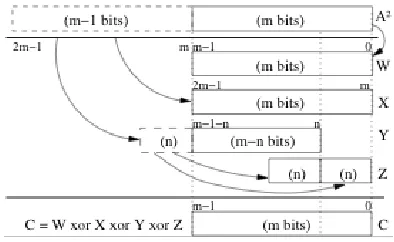
Moreover, using just the representing polynomial, we can compute the reduction stepC(X) = A(X)2 modP(X)by adding four terms,B
1,B2,B3 andB4 as,
C = A0[0,m−1]+A0[m,2m−1]+A0[m,2m−1−n]Xn
+ A0[2m−n,2m−1]+A0[2m−n,2m−1]Xn
Figure 1: Reduction scheme.
where A0[i,j] denotes the list of coefficients in A(X) with indexes ranging from
i to j. The reduction procedure described in eq. (4) is shown schematically in Fig. 2.1. Notice that for those designs implemented in hardware platforms, the field squaring computation procedure just outlined can be instrumented by using XOR logic gates only. Nevertheless, the exact computational complexity of this arithmetic operation depends on the explicit form ofmand the middle coefficient
n. For instance, in the case of the irreducible trinomialP(X) =X193+X15+ 1,
field squaring operation can be computed as,
ci =
ai/2 ieven,i <15,
ai/2+ai/2+89+a178+i/2 ieven,15< i <30,
ai/2+ai/2+89 ieven,i≥30,
a(m+i)/2+a193−(15−i)/2 iodd,i <15,
a(m+i)/2 iodd,i≥15.
(5)
(5) can be implemented at a cost of 96two-input XOR gates and two XOR gate delays,2Tx.
A straightforward but rather expensive approach for computing the square root operator is based on Fermat’s little theorem which establishes that for any nonzero elementa∈ GF(2m), the identitya2m
=aholds in the fieldGF(2m). Therefore,
√
a may be computed as√a = d = a2m−1, with a computational cost ofm−1
In this contribution we outline an alternative method for computing√a, which is also based on the linearity property exhibited by the field squaring operation defined over binary extension fields. Considering that the squaring map a 7→ a2
is linear, if we denote by A1 and A2 the polynomial representation of a and a2
respectively, there exists a square matrix M2 of order m ×m with coefficients
inGF(2) such thatA2 = M2A1. The matrixM2 can be calculated from eq’s (2)
and (3). If we are interested in calculating the square rootd=√a∈GF(2m), with
polynomial representationD(α), then we must haveM2D =A1, orD=M2−1A1
which gives the alternative procedure for square root calculation.
For instance, forP(X) =X193+X15+ 1, one can solve last matrix equation
based on (5). The following set of equations are then obtained,
di =
a2i i <8,
a2i+a2i−15 8≤i <97
a2i−15+a2i−193 97≤i <104,
a2i−193 104≤i
(6)
Eq. (6) can be implemented at a cost of96two-input XOR gates and oneTxgate
delay.
Let us now briefly examine the problem of field exponentiation computation. Leta = A(α) ∈ GF(2m)be a nonzero element in the field and let ebe anm-bit
positive integer, i.e.,m =dlog2(e)e. Then the field exponentiation of the element
araised to the powereis represented by the polynomial
C(X) = A(X)e modP(X). (7)
There exist many reported algorithms [9, 12] for the efficient computation of (7), being thebinary exponentiation algorithm the most popular for hardware imple-mentations. This is probably because of its simplicity and relatively good per-formance/cost benefit. The binary exponentiation algorithm (as in fact most ex-ponentiation algorithms) utilizes modular multiplication and squaring as the most prominent building blocks needed to obtain the desired computation.
Next Section discusses how field exponentiation can be used for computing field multiplicative inverses.
3
Itoh-Tsujii Multiplicative Inversion Algorithm
in-verses. Then, we briefly discuss the concept of addition chains, which together with the aforementioned recursive sequence yield an efficient version of the orig-inal ITMIA procedure as it was presented in [1].
3.1
A Square-Then-Multiply Recursive Sequence of Field
Ele-ments
Since the multiplicative group of the Galois fieldGF(2m)is cyclic of order2m−1,
for any nonzero elementa∈GF(2m)we havea−1 =a2m−2. Clearly,
2m−2 = 2(2m−1−1) = 2 m−2
X
j=0
2j = m−1
X
j=1
2j.
The right-most component of above equalities allow us to express the multiplica-tive inverse ofain two ways:
h
a2m−1−1i
2
=a−1 = m−1
Y
j=1
a2j (8)
Let us consider the sequenceβk(a) = a2
k−1
k∈N
. Then, for instance,
β0(a) = 1 , β1(a) = a,
and from the first equality at (8),[βm−1(a)] 2
=a−1. It is easy to see that for any two integersk, j ≥0,
βk+j(a) = βk(a)2
j
βj(a). (9)
Namely
βk+j(a) = a2
k+j−1
= a
2k+j
a =
a2k2
j
a
= a
2k a
!2j a2j
a =
a2k−1
2j a2j−1
= βk(a)2
In particular, forj =k,
β2k(a) = βk(a)2
k
βk(a) =βk(a)2k+1. (10)
Furthermore, we observe that this sequence is periodic of periodm:
k2 ≡k1 modm ⇒ βk2(a) =βk1(a).
To see this, considerk2 =k1+nm. Then, by eq. (9) and FLT,
βk2(a) =βk2(a)
2nm
βnm(a) =βk2(a)
2nm
·1 = βk2(a).
Therefore, the sequence (βk(a))k is completely determined by its values
corre-sponding to the indexesk = 0, . . . , m−1.
As a final remark, notice that for any two integersk, j, by eq. (9):
βk(a) =β(k−(m−j))+(m−j)(a) =βk+j−m(a)2
m−j
βm−j(a).
Since the sequence of β’s is periodic, and the rising to the power 2m coincides with the identity inGF(2m), we have
βk(a) =βk+j(a)2
−j
βm−j(a). (11)
Eq. (9) allows the calculation of a “current” i(= k +j)-th term as a recursive function of two previous terms, thek-th and thej-th in the sequence.
3.2
Addition Chains
Let us say that an addition chain for an integer m − 1 consists of a finite se-quence of integers U = (u0, u1, . . . , ut), and a sequence of integer pairs V = ((k1, j1), . . . ,(kt, jt)) such thatu0 = 1, ut = m −1, and whenever 1 ≤ i ≤ t,
ui =uki+uji.
Example 3.1. Consider the casee = m−1 = 193−1 = 192 = (11000000)2.
Then, a binary addition chain with lengtht= 8for thateis,
U = ( 1, 2, 4, 8, 16, 32, 64, 128, 192)
V = ( (0,0), (1,1), (2,2), (3,3), (4,4), (5,5), (6,6), (6,7))
i.e. the associated sequence is governed by the rule,ui = ui−1+ui−1 = 2ui−1
Another addition chain, also with lengtht= 8, is
U = ( 1, 2, 3, 6, 12, 24, 48, 96, 192)
V = ( (0,0), (0,1), (2,2), (3,3), (4,4), (5,5), (6,6), (7,7))
i.e. for all i 6= 2 the combinatorial rule is ui = ui−1 +ui−1 = 2ui−1, while
u2 = u0+u1.
The concept of addition chains leads us to a natural way to generalize the Itoh-Tsujii Algorithm, by using an addition chain form−1and relations (8) and (9) to computea−1 = [β
m−1(a)]2.
3.3
ITMIA Algorithm
Let a be any arbitrary nonzero element in the field GF(2m). Let us consider an addition chain U of lengtht form−1and its associated sequenceV. Then the multiplicative inverse a−1 ∈ GF(2m) of a can be found by repeatedly applying
eq’s. (9) and/or (10). Hence, givenβu0(a) =a
21−1
= a, for eachui,1 ≤i ≤ t,
compute
βui1(a) 2ui2
βui2(a) = βui2+ui1(a) = βui(a) = a
2ui−1
A final squaring step yields the required result since,
[βut(a)]
2
=
a2m−1−1 2
= (a2m−2) = a−1.
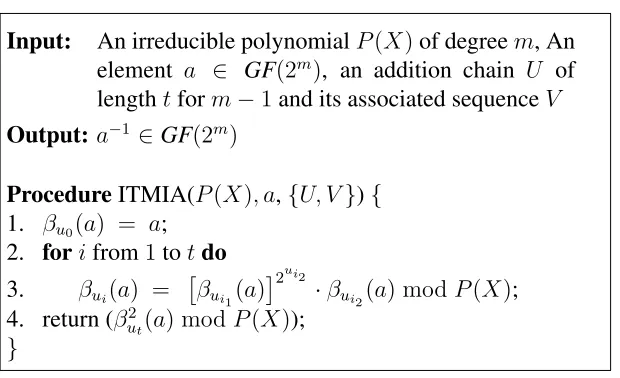
Fig. 2 shows an algorithm that iteratively computes all theβui(a)coefficients in
the exact order stipulated by the addition chainU as discussed above.
We assess the computational complexity of the algorithm shown in Fig. 2 as follows. The algorithm performstiterations (wheretis the length of the addition chainU) and one field multiplication per iteration. Thus, we conclude that a total oftfield multiplication computations are required. On the other hand, notice that at each iterationi, a total of2ui2 field squarings are performed. Notice also that by
definition, the addition chain guarantees that for each ui,1 ≤i ≤ t, the relation
ui2 = ui−ui1 holds. Hence, one can show by induction that the total number of
field squaring operations performed right after the execution of the i-th iteration isui−1. Therefore, at the end of the final iterationt, a total ofut−1 = m−2
Input: An irreducible polynomialP(X)of degreem, An element a ∈ GF(2m), an addition chain U of lengthtform−1and its associated sequenceV Output: a−1 ∈GF(2m)
ProcedureITMIA(P(X), a,{U, V}){ 1. βu0(a) = a;
2. forifrom1totdo
3. βui(a) =
βui1(a) 2ui2
·βui2(a) modP(X);
4. return (β2
ut(a) modP(X));
}
Figure 2: Multiplicative Inversion Addition-Chain Itoh-Tsujii Algorithm
Summarizing, the algorithm of Fig. 2 can find the multiplicative inverse of any nonzero element of the field using exactly,
#Multiplications =t;
#Squarings =m−1. (12)
Example 3.2. Let us consider the binary field GF(2193)using the irreducible
tri-nomialP(X) = X193+X15+ 1. Leta∈GF(2193)be an arbitrary nonzero field
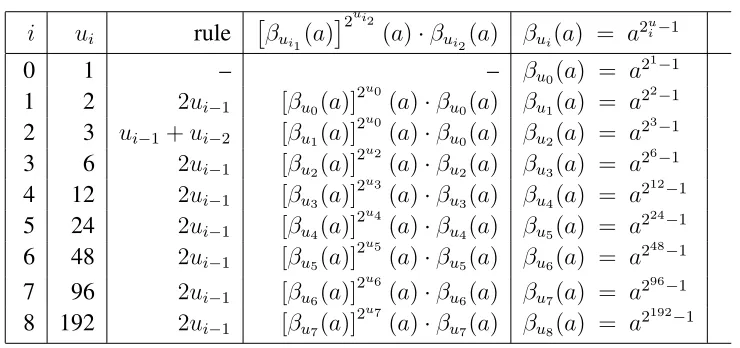
element. Then, using the addition chain of Example 3.1, the algorithm of Fig. 2 would compute the sequence of βui(a) coefficients as shown in Table 3.3. Once again, notice that after having computed the coefficientβu8(a), the only remaining step is to obtaina−1 which can be achieved asa−1 = βu28(a).
4
A Parallel Version of the Itoh-Tsujii Algorithm
Table 1: βi(a)Coefficient Generation for m-1=192
i ui rule
βui1(a) 2ui2
(a)·βui2(a) βui(a) = a
2u i−1
0 1 – – βu0(a) = a
21−1
1 2 2ui−1 [βu0(a)]
2u0
(a)·βu0(a) βu1(a) = a
22−1
2 3 ui−1+ui−2 [βu1(a)]
2u0
(a)·βu0(a) βu2(a) = a
23−1
3 6 2ui−1 [βu2(a)]
2u2
(a)·βu2(a) βu3(a) = a
26−1
4 12 2ui−1 [βu3(a)]
2u3
(a)·βu3(a) βu4(a) = a
212−1
5 24 2ui−1 [βu4(a)]
2u4
(a)·βu4(a) βu5(a) = a
224−1
6 48 2ui−1 [βu5(a)]
2u5
(a)·βu5(a) βu6(a) = a
248−1
7 96 2ui−1 [βu6(a)]
2u6
(a)·βu6(a) βu7(a) = a
296−1
8 192 2ui−1 [βu7(a)]
2u7
(a)·βu7(a) βu8(a) = a
2192−1
4.1
A Square Root-Then-Multiply Recursive Sequence of Field
Elements
For any nonzeroa∈GF(2m), we havea12 =a2m−1
, and
∀j ≤m−1 : a2−j =a2m−j (13)
just because2j(m−1) ≡2m−j mod (2m−1). Using (8) and (13), we obtain
a−1 =
1
Y
j=m−1
a2m−j =
1
Y
j=m−1
a2−j =aP1j=m−12−j
(observe that all indexes are varying in descending order). Noticing now that,
1
X
j=m−1
2−j = 1−
1 2
m
1− 1 2
−1 =
2m−1
2m−1 −1 =
2m−1−1 2m−1 ,
we get,
a−1 =a2 m−1−1
2m−1
In an analogous way as we did in Subection 3.1 for the sequence(βk(a))k∈
N, let us define now the sequenceγk(a) =a1−2
−k
k∈N
from (13),∀k ∈N:
γk(a) =a1−2−k =a·ha2−k i−1
=a·ha2m−k i−1
= [βm−k(a)] −1
. (14)
In particular, fork =m−1,
a−1 =γm−1(a). (15)
As in (9), for any two integersk, j ≥0,
γk+j(a) = γk(a)2
−j
γj(a). (16)
and, as in (10), forj =k,
γ2k(a) =γk(a)2
−k
γk(a) =γk(a)2
−k+1
(17)
The sequence (γk(a))k∈N is also periodic with periodm. Moreover, for any two integersk, j, the analogous of (11) would be,
γk(a) = γk+j(a)2
j
γm−j(a).
Furthermore, using eq’s. (15), (16) and (13),∀k ≤m−2:
a−1 =γm−1(a) = γm−1−k(a)2
−k
γk(a) =
h
βk+1(a)2
−k
βm−k(a)
i−1 .
Let us remark also that ifk, j are such thatk+j = m−j, then, according with (9) and (14),
βk(a)
βj(a)2
k γj(a)
=
βj(a)2
k βk(a)
γj(a)
= βk+j(a)γj(a) = βm−j(a)γj(a) = 1
and consequentlyβk(a)−1 =βj(a)2
k
γj(a).In summary
m≡k mod 2 =⇒ βk(a)−1 =βm−k 2 (a)
2k γm−k
2 (a), (18)
which in turn gives
k ≡0 mod 2 =⇒ γk(a) =βk 2(a)
2m−k γk
Thus, in particular by lettingk = 1in eq. (18) we get,
m≡1 mod 2 =⇒ a−1 =βm−1 2 (a)
2γ
m−1 2 (a) =
a2
m−1 2 −1
2 a1−2−
m−1 2
.
Our modification of Itoh-Tsujii algorithm uses now an addition chain for m2−1 and relations (16) and (17) to compute a−1 = γ
m−1(a). We summarize below what
we consider the main result of this paper,
Theorem 4.1. Let a ∈ GF(2m) be an arbitrary nonzero field element, with m odd. Then, its multiplicative inverse,a−1, can be found as,
a−1 = hβ{m−1 2 }(a)
i2 γ{m−1
2 }(a) =
a(2 m−1
2 −1)
2
·a1−2− (m−1)
2
. (19)
Example 4.2. Consider the smallest binary finite field, namely, GF(21) ={0,1},
then according to (19) the multiplicative inverse of the only nonzero field element would be,
1−1 = hβ{1−1 2 }(1)
i2 γ{1−1
2 }(1) =
1(2
1−1 2 −1)
2
·11−2−
(1−1) 2
= [10]2·10 = 1.
Example 4.3. Consider the binary finite field GF(23), then according to (19) the
multiplicative inverse of an arbitrary nonzero field element would be,
a−1 = hβ{3−1 2 }(a)
i2 γ{3−1
2 }(a) =
a(2 3−1
2 −1)
2
·a1−2− (3−1)
2
= a2·a1−2−1 =a2·a·ha2−1i −1
=a3·ha23−1i −1
=a3·
a4−1 =a−1.
Notice that in virtue of (13), the equalitya2−1 =a23−1 used above holds.
4.2
Square Root ITMIA
Let a be any arbitrary nonzero element in the field GF(2m). Let us consider an
addition chain U of lengtht for m−1 and its associated sequence V. Then the multiplicative inverse ofa,a−1 ∈ GF(2m), can be found by repeatedly applying
eq’s. (16) and (17). Hence, givenγu0(a) = a
1−2−1 = √a, for eachu
i,1 ≤i ≤ t,
compute
γui1(a)
2 −ui
2
γui2(a) = γui2+ui1(a) = γui(a) = a
1−2−ui
Whereγ{ut=m−1} =a
1−2−(m−1)
=a−1 gives the required result.
Fig. 3 shows an algorithm that iteratively computes all theγui(a)coefficients
in the exact order stipulated by the addition chain U as discussed above. We assess the computational complexity of the algorithm shown in Fig. 3 as follows. The algorithm performs one field multiplication in each of algorithm’stiterations, yielding a total of t field multiplication computations required. Furthermore, at each iteration i, a total of 2ui2 field square roots are performed. Since by
defi-nition, the addition chain guarantees that for each ui,1 ≤ i ≤ t, the relation
ui2 = ui−ui1 holds, one can show that the total number of field square root
oper-ations performed right after the execution of thei-th iteration isui−1. Therefore,
a total of ut −1 = m− 2 square root operations must be performed. This,
together with the initial square root operation, yield a total ofm−1field square root computations.
Summarizing, the algorithm of Fig. 3 can find the inverse of any nonzero ele-ment of the field using exactly,
#Multiplications = t;
#Square root = m−1. (20)
Example 4.4. Following with our running example, let us consider the binary field GF(2193)generated using the irreducible trinomialP(X) = X193 +X15+ 1.
Let a ∈ GF(2193)be an arbitrary nonzero field element. Then, the algorithm of
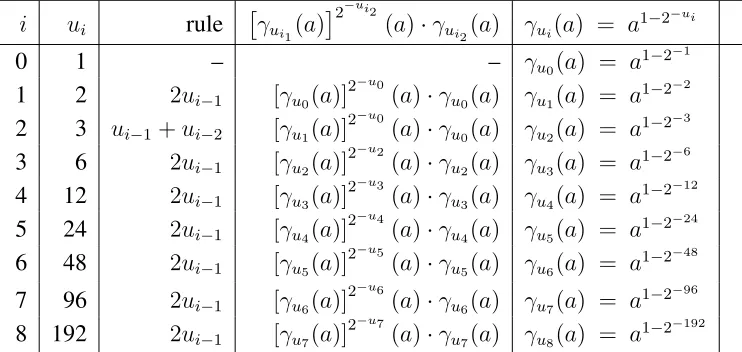
Fig. 3 would compute the sequence of γui(a)coefficients as shown in Table 4.2. The multiplicative inverse is given asγu8 =a
−1.
4.3
Itoh-Tsujii Algorithm: Parallel Version
Input: An irreducible polynomialP(X)of degreem, An element a ∈ GF(2m), an addition chain U of lengthtform−1and its associated sequenceV Output: a−1 ∈GF(2m)
ProcedureSquareRoot ITMIA(P(X), a,{U, V}){ 1. γu0(a) =a
1−2−1 = √a;
2. forifrom1totdo
3. γui(a) =
γui1(a) 2−ui2
·γui2(a) modP(X);
4. return (γut(a) modP(X));
}
Figure 3: Multiplicative Inversion Addition-Chain Itoh-Tsujii Algorithm
Table 2:γi(a)Coefficient Generation for m-1=192
i ui rule
γui1(a) 2−ui2
(a)·γui2(a) γui(a) = a
1−2−ui
0 1 – – γu0(a) = a
1−2−1
1 2 2ui−1 [γu0(a)]
2−u0
(a)·γu0(a) γu1(a) = a
1−2−2
2 3 ui−1+ui−2 [γu1(a)]
2−u0
(a)·γu0(a) γu2(a) = a
1−2−3
3 6 2ui−1 [γu2(a)]
2−u2
(a)·γu2(a) γu3(a) = a
1−2−6
4 12 2ui−1 [γu3(a)]
2−u3
(a)·γu3(a) γu4(a) = a
1−2−12
5 24 2ui−1 [γu4(a)]
2−u4
(a)·γu4(a) γu5(a) = a
1−2−24
6 48 2ui−1 [γu5(a)]
2−u5
(a)·γu5(a) γu6(a) = a
1−2−48
7 96 2ui−1 [γu6(a)]
2−u6
(a)·γu6(a) γu7(a) = a
1−2−96
8 192 2ui−1 [γu7(a)]
2−u7
(a)·γu7(a) γu8(a) = a
Example 4.5. Let us consider once again the binary field GF(2193) using the
irreducible trinomialP(X) = X193+X15+ 1. We can reuse coefficientsβ7and
ˆ
β7 defined in Tables 3.3 and 4.2, respectively. Then the multiplicative inverse ofa
can be found as,a−1 =β2
u7γu7.
Since both coefficients above can be computed in parallel, this version of the Itoh-Tsujii algorithm will show a significant saving in time performance as it is discussed in the next Section.
5
Reconfigurable Hardware Architecture for
Multi-plicative Inversion in
GF
(2
193)
In this Section, a description of our proposed architecture in reconfigurable hard-ware is presented. Field squarer, square root and Multiplier are the three most prominent building blocks for performing inversion inGF(2m)using the ITMIA procedures described in the previous Sections. Squaring in GF(2m) is a simple
operation, however, as it was stated in (12), we need to perform m− 1 squar-ings for m-bit inversion when using the ITMIA procedure of Fig. 2 (similarly, according to (20) we must perform m −1 square roots if the algorithm of Fig. 3 is executed). Fortunately, onlytfield multiplications are needed for computing multiplicative inversion, which is valuable for the design since field multiplication inGF(2m)is a costly and extensive time consuming operation.
Throughout the rest of this Section, we assume that the binary extension field
GF(2193)was generated using the irreducible trinomialP(X) = X193+X15+ 1.
Field Squaring Block
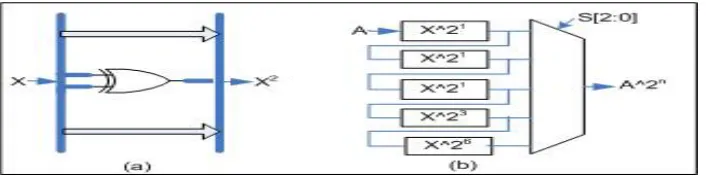
Figure 4: SquarerGF(2193)(a) forX21
(b) forX2n
Figure 4.a shows our strategy for implementing field squaring trying to use as few clock cycles as possible. In the case of the binary extension fieldGF(2193), field squaring can be obtained using XOR gates only, as it was summarized in (5). Figure 4.b shows the GF(2193)field squarer block used in this work.
Refer-ring to the addition chain described in Table 3.3, frequent squaRefer-ring operations in
GF(2193)are,
• [βui(a)]
21
(1 time);
• [βui(a)]
23
(3 times);
• [βui(a)]
26
(6 times) and;
• [βui(a)]
212
(12 times).
That is why we took the design decision of cascading 12 field squarer blocks back to back and then, by the appropriate usage of multiplexer blocks, obtain the corresponding outputs after 1, 3, 6, and 12 squarer blocks as shown in Figure 4.b. As an example, the X224
field operation can be accomplished in just two clock cycles by taking the output after the last squarer block (12 squarers) in the first clock cycle and then repeating this operation in a second clock cycle so that we get the required24field squarings.
Field Square Root Block
Based on eq. (6), we designed the square root block shown in Figure 5.a. As it can be seen, this field operation can be obtained by using two-input XOR gates only. In a similar fashion to the squaring block discussed above, Figure 5.b implements multiple square root operations trying to save as many clock cycles as possible. The five inputs of the multiplexer are formed by replicating 1, 1, 1, 3, and 6 square root blocks which can perform 1, 2, 3, 6 and 12 square root operations respectively, in just one clock cycle.
Field Multiplier
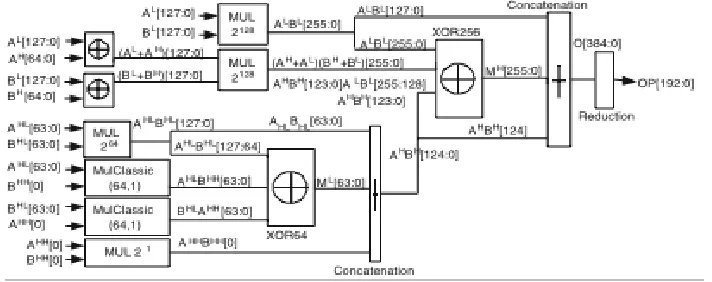
Our strategy for multiplication is based on the binary Karatsuba-Ofman multiplier which is a variation of normal Karatsuba-Ofman multiplier as it was presented in [13]. Figure 6 shows aGF(2193)binary Karatsuba-Ofman multiplier which is a
Figure 5: Square Root CircuitGF(2193)(a) forX2−1(b) forX2−n
implementation
Figure 6: GF(2193)binary Karatsuba multiplier
of the classical school-method whenever it is useful. In this design, two 193-bit operands A and B are multiplied by first dividing each operand into two parts: upper part (say AH andBH of 128 bits each) and lower part (sayALandBLof
65 bits each). For 128-bit multiplications, two Karatsuba-Ofman multipliers were used. However, for 65 bit multiplication, instead of using three 64-bit Karatsuba-Ofman multipliers, only one 64-bit Karatsuba-Karatsuba-Ofman multiplier, two64×2 clas-sical multiplier (2 multiplexers) and one 1-bit multiplier (only AND gate) were used. Using this approach, savings are made not only in terms of FPGA resources but also in achieving a higher parallelism. Therefore, the time delay of the 193-bit multiplier is equal to the time delay of the biggest multiplier only (time delay of the 128-bit multiplier block).
General Architecture
Figure 7: General Architecture for Multiplicative Inversion overGF(2193)
and 3, squaring-multiplication and square root-multiplication are the two se-quences needed for computing multiplicative inverses over GF(2193). Both are independent and can be processed in parallel provided that hardware resources meet up design requirements. A direct approach would be to use two multipliers with squarer and square root blocks operating separately. That would, however, be more expensive as our multiplier block consumes a large amount of hardware resources. A more reasonable architecture can be obtained with a single multi-plier by introducing a multiplexer for squarer and square-root blocks as shown in Fig. 7. The intermediate results required for next stages of the algorithm are read/written in a Block select RAM (BRAM).
BRAMs are built-in memory modules available in Virtex and VirtexE series devices by Xilinx. A dual port BRAM can be configured into two single port BRAMs, i.e., data can be read/written at two ports simultaneously. This useful feature was exploited in this design in order to achieve higher parallelism. First port was configured as a RAM in order to write the multiplier outputs, while the second one was configured as a ROM, responsible to read the second multiplier operand (already stored from previous iterations). A single BRAM has a size of 4K (4096 bits), which is sufficiently large for storing all intermediate results generated by our algorithm. Additionally, an array of 12 BRAMs was needed for managing a 193-bit data bus.
bits to the multiplexers available inside the SQ BLK and SR BLK blocks.
For instance, NSQ=000 selects the first input of the multiplexer which is con-nected to the output of a single squarer unit, whereas NSQ=101, selects the fifth multiplexer input, which is connected to the 12 squarer unit. A total of 17 bits (4 bits for BRAM port A, 4 bits for BRAM port B, 1 bit for MUX1, 1 bit for MUX2, 1 bit MUX3, 3 bits for NSQ, 3 bits for NSR) are used for controlling and synchronizing the whole circuitry. The 17-bit control word for each clock cycle is filled in the ROM block, and then they are extracted at the rising edge of each clock cycle. A short description of the control unit is given below.
Figure 8: Design Control Unit
As shown in Fig. 7, Control Unit block orchestrates and synchronizes data flow for the whole design. A 4- bit counter and a ROM constitute the control unit. The ROM block is filled with a total of twenty 17-bit control words. Those control words are used at each one of the 20 clock cycles required for completing the execution of our algorithm. The address bits for the ROM block are timely incremented by a 4-bit counter as shown in Figure 8.
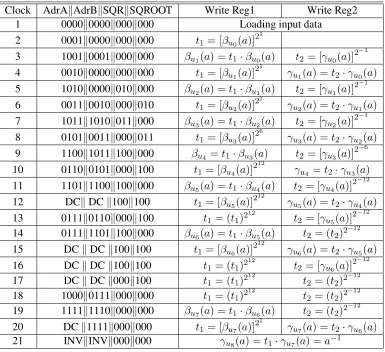
Table 3 shows the algorithm dataflow. In the first cycle, the field elementa, whose multiplicative inverse is required, is written into the BRAM. Then, start-ing at cycle 2, our architecture of Fig. 7 computes both of them, βui(a) and γui(a) fori = 0,1,· · · ,7in parallel. At clock 21, a final computation, namely, γu8(a) = [βu7(a)]
21
·γu7(a), is performed, which according to theorem 4.1 yields
the required multiplicative inverse, i.e.,γu8(a) = a −1.
Notice that the control word that commands all the operations to be performed in the next rising edge of the master clock, is set at the rising edge of the previous clock cycle. For example at cycle 8, the control word: 0101k0011k000k011 se-lects the operations for cycle 9 as follows: address 0101 commands to write data at port A; address 0011 orders to read data from port B; and address 000 com-mands to perform a single squaring; and finally the address 011 orders to perform six square root operations that will be stored in the register t2. The code word
Finally, let us say that in the very first computation, the first clock cycle is used for loading the input field elementa. If more multiplicative inverse computations are required, the input data can always be loaded during the last clock cycle of the previous computation, thus making possible that a single multiplicative inverse calculation may be accomplished in a total of 20 clock cycles.
Table 3: Algorithm Dataflow
Clock AdrAkAdrBkSQRkSQROOT Write Reg1 Write Reg2
1 0000k0000k000k000 Loading input data
2 0001k0000k000k000 t1 = [βu0(a)]
21
3 1001k0001k000k000 βu1(a) =t1·βu0(a) t2 = [γu0(a)]
2−1
4 0010k0000k000k000 t1 = [βu1(a)]
21
γu1(a) =t2·γu0(a)
5 1010k0000k010k000 βu2(a) =t1·βu1(a) t2 = [γu1(a)]
2−1
6 0011k0010k000k010 t1 = [βu2(a)]
21
γu2(a) =t2·γu1(a)
7 1011k1010k011k000 βu3(a) =t1·βu2(a) t2 = [γu2(a)]
2−1
8 0101k0011k000k011 t1 = [βu3(a)]
26 γ
u3(a) =t2·γu2(a)
9 1100k1011k100k000 βu4 =t1·βu3(a) t2 = [γu3(a)]
2−6
10 0110k0101k000k100 t1= [βu4(a)]
212
γu4 =t2·γu3(a)
11 1101k1100k100k000 βu5(a) =t1·βu4(a) t2 = [γu4(a)]
2−12
12 DCkDCk100k100 t1= [βu5(a)]
212 γ
u5(a) =t2·γu4(a)
13 0111k0110k000k100 t1= (t1)2
12
t2 = [γu5(a)]
2−12
14 0111k1101k100k000 βu6(a) =t1·βu5(a) t2 = (t2)
2−12
15 DCkDCk100k100 t1= [βu6(a)]
212 γ
u6(a) =t2·γu5(a)
16 DCkDCk100k100 t1= (t1)2
12
t2 = [γu6(a)]
2−12
17 DCkDCk000k100 t1= (t1)2
12
t2 = (t2)2
−12
18 1000k0111k000k000 t1= (t1)2
12
t2 = (t2)2
−12
19 1111k1110k000k000 βu7(a) =t1·βu6(a) t2 = (t2)
2−12
20 DCk1111k000k000 t1 = [βu7(a)]
21
γu7(a) =t2·γu6(a)
6
Comparison and Results
As it was explained in the previous Section, multiplicative inverse computation over GF(2193) was achieved by integrating three main building blocks, namely,
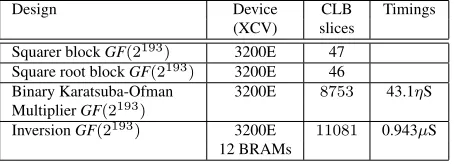
squaring, square root and multiplication blocks. Table 4 presents a summary of the implementation results obtained for each individual building block as well as for the whole system, i.e., inversion overGF(2193). Xilinx Foundation Tool F4.1i was
used for design synthesis, implementation and verification of results. The Binary Karatsuba-Ofman multiplier block occupied 8753 CLB slices executing one field multiplication in 43.1ηS. The field Squarer and square root in GF(2193) took a
total of 47 and 46 CLB slices for a single block respectively. The architecture was implemented in a XCV3200efg1156 (VirtexE device) occupying a total of 11131 (34.3%) CLB Slices and 12 (5 %) BRAMs. One inversion inGF(2193)consumes
0.943µS in 20 clock cycles at a rate of 21.2 MHz (47.16ηS).
Table 4: Design Implementation Summary Design Device CLB Timings
(XCV) slices Squarer blockGF(2193) 3200E 47
Square root blockGF(2193) 3200E 46
Binary Karatsuba-Ofman 3200E 8753 43.1ηS MultiplierGF(2193)
InversionGF(2193) 3200E 11081 0.943µS 12 BRAMs
Table 5 shows the computational cost of several reported designs for the com-putation of multiplicative inversion overGF(2m)in hardware platforms.
Further-more, we show also that an implementation of thestandardItoh-Tsujii algorithm using our architecture requires28clock cycles, thus computing the multiplicative inverse in about1.32µS. This implies that the Itoh-Tsujii parallel version proposed in this work represents a saving of about 30% when compared with the standard version.
7
Conclusions
Table 5: Specifications for inversion inGF(2m)
Reference Field Cycles Freq (MHz) timings
Gutub et. al. [6] GF(2256) 5000 50 100µS
Goodman et. al. [14] GF(2256) 3712 – –
Bednara et. al. [15] GF(2191) – 50 7.8µS
Lutz [16] GF(2163) 259 50 5.18µS
This work (Standard) GF(2193) 28 21.2 1.32µS This work (Parallel) GF(2193) 20 21.2 0.943µS
multiplicative inverse of an arbitrary nonzero field element in GF(2m)can be
com-puted by performing exactlym−1field squarings andtmultiplications, wheret
is the step-length of the optimal addition-chain form-1.
Furthermore, we derived a novel version of the Itoh-Tsujii algorithm which uses field multiplication, field squaring and field square root operators as main building blocks. We showed how this version of the algorithm can be parallelized when implemented in hardware platforms. Our method achieves its best perfor-mance when using a special class of irreducible trinomials, namely, P(X) =
Xm +Xk+ 1, withm andk odd numbers. This is because for this special class
of irreducible trinomials, the computation of the field square root operation is simpler than field squaring.
We implemented the proposed algorithm in a reconfigurable hardware device for the computation of multiplicative inverses of nonzero field elements in the finite fieldGF(2m)generated by the irreducible trinomialP(X) = X193+X15+1. Our experimental results show that the parallel version of the Itoh-Tsujii algorithm implementation yields a speedup of about 30% when compared with the standard version of it.
Since for all practical cryptographic and code applications in binary extension fields field multiplication is a mandatory operator, our solution does not represent a significant extra burden in terms of hardware resource requirements.
It is worth to notice that although the theoretical formulae included in this pa-per were derived assuming polynomial basis representation of the field elements, the extension of our results to optimal normal basis is straightforward.
References
[1] T. Itoh and S. Tsujii, “A fast algorithm for computing multiplicative inverses in GF(2m) using normal basis,” Information and Computing, vol. 78, pp.
171–177, 1988.
[2] G.L:Feng, “A VLSI architecture for fast inversion in GF(2m),”IEEE
Trans-actions on Computers, vol. 38(10), pp. 1383–1386, October 1989.
[3] N. Takagi, J. Yoshiki, and K. Tagaki, “A fast algorithm for multiplicative inversion in GF(2m)using normal basis,”IEEE Transactions on Computers,
vol. 50(5), pp. 394–398, May 2001.
[4] M. A. Hasan, “Efficient computation of multiplicative inverses for crypto-graphic applications,” in 15th IEEE Symposium on Computer Arithmetic, Vail, Colorado, U.S.A., June 2001.
[5] S. Yen, “Improved normal basis inversion in GF(2m),” IEE Electronic
Let-ters, vol. 33(3), pp. 196–197, January 1997.
[6] A. A.-A. Gutub, A. F. Tenca, E. Savas, and C. K. Koc, “Scalable and unified hardware to compute montgomery inverse in GF(p)and GF(2n),” Crypto-graphic Hardware and Embedded Systems - CHES 2002, 4th International Workshop, Redwood Shores, CA, USA, vol. 2523, pp. 484–499, August 20002.
[7] F. Rodr´ıguez-Henr´ıquez, N. A. Saqib, and N. Cruz-Cort´es, “A fast imple-mentation of multiplicative inversion over GF(2m),” inInternational
Sympo-sium on Information Technology (ITCC 2005), vol. 1, Las Vegas, Nevada, U.S.A., April 2005, pp. 574–579.
[8] J. Guajardo and C. Paar, “Itoh-tsujii inversion in standard basis and its ap-plication in cryptography and codes,” Designs, Codes and Cryptography, vol. 25, pp. 207–216, 2002.
[9] D. E. Knuth,The Art of Computer Programming 3rd. ed. Reading, Massa-chusetts: Addison-Wesley, 1997.
[11] K. Fong, D. Hankerson, J. L´opez, and A. Menezes, “Field inversion and point halving revisited,” IEEE Transactions on Computers, vol. 53, no. 8, pp. 1047–1059, Aug. 2004.
[12] A. J. Menezes, P. C. van Oorschot, and S. A.Vanstone,Handbook of Applied Cryptography. Boca Raton, Florida: CRC Press, 1996.
[13] F. Rodr´ıguez-Henr´ıquez, N. A. Saqib, and A. D´ıaz-P´erez, “A fast parallel implementation of elliptic curve point multiplication overgf(2m),”Elsevier
Journal of Microprocessors and Microsystems, vol. 28, no. 8, pp. 329–339, Aug. 2004.
[14] J. Goodman and A. P. Chandrakasan, “An energy-efficient reconfigurable public-key cryptography processor,” IEEE Journal of Solid-State Circuits, vol. 36, no. 11, pp. 1808–1820, Nov. 2001.
[15] M. Bednara, M. Daldrup, J. Shokrollahi, J. Teich, and J. von zur Ga-then, “Reconfigurable implementation of elliptic curve crypto algorithms,” inProc. of The 9th Reconfigurable Architectures Workshop (RAW-02), Fort Lauderdale, Florida, U.S.A., April 2002.