(include assigned division number from I to X)
THE SUPPLEMENTARY AND EXACT SOLUTION OF AN EQUIVALENT
MECHANICAL MODEL FOR FLUID SLOSHING IN NUCLEAR
STRUCTURE
Hongliang Gou1, Ziduan Shang2, Yuchun Li3, Shaoping Li4, and Honghui Ge5
1
Structural Engineer and Doctoral Candidate, Shanghai Nuclear Engineering Research and Design Institute, China
2
Technical Director, Shanghai Nuclear Engineering Research and Design Institute, China 3
Professor, Civil Engineering Institute of Tongji University, China 4
Technical Director, Shanghai Nuclear Engineering Research and Design Institute, China 5
Technical Director, Shanghai Nuclear Engineering Research and Design Institute, China
Abstract: In nuclear structure, fluid sloshing is one of the key factors affecting the structural safety. At present, Housner formulation for rectangular tank is widely applied for the analysis. In this paper, based on the linear potential theory of a fluid and an analogical approach, a supplementary and exact solution of an equivalent model is developed for a sloshing fluid and is compared with the existing solutions given by
Graham and Rodriguez, Housner and a semi-analytical/numerical method. The results indicate that
Graham and Rodriguez did not provide the correct location expressions for the convective masses. The expressions for the impulsive mass and its position given by Housner are not completely satisfactory approximations of the exact solutions. The solution in this paper can be an exact formulation to supply the famous, traditional formulations given by Graham and Rodriguez as well as Housner.
INTRODUCTION
As there are lots of tanks in nuclear island, it is essential to analyze the fluid sloshing such as the PCCAWST illustrated in Figure 1. At present, Housner solution is widely applied in engineering the analysis. Though Housner equation is an advanced method compared with Graham and Rodriguez, it is still an approximate solution.
For the analysis of fluid sloshing, Graham and Rodriguez (1952) first derived the exact solution of the equivalent mechanical model in a rectangular tank based on the linear potential theory. The parameters of the equivalent model included the impulsive and convective masses along with their locations and the sloshing frequencies. Housner (1957) imagined that the fluid was constrained by thin, massless, vertical membranes that are free to move in the transverse direction. Based on this physical intuition, Housner
derived the impulsive and convective masses and their heights above the tank bottom. Housner thought this solution was a good estimate relative to the exact solution presented by Graham and Rodriguez. These famous and traditional theories presented by Graham and Rodriguez as well as Housner have been widely used in engineering (Dodge, 2000; Faltinsen and Timokha, 2010; Ibrahim, 2005; Ibrahim et al., 2001). Recently, Li et al. (2011) presented a fitting solution using a semi- analytical/numerical method. From the differences among these existing formulations, the traditional theories did not appear to be perfect. In this paper, a supplementary and exact solution of an equivalent model for a sloshing fluid in a rectangular tank is presented and compared with the formulations developed by Graham and Rodriguez,
Figure 1. PCCAWST in Nuclear Structure
BASIC EQUATION
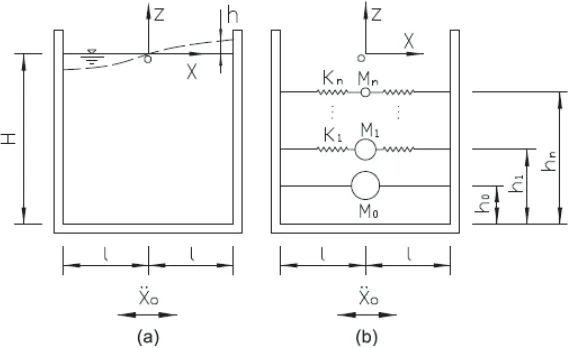
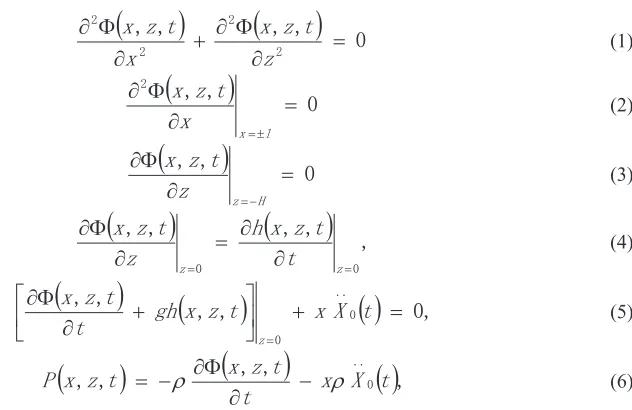
A two-dimensional sloshing problem is considered. A rectangular tank (with a unitary thickness) is shown in Figure 2 (a) where the co-ordinate system oxz is fixed to the tank, and H is the depth of the water, 2l is the width of the water, and the thickness of water is 1m. The tank is presumed to be rigid.
Figure 2. Equivalence of a sloshing liquid in a rectangular tank (a) Original system; (b) Equivalent system
When the tank is subjected to a horizontal acceleration, [
! "
W
!
"
!
"
# $ % $ & $ % $]
W
]
[
[
W
]
[
(1)!
"
# $ % $ ' # O [
[
W
]
[
(2)!
"
# $ % $ ( # + ]
]
W
]
[
(3)!
"
!
"
# # $ $ # $ % $ ] ]
W
W
]
[
K
]
W
]
[
(4)!
"
!
"
! "
# & ) * + , -. & $ % $ #
W
;
[
W
]
[
JK
W
W
]
[
] (5)!
"
!
"
! "
W
;
[
W
W
]
[
W
]
[
3
/
(/
$ % $ (
# (6)
where t is the time, F(x,z,t) is the velocity potential function, h(x,z,t) is the small wave-height function on the free surface, P(x,z,t) is the hydrodynamic pressure, r is the mass density of the fluid, and g is the acceleration due to gravity. By solving Equations (1) to (6), the hydrodynamic pressure could be obtained.
!
"
! "
!
"
;! "
W ;! "
0
!
W"
1
G [0
!
] +"
1
[;! "
W +O W
] [
3 Q Q
Q W Q Q Q Q Q
FRVK VLQ VLQ FRVK
4 3 4 3 3 2 2 /
2 2 / ( & 5 6 7 8 9 : ( ( ( (
#
;
=<
# (7) where,
!
"
O
Q
Q>
2
# ( ˈ!
Q
#"
(8)!
+
"
J
Q QQ
2
2
4
# WDQK ˈ!
Q
#"
(9)Eq. (9) is simply the analytical expression of the nth sloshing frequency, which is the same as the formula given by Graham and Rodriguez (1952). For the original system in Figure 1(a) and considering Equation 7, the horizontal force and moment acting on the tank can be written as:
!
"
!
"
0
1
<
( # ( #(#
RULJLQDO + [ O [ O
/
3
[
]
W
3
[
]
W
G]
)
(10)!
"
!
"
0
1
!
"
<
!
"
<
( # ( #( & & ( #(# O
O ] +
+ [ O [ O
RULJLQDO
/ 3 [ ]W 3 [ ] W ] + G] 3 [ ] W [G[
0 (11)
Figure 1 (b) shows the equivalent system of the sloshing fluid in a rectangular tank. The equivalent system is composed of a fixed M0 and a set of mass-spring (Mn,Kn) (n=1, 2, 3,…) models, each of which corresponds to the nth sloshing mode of the contained fluid. The symbols (h0, h1,..., hn), as shown in Figure 1 (b), represent the heights of the masses above the tank bottom. For the equivalent system, the responses of the horizontal force and moment (FL,equivalent and ML,equivalent) to the horizontal acceleration
! "
W [! "
(;
<
! "
!
("
( # = # W Q Q Q Q HTXLYDOHQW/
0
;
W
0
;
W
G]
)
4
3
VLQ4
3
(12)! "
(;
<
! "
!
("
( # = # W Q Q Q Q Q HTXLYDOHQW
/
0
;
W
K
0
K
;
W
G]
0
4
3
VLQ4
3
(13)SUPPLEMENTARY SOLUTION
Due to the fact that the actual fluid and its equivalent mechanical model have the same force and moment acting on the tank, one has the following relations:
HTXLYDOHQW /
RULJLQDO
/
)
)
# (14)HTXLYDOHQW /
RULJLQDO
/
0
0
# (15)The equivalent system, which represents the inherent dynamic characteristics of the sloshing fluid, is independent of external excitations, i.e., Equation 14 and 15 are always valid for an arbitrary acceleration excitation[
! "
W
. Substituting Equation 10 ~13 into Equation 14 and 15, it is noted that there are two time
terms, [
! "
W
and
<
W;! "
3 4Q!
W (3"
G3
VLQ , in both Equation 14 and 15. By comparing the coefficients of these
time terms on the left-and right-hand sides of Equation 14 and 15, the parameters of the equivalent system could be finally derived.
! "
!
"
!
"
WDQK+
+
O
+
0
0
Q Q Q2
2
# ˈ
!
Q
#"
(16)!
"
!
+
"
+
+
+
K
Q Q Q Q2
2
2
VLQK FRVK & (# ˈ
!
Q
#"
(17)! "
!
"
!
"
;
;
= # = # ( # ( # WDQK Q Q Q Q Q+
+
O
+
0
0
0
0
2
2
(18)! " ! "! "
! "
!
!
"
!
"
" !
!
"
!
"
"
! "
!
" !
"
;
;
= # = # ( ( & ( & # WDQK FRVK FRVK VLQKQ Q Q
Q Q Q Q Q Q
+ + O + + + + + + O + + O + K 2 2 2 2 2 2 2 (19)
!
"
WDQK ) * + , -. ?? @ A BB C D # #+
+
O
+
+
0J
0
.
Q Q Q Q Q2
2
4
ˈ!
Q
#"
(20)Where M=2!lH is the total mass of the fluid (with a uniform thickness of 1m).
Equation 16, 18 and 20 are identical to the formulae given by Graham and Rodriguez (1952). Although Equation 19 appears different from the equation given by Graham and Rodriguez, it is the same as the location expression of the impulsive mass given by Graham and Rodriguez. However, Equation 17 is very different from the equation given by Graham and Rodriguez;Equation 17 is the newly developed supplementary solution.
Figures 3 to 6, respectively, show the variations of M1/M,h1/H,M0/M and h0/H with H/l. It can be seen from Figures 3 and 4 that the 1st convective mass ratio M1/M and its position ratio h1/H given by Housner
From Figures 4 and Equation 17, it can be seen that Graham and Rodriguez did not give the correct location expression of the sloshing (convective) masses. From Figures 5 and 6, one can note that the impulsive mass ratio M0/M and its position ratio h0/H given by Housner are somewhat different from the ratios given by Equation 18 and 19 and the fitting values. The maximum errors of M0/M and h0/H relative to the exact solutions reach approximately 10.5% and 14.8%, respectively.
DISCUSSION AND CONCLUSTION
This paper discusses the four types of solutions of the equivalent model for a sloshing fluid in a rectangular tank. These solutions are, respectively, the formulations by Graham and Rodriguez (1952),
Housner (1957), Li etal.(2011) and this paper. Based on the strict linear potential theory, Graham and
Rodriguez derived the exact solution of the equivalent model with respect to horizontal sinusoidal excitation, but they did not give the correct location expression for the convective masses. A mistake might have been made during their derivation process of the formulas. The Housner’s theory was established based on physical intuition, which was not an accurate physical law. Therefore the Housner’s solution was naturally approximate. Housner’s model can offer approximate and reasonable equivalent masses and their locations, but the expressions of the impulsive mass ratio M0/M and its position ratio
h0/H are not completely satisfactory approximations of the exact solutions. Based on the linear potential theory, this paper derived the exact and complete solution of an equivalent model for a sloshing fluid in a rectangular tank. Except for Equation 17, the model expressions in this paper are basically identical to those given by Graham and Rodriguez. The new formulation (Equation 17) is very consistent with the numerical fitting (Li etal., 2011) and with Housner, which verifies the validity of this study. The solution in this paper, especially in the case of Equation 17, can be a supplementary and exact solution to the famous and traditional formulations given by Graham and Rodriguez,as well as Housner.
REFERENCES
Chopra, A.K. (2007). “Dynamics of Structures: Theory and Applications to Earthquake Engineering”, 3rd edition Prentice Hall, New Jersey.
Dodge, F.T. (2000). “The New Dynamic Behavior of Liquids in Moving Containers”, Update of NASA SP-106, Southwest Research Institute, San Antonio, Texas.
Faltinsen, O.M. and Timokha, A.N. (2010). “Book review”, Journal of Fluids and Structures, 26, 1042-1043.
Graham, E.W. and Rodriguez, A.M. (1952). “Characteristics of fuel motion which affect airplane dynamics”, Journal of Applied Mechanics, 19, 381-388.
Housner, G.W., (1957). “Dynamic pressure on accelerated containers”, Bulletin of the Seismological Society of America, 47, 15-35.
Ibrahim, R.A., (2005). “Liquid Sloshing Dynamics (Theory and Applications)”, Cambridge University Press, Cambridge.
Ibrahim, R.A. and Pilipchuk, V.N. (2001). “Recent advances in liquid sloshing dynamics”, Applied Mechanics Reviews, 54, 133-199.
Li, Y. and Di, Q. (2011). “Equivalent mechanical models of sloshing fluid in arbitrary-section aqueducts”,
Figure 3. Curve of M1/M and H/l
Figure 4. Curve of M1/M and H/l
Graham & Rodriguez (1952) Housner (1957)
Equation (16)
Fitting (Li et al., 2011)
Graham & Rodriguez (1952)
Housner (1957) Equation (16)
Figure 5. Curve of M0/M and H/l
Figure 6. Curve of h0/H and H/l
Graham & Rodriguez (1952) Housner (1957)
Equation (16)
Fitting (Li et al., 2011)
Graham & Rodriguez (1952)
Housner (1957)
Equation (16)