Disease Prediction of Paddy Crops
Using Data Mining and Image
Processing Techniques
Suraksha I S1, Sushma B2, Sushma R G3, Sushmitha Keshav4, Uday Shankar S V5
Student, Dept. of ISE, SJBIT, Bangalore, India1
Student, Dept. of ISE, SJBIT, Bangalore, India2
Student, Dept. of ISE, SJBIT, Bangalore, India3
Student, Dept. of ISE, SJBIT, Bangalore, India4
Asst. Professor, Dept. of ISE, SJBIT, Bangalore, India5
ABSTRACT: Image processing is the analysis and manipulation of a digitized image especially in order to improve its quality. Data mining is the practice of examining large pre-existing databases to generate new information and it is process of selecting and exploringlarge amounts of data. This process has become an increasingly aggressive action in all areas of agricultural sciences and research. A large amount of scattered information about paddy crops is available. Here in this paper implements an innovative idea to identify diseases affected in paddy crops and provides the remedy/solution to farmers. The images of the diseased paddy crop are captured with the help of high pixel cameras or mobile phone like android or iPhone or wireless PDA. These images are then fed for application for identifying paddy diseases and suggest remedies to the farmer. This implementation provides better choice for every class of agriculture community especially in remote villages.
KEYWORDS: Data Mining, Paddy Crop, Diseases, Morphological Operators, Remedies.
I.INTRODUCTION
Image processing is the analysis and manipulation of a digitized image especially in order to improve its quality and it is form of signal processing for whichthe input is an image, such as a photograph; the output of image processing may be either an image or a set of characteristics or parameters related to that image. Most image-processing techniques involve treating the image as a two-dimensional signal and applying standard signal-processing techniques to it. Digital image processing is the use of computer algorithms to perform image processing on digital images.
In our work, image processing starts with the digitized a colour image of paddy disease leaf. Then a method of mathematics morphology is used to segment these images. Erosion method has been used.
The following are the challenges that can be overcome in Image Processing for agricultural applications:
To detect diseased leaf.
To determine size & shape of paddy crop.
To find shape of affected area.
To determine colour of affected area
Data mining is the practice of examining large pre-existing databases to generate new information. It is computational process of discoveringpatterns in large data sets involving methods at the intersection of artificial intelligence, machine learning, statistics, and database systems. The goal is the extraction of patterns and knowledge from large amount of data, not the extraction of data itself. The overall goal of the data mining process in our implementation is to extract the information from a data set and transform it into an understandable structure called remedy. There are two forms of data analysis that can be used for extracting models describing important classes or to predict future data trends.
These two forms are as follows –
Prediction
Classification
Classification models predict definite labels in data analysis, while prediction models predict continuous-valued functions in data analysis.
Paddy Crops disease is caused by pathogen which is anyagent causing disease. In most of the cases diseases are seen on the leaves or stems of the plant. Therefore identification of plants, leaves, stems and finding out the diseases, percentage of the disease incidence, symptoms of the pest or disease attack, plays a key role in successful cultivation of paddy crops.Our team has three objectives: to process a diseased/healthy image of paddy crop leaf, to classify among diseases and finally provide the farmer with treatment possibilities for that particular disease.
II. PHASES AND METHODS
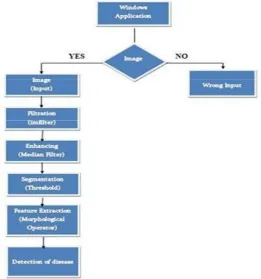
The block diagram constituting different phase is shown in below fig 1.
The following are the different phases in our work.
Filtering
Enhancing
Segmentation
Feature Extraction
Classification
2.1. FILTERING
The rgb2gray function converts RGB images to grayscale by eliminating the hue and saturation information while retaining the luminance.Theimfilter function can perform filtering using either correlation or convolution. It uses correlation by default, because the filter design functions, described in Filter Design,and the fspecial function, described in using predefined filter types, produce correlation kernels.
2.2. ENHANCING
The principal objective of image enhancement is to process a given image so that the result is more suitable than the original image for a specific application. It accentuates or sharpens image features such as edges, boundaries, or contrast to make a graphic display more helpful for display and analysis.
If the main objective is to achieve noise reduction instead of blurring filtering method is suggested .The best filtering method median filtering method should be used. This method is useful when the noise pattern consists of strong, spike-like components and the characteristic to be preserved is edge sharpness.
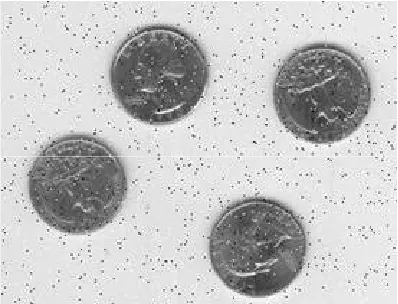
The image with salt and pepper noise is shown in fig 2, we apply the median filter to the noisy image to get the enhanced image as shown in fig 3.
Fig (3): Enhanced image using Median Filter.
2.3. SEGMENTATION
In thresholding method the pixels are partitioned depending on their intensity value. Thresholding methods replace each pixel in an image with a black pixel if the image intensity Ii,j is lessthan some fixed constant T (that is, Ii,j<T), or a
white pixel if the image intensity is greater than that constant.
2.4. FEATURE EXTRACTION
Morphological image processing is a collection of non-linearoperations related to the shape or morphology of features in an image. Morphological operations rely only on the relative ordering of pixel values, not on their numerical values, and therefore are especially suited to the processing of binary images.is a theory and technique for the analysis and processing of geometrical structures, based on set theory, lattice theory, topology and random functions. MM is most commonly applied to digital images, but it can be employed as well on graphs, surface meshes, solids, and many other spatial structures.Morphological operations can also be applied to grey scale images such that their light transfer functions are unknown and therefore their absolute pixel values are of no or minor interest.
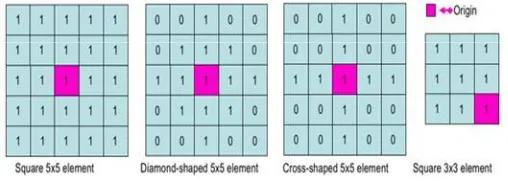
Fig ( 5): Examples of simple structuring elements.
Fig (6). Fitting and hitting of a binary image with structuring elements s1 and s2.
A common practice is to have odd dimensions of the structuring matrix and the origin defined as the center of the matrix. Structuring elements play in morphological image processing the same role as convolution kernels in linear image filtering.
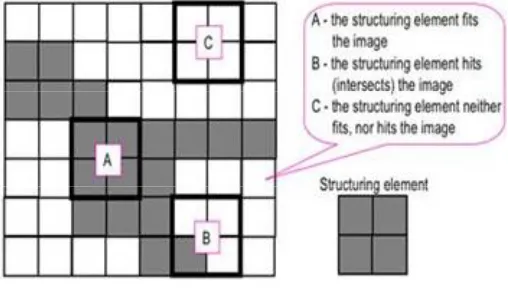
When a mesh is placed in a binary image, each of its pixels is associated with the corresponding pixel of the neighborhood under the structuring element. The mesh is said to fit the image if, for each of its pixels set to 1, the corresponding image pixel is also 1. Similarly, a mesh is said to hit, or intersect, an image if, at least for one of its pixels set to 1 the corresponding image pixel is also 1.
Fig ( 4):Probing of an image with a structuring element (White and grey pixels have zero and non-zero values, respectively).
A morphological operation on a binary image creates a new binary image in which the pixel has a non-zero value only if the test is successful at that location in the input image.
The structuring element/mesh is a small binary image, i.e. a small matrix of pixels, each with a value of zero or one:
The matrix dimensions specify the size of the mesh.
The pattern of ones and zeros specifies the shape of the mesh.
An origin of the structuring element is usually one of its pixels, although generally the origin can be outside the mesh.
Erosion and dilation
The erosion is one of two fundamental operations in morphological image processing .erosion of a binary image f by a mesh s (denoted f s) produces a new binary image g = f s with ones in all locations (x,y) of a mesh's origin at which that mesh s fits the input image f, i.e. g(x,y) = 1 is s fits f and 0 otherwise, repeating for all pixel coordinates (x,y).
Erosion with small (e.g. 2×2 - 5×5) square mesh shrinks an image by stripping or cutting away a layer of pixels from both the inner and outer boundry regions. The holes and gaps between different regions become larger, and small details are eliminated:
Fig ( 7): Erosion: a 3×3 square structuring element
Larger mesh have a more pronounced effect, the result of erosion with a large mesh being similar to the result obtained by iterated erosion using a smaller mesh of the same shape. If s1 and s2 are a pair of mesh identical in shape, with s2 twice the size of s1, then
f s
2
≈ (
f s
1
)
s
1
.
Erosion removes small-scale details from a binary image but simultaneously reduces the size of regions of interest, too. By subtracting the eroded image from the original image, boundaries of each region can be found: b = f − (f s ) where f is an image of the regions, s is a 3×3 mesh, and b is an image of the region boundaries.
The dilation is one of the basic operations in mathematical morphology. The dilation operation usually uses a mesh for probing and expanding the shapes contained in the input image
.
Dilation of an image f by a mesh s (denoted f s) produces a new binary image g = f s with ones in all locations (x,y) of a mesh's origin at which that mesh shifts the the input image f, i.e. g(x,y) = 1 if s hits f and 0 otherwise, repeating for all pixel coordinates (x,y). Dilation has the opposite effect to erosion -- it adds a layer of pixels to both the inner and outer boundaries of regions. The holes enclosed by a single region and gaps between different regions become smaller, and small intrusions into boundaries of a region are filled in:Size and shape of the structuring element influences on results of dilation or erosion. Dilation and erosion l operations have opposite effects. Let f c denote the complement of an image f, i.e., the image produced by replacing 1 with 0 and vice versa. Formally, the duality is
written as
f s
=
f
c
s
rot
Where Srot is the mesh s rotated by 180 . If mesh is symmetrical with respect to rotation, then Srot does not differ from s. If a binary image is a digital image that has only two possible values for each pixel. Typically, the two colors used for a binary image are black and white, though any two colors can be usedis considered to be a collection of connected regions of pixels set to 1 on a background of pixels set to 0, then erosion is the fitting of a mesh to these regions and dilation is the fitting of a structuring element (rotated if necessary) into the background, followed by inversion of the result.
III. EXPERIMENTAL RESULTS
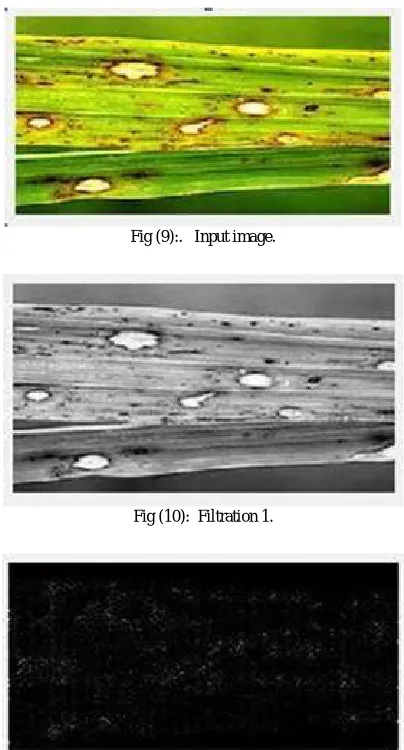
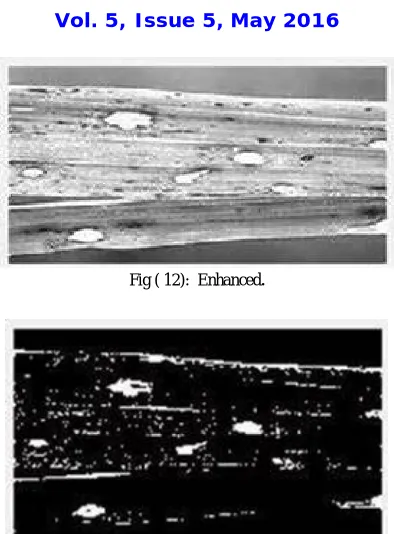
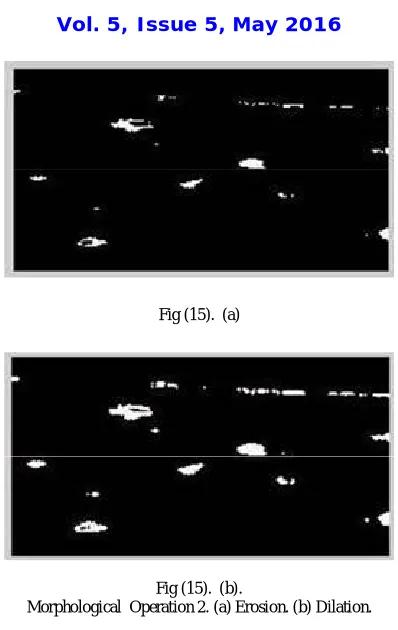
The application was deployed and tested on various systems. The following images were obtained from our implemented work, which processes the paddy crop image to identify diseases.
Fig (9):. Input image.
Fig (10): Filtration 1.
Fig ( 12): Enhanced.
Fig (13): Segmentation.
Fig (14).(a)
Fig (14). (b)
Fig (15). (a)
Fig (15). (b).
Morphological Operation 2. (a) Erosion. (b) Dilation.
IV. CONCLUSION
This paper implements an innovative idea to identify diseases affected in paddy crops and provides the remedy/solution to farmers. The images are then fed to our application for identification of paddy diseases and the remedies are suggested to the farmer. Thisimplementation provides better choice for every class of agriculture community particularly in remote villages.
REFERENCES
[1]. Di Cui, Oin Zhang, Minzan Li, Youfu Zhao and Glen L. Hartman, 2009. Detection of soybean rust using a multispectral image sensor, SpringerLink –Journal article.
[2]. ZulhaidiHelmi, MohdShafri and NasrulhapizaHamdan, 2009. Hyperspectral Imagery for Mapping Disease Infection in Oil Palm Plantation Using Vegetation Indices and Red Edge Techniques, American Journal of Applied Sciences, 6(6): 1031-1035.
[3]. Ha, S. and S. Joo, 2010. A Hybrid Data Mining Method for the Medical Classification of Chest Pain, World Academy of Science Engineering and Technology.
[4]. Abdullah, U., 2008. J. Ahmad and A. Ahmed, Analysis of effectiveness of apriori algorithm in medical billing data mining, Emerging Technologies, Islamabad.
[5]. Ullah, I., 2010. Data Mining Algorithms And Medical Sciences, International Journal of Computer Science and Information Technology (IJCSIT), 2: 6.
[6]. Rajnijain, Sonajharia Minz1 and V Ramasubramanian, 2009. Machine Learning for Forewarning Crop Diseases. J. Ind. Soc. Agril. Statist, 63(1): 97- 107.