Smart Sensor Based Soil Monitoring System
J.Dhivya1, R.Siva Sundari2, S.Sudha3, R.Thenmozhi4
Assistant Professor, Dept. of ECE, S A Engineering College, Chennai, Tamilnadu, India1
UG Student, Dept. of ECE, S A Engineering College, Chennai, Tamilnadu, India2
UG Student, Dept. of ECE, S A Engineering College, Chennai, Tamilnadu, India3
UG Student, Dept. of ECE, S A Engineering College, Chennai, Tamilnadu, India4
ABSTRACT:Development of agriculture using technology will be very much useful in cultivation. For a new agricultural area, without knowing or monitoring the important parameters of the soil, cultivation will be difficult and so the farmers suffer financial losses. This project thesis provides a brief overview of the soil monitoring system using sensors. Various soil sensors are used to measure temperature, moisture and light. The information from the sensors in the soil is sent to the Bluetooth module through PIC microcontroller. This information received from the Bluetooth is viewed in the application of the Android mobile phone. Thus this advanced technology helps the farmers to know the accurate parameters of the soil thus making the soil testing procedure easier.
KEYWORDS:Soil Monitoring, Sensor, Bluetooth, Android.
I.INTRODUCTION
Soil monitoring is an essential process which is needed for agriculture. 26% of the Earth’s surface is exposed as land. Almost all humanity lives on the terrestrial, solid Earth comprised of bedrock and the weathered bedrock called soil. Soil is a mixture of inorganic mineral particles and organic matter of varying size and composition. The particles make up about 50 % of the soil’s volume. Pores containing air and water occupy the remaining volume. The important parameters needed to be measured in the soil are temperature, moisture and light. At olden days, the farmers used to see the soil and will cultivate the required crop so the parameters are not accurately known to them to test the soil. Then after the soil testing laboratories are used to test the features of soil in which many tedious processes takes place to measure each parameter of the soil. After that many real time projects for autonomous soil monitoring purpose were done using probe systems and wired sensors.The data collected are transmitted through Zigbee, GSM, GPS and other technologies. The recent invention for soil monitoring is the four wheel rover which is a robot that has complex implementation that needs to incorporate a suspension design and high cost. To overcome the disadvantages of this rover, a smart wireless sensor based soil monitoring application “SMART AGRO” is developed for the ease of measuring soil features. The system is used to measure the important parameters of soil such as temperature, moisture and light using sensors which is suitable for all types of soil. These soil sensors can be used at multilayers and multi points of the soil. The data collected is transmitted to the user’s android app using Bluetooth technology. The PIC microcontroller is used to interface the sensors with the Bluetooth module. By knowing the features of soil, the cultivation of crops can be made easier and efficient.
II.RELATED WORKS
Author[1]Patrick M. Piper, Jacob S. Vogel, Matthew T. Fahrenkrug, Shannan J. McNamee, Quang N. Pham, Gregory C. Lewin. This paper presents an autonomous soil monitoring robot to monitor the features of soil thus expediting data collection and reducing labor. This system uses Steven’s Hydra probe to measure the parameters. Hence this probe delivery can be used under certain depth of soil. This system does not provide any information about facing the obstacles. Navigation of this robot is done using GPS sensor and wheel encoders. However this robot has several disadvantages because of complex physical design, high cost of implementation, more weight and need of external memory for storage. For implementing this four-wheeled rover we need to incorporate a suspension design.
moisture in the soil. The sensed parameters are sent to ARM processor and then to Zigbee module. The user checks the information from the central node through the PC. This system can be used for all types of soil. This system is not portable, not suitable for all types of weather conditions and implementation is quite complex.
III.PROPOSED SYSTEM
In this work we propose monitoring of various soil parameters using sensor networks. To overcome the problems caused by these expensive soil monitoring robots, a smart wireless sensor based soil monitoring android application have been proposed. This design replaces the probe system with the wireless sensor based detector which has to be buried underground. The various sensors used sense the soil and acquire data. This data is sent to mobile application using Bluetooth technology. Thus this system is economical, easy to implement and very much useful for farmers.
IV.SYSTEM ARCHITECTURE
The temperature sensor, analog moisture sensor and LDR should be kept in the soil which has to be tested. Each sensor is separately connected to the PIC microcontroller. This PIC microcontroller transmits the information about the parameters to the Bluetooth module. This Bluetooth module sends the information to the Android mobile phone when the device is paired and the user views it.
Figure 1: Block diagram of soil monitoring system
V.NEEDS AND REQUIREMENTS
Description of Sensors
For high performance and low cost system, temperature sensor (DS18B20), analog moisture sensor and LDR (Light Dependent Resistor) are used to measure soil temperature, soil moisture and light intensity.
1) Digital thermometre (DS18B20)
This sensor simplifies the temperature sensing and has three pins they are ground, data line and power supply. Here communication is done through data line. Power supply is 3V to 5.5V. Temperature range from -55˚C to +125˚C can be
sensed. Resolution is from 9 bits to 12 bits. Scratch card memory is available where the converted data is stored from the sensor.
2) Analog moisture sensor
This sensor is used to measure the moisture level in the soil. Digital output of this sensor is simple and analog output is accurate. The operating voltage is +5V. If there is water shortage the output will be high or else it will be low. Sensitivity can be adjusted. The installation is convenient due to less weight.
It is a light controlled variable resistor. The resistance increases with decrease in light intensity thus exhibits photoconductivity. In dark, the resistance of the photoresistor will be high upto several megaohms, but in light the resistance will be as low as few hundred ohms.
PIC Microcontroller
PIC is a modified Harvard architecture family made by Microchip technology. Its early models had ROM or field programmable EPROM for program memory. But the current models use flash memory. The instruction set varies with the model. The hardware of PIC ranges from 8-pin DIP chips up to 100 pin SMD chips with discrete I/O pins, ADC and DAC and communication ports like UART, I2C, CAN and USB. Low power and high speed variations will be there according to the types.
1)PIC18F452
It is an 8-bit microcontroller with RISC based architecture. It is a 40 pin IC. It has 32 kilo bytes inbuilt ROM, 1536 bytes RAM and 256 bytes EEPROM. It has five I/O ports and two CCP (Capture/Compare/PWM) peripherals. Temperature ranges from -45˚C to +125˚C. The operating voltage ranges widely from 2V to 5.5V.
It has Parallel Slave Port module (PSP). The two modes of operations are 3-wire SPI (Serial Peripheral Interface) and I2C (Inter Integrated Circuit). It has a watchdog timer with its own on-chip RC oscillator with programmable code protection. The CMOS technology of this chip is low power and high speed CMOS flash technology with fully static design.
Figure 2: PIC Microcontroller kit Bluetooth Module (HC-05)
HC-05 embedded bluetooth serial communication module is an easy way to use bluetooth SPP (Serial Port Protocol) is designed for transparent wireless connection steup. It is an external single chip bluetooth system with CMOS technology and AFH (Adaptive Frequency Hopping). The two work modes are order-response work mode when the user can send the AT command to the module to set the control parameters and send control order and automatic connection work mode where it will follow the default way set lastly to transmit the data automatically. The work modes can be switched by controlling the module PIN (PIO11) input level. Hardware features include typical -80dBm sensitivity, upto +4dBm RF transmit power and low power operation at 1.8V. It has PIO control and UART interface with programmable baud rate. It should have integrated antenna and edge connected. Software features include 38400 as default baud rate with 8 data bits and 1 stop bit. The device will be disconnected when rising pulse is given in PIO0 and it will be low-disconnected, high-connected at status instruction port PIO1. The last device on power will be auto-connected as default. It allows pairing device to connect as default and the default auto-pairing pincode is “0000”.Android mobile phone is connected with the Bluetooth module to view the sensed parameters of the soil through “SMART AGRO” application.
VI.SYSTEM DESIGN Hardware Design
The temperature sensor, analog moisture sensor are separately interfaced with PIC microcontroller. Due to low cost, high speed and large memory we use PIC microcontroller. It should be observed that the output voltage of PIC18F452 should not exceed the sensors operating voltage. If so an IC should be connected to minimize the output voltage. Here Port A and Port E are used as inputs and Port B is used as output.
be paired with it using a pincode. By knowing the MAC address, bluetooth module can be accessed and so the output is viewed through android application.
For bit by bit transmission of data we use serial communication. This transmission takes place with the fixed baud rate when the clock frequency along with the bits are transmitted to the receiver. Thus the transmitter and receiver are synchronized between them using same clock frequency. To allow serial communication with the PIC we need to make settings in the different parameters within the two registers TXSTA for transmitting the data and RCSTA for receiving the data. USART is used for transmitting or receiving information which uses 0V and 5V signals to represent logic level. RSR232 is a transmission protocol uses voltages lower than -5V and higher than +5V for logic level.
Within the range of 100 metres the bluetooth module searches for the authenticated device and gets the count. It inquires the available devices if any equipment is matched it connects the device and the other devices are disconnected. Thus the measured parameters such as temperature, moisture and light are monitored in that device which is the user’s android mobile phone.
Software Design
The embedded C coding for temperature, moisture and light sensors are compiled using MikroC compiler. This compiler has predefined function and so the compilation will be easier. If errors are detected correct them and compile again using build, translate and run options.
The required components including PIC microcontroller, sensors and Bluetooth module are placed on the platform of the Proteus software and the connections are made. The .c file is converted into .hex file which is then dumped into thet PIC microcontroller. After running the project, the simulation results can be viewed pictorially.
Android is an open source and Linux based Operating System for mobile devices such as smartphones and tablets. It offers unified approach to application development thus their applications should be able to run on different devices powered by Android. Android applications are usually developed in the Java language using the Java Development Kit (JDK). The Android application can be installed using the Java program along with the JDK by setting up the JDK. Next step is to set up the Android Software Development Kit(SDK) and then to set up the Eclipse IDE. Then to setup thr Android Development Tools(ADT) Plugin and to create an Android virtual device. Once the application is installed, the output can be monitored by the user who is present within the range.
VII.SYSTEM TEST
The system is tested by inserting the sensors of temperature, moisture and light sensitivity in the soil. Android application developed is checked for the connection with the system.
Figure 3: Initializing Bluetooth connectivity
Figure 4: Selection of the desired device for pairing
As in the figure 4 after pairing of the device with mobile phone the data sensed by the sensors inserted in the soil will be displayed in the mobile screen through PIC microcontroller and Bluetooth module.
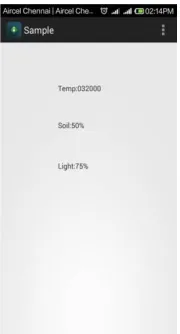
Figure 5: Output of the sensed parameters
The above figure 5 shows the final output of the android application. Here moisture and light sensitivity are displayed in percentage for the easy understanding of the farmers.
VIII.CONCLUSION
This approach for measuring the soil parameters is used for the efficient plant growth. The results obtained from the measurement have shown that the system performance is quite reliable and accurate. The important parameters of the soil such as temperature, moisture and light sensitivity are checked by the respective sensors. The coding for all these sensors used is dumped in a single PIC microcontroller. The implementation is made easier thus this system is economic.The measured parameters are transmitted to the android application through the Bluetooth module makes this system incompatible because the coverage will be of shorter range. Each parameter is viewed by separate sensors.The future works for this system can be done using Wi-Fi Technology instead of Bluetooth for larger coverage area Special sensors for measuring more than one parameter can also be used.
REFERENCES
[1]Patrick M. Piper, Jacob S. Vogel, Matthew T. Fahrenkrug, Shannan J. McNamee, Quang N. Pham and Gregory C. Lewin,“Designing an Autonomous Soil Monitoring Robot”, IEEE Conference- 2015
2]Ke-Tao Chen, Hai-Hui Zhang, Ting-Ting Wu and Jin Hu,“Design of Monitoring System for Multilayer Soil Temperature and Moisture Based on WSN”,IEEE Conference-2014
[4]Kay Smarsly,“Agricultural ecosystem monitoring based on autonomous sensor systems”,IEEE Conference-2013
[5]G.V. Satyanarayana and S.D. Mazaruddin, “Wireless Sensor Based Remote Monitoring System for Agriculture Using ZigBee and GPS”,CAC2S-2013
[6]Yumei lui, Changli Zhang and Ping Zhu, “The temperature humidity monitoring system of soil based on wireless sensor networks”,IEEE Conference-2011
[7]Y. Pingle and V. Kohli, “Data Management in soil erosion monitoring system using spatial database and its multilevel updation”,IEEE Conference-2011
[8]Zengyu Peng and Yandong Zhao, “Real-time monitoring system for soil moisture content based on μc/OS- II operating system”,IEEE Conference-2010
[9]F. T. Lin, Y.C Kuo, J.C. Hsieh and H. Y. Tsai, “A self powering wireless environment monitoring system using soil energy”,IEEE Conference-2015
[10]Y. Na and L. Junfeng, “Smart orchad soil moisture system based on wireless communication technology”,IEEE Conference- 2010 [11]Khusvinder Gill, Shuang-Hua Yang, Fang Yao, and Xin Lu, “A ZigBee-Based Home Automation System”, MAY 2009.
[12]Izzatdin Abdul Aziz, MohdHilmiHasan, Mohd Jimmy Ismail, MazlinaMehat and NazleeniSamihaHaron, “Remote Monitoring in Agricultural Greenhouse Using Wireless Sensor and Short Message Service (SMS)”, 2008.
[13]Jeonghwan Hwang, Changsun Shin, and Hyun Yoe “Study on an Agricultural Environment Monitoring Server System using Wireless Sensor Networks”,2010.
[14]Zhang xihai, Zhang changli, and Fang junlong, “Smart Sensor Nodes for Wireless Soil Temperature Monitoring Systems in Precision Agriculture”, 2009, 237-241
[15]Bogena H.R, Huisman J.A, OberdErster C, et al. “Evaluation of a low cost soil water content sensor for wireless network applications”,[J].Journal of Hydrology, 2007, 32-42
[16]N.G Shah and I. Das, “Precision Irrigation Sensor Network Based Irrigation”, a book on problems, Perspectives and Challenges of Agricultural Water Management, IIT Bombay, India,pp.217-232,April 2008.
[17]M.K Haefke, S. Mukhopadhyay and H. Ewald, “A Zigbee Based Smart Sensing Platform for Monitoring Environmental Parameters”, IEEE Conference on Instrumentation and Measurement Technology, pp 1-8, May 2011.
[18]Q. Wang, A. Terzis and A. Szalay, “A Novel Soil Measuring Wireless Sensor Network”, IEEE Transactions on instrumentation and Measurement, pp.412-415, August 2010.
[19]I. Singh and M. Bansal, “Monitoring Water Level in Agriculture using Sensor Networks”, International Journal of Soft Computing and Engineering, pp 202-204, November 2011.