Wireless Control System with Model Based
Control
Xiankleber C. Benjamim1, Felipe O. S. Gama2, Andrés O. Salazar3, Luiz F. Q. Silveira3
Universidade Federal do Rio Grande do Norte
PhD Student, Engineering of Computation and Automation, UFRN, Natal/RN, Brasil1
Master Student, Engineering of Computation and Automation, UFRN, Natal/RN, Brasil2
PhD Professor, Engineering Department of Computation and Automation, UFRN, Natal/RN, Brasil3
ABSTRACT: There are control systems in which sensors, actuators and controllers can’t communicate by wired networks. In these environments, the use of wireless communications system is an alternative, but this can create other problems in the system, like delay and information loss. This paper investigates the performance of technique a Model Based Control (MBC) used to improve the response of a nonlinear invariant system, using a analogic circuit to simulate a tank level control, and analyzing the control behavior considering a communication with information loss. The results demonstrated that the technique improves the wireless control system.
KEYWORDS: Control System, Wireless Communications, Model Based Control, Information Loss.
I. INTRODUCTION
The traditional communication architectures in control systems are generally defined on a wired infrastructure. This type of centralized communication architecture doesn’t support some requirements, such as modularity and decentralized control[1].An alternative to this scenario is the use of Wireless Sensors Networks (WSN) to interconnect sensors, actuators and controllers in a remote control environment [2].
On the other hand, the use of WSN at industrial environment can cause problems as information loss and jitter, affecting the Control System Stability [3]. In this sense, there are several techniques to minimize the degenerative effects that information loss can cause in control systems, amongst them it can be cited the MBC.
The MBC is a strategy of control where control signals are based on the plant model[4]. Its main feature is to use the process model to predict the future behavior of the controlled variables [5]. When using MBC techniques in WSN is assumes that the lost information due to miscommunication can be estimated by simulating these models [6].
MBC, using the mathematical model of the plant for treating loss of information in the network problems [7] In the control based on model, a mathematical model of the process dynamics is explicitly incorporated into the process control system, in orderto improve the performance system [8], [9], [10] and [11].
The strategy adopted in this paper considers the use of MBC to simulate the system process output when occurs a packet loss, and then use the obtained results to feed a Proportional Integrative Derivative Controller (PID).
The mathematical model of the first order invariant system used in this work is illustrated in Figure 1. The system has one input and one output, and is nonlinear. This model is important for the development of a WSN system that use the MBC control strategy.
It was used a single tank system, with the main objective to control the fluid level of the tank.It is a system commonly used in industrial plants[5] and [12]. The system has a reservoir, a pump and one vertical tanks, configured such that the liquid is pumped from the reservoir to the tank, the orifice at its base enabling this fluid flow into the reservoir to be pumped again.
Fig. 1. Coupled tank System.
The Equation (1) represents the tank level system dynamics.
(1)
Where ̇ is the tank level variation, a is the output orifice area of the tank, A bottom area of the tank, g gravity acceleration, Kmis the water pump constant and Vpis the applied pump voltage.
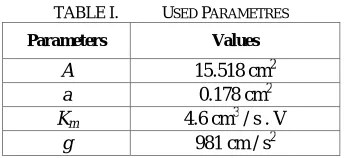
The Table 1 presents the parameters of the system describes by Equation (1).
TABLE I. USED PARAMETRES
Parameters Values
A 15.518 cm2
a 0.178 cm2
Km 4.6 cm
3 / s . V
g 981 cm / s2
(2)
The system was implemented by an analogic circuit using operational amplifiers presented in section III.
III. METODOLOGY
The main objective of predictive technique implemented in this work is to keep the regulation of the same tank level 1 in the event of packet loss between the parts of the system.
The composition of the experimental bench used in the execution of the project consists of a circuit based on operational amplifiers(Figure2) responsible by for emulation of the first order plant, ATMEGA328P microcontrollers, representing the sensor element, the actuator and controller, and wireless communication modules NRF24L01 to perform the communication link. An overview of the structure isrepresented in Figure 3.
Fig. 2. Eletronic circuit that simulate a tank level system.
The sensor element measures the tank level. The generated signal is transmitted via the RF module to the controller, which performs a PID control routine with reference to the value that is passed by the computer.
The actuator receives the control action from the controller module, via RF, and produces the PWM signal to be injected into the pump.
In order to simulatea communication environment withpacket loss, the transmission power is setat-18 dBm, and the packet size is set at 16 bytes.Besides, the Cyclic Redundancy Check (CRC) is turned off to avoid error checking in the wireless link.
Fig. 3. System diagram to experimental tests.
IV. MBCIMPLEMENTATION
than waiting for the next packet to perform the control signal calculation, the controller receives the plant level estimated value obtained through simulation based on the transfer function presented in Section II.
Figure 4 illustrates the used control strategy, where the”overflow key” is the logic to detect the packet loss, if the packet loss it detected the signal sent to the controller and obtained by system transference function discussed in Section II. Otherwise, the signal sent to the controller level is measured by the sensor.
Fig. 4. Block diagram of MBC strategy.
V. EXPERIMENTALRESULTS
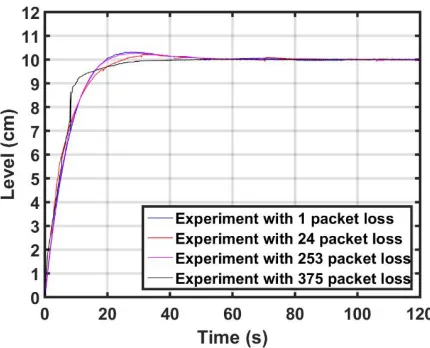
This section presents performance results obtained from experiments in a control loop where the controller is five meters from the sensor modules and actuator. The system counts the numbers of packet loss that occurred in a period of 120 s. The Figure 5 shows the results obtained from various experiments without the MBC technique, which is observed the packet loss degenerative effect can cause the control system.
Fig. 5. System response without the MBC technique.
Fig. 6. System response with the MBC technique.
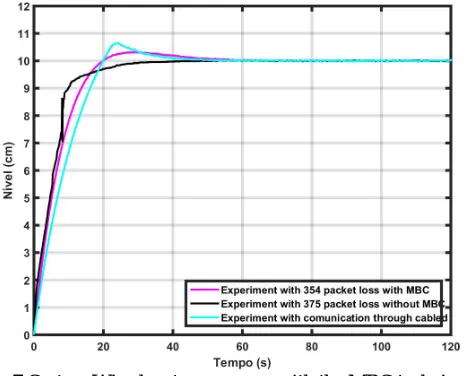
The Figure 7 shows the comparison between a control system with and without MBC technique, both with an approximate amount of packet loss, 354 and 375 respectively. It can be observed that the system response with MBC have less noise and less oscillation than the system response without the technique.
VI. CONCLUSIONS
This paper presented a methodology to improves the packet loss impact in a wireless control system and a control strategy which aims to minimize the degenerative effects that can occur with packet loss. With the insertion of MBC technique in a control system with wireless communication, it achieved a performance superior to systems
Fig. 7. System Wired systemresponse with the MBC technique.
without the MBC technique. These results show the increased performance of the controller to the technique used in this work.
problem.
ACKNOWLEDGMENT
The authors thank Capes, the support received for this work.
REFERENCES
[1] Yang, Tai C. "Networked control system: a brief survey." IEE Proceedings Control Theory and Applications 153.4 (2006): 403.
[2] Fischione, Carlo, et al. "Design principles of wireless sensor networks protocols for control applications." Wireless Networking Based Control. Springer New York, 2011. 203-238.
[3] Godoy, Eduardo Paciência. Desenvolvimento de sistemas de controle via rede (NCS) para aplicações em redes com protocolo CAN. Diss. Universidade de São Paulo..
[4] Kwong, W. H.Introdução ao Controle Preditivo com MATLAB.EdUFSCar, São Carlos, Brasil, 2012.
[5] Rodriguez, Jose, and Patricio Cortes. Predictive control of power converters and electrical drives. Vol. 40. John Wiley & Sons, 2012. [6] Gomes, Ruan D., et al. "Desafios de Redes de Sensores sem Fio Industriais." Revista de Tecnologia da Informação e Comunicação 4 (2014):
1-12.
[7] [Scorzoni, 2011] Scorzoni, F. (2011). Desenvolvimento de um sistema de controle via rede híbrido utilizando can e zigbee.
[8] [Estrada and Antsaklis, 2009] Estrada, T. and Antsaklis, P. J. (2009). Performance of model-based networked control systems with discrete-time plants. In Control and Automation, 2009. MED’09. 17th Mediterranean Conference on, pages 628–633. IEEE.
[9] Vali, Mehdi, Jan-Willem van Wingerden, and Martin Kühn. "Optimalmultivariable individual pitchcontrol for loadreductionoflargewind turbines." 2016 American ControlConference (ACC). IEEE, 2016.
[10] Mafakheri, Mohsen, and ShahramHosseinzadeh. "A fuzzy clustering based mobility-adaptive routing protocol for wireless sensor networks." Information and Knowledge Technology (IKT), 2015 7th Conference on. IEEE, 2015.
[11] Saito, Tomoyuki, et al. "A study of the total recording system for MBC with FM broadcast wave." Antenna Technology and Applied
Electromagnetics (ANTEM), 2014 16th International Symposium on. IEEE, 2014.