c e-ISSN: 2348-6848, p- ISSN: 2348-795X Volume 3, Issue 01, January 2016
International Journal of Research (IJR)
Available at http://internationaljournalofresearch.orgHigh Throughput AES Algorithm with s-box sharing for
Threshold Implementation
P.V.V Deepika
1& P.Soundarya Mala
2 1PG student (VLSI & Embedded Systems), GIET, Rajahmundry,
India
2Associate Professor, ECE Dept, GIET, Rajahmundry, India
1
[email protected]
;
2[email protected]
ABSTRACT
—A high speed security algorithm is always important
for wired/wireless environment. Fast evaluation of
digital data exchange occurs in recent years. Day by
day need for security services and security mechanism
are increasing. The use of cryptography requires the
handling of secret keys. Therefore, new approaches
are necessary to fulfill the requirements in both
software and hardware implementation approach i.e.,
advanced encryption standard (AES). AES is one of
the best security algorithm to provide data security by
using special techniques i.e., “S-box sharing &
threshold implementation”, AES can also provide
input data length upto 256 bits which is four times
greater than the DES. This leads to the increase in
throughput i.e., the obtained by AES 256 key length is
>60 kbps where as the throughput obtained by AES
128 key length is 47kbps only. Therefore AES with
256 key length is well suitable for security purposes.
The logic verification & synthesization is done
through Xilinx tool.
Index Terms– cryptography; DES; AES; S-box;
Threshold Implementation.
I.
INTRODUCTION
Recent developments in information technologies
made the secure transmission of digital data a critical
design point. Large data flows have to be exchanged
securely and involve encryption rates that sometimes
may require hardware implementations. For this
implementations we are using (FPGA‘s) Field
programmable gate arrays . Nowadays cryptography
has a main role in Embedded systems designs. In
many applications, the data requires a secured
connection
which
is
usually
achieved
by
cryptography.
Cryptography is the science of information
.
science of secret codes, enabling the confidentiality
ofcommunication through an insecure channel. It
protects against unauthorizedparties by preventing
unauthorized
alteration
of
use.
It
uses
an
cryptographicsystem to transform a plaintext into a
cipher text, using most of the time a key.
There are
two basic types of encryption commonly used today,
symmetric key(sender and receiver shares the same
key) and asymmetric key (sender and receiver shares
different key) encryption. All of the cryptographic
algorithms we have looked at so far have some
problem. The earlier ciphers can be broken with case
on modern computation systems. Symmetric
systems contains Data Encryption Standard (DES),
3DES, and Advanced Encryption Standard (AES) use
an identical key for the sender and receiver. DES
(Data Encryption Standard) was considered as the
standard of symmetric key encryption, which has a
key length of 56 bit. This key length is considered as
very small and can be easily broken. The National
Institute of Standards and Technology(NIST),
proposed Rijndael algorithm as the Advanced
Encryption Standard(AES) in October 2000 providing
strong security and high flexibility. AES has a fixed
block size of 128 bits and a key size of 128, 192 or 256
bits.
A.
Review of threshold implementation
It is a provably secure countermeasure, Against (first)
order power analysis based on
multi party
computation
and
secret sharing. the countermeasures
are nothing but
a)
Hardware
countermeasures:
Balancing
power
consumption.
c e-ISSN: 2348-6848, p- ISSN: 2348-795X Volume 3, Issue 01, January 2016
International Journal of Research (IJR)
Available at http://internationaljournalofresearch.orgc)Leakage-Resilient Crypto
The Threshold Implementation (TI) countermeasure
was proposed by Nikova .TI applies secret-sharing to
achieve provable resistance against first order side
channel attacks if the following three requirements are
fulfilled.
1) Correctness: Correctness means that combining the
output of the different shares retrieves the original
output in a correct way.
2) Non-completeness: Non-completeness means that
the equation used to evaluate any output share should
be missing at least one input share. This requirement
enforces that the information required to compute the
secret value (all the shares) is not present in the
system at any time instant. Hence, any vulnerability in
the implementation (e.g. glitches) cannot leak the
secret key.
3) Uniformity: If the input shares are uniformly
distributed, the output shares must also be uniformly
distributed.
B.
Review of s-box sharing
In cryptography, an s-box(substitution-box ) is a
basic component of symmetric key algorithms which
performs substitution. In block ciphers, they are
typically used to obscure the relationship between key
and the cipher text. In general, an s-box takes some
number of input bits, m, and transforms them into
some number of output bits, n, where n is not
necessarily equal to m. An m*n s-box can be
implemented as a lookup table with 2*m words of n
bits each .Fixed tables are normally used, as in the
data encryption standard, but some ciphers the tables
are generated dynamically from the key. We have so
many s-box implementations. Those are raw
implementation, adjusted implementation and nimble
implementation. Here we are implemented with one of
the
s-box
implementation
that
is
nimble
implementation.
These
implementations
are
implemented with multipliers, inverters and registers.
From this we conserve the uniformity property and the
security of each block is achieved only by the
correctness and non completeness properties, we can
discard the uniformity property and implement these
nonlinear functions with the smallest number of
shares. This construction requires only 32-bits of extra
randomness per s-box calculation, including the
number of shares for the s-box input.
C.
Features
The features are mainly area and randomness.
From
these
we
got
throughput.
Threshold
implementation also allows features between area,
randomness, and the resistance against differential
power analysis. In the nimble implementation reduces
the area cost significantly compared to the uniformly
shared raw and adjusted implementations.
S-box Raw Adjusted Nimble
Multiplier 625/458 625/458 418/308
Inverter 618/490 618/490 594/375
Registers 725 661 576
Table I: Synthesis Results For Different Versions of S-Box TI with Compile Commands
We show the area, randomnessrequirements, and timings of AES implementations .We again provide results using the same compilation techniques as the S-box implementations and compare them with the old results. The area costs for the state and the key arrays include the ANDs and XORs. In our implementations, the S-box occupies (30-40) % of the total area. Compared to the implementation S-boxes with uniform blocks are 13% smaller and S-box with non uniform blocks is 33% smaller. These results show a significant area and randomness improvement of the nimble implementation.
Design Old
results Raw Adjusted Nimble
State array
2529 1698 2473 1687
Key
Array 2526 1890 2762 1844
S-box 4244 3708/30
04 3653/2949 2835/2224 Mix
columns 1120 770/544 1156/816 770/544
Control 255 242 242 242
Key XOR 64 48 72 48
MUXes 376 746 853 693
Total 11114/11
031 9102/81 72 11221/10 167 8119/72 82
Cycles 266 246 246 246
Randomn
ess 48 44 44 32
c e-ISSN: 2348-6848, p- ISSN: 2348-795X Volume 3, Issue 01, January 2016
International Journal of Research (IJR)
Available at http://internationaljournalofresearch.orgII. ALGORITHM OF ADVANCED ENCRYPTION STANDARD – 128
A. AES algorithm
AES was released by NIST in 2001 as the new-generation data encryption standard for use in the USA, and it was adopted as an ISO international standard in 2005. Nowadays, smartcards are widely used in many real-life security applications as a medium of authenticating the identity of a user and/or executing cryptographic operations. Being used more and more widely in reality. One of the most widely used software countermeasures is the Boolean masking method. The main idea of thismethod is to mask any sensitive intermediate value by XORing it with one ormore randomly generated values called masks. Another kind of software countermeasures is hiding, such as randomizing the operations of an algorithm.
B. Basic Block Diagram Of AES
AES is a symmetric block cipher. This means that it uses the same key for both encryption and decryption. However, AES is quite different in a number of ways. A number of AES parameters depend on the key length. Like 128, 160, 192, 224, 256, butpreferable key lengths are 128,192,256. For example, if the key size used is 128 then the number of rounds is 10 whereas it is 12 and 14 for 192 and 256 bits respectively. The algorithm have transformations of four stages. They are Substitute bytes, Shift rows, Mix Columns, Add Round Key for encryption. For decryption these transformations are in reverse, Inverse Shift rows, Inverse Substitute bytes, Inverse Add Round Key, Inverse Mix Column. These transformations are applied for both encryption and decryption in each stage of round.
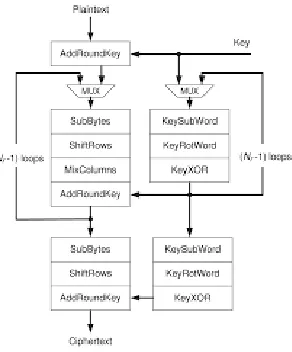
Fig 1: Block diagram of AES
The algorithm begins with an Add round key stage followed by 9 rounds of four stagesand a tenth round of three stages. This applies for both encryption and
decryption with the exception that each stage of a round the decryption algorithm is the inverse of it‘s counterpart in the encryption algorithm. The tenth round leaves out the Mix Columns stage. The first nine rounds of the decryption algorithm consist of inverse of four transformations. Again, the tenth round simply leaves out the Inverse Mix Columns stage. From this AES-128 we got throughput 47kbps only.
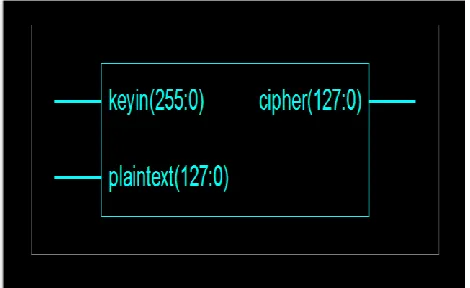
Fig2: AES schematic
III.
ALGORITHM OF ADVANCED
ENCRYPTION STANDARD-256
A.AES algorithm
Here also we have same type of transformation of operations and rounds of operations are changed. For the improving block ciphers we are taken this AES-256 algorithm. Block ciphers are nothing but increasing key length, variable number of rounds and so on.In AES-256 algorithm we have 14 rounds of with the type of transformations in each stage. Those transformation of operations are done for both encryption and decryption process also. Those are nothing but substitute bytes, Shift rows, Mix Columns, Add Round Key and Inverse Shift rows, Inverse Substitute bytes, Inverse Add Round Key, Inverse Mix Columns.
B.Block diagram of AES-256
c e-ISSN: 2348-6848, p- ISSN: 2348-795X Volume 3, Issue 01, January 2016
International Journal of Research (IJR)
Available at http://internationaljournalofresearch.orgmeasure of how many units of information of a system process in a given amount of time. It is applied broadly to systems ranging from various aspects of computer and network system to organizations.
Fig 3: Process of AES algorithm
(a)Substitute Bytes:
This stage (known as SubBytes) is simply a table lookup using a 16×16 matrix of byte values called an s-box. This matrix consists of all the possible combinations of an 8 bit sequence (28 = 16 × 16 = 256). However, the s-box is not just a random permutation of these values and there is a well defined method for creating the box tables. The s-boxes are made up and can simply take them as table lookups. Again the matrix that gets operated upon throughout the encryption is known as state. We will be concerned with how this matrix is effected in each round.
Table-III
S-box table
Table- IV Inverse s-box table
Fig 4
:
Substitute Bytes Stage of the AES
algorithm
.
(b)Shift Row Transformation:
c e-ISSN: 2348-6848, p- ISSN: 2348-795X Volume 3, Issue 01, January 2016
International Journal of Research (IJR)
Available at http://internationaljournalofresearch.orgFig 5:
Shift Rows stage
(c)Mix Column Transformation:
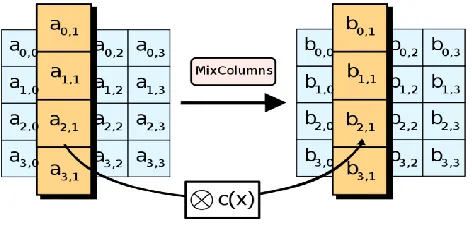
This stage (known as Mix Column) is basically a substitution. Each column is operated on individually. Each byte of a column is mapped into a new value that is a function of all four bytes in the column.The transformation can be determined by the following matrix multiplication on state. For inversemix column transformation also done like this but in reverse case.
Fig 6
: Mix Columns operates on the State
column-by-column
The mix column transformation can be done by using XOR operation. After that we have to multiply with some parametrized matrix. This matrix is irreducible polynomial function. This is the standardized form of this transformation.
Fig 7
:
Mix Columns stage
(d)Add Round Key Transformation:
In this stage (known as Add Round Key) the 128 bits of state are bitwise XORed withthe 128 bits of the round key. The operation is viewed as a column wise operation between the 4 bytes of a state column and one word of the round key. This transformation is as simple as possible which helps in efficiency but it also effects every bit of state.
Fig8:
Add Round Key XORs each column of the
State with a word from the key schedule.
IV.
RESULTS AND DISCUSSION
A. Simulation Environment:
c e-ISSN: 2348-6848, p- ISSN: 2348-795X Volume 3, Issue 01, January 2016
International Journal of Research (IJR)
Available at http://internationaljournalofresearch.orgproposed architecture.
Fig 9: Block diagram of encryption
Fig 10: Block diagram of decryption
Fig 11: Simulation result of Encryption
Fig 12: Simulation result of Decryption
B. Performance Analysis:
Table-v
Result analysis
METHOD THROUGHPUT
FORMULAE THROUGHPUT
AES-128 Delay*input[input:
128] 47KBPS
AES-256 Delay*input[input : 256]
60KBPS[more than 60KBPS]
V.
CONCLUSION
This paper shows successful implementation of AES 256 bit algorithm. It provides better security from unauthorized access. The data was encrypted using different keys and the original data was retrieved via decryption of cipher text. This algorithm guarantees secure end to end transfer of data without any corrupt data. It gives high throughput rate i.e., >60kbps than the throughput obtained by AES 128 bit is 47kbps. As a result the AES algorithm well performed in terms of speed and performance of security. The timing analysis verified on Xilinx simulator. The xilinx13.2i software is utilized in the project and code is written on VHDL. In future the implementation may beimplemented in military and forensic laboratories.
ACKNOWLEDGEMENT
I would like to thank my guide and all the reviewers for their constructive comments and active support to my work.
REFERENCES
[1] BegülBilgin, BenediktGierlichs, SvetlaNikova, VentzislavNikov, and Vincent Rijmen,vol. 34, NO. 7, JULY 2015
[2] P. C. Kocher, J. Jaffe, and B. Jun, ―Differential power analysis,‖ in Advances in Cryptology—CRYPTO (LNCS 1666). Berlin,GermanySpringer, 1999, pp. 388–397
[3] J. Daemen and V. Rijmen, AES Proposal: Rijndael, AES Algorithm Submission, September 3, 1999.
[4] L. Goubin and J. Patarin, ―DES and differential power analysis the ‗duplication‘ method,‖ in Cryptographic Hardware and EmbeddedSystems (LNCS 1717). Berlin, Germany: Springer, 1999, pp. 158–172.
c e-ISSN: 2348-6848, p- ISSN: 2348-795X Volume 3, Issue 01, January 2016
International Journal of Research (IJR)
Available at http://internationaljournalofresearch.org[6] T. S. Messerges, ―Securing the AES finalists against power analysis attacks,‖ in Fast Software Encryption (LNCS 1978). Berlin, Germany: Springer, 2000, pp. 150– 164.
[7] J. Daemen and V. Rijmen, The block cipher Rijndael, Smart Card research and Applications, LNCS 1820, Springer-Verlag, pp. 288-296.
[8] Mr. Atul M. Borkar, Dr. R. V. Kshirsagar and Mrs. M. V. Vyawahare, ―FPGA Implementation of AES Algorithm‖, International Conference on Electronics Computer Technology (ICECT), pp. 401-405, 2011 3rd.
[9] FIPS 197, ―Advanced Encryption Standard (AES)‖, November 26, 2001.