DOI: 10.15662/ijareeie.2014.0307064
Dc-Dc Converters Based On 3SSC and VMC
Using High Voltage Gain Non-Isolated
Converter
M. Vijaya Kumar
1, K. Babu
2,K. Guna Prasad
3, R. Ramesh
4PG Student [PE&ED], Dept. of EEE, SISTK, Chittoor (D), Andhra Pradesh, India1
Assistant Professor, Dept. of EEE, SISTK, Chittoor (D), Andhra Pradesh, India2
Assistant Professor, Dept. of EEE, SISTK, Chittoor (D), Andhra Pradesh, India3
PG Student [PE&ED], Dept. of EEE, SISTK, Chittoor (D), Andhra Pradesh, India4
ABSTRACT—Now-a-days the new family of dc-dc converters based on three state switching cell and voltage multiplier cells. It present a demonstrate of some advantages and limitations of a several topologies were typically use in voltage step-up applications. The operating principle of this family has chosen the boost converter and discussed in detail. The analysis of converter can applicable in uninterruptible power supplies, fuel cell systems and it is adequate in operating the high-gain boost stage with cascaded inverters in the renewable energy systems. Furthermore, It is applicable in dc voltage step-up is demanded, like electrical fork-lift, audio amplifiers, and some other applications.
KEYWORDS:dc-dc converters, voltage gain, voltage number cells (VMCs), Boost converters
I.INTRODUCTION
Depending on the appliance nature, many kinds of static power converters are necessary for the adequate conversion and acquisition of the energy provided by primary sources like electrical phenomenon arrays, wind turbines, and fuel cells. Besides, considering that the price of renewable energy systems is high, the utilization of high-efficiency power electronic converters may be a should.
The need for solid-state ac–dc converters to enhance power quality in terms of power factor correction, minimized over all harmonic distortion at input ac mains, and exactly regulated dc output has intended the investigation of many topologies supported classical converters like buck, boost, and buck–boost converters. Boost converters operative in continuous-conduction mode became particularly fashionable because reduced magnetic attraction interference levels result from their utilization.. The approach additionally employs the principle of interleaved converters, because it is extended to a generic range of legs per winding of the autotransformers and high power levels.
determined. In this case, the minimum current through Lb is null, i.e., the current through Lb is equal to zero for a single time instant. The ripple current through Lb is then equal to the maximum current IM.
Fig.1.Block Diagram of DC-DC Converter
For good operation of the VMC ac input voltage is required, which is an important requirement of this cell. Due to this fact, the use of the 3SSC depicted is considered because it generates such ac voltage across the terminals of the autotransformer and therefore the drain terminals of the controlled switches. Within the ensuing cell, the controlled switches may be described by MOSFETs, junction field-effect transistors, insulated gate bipolar transistors, bipolar junction transistors, etc. Completely the generated topologies gift bifacial characteristics. As was mentioned before, the utilization of high-voltage gain converters is of nice interest, although several approaches are supported isolated topologies. it's price value that the utilization of non-isolated converters significantly dedicated to applications relating to renewable power systems has been the scope of recent works. The efforts resulting in the event of such non-isolated topologies area unit then well even within the literature.
II.LITERATURE SURVEY
Title: An improved maximum power point tracking for photovoltaic grid-connected inverter based on voltage-oriented control
Author: R. Kadri, J.-P. Gaubert, and G. Champenois, Publish: IEEE, vol. 58, no. 1, pp. 66–75, Jan. 2011.
An improved maximum power point (MPP) tracking (MPPT) with better performance based on voltage-oriented control (VOC) is proposed to solve a fast changing irradiation problem. In VOC, a cascaded control structure with an outer dc link voltage control loop and an inner current control loop is used. The currents are controlled in a synchronous orthogonal d, q frame using a decoupled feedback control.
Title: Class-D audio amplifiers in mobile applications Author: M. Berkhout and L. Dooper,
Publish: IEEE, vol. 57, no. 5, pp. 992–1002, May 2010.
A comparative system-level overview is given of alternative class-D amplifier architectures. The theory behind pulse width modulation and different modulation schemes is
discussed. Topological alternatives such as open-loop versus feedback and fixed-carrier versus self-oscillating are analyzed and compared in terms of relevant characteristics, such as distortion,
power supply rejection, efficiency, and electromagnetic interference. The combination of digital-to-analog conversion and class-D amplifiers is discussed.
Title: Highly efficient high step-up converter for fuel-cell power processing based on three- state commutation cell
Author: S. V. Araujo, R. P. Torrico-Bascope, and G. V. Torrico-Bascope, Publish: IEEE, vol. 57, no. 6, pp. 1987–1997, Jun. 2010.
The modification of a boost converter operating with a three-state commutation cell
III. MODULATION SRATEGIES
Voltage multiplier Cell
A voltage multiplier factor is an electrical circuit that converts AC power from a lower voltage to a better DC voltage, usually employing a network of capacitors and diodes. Voltage multipliers are often used to generate some volts for electronic appliances, to many volts for functions like high-energy physics experiments and lightning safety testing.
Fig.2.1.Voltage Multiplier Cell. Fig.2.2.State Switching Cell
Fig.2.3.Resulting Cell
State switching cell
Operating Principle
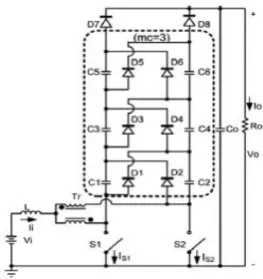
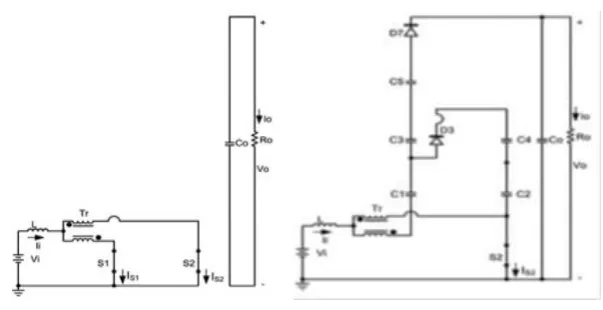
Switches S1 and S2 are turned ON, whereas all diodes are reverse biased. Energy is kept in inductance L and there's no energy transfer to the load. The output capacitor provides energy to the load. This stage finishes once switch S1 is turned OFF.
Switch S1 is turned OFF, whereas S2 remains turned ON and diodeD5 is conducted. There is no energy allocation to the load also. Inductor L stores energy, capacitors C1 and C3 are discharged, and capacitors C2, C4, andC6 are charged
IV. PROPOSED TOPOLOGIES
The developed analysis considers the device related to three voltage multiplier cells and is elaborated as follows. In order to raised perceive the in operation principle of the
Structures, the subsequent assumptions are made: 1) The input voltage is less than the output voltage 2) Steady-state operation is taken into account 3) Semiconductors and geophysics are ideals 4) Change frequency is constant;
5) The turn’s ratio of the autotransformer is unity;
6) The drive signals useful to the switches are 180◦Exiled. Operating principle
The pattern that uses three multiplier cells is defined in Fig. 3. The comparable circuits that match up to the device process given in Figs. 4 correspondingly.
Fig.3. Proposed boost converter using 3SSC and VMCs.
Fig 4. Operating stages: (a) first stage, (b) second stage
Second stage [t1,t2] [see Fig. 4(b)]:switch S1 is turned OFF, whereas S2 remains turned ON and diodeD5 is forward
biased. There’s no energy transfer to the load also. Inductor L stores energy, capacitors C1 and C3 area unit discharged,
and capacitors C2, C4, and C6 are charged.
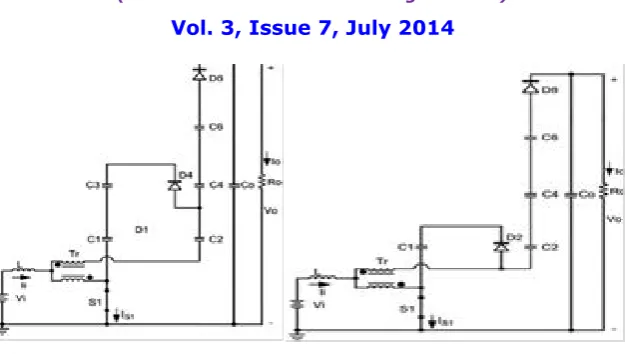
Fig 4. Operating stages: (c) third stage, (d) fourth stage
Third stage [t2,t3] [see Fig. 4(c)]:switches S1 and S2 stay turned OFF and ON, respectively. Diodes D3 and D7 are forward biased, whereas all the outstanding ones are reverse biased. Energy is transmitted to the output stage over D7.The inductor stores energy and capacitors C2 and C4 are still charged. Capacitors C1 is discharged, and then are C3 and C5.
Fourth stage [t3,t4] [see Fig. 4(d)]:clarifies the switch S2 remainders turned ON, diode D3 is inverse biased, and diode D1 is forward biased. Energy is conveyed to the load over D7. The inductor is discharged, and then are capacitors C1, C3, and C5, whereas C2 is charged
Fig 4. Operating stages: (e) fifth stage, (f) sixth stage
Fifth stage [t4, t5 ] [see Fig. 4(e)]: This stage is identical to the first one.
Fig 4. Operating stages: (g) seventh stage, and (h) eighth stage.
Seventh stage [t6, t7 ] [see Fig. 4(g)]: This stage is similar to the third one.
Eighth stage [t7, t8] [see Fig. 4(h)]: Switch S1 is turned ON, while S2 remains turned OFF. Diodes D2 and D8 are forward biased, while D4 is reverse biased as well as the remaining diodes. Energy transfer to the load occurs through D8, and capacitor Co is being charged. The inductance is discharged, while capacitor C1 is charged then capacitors C2, C4, and C6 remain discharged.
Static Gain
The static gain for the generic structure of the boost converter can be obtained from the inductor volt–second balance. The voltage range increased by the time interval that agrees to the inductor charge is equal to that regarding the inductor discharged.
Expected Input And Expected Out Put For All Modules
Open loop:
Input Vdc=42V Output Vdc= 451V
Close loop:
Input Vdc=48v Output Vdc= 400v
V. SIMULATION RESULTS
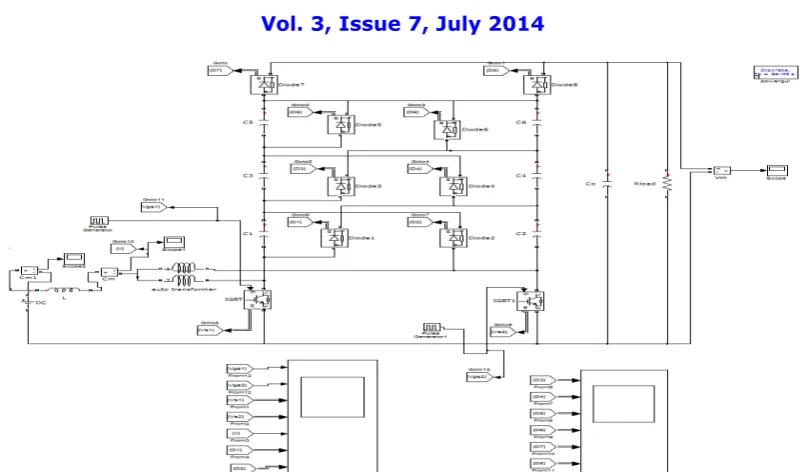
Fig 5 shows the simulation circuit of High Voltage Gain DC-DC Converters Based On 3SSC and VMC Using Non isolated Converter
The above fig.5 shows the simulation diagram for the proposed boost converter based on 3SSCand VMC in these
simulation switches S1and S2 are taken as MOSFET’s and then VMC can going to add the voltage levels at three
stages and it produce the output voltage as 450V in these we are giving the input voltage as 42V-54V based on the specifications we are going to give the input supply.
Fig. 6 Open loop Output DC voltage
The above fig. 6 shows the output DC voltage of the boost converter based on 3SSC and VMC in the open loop circuit as the supply we are going to give the source 48V we are going to get the 455V output supply has been presented in the system .
Fig. 7 Gate pulses of the switch VgS1 and VgS2 with Duty cycle 58% and 42%
Fig. 8 voltage across the switch s1 and s2
The above fig. 8 shows the voltages were presented across the switches of the MOSFET’s were S1 and S2has been presented in the wave from.
Fig. 9 current across boost converter Is1 and Is2
The above fig. 9 shows the current wave forms were it presented across the boost converter switches of the MOSFET’s it going to be presented and it show the Is1 and Is2.
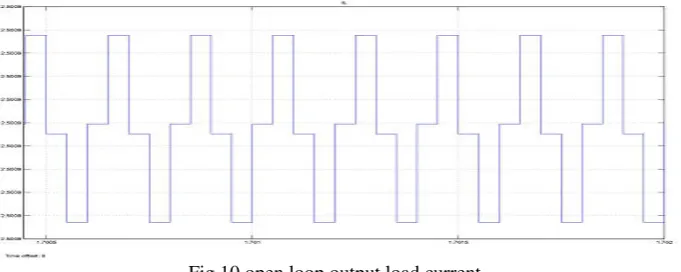
Fig.10 open loop output load current
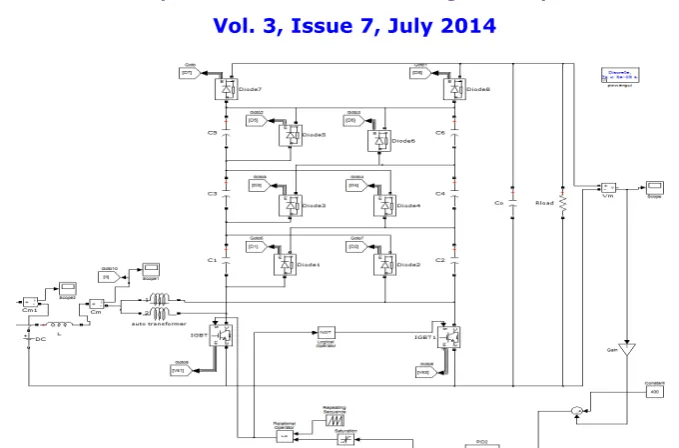
Fig 11 shows the closed loop simulation circuit of High Voltage Gain DC-DC Converters Based On 3SSC and VMC Using Non isolated Converter
The above fig. 11 shows the closed loop circuit diagram of the proposed converter of the 3SSC and VMC by placing the PID controllers across the switches S1 and S2 of the boost converter and we are giving the source as 48V then we are getting the 400V output as we are already mention the reference value as 400V by that it going to calculate and it going to present the output wave form of the system.
Fig. 12 closed loop Output DC voltage
The above fig. 12 shows the output voltage wave form of the 400V
VI. CONCLUSION
Six generalized non isolated high gain voltage dc–dc converters. To verify the principle operation of the generated structures, the boost converter was chosen. The topology is adequate for several applications such as photovoltaic systems, fuel cell systems, and UPSs, where high voltage gain between the input and output voltages are demanded.
REFERENCES
[1] R. Kadri, J.-P. Gaubert, and G. Champenois, “An improved maximum power point tracking for photovoltaic grid-connected inverter
[2] M. Berkhout and L. Dooper, “Class-D audio amplifiers in mobile applications,” IEEE Trans. Circuits Syst. I, Reg. Papers, vol. 57, no. 5, pp. 992–1002, May 2010.
[3] S. V. Araujo, R. P. Torrico-Bascope, and G. V. Torrico-Bascope, “Highly efficient high step-up converter for fuel-cell power processing based on three-state commutation cell,” IEEE Trans. Ind. Electron., vol. 57, no. 6, pp. 1987–1997, Jun. 2010.
[4] X. G. Feng, J. J. Liu, and F. C. Lee, “Impedance specifications for stable dc distributed power systems,” IEEE Trans. Power Electron., vol. 17, no. 2, pp. 157–162, Mar. 2002.
[5] Y. Jang and M. M. Jovanovic, “Interleaved boost converter with intrinsic voltage-doubler characteristic for universal-line PFC front end,” IEEE Trans. Power Electron., vol. 22, no. 4, pp. 1394–1401, Jul. 2007.
[6] S. V. Araujo, R. P. Torrico-Bascope, G. V. Torrico-Bascope, and L. Menezes, “Step-up converter with high voltage gain employing three- state switching cell and voltage multiplier,” in Proc. Power Electron. Spec. Conf., 2008, pp. 2271–2277.
[7] R. A. da Camara, C. M. T. Cruz, and R. P. Torrico-Bascope, “Boost based on three-state switching cell for UPS applications,” in Proc. Brazilian Power Electron. Conf., 2009, pp. 313–318.