Western University Western University
Scholarship@Western
Scholarship@Western
Electronic Thesis and Dissertation Repository
12-13-2013 12:00 AM
Missing Requirements Information and its Impact on Software
Missing Requirements Information and its Impact on Software
Architectures: A Case Study
Architectures: A Case Study
Md Rounok Salehin
The University of Western Ontario Supervisor
Dr. Nazim Madhavji
The University of Western Ontario Graduate Program in Computer Science
A thesis submitted in partial fulfillment of the requirements for the degree in Master of Science © Md Rounok Salehin 2013
Follow this and additional works at: https://ir.lib.uwo.ca/etd Part of the Software Engineering Commons
Recommended Citation Recommended Citation
Salehin, Md Rounok, "Missing Requirements Information and its Impact on Software Architectures: A Case Study" (2013). Electronic Thesis and Dissertation Repository. 1811.
https://ir.lib.uwo.ca/etd/1811
This Dissertation/Thesis is brought to you for free and open access by Scholarship@Western. It has been accepted for inclusion in Electronic Thesis and Dissertation Repository by an authorized administrator of
Missing Requirements Information and its Impact on
Software Architectures:
A Case Study
(Thesis format: Monograph) by
Md Rounok Salehin
Graduate Program in Computer Science
A thesis submitted in partial fulfillment
of the requirements for the degree of Master of Science
The School of Graduate and Postdoctoral Studies The University of Western Ontario
London, Ontario, Canada
i
Abstract:
[Context & motivation] In the development of large, software-intensive systems, the
system’s requirements are seldom, if ever, concluded upon prior to commencing with
systems architecting. Research shows that, in order to manage development and domain
complexities, instances of requirements engineering (RE) and systems architecting (SA)
processes tend to inter-weave. [Question/problem] However, missing requirements
information can cause one to create (or recreate) the needed information during different
SA activities. While backtracking in the software development process is known to be
costly, the costs associated with missing requirements in the SA process have not been
investigated empirically. [Principal ideas/results] We thus conducted a case study where we
investigated to what extent requirements or requirements attributes’ information found
missing during the SA process and impact of that missing information on SA in terms of
effort. The study involved five architecting teams that involve final year undergraduate
and graduate students enrolled in the university course on SA, working on architecting a
system falling under the “banking” domain. Our result shows that, architects did find
requirements and requirements attributes’ information missing while architecting. Among
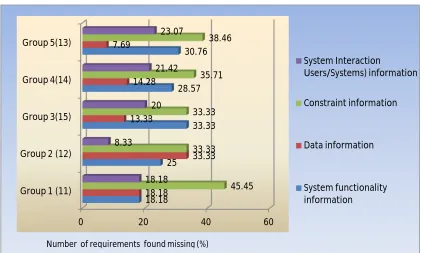
requirements information, architects found that, system functionality information, constraints information and system interaction (users/systems) information are missing in requirements at higher percentages. Within requirements’ attributes, architects found
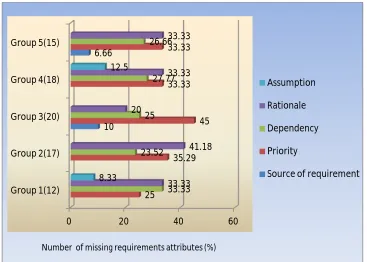
requirements priority, dependency and rationale missing at higher percentages. It is also found that, out of total time spent on architecting the system, effort given to recreate
missing requirements information is higher for group3 (21.5%), group1 (18%), and
group2 (17%) than group4 (12.37%) and group5(10.18%). [Contribution] The anticipated
benefits of the findings are, it can motivate researchers to venture into other areas of
software engineering (such as coding, testing, maintenance, etc.) from the view point of
ii
help software practitioners to decide what kind of information needs to be taken care of,
during RE process, that could possibly ease SA process and later development phases. To
the best of my knowledge, this is the first work which focuses on, to what extent
requirements and requirements’ attributes information found missing during SA;
characteristics and impact of those requirements missing information on SA process in
terms of effort.
iii
Acknowledgements
First and foremost, I would like to thank Dr. Nazim Madhavji for his constant
guidance and supervision. Without his strong motivation, valuable inspiration and
support, this work could not have been completed. Your passion for education and
research are admirable.
I would like to thank all the members in my research team. Special thanks go to
Md. Rashed Iqbal Nekvi who has suggested many valuable ideas for conducting the
research.
I would like to thank Muhammad Iftekher Chowdhury and Dr. Remo N. Ferrari
as there research works helped me a lot with diverse ideas to conduct my research.
I would also like to thank Dr. Shahedul Islam and Rafiqul Islam for giving
suggestions on statistical analysis with their diverse knowledge in Statistics.
I would like to thank the participants of the study; I greatly appreciate the effort
that was expended in the research, and hope that the research output will be of good value
to everyone.
Last, but not the least, I would like to thank my parents back home, Md Mosharraf
Hossain, Mrs. Sayma Hossain and my little sister Shoria Sharmin for their continuous
source of support. I am grateful for their love, patience and trust that acted as a driving
iv
Glossary of terms and definitions
Requirement:
A requirement is a statement of what a system is required to do and the
constraints under which it is required to operate.
Requirements document:
The requirements document is the official collection of all the requirements of a
system for different stakeholders (e.g., customers, end users, developers etc.).
Software architecture:
Architecture is a description of system structures. It is the first artifact that can be
analyzed to identify how well quality attributes are achieved, and it also acts as the
blueprint of the project.
Requirement attributes:
It refers to different properties of requirement that describes definition,
importance of the requirement, and also describes impact of the requirement on overall
system development process. In our thesis we have considered following requirement
attributes:
Source of requirement: It refers to the origin of a requirement where it is elicited
from.
Priority: It refers to the relative importance of one requirement to others.
Dependency: It refers to the set of requirements on which a given requirement is
dependent.
Rationale: Rationale captures the information about the intent behind a
v
Assumption: It refers to any proposition regarding a requirement, which has been
considered to be true during specification of the requirement.
Missing requirements:
It refers to requirements information that is not found in requirements from
architects’ point of view. We have considered following information in requirements:
Functionality information: It describes the behaviour and functionalities of the
system i.e., how a system should function against different set of inputs (i.e.,
technical details, data manipulation and processing etc.).
Data information: It describes how the system deals with user’s information or
system information.
Constraint information: It describes information relevant to technical aspects of
the system (i.e., capacity, speed, memory etc.).
System interaction (users/systems) information: It describes information about
how the system should interact with different users and other systems.
Missing requirements attributes:
It refers to requirements attributes information that is not found in requirements,
from architects’ point of view. We have considered all requirements attributes as
described above.
Architecturally significant requirement: Architecturally significant
requirements are a subset of the requirements that need to be satisfied before the
architecture can be considered "stable". Typically, these are requirements that are
technically challenging, technically constraining, or central to the system's purpose.
Crosscutting requirement: It refers to requirement that depends on one or more
requirements and cannot be satisfied until other requirements are taken into account.
Quality requirement: It refers to requirement (non-functional) that deals with
vi
List of Contents
Abstract: ... i
Acknowledgements... iii
Glossary of terms and definitions ... iv
List of Contents ... vi
List of Tables ... ix
List of Figures ... x
List of Abbreviations ... xi
Appendix ... xii
Chapter 1: Introduction... 1
1.1 Problem description ... 1
1.2 Focus of research and motivation ... 2
1.3 Originality... 3
1.4 Research approach ... 3
1.5 Research contributions ... 4
1.6 Implications of the findings ... 4
1.7 Thesis organization ... 5
Chapter 2: Literatures Review ... 6
2.1 Requirements Engineering (RE) process ... 6
2.2 Software architecture ... 8
2.3 What is a requirements document ... 9
2.4 Attribute Driven Design (ADD) ... 9
2.5 Why requirements information goes missing in RE documents ... 11
2.6 Empirical research on: ... 12
2.6.1 Importance of software documentation... 12
2.6.2 Knowledge gap between software development phases ... 13
2.6.3 Requirements problems and its impact of on SA ... 14
vii
2.7 Importance of different characteristics of requirement in SA ... 17
2.8 Importance of requirement attributes information... 19
2.9 Analysis of research gap ... 20
Chapter 3: The Empirical Study ... 22
3.1 Goal, Questions and Metrics ... 22
3.1.1 The Goal ... 22
3.1.2 Research Questions and Associated Metrics ... 23
3.2 Requirements document ... 34
3.3 Architecting process ... 35
3.4 Research Procedures... 36
3.4.1 Participants ... 37
3.4.2 Data collection... 38
3.4.3 Data analysis ... 39
3.5 Threats to Validity ... 39
3.5.1 Internal Validity ... 39
3.5.2 Qualitative Validity ... 40
3.5.3 External Validity... 42
3.5.4 Construct Validity ... 43
3.5.5 Conclusion Validity ... 44
Chapter 4: Results and Interpretations ... 45
4.1 Missing requirements and requirements’ attributes found during SA ... 45
4.1.1 Missing requirements found while architecting ... 45
4.1.2 Requirements’ attributes found missing, while architecting ... 47
4.2 Number of changes made in requirements and requirements’ attributes during SA ... 49
4.2.1 Number of changes made in requirements ... 50
4.2.2 Number of changes made in requirements’ attributes: ... 51
4.3 Characteristics of the changed requirements: ... 53
4.4 Impact on rework of requirements missing information, in terms of effort while architecting ... 58
Chapter 5: Implications ... 59
5.1 Implications on Practice ... 60
viii
5.3 Implication on Empirical research ... 61
Chapter 6: Limitations, Conclusions, Ongoing and Future Work ... 64
6.1: Limitations ... 64
6.2 Conclusions ... 65
6.3 Ongoing and future works ... 66
References: ... 68
ix
List of Tables
Table 1: Types of requirements information ... 24
Table 2: Metric M1. – Number of requirements missing, found while architecting the system ... 24
Table 3: Description of different types of requirement attributes ... 25
Table 4: Metric M2- Number of requirements attributes, found missing ... 26
Table 5: Metric M3- Number of changes on requirements ... 27
Table 6: Metric M4- Number of changes on requirement attributes ... 28
Table 7: Definition of different characteristics of a requirement ... 29
Table 8: Metric M5: Number of architecturally significant requirements ... 30
Table 9: Metric M6: Number of crosscutting requirement ... 30
Table 10: Metric M7: Number of quality requirements ... 31
Table 11: Metric M8: (Person/hours) spent on requirements missing information, while architecting ... 32
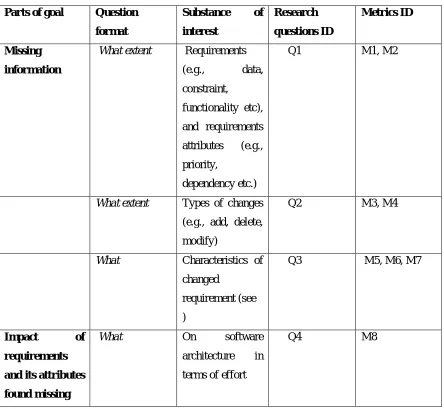
Table 12: Possible substances of interest to satisfy the goal and their corresponding research questions, metrics ... 33
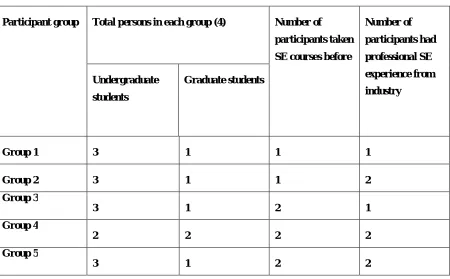
Table 13: Distribution of participants’ background knowledge and experience for different groups ... 37
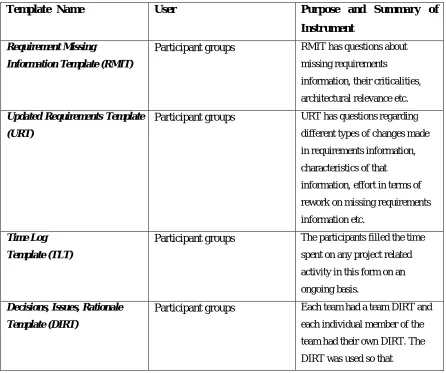
Table 14: Description of different data collection templates ... 38
Table 15: Number of requirements found missing, while architecting the system ... 46
Table 16: Number of requirements attributes, found missing ... 48
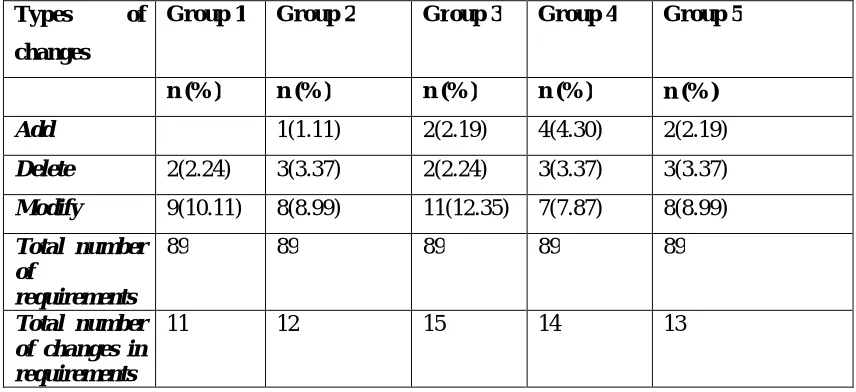
Table 17: Number of changes in requirements ... 50
Table 18: Number of changes in requirements attributes ... 52
Table 19: Frequency of different characteristics of the changed requirements ... 53
x
List of Figures
Figure 1: The common RE process ...7
Figure 2: Common software architecture structure ...8
Figure 3: Relationships between the goal, questions and metrics ... 34
Figure 4: Number of requirements missing, while architecting the system ... 47
Figure 5: Number of requirements attributes’ missing, while architecting ... 49
Figure 6: Number of changes made to requirements, while architecting ... 51
Figure 7: Number of changes to requirements attributes, while architecting ... 53
Figure 8: Number of architecturally significant requirements ... 55
Figure 9: Number of crosscutting requirements ... 56
Figure 10: Number of quality requirements ... 57
xi
List of Abbreviations
SE
: Software engineering
RE
: Requirements engineering
SA
: Software architecture
SRS
: Software requirements specification
ASR
: Architecturally significant requirement
GQM:
Goal, question and metric
QR
: Quality requirement
xii
Appendix
Instruments design (Templates questionnaires)
1
Chapter 1: Introduction
1.1 Problem description
Requirements engineering (RE) and software architecting (SA) are two front end
activities in the Software development lifecycle which greatly impact the overall success
of a software project. The flow of “authoritative information” and control in requirements within RE and SA are maintained through software requirements
specification (SRS) [25]. SRS plays an important role in software development projects.
SRS contains all relevant and “official” information that is required to implement a software system. It is also considered as one of the “main sources” of information for software architects [25]. To achieve a successful design approach of any system,
specifications of quality attribute requirements are very important and there should be a
linkage between requirements specification and design approaches [5]. SA activities (i.e.,
defining quality attribute scenarios, tactics, patterns, views, etc.) while architecting any
system, depend “heavily” on requirements and mostly on quality attribute requirements [38]. There is a systematic relationship between general scenarios, concrete scenarios,
architectural tactics, and design fragments while architecting a system [38]. Besides,
tactics are also dependent on the relationship between design decisions and quality
attribute requirements [5][3] and it is an oversimplification, that architecture can be
derived from requirements in a single instance [10]. On other note, there is one to many
relations between requirements to design [24] and the translation from requirement to
design sometimes results in misconception due to the lack of information [24], that could
be requirements or requirements attributes’ information as well. This requirements’
missing information found while architecting could force architects to recreate those
information, which would require additional effort on their part. Even though textbooks
(e.g., [5], [36], etc.) and standards (i.e., [31], [32]) suggest recording all the artefacts and
necessary related information as part of the SRS, it is impossible in reality because
2
human mind in acquiring knowledge. These requirements’ missing information cause
problems in different software development phases in the form of errors,
misunderstandings and parallel work [51] and affect the actual product in the form of
architectural drifts and incorrect design [24] leading to software defects [23][8]. Standish
Group report [57] found a striking 28% of projects were cancelled completely. Top
factors of failure were lack of a clear statement of requirements in SRS, and incomplete
and changing requirements. In a Siemens project the root cause analysis done by Siemens
Corporate Research(SCR) showed that 40% of the defects were caused by incomplete or
not at all recorded requirements information in SRS [23] [28].
Even though requirements missing information affects other software
development phases like product quality [28], product management [28][14][8], software
maintenance [28][14] and software quality [42][9], for time and resource constraints our
work focuses on finding the extent to which requirements and requirements’ attributes
are found missing during SA process and its impact in terms of effort on requirements
while architecting a system.
1.2 Focus of research and motivation
Research shows evidence about the impact of missing requirements’ information
on architectural design decisions [25] [39]. Requirements to design transition is defined
as the most severe among different software information leaks between development
phases [24]. Relative expense for fixing defects, introduced in requirements, are three
times higher if found during architecture phase and five to ten times higher if found
during construction phase of development of the system [27]. But we could not find any
empirical evidence of the extent of missing requirements and requirements’ attributes and
its impact on SA, in terms of effort. This motivates us to look into the extent of missing
requirements and requirements’ attributes’ information during SA and its impact on SA.
Our research is focused on identifying the extent to which requirements and
3
of effort. Our research also focused to identify the extent of different types of changes
made to requirements and requirements’ attributes, and different characteristics of
changed requirements that are important from architects’ points of view.
1.3 Originality
To the best of my knowledge, characterisation of different requirements and
requirements’ attributes, found missing during SA activities has not been carried out by
any other researcher. Even though there is mention of “information leaks” in different development phases [24], there is no scientific research that I am aware of that is
engaging this study. While there is some evidence in the literature of the knowledge gap
between architecture and coding [19] and architects’ assumptions on requirements [1], it
is not known to what extent, requirements and requirements attributes’ information are
found missing during SA and how frequently it introduces rework in missing
requirements information in terms of effort.
1.4 Research approach
We have used the case study approach as it allows for an empirical investigation
of a contemporary phenomenon within its natural context using multiple sources of
evidence [60]. The type of study conducted was a multiple-case study design [15] where we had five parallel cases (i.e., one case per architecting team). Despite this, it was an
exploratory study in that we had no initial hypothesis, and we did not know which phenomena were important (i.e., impact of missing information on architecture in terms
of effort). This is because, to our knowledge, there was not much background literature
on related research questions. Details of the study design are described in section 3.1 and
4
1.5 Research contributions
From our findings we found that, constraints information and system functionality information are found missing in requirements at higher numbers for different groups. Among different missing requirements’ attributes, priority, dependency and rationale of requirements, have higher percentages for different groups. Our findings also state the
extent of different changes made to requirements and requirements’ attributes. Among
them modification of requirements and requirements’ attributes are having higher
percentages for all the groups. Our results also state whether the changed requirements
have certain characteristics (i.e., architecturally significant requirement, crosscutting
requirement, and quality requirement) that are important from architecture’s point of
view. Our findings also show the evidence about the impact of missing information on
SA, in terms of effort. Among them group 3 spent more time on missing information; that
is, 21.5% of total time was spent on the project. Details of our findings are described in
Chapter 4.
1.6 Implications of the findings
To the best of my knowledge, there is no empirical evidence that shows, to what
extent requirements and requirements attributes’ information is found missing and impact
of this missing information on SA, in terms of effort. This work could motivate the
practitioners to use RE process in a way so that minimal requirements’ and requirements
attributes’ information goes missing. This work could also motivate researchers to
venture into other areas of software engineering (i.e., coding, testing, maintenance, etc.)
to find out the impact of requirements missing information on different development
phases. For example, knowing what kind of requirements and requirements attributes’
5
software practitioners to decide which medium or approach to avoid and to use with
caution in RE and SA processes.
There are already some research tools (e.g., [23] and EGRET [51]) and tools used
in industry (e.g., Rational Team Concert [46]), which provide traceability between
software artefacts and communication artefacts (e.g., meeting videos, email, chat, etc.).
Researchers could improve features of different tools or try to develop new tools if
needed by keeping our findings in mind so information goes missing as infrequently
possible. Details of implications of our findings are described in chapter 5.
1.7 Thesis organization
Chapter 2 discusses the relevant background literature and research gap. Chapter
3 explains the research questions, metrics, experiment design and threats to validity.
Chapter 4 presents the data analysis, results and interpretations. Chapter 5 explores the
implications of the findings and Chapter 6 closes this thesis with limitations of this study,
6
Chapter 2: Literatures Review
The review of the literature culminated into broad areas discussed in Section 2.1,
2.2, 2.3, 2.4, 2.5, 2.6, 2.7, and 2.8. Section 2.1 describes about the RE process and
Section 2.2 shows the commonly used architecture structure. Section 2.3 describes what
is meant by requirements document in this thesis and Section 2.4 describes the attribute
driven design (ADD) approach that is used by architects in this thesis for architecting the
system. Section 2.5 describes, why in current practices, requirements’ information go
missing in RE documents. Section 2.6 discusses key empirical research on importance of
software documentation, knowledge gap between development phases, requirements
problems and its impact on SA, and impact of missing/incomplete requirements in
industries. Section 2.7 describes importance of requirements characteristics in SA.
Section 2.8 describes importance of requirements’ attributes. Section 2.9 describes the
overall research gap based on sections 2.5, 2.6, 2.7, and 2.8.
2.1 Requirements Engineering (RE) process [36]
There are different RE processes that vary based on application domain, people
involved and the organization developing the requirements. The common RE process is
given in Figure 1. Generic activities that are common to all processes are:
Requirements elicitation: It involves the task of working with customers to find out about the application domain, different services that the system should
provide and system’s operational constraints. It can also involve different
stakeholders (i.e., technical staff, end-users, managers, engineers etc.). It is also
7
Requirements analysis: It involves the tasks that should be implied on elicited requirements.
o Requirements classification and organization: it refers to group related
requirements and organizing them accordingly.
o Prioritization and negotiation: Prioritizing requirements and resolving
requirements conflicts.
o Requirements documentation: All requirements are documented and input
into the next round of the process.
Requirements validation: It involves the task of identifying whether the requirements define the system that the customer really wants. It checks for
different requirements concerns (i.e., validity, consistency, completeness, realism
etc.).
Requirements management: It involves the task of managing existing requirements and changing requirements during the RE process and system
development.
Figure 1: The common RE process [36]
8
2.2 Software architecture [5]
Architecture is a description of system structures. It is known as the first artifact
that can be analyzed to identify how well quality attributes are achieved, and it also acts
as the blueprint of the project. It serves as the communication vehicle that can be
transferred to new systems. Common software architecture structure will be most likely
as given in Figure 2. As architecture acts as a backbone of the project’s design, it must be
communicated clearly without any ambiguity to all of the stakeholders (i.e., customer,
user, project manager, coder, tester, etc.). All stakeholders need to understand it in a
better way as:
Developers must understand the work architecture requires of them.
Testers must understand the task structure it imposes on them.
Management must understand the scheduling implications that the architecture suggests, and so forth.
Towards the end the architecture documentation should be informative, unambiguous, and readable by many people of
various backgrounds.
Figure 2: Common software architecture structure [5]
9
2.3 What is a requirements document
A requirement is a statement of what a system is required to do and the
constraints under which it is required to operate. The requirements document is the
official collection of all the requirements of a system for different stakeholders (e.g.,
customers, end users, developers etc.). A requirements document is also known as
‘functional specification’, ‘requirements definition’, ‘software requirements specification
(SRS)’ etc [36]. Requirements can be written in different formats like natural language
description [36], formal specification [36], user story [2] etc. There are various tools
varying from simple word files [4] to complex multitier data base management systems
[22] are also used for storing requirements documents. In this thesis, we refer to
requirements document using the terminology ‘requirements document’ and “SRS”
respectively.
2.4 Attribute Driven Design (ADD) [5]
ADD is a design approach to define software architecture. It is based on the
decomposition process on the quality attributes the software has to fulfill. It is a recursive
decomposition process where, at each stage, tactics and architectural patterns are chosen
to satisfy a set of quality scenarios and then functionality is allocated to instantiate the
module types provided by the pattern. In our thesis, for architecting the system, architects
have used this approach.
ADD steps [5]:
First, architects need to choose a module to decompose. The module to start with is usually the whole system. All required inputs for this module should be
10
Then they need to refine the module according to these steps:
o Choosing architectural drivers from the set of concrete quality
scenarios and functional requirements. This step determines what
is important for this decomposition.
o Choosing an architectural pattern that satisfies the architectural
drivers. Create (or select) the pattern based on the tactics that can
be used to achieve the drivers. It helps to identify child modules
required to implement the tactics.
o Instantiate the modules and allocate functionality from the use
cases and represent using multiple views.
o Define interfaces of the child modules. The decomposition
provides modules and constraints on the types of module
interactions.
Architects need to verify and refine the use cases and quality scenarios and make them constraints for the child modules. This step verifies that nothing important
was forgotten and prepares the child modules for further decomposition or
implementation.
They need to repeat the steps above for every module that needs further
11
2.5 Why requirements information goes missing in RE documents
Different types of communication channels (e.g., face to face, e-mail, chat, etc.)
are used in RE. Because of their highly communication intensive nature all types of
information are not possible to document. Besides, requirements document is considered
as the “main source” of information for later development phases [25]. Here are some of the reasons why requirements or attributes of requirements could go missing during RE:
In current documentation practice one of the stakeholders present in the meeting takes the role of the scribe [53]. It is seen that sometimes different
stakeholders involved in the process may not share a common language or
project knowledge, and due to that the notes of the scribe can be
incomplete, inconsistent or incorrect [53]. For example, the scribe may
misinterpret a statement, note something incorrectly or partially, or omit
important statements made by a stakeholder [53]. This might cause
missing information from the overall documentation.
Sometimes important information is discussed outside formal documentation [51] [12]. Fluid information (such as meetings and oral
communications, blogs, chats, informal wikis, and phone calls, etc.)
usually get ignored from explicit documentation [51].
Documentation is effort consuming [51] but quickly becomes outdated [12] [16]. Often it takes few weeks to months for the documentation to be
updated [40]. This delay in update might result in information missing in
documents.
12
conferencing tools, etc.), information gets fragmented across several
media (e.g., documentation tools or databases, bug repository, e-mail, text
chats, etc.) which leads to frequent context switching (e.g., rechecking old
email, chat sessions, meeting minutes) during work and results in a lack of
common understanding and awareness [51]. Important domain
information is personalized (i.e., “at best retained in the team member’s
mind”) and gets missing when the team member leaves the project [51].
Sometime, requirements engineers who are inadequately trained, have inadequate access to stakeholders and other sources of the requirements.
They are given inadequate resources or authority to properly engineer the
requirements [21].
2.6 Empirical research on:
We have discussed some key research here but it is important to note that the
actual research focus for some of the studies mentioned below spans a broader area.
Because of our scope, we only discuss issues and findings that are related to the
importance of software documentation, knowledge gap between development phases,
requirements problems and its impact on SA, the importance of different characteristics
and attributes of requirements in SA, and the impact of missing/incomplete requirements
in industries.
2.6.1 Importance of software documentation
Lethbridge et al. reported three studies on the use of software documentation [40].
For their study they have used methods like interviews, surveys and observing
individuals’ work. Their study showed that documentation other than testing and quality
13
made to the documentation it usually takes several weeks for the documents to reflect
actual system changes. They also found that the out-dated documentation might remain
useful in some cases, particularly if the high level abstractions remain valid. They also
mentioned the necessity of simple and powerful documentation tools and formats.
Beecham et al. conducted a study in 12 software companies ranging from CMM
level 1 to 4 to find their software process improvement problems [6]. In their study they
divided 200 employees from these companies into 45 groups and used focus group
techniques to collect data. Their result shows that documentation issue (i.e., coordination
and document management, feedback, post-mortems and data collection) is one of the
major problems reported by developers, project managers and senior managers. Amongst
the project issues, documentation was ranked number 2 and amongst the top 6 problems
identified from all the areas (i.e., organizational issues, project issues and software
development lifecycle process), documentation was ranked number 3.
2.6.2 Knowledge gap between software development phases
George et al. described relevant information that is lost during different
development phases and termed it as “Software Information Leaks (SIL)” [24]. Definition of SIL is given as, “relevant information once known, but not incorporated in later stages and thereby lost in software evolution”. They developed a software security impact analysis model and tried to find key dependencies between information. SIL is
identified to occur in technology level, domain level, requirement level, architectural
level, design level and code level. Improper documentation is mentioned as one of the
major causes of architectural drift. SIL that occurs during transition of requirements to
design is defined to be the most severe leaks of software development.
Feilkas et al. conducted a case study about loss of architectural knowledge in three
industrial projects [19]. They answered questions like: i) to what degree is the
architectural documentation kept in conformance with the code; and ii) how well does the
14
and by interviewing developers. It is found that, between 9% and 19% of all
dependencies contained in implementation, could not be identified in architecture
documentation, and between 72% and 90% of the differences between documented and
implemented architecture is due to lack of proper documentation information. Lessons
learnt in this study are: architectural knowledge gets lost due to the gap between
architectural specification and implementation; significant amount of effort is needed for
reverse engineering the architecting process.
Albayrak et al. conducted an empirical study with 251 software engineers from eight companies, and 39 projects to show how software engineers responded to an
incomplete requirement and how it is having impact on the number of explicit
assumption they made [1]. They have suggested as per their findings that, implicit
assumptions should be avoided and explicit assumptions should be preferred so engineers
do know explicitly that which gap to fill and how to fill. They have shown by using
statistical ANOVA method that, preferred response of engineers to given incomplete
requirements have impact on the number of explicit assumptions they made, and on
average, non-computer-background engineers made more explicit assumptions other then
computer background graduates.
2.6.3 Requirements problems and its impact of on SA
Gross and Doerr described the results of explorative studies conducted on two
academic practical courses having a total of 13 students [25]. They discussed about
architects information need that should be fulfilled in SRS. SRS documents are
mentioned as “official” information that is required for implementing the system and considered as main sources of information for architects. It also described about negative
impacts of over-documented and less-documented SRSs on architects, that in the worst
case sometimes they could neglect or even ignore the SRSs. They have investigated to
find best-practice artifacts types and their representations from the viewpoint of software
15
responsibilities, data, system functionalities, interactions, and technical constraints are
found very important from architects’ points of view.
Lee and Rine described a methodology named “Proxy viewpoints Model-based Requirements Discovery (PVRD)” that provides a framework to construct a viewpoints model from requirements and supports requirements discovery for efficient management
[39]. They discussed incomplete SRS with “missing, not available and hard-to-locate requirements” and mentioned manual discovery of missing requirements and relationships between them as a “highly labor intensive” task. They have applied their model to study a finance application system domain and showed the process for
identifying missing requirements and the relationship chain between requirements.
Gumuskaya described the core issues that are affecting the architecture in
enterprise projects where complex business, management and technical problems exist
[27]. He stated that, requirements information problems in documents have more
potential to cause longer system defects and found them to be more expensive as well. As
per the results, it is found that, the relative expense for fixing defects, introduced in
requirements, are three times higher if found during the architecture phase and five to ten
times higher if found during the construction phase of development of the system.
Ferrari and Madhavji described an exploratory case study to determine different
types of requirements oriented problems that architects faced while architecting the
system [20]. They designed a multiple case study design that includes 16 architecting
teams (i.e., one case per architecting team). Architects faced 35% problems due to
requirements. Their results also found severe problematic technical areas within
requirements oriented problems like, quality satisfaction (22%), requirements
understanding (18%). quality drivers determination (15%), abstraction (14%), and
16
Firesmith has summarized the 12 “worst” of the most common requirements
problems from his working experience with real projects as a requirements engineer,
consultant, and evaluator [21]. Poor requirements quality in requirements specifications
was one of them. He described from practice that, too many requirements in real
specifications are found ambiguous, incomplete, inconsistent, incorrect, out-of-date. They
do not follow the terminology of the user or business/application domain. He also
specified that, in practice, architecturally-significant requirements are accidentally
overlooked many times and those are usually non-functional requirements, most
commonly quality requirements. This problem happens most of the time because the
stakeholders often assume that such requirements are obvious and go without saying.
Kamsties et al. summarized the results of a workshop on requirements
engineering held with practitioners from 10 small and medium enterprises (SMEs) [34].
It is found that, they were organized around issues like, product and project
characteristics, requirements sources and elicitation activities, requirements engineering
products (i.e., the software requirements specification (SRS)), requirements validation
activities, and system evolution (i.e., further development activities). As per their
findings, SMEs that do produce SRS face subtle problems during the evolution of the
system. Among the top problems implicit domain knowledge in SRS is one of them as it
is difficult to understand vague requirements for them. Besides, these vague requirements
are causing problems in testing as requirements are not traceable enough.
2.6.4 Impact of missing/incomplete requirements in industries
Here is some empirical evidence from existing literature which shows the severity
of the problems caused by missing or incomplete requirements in industries:
A study conducted by the Standish Group [57] found a striking 74% project failure rate, while 28% of projects were cancelled completely and
top reasons of failure was lack of user input, lack of a clear statement of
17
In a Siemens project the root cause analysis done by Siemens Corporate Research(SCR) showed that 40% of the defects were caused by
incomplete or not at all recorded requirements in documents[23][8].
In a study [53], a survey was conducted in 63 software companies in Malaysia. The companies cited problems like incomplete requirements
(79.4%), misplaced requirements in a requirements document (37.1%) as
some of the reasons behind late delivery of products (76.2%), budget
over-runs (58.7%) and poor quality products (44.4%).
In June 1991 to September 1991, three surveys on 39, 41 and 44 software maintenance professionals (with overlapping participants) were conducted
and 19 major problems in software maintenance were identified [17].
Incomplete information in system documentation was ranked number 3
amongst them.
As per the report [59], industry data suggests that approximately 50% of product defects originate in the requirements. Perhaps 80% of the rework
effort on a development project can be traced to requirements defects.
These defects are the cause of over 40% of accidents involving
safety-critical systems.
2.7 Importance of different characteristics of requirement in SA
2.7.1 Architecturally Significant Requirement (ASR)
In a study [14], the authors described the importance of identifying architecturally
18
validate the architectural design. ASRs are mentioned as the “driving force” to architectural design of a software intensive system. It is also used as the selection criteria
for deciding between alternate architectural options. It is therefore suggested that, it will
be beneficial for a project if we could elicit and analyze these requirements in the early
phases and document them as that could help in considering the architectural design of
the system.
In early project stages, requirements and architecture are expressed as “highly informal” [58] and due to that, often ASRs are overlooked in the beginning of a project [13]. The hints those are uncovering them are sometimes found not well documented as
well [29]. In consequence, also the decision knowledge tends to remain implicit
sometimes. When requirements and architecture evolve, this informality eventually leads
to a loss of decision knowledge. Due to the vague or changing ASRs in documents,
sometimes it may not be reflected in the architecture, which results in high costs for later
changes [13].
2.7.2 Quality requirement:
Quality (non-functional) requirements (QR) for a system represent a special
subset of architecturally significant requirements (ASRs) and describe the non-behavioral
constraints on the system [14]. It has the “biggest” role in the architectural design [44]. These requirements define the overall qualities and attributes of the resulting system like
(i.e., safety, security, usability, reliability, performance etc.). But in practice, sometimes,
interdependencies and trade-offs among QRs remain unclear. Sometimes they are not
appropriately defined and prioritized in documents. This unusual missing information in
documents causes problems during architecting the system and other development
activities as well [37].
2.7.3 Crosscutting requirement:
In a study [48], the author defined requirements that crosscut other requirements;
known as crosscutting requirements. For example, requirement X crosscuts requirement
19
taking X into account. So X in this case will be crosscutting requirement. In reality,
semantic relationships between requirements could not be identified and they are
explicitly recorded in specifications [48]. If some of the relationships among
requirements (such as crosscutting influences) remain obscure, developers have the risk
of forgetting about them. In the worst case, it is found that those relationships are
discovered indirectly by users while requirements are not totally fulfilled by the software
after deployment. In both cases increased costs are the result of the requirements
deficiencies and it can rise to other troubles such as loss of faith in the developers or even
the failure of critical system components [48].
2.8 Importance of requirement attributes information
In a study [41], the authors surveyed the state of practice on rationale
management, usage, and challenges of integrating rationale management in RE activities.
They stated that, traditional requirements specification only specifies what the requirements are, but not why these requirements are specified. This causes problem in later phases of development, where requirements get involved due to stakeholders’
change of mind when the system is being updated. As a result of their findings, it is
defined that rationales in specification should include every decision, its alternative
decisions, and underlying arguments leading to that decision (e.g., influence factors,
criteria, and negotiations). These decisions also help in prioritizing the requirements as
rationale helps to make decisions about what requirements to be implemented first or
should be given most resources from architects’ points of view [11].
Traceability is another important requirements attribute that defines the ability to
follow and describe the life cycle of a requirement, in both forward and backward
direction [35]. Traceability has a positive effect on project management (simplifying
project estimates), process visibility (accessibility to contextual information about
20
Assumptions in RE are sometimes found “too ideal” and some of them cannot be satisfied in the running system due to unexpected agent behavior [38]. This lack of
anticipation results in unrealistic and incomplete requirements that result in poor
performance or failures. Improper documenting of assumptions about requirements
sometimes results in run time inconsistencies between specification of the system and
actual behavior of the system [38]. Sometimes there is “invalidity” in assumptions and requirements and that is a source of problems for software developers and users. For an
operational system, this problem may imply from a diminishing value the system to a
software failure as well [43].
2.9 Analysis of research gap
Studies show (section 2.5) several reasons for why requirements information is
found missing during RE includes: (i) use of different communication language [23], (ii)
lack of project knowledge between stakeholders [23], (iii) omitting statements made by
stakeholders [23], (v) misinterpreting any statement and note something incorrectly or
partially [23] and (vi) absence of integration between software artifacts and
communication artifacts [51]. But the types of requirements or requirements attributes’
information goes missing are not stated within any study.
Studies show evidence of the importance of complete SRS in architecting and
other phases [25][9] but rarely discuss anything about what types of information were not
there in the SRS or impact of this missing information on architecture or other
development phases. In a study [24], the authors describe design decision recording
problems that include partial documentation, lack of information relating requirements to
rationales, while architecting the system, but did not mention anything about to what
extent, requirements were missing in SRS and its impact on architecture and other phases
of development.
Research also depicts that, missing requirements information affect software
development phases like architecture [24] [28], product quality [53], product
21
none of them discussed anything about the impact of incomplete information on different
phases in terms of effort on this missing information.
In (section 2.7), studies refer to different characteristics of requirements (i.e., ASR
[14] [58], quality requirement [14] [44] and crosscutting requirement [48]), that are
important from a system development perspective, but none of them really state anything
about the extent to which missing requirements or missing requirements’ attributes are
having this characteristic and how it could affect the architecture or other development.
Section 2.8 gives evidence about the importance of different requirements’ attributes, but
studies did not discuss to what extent they are going missing or its impact on
development phases.
In (section 2.6.2), we found a study [24] concerning the occurrence of missing
information in different software development phases. The software information leak, at
the transition from requirements to design is mentioned as the most severe leak [24] but
the study did not mention anything about to what extent, requirements information was
missing from requirements to architecture and other development phases. In another
study [20] the authors described requirements problems found during architecture but did
not state anything about the extent to which requirements or requirements’ attributes are
found missing during SA or the impact of this missing information on SA, in terms of
effort. Studies also have evidence about knowledge loss in architecture and its impact on
coding [19], designers implicit assumptions while they cannot avoid getting incomplete
SRS when designing the system [1], architects’ expectation from SRS [25], but none
them explore to what extent requirements information has gone missing or what impact it
has on architecture or other development phases in terms of effort and quality.
However, there is a significant research gap in finding to what extent
requirements or requirements’ attributes are found missing; its impact in terms of effort
on this missing information during the software architecting process; and characteristics
of changed requirements; impact of this missing information on overall software
development life cycle and other development phases (i.e., product management, project
management, risk analysis, software quality etc.), that motivate empirical investigation in
22
Chapter 3: The Empirical Study
This chapter describes the details of the study and the research procedures that
were carried out. Section 3.1 defines the overall research goal, specific research questions
and associated metrics. Section 3.2 describes the RE document that is given to all the
groups and section 3.3 describes the architecting process that all the groups have
followed. Section 3.4 describes the research procedures in terms of participants, data
collection and data analysis. Section 3.5 describes the threats to validity of our study.
3.1 Goal, Questions and Metrics
We used the Goal Question Metric (GQM) [4] to formulate the goal of the study, pertinent research questions and associated metrics to gather appropriate data. In the
following, we first define goal of the study, then we describe our research questions and
associated metrics.
3.1.1 The Goal
Purpose: To determine and analyze
Issue: Characteristics and extent of requirements and their attributes that are found
missing during SA, and impact of these missing information on SA in terms of effort.
Object: Requirements information and requirements attributes information
Viewpoint: From the viewpoint of software architects
Context: In the context of software development project with particular focus on (RE)
23 3.1.2 Research Questions and Associated Metrics
The goal of the study has two dimensions: (i) characteristics of requirements information; and (ii) impact of missing requirements on software architecting efforts. Our research goal has led us to formulate following research questions.
Q1: To what extent, (i) requirements and (ii) their attributes found missing, for
architecting the system?
Q1 can be decomposed into two separate questions i.e., Q.1.1 and Q.1.2 as follows:
Q1.1: To what extent, requirements found missing while architecting.
Q1.2: To what extent, requirements attributes found missing while
architecting.
Q 1.1: To what extent, requirements, found missing while architecting?
Description:
There are various types of requirements information that could be missed while
doing the RE works. To categorize the missing requirements information we used the
classification of requirements information as suggested by Gross and Doerr in [25]. In
[25], the authors presented the types of requirements information including functional
information, data information, constraint information, etc. (see Table 1) that the architects
usually expect to be specified in the requirements documents. With reference to Q.1.1,
we sought to investigate the extent to which these types of information that were found
24
Table 1: Types of requirements information Types of Requirements information Description
Functionality information It describes the behaviour and functionalities of the system i.e., how a system should function against different set of inputs (i.e, technical details, data manipulation and processing etc.)
Data information It describes how the system deals with users’ information or system information.
Constraint information It describes information relevant to technical aspects of the system (i.e., capacity, speed, memory etc.)
System interaction (users/systems) information
It describes information about how the system should interact with different users and other systems.
From Q1.1, we have one theoretical “construct” i.e., extent of requirements found missing while architecting. Thus, we define the following metric (M1) for data gathering
(Table 2).
M1: Number of requirements missing, found while architecting the system.
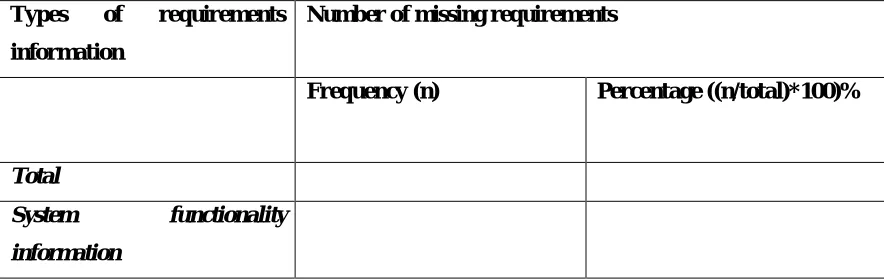
Table 2: Metric M1. – Number of requirements missing, found while architecting the system
Types of requirements information
Number of missing requirements
Frequency (n) Percentage ((n/total)*100)%
Total
25
System data information Constraint information System interaction (users/systems) information other
Q1.2 To what extent, requirements attributes found missing while architecting?
Description:
Here, we sought to investigate the extent of the missing information concerning
various requirements attributes, which are later discovered by the software architects
team. We have used existing literature [4] for the set of requirements attributes. Table 3
depicts the list of requirements attributes (see the 1st column) and associated brief
descriptions (see the last column) which have been considered in the study.
Table 3: Description of different types of requirement attributes Types of requirements attributes Description
Source of requirement It refers to the origin of a requirement where it is elicited from.
Priority It refers to the relative importance of one requirement to others.
Dependency It refers to the set of requirements on which a given requirement is dependent.
Rationale Rationale captures the information about the intent behind a requirement.
26
From Q.1.2, we have one theoretical “construct” i.e., extent of requirement attributes found missing while architecting. Thus, we define the following metric (M2) and
definition of the metric is given in Table 4.
M2: Number of requirements attributes, found missing, for architecting the system.
Table 4: Metric M2- Number of requirements attributes, found missing Types of requirements
attributes
Number of requirements attributes, found missing
Frequency (n) Percentage (n/total)*100%
Total
Source of requirement Priority
Dependency Rationale
Assumption Other
Q2: To what extent, changes are required in the requirements and requirement attributes,
while architecting the system?
Description:
This question was asked to have information about what kind of changes
architects made to the given requirements. We defined three possible types of changes
that architects’ can do in requirements document.
Add: Adding one or more new requirements.
27 Modify1: Modifying specific requirement
Q2 can be decomposed into two separate questions i.e., Q.2.1 and Q.2.2 as follows:
Q.2.1: To what extent, changes are required in the requirements?
Q.2.2: To what extent, changes are required in the requirements attributes?
With reference to Q.2.1, we have considered different requirements information
described in [25] (see Table 1). There is one theoretical “construct”: extent of changes to requirements while architecting. Thus, we define the following metric (M3) (Table 5).
M3: Number of changes on requirements, while architecting.
Table 5: Metric M3- Number of changes on requirements
Requiremen
ts
information
Number of changes on requirements, while architecting
Add Delete Modify
Frequency (n) Percentage (n/(n+total))*100 Frequency (n) Percentage (n/total))*100 Frequency (n) Percentage (n/total)*100 System functionality information System data information Constraint information System interaction (users/syste ms) information Total 1
28
With reference to Q.2.2, we have considered different requirement attributes
described in Table 2. There is one theoretical “construct”: extent of changes to requirement attributes while architecting. Thus, we define the following metric (M4)
(Table 6).
M4: Number of changes on requirement attributes, while architecting
Table 6: Metric M4- Number of changes on requirement attributes
Requirements information
Number of changes on requirement attributes, while architecting
Add Delete Modify
Frequency
(n)
Percentage
(n/(n+total))*100
Frequency
(n)
Percentage
(n/total))*100
Frequency
(n)
Percentage
(n/total)*100
Source of requirement Priority Dependency Rationale
Assumption Other Total
Q3: What are the characteristics of the changed requirement?
Description:
In Table 7, we have described different requirement characteristics, those are
important software architecting [14][48]. Definition of different characteristics of a
requirement is given in Table 6. Q3 can be decomposed into three separate questions i.e.,
29
Q.3.1: How many of the changed requirements are architecturally
significant?
Q.3.2: How many of the changed requirements are cross-cutting
requirements?
Q.3.3: How many of the changed requirements are quality requirements?
Table 7: Definition of different characteristics of a requirement Requirement
characteristics
Description
Architecturally significant
requirement (ASR)
Architecturally significant requirements are a subset of the requirements that need to be satisfied before the architecture can be considered "stable". Typically, these are requirements that are technically challenging, technically constraining, or central to the system's purpose [14].
Crosscutting requirement
It refers to requirement that depends on one or more requirements and cannot be satisfied until other requirements are taken into account [40].
Quality requirement
It refers to requirement (non-functional) that deals with “Quality Characteristics” of the system (i.e., performance, usability, reliability etc.) [14]
With reference to Q.3.1, there is one theoretical “construct”: how many of the changed requirements are architecturally significant. Thus, we define the following metric (M5)
(Table 8).
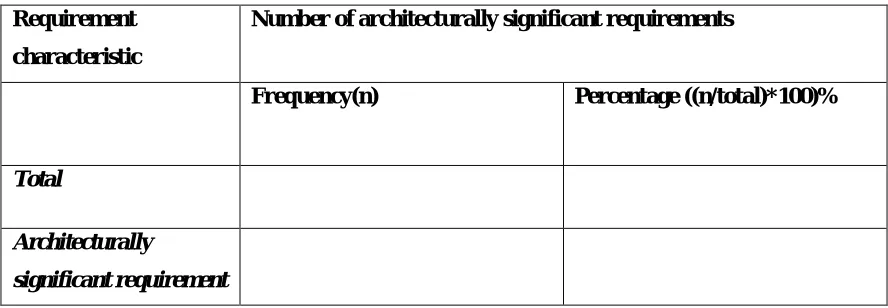
M5: Number of architecturally significant requirements.
30
Table 8: Metric M5: Number of architecturally significant requirements
With reference to Q.3.2, there is one theoretical “construct”: how many of the changed requirements are crosscutting requirements. Thus, we define the following metric
(M6)(Table 9).
M6: Number of crosscutting requirements.
Table 9: Metric M6: Number of crosscutting requirement
With reference to Q.3.3, there is one theoretical “construct”: how many of the changed requirements are quality requirements. Thus, we define the following metric (M7)(Table
10).
M7: Number of quality requirements.
Requirement characteristic
Number of architecturally significant requirements
Frequency(n) Percentage ((n/total)*100)%
Total
Architecturally
significant requirement
Requirement characteristic
Number of crosscutting requirements
Frequency(n) Percentage ((n/total)*100)%
Total
![Figure 1: The common RE process [36]](https://thumb-us.123doks.com/thumbv2/123dok_us/7793348.1292130/21.612.190.457.481.681/figure-the-common-re-process.webp)