Locus of Control and Suicidal Ideation
among High School Students
Ravikumar N. L
1Dr. R. Gopalakrishna
21
Research scholar Department of psychology, Bangalore university,
2
Professor(Retd) Department of Psychology Bangalore University,
ABSTRACT
Suicidal behaviour is a serious public health problem among adolescents. It is a complex phenomenon and process that may originate with suicidal thoughts and evolve over time into plans or attempts, or can more rarely be an impulsive act. A suicidal attempt may result in injury, disability or death. As adolescents are in a transitional period between childhood and adulthood, they are more vulnerable to adverse effects from health behaviours that put them at higher risk for suicidal behaviour. The purpose of the present research was to study the Level of Locus of control and Suicidal Ideation Between Male and Female and Urban and rural High School students. The Descriptive Study Design was employed, in which 30 Male and 30 Female high School students were included. The data on Suicidal ideation was obtained by using Suicidal Ideation Scale developed by Devendra Singh Sisodia and Vibhuti Bhatnagar (2011) and Rotter’s Locus of control Scale (1966). The sample chosen were in the age group between 13-16 years. The obtained data was analysed with the help of independent ‘t’ test. The results indicated that Significant differences were found between Male and Female High School students in Locus of control and Suicidal ideation and also Significant differences were found between urban and rural High School students in Locus of control and Suicidal ideation.
Key words; Locus of control and Suicidal Ideation, High School students.
INTRODUCTION
Suicidal behaviour among young people is of increasing concern to society. Although completed suicide amongst adolescents is still relatively uncommon, with estimates of between 9 and 12 completed suicides per 100,000 people, the suicide rate amongst young people aged 15 to 19 years has more than tripled in the last 30 years. More disturbing is the fact that suicide thoughts, attempts and other self-destructive behaviour occur far more frequently, with estimates of the ratio of adolescent attempts to each death varying between 50: l and 120: l. Such estimates are often derived from special samples (typically, the adolescents who are hospitalized as a result of a suicide attempt);
yet the majority of adolescent attempters may not seek medical attention following an attempt. Hence, epidemiological studies may, in fact, be underestimating the true incidence of suicidal behaviour among adolescents. Further, the literature on school population surveys, although sparse, suggests that attempters make up approximately 11% of high school. students, whereas suicidal ideation is much more common.
attribute the reinforcement (or effect) to some factor outside of their own control, such as luck, chance, fate or powerful others; and they often feel relatively unable to influence their environment. Conversely, individuals typifying an internal locus of control orientation perceive that reinforcement (or an effect) is contingent on their own actions or attributes, and hence, is to some degree under their control.
Goldney suggests that this construct is valuable in the assessment of suicidal individuals, as clinical reports have identified analogous characteristics. He suggests the oft-quoted “cry for help” is a clear reference to the need for external intervention from significant others, and hence, an external LOC orientation. Indeed, in his study of young women who had attempted suicide, Goldney found they scored more externally than a non-suicidal control group on the Adult Nowicki Strickland Internal- External Locus of Control scale. He also found that LOC scores varied according to lethality, with high lethality attempters scoring more internally than low lethality attempters. A number of other studies have identified a relationship between locus of control and suicidal behaviour among adolescents and young adults. For example, Goldney et al, in their 8-year longitudinal study of suicidal ideation among high school students as they moved into young adulthood, found that locus of control scores were associated with suicidal ideation over time and suggest that suicidal ideation is not simply a transient phenomenon but is associated with more pervasive psychological attributes. Further, Topol & Reznikoff found that hospitalized suicidal adolescents scored more externally than hospitalized suicidal teenagers and non-hospitalized controls. They also suggest that the locus of control construct may be useful in identifying potentially suicidal adolescents.
METHODOLOGY
PROBLEM:
To study the Level of Locus of control and Suicidal Ideation among High School students.
OBJECTIVES
Keeping the problem of the study in view, the following objectives were drawn
1) To study the gender difference in Locus of control among High School students.
2) To study the gender difference in Suicidal Ideation among High School students.
3) To study the Level of Locus of control between Rural and urban High School students.
4) To study the Level of Suicidal Ideation between Rural and urban High School students.
HYPOTHESES
1) There will be a significant gender difference in Locus of control among High School students.
2) There will be a significant gender difference in Suicidal Ideation among High School students.
3) There will be a significant difference in Locus of control between Rural and urban High School students. 4) There will be a significant difference
in Suicidal Ideation between Rural and urban High School students.
VARIABLES
Independent variables
Gender Rural and urban High School students
Dependent variables
Locus of control Suicidal ideation
INCLUUSION CRITERIA
Students between the age group of 13-16
would be included High School students only.
1) Students form broken family, divorced families were excluded
2) Students who are mentally or physically challenged were excluded TOOLS
1) Semi structure interview schedule to obtain the demographic details.
2) Suicidal ideation scale by Devendra Singh Sisodia and Vibhuti Bhatnagar (2011)
3) Rotter’s Locus of control Scale (1966) RESEARCH DESIGN
Between groups design SAMPLE
The Purposive Sampling technique was used to select the sample. On the whole, a total of 60 students were chosen as the sample. Among them 30 Male and 30 female High School students which included rural and urban subjects.
STATISTICAL ANALYSIS
Data was analysed with the help of descriptive statistics, mean SD, independent ‘t’-test. The statistical analysis was done with the help of SPSS 20.0 version.
RESULTS AND DISCUSSION
Table 1 Showing the mean, S.D and ‘t’ value between Male and Female High School students in Locus of control.
Variabl
e Group N Mea
n S.D ‘t’ value
Locus of control
Male 3 0
10.4 3
1.2
7 4.88* * Femal
e 3 0
12.4 6
1.8 8 ** Significant at 0.01 level
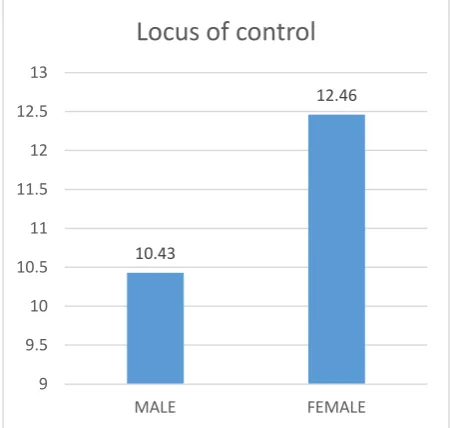
Table-1 Shows the result of Locus of control between Male and Female High School students. As per the above table, the mean obtained is 10.43 and 12.46, with the
standard deviation being 1.27 and 1.88 in Locus of control for male and female High School students respectively and obtained ‘t’ value is 4.88, which revealed that it is Significant at 0.01 level. Hence, the hypothesis that “There will be a Significant gender difference in Locus of control among High School students” has been accepted.
The Graph that follows depicts the mean difference in Locus of control between Male and Female High School students.
Graph-1 depicting the mean scores of Locus of control between Male and Female High School students.
Table 2 Showing the mean, S.D and ‘t’ value between Male and Female High School students in Suicidal ideation.
Variabl
e Group N Mea
n S.D ‘t’ value
Suicida l ideation
Male 3 0
41.0 6
6.1
3 5.58* * Femal
e 3 0
48.8 3
4.5 0
** Significant at 0.01 level
10.43
12.46
9 9.5 10 10.5 11 11.5 12 12.5 13
MALE FEMALE
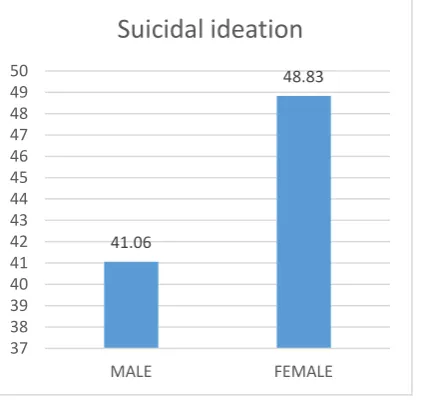
Table-2 Shows the result of Suicidal ideation between Male and Female High School students. As per the above table, the mean obtained is 41.06 and 48.83, with the standard deviation being 6.13 and 4.50 in Suicidal ideation for male and female High School students respectively and obtained ‘t’ value is 5.58, which revealed that it is Significant at 0.01 level. Hence, the hypothesis that “There will be a Significant gender difference in Suicidal ideation among High School students” has been accepted.
The Graph that follows depicts the mean difference in Suicidal ideation between Male and Female High School students.
Graph-2 depicting the mean scores of Suicidal ideation between Male and Female High School students.
Table 3 Showing the mean, S.D and ‘t’ value between Urban and Rural High School students in Locus of control.
Variabl e
Grou p N
Mea
n S.D ‘t’ value
Locus of control
Urban 3 0
12.2 3
1.9
0 3.80* * Rural 3
0
10.6 0
1.3 7
** Significant at 0.01 level
Table-3 Shows the result of Locus of control between Urban and Rural High School students. As per the above table, the mean obtained is 12.23 and 10.60, with the standard deviation being 1.90 and 1.37 in Locus of control for Urban and Rural High School students respectively and obtained ‘t’ value is 3.80, which revealed that it is Significant at 0.01 level. Hence, the hypothesis that “There will be a Significant difference in Locus of control between Urban and Rural High School students” has been accepted.
The Graph that follows depicts the mean difference in Locus of control between Urban and rural High School students.
Graph-3 depicting the mean scores of Locus of control between Urban and rural High School students. Table 4 Showing the mean, S.D and ‘t’ value between Urban and Rural High School students in Suicidal ideation.
Variabl e
Grou p N
Mea
n S.D ‘t’ value
Suicidal ideation
Urban 3 0
46.2 6
7.1
1 4.23*
* Rural 3
0
39.6 0
4.4 7
** Significant at 0.01 level
41.06
48.83
37 38 39 40 41 42 43 44 45 46 47 48 49 50
MALE FEMALE
Suicidal ideation
12.23
10.6
9.5 10 10.5 11 11.5 12 12.5
URBAN RURAL
Table-4 Shows the result of Suicidal ideation between Urban and Rural High School students. As per the above table, the mean obtained is 46.26 and 39.60, with the standard deviation being 7.11 and 4.47 in Suicidal ideation for Urban and Rural High School students respectively and obtained ‘t’ value is 4.23, which revealed that it is Significant at 0.01 level. Hence, the hypothesis that “There will be a Significant difference in Suicidal ideation between Urban and Rural High School students” has been accepted.
The Graph that follows depicts the mean difference in Suicidal ideation between Urban and Rural High School students.
Graph-4 depicting the mean scores of Suicidal ideation between Urban and rural High School students.
CONCLUSION
The present research aimed at studying the Locus of control and suicidal ideation between Male and Female High School students. Based on the finding of the present study, the following conclusions were drawn. Significant differences were found between Male and Female High School students in Locus of control and Suicidal
ideation and Significant differences were found between urban and rural High School students in Locus of control and Suicidal ideation. The results showed that Female High School Students had more external locus of control experienced More Suicidal Ideation and Male students had more internal locus of control experienced less Suicidal Ideation and when results were compared between Urban and rural setting, The Urban High School Students had more external locus of control experienced More Suicidal Ideation and Rural High students had more internal locus of control experienced less Suicidal Ideation. The findings of study can be used to formulate training the wellbeing and life skills training programmes for promoting positive aspects of mental health as well as to minimize suicidal ideation among the young people. Educational Psychologists, School and college counsellors may use such programs as a part of their counselling services for their students.
LIMITATIONS OF THE PRESENT STUDY:
1) The study was conducted on a sample of 60 students only.
2) The study was restricted to the colleges of High School students of Bangalore City only.
SUGGESTIONS FOR FUTURE RESEARCH:
The study was conducted only on a limited sample of 60 students. To establish validity and reliability, further study can be conduction on a larger sample
REFERENCES
[1] SHAFFERD, GARLAND A. GOULD M, FISHER P. TRAUT- MAN MD. Preventing teenage suicide: a critical review. J Am Acad Child Adolescent Psychiatry 1988: 27: 675-687.
46.26
39.6
36 38 40 42 44 46 48
URBAN RURAL
[2] SMITH K, CRAWFORD S. Suicidal behaviours among “normal” high school students. Suicide Life Threat Behaviour. 1986: 16: 313-325.
[3] JACOBZINER H. Attempted suicides in children. J Pediatr TUCKMAN J. CONNON HE. Attempted suicide in adolescents- cents. An1 J Psychiatry 1962: 119: 228-232.
[4] GARRISON CZ. The study of suicidal behaviour in the schools. Suicide Life Threat Behaviour 1989: 19: 120-130.
[5] DAVIS JM. Suicidal crises in schools. School Psychology Rev 1985: 14: 313-324.
[6] MARTIN G, CLARKE M, PEARCE CM. Adolescent suicide: music preference as an indicator of vulnerability. J Am Acad Child Adolescent Psychiatry 1993: 32: 530-535.
[7] KOTTER JB. Generalized expectancies for internal versus external control of reinforcement. Psychology Monogr 1966: 80: (1, Whole No. 609).
[8] GOLDNEY RD. Locus of control in young women who have attempted suicide. J Nerv Ment Dis 1982: 170: 198-201.
[9] TOPOL P, REZNIKOFF M. Perceived peer and family relationships, hopelessness and locus of control as factors in adolescent suicide attempts. Suicide Life Threat Behaviour 1982: 12: 141-150.
[10] GOLDNEYR D, WINEFIELD AH, TICGEMAN M, WINE- FIELD HR, SMITH S. Suicidal ideation in a young adult population. Acts Psychiatry Scand 1989: 79: 481-489.
[11] GOLDNEY RD, SMITH S. WINEFIELD AH, TICCEMAN M, WINEFIELD HR. Suicidal ideation: its
enduring nature and associated morbidity. Acta Psychiatry Scand 1991: 83: 115- 120.