ENHANCED ANT COLONY SYSTEM
BASED ON RASA ALGORITHM IN GRID
SCHEDULING
D.Maruthanayagam
Associate Professor, MCA Department, Gnanamani Collge of Technology, Namakkal, Tamilnadu, India
Dr. R.Uma Rani
Associate Professor, Department of Computer Science, Sri Sarada College for Women, Salem,
Tamilnadu, India
ABSTRACT:
This paper, proposes an enhanced ant colony scheduling algorithm combined with the concept of RASA. The Grid Environment has various operating systems, hardware, and software, different storage capacities, CPU speeds, network connectivities and technologies. Deployment is a very important phase as it bridges the gap between the user sytem (the resourses) and the grid (the resources).The first step for this to select a set of computers and a network connections (switching, routers, Ethernet, Myrinet Etc.,) for an application. A task algorithm from RASA first estimates the completion time of the tasks on each of the available grid resources and then applies the Max-min and Min-min algorithms. Allocation of resources to a large number of jobs in a grid computing environment is more difficulty than in network computational environments. Resources to jobs will be allotted by resource discovery and filtering automatically which is composed of the selection of resources, idea specific scheduling and job submission. This algorithm is evaluated using the simulated execution times for a grid environment.
Key words: Grid Computing, Job Scheduling, Heuristic Algorithm, Load Balancing, scheduling algorithm,
simulation, ant algorithm.
I. INTRODUCTION
Grid environment is a distributed environment
including different processors with various capabilities. One of the most important issues in resources is the problem of job scheduling. In most of the works accomplished in this field the purpose is finding an appropriate scheduling which minimizes the total tardiness time. Schedulers are to be selected in order to minimize the mean waiting time of processes in queues and also the mean length of queues [1]. The efficient scheduling of jobs on Grid systems is clearly critical because long wait time or queue's long length leads to grate waste of computational resources and also leads to finalization of deadline of some processes [2]. There are relatively a large number of task scheduling algorithms to minimize the total completion time of the tasks in distributed systems [3]. Actually, these algorithms try to minimize the overall completion time of the tasks by finding the
most suitable resources to be
allocated to the tasks. It should be noticed that minimizing the overall completion time of the tasks does not necessarily result in the minimization of execution time of each individual task.
Two well known examples of such algorithms are Min-min and Max-min. These two algorithms estimate the execution and completion times of each of the tasks on each of the grid resources [4]. The Min-Min-Average algorithm (MMA) for scheduling transaction-intensive grid workflows involving considerable communication overheads. First, we establish a fundamental design which can provide nearest neighbours, i.e., the nodes which have the highest network transmission speed with the specific node, for joint scheduling planning, and use real-time information to track the change of network transmission speed so that the scheduling can always be adapted to the current network situation automatically. Due to this adaptation, the communication time can be decreased significantly. It also can make the scheduling algorithm adapt to the change of network transmission speed dynamically [5]. The Max-Min-Average algorithm (MMA) for scheduling found during iteration or during the run of the algorithm, after each iteration only one single job adds with instruction and speed computes. This job may be the one which found the best solution in the current iteration or the one which found the best solution from the beginning of the trial. To avoid stagnation of the search, the range of possible best resourse’s (instruction and speeds) on
each solution component is limited to an interval [min, max] [6].
The algorithm, RASA (Resource Aware Scheduling Algorithm), applies the Max-min and Min-min strategies alternatively to assign tasks to the resources. RASA firstly estimates the completion time of the tasks on each of the available grid resources and then applies the Max-min and Min-min algorithms. The chosen job is then allocated to the best selected ant of each iteration. This process is repeated until all jobs have been scheduled and a complete solution has been built. Each ant in the colony builds a solution in this manner in each iteration. Once all the ants have built a solution the pheromone trail update procedure is performed.
II. MATERIALS & METHODS
Various algorithms have been designed to schedule the jobs in computational gird. The most commonly used algorithms are MET, MCT, Min-Min, Max-Min and ACO.
A. Minimum Execution Time (MET)
The first available machine is assigned a job with the smallest execution time. It neither considers the ready time nor the current load of the machine and also the availability of the resources at that instant of time is not taken into account. The resources in grid system have different computing power. Allocating all the smallest tasks to the same fastest resource redundantly creates an imbalance condition among machines. Hence this solution is static. Since the number of resources is much less than the number of tasks, the tasks need to be scheduled on the resources in a certain order. Many of the batch mode algorithms intend to provide a strategy to order and map these parallel tasks on the resources, in order to complete the execution of these many processor tasks at earliest time. They can also be applied to optimize the execution time of a workflow application which consists of lot of independent parallel tasks with a limited number of resources [7].
B. Minimum Completion Time (MCT)
It uses the ready time of the machine to calculate the job’s completion time (ready time of the machine + execution time of the job). It calculates the completion time of current job in the earliest available machines. From the list, the job with smallest completion time is selected and is assigned to that machine. This means the assigned job may have a
higher execution time than any other job. This algorithm calculates the completion time of current unfinished job in only one earliest available node. But, the same job may be completed in lesser time in some other machine which is available at that time.
C. Min-Min
It starts with a set of unmapped tasks. The minimum completion time of each job in the unmapped set is calculated. This algorithm selects the task that has the overall minimum completion time and assigns it to the corresponding machine. Then the mapped task is removed from the unmapped set [9]. The above process is repeated until all the tasks are mapped. When compared with MCT, Min-Min considers all the unmapped tasks during their mapping decision. The smaller makespan can be obtained when more tasks are assigned to machines that complete them the earliest and also execute them the fastest.
D. Max-Min
First it starts with a set of unmapped tasks. The minimum completion time of each job in the unmapped set is found. This algorithm selects the task that has the overall maximum completion time from the minimum completion time value and assigns it to the corresponding machine. The mapped task is removed from the unmapped set. The above process is
repeated until all the tasks
are mapped.
OnE. ACO
Ant colony optimization (ACO) was first introduced by Marco Dorigo as his Ph.D. thesis and was used to solve the TSP problem [10]. ACO was inspired by ant’s behavior in finding the shortest path between their nests to food source. Many varieties of ants deposit a chemical pheromone trail as they move about their environment, and they are also able to detect and follow pheromone trails that they may encounter. With time, as the amount of pheromone in the shortest path between the nest and food source increases, the number of ants attracted to the shortest path also increases. This cycle continues until most of the ants choose the shortest path. As this work is a cooperative one and none of the ants could find the shortest path separately, Max-Min Ant System is based on the basic ACO algorithm but considers low and upper bound values and limits the pheromone range to be between these values. Defining those values, lets MMAS avoid ants to converge too soon in some ranges. In ACO one ant participate in each iteration search and also there is no pheromone evaporation rule. Hence the ant algorithm is suited for usage in Grid computing task scheduling.
In the grid environment, the algorithm can carry out a new task scheduling by experience, depending on the result in the previous task scheduling. In the grid computing environment, this type of scheduling is very much helpful. Hence this paper proposes the ant algorithm for task scheduling in Grid Computing.
F. RASA (Resource Aware Scheduling Algorithm) in GRID
III. PROPOSED WORK
The grid scheduler finds out the better resource for a particular job and submits that job to the selected systems. The grid scheduler does not have control over the resources and also on the submitted jobs. Any machine in grid can execute any job, but the execution time differs. The resources are dynamic in nature. As compared with the expected execution time, the actual time may vary when running the jobs in the allocated resources. So, the job placement has been determined according to the scheduling intension and then data move operations have been initiated for necessary task to transfer relevent machines. Processors are claimed after all job components have been placed. In between the job placement time and job claiming time the processors could be allocated to some other job and if this happens the job component can be re-placed on another task.
The time between job placement time and job claiming time is decreased by a fixed amount after every claiming failure. A job can fail for various reasons, e.g., badly configured or faulty nodes, hardware, and software errors. During this scheduling failed, job and counts the number of failures of the supposedly faulty node. When a job fails a previously set number of times then the job is removed and not rescheduled [8]. If the error count of a node exceeds a fixed number then that node is not considered by the co-allocator anymore. The states at the bottom depict the happy flow, i.e., the states a job goes through if nothing fails. Different errors occur at various states of a job. Depending on the kind of error, this system will chooses to end the job altogether or to retry the job.
The resubmit the job immediately done too quickly from new task of a machine, due to failure cannot claim its network. We also wait for job to finish so it can properly execute its clean up phase in which it removes the temporarily created works.When a job request with an incomplete or incorrect network specification is submitted the job will naturally, not be resubmitted and will exit immediately. Once all components are placed the claiming phase starts. In contrast to other jobs this is done once for the whole job, i.e., the components do not get claimed independently.
accounts on. As the number of resources grows, it simply does not make sense to examine those resources that are not authorized for use.
When a user is performing scheduling at the
Grid level, the most common solution to this problem is to simply have a list of account names, machines, and passwords written down somewhere and kept secure. While the information is generally available when needed, this method has problems with fault tolerance and scalability for few stages, to proceed in resource discovery, the user must be able to specify some minimal set of job requirements in order to further filter the set of feasible resources. The set of possible job requirements can be very broad and will vary significantly between jobs. It may include static details (the operating system or hardware for which a binary of the code is available, or the specific architecture for which the code is best suited) as well as dynamic details (for example, a minimum RAM requirement, connectivity needed, time space needed). Some schedulers are at least allowing for better coarse-grained information about the applications fulfills [16].
The grid scheduler’s aim is to allocate the jobs to the available nodes. The best match must be found from the list of available jobs to the list of available resources. The selection is based on the prediction of the computing power of the resource. The ant based algorithm is evaluated using the simulated execution times for a grid environment. Before starting the grid scheduling, the expected execution time for each task on each machine must be estimated and represented by an ET matrix. Each row of ET matrix consists of the estimated execution time for a job on each
resource and every column of the ET matrix is the estimated execution time for a particular resource of list of all jobs in the job pool.
Here the algorithm,
r
j denotes the expected time which resourceR
j will become ready to executea task after finishing the execution of all tasks
assigned to it. First, the
C
ij entries are computedusing the ETij (the estimated execution time of task
T
ion resource
R
j) andr
j values. For each taskT
i, the resource that gives the earliest expected completion time is determined by scanning the ith row of the Cmatrix (composed of the
C
ijvalues). The task Tk thathas the minimum earliest expected completion time is determined and then assigned to the corresponding resource from ACO algorithm.
C
ij=ET
j+r
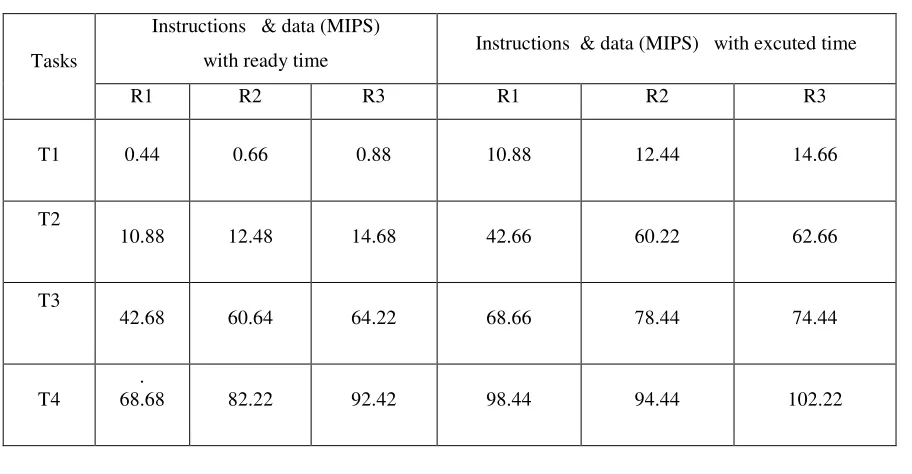
j (1)TABLE 1: SPECIFICATION OF THE RESOURCES AND TASKS.
Tasks
Instructions & data (MIPS)
with ready time Instructions & data (MIPS) with excuted time
R1 R2 R3 R1 R2 R3
T1 0.44 0.66 0.88 10.88 12.44 14.66
T2
10.88 12.48 14.68 42.66 60.22 62.66
T3
42.68 60.64 64.22 68.66 78.44 74.44
T4
.
68.68 82.22 92.42 98.44 94.44 102.22
Execution of ACO System (Old)
No of job & resources: 4 3 Jobs: T1
Jobs: T2 Jobs: T3 Jobs: T4 Resourse: R1 Resourse: R2 Resourse: R3
--- Workload and timing allotments --- T1 and R1 ready time: 0.44
T1 and R1 expected time: 10.88
T1 and R2 ready time: 0.66
T1 and R2 expected time: 12.44
T1 and R3 ready time: 0.88
T1 and R3 expected time: 14.66
T2 and R1 ready time: 10.88
T2 and R1 expected time: 42.66
T2 and R2 ready time: 12.48
T2 and R2 expected time: 60.22
T2 and R3 ready time: 14.68
T2 and R3 expected time: 62.66
T3 and R1 ready time: 42.68
T3 and R1 expected time: 68.66
T3 and R2 ready time: 60.64
T3 and R2 expected time: 78.44
T3 and R3 ready time: 64.22
T3 and R3 expected time: 74.44
T4 and R1 ready time: 68.68
T4 and R1 expected time: 98.44
T4 and R2 ready time: 82.22
T4 and R2 expected time: 94.44
T4 and R3 ready time: 92.42
--- n ij values :
--- 0.01 0.01 0.01 0.01 0.01 0.01 0.01 0.01 0.01 0.01 0.01 0.01 --- Trail level values:
--- 0.09 0.08 0.07 0.02 0.02 0.02 0.01 0.01 0.01 0.01 0.01 0.01 --- CTij values: --- 11.76 13.32 15.54 57.34 74.90 77.34 132.88 142.66 138.66 190.86 186.86 194.64 --- --- Task running compute
--- [0][0] 1.00
[0][1] 0.45 [0][2] 0.26 [1][0] 0.09 [1][1] 0.06 [1][2] 0.05 [2][0] 0.05 [2][1] 0.04 [2][2] 0.04 [3][0] 0.03 [3][1] 0.03 [3][2] 0.02
--- Probability Makespan time with ETij --- [0][0] 100.00
[0][1] 41.98 [0][2] 21.53 [1][0] 2.88 [1][1] 1.35 [1][2] 1.12 [2][0] 1.07 [2][1] 0.77 [2][2] 0.77 [3][0] 0.51 [3][1] 0.52 [3][2] 0.40
--- Makespan time with CTij
--- [0][0] 100.00
[0][1] 45.51 [0][2] 26.15 [1][0] 7.62 [1][1] 5.23 [1][2] 4.40 [2][0] 2.89 [2][1] 2.49 [2][2] 2.27 [3][0] 1.88 [3][1] 1.79 [3][2] 1.53
---
Job scheduling system is the most important part of grid resource management system [11]. The scheduler receives the job request, and chooses appropriate resource to run that job. In this paper, the formulation of job scheduling is based on the expected time to compute (ETC) matrix. Meta-task is
defined as a collection of independent task (i.e. task doesn’t require any communication with other tasks). Tasks derive mapping statically. For static mapping, the number of tasks, t and the number of machines, m is known a priori. ETC (i, j) represents the estimated
expected completion time of the task ti on machine
mj is
ct
(t
i,m
j) = ready (i) + ETC(t
i,m
j) ready (i) isthe machine availability time, i.e. the time at which
machine
m
j completes any previously assigned tasks[12]. The new algorithm is proposed and compare with existing algorithm also presented here.
It is start from a mechanism for defining the grid nodes as well as the input data sources and output data locations load balancing scheme to improve the scaling efficiency of the parallel computation and activity of each node in the grid. To collection of partial result sets from the nodes in the grid and then back to a centralized location. In this method, we achieve the optional additional analysis from the collected results.
The result of the algorithm will have four values (task, machine, starting time, executed completion time). Then the new value of free(j) is the starting time plus ETij. A heuristic function is used to find out the best resource
ij=1 / free (j) (2)
Using the formula 3 the highest priority machine is found which is free earlier. Here four ants are used. Each ant starts from random resource and task (they select ETij randomly jth resource and ith
job). All the ants maintain a separate list. Whenever they select next task and resource, they are added into the list. At each iteration, the ants calculate the new pheromone level of the elements of the solutions is changed by applying following updating rule
T
ij= 1 /Et
ij (3)The scheduling algorithm is executed periodically. At the time of execution, it finds out the list of available resources (processors) in the grid environment, form the ET matrix and start scheduling. When all the scheduled jobs are dispatched to the corresponding resources, the scheduler starts scheduling over the unscheduled task matrix ET. This is guaranteed that the machines will be fully loaded at maximum time. The Pij’s value has been modified to include the ETij is modified to the following equation
P
ij=T
ij ij(1/ET
ij) /T
ij ij(1/ET
ij) (4)Further more, instead of adding ETij, execution time of the ith job by the jth machine (predicted), in the calculation of probability
P
ij =T
ij ij /T
ij ij (5)The proposed algorithm
for each tasks
T
i and resourcesR
j allocationsCompute approximate
C
ij=E
j+r
j to ant’s resource allocate end for do until all tasks in Mv are mappedfor each tasks
T
i andR
jif the number of resources is even then find the resource free times
for each task in
M
vfind the earliest completionfind the task
T
kwith theminimum earliest completion time find the task
T
kwith themaximum earliest completion time
assign task
T
kto the resource Rl that givesthe better completion time from min and max Choose place p randomly from set the resources
Suitable for event e, according to probabilities
end for
for each no of resource & tasks (ants)
best of C and Citeration best with Tmin and Tmax
end for
end for
end while
Execution of proposed System
No of job & resources: 4 3 Jobs: T1
Jobs: T2 Jobs: T3 Jobs: T4 Resourse: R1 Resourse: R2 Resourse: R3
--- Workload and timing allotments --- T1 and R1 ready time: 0.44
T1 and R1 expected time: 10.88
T1 and R2 ready time: 0.66
T1 and R2 expected time: 12.44
T1 and R3 ready time: 0.88
T1 and R3 expected time: 14.66
T2 and R1 ready time: 10.88
T2 and R1 expected time: 42.66
T2 and R2 ready time: 12.48
T2 and R2 expected time: 60.22
T2 and R3 ready time: 14.68
T2 and R3 expected time: 62.66
T3 and R1 ready time: 42.68
T3 and R1 expected time: 68.66
T3 and R2 ready time: 60.64
T3 and R2 expected time: 78.44
T3 and R3 ready time: 64.22
T3 and R3 expected time: 74.44
T4 and R1 ready time: 68.68
T4 and R1 expected time: 98.44
T4 and R2 ready time: 82.22
T4 and R2 expected time: 94.44
T4 and R3 ready time: 92.42
--- n ij values :
--- 0.01 0.01 0.01 0.01 0.01 0.01 0.01 0.01 0.01 0.01 0.01 0.01 --- --- Trail level values:
--- 0.09 0.08 0.07 0.02 0.02 0.02 0.01 0.01 0.01 0.01 0.01 0.01 --- CTij values: --- 11.76 13.32 15.54 57.34 74.90 77.34 132.88 142.66 138.66 190.86 186.86 194.64 --- Min- Max Completion time:
Min Completion time: 11.760000
Max Completion time: 1.07374176.000000
---
Task running compute
--- [0][0] 1.00
[0][1] 0.30 [0][2] 0.21 [1][0] 0.15 [1][1] 0.10 [1][2] 0.02 [2][0] 0.02 [2][1] 0.02 [2][2] 0.01 [3][0] 0.01 [3][1] 0.01 [3][2] 0.01
---
---
Probability Makespan time with ETij --- [0][0] 100.00
[0][1] 31.98 [0][2] 11.53 [1][0] 1.66 [1][1] 0.25 [1][2] 0.12 [2][0] 0.03 [2][1] 0.43 [2][2] 0.33 [3][0] 0.31 [3][1] 0.26 [3][2] 0.18 Min- Max ET time: Min ET Time: 0.513769
Max ET time: 1.0737417600.000000 --- Makespan time with CTij
--- [0][0] 100.00
[0][1] 32.00 [0][2] 21.56 [1][0] 7.02 [1][1] 5.00 [1][2] 3.85 [2][0] 2.84 [2][1] 2.00 [2][2] 1.52 [3][0] 1.34 [3][1] 1.22 [3][2] 0.42
This algorithm can be improved using some form of operating systems, hardware, and software, different storage capacities, CPU speeds, network connectivities and technologies needs. In this method we first find the problem resources and those total execution times equal to the makespan of the solution, and attempt to move or swap set of jobs from the problem processor to another resource that has the minimum and maximize of makespan as
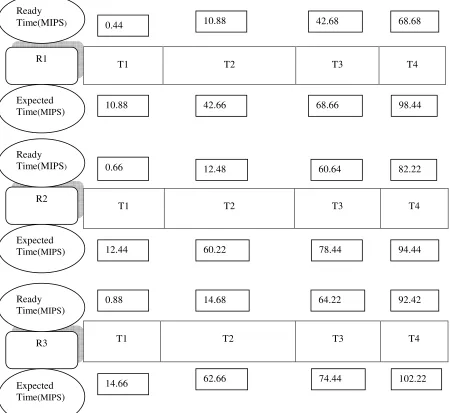
compared with all other resources.[13]. After applying the above local optimum technique, find out the problem resource reduce time again, swap or move some of the jobs from the resource for relevent jobs.The search is performed on each problem processor and continues until there is no further improvement in the fitness value of the solution. The following diagram (Fig 1) shows machine execution time for the introduced mechanism.
T1 T2 T3 T4
T1 T2 T3 T4
T1 T2 T3 T4
Fig 1: 3x4 (resources and tasks) processing times for both ACO & proposed Algorithm.
R2 R1
R3
0.44 10.88 42.68 68.68
42.66 68.66
82.22 60.64
12.48
102.22
0.88 14.68 64.22 92.42
98.44 10.88
12.44 60.22 78.44 94.44
14.66 62.66 74.44
0.66 Ready
Time(MIPS)
Ready Time(MIPS)
Ready Time(MIPS)
Expected Time(MIPS)
Expected Time(MIPS)
Using the Mv are mapped model, the scheduling problems are number of independent jobs to be allocated to the available grid resources [14]. Because of no preemptive scheduling, each job has to be processed completely in a single machine. Number of machines is available to participate in the allocation of tasks. The workload of each job the computing capacity of each resources (in MIPS) , m- represents the ready time of the machine after completing the previously assigned jobs of minimum earliest completion time find the task Tk with the maximum earliest completion time, where the executed machines represents the n-number of jobs and m-represents the number of machines.[15].
IV. RESULTS & DISCUSSION
The proposed algorithm target on grids if the number of available resources is odd, the min-min strategy is applied to assign the first task, otherwise the max-min strategy is applied. The remaining tasks are assigned to their appropriate resources by one of the two strategies, alternatively. For instance, if the first task is assigned to a resource by the min-min strategy, the next task will be assigned by the max-min strategy. Alternative exchange of the max-min-max-min and max-min strategies results in consecutive execution of a small and a large task on different resources and hereby, the waiting time of the small tasks in max-min algorithm and the waiting time of the large tasks in min-min algorithm are ignored. As RASA consist of the max-min and min-min algorithms and both have no time consuming instructions. ACO and RASA algorithms incorporate in which intend to optimize workflow execution times on grids have been presented here. The
comparison of these algorithms in computing time, applications and resources scenarios has also been detailed. In dynamic grid environments this information that can be retrieved from a many servers includes operating system, processor type and speed, the number of available CPUs and software availability as well as their installation locations. The distributed monitoring system is designed to track and forecast resource conditions. The n tasks can obviously intercommunicate. A general model should take into consideration that the communication phase can happen at any time with I/O phases. To overcome these diffculties our new algorithm is proposed.
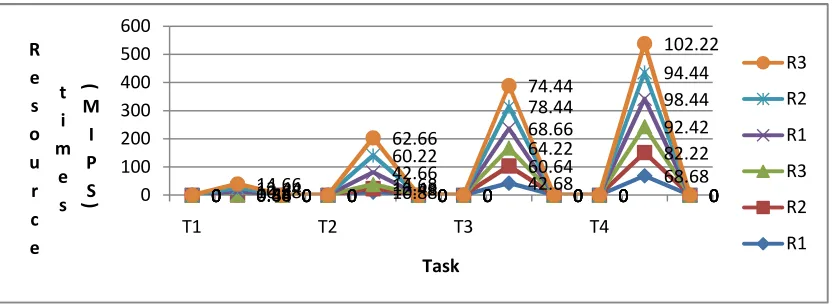
Fig 2: The processing times for both ACO & proposed Algorithm
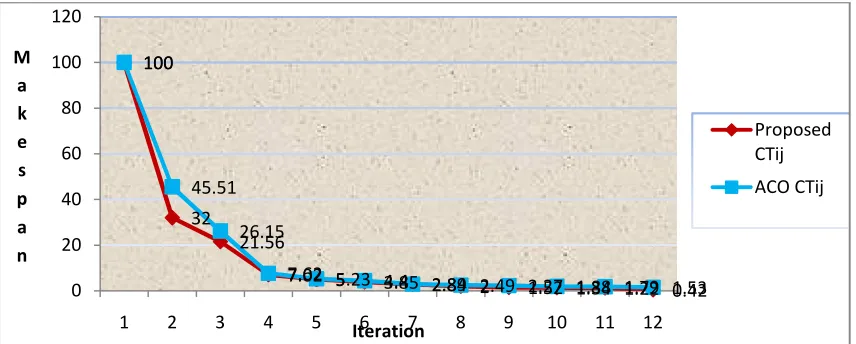
These exeution minimize the overall completion time of the tasks by finding the most suitable resources to be allocated to the tasks. It should be noticed that minimizing the overall completion time of the tasks does not necessarily result in the minimization of execution time of each individual task. The completion time of makespan for both ACO and proposed algorithms are illustrated in Fig 3 and Fig 4 respectively. Task is assigned to a resource by the min-min strategy; the next task will be assigned by the max-min strategy. In the next round the task assignment begins with a strategy
different from the last round. For instance if the first round begins with the max-min strategy, the second round will begin with the min-min strategy. Jobs can be farmed out to idle servers or even idle processors. Many of these resources sit idle especially during off business hours. Fig 5 is shown the compare the completion times of makespan of ACO as well as proposed algorithm. Policies can be in places that allow jobs to only go to servers that are lightly loaded or have the appropriate amount of memory/processors characteristics for the particular application.
Fig 4: The Completion time of makespan for proposed Algorithm.
Fig 5: Compare the Completion time of makespans for ACO & Proposed Algorithm.
V. CONCLUSION
This paper investigates chosen job had been allocated to the best selected ant of each iteration. This process is repeated until all jobs have been scheduled and a complete solution has been built. Each ant in the colony builds a solution, in this manner in each iteration the searching of proper resource allocation on each processing jobs. This algorithm can find an optimal processor and network for each machine to allocate a job that minimizes the tardiness time of a job when the job is scheduled in the system. The proposed scheduling algorithm is
designed to achieve high throughput computing in a
environment high throughput is of great enhancement of resouse allocation accorrding to (CPU, network and operating system) system existing scheduling algorithms in large scale distributed system’s cost of the communication and many other cases open problem in this area here we concentrate throughout mechnisum of entire system needs .
REFERNCES
[1] SamanehHoseini Semnani, Kamran Zamanifar, Naser
Nematbakhsh “New Heuristic in Ant ColonyOptimization to Solve
Job Scheduling Problem in Grid”, Dept. of Computer Science,
University of Isfahan, Isfahan, Iran : 2009
[2] S_ Lorpunmanee, M_ Noor Sap, A_ Hanan Abdullah, and C_
Chompoo-inwai “An ant colonyOptimization for Dynamic Job
Scheduling in Grid Environment”, International Journal of
Computer and Information Science and Engineering, 2007.
[3] He, X., X-He Sun and G.V. Laszewski, 2003. QoS Guided
Min-min Heuristic for Grid Task Scheduling. Journal of Computer
Science and Technology, 18: 442-451.
[4] Saeed Parsa and Reza Entezari-Maleki RASA: A New Task
Scheduling Algorithm in Grid Environment World Applied
Sciences Journal 7 (Special Issue of Computer & IT): 152-160,
2009,ISSN 1818.4952
[5] Ke Liu1,2, Jinjun Chen1, Hai Jin2 and Yun Yang1 A Min-Min
Average Algorithm for Scheduling Transaction-Intensive Grid
Workflows, Swinburne University of Technology.
[6] Mr.K.Sankar1 and Dr. K.Krishnamoorthy2 MAX-MIN ANT
OPTIMIZER FOR PROBLEM OFUNCERTAINITY, K. Sankar et
al. / (IJCSE) International Journal on Computer Science and
EngineeringVol. 02, No. 03, 2010, 473-480
[7]M. Maheswaran, S. Ali, H.J.Siegel, D. Hensgen, and R. Freund.
Dynamic Matching andScheduling of a Class of Independent Tasks
onto Heterogeneous Computng Systems. In 8thHeterogeneous
Computing Workshop (HCW’99), Apr. 1999.
[8] J.Brevik, D.Nurmi, and R.Wolski, “Automatic Methods for
Predicting Machine Availability in Desktop Grid and Peerto- Peer
Systems”, In Proceedings of CCGRID’04, pp. 190- 199, 2004.
[9] ] A Heuristic Algorithm for Task Scheduling Based on Mean
Load1 Lina Ni1,2, Jinquan Zhang1,2, Chungang Yan1, Changjun
Jiang1 1 Department of Computer Science, Tongji University,
Shanghai, 2000-92, China.
[10] K. Kousalya and P. Balasubramanie,”To Improve Ant
Algorithm’s Grid Scheduling Using Local Search.
(HTTP://WWW.IJCC.US), VOL. 7, NO. 4, DECEMBER 2009
[11] E. Tsiakkouri et al., “Scheduling Workflows with Budget
Constraints”, In the CoreGRID Workshop on Integrated research
in Grid Computing, S. Gorlatch and M. Danelutto (Eds.),
Technical Report TR-05-22, University of Pisa, Dipartimento Di
Informatica, Pisa, Italy, Nov. 28-30, 2005, pages347-357.
[12]. J. D. Ullman, "NP-complete Scheduling Problems," Journal
of Computer and System Sciences, vol. 10, pp. 384-393, 1975.
[13]. L. Wang, H. J. Siegel, V. P. Roychowdhury, and A. A.
Maciejewski, "Task Mapping and Scheduling in Heterogeneous
Computing Environments Using a Genetic-Algorithm-Based
Approach," Journal of Parallel and Distributed Computing, vol. 47,
pp. 8-22, 1997.
[14] Szajda, D., Lawson, B., and Owen, J. Hardening Functions for
Large-Scale DistributedComputations. IEEE Symposium on
Security and Privacy, 2003, pp. 216-224.Vanderbei, R. Linear
Programming: Foundations and Extensions, Second
Edition.Norwell: Kluwer, 2001, pp. 136-141.
<http://www.princeton.edu/~rvdb/LPbook>Accessed 17 March
2006
[15] E. Rosti, G. Serazzi, E. Smirni, and M. S. Squillante. Models
of parallel applications with large computation and I/O
requirements. IEEE Trans. on Software Engineering, 28:286–
307, March 2002
[16] P. Cremonesi and C. Gennaro. Integrated performance models
for SPMD applications and MIMD architectures. IEEE Trans. on
Parallel and Distributed Systems, 13(12):1320–1332, 2002.
Authors Profile
D.Maruthanayagam received his M.Phil, Degree from Bharathidasan University, Trichy in the year 2005. He has received his M.C.A Degree from Madras University, Chennai in the year 2000. He is working as a Associate Professor in Master of Computer Applications Department, Gnanamani College of Technology, Pachal, Namakkal, Tamilnadu, India. His areas of interest include Computer Networks,
Grid Computing and Mobile
Computing.