Development of an Intelligent and Energy
Efficient Spindle System
Narrendar.R.C1, Indira Kumar.S2, Tilak3
PG Student, Dept. of Mechatronics Engineering, VIT University, Vellore, India1
PG Student, Dept. of Mechatronics Engineering, VIT University, Vellore, India2
PG Student, Dept. of Mechatronics Engineering, VIT University, Vellore, India3
ABSTRACT: Spindle system plays a very important role in CNC and milling machines; but the foremost disadvantage over these machines are - they dissipate lots of energy which affects the overall efficiency and accuracy of the process. On identifying the various causes for the energy dissipation - major factors like improper speed control and imperfections in design may cause pulsation and thermal inertia that may impart a great amount of disturbance in the system. This paper emphasis on a framework in the development of a smart spindle system innate with cutting edge Mechatronics system that aims for its intelligent and dynamic control. The proposed system is equipped with sensory feedback to understand the environmental variations and spindling processes it also has an on-board control system, intelligent enough to control the machining process effectively and efficiently.
KEYWORDS: Spindle System, Energy Efficiency, Sensors Fusion, Intelligent Control.
I.INTRODUCTION
Spindles are the primary components of machining heads. As an industry may have N-array of machining tools overall productivity is influenced by each and every component of the spindle mechanism. So improving the energy efficiency of individual units will improve the overall power overheads that may reform current industrial scenario. As more research has been dedicated to speed control of spindle drives, techniques in spindle speed control is not considered, rather focus is particular to other areas that may have considerable influence. Improvements in the production efficiency and the quality of machining also reduces the need for frequent maintenance. Various research concerning the development of an Open Architecture for machine tool centres [1], Smart Machining system that are computationally efficient in handling environmental disturbances and Machining Models that are modular with process planning knowledge base [3] are realised. The various establishments in achieving a full-fledged smart energy efficient spindle system will yield the system with the following capabilities:
1. Adaptive feed rates with variable spindle speed to maintain stability. 2. Spindle health monitoring using sensor fusion techniques.
3. Dexterity to work-piece dynamics.
4. Temperature compensation through smart cooling system.
II. RELEVANT WORK
speed and cutting velocity, compensated losses due to power transmission elements and the heat dissipation between the source and coolant entities.
III. FACTORS INFLUENCING 1. Non-Linear Factors that affect the Machine tools:
The discrepancy in the mechanical properties and system design can affect the spindle system. As finite parts of spindle system are manufactured and assembles any interference between the components can impart wear. The nature of materials utilized, their mechanical & thermal properties, tool holding mechanism, coupling design, structural integrity of fasters imparts nonlinear disturbances into the system. These factors are highly uncontrollable and are prone to increase with timeline. Design factors and vibrations imparted due to various assembly fits can be damped out by elastic materials.
Figure 1: Elements in a Spindle System
Typical elements of a spindle machining centre includes the Electric drive as the power source, coupling unit to transmit power from drive to the tool head, with bearings for support as shown in the Fig.1
2. Imbalance Due To Unrectified Vibrations:
The imbalance effect caused by the untreated vibrations and thermal variations are highly vulnerable when compared to the non-linear factors affecting the spindle system. So the various factors affecting it has to be identified and possibly all the factors has to be controlled. The most venerable factors that may induce vibration into the system are spindle’s centre of mass and axis of bearing support which demands the formulation of strategies towards the mass eccentricity. Based on the factors affecting the spindle the key parameters to be controlled are Amplitude and frequency of vibration to determine whether the machining is stable within the intended range,Axial shifts which are caused when the axial clearance between rotor and stator increases - which may greatly disturb the tool positioning and its control, also the Rotating speed of the spindle to avoid the critical resonance speed and finally the Temperature component caused due to Intense frictional heat and high-frequency electric heat of Spindle bearing in high speeds that can make the spindle to deformation.
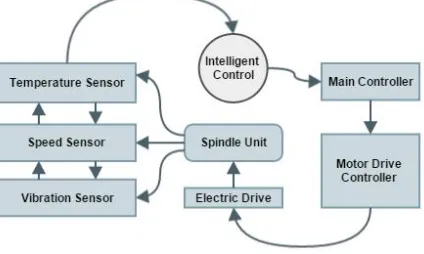
A system depicting vibration control for a spindle is shown in Fig.2 where the vibration profile is estimated from the sensory feedback on speed, displacement, thermal variations. When the system deviates from its operating domain a compensating control signal, regulating the electric drive is sent from the intelligent control unit.
III. SYSTEM MODELLING
The various components that are incorporated into the spindle system are given below, where in their co-ordinated activity may give rise to an expected smart and intelligent system that is highly energy efficient.
1. Sensor Fusion:
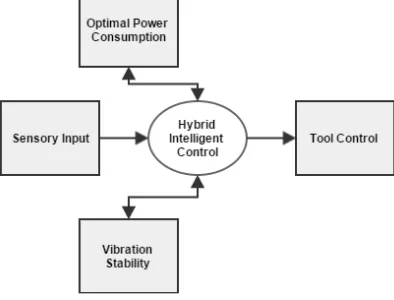
For measuring the vibration using the sensor, accurate and reliable readings are required. Placing the sensor at optimal position can enhance the signal. Also dependency of a single sensor to provide precise data all the time is unreliable. The disturbances in the signal as noise, harsh environment, bandwidth limitations demand the need for a smart approach towards sensing. Such a methodology can be evolved by using two or more sensors and fusing their measurements can improve the robustness of sensing and interpretation as by Fig.3. This synergistic approach towards sensor data is called sensor fusion and it has the advantages of improved signal to noise ratio, robustness and reliability in the event of sensor failure, extended parameter coverage, Integration of independent features, increased dimensionality of the measurement and reduced uncertainty.
Figure 3: Sensor Fusion for perception of physical signals
2. Adaptive Worktable:
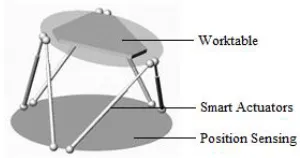
The inherent disorientation and prolonged exposure to vibration might have disturbed the tool position/orientation that affect the accuracy of machining. As repositioning of tool head is impractical, instead a movable worktable can be employed. The worktable is actuated by precise actuators aided by a position control system. In case of any abnormalities sensors gives a feedback equivalent to the rectification required, which is compensated by precise motion of worktable. This aids the overall machining process that not only improves the tool’s life but also improves production accuracy.
Figure 4: Adaptive Worktable with motion Control System
Fig.4 shows the worktable that holds the workpiece in the home position while machining, its motion and position can be preciselyachieved by smart piezo-electric actuators coupled with displacement sensors to have a closed loop control.
3. Smart Actuators:
such that the entire spindle drive is replaced with the new paradigm, they are incorporated only at specific entities based on their property of implication. Considering shape memory alloys they can be used along the fits and clearances that acts intelligently to maintain the structural integrity, Piezo-electric actuators for micro actuation of worktable, Magneto-Rheological fluids in dynamic bearings that vary their dampness according to the axial shift compensation.
4. Intelligent Speed Control
Reliability, adaptiveness and instant dynamic performance are typical requirements of an intelligent speed control. Extensive research has been carried out to facilitate the evolution of new generation intelligent drives. These research have shown substantiate advancements in system modelling and control algorithms where fuzzy and neural based hybrid algorithms are used. The speed control module and vibration monitoring module are designed to work alongside in facilitating a high-speed motorized spindle operation.
5. Temperature Cooling System
The intelligent thermal control module consist of several temperature sensors around the spindle and its carrier. The thermal behaviour of the machine is modelled and software algorithms can predict the thermal drift of the spindle at various spindle speeds and at various points in time. In case of instant cooling heat is driven away by alter the flow of fluid that flows around the spindle through heat conducting pipes.
6. Control Algorithm
The program to control the spindle using the feedback sensor inputs for stability energy efficiency are yet to be achieved. Aiming at the vibration control problem of high-speed motorized spindle, a reconfigurable vibration monitoring and control system is developed. The milling process can be monitored by placing various sensor over the spindle. Eddy current based displacement sensors to detect the axial/radial motion, thermocouples at critical structures are to measure thermal disturbances. These sensory elements make the entire machining process intelligent by perceiving the tool wear, cutting force, process accuracy etc., which are crucial for process feedback control. Primarily the unbalance factors during machining process are identified and vibration profile excited by these centrifugal forces are defined. The Knowledge base of the system evolves, initiallyit is static later on it learns the system behaviours and acts accordingly. It could process lots of raw data and perform tedious computation.It is the main controlling unit that performs all the complex computation. The systems must be highly sophisticated as it has lots of raw data to be processed and an ANN – Fuzzy based libraries are attached to its headers as it is an adaptive controller. It is also equipped with enough hardware to perform all the computation in real time.
Figure 2: Vibration Control in Spindle System
The spindle drive thus would be capable of monitoring its condition, detecting failure, diagnose problems, and react accordingly. Also the development of modular architectures with standardized modules as shown in fig.4 allows for seamless system integration.
Function Parameters Affecting Proposed Rectification Speed Motor Drive Speed Control ANFIS based PWM Controller
Inertial Rotation Regenerative Commutation
Vibration Conventional Ball Bearing in Spindles Fluid Dynamic Bearings
Axial Shifts Smart Fluid based Bearings
Harmonics in Supply AC/DC Harmonic Filter
Temperature Frictional and Electric Losses Intelligent thermal drive away system Thermal Inertia Fin flanges for heat sinking
Design Interference Fit between drive & chuck Reconfigurable Smart Materials
Table 1: Factors Affecting and Their Rectifications
IV. CONCLUSION
The intent in evolving a framework for an energy efficient spindle system was comprehended. The design mainly concentrates to aim highly in integrating all the cutting edge features to provide a smarter way to improve the energy efficiency of the spindle system. The controller is flexible in such a way that program can be modified according to our needs. The sensors placed at the critical points constantly helps to perceive the nonlinearity and stabilize itself by robust and optimal control paradigms. The availability of cheap sensors, computing power, networkingcapabilities and the familiarization of PC-based open-architecture controllers facilitates the rapid realization of these smart spindle systems.
REFERENCES
[1] Discenzo, F. M., Nickerson, W., Mitchell, C. E., and Keller, K. J., “Open Systems Architecture Enables Health Management for next Genern, System Monitoring and Maintenance”, www.osacbm.org
[2] K.Yamazaki, Y.Hanai, M.Mori and K. Tezuka, “Autonomously Proficient CNC Controller for High-Performance Machine Tools Based on an Open Architecture Concept”, Annals of the CIRP, 46-1, 1991.
[3] M.Kaever, N.Brouer, M.Rehse and M.Weck, “NC integrated process monitoring and control for intelligent autonomous manufacturing systems”, 29th CIRP International seminar on manufacturing system, Osaka, 1997.
[4] H.Schulz and T.Wurzb, "Balancing Requirements for Fast Rotating Tools and Spindle systems," Annals of the CIRP, Vol. 47 (1998), No.1, pp. 321-324.
[5] C.G. Shen, G.C. Wang and S.L. Wang, "Computation and Analysis of Unbalancing Responses of High Speed Machining Tool System, “Advanced Materials Research, Vol. 148-149, No.1, pp. 40-46, 2010.
[6] NI Jun, "A perspective review of CNC machine accuracy enhancement through real-time error compensation," J. China Mechanical Engineering, vol. 8, no. 1, pp. 29-33, 1997.
[7] Hong Yang, Jun Ni, "Dynamic modelling for machine tool thermal error compensation," J. Journal of Manufacturing Science and Engineering, vol. 125, pp. 245-254, 2003.
[8] Chi-Wei Lin, Jay F. Tu, Joe Kamman, “An integrated thermo-mechanical-dynamic model to characterize motorized machine tool spindles during very high speed rotation”, International Journal of Machine Tools and Manufacture, Volume 43, Issue 10, Pages 1035–1050, Aug 2003. [9] Moon Jong Duk, Kim Bong-Suk, Lee Soo-Hun,” Development of the Active Balancing Device for High-Speed Spindle System Using
Influence Coefficients” International Journal of Machine Tools and Manufacture, 46 (9): 978-987,2006.
[10] Atsushi Matsubara, Motoyuki Sugihara, Ahmed A.D.Sarhan., “ Research on spindle and machining process monitoring for intelligent machine tools”, International conference on Leading Edge manufacturing in 21st century, Nagoya-Japan. Oct, 2005.
[11] Jerard, R B. , Barry K. Fussell, Min Xu, Chad Schuyler, Donald Esterling, “Development of a Testbed for Research on Smart Machine Tools, ”, Proceedings of 2006 NSF DMII Grantees Conference, St. Louis, July 24-27, 2006.
[12] Xu, M., C.K. Schuyler, B.K. Fussell, R.B. Jerard, “Experimental Evaluation Of A Smart Machining System For Feedrate Selection And Tool Condition Monitoring,” Transactions of the North American Manufacturing Research Institution/SME Volume 34, NAMRC 34, Marquette University, 2006.
[13] Al-Shareef, K.J.H, Brandon, J.A., "On the Applicability of Modal and Response Representations in the Dynamic Analysis of Machine Tool Spindie Bearing Systems," Journal of Engineering Manufacture, Vol. 205,pp. 139-145, 1991.