Implementing Customizable Online Food Ordering System
Using Web Based Application
Varsha Chavan, Priya Jadhav, Snehal Korade and Priyanka Teli
Computer Department,Pune University
Indapur, Maharashtra,India
Abstract -
Typically in a restaurant food order
process involves several steps for ordering the
food where firstly customer starting from
browsing the paper based menu and then inform
to the waiter for ordering items. Usually the
process require that the customer has to be
seated before starting. An alternative method for
the customers is “Food Pre-Order System using
Web Based Application” in which customer can
be able to create the order before they approach
the restaurant. Customer using Smartphone.
When the customer approach to the restaurant,
the saved order can be confirmed by touching
the Smartphone. The list of selected pre-ordered
items shall be shown on the kitchen screen, and
when confirmed, order slip shall be printed for
further order processing. The solution provides
easy and convenient way to select pre-order
transaction form customers.
Keywords - Smart phone, Android application,
Wi-Fi, Android Mobile, Dynamic database.
I. INTRODUCTION
With the online food ordering method , food is
ordered online and delivered to the customer.
This is made possible through the use of
electronic payment system .The payment can be
done through the customer’s credit card ,debit
card. So, in this project we design a system
which will allow customers to go online and
place order for their food.
Due to the rapid growth in the use of internet
and the technologies associated with it, the
several opportunities are coming up on the web.
So many businesses and companies are now
undertaking into their business with comfort
because of the internet. One of the businesses
that the internet introduced is an online food
ordering system. In today’s life many restaurants
have focus on quick preparation and speedy
delivery of orders rather than offering a rich
dining experience. Recently, most of this
delivery orders were placed over the phone, but
there are many drawbacks of this system.
It is possible for everyone to order any goods
from anywhere via the internet and have the
goods delivered at his/her home. But while
trying to discuss the transfer method of the
goods and services, attention is focused on the
payment mode. In other words, how possible is it
to pay for goods and services via the internet?
This then leads to the discussion of the economic
consequences of digital cash. What are the
implementations from the view point of
economic? Since the world is fast becoming a
global village, the necessary tool for this process
is communication of which telecommunication
is a key player. A major breakthrough is the
wireless 2 telephone system which comes in
either fixed wireless telephone lines or the
Global System of Mobile communication
(GSM).
end is lightened. Once an order is placed on the
webpage that will be designed, it is placed into
the database and then retrieved, in pretty much
real-time, by a desktop application on the
restaurants end. Within this application, all items
in the order are displayed, along with their
corresponding options and delivery details, in a
concise and easy to read manner. This allows the
restaurant employees to quickly go through the
orders as they are placed and produce the
necessary items with minimal delay and
confusion. The greatest advantage of this system
is its FLEXIBILITY.
II. LITERATURE REVIEW
Existing Food Order Process
1)FULL SERVICE RESTAURANT: Tradition food order process used in most full-service restaurants starting when a waiter brought the guests the paper-based menu, and then waiting for the guests to choose items from the menu and inform the waiter the order items. The process typically required the guests to be seated in the restaurant and a waiter to assist the ordering .One of the most widely used food ordering system is the conventional paper based system. In this system all records are stored on paper. The main drawback of this system is papers can get easily lost or damaged. There is also wastage of money, time and paper. Paper-based systems do not provide any form of dynamicity. Even a small change requires the re-print of entire menu-card. Also large amount of human efforts are required, this system is not work properly because it has some error and from a customer’s point of view it is time consuming.
2)SELF SERVICE RESTAURANT: This process required the guests to place order at the service counter in the restaurant. The guests shall have decision in advance, before presented at the counter, of which menu items to order. Menu catalog is mostly presented as posters placing behind the order counter.
3)AUTOMATED FOOD ORDERING SYSTEM: In order to reduce service cost and enhance customer experiences, few restaurants have invested in the service automation system. The automation system used to capture the food order from guests ranged in many forms but mostly comprise of an electronic
device with a screen presenting the menu and accept user’s input for order placing First waiter takes the order from customer. After taking the order, waiter should enter that order in system where PC was set up. At the kitchen information was displayed on screen. The kitchen staff would then prepare the dishes according to order and after completion of order they would inform to waiter, who collected and delivered the dishes to the respective tables. The system was also informing the waiter about the availability of a dish. If a certain dish was not available then waiter was able to ask for changes or even cancel a customer’s order. After serving the order, bill was generated at the cash counter as per customer order. The management had full authority to access all details of the customer which are fed into the system.
With the improvement in the computer and communication technology, various systems were launched in market for the purpose of computerization of the food ordering system. Some of the existing systems are mentioned below:
PERSONAL DIGITAL ASISTANTS(PDA'S) BASED SYSTEM:
A number of wireless systems like WOS, i-menu, FIWOS were developed when new technologies and approaches being introduced to automate the food ordering process. All the above systems were PDA- based. The feature of PDA systems was that customers or waiters key in ordering process. Using wireless technology there was easy communication between the PDA’s and server. But PDA based system also had several drawbacks. PDA-based system increased the restaurants expenditures. PDA systems also did not provide any real time feedback from customers. Menu cards in the PDA’s were not attractive and uninformative as it did not support images.
MULTITOUCH TECHNOLOGY:
of conductive material. One more disadvantage of capacitive touch screen is it is expensive, offers less durability and short life. The drawbacks of resistive touch screen include its inability to support multi-touch gestures, its poor visibility in direct sunlight and its less durability. The technology can be susceptible to data-noise, it may be affected by large amounts of dirt and dust in the environment.
RELATED WORK
To overcome the limitations of above system, we propose customizable online food ordering system using web based application. It is a wireless food ordering system which is based on android devices. Android smart phones attract both the general and commercial users. Android devices have gained massive popularity and have innovated use of mobile technology in the automation of routine task in wireless environment. Android is a Linux based operating system for mobile devices such as smart-phones and tablets. Location Based services using Android OS Motivated by the use of Android mobile OS in Health and other applications, we present the use of Android Devices in Business applications, namely the food ordering system in restaurants. Considering the promising future of Android market, it is beneficial and worth to write applications for android that target mob of people.
The Objectives of our proposed system are:
To combine Wireless technology and Android OS to automate food ordering process.
To minimize the imperfection in conventional system by reducing the working of a restaurant.
To make provisions for obtaining feed-back from the customers and provide the restaurant a means of review of their service.
To automate food ordering system at Madhudeep Restaurant that can eliminate or minimize the current problems in conventional system.
To utilize wireless communication and smart phone technology in implementing the automated system.
To make more user interfaces friendly and customization for the restaurant owner to update the menu content on the customer devices.
To enable real-time feedback between the restaurant owner and customers on the order status.
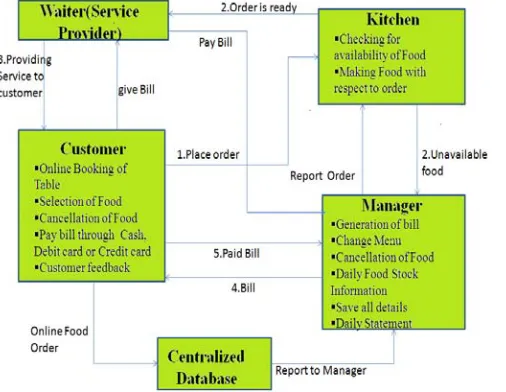
SYSTEM ARCHITETURE
The system architecture of customizable online food ordering system using web based
application is shown in figure 2. The architecture includes the three main areas of restaurant: the Server, the Kitchen, and the Cashier counter. Conceptually this system is built using following components:
The android application is used to make orders from tablet.
The restaurant-owner’s laptop/tablet will keep track of customer records and also customize menu using server application.
The central database is used for restaurant-owner to store updated menu information and order details.
Three main areas of restaurant are connected using wireless technology.
The Android application is used to find out the location in restaurant according to its latitude and longitude.
Fig 2: System Architecture
SYSTEM MODULES AND SYSTEM DESIGN
The restaurant owner or manager will have authority to log into the system and update the menu as per the availability of the dishes. The manager will also advertise the various offers of the day. Manager will dynamically add different catagories of food. After arrival of customer in restaurant, he or she select the information and menu from tablet then this orderis sent to the system over wireless network. The restaurant manager or owner and the kitchen staff will receive the ordered lists from the customer tablet or system. The restaurant owner can update the order status into the system. The customer can also view the order status and he has authority to cancel the order. The whole application will already be installed and kept open on the tablets on the tables. Customer who is outside the restaurant will book table in restaurant or he will give order from his smart phone. The turn-off or shutdown option of the application will remain disabled for the customers i.e. the customers can not be able to turn off theapplication and do any other work on the tablets. After having the food, customer can make paymentby online or by cash and enter feedback regarding to that restaurant system facility and services. Customer contact number will be saved in database for sending massage about next offers.
This project consists of 3 main modules as follows:
1) USER TABLET(module 1)
This type of the tablets are especially made for the normal users coming in the restaurant.
First customer has to be done registration after registration he/she will get password and user name then he/she can order process .Bill is automatically goes to that particular user
These tablets will consist of the whole menu of the restaurant. The items in the menu are non -editable for these types of the tablets.
During registration process customer has to be enter pin code .customer can give order from any city to any branch of restaurant using pin code.
They will be enabled with the Wi-Fi connectivity.
Customer from any layer of the society should be able to handle and operate all the functions easily.
2) MANAGER'S TABLET(module 2)
These desktops are especially for the use of the restaurant manager.
The manager should be able to control the function of whole restaurant from a single desktop/tablet.
He can access any tablet and should be able to make changes to the menu.
Also he can change price of particular item or disable particular item which is not available at that particular time.
3) KITCHEN DISPLAY(module 3)
These are present at the kitchennear chefso that he should be able to see what a particular has ordered.
All the ordered items are displayed on the screen giving the table number below.
They should be sufficiently large to be seen by chef at a reasonable distance.
Chef should be able to notify when a particular item is ready.
4) SMS INTEGRATION(module 4)
At the time of registration customer has to be enter the contact number & other information ,this contact number & other information will saved in database. If there is any offer in restaurant then server will automatically send SMS to the customer.
We are providing menu recommendation to the customer such as if customer order any menu then our system will shows related menus to that order.
6) CUSTOMER FEEDBACK-
We also provide facility to the customer to give feedback about services of restaurant.
7) REPORT GENERATION-
System generates Daily ,Weekly& Monthly report.
Fig 3:-Modules
B SYSTEM TECHNOLOGY
The technologies which are used to implement the system are:
1. Visual Studio 2010 for developing web application. 2. Android version 2.2 or more for Tablets is required.
We have used Android 4.2 Jellybean as the working platform to develop this application.
3. SQL 2008 is a light weight Database which is going to be used for database access from the tablet.
V. CONCLUSION
In this paper, we have presented a digital restaurants and inter-restaurant navigation using smart phones to customers. Instead of using PDAs to interface with customers, we are using smart phones or tablet to provide necessary interfaces for customer to view and order menu. With private login system, customers can view and make order and receive updates in real-time and collect receipts right from the smart phone itself. It allows customers to
navigate the places or directions in restaurant and also it allows restaurant owners to manage orders from customers immediately whenever he or she logged in into the system. Our experience in developing digital restaurants and inter-restaurant navigation using smart phones shows the capabilities of wireless communication and smart phone technology in fulfilling and improving business management and service delivery. This system is convenient, effective and easy so that it improves the performance of restaurant’s staff.
Acknowledgement
Working on this project under the guidance of Mr. Ram Anpat , Assistant Professor at S. B. Patil College of Engineering ,Indapur.
REFERENCES
[1].VarshaChavan,PriyaJadhav,SnehalKorade,PriyankaTel iProf.Mr.R.B.Anpat”Implementing Digital Restaurant and Inter-Restaurant Navigation Using Smart Phone”,inInternational Journal of Computer Science and Mobile Computing,Volume 4,Issue 2 February 2015.
[2]. Apurva Joshi, PrachiOke, NiranjanJadhav, AshutoshBhargave Prof. Mr. S. R Lahane, “Digital Ordering System for Restaurant using Android”, in International Journal of Scientific and Research Publications, Volume 3, Issue 4, April 2013.
[3].PriyankaThakare, ReshamShinde, SushimitaSarkar,“ Design and Implementation of Digital Dining In Restaurants Using Android”International Journal of Advance Research in Computer Science and Management Studies Volume 2, Issue 1, January 2014.
[4].M. Firdouse Ali Khan, Swapna, “Design and Implementation of Ordering System for Restaurants”, in International Journal of Engineering Research & Technology (IJERT), Vol. 1, Issue 10, December- 2012.
[5]. Wei Wing Chiew, Wen Jiun Yap, Soon Nyean Cheong, “Design and Development of Multi-Touchable E-Restaurant Management System”, in 2010 International Conference on Science and Social Research (CSSR 2010), December 5 - 7, 2010, Kuala Lumpur, Malaysia.
Journal of Computer Science and its Applications - Volume 2: Issue 1.
[7]. Ayob J., Mohd. HelmyA.Wahab, Khairunnisa K., M. IzwanAyob, M. AfifAyob, M. ErdiAyob, “The Application of Wireless Food Ordering System”, in MASAUM Journal of Computing, Volume 1 Issue 2, September 2009.
[8].Sun Guiling; Qingqing Song, "Design of the Restaurant Self-Service Ordering System Based on ZigBee Technology, “Wireless Communications Networking and Mobile Computing (WiCOM), 2010 6th International Conference on, vol., no., pp.1,4, 23-25 Sept. 2010.
[9]. M.H.A. N. Ahmad, A.A. Mutalib H.A. Kadir, Wahab and M.F.M. Mohsin, “Implementation of network-based smart order system,” International Symposium on
Information Technology 2008 (ITSim 2008), pp. 1-7,
2008.
[10].Hashim,NikMohdZarifie and Ali,Nur Alisa and Ja'afar,AbdShukur and Mohamad, NajmiahRadiah and Salahuddin, LizawatiandIshak, Noor Asryran (2013) Smart Ordering System via Bluetooth. International Journal of Computer Trends and Technology (IJCTT), 4 (7). pp. 2253-2256.
[11]. M. ErdiAyob, Ayob J., Mohd. Helmy A. Khairunnisa K., Wahab, M. IzwanAyob, M. AfifAyob “The
Application of Wireless Food Ordering System,” MASAUM Journal of Computing, Volume 1 Issue 2, September