Dec ember 2 0 1 6
Tracking the Maximum Power Point With Artificial
Neural Network
1.
E. ANJANEYULU,2.
B. RAMESH
1PG Scholar, Department Of EEE,Sri Sai Educational Society's Group of Institutions, Kodad.
2Assistant Professor, , Department Of EEE,Sri Sai Educational Society's Group of Institutions, Kodad.
A
BSTRACTSolar photovoltaic system characteristics depends on environmental factors, therefore a
maximum power point tracking MPPT
technique is needed to keep the working point of the system as close as possible to the MPP. In this paper we present a PV generator composed by four PV panel (60Watt) placed in series, and a neural network model developed by the authors. The aim of this study focuses on the application of the artificial neural networks to extract the maximum power point of a photovoltaic generator that feeds a motor- pump group unit through a PWM inverter installed in the laboratory. The output of the
ANN is the optimal voltage Vopt which is
compared to the PV generator voltage Vpv, then
passed through an integrator to extract the stator frequency fs that are given to the PWM control of the DC-AC inverter to find out the sinusoidal reference voltage and the sampled wave.
K
EYWORDS:
MPPT, Artificial Neural Network,PV system, MATLAB Simulink.
I.
I
NTRODUCTIONThe production of energy is a challenge of great importance for the coming years. Indeed, the energy needs of the people are rising. Furthermore, developing countries will need more energy to complete their development. Today, much of the world's energy is supplied from fossil sources.
unlimited and reduce emission of greenhouse gases. Renewable energies include a number of technology clusters by source of energy valued and useful energy obtained. The studied photovoltaic structure is composed by a photovoltaic generator, a DC / AC inverter and a motor-pump unit connected with a storage tank. By applying the technique of maximum power point tracking, the efficiency of the system rises whatever is the irradiation and the temperature of the environment. Several different MPPT techniques have been proposed in the literature [1-2], several papers tackle the problem concerning the search of the optimal operation point by using Hill-climbing algorithms [1-3-4-5], fuzzy logic or digital signal processing. The uses of neural network in the industrial electronics have been increased, and have a large perspective in intelligent control area that is evident by the publications in the literature. Considering the immense potentiality of neural networks in future, their applications in industrial electronics area are yet in the stage of infancy [6].
Dec ember 2 0 1 6
II.
PHOTOVOLTAIC MODULE MODELLINGPhotovoltaic conversion is produced by subjecting the solar cell to sunlight. The received energy causes chaotic movement of the electrons within the material, the current collection is done by the metal contacts (electrodes). If these electrodes are connected to an external circuit, a direct current flows.
In this PV generator, a number of solar cells are assembled to form a photovoltaic module, the link between these modules in parallel rise the direct current value and its link in series rise the direct voltage value. Thus, the group of linked PV modules according to desired values of both the current and the voltage forms the PV generator. The PV array characteristics presents three important points, the short circuit current, the open circuit voltage and the optimum power delivered by the PV
module to an optimum load when the PV modules operate at their maximum power point. Our model of PV module consisting 4 cells Kaneka GSA211 (60Watt) in series which has been evaluated using MATLAB environment.
The PV generator behaviour is equivalent to a current source shunted by a junction diode, if we neglect the physical phenomena of PV cell such as contact resistance, the current lost by photocell sides as well as the age of cells [7-8-9].
Fig ure 1. Electrical schema of PV module
The relationship between the output voltage Vpv and the load current Ipv can be expressed as:
Where;
Ec: solar illumination in W/m2
Ecref: the reference illumination (1000W/m2) T:
the ambient temperature in °C
Tref: the reference ambient temperature (25°C)
Tp : the surface temperature of the PV generator
(°C ou °K) Icc : the total short-circuit current for
the state reference in A
Kisc : the short-circuit -temperature current
coefficient (Kisc = 0.0017 A/°C) Is : the opposite
total current of the PV generator in A
(1)
n
i : the ideality factor of the PV fieldDec ember 2 0 1 6
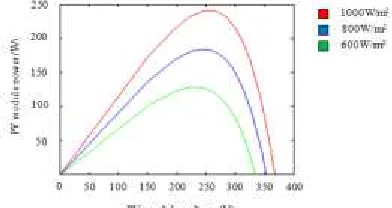
The output of the PV model characteristics I-V and P-V is shown first for different illuminations levels (600; 800; 1000 W/m2) at 30°C in figures 2 and 3, and then for various temperature (30; 35; 40 °C) for 1000 W/m2 in figures 4 and 5 respectively.
Fig ure 2. I-V plot of PV module Fig ure 3. P-V plot of PV module
Dec ember 2 0 1 6
The P-V plot is overlaid on the I-V plot of the PV module, as shown in Figure 2 and 3. It reveals that the amount of power produced by the PV module varies greatly depending on its operating conditions. It is important to operate the system at the MPP of PV module in order to exploit the maximum power from the module. The aim of a maximum power point tracking system is to force the PV generator to operate on points which are located on this curved trace. The operating point of a PV generator should be continuously adjusted in order to compensate the variation of load, temperature and irradiance level.
III.
A
RTIFICIALI
NTELLIGENCE ANDA
RTIFICIALN
EURALN
ETWORK3.1.
Artificial neural networks
Artificial neural network (ANN) technology has been successfully applied to solve very complex problems. Recently, its application in various fields is increasing rapidly [10-l1]. The science of artificial neural network is based on the neuron. In order to understand the structure of artificial network, the basic element of the neuron should be understood. A system with embedded computational intelligence is considered as an intelligent system that has learning, self-organizing and generalisation capability. In fact neural network is more genetic in nature that tends to emulate the biological NN directly. From twice decade, NN technology captivates the attention of a large number of scientific communities, since then, the technology has been advancing rapidly and its applications are expanding in different areas [12].
The operation of the artificial neurons is inspired by their natural counterparts. Each
artificial neuron has several inputs and one single output, the axon. Each input is characterized by a certain weight indicating the influence of the corresponding signal over the output neuron.
The neuron calculates an equivalent total input signal as the weighted sum of the individual input signals. The resulting quantity is then compared with a constant value named the threshold level and the output signal is calculated as a function of their difference, this function is named the activation function. The input weights, the threshold level and the activation function are the parameters which completely describe an artificial neuron.
Over the last few years, more sophisticated types of neurons and activation functions assembled in algorithms have been introduced in order to solve different sorts of practical problems. In particular, Quasi-Newton Levenberg Marquardt method has useful for many control system and system identification applications [13].
3.2.
Artificial neural network architecture
Dec ember 2 0 1 6
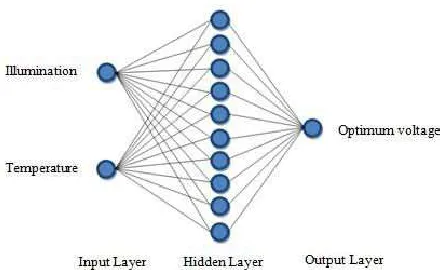
Fig u re 6. Architecture of Back Propagation Neural Network.
We can conclude unlimited neural network architecture, more several hidden layer and neuron in each layer are added; the more complex they become. The realization of the back propagation network is based on two main points: learning and knowledge. This research was applied by the use of sigmoid function as an activation function in order to calculate the hidden layer output and a linear function to calculate the output
[15]. The output for the sigmoid function varies continuously but not linearly as the input changes. Sigmoid units bear a greater resemblance to real neurons than do linear or threshold units, but all three must be considered rough approximations [16-17]. The result of the transfer function is usually the direct output of the processing element. An example of a sigmoid transfer function is shown in figure 7.
Fig u re 7. Sigmoid transfer function.
This sigmoid transfer function takes the value from the summation function, and turns it into a value between zero and one, mathematically it is given by:
Dec ember 2 0 1 6
(3)
Learning networks multilayer fear be made by different learning algorithms, the best known is the backpropagation which become so popular that appears as a synonym of neural networks. We present the method of obtaining the gradient, which is based on the calculation of successive partial derivatives of composite functions [19].
The cost function used is the squared error:
(4)
i is the index of the output neurons, is the measured output of the output neurons and is the desired output of the output neurons.
The weights of the network are modified according to the following rule:
(5)
And
(6)
is a positive constant called the gradient step. The calculation of the quantity is starting from the output layer and shifting to the input layer. The spread in the opposite direction of the NN activation of the neuron of the network, justifies the name of the algorithm. The calculation in made as follows:
By placing,
We obtain:
And
(7)
(8)
(9)
(10)
Then (11)
is called contribution to the error of neuron , where is the index of an output neuron, we obtain:
(12)
(13)
Then (14)
Dec ember 2 0 1 6
is the index of all neurons in which the neuron sends connexion. The calculation results are:
Then
(15)
(16)
(17)
The neural network used here has two input layers (illumination and temperature), hidden layer with 10 neurons. The hidden layer contains tan-sigmoid functions and the output layer (the optimal voltage) contains a linear function. This neural network will be trained by a back propagation method and the Levenberg Marquardt algorithm.
The LM algorithm is the second order method which implements an iterative approximation of the hessian matrix (or its inverse) and which consists in modifying the weights by the following formula:
(18) (19) H: the hessian matrix with general term
The LM algorithm is equivalent to the application of the simple gradient rule with a step of 1/�i.
(20)
The LM algorithm shows a faster convergence and a better accuracy than other algorithms. Although the LM algorithms needs an important memory space in training stage, this method is preferred to be utilised.
3.3.
Artificial neural network training
Artificial neural network have memory, which corresponds to the weights in the neurons. The weights and biases of the network are adjusted by the learning rate in order to move the network output closer to the targets. The 'newff' function allows a user to specify the number of layers, the number of neurons in the hidden layer and the activation function used as described below. After training, the network weights are set by the back-propagation learning rule. The number of epochs for this example is set to 100 and the learning rate is 0.02. During training, the input vector will be passed through the neural network and the weights will be adjusted 100 times. The learning rate of the network is also set [22-23].
The following Matlab code creates a feed forward network:
net = newff(pr,tr,[10,1],{'tansig','purelin'},'trainlm','learngdm','msereg'); net.trainparam.epoch=100;
Dec ember 2 0 1 6
Nonlinear I-V characteristics of a PV module match very well to a neural network application. The block diagram of the proposed MPPT scheme is shown in the figure 8. In this scheme ANN is used to find out optimal voltage which is compared with the PV generator voltage.
The error is given to the integrator controller. The output of the integrator controller is the stator frequency fs that are given to the PWM control of the DC-AC inverter to find out the sinusoidal reference voltage and the sampled wave.
4.2.
Simulationresults
Fig ure 8. Proposed MPPT scheme.
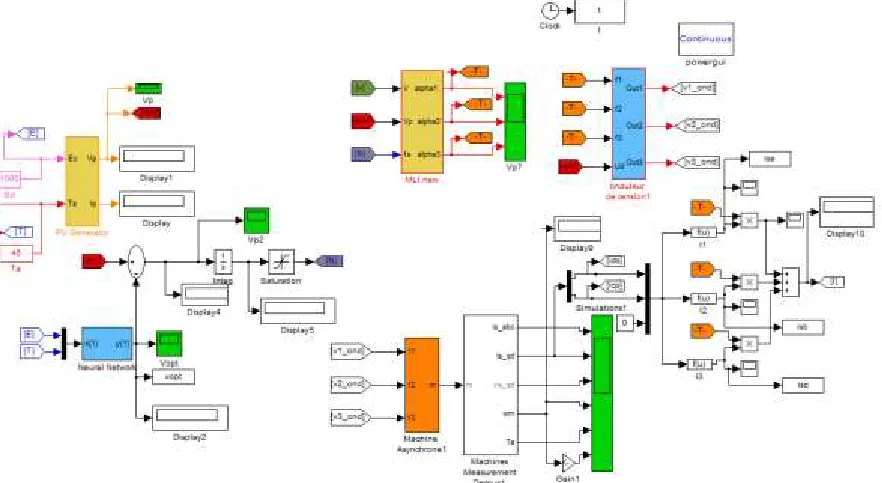
In order to simulate the system, the PV model described above implemented in Matlab Simulink [24] is submitted under real conditions of irradiation and temperature, and Neural network controller was defined and designed using neural network toolbox, as follow in figure 9, the training results of ANN are shown in figure 10, 11 and 12.
Fig ure 9. PV model and Neural Network scheme.
Dec ember 2 0 1 6
Fig u re 10. PV model performance plot
The performance plot is mapped between mean squared error and number of epochs that leads the train data to the best performance. The next figure presents the training state which determines the position of gradient, mu and the validation check at epoch 5 in which the network is completely trained.
Dec ember 2 0 1 6
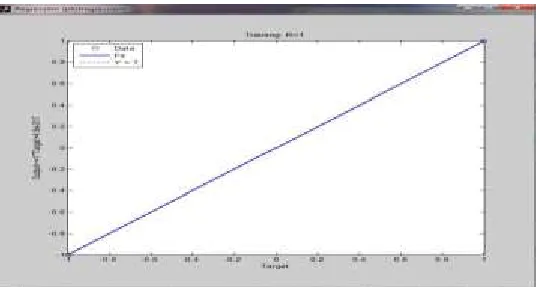
The figure 12 is the plot that tells the linear regression of targets relative to outputs. The linear line proves that the output data is exactly the same as the target data.
Dec ember 2 0 1 6
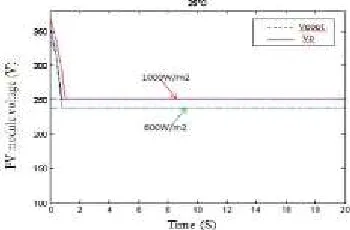
The figure 13 and 14 shows the simulation of the PV module voltage and the optimal voltage in different values of illumination and temperature.
V.
F
UTURE WORKThe proposed work is on-going project hence there are different path to explore it, as we will use the bond graph method for modelling and the artificial neural network for vector control of the motor- pump. We can use some other network to increase the system accuracy other than back-propagation network.
VI.
C
ONCLUSIONSDue to the importance of photovoltaic systems, this paper presents a study of maximum power point tracking using artificial neural network. To extract the optimal voltage of PV generator we have trained the network by a back propagation method and the Levenberg Marquardt algorithm. Simulation studies have been carried out to verify the proposed artificial neural network method. The obtained results show that the proposed approach could furnish a new interesting point of view in tracking the maximum power point of PV systems.
R
EFERENCES[1] C.Hua, J.Lin, C.Shen. (1998), "Implementation of DSP-Controlled PV system with peak power tracking", IEEE Trans, Ind, Electron, vol45(1), pp,11-24.
[2] Y. Chen, Smedley K. Vacher F. Brouwer J, (2003), "A New Maximum power Point Tracking Controller for PV Power Generation". In Proc, IEEE Applied Power Electron, Conf, Miami Beach, FL, USA, pp56-62.
[5] M.A.S. Masoum, H. Dehbonci, E.F Fuchs, "Theoretical and Experimental Analyses of PV Systems with Voltage and Current-Based Maximum Power Point Tracking", Accepted for publication in IEEE Trans, on Energy Conversion.
[6]. B. K. Bose, (2007), "Neural Network Applications in Power Electronics and Motor Drives—An Introduction and Perspective", IEEE Trans. On Industrial Electronics, vol. 54, no. 1, pp. 14-33.
[7]. D.Mezghani, (2009), "Study of a photovoltaic pumping by a bond graph approach", thesis prepared in the Laboratory Analysis and Control Systems (ACS) team modeling and control of photovoltaic systems in the Sciences university of Tunis.
[8].Y.Oueslati, (2007), "Study of performance of a photovoltaic generator coupled to the network draft" Master, High School of Sciences and Techniques of Tunis.
[9]. A. Elgharbi, (2010), "Ameliorated control of a motor-pump coupled to a photovoltaic generator". Sciences university of Tunis, masters memory, December.
[10] Bose B K, (2001), "ANN Application in Power electronics", IEEE, Ind, Electron conf, Denver CO, USA, pp1631-1638.
[11] S. Haykin, (1999), "Neural Networks_A Comprehensive Foundation", 2nd Edition, New York Prentice Hall Inc.
[12]. M.Hatti, (2007), "Neural Network Controller for P E M Fuel Cells", IEEE International Symposium on Industrial Electronics, pp. 341 – 346.
Dec ember 2 0 1 6
automatic of industrial and human systems, Valencia and Hainaut-Cambresis University. [18]
http://alp.developpez.com/tutoriels/intelligence-artificielle/reseau x-d e- neu ron es/#L V II.
[19]. Gauthier E. (1999), "Use of the artificial neural network for autonomous vehicle control", Phd thesis, National Polytechnic Institute of Grenoble.
[20]. M. Veerachary, T. Senjyu, and K. Uezato, (2003) "Neural-network-based maximum-power-point tracking of coupled-inductor interleavedboostconverter-supplied PV system using fuzzy controller", IEEE Trans. Ind.Electron., vol. 50, no. 4, pp. 749–758. [21]. E. Roman, R. Alonso, P. Ibanez, S. Elorduizapatarietxe, and D.Goitia, (2006) "Intelligent PV module for grid-connected PV systems", IEEE Trans.Ind. Electron., vol. 53, no. 4, pp. 1066–1073.
[22]
http://www.iau.dtu.dk/research/control/nnlib/manual.p df.
[23] http://fr.w3support.net/index.php.
[24] http://w w w .m athw o rks.com/pr oducts/matlab/ . A UTHOR’S PROFILE:
1.E.A NJANEYULU
PG Scholar, Department Of EEE. Gandhi Academy Of Technical Education, Ramapuram (kattakommu Gudem), Chilkur(M), Kodad, Telangana 508206.
2.B.RA M ESH