Modeling and Simulation of Different Types of
Converter in SRM for Reducing the Torque Ripple
Using PV as Source
MOHD.SAYEED AHMEDM-tech Student Scholar
Department of Electrical & Electronics Engineering, VIF College of Engineering & Technology, Himayat Nagar, Gandipet’X’Road,Moinabad (R.R Dist-500075); Telangana, India.
Email:[email protected]
BANOTH VEERANNA Assistant Professor
Department of Electrical & Electronics Engineering, VIF College of Engineering & Technology, Himayat Nagar, Gandipet’X’Road,Moinabad (R.R Dist-500075); Telangana, India.
Email:[email protected]
Abstract- Switched Reluctance Machines (SRMs) are receiving
significant attention from industries in the last decade. They are extremely inexpensive, reliable and weigh less than other machines of comparable power outputs. Although the design principles of the machine are available as a concatenation of many different sources, the need for a unified, step-by-step design procedure from first principles of electromagnetic is an absolute requirement. The advantage of SR motors are highly reliable, good performance and reduces the maintenance. The absence of windings in rotor and permanent magnets gives possibility to achieve very high speeds (above 10000 rpm) and turned SRM into perfect solution for operation in hard conditions like presence of vibrations or impact. Such simple mechanical structure greatly reduces its price. In present work detailed analysis, and modeling of six different type of converters used in with three phase switched reluctance motor (SRM). These converters are Asymmetric, Bifilar, Auxiliary, High Demagnetization dump, C-dump type. The simulation results are presented the proposed system is implemented to RES using Matlab/simulation software
Key words - SRM, Converters, R-dump, C-dump, Bifilar, Auxiliary, Asymmetric
I. INTRODUCTION
Switched reluctance motor (SRM) drive technology has remarkably developed in the past two decades. The interest over SRM is due to its advantages over the induction motor or permanent magnet synchronous motor. These advantages include lower price, boosted performance, equal or better reliability, comparable or better efficiency, lower volume and ease of production and storage in comparison to AC and DC motor drives [1-3]. SRM drive has the crucial problem of large torque ripples due to lack of continuity in the generated torque. But this can be mitigated to a great extent by phase current overlapping. Therefore, the converters used for SRM drive requires separate control for each phase so that the torque ripples can be reduced by phase current overlapping. Another reason for torque ripples is that the stator current falls behind the reference current during the commutation of each SRM phase current because of back EMF. This means that during commutation, the phase current reaches zero after the reference current which causes negative torque and more ripples in the torque produced by the motor. Thus, the converter used in the SRM drive must have the quick commutation ability of
phase currents, which will reduce torque ripples considerably.
This is more important at higher speeds where commutation interval is very short [4]. As shown in recent years, the increasing demand for energy has stimulated the development of alternative power sources such as photovoltaic (PV) modules, fuel cells, and wind turbines. The PV modules are particularly attractive as renewable sources due to their relative small size, noiseless operation, simple installation, and to the possibility of installing them closer to the user. In PV modules, the output voltage has a low dc amplitude value. In order to be connected to the SRM drive need extra power electronics technology, the PV modules output voltage should be boosted and converted into an ac voltage with high step up dc/dc converter with asymmetrical topology. This task can be performed using one or more conversion stages (multistage). Many topologies for PV systems are multi-stage.
However, the conversion stages decrease the efficiency and make the system more complex [4]. The transformer less centralized configuration with one-stage technology uses only one inverter and a large number of series connected PV modules, called strings, are used in order to generate sufficient voltage to support the load [5]. The life cycle of the solar cell is more than 20 years, and it can minimize maintenance and management expenses. The output power of the solar cell is easily changed by the surrounding conditions such as irradiation and temperature, and also its efficiency is low. Thus high efficiency is required for the power conditioning system (PCS), which transmits power from the PV array to the load. In general, a single-phase PV PCS consists of two conversion stages (i.e., dc/dc conversion stage and dc/ac conversion stage).
In this paper presents the electronic approach is based on optimizing the control parameters, which include the supply voltage, turn-on and turn-off angles, and current level. The minimization of torque ripple through electronic control may lead to a reduction in the average torque, since the motor capabilities are not being fully utilized at all power levels.
A main problem in certain application is the selection of converter topology. The SRM Converter has some essential requirements [6], they are:
Minimum one switch is capable to conduct freely in each phase of the motor.
The converter would be capable to excite the phase before it enters the generating or demagnetizing region. The converter needs to satisfy several other necessities in order to increase the converter performance; such as fast Demagnetization time, faster excitation time, high power, higher efficiency, and fault acceptance. They are [4], [7]-[9]:
The converter must be able to allow phase overlap control because the converter energy can be provided to one phase whereas at the same time it is removed from the other phase.
The phase voltage should be modulated using Pulse Width Modulation (PWM) technique at low speeds for the controlling of phase current.
On each operating point, to inject the sufficient current into the winding at high speed, necessary high driving voltage is essential. This necessary control system can be single pulse or hysteresis current control. Using this device; the demagnetization time can be reduced for avoiding negative torque and / or allowing an addition of commutation period (i.e.; dwell angle).
The demagnetization energy from the leaving phase must be provided back to the dc source or should use it in the incoming phase.
The hysteresis losses and switching losses can be reduced by the converter, because in order to decrease the switching frequency it is capable of freewheeling during the chopping period.
In order to decrease the voltage stress through the semiconductor switches, the converter takes to be single rail of power source.
Upon the construction of motor, the converter would have to be single rail of power source.
The resonant circuit is needed for the converter to apply zero-voltage or zero-current switching for reduction of switching loss.
Less number of semiconductor switches is suitable.
Power factor correction circuit should be applied for improve the power factor.
Little complexity of converter is required. Application and efficiency of this converter is defined by choosing the appropriate dwell angle, switching strategy, and control technique (usually hysteresis current control).
III. TYPES OF CONVERTER IN SRM The converter fed SRM is power-driven from fixed dc-link voltage, which is established by an ac/dc converter or directly by a Battery. The group of suitable converter and control scheme depends on the performance
and the necessities of application of SRM [4], [10]. The features of SRM operation must be shown before the converter types are to be used. Based on operation these features can be summarized by 3 tasks [6]:
In the Inductance profile, the current should be supplied into the phase only in the positive gradient period.
During the phase energizing of the motor phase, the torque must be maximized. By shaping the phase current by maximizing the amount of it at rise time period and then minimizing at fall time period by this it can be achieved.
During the commutation the stored magnetic energy must be returned to the dc supply.
Fig 1 Basic SR Motor Drive A. Dump Converter
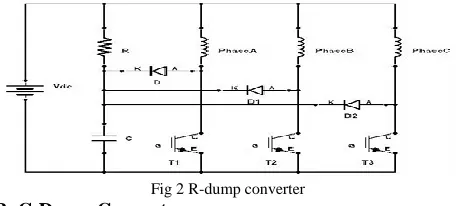
R-dump is one of the configurations which have one switch (lGBT) and one diode for every phase. The value of resistance R determines the switch voltage and also the power dissipation. To attain both realistic stress on the switch (higher resistance R increased), and suitable fall time of the current (lower resistance R increased) by changing the value of resistance R. While the T1 switch is
turned off, the current through diode D, charging capacitor C, and afterward flows through the external resistor R. This resistor moderately dissipates the energy stored in the magnetized phase [11], [12]. R-dump converter type is shown in Fig.2.
Fig 2 R-dump converter B. C-Dump Converter
Fig 3 C-dump converter
In C-Dump converter, imagine that Tl switch is turned on
to magnetize the phase A. While the phase current exceeds the reference value, Tl switch is turned off, this
allows the Dl diode to be forward biased and Fast
demagnetization is achieved by, increases the voltage across Dump Capacitor by closing the current path and then the excess voltage from the (dump) capacitor is given into the power supply [ 12].
C. Asymmetric Converter
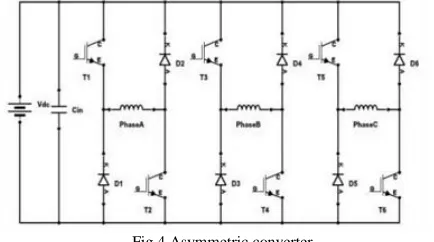
Asymmetric bridge converter is used for high switching voltage to have fast developed of the excitation current. Asymmetric bridge converter is shown in Fig.4. In each phase the converter consists of two power electronic switches and two diodes so that the unipolar switching strategy is achieved. In every phase, the lower switch is used in charge of commutation, while the PWM switching control can be performed by the upper one. Every phase can be controlled separately. Magnetization, demagnetization and freewheeling mode [4] are defined as the three current modes of operation. In the inner current control loop of the SRM drive, less current ripple and an improved frequency reaction can be obtained by using unipolar switching approach.
Fig 4 Asymmetric converter
SRM is generally controlled by either voltage or current control in the asymmetric converter. Phase current can be controlled accurately that means torque is accurately controlled and the decrease of torque ripple or noise is achieved. This is the main benefit of current control over voltage control the main demerit is it requires a larger heat sink for cooling because the one switch that is always in the current conduction path increases the losses in the converter so it reduces the efficiency of the system. From this paper, it is found that the asymmetric converter type
is suitable for very high speed operation of SRM drive because of the quick rise and fall times of current and moreover it give negligible shoot through faults. Because of the nonappearance of the resistance commutation circuit or any coil that is added to the converter, copper losses is not presented in the asymmetric converter. So, for high power SRM drives, Asymmetric converter is considered as the most suitable converter.
D. Bifilar and auxiliary type Converter
The Bifilar and Auxiliary type converter type dissipate some or all of the stored magnetic energy using external resistor, a phase resistor, or both. Then the remaining energy is transferred as mechanical energy [7].
Fig 5 Bifilar converter
So, nothing from the stored magnetic energy in the phase winding is returned to the power supply or DC link capacitor. Bifilar and Auxiliary type converter is shown in Fig.5 and Fig.6 respectively
Fig 6 Auxiliary converter
The benefit of this type of converter is its simplicity, used less number of semiconductor components, and low cost. E. High Demagnetization type Converter
In (High Demagnetization) resonant type converter for buck, boost, and resonant purposes, one or more external inductances are used [7]. Resonant type (High Demagnetization) converter is shown in Fig.7.
Snubber circuit consists of the diode, inductance, and power switches. It makes the dump voltage simple to control and also give low voltage for easy boost up. Resonant converter is constructed by inductor in special cases. Snubber circuit controls the voltage of the phase winding. The size and cost of the converter is increased by adding inductance, and the cost of converter is increased by adding some other components.
IV. PHOTOVOLTAIC SYSTEM
A Photovoltaic (PV) system directly converts solar energy into electrical energy. The basic device of a PV system is the PV cell. Cells may be grouped to form arrays. The voltage and current available at the terminals of a PV device may directly feed small loads such as lighting systems and DC motors or connect to a grid by using proper energy conversion devices this photovoltaic system consists of three main parts which are PV module, balance of system and load. The major balance of system components in this systems are charger, battery and inverter.
Practical PV device.
A photovoltaic cell is basically a semiconductor diode whose p–n junction is exposed to light. Photovoltaic cells are made of several types of semiconductors using different manufacturing processes. The incidence of light on the cell generates charge carriers that originate an electric current if the cell is short circuited1
. Characteristics I-V curve of the PV cell.
The equivalent circuit of PV cell is shown in the fig.5. In the above figure the PV cell is represented by a current source in parallel with diode. Rs and Rp represent series and parallel resistance respectively. The output current and voltage form PV cell are represented by I and V. The I-Characteristics of PV cell are shown in fig.6. The net cell current I is composed of the light generated current IPV and the diode current ID
IV. MATLAB/SIMULATION RESULTS
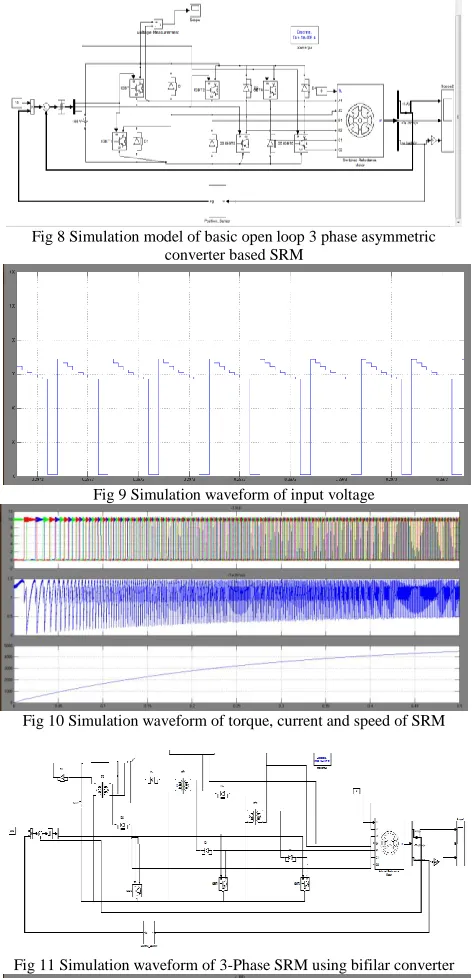
Fig 8 Simulation model of basic open loop 3 phase asymmetric converter based SRM
Fig 9 Simulation waveform of input voltage
Fig 10 Simulation waveform of torque, current and speed of SRM
Fig 11 Simulation waveform of 3-Phase SRM using bifilar converter
Fig 13 Simulation model of basic open loop 3 phase C-dump converter based SRM
Fig 14 Simulation waveform of C-dump converter characteristics
Fig 13 Simulation model of basic open loop 3 phase R-dump converter based SRM
Fig 14 Simulation waveform of R-dump converter characteristics
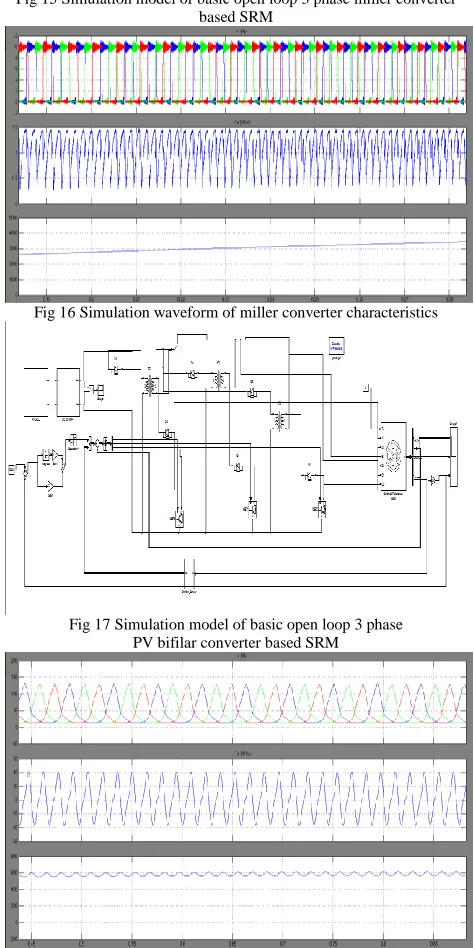
Fig 15 Simulation model of basic open loop 3 phase miller converter based SRM
Fig 16 Simulation waveform of miller converter characteristics
Fig 17 Simulation model of basic open loop 3 phase PV bifilar converter based SRM
V. CONCLUSION
Power electronics applications requiring high-voltage high-power converters have been steadily growing in fields such as interfacing drive control system, power quality, power systems control, adjustable speed drives, and uninterruptible power supplies (UPS), and co-generation. Most applications demand high voltage gain converters applications to SRM drive. Various converter topologies have been proposed in the literature, to improve performance, adapt to requirements and avoid proprietary technologies. This paper deals the with PV source fed SRM drive. Thus, improvements to the efficiency of the proposed converter have been achieved. The switching signal action is performed well by the floating switch during system operation; on the other hand, the residential energy is effectively eliminated during the non-operating condition, without extreme duty ratios and turns ratios, the proposed converter achieves high step-up voltage gain and supports the load condition, of up to 13 times the level of input voltage.
REFERENCES
[1] Samia M. Mahmud, Mohsen Z. EI-Sherif, "Studying Different Types of Power Converters Fed Switched Reluctance Motor," International Journal of Electronics and Electrical Engineering, vol. I, no. 4, pp. 281-290 December 2013.
[2] T. Wichert, “Design and construction modifications of switched reluctance machines,” Ph.D. Thesis, Warsaw University of Technology, 2008.
[3] Y Hasegawa, K. Nakamura and O. Ichinokura, "Development of a switched reluctance motor made of pretender,” in Proc. 2nd Int. Symp. On Advanced Magnetic Materials and Applications, Journal of Physics, 2011.
[4] M. T. Lamchich, Torque Control, InTech Publisher, February 10, 2011, ch. 8.
[5] R. D. Doncker, D. W. J. Pulle, and A. Veltman, Advanced Electrical Drives: Analysis, Modeling, Control, Springer Press, 2011, ch. 10.
[6] E. S. Elwakil and M. K. Darwish, "Critical review of converter topologies for switched reluctance motor drives," International Review of Electrical Engineering, vol. 2, no. I, January-February 2011.
[7] 1. W. Ahn, 1. Liang and D. H. Lee, "Classification and analysis of switched reluctance converters," Journal of Electrical Engineering & Technology, vol. 5, no. 4, pp. 571-579, 2010.
[8] Z. Grbo, S. Vukosavic and E. Levi, "A novel power inverter for switched reluctance motor drives," FACTA Universitatis (NIS), Elec. Eng., vol. 18, no. 3, pp. 453-465, December 2005.
[9] B. Singh, R. Saxena, Y. Pahariya, and A. R. Chouhan, "Converters performance evaluation of switched reluctance motor in simulink," International Journal of industrial Electronics and Control, vol. 3, no. 2, pp. 89-101, 2011.
[10] P. Vijayraghavan, "Design of switched reluctance motors and development of a universal controller for switched reluctance and permanent magnet brushless DC motor drives," Ph.D. dissertation, Faculty of the Virginia Polytechnic Institute and State University, Blacksburg, Virginia, November 200 I.