WESTLANDS DISTRICT NAIROBI COUNTY,
KENYA
KIARIE MAINGI BERNADETTE KAMENE
E55/CE/13461/2009
A THESIS SUBMITTED IN PARTIAL FULFILLMENT FOR
THE DEGREE OF MASTERS IN EDUCATION IN THE
SCHOOL OF EDUCATION OF KENYATTA UNIVERSITY
DECLARATION
This thesis is my original work and has not been presented for a degree in any other University or for any other award.
Signature _________________________ Date _____________________
Kiarie Maingi Bernadette Kamene E55/CE/13461/2009
Supervisors:
This thesis report has been submitted for review with our approval as University Supervisors.
1. Signature _________________________Date _____________________ Dr. Wilson Kerich
Senior Lecturer
Department of Educational Communication and Technology
2. Signature _________________________Date _____________________ Dr. Ndichu Gitau
Senior Lecturer
DEDICATION
ACKNOWLEDGEMENT
I am grateful to the Almighty God for giving me good health, a sound mind and the strength to undertake this study.
I wish to thank St. Theresa of the child Jesus for all the favours she granted me during the entire journey of the course work and writing of this thesis.
I would like to appreciate the efforts of my supervisors Dr. Wilson Kerich and Dr. Ndichu Gitau who offered me academic guidance at the numerous phases of my work.
I cannot forget to thank Dr. Samson Ondigi, my Research Methods lecturer whose help became invaluable each step of the way.
I am grateful to all the staff of the Educational Communication and Technology Department of Kenyatta University for their help thought out my studies.
I wish to thank my family who gave me peace to work at home; foregoing family time with me and checking on me in the study room late in the night to make sure I was just fine – special thanks go to Andrew.
I also wish to thank all the teachers and students who participated in this study for finding time to respond to the questionnaires and returning them on time.
TABLE OF CONTENTS
DECLARATION ... ii
DEDICATION ... iii
ACKNOWLEDGEMENT ... iv
LIST OF TABLES ... xi
LIST OF FIGURES ... xiii
ABBREVIATION AND ACRONYMS ... xiv
ABSTRACT ... xvi
CHAPTER ONE ... 1
INTRODUCTION ... 1
1.1 Background of the Study ... 1
1.2 Statement of the Problem... 5
1.3 Research Objectives... 7
1.4 Research Questions ... 7
1.5 Significance of the Study ... 8
1.6 Limitations of the study ... 11
1.7 The Scope of the Study ... 11
1.9 Theoretical Framework ... 13
1.10 Conceptual Framework ... 15
1.11 Operational Definition of Terms ... 18
CHAPTER TWO ... 20
LITERATURE REVIEW ... 20
2.1 Introduction... 20
2.2 Historical Background of Computers in Schools ... 20
2.3 Availability of Computers to Teachers and Learners of Business Studies in Schools ... 21
2.4 Utilization of Computers by teachers and learners of Business Studies in Schools ... 23
2.5 Business Studies teachers and Learners Attitudes towards the Use of Computers in Schools ... 25
2.6 The General Benefits of Using Computers in Teaching and Learning ... 26
2.7 Challenges Experienced in the Use of Computers in Teaching and Learning ... 27
2.8 A Review of Bates Theory ... 30
2.9 Summary of the Literature ... 31
METHODOLOGY ... 32
3.1 Introduction... 32
3.2 Research Design ... 32
3.3 Variables ... 33
3.4 Location of the Study... 34
3.5 Target Population... 35
3.6 Sampling Procedures and Sample Size... 35
3.6.1 Sampling Procedure ... 35
d) Sample Size ... 36
3.7 Instrumentation ... 37
3.7.1 Questionnaires ... 38
3.7.1 Interview schedule ... 39
3.8 Piloting ... 39
3.8.1 Reliability ... 40
3.8.2 Validity ... 42
3.9 Data Collection ... 42
3.9.1 Questionnaires ... 43
3.9.3 Documentary data ... 44
3.10 Data Analysis ... 44
3.11 Logistics and Ethical Considerations... 45
CHAPTER FOUR ... 46
REPORTING AND DISCUSSIONS OF THE FINDINGS ... 46
4.1 Introduction... 46
4.2 Biographical data ... 47
e) Availability and accessibility of computers to teachers and learners ... 50
4.4 Utilization of computers by teachers and learners in schools. ... 59
4.5 Teachers and learners attitudes towards the use of computers in schools. ... 68
4.5.1 Business Studies teachers‟ attitude on the use of computers in the classroom ... 68
4.5.2 Business Studies students‟ attitude on the use of computers in the classroom ... 73
4.6 The general benefits of using computers in teaching and learning. ... 75
4.7 The Challenges Experienced in the Use of Computers in Teaching and Learning. ... 77
4.7.2 Teacher preparedness in using computers to teach... 81
4.7.3 Other challenges facing the teachers and students in using computers ... 83
CHAPTER FIVE ... 87
SUMMARY, CONCLUSIONS AND RECOMMENDATIONS ... 87
5.1 Introduction... 87
5.2 Summary of the findings ... 87
5.2.1 Availability and accessibility of computers to teachers and learners of Business Studies ... 87
5.2.2 Utilization of computers in teaching and learning Business Studies ... 88
5.2.3 Business Studies teachers and learners attitude towards the use of computers ... 88
5.2.4 The challenges experienced in using computers to teach and learn ... 89
5.3 Implications of the findings ... 89
5.3.1 Availability and accessibility of computers to teachers and learners of Business Studies ... 89
5.3.3 Business Studies teachers and learners attitude towards the use of
computers. ... 91
5.3.4 The challenges experienced in the use of computers for teaching Business Studies ... 92
5.4 Conclusion ... 92
5.5 Recommendations... 93
5.6 Recommendation for Further Research ... 95
REFERENCES ... 96
APPENDIX I: INTERVIEW SCHEDULE FOR PRINCIPAL ... 102
APPENDIX III: QUESTIONNAIRE FOR BUSINESS STUDIES TEACHERS ... 103
LIST OF TABLES
Table 3.1 The Sampling Grid for Westlands District Schools ... 36
Table 4.1: Participating Teachers Teaching Experience ... 48
Table 4.2: How Head Teachers Get Computers for their Schools ... 52
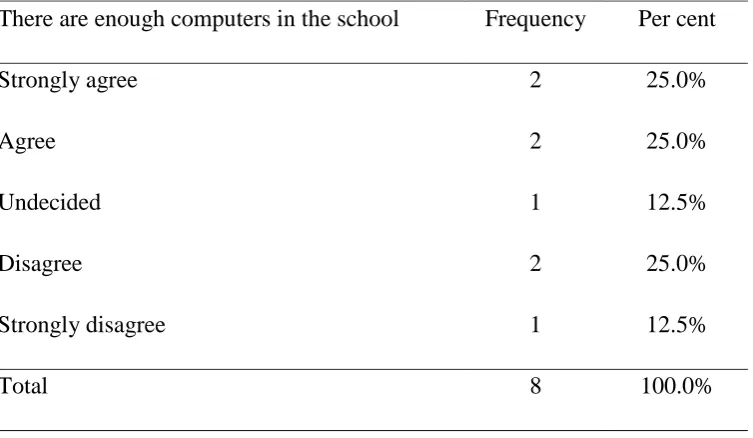
Table 4.3: Teachers‟ Opinion on Sufficiency of Computers in Schools ... 54
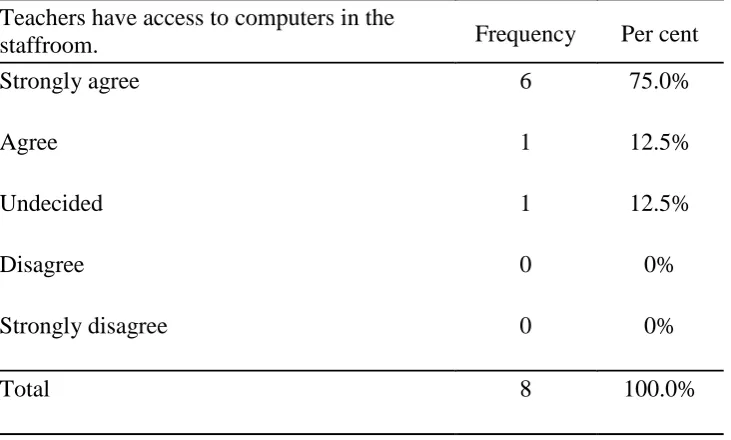
Table 4.4: Teachers Access to Computers ... 55
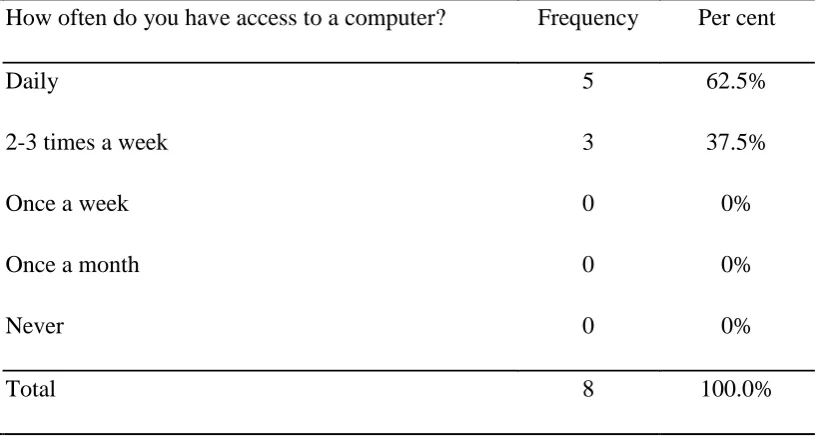
Table 4.5: Teachers‟ Frequency of Access to Computers ... 56
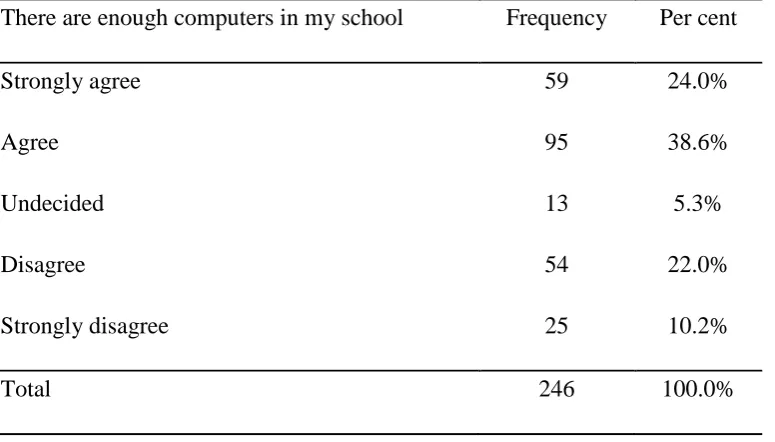
Table 4.6: Students‟ Opinion on Sufficiency of Computers in Schools ... 57
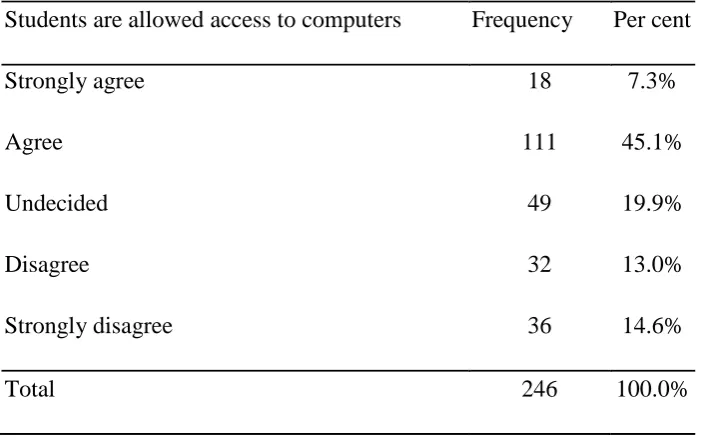
Table 4.7: Students‟ Opinion on Access to Computers ... 58
Table 4.8: Teachers‟ Response to Availability of a School Projector ... 60
Table 4.9: Availability of Computer Technician to Help Teachers Use Computers ... 61
Table 4.10: Students‟ Experience on Use of Computers in Business Studies .. 64
Table 4.11: Students‟ Communication over the Internet on Learning ... 66
Table 4.12: Students‟ Opinion on whether they are Encouraged to Use Computers ... 67
Table 4.13: Teachers‟ Opinion on Computers Advantage in Teaching ... 69
Table 4.14: Teachers‟ Opinion on whether Computers are a Distraction ... 70
Table 4.16: Teachers‟ Opinion on Class Time and Computers ... 72
Table 4.17: Students‟ Opinion on a Class with Computers ... 73
Table 4.18: Students‟ Opinion on the Best Topic with Computers ... 76
Table 4.19: Teachers rating their own Computer Literacy ... 78
Table 4.20: Teachers Rating their Students‟ Computer Literacy ... 79
Table 4.21: Students Rating their Computer Literacy ... 80
Table 4.22: Teachers‟ Reaction to their Preparedness to Use Computers ... 82
Table 4.23: School Heads‟ Main Challenge towards Use of Computers ... 83
Table 4.24: Teachers‟ Main Challenges towards the Use of Computers and Proposed Solutions ... 84
LIST OF FIGURES
Figure 1.1: The Conceptual Framework ... 15
Figure 4.1: Teachers‟ Response on Age ... 47
Figure 4.2: Students‟ Gender Summary ... 49
Figure 4.4: Number of Computers Available to Teachers and Students ... 50
Figure 4.5: Head Teachers Opinion on Sufficiency of Computers in Schools . 51 Figure 4.6: Head Teachers‟ Desired Computer Student Ratio ... 52
Figure 4.7: Head Teachers‟ Response on Use of Computers to Teach Business Figure 4.8: Business Studies Teachers‟ Response on Use of Computers to Studies ... 62
Teach... 63
Figure 4.9: Teachers‟ Response on Use of the Internet for Teaching Purpose. 65 Figure 4.10: Students‟ Opinion on Computers as a Distraction ... 74
Figure 4.11: Students‟ Opinion on Computers and Content Retention ... 75
ABBREVIATION AND ACRONYMS
The following abbreviations and acronyms were used in this study:
ACOT - Apple Classroom of Tomorrow
ASTUTE - Association of State Technology Using Teacher
Educators
CFSK - Computers for Schools Kenya
CRE - Christian Religious Education
DEO - District Education Officer
ICT - Information Communication Technology
IT - Information Technology
LCD - Liquid Crystal Display
KCSE - Kenya Certificate of Secondary Education
KICD - Kenya Institute of Curriculum Development
KNEC - Kenya National Examinations Council
NEPAD - New Partnership for Africa‟s Development
NGO - Non-Governmental Organization
PDE - Provincial Director of Education
UK - United Kingdom
ABSTRACT
CHAPTER ONE INTRODUCTION 1.1 Background of the Study
Computers‟ role in learning is simplification of reality, often with exaggerated
cause-effect linkages which can be very effective in a teaching context (Garson
1987). Reid & Rushton (1985) recognise that there is little room for scepticisms
over the growing importance of computers in education. Useful as teaching
resources are, they cannot replace the teacher (Twoli et al. 2007); and the
computer is one such resource. However, a lot depends on the availability and
utilization of computers in the classroom.
According to Shue (2009), computers were introduced in American schools in
1965 and were mostly used for administrative purpose. Molnar (1997) explained
that computers were not widely accepted in American schools during the 1950s
and 1960s because it was difficult and expensive to house the huge machines that
they were during that period of time. However, Apple II computers found
widespread acceptance in education around the year 1983 (Murdock & Desburg
1994). David (1991) in her report presented at the annual meeting of the American
Education Research Association described a research and development
collaboration among public schools, universities and research agencies that Apple
– the Computer Company – initiated in 1985 and sustained through 1995 with
outstanding results. It was named the Apple Classroom of Tomorrow (ACOT). Its
goal was to examine how the routine use of technology especially the
Virtually, no modern public or private school could exist in the United States of
America without a computer lab and computer instructions in the 90s (Murdock &
Desburg 1994).
The assumption that computer technology has become an essential part of the
basic school curriculum was summed up in the report of the United States
Department of Education (1996); the report referred to computers in the
classroom as “the „new basic‟ of American education,” and to the Internet as “the
blackboard of the future”. Murdock & Desberg (1994) says that in 1985,
California Legislature passed a senate bill that established a technology
component in the state‟s teaching credential requirements for California teachers.
Emphasis was on computer based technology; thus an organization called the
Association of State Technology Using Teacher Educators (ASTUTE) was
formed and became an instrumental force in helping improve the way teachers
were taught to use educational technology.
In Britain, computers were used in many schools around the year 1984 (Hermes
2008). Candau, Hannafin, Doherty, Judge, Kuni and Yost (2003) wrote a manual
in Britain with the goal of helping teachers learn how to use the computer
technology to effectively create a learning environment that would provide
opportunities for students to interact with content in a meaningful way. According
to Candau et al (2003), preparing young people for the future goes beyond the
issue of getting them ready to work; they also need new skills as computer
A study done by Afshari, Bakar, Luan, Fool, & Samah, (2010) in Pakistan showed
that the Ministry of Education in Iran invested a great deal of funds to facilitate
the integration of Information Communication Technology (ICT) in schools. They
observed that school leaders and teachers in Iran were key factors in ICT
implementation in schools – because teachers make decisions on whether or not to
integrate resources in schools. Lara & Whitter (1996) explain that using computer
technology improves students‟ learning process. In Nigeria, Fakeye (2010) say
that beginning and experienced teachers can benefit from the role that computers
play; beginning teachers can access a wealth of teaching resources while old teachers can share their knowledge with those who seek it. He also outlines the fact that the Nigerian federal government conducted a pilot project of integrating
computers in sixty secondary schools and colleges with reasonable success
although access to computer resources was the biggest barrier in both rural and
urban areas.
teaching technology. He suggested that teachers' and administrators' perceptions and experiences play a significant role in the use of computers in Kenyan classrooms and hence the need to provide pre-service and in-service training programs to enable them to successfully teach using computers in the classrooms.
Ivers (2003) confirmed that beginning and experienced teachers can benefit from the role that computers play in teaching and learning; beginning teachers can access a wealth of teaching resources and learning opportunities via the internet as well as collaborate online with other teachers. Experienced teachers have these same benefits, as well as the opportunity to share their expertise with others. Ivers (2003) further confirms the situation in Kenya; that many veteran teachers have had to learn how to use computers on their own.
While the use of Computer Based Instructions is prolific in most developed world schools, it is still a dilemma that poses great challenges to the majority of Kenyan teachers with regards to their perception and the roles they should play as they cope with this emergent technology. (Tanui, Kiboss, Wabala & Nassiuma 2008). According to Smerdon et al. (2000) advances in modern computer technology
have changed the way we do many things including the way we learn, study and
communicate. What goes on in the classroom today is impacted upon by the
computer technology and will likely affect the skills that today‟s children learn in
schools and the way they are taught to function in the world (Kashorda, Waema,
Omosa, & Kyalo 2007).
Computers have been used at the university level in Kenya to teach Business
Studies related courses such as Commerce, Entrepreneurship, Banking and others.
However, at the secondary school level it is not very clear whether Business
Studies teachers use computers where they are available to them. It is clear though
that some teachers of Business Studies may be using computers even if it is only
for the preparation of examinations and or for social purposes. This research
therefore endeavoured to establish whether computers were available at the
secondary school level and if so verify whether they were used by Business
Studies teachers and their learners for teaching and learning purposes.
1.2 Statement of the Problem
their learning environment and increasing learning resources. Availability of computers to Business Studies teachers is the first stage in the successful adoption of computers in teaching the subject in secondary schools. This is because teachers can only be competent and interested users of computers as teaching tools if they are available and easily accessible. Teachers will not adopt computer technologies into their instructional tasks if computers are not available in the first place.
There are many challenges that hinder the process of using computers in the classroom. However, when effectively used, computers have a dramatic effect on teachers and learners as concluded by Reid & Rushton (1985). But, where computers are not used effectively, they do not add value to teaching and learning.
1.3 Research Objectives
The objectives of this research were to:
(i) Investigate the availability and accessibility of general purpose computers to teachers and learners of Business Studies
(ii) Ascertain the ways in which teachers and learners use computers for teaching and learning purposes in Business Studies.
(iii) Establish the attitude of teachers and learners towards the use of computers in teaching and learning of Business Studies.
(iv) Explore the main benefits of using computers in teaching and learning of Business Studies.
(v) Investigate the challenges that teachers and learners experience when using computers for teaching and learning of Business Studies.
1.4 Research Questions
This research sought to answer the following research questions:
(i) How available and accessible are computers to the teachers and learners of Business Studies?
(ii) For what purposes if any do Business Studies teachers and learners in Westlands district schools use computers in their teaching and learning?
(iv) What are the main benefits of using computers in teaching and learning of Business Studies?
(v) What challenges are experienced by teachers and learners of Business Studies in their bid to use computers for teaching and learning in Westlands district secondary schools?
1.5 Significance of the Study
As Carrington & Robinson (2010) put it; in both the developed and developing nations, an increasing number of children and young people walking through the school gates each morning are required to leave behind an entire suite of competencies, practices and knowledge about digital technologies. This research could be the genesis of freeing these children and young people in our classrooms by giving them the wings of technology through their teachers‟ positive attitudes towards the use of computers in teaching and learning. Knowledge heresies are possible to eliminate if teachers can easily access computer technologies. Educational heresies have been carried over for too long according to Carrington & Robinson (2010). This situation is besides the fact that the same young people are later on in the job market expected to relate to computer applications as if they have done so all their lives – majority of the times without induction.
educators and the teachers-to-be will seek to use computers where they are available.
This study sought to help Business Studies teachers to realise the instructional possibilities afforded by computer technology. Urs (1989) noted that teachers can learn to value past teaching experiences while identifying and maintaining the exploration of the new technologies such as the computer. This study can therefore help Business Studies teachers in removing any bias they may have harboured in relation to computer technology. Once the bias is removed these teachers will be drawn to use the computer technology and explore its pedagogical possibilities.
Business Studies learners may end up enjoying a more learner centred instructional process due to the effects of studies such as this one. This is because such studies may have a positive impact that could eventually change availability and use of computers in the classroom for the better. Teachers will realise that preparing our young people for the future goes far beyond the issue of getting them ready to work theoretically but they need the practise that comes with the exposure provided by the computer technology.
processing can be used to prepare class notes; Desktop Publishing and PowerPoint packages can be used to prepare interesting and colourful learning materials such as book covers, short notes and charts that would otherwise not be possible in a Business Studies class or any other classroom.
The Republic of Kenya (2007) in its Kenya Vision 2030, states that Kenya aims to be a regional centre of research and development in new technologies. Majority of new technologies will now have something to do with computers even if the computer‟s only use would be to analyse data. This study can help the government in achieving this goal which can only be done if computer technology is integrated into the school system at an early and prime time such as in the secondary school phase. This study can also help the government achieve another objective stated in Kenya Vision 2030; that Kenya intends to have international ranking for her children‟s achievement in science and technology by the year 2030. The study can help the government and its relevant agencies like the Ministry of Education to justify the need to devote more resources in the national budget to computers and other related technologies such as smart boards in the classrooms because these are included in science and technology. This would then definitely improve availability and use of computers for all teachers including those teaching Business Studies.
could be beneficial to researchers, Business Studies teachers and teacher training institutions and in the long run to the education policy makers in Kenya.
1.6 Limitations of the study
(i) Being an outsider in the institutions that were under investigation may have limited what was revealed to the researcher in the research instruments that were used.
(ii)School culture and leadership practices in the schools sampled may have interfered with the data that the researcher collected in the long-run.
(iii)Within the sample investigated, the different institutions presented spontaneously different educational circumstances that may have contributed to the outcome of the study.
(iv)Since this study was descriptive in nature, its findings were an indication of possible trends and not an ultimate judgement on the entire school structure in the Kenyan nation.
The world over, everybody is expected to know something about computers. In this context some of the respondents to the research instruments may have deliberately concealed their ignorance on the topic under investigation. However, the researcher put measures in place to counter this during data collection. For example the questionnaires had control questions.
1.7 The Scope of the Study
the north-east is Kasarani district while to the South-east is the Central Business district. Westlands district had twenty three (23) secondary schools at the time of this research. Ten (10) schools were public schools and thirteen (13) were private at the time of the study.
b) Westlands district is located in the capital city of Kenya. In the capital city, technological advancement is not the same as in the rural areas because schools in the Capital are more easily exposed to computers. The study results can therefore not be generalised to all the schools in Kenya or in any other nation for that matter.
c) This study was carried out in Westlands district secondary schools only and cannot be a reflection of what happens in the primary or tertiary levels within the same education system as there could be differences.
1.8 Assumptions
The following assumptions were made during this research:
(i) That the administrators, teachers and learners attitudes play a role in the way in which computers are used in schools.
(ii)That majority of Business Studies teachers and students had used computers and or other digital devices such as mobile phones before, either within or outside the school environment.
1.9 Theoretical Framework
According to Bates (1995), major changes are needed in the education system in order to meet the need for a higher skilled workforce, and for lifelong learning in an increasingly complex society. Bates says that those countries that harness the power of telecommunications and computing to the education and training needs will be economic leaders of the 21st century. This research adopted Bates ACTIONS model as outlined below:
Access: How accessible is a particular technology for learners? How flexible is it for the particular target group?
Costs: What is the cost structure of the technology? What is the unit cost per student?
Teaching functions: What are the best teaching applications for this technology?
Interactivity and user friendliness: How easy is it to use? What kind of interaction does it provide?
Organizational issues: What changes in organizations need to be made? What barriers need to be removed for the success of this technology?
Novelty: How new is this technology?
Speed: How quickly can courses be mounted in this technology? How quickly can materials be changed?
Independent variables
Teaching strategies
Learner-centred (Heuristic strategies)
Interactivity and user friendliness
Teacher-centred (Expository strategies) 1.10 Conceptual Framework
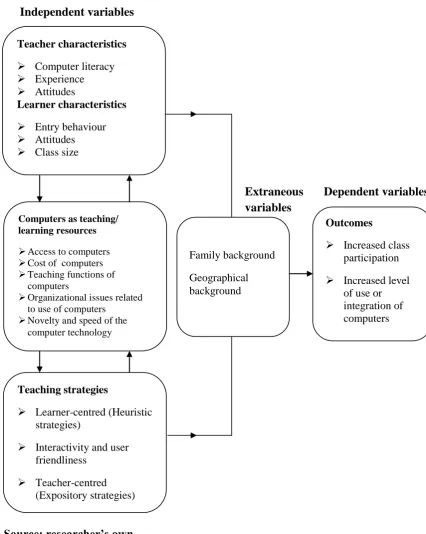
By using Bates ACTIONS theory the researcher has developed a conceptual framework as illustrated in figure 1 below to guide this study.
Source: researcher’s own
Figure 1.1: The Conceptual Framework
Extraneous variables
Teacher characteristics
Computer literacy
Experience
Attitudes
Learner characteristics
Entry behaviour
Attitudes
Class size
Outcomes
Increased class participation
Increased level of use or integration of computers
Dependent variables Computers as teaching/
learning resources Access to computers Cost of computers Teaching functions of
computers
Organizational issues related to use of computers
Novelty and speed of the computer technology
Family background
This conceptual framework has identified the independent variables as; teacher and learner characteristics, the computer as a teaching and learning resource and teaching strategies. These independent variables influenced by the extraneous variables of geographical and family background brings about the expected outcome of this study which are increased class participation and an increased level of use or integration of computers in teaching and learning.
There is some evidence that students respond enthusiastically to the use of novel technologies in teaching (Osondo et al., 2010). Bates (1995) discredits any novelty in print materials in favour of the computer technology novelty that attracts learners but also realises that computer instructional design in the different areas of education remain critical for educational success. This newness of the computer technology may result in an improvement in student satisfaction and learning outcomes (Reid & Rushton 1985).
that what gets learned from such a multifaceted innovation (the computer) is not easy to evaluate, all these authors had one thing in common; the belief that when teachers attitude is positive towards the use of computers, the learners would inevitably benefit so long as their entry behaviour was catered for.
Bates (1995) theory has the cost structure where he admits that computer technology is difficult to put a price tag on because its capabilities keep improving yet the costs seem to be going down. The costs of computer hardware have been going down steadily although this is not matched by the software costs that are still high in our set up. The developed world has also increasingly donated computer hardware to Kenyan schools through the Computers for Schools Kenya (CFSK) – a non-governmental organization formally registered in October 2002. In the years CFSK has been in existence, it has sourced over 40,000 personal computers some of which have been deployed in public secondary and primary schools at minimal costs. Business Studies teachers and learners are some of the beneficiaries of these computers and their use of the technology could change the way Business Studies is taught and learned.
In order for computers to play a positive and effective role in teaching and learning of Business Studies there are many organizational changes that would need to be integrated in our educational policies. These may include in-servicing teachers, ensuring that teacher training institutions are integrating the use of computers in the subjects taught and providing computer laboratories to both teachers and their students indiscriminately.
1.11 Operational Definition of Terms
Attitude: Is that which influences an individual‟s choice of action and response to a stimuli.
Business Studies: A subject offered under the 8-4-4 Kenyan education system and covers commerce, accounting, economics, entrepreneurship and office management.
Computer: An electronic device that accepts user input referred to as data, processes it under specials instructions called programs in order to produce a desired output called information.
Computer applications: The software or sets of instructions that direct a computer user on the tasks to perform and how to perform them.
Computer hardware: The physical computer components that one can see and touch. Such equipment includes; the system unit, input devices, storage devices and output devices.
Computer technology: The computer devices which are used in the communication of ideas between persons and groups in various teaching and training situations.
Cooperative learning strategies: A plan of action in gaining of knowledge and skills that is characterised by willingness of the learner and teacher to comply in the learning processes.
General purpose computers: Computers that are designed to be able to perform a variety of tasks when loaded with the appropriate programs.
Microcomputer: A small, relatively cheap computer that is commonly used in schools, training and learning institutions, small business enterprises and communication centres among others.
Information and Communication Technologies: diverse set of technological tools and resources used to communicate and to create, disseminate, store, and manage information. Examples are computers, the Internet, broadcasting technologies (radio and television), and telephony.
Multimedia: The ability of a computer to process and output text, sound, video and pictures.
Personal computer: A computer that is mostly used by one person because it has one microprocessor. It is also called a microcomputer.
CHAPTER TWO LITERATURE REVIEW 2.1 Introduction
This chapter examines the literature under the following headings:
a) Historical background of computers in schools.
b) Availability and accessibility of computers to teachers and learners of Business Studies in schools.
c) Utilization of computers by teachers and learners of Business Studies in schools.
d) Business Studies teachers and learners attitudes towards the use of computers in schools.
e) The general benefits of using computers in teaching and learning.
f) The challenges experienced in the use of computers in teaching and learning.
g) A review of Bates ACTIONS model/theory.
2.2 Historical Background of Computers in Schools
often used in the 1960s for computer-assisted instruction in American schools; Reid & Rushton (1985) observe that computer use was limited to developing computer literacy in secondary schools in computer labs usually by one teacher. They noted that most of the teachers didn't know how to use the computers and students didn't use them in other subjects. This research seeks to shed more light on the situation in Kenya in relation to Reid & Rushton‟s (1985) conclusions. Since the early 1980s, statistics show that computer usage in schools has grown remarkably Hermes (2008) and has been encouraged in all subjects indiscriminately.
Many Kenyan schools have computers that are used for various purposes. The researcher sought to find out whether these computers are accessible and utilized by teachers and learners for instructional purposes specifically in Business Studies. Although many computers have been donated by the private sector and Non-Governmental Organizations (NGOs), their availability to teachers and learners in Kenyan schools is worth investigating.
2.3 Availability of Computers to Teachers and Learners of Business Studies in Schools
experience. Although Crooks (1994) realises that what gets learned from such a multifaceted innovation (the computer) is not easy to evaluate, Candau et al (2003) agrees that access to computers can ignite students‟ thoughts and eventually move them towards a better learning experience. It was significant to verify in this study whether conclusions such as these hold in the Kenyan context. Accessibility of computers should enhance the easy use of computers as students and teachers alike consequently employ them more often.
Willoughby & Wood (2008) argue that the past several decades have produced rapid advances in computer technology and increased access to computers in both developed and developing nations. This is a likely situation in Kenya too although undeniably Kenya has been lagging behind the developed world. Global statistics show that schools around the world are becoming increasingly well equipped with computer hardware (Willoughby & Wood 2008).
2.4 Utilization of Computers by teachers and learners of Business Studies in Schools
The most basic educational administrators are the classroom teachers when it comes to the use of teaching resources. Bates (1995) notes that achieving quality in teaching and learning depends substantially on making learning resources such as the computer as accessible and interactive as possible. Bates (1995) also brought out the fact that the level of organisational support given to a technology is critical to its long-term success. Changes in administrative structures and procedures, improved technical support for staff and students, and additional staff development and training were supported by Crooks (1994).
al (2010) concluded that computers are underutilised even when they are available. It will also test availability of computers in Westlands secondary schools.
In their research, Murdock & Desberg (1994) found that around the year 1994 computers were being used in the United States of America for a wide range of activities in schools including drill and practice or tutorial instructions, promoting writing and language skills as well as using problem solving software or learning of programming languages. Initially there was fear and apprehension of the computer as disruptive in the developed world such as in the USA. The fears were thought to be responsible for the limited use of computers in the early years of implementation in most countries and subjects (Willoughby & Wood 2008). In this study, the researcher was interested in finding out whether similar fears exist in Kenya or whether that phase has passed. Computers are no longer a new phenomenon and their use is expected to increase because teachers and learners have been continuously exposed to their use either in the school or social setups. Exposure to computers could be the key to their use in our education system in general and in Business Studies in particular.
2.5 Business Studies teachers and Learners Attitudes towards the Use of Computers in Schools
Christensen (2002) clarifies that teachers are the main gatekeepers in allowing educational innovations to diffuse into their classrooms. Learners‟ belief in their teachers is very strong in the Kenyan culture. This therefore could mean that the way teachers perceive computers could make or break in terms of implementing their use by the government or any other body for that matter. Also, the success of any initiatives to implement technology in an educational program depends strongly upon the support and attitudes of the teachers involved as seen by Yuen, Law & Chan (1999). Osondo et al (2010) showed that positive attitudes toward computers are positively correlated with teachers‟ extent of experience with computer technology. With familiarity, anxieties and fears towards the use of computers in the classrooms tend to decrease, and confidence increases for both teachers and students. The saying that practice makes perfect holds in relation to the use of computers in schools.
2.6 The General Benefits of Using Computers in Teaching and Learning
Although it is generally recognised that the adoption of computers in education in the developed countries has progressed well in the acquisition of basic skills in different areas of study, according to the Ministry of Education‟s National Information and Communication Strategy for Education and Training (2006), the impact of ICT on the educational goals in Kenya is still inconclusive. Nevertheless, reported observations have been: rapid expansion of knowledge, improved examination outcomes, enhanced communication and technical efficiency as well as decentralization in the delivery of educational services. These are great benefits although not in relation to the direct subjects taught in the school system such as Business Studies. The ministry also realises the fact that computers have a more powerful role of increasing resources and improving the learning environment. This was echoed by researchers such as Ivers (2003), Reid & Rushton (1985) and Carrington &Robinson (2009). This benefit can only be meaningful where a teacher sees that the learning environment (for the learner) is being improved in the same measure as the teaching environment (for the teacher).
for example, using computers, students can easily do a project and compare data with students in far off areas through the internet.
Research also showed that students who used computers were more engaged and more independent in the classroom. Reid & Rushton (1985) puts it that, computers could provide instant feedback that provides the learner with the individual attention that drives him or her to great heights in terms of motivation.
Another benefit of using computers in the classrooms is that it prepares students for the outside world (Mann 2006). This is a conclusion worth investigating because, in order to get by in today‟s job market one must be proficient in the use of technology – specifically computers. At the turn of the 21st Century, sixty (60) per cent of jobs required skills in computer and network use. Educators must therefore prepare their students so that when they are done with school they will be marketable. The secondary school level would be the best level at which the use of computers must be insisted upon. As seen earlier in this research, secondary school is the structure within which the use of computers should be seriously implemented to take root and be carried into the tertiary level and eventually into the job market.
2.7 Challenges Experienced in the Use of Computers in Teaching and Learning
a uniquely challenging medium to integrate in teaching and learning because the technology changes at a rapid pace. This may inhibit its smooth acquisition and adoption as it may leave teachers in a fix as to whether this technology is worth chasing after. Educators constantly need to update their technological skills in order to use this technology effectively. This constant change can make teachers feel like perpetual novices (Willoughby & Wood 2008). Predictably then this feeling may bring about negative attitude towards the use of computers in the classroom.
Teachers also tend to view the use of computers as bringing about increased workload in terms of lesson preparation. There is also the possibility of feeling very frustrated when a lesson that took a long time to prepare cannot be delivered due to technical and logistical issues that come with the use of computers and its related technologies. This may discourage teachers from using the technology and thus revert to the old ways of teaching. The Government of Kenya through the Ministry of Education Science and Technology (2006) notes that teachers are a major barrier in the integration of ICTs and related technologies in education. There is need therefore to investigate the use of the computer technology in Kenyan secondary schools starting with Business Studies in this study. This is because computers are an important part of the integrated ICT infrastructure.
computers were more likely to be found in affluent, suburban schools. Poorer inner-city or rural schools usually had older models of computers.
Teachers throughout the UK around the year 2003 asked for help in integrating computer technology into the classroom (Candau et al. 2003). Similarly according to Willoughby & Wood (2008) many educators highlighted the need for support personnel and material resources to support their integration of computer technology in their teaching. In Kenya employment of support staff in relation to ICT implementation in schools is done privately by the heads of schools and not as a matter of policy from the government. This situation can be improved in order to increase access and lower the costs involved.
Willoughby & Wood (2008) maintain that the comfort level of the teachers when using computers in the classroom determines the level of use of computers. However, a higher comfort level can only be brought about by constant use of computers in the classrooms. Ivers (2003) also feels that teachers should take into account their own familiarity and comfort with the topic and methods through which they plan to teach using computers. Murdock & Desberg (1994) describes designing computer based lessons as a complex endeavour. These are observations that cannot be taken for granted by Business Studies teachers if they want to successfully use computers in teaching the subject.
of the challenges as highlighted by the Ministry of Education Science and Technology (2006).
(i) High levels of poverty that hindered access to computers and related facilities. (ii)Unavailability of ICT teachers.
(iii)High cost of hardware and software for educational institutions. (iv)Frequent power disruptions and limited access to electricity.
(v) Obsolete computers in schools due to the rapid changes in the computing technology.
(vi)Increased moral degradation as a result of the continued use of computers in schools.
The first and second challenges have been addressed over the last seven years and may not be as pronounced as they were in the year 2006. However, these challenges have been echoed by other researchers in relation to developing nations although the fourth one is unique to the Kenyan society.
2.8 A Review of Bates Theory
determine the availability and where available, the utilization of the computer technology in schools.
2.9 Summary of the Literature
CHAPTER THREE METHODOLOGY 3.1 Introduction
This chapter covers the following subtopics; research design, the target population, sampling procedure and sample size, instruments used for the study, piloting: reliability and validity, data collection procedures, data analysis, logistics and ethical considerations.
3.2 Research Design
This study used a descriptive survey approach due to its fact-finding nature. This approach enabled the researcher to obtain information relating to the availability and utilization of computers in teaching Business Studies from teachers and students as well as the school heads. According to Neuman (2006), a research design should address the arrangement of conditions for collection and analysis of data in a manner that aims to combine relevance to the research purpose with economy in procedure. Further Kothari (2010) recommends that the research design should be a conceptual structure within which research will be conducted.
help a researcher to find out how people (in this case teachers and students) feel or what they think about a particular subject; in this case the availability and use of computers for teaching and learning Business Studies.
3.3 Variables
In this study the independent variables were teacher and learner characteristics, the computer as a teaching and learning resource and teaching strategy used. Teachers‟ characteristics as an independent variable took into account computer literacy, teaching experience and attitudes towards computers and related technologies in teaching Business Studies. Learner characteristics were incorporated in terms of entry behaviour, attitudes towards computers in Business Studies and class size. The computer as a teaching and learning resource was an independent variable keeping in mind Bates ACTIONS theory in terms of access to computers, cost of computers, teaching functions of computers, organizational issues related to the use of computers, novelty of computers and speed of the technology. The final independent variable, teaching strategy was looked into in terms of the heuristic and expository teaching strategies.
3.4 Location of the Study
The study was conducted in Westlands district Nairobi County, Kenya. Westlands district is one of the seven districts in Nairobi County. This district borders Kiambu County to the North. To the south it borders Dagoretti district and to the north-east is Kasarani district. To the South-east is the Central Business district. The district under study had twenty three (23) secondary schools ten (10) of which are public schools and thirteen (13) are private schools. There are two major roads that pass through the district. These are Waiyaki Way which is the main road from the western parts of Kenya into the Nairobi city and Limuru Road that comes into the city from Kiambu County. There are four main business areas within the district namely, Westlands, Lavington Green, Kangemi market and Village Market. The district administrative offices are in Westlands business area.
The researcher opted for the location due to the reasons outlined below:
(i) No study of this kind had been carried out in Westlands District before.
(ii)There was expectation that Westlands district had in general terms incorporated the use of computers in schools and in businesses. The teaching technology under investigation – computers – was likely to be available in the district.
(iii)Westlands is becoming an increasingly important district as an education and business centre.
3.5 Target Population
The target population was obtained as secondary data from Westlands D.E.O‟s office authorised by the County Director of Education in Nairobi. This study targeted twenty three (23) secondary schools in Westlands district Nairobi County. Ten (10) of the schools were public while thirteen (13) were private. There were eleven (11) girls‟ schools, seven (7) mixed schools and five (5) boys‟ schools. The study targeted all the twenty three (23) school head teachers, thirty two (32) Business Studies teachers and one thousand five hundred (1500) Form three students. The total target population was therefore one thousand five hundred and fifty five (1555).
3.6 Sampling Procedures and Sample Size
Use of sampling procedures was necessary in order to get a sample population that would represent the rest.
3.6.1 Sampling Procedure
sampling technique was used to select the students who would take part in this study. Thus a combination of sampling techniques was used to make the sample population as inclusive as possible in relation to the schools and the respondents.
d) Sample Size
The sample size for this study was as shown in the sampling grid table 3.1 below: Table 3.1 The Sampling Grid for Westlands District Schools
Name of school Type Category Business Students Teachers School Heads Enrolled Sampled No. Sampled
Kenya High sch Girls Public 92 50 2 1 1
Nairobi school Boys Public 106 50 2 1 1
St. Georges Girls Girls public 49 40 2 1 1
Kangemi High Sch Boys public 66 40 1 1 1
Kianda School Girls Private 53 40 1 1 1
St. Mary‟s School Boys Private 22 22 1 1 1
St. Martin‟s School Girls Private 32 32 1 1 1
Agakhan High Sch Mixed Private 26 26 1 1 1
Total 460 300 12 8 8
the sample size was thirty four point seven eight (34.78) per cent, large enough to ensure that the results were reliable. The heterogeneous nature of the entire population in this research also necessitated the large per cent age of the sample size. The large sample size although expensive was to enhance accuracy and acceptability of the results or findings of the study.
Four (4) of the schools were public while four (4) were private schools. Three (3) schools were boys‟ schools while three (4) were girls‟ and the remaining one (1) was a mixed school. Eight (8) Business Studies teachers were randomly sampled while eight (8) school heads were interviewed. The student population was also randomly sampled to get the three hundred (300) students who participated in this study. Business Studies is an elective subject in all the schools and subject choices were done at the end of Form one in some schools and at the end of Form two in others. Form three Business Studies students were therefore the best participants in this research as they had chosen the subject for KCSE and so could answer the questionnaire more objectively.
3.7 Instrumentation
The researcher developed the following instruments for collecting data:
(i) Questionnaires
3.7.1 Questionnaires
Two questionnaires were developed for this research. The questionnaires were for Business Studies teachers and students. These questionnaires were carefully constructed as they were the heart of the study. The researcher developed them from scratch with the help of colleagues in class and the Research Methods lecturer as well as the University supervisors in the final stage of their development. In order to ensure that the questionnaires captured data accurately, the wording was carefully done to avoid ambiguity. The questionnaires had three sections each. The first section aimed at collecting biographical data of the respondents. The second part aimed at collecting data relating to the use of computers while the third and last part aimed at collecting data that forms the opinion and attitude of the respondent towards the use of computers in teaching and learning.
3.7.1 Interview schedule
The school heads were interviewed orally. The researcher made telephone calls and booked appointments with the Head Teachers through the secretaries in order to carry out the interviews. The interviews were structured to ensure that similar data was collected from the different school heads and to make it possible to analyse such data. The wording in the interview schedule was carefully done avoiding ambiguity and phrases that would make the respondents uncomfortable. The interview schedule also had a few control questions that helped indicate reliability of the responses sought.
3.8 Piloting
Although conducting a pilot study does not guarantee success in the main study, it does increase the likelihood of succeeding (Berg 2008). The researcher did the feasibility study in two (2) schools. The two schools chosen were; a private girls‟ school and a mixed day school due to their proximity to the researcher and their representation of the other schools that were considered in the sample population. The researcher aimed at testing the reliability and validity of the research instruments. The reliability and validity index expected was calculated using the Karl Pearson‟s coefficient of correlation; the same one that was used to test the overall data validity.
questionnaires were received back they were carefully analysed to check on weaknesses that they may have had. A few weaknesses were discovered and adjustments were made to the questions therein. This helped the researcher to come up with more reliable questionnaires for the teachers and students. The school principals were included in the pilot survey through interviews. The interview schedule for the principals was also improved into a structured interview after the pilot study to get better data reliability. The researcher realised that a structured interview would be easier to analyse during the full scale study. The two schools on which the pilot study was done were not included in the sample population for the main study.
3.8.1 Reliability
The simplicity and user friendliness of the research instruments (the questionnaires and interview schedule) were also to ensure that they were as reliable as possible thus enhancing data integrity. The respondents were given adequate time to respond to the questions in the questionnaires and interview schedule.
To test reliability in this research, the researcher used Karl Pearson‟s coefficient of correlation (also called the Product Moment correlation coefficient). Using this correlation coefficient it was possible to draw inferences and conclusions given the social nature of this research. The following formula was used to measure reliability of the research instruments in this study.
Data reliability formula: ∑ (xi-x) (yi-y)
r =
√
∑ (xi-x) 2. ∑ (yi-y) 23.8.2 Validity
Validity determines whether the research truly measures that which it was intended to measure and how truthful the research results are (Bennars & Otiende 1994) and (Neuman 2006). The researcher sought to get data from Form Three students because they have done the subject for three years and that ensured content validity of the students‟ questionnaire. The researcher was also lucky to find teachers who had been teaching the subject for more than three years for this ensured that content validity for the teachers‟ questionnaire was also met. An early definition of test validity identified it with the degree of correlation between the test and a criterion (Kothari 2010).
To establish validity of the instruments, the researcher consulted specialists in the department of Educational Communication and Technology as well as experts in the school of education. The university supervisors too had a great input in ensuring that all the data collection instruments used in this study portrayed content validity. Discussion with fellow Masters Students also contributed to the content validity of the questionnaires and interview schedule.
3.9 Data Collection
collection of data. The researcher took copies of the permit and research authorization letter to the Nairobi County Director of Education, Westlands District Education Officer and head of schools where data was collected.
The researcher sought consent of participants in the research through the appropriate channel in each case. The heads of schools were directly approached for consent to the interviews as well as to permit the administration of the questionnaires to Business Studies teachers and students. Once the head teacher gave the permission for the researcher to contact the Business Studies teacher, he or she became the contact person in that school and in turn gave consent for data to be collected from the students.
3.9.1 Questionnaires
Questionnaires were taken to the participating schools to collect data. The researcher met teachers, gave them the instruments and agreed to pick them after one week. As for the students, the researcher visited the sampled schools as arranged through the school head, met the students in an area provided by the school administration and gave the questionnaires. Collection of the instruments was done soon after the students were done with them. To ensure 100% collection of the instruments, the students gave back the questionnaire as they left the room.
3.9.2 Interview schedule
to administer the interview. Notes were taken during the interview to facilitate data analysis at a later time.
3.9.3 Documentary data
The secondary data collected was mainly from the D.E.Os office in relation to the number of schools in Westlands district, the number of Business Studies teachers and students in the district and the KCSE performance in Business Studies.
3.10 Data Analysis
Kothari (2010) defines data analysis as the computation of measures along with searching for patterns of relationships that exist among the data groups. The researcher therefore inspected, cleaned, transformed, and modeled data with the goal of highlighting useful information suggesting conclusions, and supporting decision making in relation to the topic under investigation. Use of computers in teaching Business Studies was analyzed in relation to the effect this has on class participation. The relationship between variables such as teachers‟ attitude towards using computers and their competence in the use of computers was also analyzed.
established and then coded and entered in the computer for analysis. Both the quantitative data and the processed qualitative data were analyzed using descriptive analysis tools such as frequencies and percentages. The findings were presented in the form of tables, pie charts and graphs.
3.11 Logistics and Ethical Considerations
CHAPTER FOUR
REPORTING AND DISCUSSIONS OF THE FINDINGS 4.1 Introduction
This chapter presents the data collected and analyzed. The data was edited, coded, organized and analyzed using SPSS with the aim of establishing the availability and utilization of computers in the teaching and learning of Business Studies in Westlands District Nairobi County, Kenya. In order to achieve the objectives of the study three data collection instruments were used; namely, an interview schedule for the school heads, and two questionnaires one for the Business Studies teachers and the other for the Business Studies students. Observation was also used during the interviews to ascertain the number of computers present in the school computer laboratories.
Eight schools provided the data for the full scale study; school heads in all the eight school were available for the interview and all the eight Business Studies teachers in the school chosen for this study returned the questionnaires giving a hundred per cent success in data collection for two instruments. The student sample population was three hundred (300); two hundred and forty six (246) students returned the questionnaires giving an eighty two per cent (82%) success in getting back the research instrument.
a) Availability and accessibility of computers to teachers and learners of Business Studies in Westlands schools.
b) Utilization of computers by teachers and learners of Business Studies in Westlands schools.
c) Business Studies teachers and learners attitudes towards the use of computers in the classrooms.
d) The general benefits of using computers in teaching and learning.
e) The challenges experienced in the use of computers in teaching and learning.
The findings of this study are presented here:
4.2 Biographical data
Insight into the nature of the sample population was sought. The biographical data of the sample population is given as follows starting with the teachers Age.
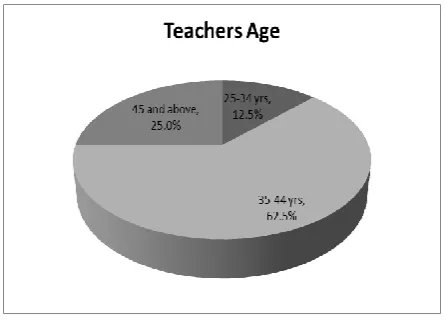
Figure 4.1: Teachers’ Response on Age
Twenty five to thirty four age bracket while two female teachers were aged forty five years and above.
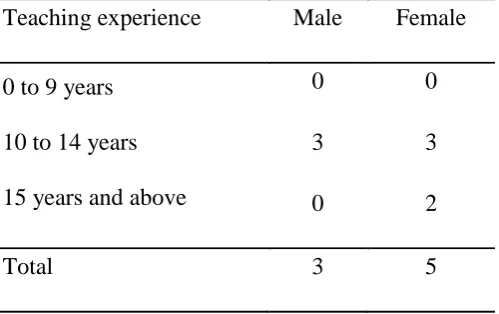
The researcher sought to know the teaching experience of Business Studies teachers who participated in this study and their responses were summarised in Table 4.1 below.
Table 4.1: Participating Teachers Teaching Experience Teaching experience Male Female
0 to 9 years 10 to 14 years 15 years and above
0 0
3 3
0 2
Total 3 5
All the teacher participants had been teaching Business Studies for over ten years with two of them having fifteen years and above teaching experience. This indicated that they had a wealth of experience in teaching the subject.
Figure 4.2: Students’ Gender Summary
All the student participants in this study were in Form Three. Form Three is a non-examination class and the students had chosen Business Studies for KCSE. Fifty one point six per cent (51.6%) of students who participated in this study were female. The male population was forty eight point four per cent (48.4%). It is therefore not easy to say either sex likes the subject more than the other because the difference is minimal.
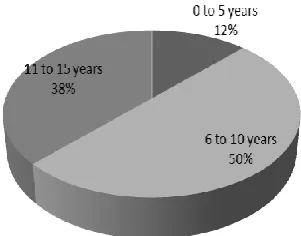
During the school administrators‟ interviews, they were asked how long they had been at the same schools and their responses are summarised as shown in figure 4.3 below:
A half of the teachers interviewed (50%) had been working in the same school for between six to ten years. Only twelve per cent (12%) had been at the same station for less than five years. Thirty eight per cent (38%) had been in their schools for over ten years.
(v) Availability and accessibility of computers to teachers and learners
Availability and accessibility of computers in schools precedes their use in teaching. To assess this factor, the researcher asked the school administrators, the teachers as well as the students a number of questions that would give an indication on the availability as well as accessibility of computers in schools. However, the study dwelt more on the head teachers because they were recognized as being the organizing authority in the provision of computers for their schools.
On the number of computers that were available to the teachers and the students. The head teachers‟ responses were as shown in Figure 4.4 below:
51 to 100 computers
37.5% 101 to 150
computers 37.5%
1 to 50 computers
25%
Figure 4.4: Number of Computers Available to Teachers and Students
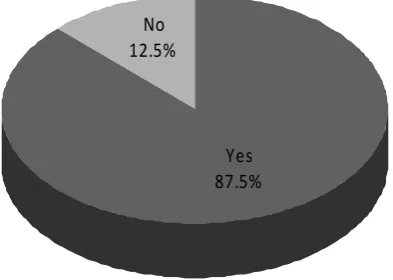
schools included in the study had the highest number of computers but also had the highest student population with six streams in each school. This made the student: computer ratio approximately one to seven (1:7) which the head teachers acknowledged as undesirable. Both public and private schools had computers in the computer laboratories, staffrooms and in the school offices. Head teachers indicated that these computers were available to the teachers and their students in the computer laboratories and staffrooms. The head teachers however, in another question on whether they thought that the computers they provided were enough responded as shown in Figure 4.5 below:
Yes 87.5% No
12.5%
1 to 1 ratio 37.5% 1 to 4 ratio
62.5%
Figure 4.6: Head Teachers’ Desired Computer Student Ratio
The sixty two point five per cent (62.5%) of head teachers indicated that they were working towards achieving a one to four (1:4) computer student ratio as recommended by the Ministry of Education and KICD. This was realistic, given the current situation where there were mostly three computer labs in the national schools and one or two in all the other schools. The number of computers in a lab ranged between thirty five and forty as observed during data collection. Worth noting also was how the heads of school acquired the computers used in schools as shown in Table 4.2 below:
Table 4.2: How Head Teachers Get Computers for their Schools
How do you get computers for the school? Frequency Per cent
Through donations 2 25.0%
Through partnerships 5 62.5%
through buying 1 12.5%
Total 8 100.0%
Schools Kenya (CFSK) a Non-Governmental Organization (NGO) that has gone a long way in getting computers into Kenyan secondary schools. This concurs with what the Ministry of Education (2006) realised that availability of computers in schools is supported by parents, development agencies and the private sector. Public schools were not initially financed by the government to get computers for their teachers and learners. The researcher is of the opinion that the government should take up the responsibility of providing computers to schools because it is difficult for head teachers to procure computers cheaply and it would be cheaper for the government to buy the computers on large scale maximising on economies of scale. Establishing the computer supply programme would also help to achieve Kenya‟s vision 2030.