674 |
P a g e
EFFECT OF SOME CONSTRUCTION ELEMENTS ON
THE FUNCTIONAL PROPERTIES OF CAR SEAT
FABRICS
Dr. Tamer F. Khalifa
1, Dr. Mohamed Abdel Gawad
2,
Dr. Mokhtar El-Homossani
3, Eng. Hafez said Hafez
41
Vice Dean of Postgraduates & Research, Applied Arts, Helwan University
2
Assistant Prof, Textile Dept. Applied Arts, Helwan University
3
Visiting Professor, Textile Dept. Applied Arts, Helwan University
4
Assistant Lecturer, Textile Dept. Applied Arts, Helwan University
ABSTRACT
Textiles in transportation are classed as technical because of the very high performance specifications and special properties required.. The seat is probably the most important item in the car interior. It is the first thing the customer sees when the car door is opened and he or she will probably instinctively touch it; there is only one opportunity to make the most of this first impression. The seat is also the main interface of man and machine and seat comfort is of paramount importance.
The objective of this study is investigating the impact of some geometrical construction elements on the functional properties of car seat fabrics, five chenille yarns were produced with different pile lengths and different pile materials. chenille yarns were used for producing chenille fabrics ( fifteen) samples with two different weave structures ,in addition to the usage of two different materials for the auxiliary weft.
Keyword
: car seats, technical textile, mobiltech, Chenille yarn, Abrasion resistance, tensile
strength, phase change materials (PCMs).
I. INTRODUCTION
Textiles provide a means of decoration and a warm soft touch to surfaces that are necessary features for human
well being and comfort, but textiles are also essential components of the more functional parts of all road
vehicles, trains, aircraft and sea vessels[1].
Along with the growth in the number of vehicles worldwide, the amount of textile materials used in motor
vehicles has increased [2].As can be seen in Fig (1), the second largest area of technical textile application is
675 |
P a g e
Fig (1) World end- use consumption of technical textiles in terms of application area, 2011 [3].
I CAR SEAT FABRICS (REQUIREMENT
&DESIGN)
Although textiles have been used in some car seats since the invention of the car, widespread use has only
occurred since the mid-1970s. The technology and manufacturing methods are still on the „learning curve‟
compared to other sectors of the textile industry[1].
1-1: Car seat covering requirement
For seat coverings the main technical requirements are resistance to sunlight (both colour fading and
fabric degradation by UV), abrasion resistance and, for public transport vehicles, reduced flammability. Table
(1) shows a summary of the requirements for car seat classification, taking into account their relative
importance. As shown, the most important physical requirements are abrasion and pilling resistance.
676 |
P a g e
1-1-1: Abrasion resistance
Seating fabric needs to be of the highest standard of abrasion resistance. Only polyester, nylon and
polypropylene are generally acceptable, although wool is used in some more expensive vehicles because of its
aesthetics and comfort. Fabric abrasion is influenced by yarn thickness, texture, cross-section and whether spun
or continuous filament. Those factors that result in larger surface area or provide points of frictional stress
reduce abrasion resistance. Fabric construction and weight have an effect on abrasion[5].
1-2: Car seats fabric design process
The textile designer must be able to produce innovative interior appearances which reflect or even set current
fashion trends, social and economic moods and customer lifestyles. Whilst at the same time being compatible
with the exterior colour and car shape. The textile designer must be able to select of: fibre types, yarn types and
fabric structures
.
1-2-1 Fiber selection
The two most important factors governing the selection of fabrics for car seat covers are resistance to light (UV
radiation) and abrasion. These factors have resulted in polyester emerging as the predominant fibre now
accounting for about 90% of all textile seat covers worldwide [6].
1-2-2 Yarn types
Fabrics are generally produced from bulked continuous filament (BCF) textured polyester yarns; false twist, knit
de knit and air texturising are common, although the latter method is the most used [1].
1-2-2-1 Chenille yarn.
Chenille yarns are fancy yarns with beautiful, soft and fuzzy surfaces. They have become the choice of
designers for many items, they used in both woven and knit constrictions and are popular for use in apparel
(sweater, out wears, blankets), home textile (upholstery, curtains, bed-spread-rugs) and automotive (decorative
fabrics, seats fabrics) [7].There are existing different methods of the chenille yarn production as follows:
weaving, knitting, flocking and twisting methods.The latter method used greater than the previous methods [8].
1-2-3 Fabric structure.
The main car seat fabric types with typical weight ranges are: [9]
flat woven fabric (200– 400g/m2) ,flat woven velvet (360–450g/m2) ,warp knit tricot (generally pile
surface,160–340 g/m2), raschel double needle bar knitted (pile surface, 280–370 g/m2) , Circular
knits (generally pile surface, 160–230 g/m2) , Fabrics in nylon tend to be towards the lower weight
range.
II. Materials and Methods.
2-1 Specification of produced chenille yarns.
677 |
P a g e
1. Pile materials: Outlast® Polyester 80/36 denier Filament Yarn,Pcm (OLPF) , Outlast® viscose
polyester 36/1 Ne spun yarn, Pcm (OLV,p) and polyester 75/36 denier Filament Yarn (without pcm,
control sample)
2. Pile length: Two pile lengths (1mm & 3 mm) were used in the research for producing the chenille yarns.
2-2: Specification of produced chenille fabrics.
The five chenille yarns were used for producing the chenille fabrics (15 samples) with two different weave
structures (depending on the arrangement between chenille weft and auxiliary weft). . Addition to use two
different materials for auxiliary weft.
2-2-1: The weave structure of the chenille fabrics.
Two different weave structures were used for producing the chenille fabrics both of them follow double-cloth
construction, the arrangement of warp (three ends back to one end face):
Fig. (2): the first structure (A)
the arrangement of the weft (one
auxiliary to one chenille)
Pick for auxiliary
weft
Pick for chenille weft
Fig. (3): the second structure (B)
the arrangement of the weft (two
auxiliary to one chenille)
2-2-2: chenille fabrics Specification.
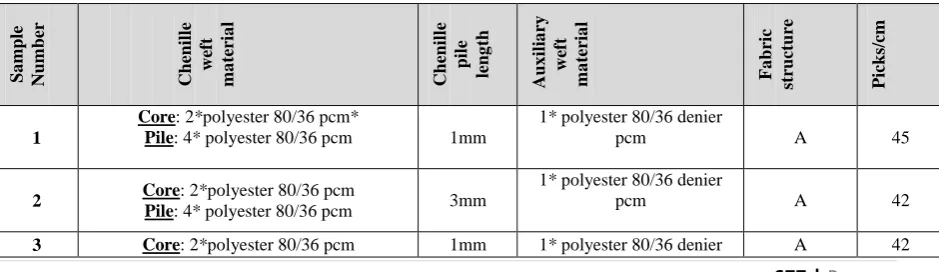
The below table (2) shows the operational specifications of the produced samples
Table (2) The operational specifications of the produced samples
Pi ck s/c m Fa b ric str u ctu re Aux il ia ry we ft m a te ria l Cheni ll e p il e leng th Cheni ll e we ft m a te ria l S a m p le Num b er 45 A
1* polyester 80/36 denier pcm
1mm Core: 2*polyester 80/36 pcm*
Pile: 4* polyester 80/36 pcm 1
42 A
1* polyester 80/36 denier pcm
3mm Core: 2*polyester 80/36 pcm
Pile: 4* polyester 80/36 pcm 2
42 A
1* polyester 80/36 denier 1mm
678 |
P a g e
pcmPile: 4*viscose/polyester 36/1 Ne. Pcm
40 A
1* polyester 80/36 denier pcm
3mm Core: 2*polyester 80/36 pcm
Pile: 4*viscose/polyester 36/1 Ne. Pcm 4 45 A 1*viscose/polyester 36/1 Ne. Pcm 1mm
Core: 2*polyester 80/36 pcm Pile: 4* polyester 80/36 pcm 5 42 A 1*viscose/polyester 36/1 Ne. Pcm 3mm
Core: 2*polyester 80/36 pcm Pile: 4* polyester 80/36 pcm 6 42 A 1*viscose/polyester 36/1 Ne. Pcm 1mm
Core: 2*polyester 80/36 pcm Pile: 4*viscose/polyester 36/1 Ne. Pcm 7 40 A 1*viscose/polyester 36/1 Ne. Pcm 3mm
Core: 2*polyester 80/36 pcm Pile: 4*viscose/polyester 36/1 Ne. Pcm 8
55 B
2* polyester 80/36 denier pcm
1mm Core: 2*polyester 80/36 pcm
Pile: 4* polyester 80/36 pcm 9
48 B
2* polyester 80/36 denier pcm
3mm Core: 2*polyester 80/36 pcm
Pile: 4* polyester 80/36 pcm 10 48 B 2*viscose/polyester 36/1 Ne. Pcm 1mm
Core: 2*polyester 80/36 pcm Pile: 4*viscose/polyester 36/1 Ne. Pcm 11 42 B 2*viscose/polyester 36/1 Ne. Pcm 3mm
Core: 2*polyester 80/36 pcm Pile: 4*viscose/polyester 36/1 Ne. Pcm 12 55 B 2*viscose/polyester 36/1 Ne. Pcm 1mm
Core: 2*polyester 80/36 pcm Pile: 4* polyester 80/36 pcm 13 48 B 2*viscose/polyester 36/1 Ne. Pcm 3mm
Core: 2*polyester 80/36 pcm Pile: 4* polyester 80/36 pcm 14
45 A
1* polyester 70/36 denier 1mm
Core: 2*polyester 75/36 denier Pile: 4* polyester 75/36 denier 15
Control Withou t pcm
*Pcm [10].
2.3 Laboratory Test
2-3-1 tensile strength test (Grab method)
This test was carried out by using (SDL ATLAS tester) according to the American Standard Specification of
(ASTM D5034 -09 (2013)) [11].
2-3-2 Fabric stiffness test
This test was carried out by using (Digital Pneumatic Stiffness Tester) as shown in figure (2-11) according to
679 |
P a g e
2-3-3 Fabric abrasion resistance test. (mass loss)
This test was carried out by using (Martindale Abrasion Tester) according to the American Standard
Specification of (ASTM D4966 – 10) [13].
III. RESULT AND DISCUSSION
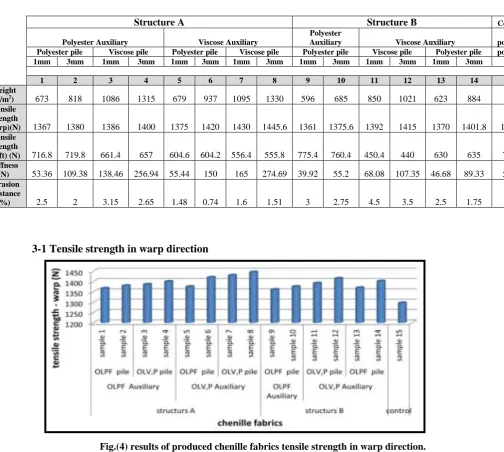
Table (3) produced chenille fabrics testing results
* Control sample (without pcm)
3-1 Tensile strength in warp direction
Fig.(4) results of produced chenille fabrics tensile strength in warp direction.
3-1-1 Effect of Chenille’s pile yarn material on tensile strength in warp direction.
figure (4) show that the fabrics produced from (Viscose, pcm) have recorded the highest rates of tensile strength
in warp direction followed by (polyester, pcm). This is owing to the increase in chenille yarn count increasing
warp crimp as a result, the resistance of fabrics to tensile strength in warp direction increased.
Structure A Structure B Control*
Polyester Auxiliary Viscose Auxiliary
Polyester
Auxiliary Viscose Auxiliary polyester
Polyester pile Viscose pile Polyester pile Viscose pile Polyester pile Viscose pile Polyester pile polyester
1mm 3mm 1mm 3mm 1mm 3mm 1mm 3mm 1mm 3mm 1mm 3mm 1mm 3mm 1mm
1 2 3 4 5 6 7 8 9 10 11 12 13 14 15
Weight
(g/m2) 673 818 1086 1315 679 937 1095 1330 596 685 850 1021 623 884 597
Tensile strength
(warp)(N) 1367 1380 1386 1400 1375 1420 1430 1445.6 1361 1375.6 1392 1415 1370 1401.8 1296.6
Tensile strength
(weft) (N) 716.8 719.8 661.4 657 604.6 604.2 556.4 555.8 775.4 760.4 450.4 440 630 635 793.2
Stiffness
(N) 53.36 109.38 138.46 256.94 55.44 150 165 274.69 39.92 55.2 68.08 107.35 46.68 89.33 58.89
Abrasion resistance
680 |
P a g e
* Sample one (Polyester, pcm) has recorded high rates to fabric tensile strength in warp direction compared to
sample fifteen (Polyester, without pcm)
3-1-2 Effect of Chenille’s pile length on tensile strength in warp direction.
From figure (4) it can be noticed that, there is a direct relation between the tensile strength in warp direction and
Chenille‟s pile length, so as the pile length increase the tensile strength in the warp direction increases and vice
versa. This is because of the increase in the pile length which leads to an increase in the warp crimp, as a result
the fabric tensile strength in warp direction increased.
3-1-3 Effect of weave structure on fabric tensile strength in warp direction.
From figure (4) it can be seen that, (Structure A) has recorded higher rates of fabric tensile strength in warp
direction followed by (Structure B). This is due to the increase in chenille yarn percentage in the weave structure
that lead to an increase in the warp crimp, as a result the fabric tensile strength in warp direction increased.
3-1-4 Effect of auxiliary weft materials on fabric tensile strength in warp direction.
From figure (4) it is clear that, the auxiliary weft produced from (Viscose, pcm) has recorded the highest rates of
fabric tensile strength in warp direction followed by (polyester, pcm), this is due to (viscose, pcm) count is
thicker than (polyester, pcm) which leads to an increase in warp crimp (more length). So as a result the usage of (Viscose, pcm) as an auxiliary weft leads to an increase in fabric tensile strength in warp direction and vice
versa.
3-2 Tensile strength in weft direction.
Fig.(5) results of produced chenille fabrics tensile strength in weft direction.
3-2-1 Effect of Chenille’s pile yarn material on tensile strength in weft direction.
from figure (5) it is obvious that (polyester, pcm) yarns have recorded the highest rates of tensile strength in weft
direction followed by (viscose, pcm). This is due to that Polyester fibers have a higher tenacity compared to other
materials, this is mainly due to their extremely crystalline polymer system, which prevents the Polyester polymers
681 |
P a g e
* sample fifteen (Polyester, without pcm) has recorded high rates of tensile strength in weft direction compared
to Sample one (Polyester, pcm).
3-2-2 Effect of Chenille’s pile length on tensile strength in weft direction.
It can be noticed from figure (5) that the pile length of chenille yarns do not represent any significant effect on
the fabric tensile strength in weft direction.
3-2-3 Effect of weave structure on fabric tensile strength in weft direction.
From figure (5) it can be seen that, (Structure B) has recorded higher rates of fabric tensile strength in weft
direction followed by (Structure A), mostly when it uses (polyester, pcm) as a chenille weft. This is owing to the
increase in weft density per centimeter in weave structure, increasing the number of the yarns under the jaws of
tensile testing machine, which leads to an increase in the tensile strength in the weft direction. As a result
(Structure B, more picks / cm)reveals higher tensile strength in the weft direction than(Structure A).
3-2-4 Effect of auxiliary weft materials on fabric tensile strength in weft direction.
From figure (5) it can be observed that, (polyester, without pcm) auxiliary yarns have recorded the highest rates
of tensile strength in weft direction followed by (polyester, pcm),(Viscose, pcm) respectively. This is due to
(polyester, without pcm) has a high tenacity, 37.12 CN/Tex compared to (polyester, pcm) which has a tenacity,
26.43 CN/Tex and (Viscose, pcm) which has a low level of tenacity, 13.9 CN/Tex.
3-3 Stiffness
Fig.(6) results of produced chenille fabrics stiffness
3-3-1 Effect of Chenille’s pile yarn material on stiffness.
From figure (6), it can be observed that, chenille fabrics produced from (Viscose, pcm) have recorded the
highest rates of fabric stiffness followed by (Polyester, pcm). This is due to the increase in yarn diameter leads
to an increase in the bending resistance of fabrics. So as a result uses chenille yarn produced from (Viscose,
pcm) (low yarn count in Indirect system counts) increases chenille fabrics stiffness.
* Sample one (Polyester, pcm) has recorded insignificant value of fabric stiffness compared with sample fifteen
682 |
P a g e
3-3-2 Effect of Chenille’s pile length on stiffness.
From figure (6) it is obvious that, there is direct correlation between the fabric stiffness and pile length, this is
due to increase of the yarn pile length increase the chenille yarn diameter and increase the thickness of produced
fabrics. So as a result the thicker fabrics are stiffer than others. [15].
3-3-3 Effect of weave structure on stiffness.
From figure (6) it can be seen that, (Structure A) has recorded the high rates of fabric stiffness followed by
(Structure B). This is because of the fact that the increases in chenille yarn weft percentage in weave structure
leads to an increase in the stiffness of fabrics and vice verse.
3-3-4 Effect of auxiliary weft materials on stiffness.
From figure (6) it is clear that, there is a direct relationship between the fabric stiffness and the usage of
(Viscose, pcm) as an auxiliary weft, this is due to (viscose, pcm) count is thicker than (polyester, pcm). So as a
result usage (Viscose, pcm) as an auxiliary weft leads to an increase in the fabric bending resistance and vice
verse
3-4 Abrasion Resistance
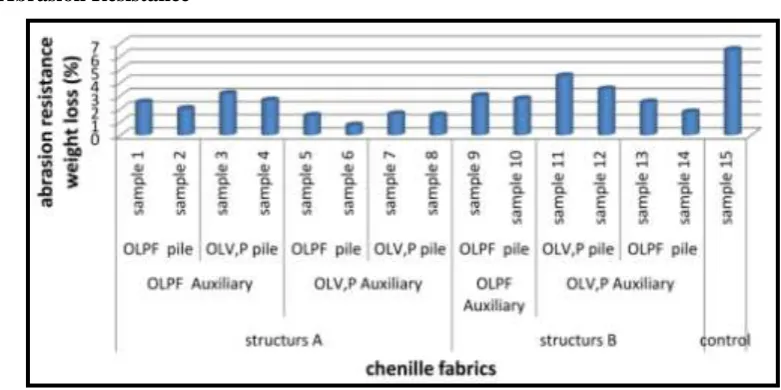
Fig.(7) results of produced chenille fabrics abrasion resistance
3-4-1 Effect of Chenille’s pile yarn material on fabric abrasion resistance.
figure (7) the chenille fabrics produced from (polyester, pcm) have recorded the highest rates of fabric abrasion resistance followed by (Viscose, pcm). Because of the Polyester fiber has a high tenacity compared to viscose
fiber, which leads to an increase in the fabric abrasion resistance.
* sample fifteen (Polyester, without pcm) has recorded high rates of fabric stiffness compared with Sample one
(Polyester, pcm)
3-4-2 Effect of Chenille’s pile length on fabric abrasion resistance.
It can be noticed from figure (7) that, there is a direct relationship between the fabric abrasion resistance and the
683 |
P a g e
pulled out from the fabric and will also take longer time to abrade, that leading to an increase in fabrics
abrasion resistance.
3-4-3 Effect of weave structure on fabric abrasion resistance.
From figure (7) it can be seen that, (Structure A) has recorded the high rates of fabric abrasion resistance
followed by (Structure B). This is because of increases the percentage of chenille yarn in weave structure leads
to an increase in the number of chenille yarn on the surface of the fabric which facing the abrading fabric so as a
result the fabric abrasion resistance increase.
3-4-4 Effect of auxiliary weft materials on fabric abrasion resistance.
From figure (7) it can be observed that, (polyester, without pcm) auxiliary yarns have recorded the highest rates
of abrasion resistance followed by (Viscose, pcm) , (polyester, pcm) respectively. Because of the Polyester fiber
has a high tenacity compared to viscose fiber, which leads to an increase in the fabric abrasion resistance.
IV. CONCLUSIONS
1. The polyester (Pcm) fabrics have recorded highest rates of tensile strength in weft direction. Whilst the
viscose (Pcm) fabrics have recorded highest rates of fabric tensile strength in warp direction and stiffness.
2. It was concluding that, the pile length has a direct relation with fabric tensile strength in warp direction,
stiffness and abrasion resistance. Pile length of chenille yarns do not represent any significant effect on the
fabric tensile strength in weft direction.
3. As far as the effect of fabric structure on tensile strength in warp and fabric stiffness is concerned, it has
been found that tensile strength in warp and fabric stiffness are affected by the change in fabric structure
where the Structure A showed the high rates of that tensile strength in warp and fabric stiffness .
4. The viscose auxiliary yarns have recorded the highest rates of fabric tensile strength in warp, stiffness and
abrasion resistance. Whilst the polyester auxiliary yarns have recorded the highest rates of tensile strength in
weft direction
5. This result is consistent with [7], in which it was pointed out that the fabrics made from viscose yarns have
less abrasion resistance than those made from polyester
6. Based on the results, we also conclude that pile length is one of the properties of chenille yarn which affect
the abrasion resistance of car seat fabrics. It is hard to remove longer fibers incorporated into the twists of
the chenille yarns than short fibers.
7. As far as the effect of fabric structure on abrasion resistance is concerned, it has been found that abrasion
resistance is affected by the change in fabric structure where the Structure A showed the best abrasion
resistance as per the weight loss results.
Acknowledgements
We would like to thank Outlast® Technology Company for supporting this work by Phase Change Material
684 |
P a g e
REFERENCES
[1].A R Horrocks and S C Anand, “HANDBOOK OF TECHNICAL TEXTILES”, Wood head Publishing Ltd
and CRC Press LLC, 2000
[2].Avinash Kolhatkar, Ajay Rathod, “Measurement of Thermal Properties of Automotive Textiles”,
International Journal of Research in Engineering and Technology (IJRET) Vol. 2, No. 5, 2013
[3].http://www.transparencymarketresearch.com/pressrelease/ tech- nical-textiles-market.htm (March 2015)
[4]. Ivona Jerkovic, Josep Maria Pallarés, “Abrasive Elements and Abrasion Resistance Tests for Car Seat
Upholstery”, Journal of Engineered Fibers and Fabrics, Volume 8, Issue 3 – 2013.
[5]. Pamuk G., Çeken F.; “Comparative Study of the Abrasion Resistance of Automobile Seat Covers”, FIBRES
& TEXTILES in Eastern Europe 2008, Vol. 16, No. 4 (69) pp. 57-61
[6]. R. Shishoo, “Textile advances in the automotive industry”, Woodhead Publishing Limited and CRC Press
LLC, 2008
[7]. Mohamed Abdel El- Gawad “ Affect of some geometrical construction elements on the functional
performance properties of chenille fabrics” PH.D, Helwan university , App. Arts , 2006
[8]. RHGong and RMWright “Fancy Yarns Their Manufacture and application”, Wood Head publishing limited,
2002.
[9]. Heba Khamees, “Achieving Optimum functional properties for producing automotive airbags fabrics”
PH.D, Helwan University, Applied Arts, 2013
[10]. M. El-Homossani, M. Abdel Gawad, T.F.khalifa, H. S. Hawas “Achieving optimum thermal comfort
properties for Automotive Seat Fabrics”, international journal of advance research in science and engineering
(IJARSE), vol.4, issue.11, November 2015.
[11]. ASTM D5034 -09 (2013) “standard Test Method for Breaking Strength and Elongation of Textile Fabrics
(Grab Test)”
[12]. ASTM D4032-08 “Standard Test Method for Stiffness of Fabric by the Circular Bend Procedure”
[13]. ASTM D4966 – 10 “Standard Test Method for Abrasion Resistance of Textile Fabrics (Martindale
Abrasion Tester Method)”
[14]. Gohl- Vilensky, Textile Science, an explanation of fiber properties, 2nd edition 1983
![Fig (1) World end- use consumption of technical textiles in terms of application area, 2011 [3]](https://thumb-us.123doks.com/thumbv2/123dok_us/7763845.1275607/2.595.60.511.488.752/fig-world-consumption-technical-textiles-terms-application-area.webp)