WASTE STABILIZATION AND TREATMENT OF MSW
BY USING GOMUTRA
Debashree Majumder,
1Dr. Basavaraj .S. Balapgol
2 1P.G Student at
D. Y. Patil Collage of Engineering Akurdi, Pune, (India)
2
Principal at
D. Y. Patil Collage of Engineering Akurdi, Pune, (India)
ABSTRACT
This paper examined the variability which occurs in key parameters like pH, temperature, moisture content,
organic carbon, nitrogen, phosphorous, odour, color etc. during the 30 days regular monitoring of composting
process.5 kg of municipal solid waste, old compost, straw and soil, was mixed with 5%, 10%, 15% of gomutra
of 3 kg municipal solid waste for composting. Composting was done by using 16th buckets model composter
made up with proper aeration and drainage facility and was kept in semi sun rays condition. pH ranging 7.6 to
8.9 in the first phase, Temperature rise from the first day of process and become 55°C on 18 day. Moisture
content in compost was unstable throughout the process due to changing microbial population. The NPK
content of final compost are find out .After finding the results of NPK obtained from composting treatment given
to MSW and Gomutra are indicate that combined composting are an attractive method for management of
municipal solid waste.
Key Word
: Municipal Solid Waste, Gomutra, Composting, Key ParametersI. INTRODUCTION
Due to increasing population as well as industrial and economic development, the output of the municipal solid
wastes (MSW) has been increasing in India. On the other hand, sanitation landfill would occupy a lot of lands
and lead to two-step solution by less developed technology. Solid waste management is considered to be one of
the most serious environmental problems confronting urban areas in developing countries.
Composting of MSW reduces the volume of the wastes, germination of weeds in agricultural fields and destroys
malodorous compounds .In adequate collection and uncontrolled disposal of solid wastes results in a serious
threat to the inhabitants as well as an environment. Municipal solid waste and its management is a big concern
for India these days. Municipal Solid waste management is taken as one of the burning issue. Among solid
waste, more than 80% is organic. Hence effective Composting can be the best option for its management. Cow
urine (Gomutra) has high nitrogenous fertilizer value than cow dung. Nutrient value of urine can be trapped
through organic composting. Urine applied compost accelerated the composting process as well as enhance the
to apply directly in the field and should be diluted in order to apply directly in the plants. Cow urine is in liquid
form and thus is not easy to transport it as of chemical fertilizer. Waste recovery such as recycling and
composting is an option of reducing the waste amount to be disposed. Composting MSW is seen as a method of
diverting organic waste materials from landfills, while creating a product, at relatively low-cost, that is suitable
for agricultural purposes. Many studies have been carried out on assessing the effect of Gomutra in composting
of Municipal solid waste. Composting satisfies the health and aesthetic aspects of waste disposal by destroying
almost all pathogens. In addition, the product becomes having agricultural and horticultural benefits as a soil
conditioner and fertilizer.
II. MATERIALS AND METHODS
Experiments on combined composting were conducted at a campus of D. Y. Patil Educational Complex, situated
at Sector 29, Nigdi, Pradhikaran, Pune, Maharashtra India, to study the effectiveness of municipal solid waste
and cow urine. The amount of generation and composition of solid waste varies from place to place within the
study. For the present study, sample of municipal solid waste was collected from The Moshi depot, which was
earlier outside the jurisdiction of PCMC, is spread over 80 acre along Pune-Nashik highway Pune Maharashtra.
Collection of cow urine was done from Tathawade village, situated in the Pimpri-Chinchwad south of Pune city,
Maharashtra. Cow urine sample was in liquid form and collected in air tight plastic bins to enclose it from
surrounding. 1.5 kg segregated vegetable waste, 1.5 old compost, 0.5 kg soils; 1.5 kg straw was mixed with 5%,
10%, and 15% of gomutra of 3 kg municipal solid waste for composting. The chemical parameters were
determined at Aavanira Biotech (P) Ltd., Kinetic Innovation Park, D-1 Block, Plot No.-18/1 Part, MIDC
Chinchwad, Pune, Maharashtra, Pune, Maharashtra. To know the trends which occur in the composting process
a regular monitoring of key role parameters, pH, temperature, moisture content, organic carbon nitrogen,
phosphorous, odour, color etc. was done for 30 days period. Physicochemical analysis of finished compost will
do for pH, conductivity, total nitrogen, organic carbon. Total Phosphorous will determined colorimetrically
Potassium will determine by flame emission spectrophotometry, while heavy metal concentrations
III. RESULTS AND DISCUSSION
The present study proved that limited dose of gomutra accelerates the composting process in combination with
municipal solid waste. Table 1, 2, 3, 4, 5, 6 shows the physiochemical characteristics of compost obtained. During
monitoring of composting
1
stday without gomutra and with gomutra pH, temperature, moisture contain,
organic carbon, nitrogen, phosphorus, color, odour is respectively nil, 33 and 30, nil, nil, nil, nil,
yellow, nil. After 30 days without gomutra pH, temperature, moisture contain, organic carbon,
nitrogen, phosphorus, potassium, color, odour of the bucket no 16 is respectively 5.9(acidic), 35
oc,
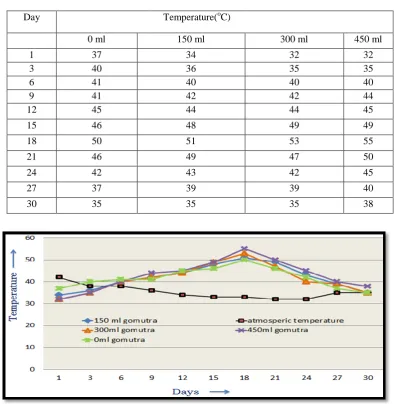
Table 1: Temperature of compost obtained from municipal solid waste and by using 5%, 10%, 15% gomutra of 3 kg municipal solid waste
Day Temperature(oC)
0 ml 150 ml 300 ml 450 ml
1 37 34 32 32
3 40 36 35 35
6 41 40 40 40
9 41 42 42 44
12 45 44 44 45
15 46 48 49 49
18 50 51 53 55
21 46 49 47 50
24 42 43 42 45
27 37 39 39 40
30 35 35 35 38
Figure 1: Temperature of compost obtained from municipal solid waste and by using 5%, 10%, 15% gomutra of 3 kg municipal solid waste
Table 2: pH of compost obtained from municipal solid waste and by using 5%, 10%, 15% gomutra of 3 kg municipal solid waste
Days
pH
0 ml
150 ml
300 ml
450 ml
6
7.9
8.2
8
8.2
12
7.5
8
7.8
7.9
18
7.3
7.6
7.7
6.81
24
6.25
7.2
7.90
6.25
Fig2: pH of Compost Obtained from Municipal Solid Waste and By Using 5%, 10%, 15% Gomutra of 3 Kg Municipal Solid Waste
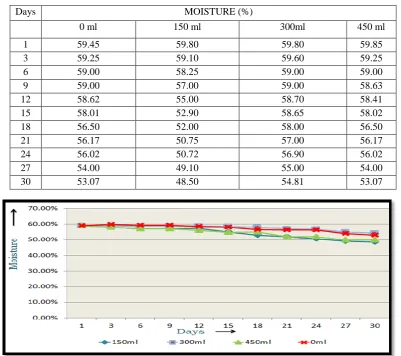
Table 3: Moisture of compost obtained from municipal solid waste and by using 5%, 10%, 15% gomutra of 3 kg municipal solid waste
Days MOISTURE (%)
0 ml 150 ml 300ml 450 ml
1 59.45 59.80 59.80 59.85
3 59.25 59.10 59.60 59.25
6 59.00 58.25 59.00 59.00
9 59.00 57.00 59.00 58.63
12 58.62 55.00 58.70 58.41
15 58.01 52.90 58.65 58.02
18 56.50 52.00 58.00 56.50
21 56.17 50.75 57.00 56.17
24 56.02 50.72 56.90 56.02
27 54.00 49.10 55.00 54.00
30 53.07 48.50 54.81 53.07
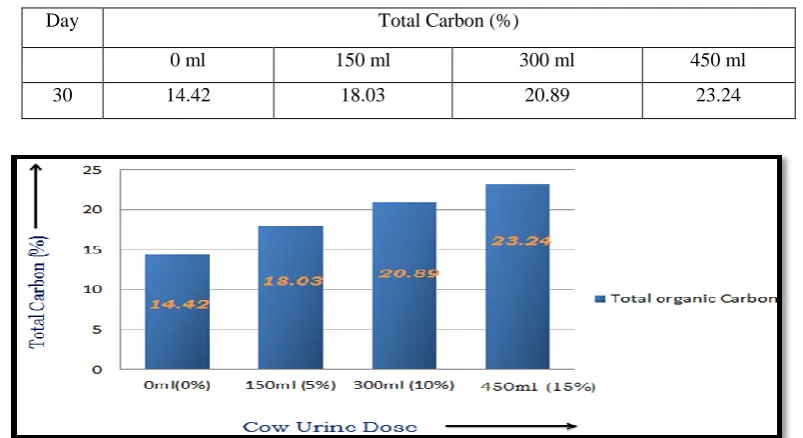
Table 4: Total carbon of compost obtained from municipal solid waste and by using 5%, 10%, 15% gomutra of 3 kg municipal solid waste after 30 days
Day Total Carbon (%)
0 ml 150 ml 300 ml 450 ml
30 14.42 18.03 20.89 23.24
Figure 4: Total organic carbon of Compost Obtained from Municipal Solid Waste and By Using 5%, 10%, 15% Gomutra of 3 Kg Municipal Solid Waste after 30 days
Table 5: Phosphorus of compost obtained from municipal solid waste and by using 5%, 10%, 15% gomutra of 3 kg municipal solid waste after 30 days
Days Phosphorus (mg/kg)
0 ml 150 ml 300ml 450 ml
30 155.9 39.47 37.23 41.3
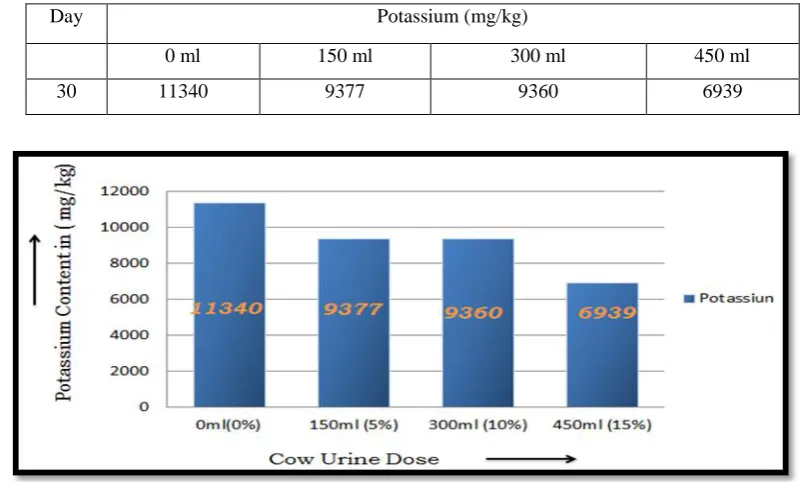
Table 6: Potassium of compost obtained from municipal solid waste and by using 5%, 10%, 15% gomutra of 3 kg municipal solid waste after 30 days
Day Potassium (mg/kg)
0 ml 150 ml 300 ml 450 ml
30 11340 9377 9360 6939
Figure 6: Potassium of Compost Obtained from Municipal Solid Waste and By Using 5%, 10%, 15% Gomutra of 3 Kg Municipal Solid Waste after 30 days.
Table 7: Nitrogen of compost obtained from municipal solid waste and by using 5%, 10%, 15% gomutra of 3 kg municipal solid waste after 30 days
Day Nitrogen (mg/kg)
0 ml 150 ml 300 ml 450 ml
30 11824.92 6539.64 8767.24 9358.29
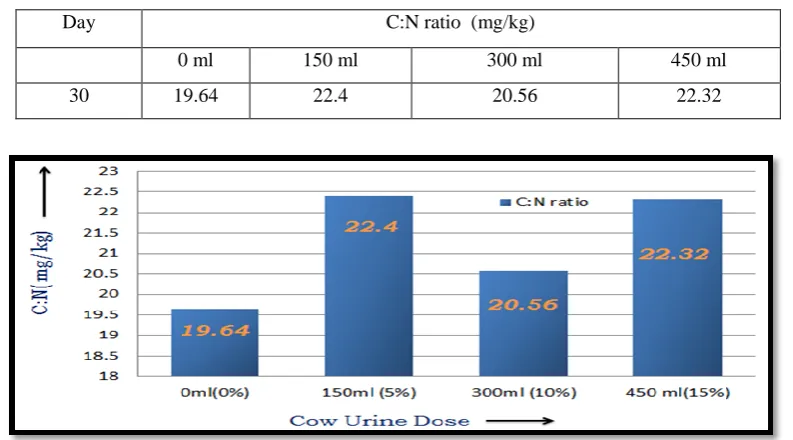
Table 8: C:N ratio of compost obtained from municipal solid waste and by using 5%, 10%, 15% gomutra of 3 kg municipal solid waste after 30 days
Day C:N ratio (mg/kg)
0 ml 150 ml 300 ml 450 ml
30 19.64 22.4 20.56 22.32
Figure 8: C:N ratio of Compost Obtained from Municipal Solid Waste and By Using 5%, 10%, 15% Gomutra of 3 Kg Municipal Solid Waste after 30 days
Temperature rises from the initial day and it rises to maximum after 18 days. After 18 days’ notice that the
temperature began to fall and at 30th days temperature come near to ambient temperature. Moisture content in
compost was 59.85 by using gomutra and 59.45 was without using gomutra throughout the process due to
changing microbial population. As their population increases, degradation process become rapid and breakdown
of waste organic matter leads into residue in the form of carbon source material, after 30th days test the total
organic carbon, Phosphorous, Potassium, Nitrogen, and C: N ration of compost. .
IVCONCLUSION
In Conclusion showed that the combination of municipal solid waste and 10% of gomutra was effective and
gomutra tends to accelerate the composting process. Reduction of waste by recycling at an affordable cost with
locally available resources was a practical approach for waste management and environmental protection.
VACKNOWLEDGMENT
The author highly acknowledge the help provided by the University gardening department as well as Aavanira
Biotech (P) Ltd., Kinetic Innovation Park, D-1 Block, Plot No.-18/1 Part, MIDC Chinchwad, Pune,
Maharashtra, during conducting the project .
REFERENCE
[1] Zhong, Z.Y. and Q.X. Zhou, 1999. Sanitation landfill technology for refuse. Urban Environment & Urban
[3] Eriksen, G., F. Coale and G. Bollero, 1999. Soil nitrogen dynamics and maize production in municipal solid
waste amended soil. Agron. J., 91: 1009-1016.
[4] Wolkowski, R, 2003. Nitrogen management considerations for land spreading municipal solid resources
were a practical approach for waste management waste compost. J. Environ. Qual., 32: 1844-1850.
[5] Tessier, A., P.G.C. Campbell, & M. Bisson, 1979. 11. Carra, J.S. and R. Cossu, 1990. International
Sequential extraction procedure for the speciation of perspectives on Municipal Solid Wastes and particulate
traces metal.Anal. Chem., 51: 844-851. Sanitary Landfillings.Academic press San Diego.
[6] Sridevi, G., Srinivasamurthy, C.A., Bhaskar, C.Viswanath, S. (2009) Evaluation of Source Separated cow
Urine as a Source of Nutrients for Banana Cultivation and Impact on Quality Parameter.Journal of
Agricultural and Biological Science Vol.
[7] Vinnerås, B., Palmquist, H., Balmer, P. and Jönsson, H. (2006) The characteristics of household wastewater
and biodegradable solid waste—A proposal for new Swedish design values. Urban Water, 3(1): 3-11.pp:
498. Pollution, 114: 119-127.
[8] Thorup-Kristensen, K. (2001) Root growth and soi nitrogen depletion by onion, lettuce, early cabbage and
carrot. ActaHorticulturae. 563: 201-206.
[9] Rodhe L., Richert Stintzing A. and Steineck S., (2004) ‘Ammonia emissions after application of human urine
to clay soil for barley growth’. Nutrient Cycling in Agro ecosystems, 68:191-198.
[10] Schouw, N.L., Danteravanich, S., Mosbaeck, H., Tjell, J.C. (2002) Composition of human excreta—a case