Design and Implementation of Three Fish Cipher
Algorithm Blocks Using FPGA
V. Vijaya
1,
Ramavath.Anusuria
2, N. Surya
3,
1
M. Tech, SRIET, Hyderabad, Telangana (India)
2,3
Asst. Professor, TKRCET, Hyderabad, Telangana (India)
ABSTRACT
Every organization sees the secure communication is the prime requirement. In today’s world the security has
became the major aspect of life. It can be achieved by various techniques such as password, cryptography and
biometrics. In this work, to study various encryption algorithms, data encryption standard used for data security
and implement Three-Fish Cipher algorithm in order to achieve security with minimum number of overheads
then compare the proposed work with test bench and then compile, simulate the test bench with the help of
Xilinx ISE software.
Key Index:
Secure communication, Three-Fish Cipher algorithm, Xilinx ISE software.I. INTRODUCTION
Data Encryption Standard (DES) is the most well-known cryptographic mechanism in history [1]. It begins with
the work of Feistel at IBM in the early 1970s. Ruth M. Davis [3] provides a hardware-implementable algorithm
for enciphering data, which has been adopted as a Federal standard to provide a high level of cryptographic
protection against various attacks. Whitfleld Diffie et. al [4] describes cryptographic technology, which
examines the forces driving public development of cryptography. Ingrid Verbauwhede [5] described Security
and Performance Optimization of a New DES Data Encryption Chip. James E. Katz [6] provides Social Aspects
of Telecommunications Security Policy for privacy and of society for security. H. Bonnenbergt [7] described the
VLSI implementation of a new block cipher. K.H. Mundt [8] presented superscript ASIC get 100Mbits/ s
encryption speed on silicon applying 1 micron design rules. C. Boyd [9] provides the modern data encryption in
which proposed standard for digital signatures based on RSA were introduced. R. Zimmermann et. al. [10]
provides a 177 Mb/s VLSI implementation of the International Data Encryption Algorithm. Stefan Wolter [11]
provides the implementation of the IDEA architecture that includes a concurrent self-test based on a mod3
residue code self-checking system. Seung-Jo Han [12] describes the improved DES algorithm in which a 96-bit
data block is divided into three 32-bit sub-blocks. Hassina Guendouz et. al. [13] describes rapid prototype of a
fast data encryption standard with integrity processing for cryptographic applications. K. Wong [14] performed
transform domain analysis of DES algorithm by using tool. M.P. Leong [15] described a bit-serial
implementation of the International Data Encryption Algorithm (IDEA). R. G. Sixel et. al. [16] describes a high
level language implementation of the DES and bit-slice architecture. Teo Pock Chueng [17] provides
Advanced Encryption Standard (AES). Cameron Patterson [20] provides high performance DES encryption
using Vertex FPGA. Jbits. Pui-Lam Siu et. al. [22] presented about the A Fault Attack on pairing based
Cryptography Current fault attacks against public key cryptography focus on traditional schemes.
II. NEED OF WORK
After the study of various encryption algorithms, the concept of keys has been successfully observed from the
observation it has been seen that better secured system can be achieved by increasing the key length. Longer key
lengths consume more power and dissipate more heat. Basically it is a tradeoff, between security and overheads.
In order to achieve more secured system continuous efforts are required. An efficient encryption algorithm
should consist of two factors – fast response and reduced complexity. By keeping the utility of encryption
algorithm in secure communication it is desirable to optimize and/or improve the encryption techniques, so
security overheads remains under control.
III. THREE FISH CIPHER ALGORITHM
This report discusses the three fish cipher algorithm with the help of key scheduling how the encryption does
and decryption algorithms are defined by applying the plain text to encryption block and generation of cipher
text as output. By applying cipher text to the decryption block and key has been scheduled in a way that
deciphered text has been found.
IV. KEY INJECTION SCHEDULING
Block Size Number of Words (Nw) Number of rounds (Nr)
256 4 72
512 8 72
1024 16 18
V. RESULTS AND CONCLUSION
CIPHER OUT PUTS
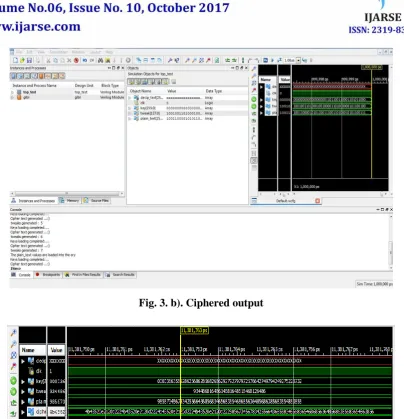
Following are simulated results of three fish block cipher algorithm implemented in virtex-5 kit with the help of Xilinx ISE 12.1.CIPHERED OUT PUTS
Fig.3. a) .Ciphered output
Fig. 3. b). Ciphered output
Fig. 3. c). Ciphered output
VI. CONCLUSION
It has been noted that 14.2ns for 256 bits of input data and is very low compared to 128 bits AES encryption
standard.
The improvement has been observed to be 45.78% as compared to classical DES technique.
The key length can be reduced, keeping the same security, in order to optimize the utilization of resources.
The few gaps have been covered but still a lot of work can be done for the increase in security of the data
REFERENCES
[1]. Niels Ferguson, Stefan Lucks, Bruce Schneier, Doug Whiting, Mihir Bellare, Tadayoshi Kohno, Jon
Callas, Jesse Walker, “The Skein Hash Function Family (Version 1.3)”, Oct 2010.
[2]. D. Kahn: The Code breakers: the story of secret writing, MacMillan publishing,1996.W.Diffie and M.
Hellman, “New Directions in Cryptography”, IEEE Transaction on Information Theory, Vol. IT-22,
1976, pp. 644-654.
[3]. Ruth M. Davis, “The Data Encryption Standard”, Proceedings of Conference on Computer Security and
the Data Encryption Standard, National Bureau of Standards, Gaithersburg, MD, 1977, NBS Special
Publication 500-527, pp 5-9.
[4]. Whitfleld Diffie, “Cryptographic Technology: Fifteen Year Forecast” Reprinted by permission AAAS,
1981 from Secure Communications and Asymmetric Crypto Systems. AAAS Selecte8 Symposia.
Editor: C.J. Simmons. Vol. 69, West view Press, Boulder, Colorado, pp 38-57.
[5]. Ingrid Verbauwhede, “Security and Performance Optimization of a New DES Data Encryption Chip”,
IEEE journal of Solid-State Circuits, Vol. 23, No. 3.1988, pp 647-656.
[6]. James E. Katz, “Social Aspects of Telecommunications Security Policy”, IEEE journal Technology and
Society Magazine, 1990, pp 16-24.
[7]. H. Bonnenbergt, “VLSI Implementation of a New Block Cipher”, IEEE journal on Information Theory
1991, pp 510-513.
[8]. K.H. Mundt, “SUPERCRYPT, ASIC Technology facilitates a new Device Family for Data Encryption”,
IEEE journal on cloud computing 1992, pp 356-359.
[9]. C. Boyd. “Modern Data Encryption,” Electronics & Communication Engineering Journal on data
security and neural networks 1993, Vol. 5, pp 271-278.
[10]. R. Zimmermann, “A 177 Mb/s VLSI Implementation of the International Data Encryption Algorithm”,
IEEE Journal of Solid-State Circuits. Vol. 29, No. 3, 1994, pp 303-307.
[11]. Stefan Wolter “On the VLSI Implementation of the International Data encryption Algorithm IDEA”,
IEEE journal on computer system and data security 1995, pp 397-400.
[12]. Seung-Jo Han, “The Improved Data Encryption Standard (DES) Algorithm” IEEE journal on
information system 1996, Vol. 3, pp 1310-1314.
[13]. Hassina Guendouz, “Rapid Prototype of a Fast Data Encryption Standard with Integrity Processing for
Cryptographic Applications”, IEEE transaction on data originations 1998,pp 434-437.
[14]. K. Wong, “A Single-Chip FPGA Implementation of the Data Encryption Standard (DES) Algorithm”
Global Telecommunications Conference, 1998. GLOBECOM 98, IEEE, Vol. 2, pp. 827-832.
[15]. M.P. Leong, “A Bit-Serial Implementation of the International Data Encryption Algorithm IDEA”,
2000 IEEE conference Symposium on Field-Programmable Custom Computing Machines, pp 122-131.
[16]. R. G. Sixel, “A High Level Language Implementation of the Data Encryption Standard and a Bit-Slice
Architecture”, Roc 43rd IEEE Midwest Symposium on Circuits and Systems, Lansing MI, 2000, pp
[17]. Teo Pock Chueng, “Implementation of Pipelined Data Encryption Standard (DES) Using Altera CPLD”,
TENCON 2000 Proceedings, Vol. 3, IEEE 2000, pp 17-21.
[18]. Yeong-Kang Lai, “A Novel VLSI Architecture for a Variable-Length Key, 64-Bit Blowfish Block
Cipher”, Signal Processing Systems, 1999 IEEE Workshop, pp 568-577.
[19]. Toby Schaffer, “A Flip-Chip Implementation of the Data Encryption Standard (DES)”, IEEE1997, pp
13-17.
[20]. Cameron Patterson, “High Performance DES Encryption in Vertex FPGAs using Jbits”, journal
Symposium on FPGA 2000, pp 113-121.
[21]. Cameron Patterson, “High Performance DES Encryption in Vertex FPGAs using Jbits”, IEEE journal