MEASURING PERFORMANCE OF DELAY BASED
CONGESTION CONTROL ALGORITHMS
(LOW PRIORITY, WESTWOOD AND VENO)
Deepak Mehta
1, Sanjay Dahiya
21
Research Scholar, Dept. of CSE, JJT University, Rajasthan, (India)
2
Dept. of CSE, Ch. Devi Lal State Institute of Engineering & Technology,
Panniwala - Mota Sirsa, Haryana, (India)
ABSTRACT
Transmission Control Protocol congestion control is backbone of the Internet stability. TCP Westwood, Veno
routing agents are sender-side modification of the congestion window algorithm that improves upon the
performance of Reno in wired as well as wireless networks. Both continuously measure the bandwidth at the
TCP sender side via monitoring the rate of returning ACKs. This estimate is then used to compute congestion
window and slow start threshold when congestion occurs. In contrast with TCP Reno which “blindly” halves
the congestion window after three duplicate ACKs received. TCP LP implement the mechanism which provide
“better than best effort service” by classifying the existing traffic as best-effort class and the other low-priority
class. LP flows are able to successfully utilize excess network bandwidth; moreover, multiple TCP-LP flows
share excess bandwidth fairly; substantial amounts of excess bandwidth are available to the low-priority class,
even in the presence of “greedy” TCP flows.
Keywords: AODV, Best effort class,DSDV, DSR, Low Priority class, Reno,Slow Start
I. INTRODUCTION
TCP congestion control mechanism was introduced by Van Jacobson in late 1980’s. The internet was suffering
from congestion collapse because sender sends their packets into internet as fast as advertised window allow and congestion occur at router cause packet drop. So, sender would time out and retransmit packet, this gives more congestion in internet. TCP uses acknowledgment for transmission of new packet. The available bandwidth changes over time so windows size must be changed over time. The algorithms used by TCP and problems. Basic algorithms are slow start algorithm, congestion avoidance, fast retransmit and fast recovery [6].
TCP-LP
is a distributed algorithm that is realized as a sender-side modification of the TCP protocol. One classTCP Westwood
congestion control algorithm use a bandwidth estimation, it executed at sender side of a TCPconnection. The congestion window dynamics during slow start and congestion avoidance are unchanged. The general idea is to use the bandwidth estimate BWE to set the congestion window (cwin) and the slow start threshold (ssthresh) after a congestion episode. In TCP Westwood the sender continuously computes the connection BWE which is defined as the share bottleneck used by the connection. Thus, BWE is equal to the rate at which data is delivered to the TCP receiver. The estimate is based on the rate at which ACKs are received and on their payload. After a packet loss, the sender resets the congestion window and the slow start. Threshold based on BWE. The packet loss is suspected with a reception of three duplicates ACKs or timeout expiration. Another important element of this procedure is the RTT estimation. That is because the congestion window is set precisely to BWE * RTT after indication of packet loss.
II. ALGORITHM AFTER THREE DUPLICATE ACK
The pseudo code of the TCP Westwood algorithm after three duplicate acknowledgements is: After 3 DUPACKS
Set ssthresh=(BWE*RTTmin) /seg_size; and if cwnd >ssthresh then set cwnd = ssthresh ; enter congestion.
In the pseudo-code, seg_size indicates the length of TCP segments in bits. During the congestion avoidance phase the sender is trying for extra available bandwidth. If three duplicate ACKs are received, the network capacity might have been reached or that in case of wireless links, one or more segments have were dropped due to sporadic losses.
Veno makes use of a mechanism similar to that in Vegas to estimate the state of the connection, nonetheless, such a scheme is used to deduce what kind of packet loss–congestion loss or random loss—is most likely to have occurred, rather than to pursue preventing packet loss as in Vega. If packet loss is detected while the connection is in the congestive state, Veno assumes the loss is due to congestion; otherwise, it assumes the loss is random. Veno makes use of a mechanism similar to that in Vegas to estimate the state of the connection, nonetheless, such a scheme is used to deduce what kind of packet lossy congestion loss or random loss -- is most likely to have occurred, rather than to pursue preventing packet loss as in Vegas.
III. RELATED WORK
Jch described about TCP-LP in [1] that people prefer to Bit Torrent traffic to other network traffic. They always want to make BitTorrent traffic always stay "in the background", access to web and other traffic as much speed whenever needed. Since normal network traffic can be considered as "best-effort traffic", other traffic like BitTorrent traffic "less than best-effort". Author gave solution by taking example prevalent downloading application-µTorrent µTP which will always give priority or service to best effort clients to access the web and use network traffic when not in use or extra free traffic to download and. It can be implemented in operating system which consists in building in less than best-effort capabilities in a compatible manner, and so that all applications can use it. In Linux implemented as "low priority" variant of TCP called TCP-LP.
E. Fathima et.al coined the term Service prioritization in [2]. Author try to implement the mechanism which provide ―better than best effort service‖ by classifying the existing traffic as best-effort class as the low-priority
class. Author devised an approach which can also be called as distributed algorithm TCP Low Priority (TCP-LP). Its core characteristic isutilize only the excess network bandwidth as compared to the ―fair share‖ of bandwidth as targeted by TCP. For early congestion indication, it use one-way packet delays and also use TCP-transparentcongestion avoidance policy. Author concluded that the LP flows are able to successfully utilize excess network bandwidth; moreover, multiple TCP-LP flows share excess bandwidth fairly; substantial amounts of excess bandwidth are available to the low-priority class, even in the presence of ―greedy‖ TCP flows; The response times of web connections in the best-effort class decrease by up to 90% when long-lived bulk data transfers use TCP-LP rather than TCP; despite their low-priority nature, TCP-LP flows are able to utilize significant amounts ofavailablebandwidth in a wide-area network environment.
timeout. Since TCP Reno which ―blindly‖ halves the congestion window after three duplicate ACKs, the working of Westwood is particularly effective over wireless links where sporadic losses due to radiochannel problems are often misinterpreted as a symptom of congestion by Current TCP schemes and thus lead to an unnecessary window reduction which was misinterpreted by Reno.
CLAUDIO CASETTI et.al characterized TCP Westwood (TCPW) a better approach for congestion control in wireless network [4]. TCP Westwood introduces a ―faster‖ recovery mechanism to avoid over-shrinking CWnd after three duplicate ACKs. It does so by taking into account the end-to-end estimation of the bandwidth available to TCP but it performs poorly when random packet loss rate exceeds a few percent.
In the recent communication world amajority of people are accessing the network by wireless media. Wireless access networks in the form of wireless local area networks, home networks, and cellular networks are becoming an integral part of the Internet. Cheng Peng Fu proposed [5] a novel end-to-end congestion control mechanism called TCP Veno that is very effective for dealing with random packet loss. Basically Veno make minor changes only the sender-side protocol of Reno without changing the receiver-side protocol stackAmajor part of this technology is it monitors the network congestion level and uses that information to decide whether packet losses are likely to be due to congestion or random bit errors.Actually it refines the multiplicative decreasealgorithm of TCP Reno, by adjusting the slow-start threshold according to the perceived network congestion level rather than a fixed dropfactor and it refines the linear increase algorithm so that the connection can stay longer in an operating region inwhich the network bandwidth is fully utilized.
IV. QOS BASED PERFORMANCE METRICS
The performance metrics includes the QoS parameters such as Packet Delivery Ratio (PDR), average
Throughput, average Delay, Routing Overhead and average Jitter
.
Packet Delivery Ratio (PDR)
:
PDR also known as the ratio of the data packets delivered to the destinationsto those generated by the CBR sources. This metric characterizes both the completeness and correctness of the routing protocol.
PDR=∑
Average End to End Delay
:
Average End to End delay is the average time taken by a data packet to reachfrom source node to destination node. It is ratio of total delay to the number of packets received.
Average E2E Delay =
Throughput:
Throughput is the ratio of total number of delivered or received data packets to the total durationof simulation time.
V. SIMULATION RESULT & DISCUSSION
The performance of AODV, DSDV and DSR has been analyzed on Delay based TCP Variants varying number of nodes. The parameters used for simulation are summarized in Table 1.The performance metrics comprises of QoS parameters such as packet delivery ratio, average throughput, average delay
Simulation Environment in NS2 Simulator
Parameters Values
Number of Nodes 10,30
Simulation Time 100
Environment Size 500X400
Traffic FTP
Queue Length 50
Source Node Node 0
Destination Node All nodes except Zero node
Source Type Veno, Westwood, LP
Routing Protocol AODV, DSDV, DSR
Mobility Model Random Way Point
Antenna Type Omni Directional
Simulator NS 2.35
VI. RESULTS AND FINDINGS
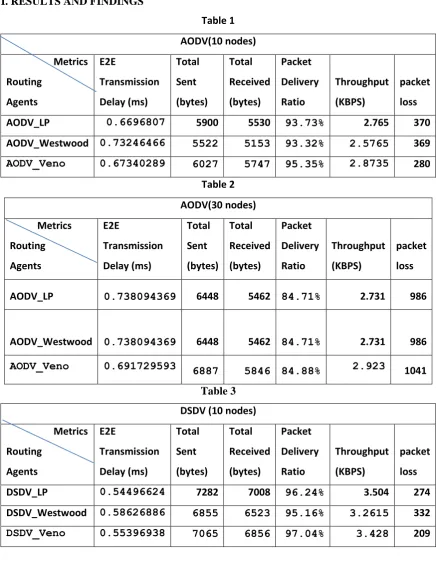
Table 1
AODV(10 nodes)
Metrics
Routing
Agents
E2E
Transmission
Delay (ms)
Total
Sent
(bytes)
Total
Received
(bytes)
Packet
Delivery
Ratio
Throughput
(KBPS)
packet
loss
AODV_LP
0.6696807
5900
5530
93.73%
2.765
370
AODV_Westwood
0.73246466
5522
5153 93.32%
2.5765
369
AODV_Veno
0.67340289
6027
5747 95.35%
2.8735
280
Table 2
AODV(30 nodes)
Metrics
Routing
Agents
E2E
Transmission
Delay (ms)
Total
Sent
(bytes)
Total
Received
(bytes)
Packet
Delivery
Ratio
Throughput
(KBPS)
packet
loss
AODV_LP
0.738094369
6448
5462
84.71%
2.731
986
AODV_Westwood
0.738094369
6448
5462
84.71%
2.731
986
AODV_Veno
0.691729593 6887
5846 84.88%
2.923
1041
Table 3
DSDV (10 nodes)
Metrics
Routing
Agents
E2E
Transmission
Delay (ms)
Total
Sent
(bytes)
Total
Received
(bytes)
Packet
Delivery
Ratio
Throughput
(KBPS)
packet
loss
DSDV_LP
0.54496624
7282
7008
96.24%
3.504
274
DSDV_Westwood
0.58626886
6855
6523 95.16%
3.2615
332
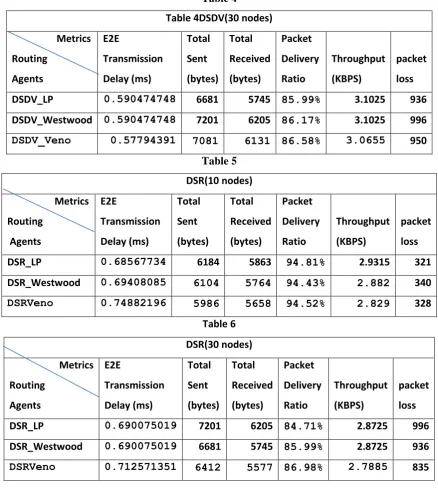
Table 4
Table 4DSDV(30 nodes)
Metrics
Routing
Agents
E2E
Transmission
Delay (ms)
Total
Sent
(bytes)
Total
Received
(bytes)
Packet
Delivery
Ratio
Throughput
(KBPS)
packet
loss
DSDV_LP
0.590474748
6681
5745
85.99%
3.1025
936
DSDV_Westwood
0.590474748
7201
6205
86.17%
3.1025
996
DSDV_Veno
0.57794391 7081
6131 86.58%
3.0655
950
Table 5
DSR(10 nodes)
Metrics
Routing
Agents
E2E
Transmission
Delay (ms)
Total
Sent
(bytes)
Total
Received
(bytes)
Packet
Delivery
Ratio
Throughput
(KBPS)
packet
loss
DSR_LP
0.68567734
6184
5863
94.81%
2.9315
321
DSR_Westwood
0.69408085
6104
5764 94.43%
2.882
340
DSRVeno
0.74882196
5986
5658 94.52%
2.829
328
Table 6
DSR(30 nodes)
Metrics
Routing
Agents
E2E
Transmission
Delay (ms)
Total
Sent
(bytes)
Total
Received
(bytes)
Packet
Delivery
Ratio
Throughput
(KBPS)
packet
loss
DSR_LP
0.690075019
7201
6205
84.71%
2.8725
996
DSR_Westwood
0.690075019
6681
5745
85.99%
2.8725
936
DSRVeno
0.712571351 6412
5577 86.98%
2.7885
835
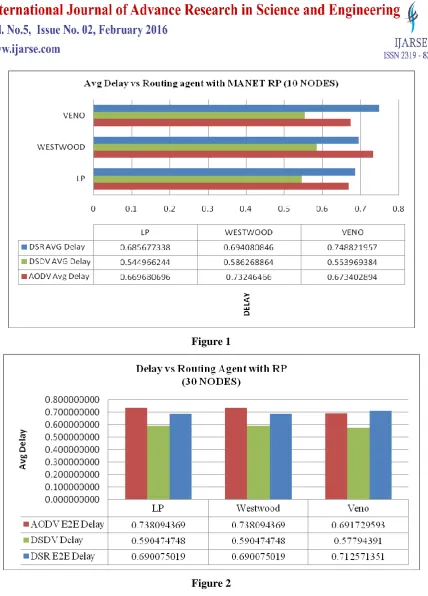
VII. AVERAGE DELAY
Figure 1
Figure 2
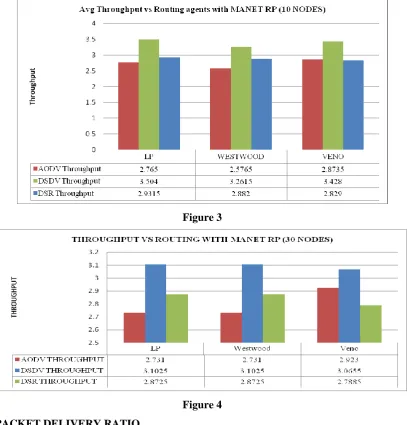
VIII. AVERAGE THROUGHPUT
Westwood and LP on increasing the numbers of nodes so clear that when the number of nodes are becoming higher LP and Westwood showing same growth.
Figure 3
Figure 4
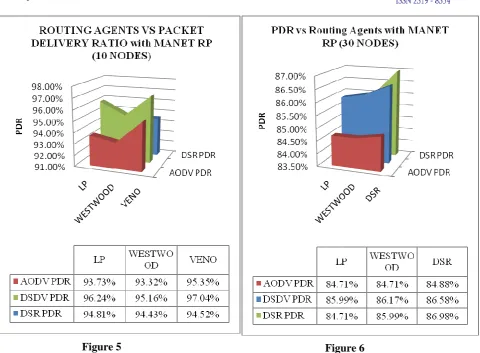
IX. PACKET DELIVERY RATIO
Figure 5
Figure 6
X. CONCLUSION
Above scenarios reflect that DSDV with any routing agents (LP, Westwood, and Veno) exhibiting better result among three MANET Routing protocols with high scalability.
Same scenarios can be tested with different active queue management techniques
.
REFERENCES
[1] Jch ,(2010,April)-― Better than µTP? TCP-LP in Transmission‖ January 30,2016 from https://forum.transmissionbt.com/viewtopic.php?t=9945
[2] E. Fathima and K.P. Kaliyamoorthie 2014. An Innovative of Low-Priority Service via End-Point Congestion Control for TCP-LP, Middle-East Journal of Scientific Research 20 (1): 100-107, 2014 ISSN 1990-9233
[3] Vasudev I Kanani, Mr.Krunal J Panchal 2014. Performance Analyses of TCP Westwood, IJEDR, Volume 2, Issue 2, ISSN: 2321-9939
[5] Cheng Peng Fu, Soung C. Liew- TCP Veno: TCP Enhancement for Transmission Over Wireless Access Networks, IEEE JOURNAL ON SELECTED AREAS IN COMMUNICATIONS, VOL. 21, NO. 2, FEBRUARY 2003, ISSN: 0733-8716, Feb 2003.
[6] ShimaaHagag and Ayman El-Sayed ―Enhanced TCP Westwood Congestion Avoidance Mechanism (TCP WestwoodNew)‖ International Journal of Computer Applications (0975 – 8887) Volume 45–
No.5, May 2012