1113 | P a g e
Biometric Access Control System Using IOT with login
alert message
Zeeshan Ahmed Shameem J.¹,J.N.Mohite ²
1
ME Student-E&TC Department ,MSSCET, Jalna, (India)
2
Assistant professor-E&TC Department, MSSCET, Jalna, (India)
ABSTRACT
In this paper design and implementation of secure biometric access control system using IoT is presented. The
fingerprint based biometric access control system is now mostly used. Thesesystems used for security so that
only the authorized persons are allowed to pass or forattendance measuring purposes. The Finger print based
system has more secured and too many advantages. By connecting it to internet using IoT we can have
advantages that monitoring is possible from anywhere in the world. But when it connects to internet security
must be ensured. To increase security we can send message to tweeter account of person who is logged in.
Keywords: Biometric, IoT, Fingerprint Scanner, Wi-Fi.
I. INTRODUCTION
As we know there are certain places where access to only authorized person is allowed. Previously a manual
authentication was used. But in today‟s digital world we use machines for authentication. There several
technologies that can be used for this purpose like RF-ID, Magnetic Card, Iris scan, Fingerprint etc. The
Fingerprint is very much popular because of its benefit over other technologies. Every person in this world has
unique fingerprint. So it‟s easy to identify person by his fingerprint. Recently the internet of thing (IoT) has
introduced too many advantages in electronics automation.The IoT based fingerprint access control system has
advantage of being mobility. We can move it to anywhere only the requirement is internet connectivity. On
successful verification user will get message. If someone else use his credentials then he can notice it as
message come like successful login. So the system is become more secure as well as users also getting feedback
messages.
II. RELATED WORKS
Divil Jain and Dr. P.S. Ramkumar has proposedand implemented the IoT Based Biometric Attendance System.
Fingerprint scanner - R305 Fingerprint scanner is used here to capture and process the fingerprint image. C8051F380 Microcontroller - Silicon Labs C8051F380 acts as a core MCU which performs all input/output
1114 | P a g e
ESP8266 Wi-Fi module- ESP8266 12E Wi-Fi module acts as a communication module between C8051F380and web server.
Wi-Fi Router- Its used to send incoming data from ESP to web and vice versa. Web server - Used to store the attendance related information.
Power Supply system- Provides power supply as per the requirements.PiyushDevikar, AjitKrishnamoorthy has proposed system involves a biometric attendance system that
integratesan ESP8266 NodeMCU breakout board and a fingerprint scanner. The fingerprint scanner processes
the user‟s fingerprint to verify the student‟s attendance. NodeMCU uploads the attendance data to Google Spreadsheet using a service called PushingBox API.
AmbavarapuBhavana and M. Jasmine implemented the [4] „Fingerprint Based Authentication System using ARM7‟. They developed an authentication system using finger print and GSM technology. Finger prints of the
users are stored in first and the verified at the time of use. If fingerprint is matched to the trained prints then
access was accepted again through GSM OTP was generated automatically and then send to registered mobile
number. If it was typed by keypad then LCD displays authorized person accessed. The main aim of this project
is to provide the security to your bank locker or for your home. This is the multi way security. To do this author
used fingerprint module, GSM module and keypad.
III. SYSTEM OVERVIEW
The proposed system implemented into basically two parts. Mobile Fingerprint scanner unit and second
workstation computer/Laptop. These two units are connected by internet. Mobile Fingerprint scanner is portable
can be place anywhere, only needs internet enable Wi-Fi connectivity.
1115 | P a g e
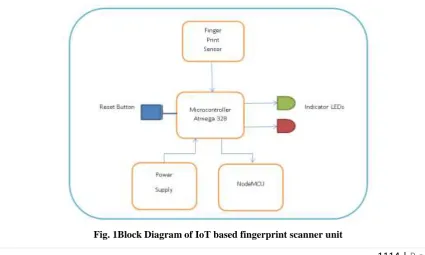
As shown in block diagram Fig. 1 the fingerprint scanner unit consist of 5v power supply, IoT module which isNodeMCU and fingerprint scanner GT-511C3, microcontroller Atmega328, Indicator LED, Reset button. The
scanner unit is connected to cloud using Wi-Fi.If user scans his finger then system identifies him. The scanner
unit uploads the specific code for identified person to cloud. We can connect number of scanner to cloud.
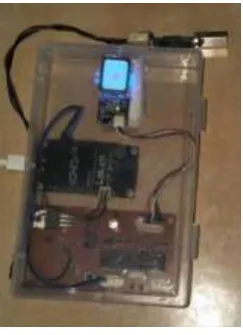
Fig. 2 Hardware implemented fingerprint scanner unit
At workstation computer receiver system consistsof ESP8266 based NodeMCU and serial to USB interface
module as shown if Fig. 3. The nodeMCU is connected to cloud and it receives the data and codes for identified
persons with time and date. The visual basic software interface is used to access information of registered users.
Based on the code received from cloud the software shows the persons details with login time and date.
1116 | P a g e
IV. RESULTS
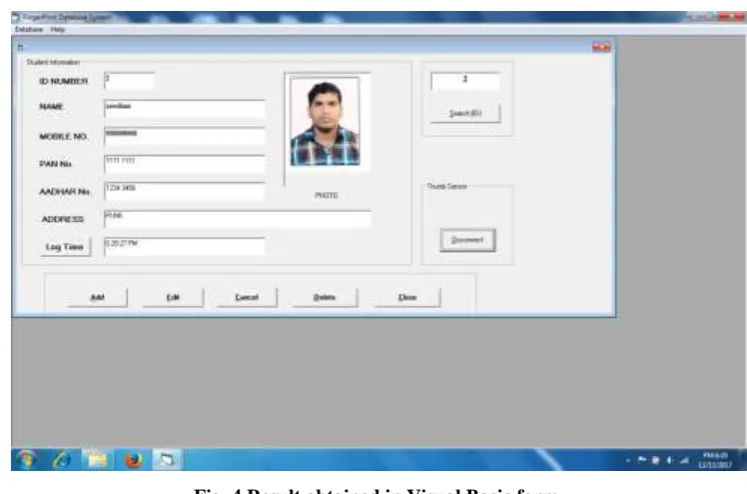
The experimentation carried out on implemented hardware and observed the results. Firstly database was
created by scanning user‟s finger and filled the information details. Then finger scanned and observed the visual
basic window. After scanning finger visual basic window showing the logging details of user as shown in fig.4.
It contains user‟s information with logging time.
Fig. 4 Result obtained in Visual Basic form.
After login user received the message in his tweeter account. The message received immediately after login as
shown in fig. 5.
1117 | P a g e
V. CONCLUSION
The IoT based biometric finger print scanner is portable. It is easy to use and works correctly. The data update
speed depends upon the speed of internet. Login alert message make the user aware, as they gets the tweeter
message. System is useful for attendance monitoring of employees who are working in remote locations. Only
need is internet connectivity.The future development can be done by use of GPS to find the location at which
user logged in.
REFERENCES
[1] Mohammed NasirUddin, SelinaSharmin, “A Survey of Biometrics Security System,” IJCSNS ,VOL.11
No.10, October 2011.
[2] Amber Habib, IjlalShahrukhAteeq, Kamran Hameed, “Biometric Security System based on Fingerprint
Recognition,” IJCSNS, Volume No.2, Issue No.9 1 Sept. 2013,ISSN : 2277-1581
[3] Ms. Shraddha S. Giradkar, “A survey paper on Various biometric security system methods,” IRJET,
Volume: 03 Issue: 02 | Feb-2016, e-ISSN: 2395 -0056, p-ISSN: 2395-0072
[4] Ambavarapu Bhavana1, M. Jasmine, “Fingerprint Based Authentication System using ARM7,” IJSR,
Volume 5 Issue 5, May 2016 ,ISSN (Online): 2319-7064
[5] SuhasS.Kibile, WasimUstad, “Automotive Security and Safety System Using ARM Microcontroller,”
IJESRT ,April, 2014, ISSN: 2277-9655
[6] Ajay Jangra, ShiviGoel, “Biometric based Security Solutions for MANET: A Review ,” Computer Network
and Information Security, August 2013, I. J. 2013, 10, 44-50
[7] Divil Jain, Dr. P.S. Ramkumar, “IoT based Biometric Access Control System,” IJIRSET, Vol. 5, Special
Issue 9, May 2016, ISSN(Online) : 2319-8753
[8] PiyushDevikar, AjitKrishnamoorthy, “IoT Based Biometric Attendance System,” IJARCCE, Vol. 5,
Special Issue 2, October 2016, ISSN (Online) 2278-1021
[9] J.L. Dugelay, J.C. Junqua, C. Kotropoulos and R. Kuhn., “Recent Advantages in Biometric Person
Authentication”, International Conference on Acoustics, Speech and Signal Processing.,Vol. 4,
pp.4060-4063,2002.
[10] Zhang Yongqiang and Liu Ji., “The design of wireless fingerprint attendance system”, Proceedings of
International Conference on Communication Technology., Vol.1, pp.1-4, 2006.
[11] Prabhakar S., S. Pankanti and A.K. Jain., “Biometrics Recognition: Security and Privacy Concerns”, IEEE
Security & Privacy., Vol. 1, No 2, pp.33-42, 2003.
[12] Sagar Wale, S.A. Patil, “Indigenous Development Of Automated Wireless Fingerprint Attendance
System,” IJSTR, VOLUME 3, ISSUE 8, AUGUST 2014.
Zeeshan Ahmed Shameem J., J. N. Mohite, “A Review on Advance Biometric Fingerprint Based Security
Systems”,International Journal for Research in Applied Science & Engineering Technology, Volume 5