8 |
P a g e
PROJECT MANAGEMENT PROCESS GROUP AND
KNOWLEDGE AREA: REVIEW
Ajit Pal Singh
PhD Research Scholar
Shri Jagdishprasad Jhabarmal Tibrewala University, Jhunjhun, Rajasthan, (India)
ABSTRACT
This review paper provides a literature on project management practices and a classification under the PMBOK Guide framework. Various research papers on project management areas are analyzed and classified into five process groups, ten knowledge areas, and four construction extension project management knowledge areas. The findings of this review clearly show that some of knowledge areas are well adopted and some are neglected areas.
Keywords –
Project Management,
Process Group, Knowledge Areas
I. PROJECT MANAGEMENT PROCESSES
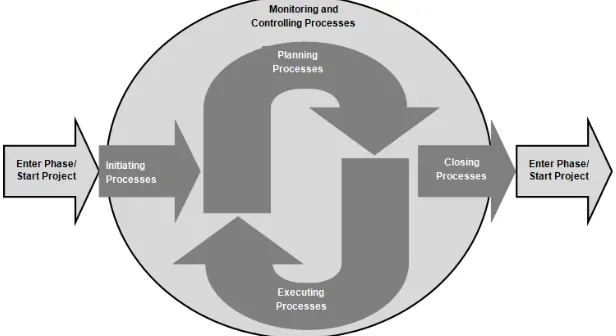
Project management is an application of knowledge, skills, tools, and techniques to project activities to meet the project requirements (PMI, 2013). This application of knowledge requires the effective management of the project management processes. Whereas, a process can be defined as a set of interrelated actions and activities performed to create a pre-specified product, service, or result. Every process is categorized by its inputs, the tools and techniques that can be applied, and the resulting outputs. Project management processes is integration between the processes, their interactions, and the purposes they serve. These processes are grouped into five categories known as project management process groups or process groups (PMI, 2013). The integrative nature of project management requires the monitoring and controlling process group to interact with the other process groups, as shown in Figure 1.
9 |
P a g e
These five project management process groups describe project in terms of phases. They involve several areas of project management applications. These areas refer to as project management knowledge areas. The interaction of the 47 project management process within the 5 project management process groups and the 10 project management knowledge areas is indicated in Appendix-1.(1) Initiating Process Group
The processes in this grouped are used to define a new project or a new phase for existing project by obtaining approval for starting the project or phase. According to Hayes (2000) project charter will lead to success of a project by transforming agreements into a project management approach. The document output will provides a foundation on which project decisions are based. They evaluated the effectiveness of a project charter template as a project management tool and developed project charter for an information system development project for medical laboratory. Finally they validate and integrate the concept of a formalized project initiation process.
(2) Planning Process Group
The processes in this group are used to set scope and objectives for a project as well as to list down course of actions required to attain the objectives that the project was undertaken to achieve. Gulick (1936) defines planning as working out in broad outline the things that need to be done and the methods for doing them to accomplish the purpose. According to Goetz (1949) planning can be defined as a fundamentally choosing, whereas Koontz (1958) defines planning as the conscious determination of courses of action designed to accomplish purposes. Mintzberg (1994) describes planning as the effort to formalizing decision making activities through decomposition, articulation and rationalization. According to Gibson and Gebken (2003) pre-project planning in construction is a phase after business planning where a deal is initiated and prior to project execution.
According to Gibson and Gebken (2003) the development of the project scope definition is important tasks in the pre-project planning process. In project scope development project risks are analysed, designs are formulated, critical decisions are made and execution is defined. The project definition rating index is a toll used for determining the level of scope definition of building projects during pre-project planning and used by various owners and designers in the building industry. This tool enhances design quality during pre-project planning by integrating the various planning charrettes, including key participants, required resources and outcomes. In building industry, many times early planning was not performed as a result it suffers from weak scope definition and frequent changes leads to cost and schedule overruns.In the last they provided recommendations about the use of the charrette approach for project professionals.
10 |
P a g e
requirements, processes, and scope definition elements that involved in peproject planning. Comparision in the scope definition of building and industrial projects are also presented by them.Steinfort and Walker (2007) stated that a project plan and programme method of work being resolved and agreed by all parties involved in project as a success factor. According to Shehu and Akintoye (2009) planning is one of the most important critical success factors and their research ranks effective planning at the top of a list of critical success factors. Research data collected was collected by 119 questionnaires and further analyzed followed by structured interviews with 17 programme management experts. There findings are based on a critical literature review, questionnaire survey and semi-structured interviews with programme management expert in the UK construction environment. The study provides critical factors for the success of any effective construction programme. Serrador (2012) literature surveyed pointed out there is a strong link between planning and project success. According to Wang and Gibson (2008) and Dvir, Raz, and Shenhar (2003) planning and analysis are important and the more planning there is in a project, the more successful the project will be, time spent on these activities will reduce risk and increase project success.
On the other hand, Thomas, Jacques, Adams, and Kihneman-Wooten (2008), Morris (1998) stated that inadequate analysis and planning will lead to a failed project. Choma and Bhat (2010) noted that the optimum amount of effort spent planning and its relationship to success is an area of interest to researchers (speaks to the general nature and characteristics of projects) and practitioners (as guidance when defining project structure and timelines). Thomas, Jacques, Adams, and Kihneman-Wooten (2008) proposed the process for accomplishing the integration of project planning, project planning and control development, and project team building.
(3) Executing Process Group
The processes in this group are used to perform works of the project that are defined in the project management plan to achieve project requirements.
(4) Monitoring and Controlling Process Group
The processes in this group are used to follow, review, and facilitate the flow and performance of a project; identify any areas in which changes to the plan are required; and initiate the corresponding changes. Pinto and Slevin (1989) identified that monitoring and feedback-timely provision of comprehensive control information and troubleshooting-ability to handle unexpected crises and divisions from plan as critical success factors.
Aubry, Hobbs, Muller and Blomquist (2010) presented results on the nature and reasons for project management office transition and aimed at understanding the dynamics of project management offices. 184 responses were collected by web-based questionnaire on project management office transitions. Results revealed that the transition of a project management office is not a question of being right or wrong.
(5) Closing Process Group
11 |
P a g e
major concern and it is due to unreliable for lack of empirical evidence found in literature because researches are carried out in environments which are different from that of the Africa’s conditions. Many researches were conducted to find out why projects and programs fail in Ghana.Amponsah (2010) identified and analyzed the project failure/success factors in three selected sectors. He conducted study on improvement of project management practice in Ghana focusing on agriculture, banking and construction sectors of the Ghanaian economy. He also identified project management tools, techniques and methods which are used by project managers which leads to project success/failures. He surveyed 324 project practitioners in three different sectors and used project factors as independent variables and project success criteria as dependent variable. Data was analyzed by multivariate analysis for variance and tested hypotheses. He used capability maturity model integration for three sectors assessement in the process area of requirement management, project planning, monitoring and evalution, measurement and analysis, and product and process quality assurance. Results revealed that limlimted companies were close to the capability maturity model level 3 and it was recommende that companies should focus their project management activities for better improvement.
II. ROLE OF THE KNOWLEDGE AREAS OF PROJECT MANAGEMENT
The 47 project management processes identified and are further grouped into ten separate knowledge areas. A knowledge area represents a complete set of concepts, terms, and activities that make up a professional field, project management field, or area of specialization. These ten knowledge areas are used on most projects most of the time. Project teams should utilize these ten knowledge areas and other knowledge areas, as appropriate, for their specific project. The knowledge areas (Appendix-1) are project integration management, project scope management, project time management, project quality management, project human resource management, project communications management, project risk management, project procurement management and project stakeholder management (PMI, 2013). PMI (2013) defines the important aspects of each knowledge area and how it integrates with the 5 process groups. The knowledge areas provide a detailed description of the process inputs and outputs along with a descriptive explanation of tools and techniques used to produce each outcome within the project management processes.
(1) Project Integration Management
Within the project management process groups, project integration management includes the processes and activities to identify, define, combine, unify, and coordinate the various processes and activities in project. The project integration management processes include the following.
12 |
P a g e
(ii) Develop Project Management Plan: The process of documenting the action necessary to define, prepare, integrate, and coordinate all subsidiary plans into a comprehensive project management plan.
(iii) Direct and Management Project Work: The process of leading and performing the work as defined in the project management plan and to achieve the projects objectives.
(iv) Monitor Integrated Change Control: The process of tracking, reviewing, and reporting project progress to meet the performance objectives defined in the project management plan. Conforto and Amaral (2010) developed and implemented agile project management principles by a qualitative evaluation which was carried out by a document analysis and questionnaire application. The investigation was carried out in two technology-based companies of the Sao Carlos technological pole in Brazil. Results revealed that there are benefits of using simple, iterative, visual, and agile techniques to plan and control innovative product projects combined with traditional project management best practices.
(v) Perform Integrated Change Control: It is the process of reviewing all change requests, approving changes and managing changes to deliverables, organizational process assets, and project. Aubry, Hobbs, Muller and Blomquist (2010) stated that project management offices are dynamic and in transition from one charter and structure to the next. They presented empirical results on the nature and reasons for such transition project management offices. They proposed a process view on the transformation of the project management offices as being triggered by conditions which will produce outcomes in terms of impacts from the transformation. They collected the data by global web based questionnaire on project management offices transitions and got 184 responses. Factor analysis and correlation analyses has been conducted and results revealed that the transition of a project management offices from one configuration to the next is due to a multilevel dynamic process anchored in a specific organizational context change.
(vi) Close Project/Phase: The process of finalizing all activities across all the project management process groups to formally complete the project/phase.
(2) Project Scope Management
It includes the processes required to ensure that the project includes all the work required, and only the work required, to complete the project successfully and it is primarily concerned with defining and controlling what is and is not included in the project.
(i) Plan Scope Management: The process of developing documents that will define, validate, and control the project scope and it also provides guidance and direction on how scope will be managed.
(ii) Collect Requirements: The process of determining, documenting, and managing stakeholder needs and requirements to meet the project objectives. This process also provides the basis for defining and managing the project scope and product scope.
13 |
P a g e
(iv) Create Work Breakdown Structure: The process of subdividing project deliverables and project work into smaller, more manageable components and provides a structured vision of what has to be delivered.
(v) Validate Scope: The process of formalizing acceptance of the completed project deliverables activities and bringing objectivity to the acceptance process and increases the chance of final product, service, or result acceptance by validating each deliverable.
(vi) Control Scope: The process of monitoring the status of the project, product scope and managing changes to the scope baseline and baseline to be maintained throughout the project.
(3) Project Time Management
It includes the processes required to accomplish the timely completion of the project.
(i) Plan Schedule Management: The process of establishing the policies, procedures, and documentation for planning, developing, managing, executing, controlling the project schedule, guidance, and direction on how the project schedule will be managed in project.
(ii) Define Activities: The process of identifying and documenting the specific actions to produce the project deliverables and work packages are break down into activities that provide a basis for estimating, scheduling, executing, monitoring, and controlling the project work. Abbasi and Arabiat (2001) conducted the research to schedule project activities based on maximum net present value and minimum duration. They combined minimum late start and shortest processing time priority-rules and a new hybrid heuristics was developed. Analysis of the newly developed late start and shortest processing time heuristic was done by using sixty problems of the Patterson set and results were compared with four different heuristics. Statistical analysis results revealed that the late start and shortest processing time heuristic developed produced a higher net present value when comparing its mean with the other four heuristics. They mentioned that even different heuristics project duration results are same then also the late start and shortest processing time gives higher net present value. Late start and shortest processing time procedure tends to minimize the project time which helps to meet the project due date and avoids delay costs, and results in maximizing the net present value. Late start and shortest processing time heuristic can be used in project scheduling with constrained resources.
(iii) Sequence Activities: The process of identifying and documenting relationships among the project activities and defining the logical sequence of work to obtain the greatest efficiency.
(iv) Estimate Activity Resources: The process of estimating the type and quantities, descriptions of resources, equipment/supplies required to complete the activity which allows more accurate cost and duration estimates for the project.
(v) Estimate Activity Durations: The process of approximating the amount of time needed to complete individual activities with estimated resources, which is a major input into the develop schedule process in the project.
14 |
P a g e
Gemmel (2005) stated the project scheduling game is based on information technology supported simulation in which it eplian the complexity of scheduling sequences of activities for real-life projects. By focusing on project scheduling game they explained how it supported the realization of a massive water purifcation project at a Belgium water distribution company, Vlaamse Maatschappij voor Watervoorziening. During examination of the project, they used basic approach a critical path method network problem and analyzed the time and cost relationship for each activity performed during this project.(vii) Control Schedule: The process of monitoring the status of project activities to update and managing changes to the schedule baseline to achieve the plan and to recognize deviation from the plan and take corrective and preventive actions and thus minimize risk.
(4) Project Cost Management
It includes the processes involved in planning, estimating, budgeting, financing, funding, managing, and controlling costs so that the project can be completed within the approved budget.
(i) Plan Cost Management: The process of establishing the policies, procedures, and documentation for planning, managing, expending, and controlling project costs throughout the project.
(ii) Estimate Costs: The process of developing an estimating of the monetary resources needed to complete project activities. Eden, Ackermann, and Williams (2005) discussed about massive cost overruns in public construction projects such as airports, bridges, or public buildings and stated that large overruns also exist in private industry. In there study they considered industrial projects that overrun is well beyond what might ever have been anticipated and overrun in a surprising manner. The analysised many large projects particularly “delay and disruption” claims for projects to understand why and how projects go badly wrong, when they do, and concluded that project managers are just the responsible for cost escalation in projects.
(iii) Determine Budget: It is the process of aggregating the approximated costs of individual activities or work packages to establish an authorized cost baseline against which project performance can be monitored and controlled.
Haga and Marold (2004) stated that the traditional method of crashing project evaluation and review technique networks ignores the stochastic nature of activity completion times, reducing the stochastic model to a deterministic critical path method model and simply using activity time means in calculations. In a traditional method the project is arbitrarily crashed to desired completion date, without consideration for the penalty for late completion of the project and ignoring that reducing activity times may reduce the mean project completion time. To slove such problem they used a computer simulation model for three extreme network types, each with two different penalty functions to crash the activities in order and made optimal crashing strategy for a project evaluation review technique network to minimize the total cost by giving a specified penalty for late completion of the project.
15 |
P a g e
action and minimize risk. Miranda and Abran (2008) stated that when a project in progress has been underestimated, it is important to estimate how much extral effort is needed to finish it within its original scope and delivery date. According to them project contingencies should be based on the amount it will take to recover from the underestimation and further they developed a model to calculate the required costs.(5) Project Quality Management
It includes the processes and activities of the performing organization that determine quality policies, objectives, procedures to implement, and responsibilities within the project’s context and to supports continuous process improvement activities as undertaken on behalf of the performing organization. Quality management processes ensure that the project and product requirements are met and validated.
(i) Plan Quality Management: The process of identifying quality requirements and/or standards for the project, product and documenting how the project will demonstrate compliance with quality requirements and to manage and validate throughout the project.
Kuprenas, Kendall and Madjidi (1999) stated that production of spacecraft components systems are complex and costly to build. After launching a spacecraft it is extremely difficult and expensive to repair. In this regard, strict standards for quality and reliability are important. A case study was conducted on project quality management for the production of spacecraft printed circuit board electronics components as part of an overall spacecraft project. Pareto analysis was used for printed circuit board data investigation by project managers for different defect types to solve process problems. Corrective actions to the spacecraft printed circuit board production process and ideas to improve future quality management studies were discussed.
(ii) Perform Quality Assurance: The process of auditing the quality requirements and the results from quality control measurements to ensure that appropriate quality standards and operational definitions are used and it facilitates the improvement of quality processes. Gupta and Graham (1997) stated that quality management mechanism is more productive and meets customers’ needs more effectively. They addressed the quality management issues by taking a case study on the quality management approach of Diamond Offshore Drilling, Inc. a project-driven organization, which is one of the largest offshore oil-drilling companies in the world. They also discussed initiation, implementation and post implementation in management systems program by emphasing the continuous improvement of industrial safety, natural environment, maintenance, training, equipment upgrades and customer satisfaction.
16 |
P a g e
things are impacting the key metric?”, scatter plots are the appropriate tool to visually show if there is a correlation between two variables.(6) Project Human Resource Management
It includes the processes that organize, manage, and lead the project team. Project team members may also be referred as the project’s staff consisting of the people with assigned specific roles and responsibilities for completing the project. Team members may have varied skill sets, may be assigned full or part-time, and may be added or removed from the team as the project progresses. Participation of team members during planning and decision making adds their expertise to the process and strengthens their commitment to the project.
(i) Plan Human Resource Management: The process of identifying and documenting project roles, responsibilities, required skills, reporting relationships, and creating a staffing management plan. It establishes project roles and responsibilities, project organization charts, and the staffing management plan including the timetable for staff acquisition and release. According to Dainty, Raiden, and Neale (2009) the human resource management practices form the key components of the resourcing process. Employee resourcing is the process for the strategic and operational matching needs of the organization. They examined the human resource management practices which are the key components i.e., inter alia, human resource planning, recruitment and selection, team deployment, performance management, and human resource administration of the resourcing process by taking real case study of seven leading construction firms, which faced dynamic resourcing priorities. Semi structured interviews methodology was used with senior executives, human resource management, operational and project-based managers and staff. Based on a practices extracted from the case study, an approach to project resourcing was developed to balance organizational, project, and individual employee requirements.
(ii) Acquire Project Team: The process of confirming human resource availability and obtaining the team necessary to complete project activities and outlining, guiding the team selection and responsibility assignment to obtain a successful team.
(iii) Develop Project Team: The process of improving competencies, team member interaction, improved teamwork, enhanced people skills, motivated employees, reduced staff turnover rates, and improved overall project performance to enhance project performance.
17 |
P a g e
(7) Project Communications Management
It includes the processes that are required to ensure timely and appropriate planning, collection, creation, distribution, storage, retrieval, management, control, monitoring, and the ultimate disposition of project information. Project managers communicate with team members and other project stakeholders, whether they are internal or external to the organization, which impact or have an influence upon the project execution or outcome.
(i) Plan Communications Management: The process of developing, identifying and documenting an approach and plan for project communications most effectively and efficiently based on stakeholder’s information needs and requirements, and available organizational assets. Abdomerovic, Blakemore, and Stewart (2000) stated that project management reports must be simple and useful. The communications planning process can be complex to create the reports depending upon the project data structures. There research paper recommended that how multiple data structures are related to make a report structure. By interfacing data structures with project scope will create simple report structures. They identified the project management information needs and information sources for making the report structure. By analysing the reports results of construction projects and answers to, who needs what information?
(ii) Manage Communications: The process of creating, collecting, distributing, storing, retrieving and the ultimate disposition of project information with efficient and effective communications flow between project stakeholders in accordance with the communications management plan. Hossain and Kuti (2008) study hypothesized that change to interconnectedness of network nodes have implications to coordinate. To validate the hypotheses, they investigated survey data by performing macro agency based and micro cross agency analysis and identified attributes of each network and coordination.
(iii) Control Communications: The process of monitoring and controlling communications, optimal information flow throughout the entire project life cycle to ensure the information needs of the project stakeholders are met at any moment in time. Dietrich, Eskerod, Dalcher, and Sandhawalia (2010) stated that in many project based industries, collaboration and cocreation of value with the customers were increasing apart from inherent challenges and complexities related to multi-partner collaboration. They developed a conceptual framework which explains the focal collaboration elements based on knowledge integration, project success and their interdependencies in multi-partner projects. They identified 8 collaboration antecedents and three collaboration outcome elements and 15 mechanisms that enhance the project collaboration quality in multi-partner projects. They provided the concepts of project collaboration quality, knowledge integration capability and its role in collaborative projects.
(8) Project Risk Management
18 |
P a g e
(i) Plan Risk Management: The process of defining how to conduct risk management activities for a project. Risk management plan is important to communicate with and obtain agreement and support from all stakeholders to ensure the risk management plan performed effectively over the project life cycle.
(ii) Identify Risks: The process of documentation of existing risks, determining which risks may affect the project, documenting their characteristics and the knowledge and ability it provides to the project team to anticipate events.
(iii) Perform Qualitative Risk Analysis: The process of short listing risks for further analysis or action by assessing and combining their probability of occurrence and impact on the project. It enables project managers to reduce the level of uncertainty and to focus on high-priority risks.
(iv) Perform Quantitative Risk Analysis: The process of quantitative risk information analyzing in order to reduce project uncertainty on overall project objectives. Krane, Rolstadas, and Olsson (2010) stated that in project objectives, operational objectives are related to the project results and strategic objectives are concern with the project goal and purpose. Therefore, strategic objectives will be different from operational objectives in hierarchy of project objectives. In there study they categorized risks as risks to operational, long-term, or short-term strategic objectives, and studied about 1,450 risk elements of 7 large projects, and investigated how operational and strategic risks are distributed in the projects. The study results indicated that risks to a project's strategic objectives rarely occur in the project's risk registers.
(v) Plan Risk Responses: The process of developing alternatives, addressing the risks by their priority, inserting resources, activities into the budget, schedule and plan as needed and to reduce threats to project objectives.
(vi) Control Risks: The process of improving efficiency of the risk approach throughout the project life cycle, implementing risk response plans, tracking identified risks, monitoring residual risks, identifying new risks, and evaluating risk process effectiveness to continuously optimize risk responses throughout the project. Taylor (2006) reported findings from an exploratory field study of risk management and problem resolution strategies used by project managers working for local and multinational information projects in Hong Kong. They discussed about general strategies within categories of control, negotiation, research, and monitoring related to their projects. Findings suggested that practical alternative to traditional formal prescriptions may be needed in managing high uncertain situations with limited resources by project managers.
(9) Project Procurement Management
It includes the processes essential to contract management and change control and administers contracts or purchase orders or acquires products, services, or results needed from outside the project team members. The organization can be either the buyer or seller of the products, services, or results of a project. Procurement management also includes controlling any contract issued by an outside organization that is acquiring deliverables from the project from the performing organization and administering contractual obligations placed on the project team by the contract.
19 |
P a g e
acquire, how to acquire it, amount needed, and time to acquire it. Bevilacqua, Ciarapica, and Giacchetta (2008) applied value stream mapping to analyze and redesign for managing the materials procurement stage of a project. Integrated definition, stream analysis approach, activity-based costing, and discrete event simulation methodology was applied to a company specialized in engineering, procurement, and construction projects and whose core business is the design and construction of offshore oil rigs. Such projects have common features of design and components, and are characterized by a short “time to delivery.” Their study assessed the possible effects of new materials management policies on reducing project completion time and the resources required.(ii) Conduct Procurements: The process of obtaining seller responses, selecting a seller, and awarding a contract with alignment of internal and external stakeholder expectations through established agreements.
(iii) Control Procurements: The process of managing sellers and buyers relationships, monitoring contract performance, and making changes and corrections as appropriate according to the terms of the legal agreement. Rose and Manley (2010) stated that the construction customers use financial incentives to attract stakeholder motivation for high order project goals. By using case study methodology they examined Australian construction project and studied procurement approach that promotes the effectiveness of financial incentives. To positively motivate the contractors without manipulate incentive system should be fair and reward should be given to exceptional performance.
(iv) Close Procurements: The process of closing each project procurement by making agreements and related documentation for future reference.
(10) Project Stakeholder Management
It includes the processes required to identify the human resources or organizations that could impact or be impacted by the project, to analyze stakeholder expectations and their impact on the project, and continuous communication with stakeholders to understand their needs and expectations, addressing issues, managing conflicting, to develop appropriate management strategies for effectively engaging stakeholders in project decisions, activities and execution.
(i) Identify Stakeholders: The process of identifying the human resources or organizations that could impact or be impacted by a decision, activity, or outcome of the project; and analyzing and documenting relevant information regarding their interests, involvement, interdependencies, influence, and potential impact on project success. It allows the project manager to identify the appropriate focus for each stakeholder or group of stakeholders.
(ii) Plan Stakeholder Management: The process of developing appropriate management strategies to engage project stakeholders throughout the project, based on their needs, interests, and potential impact on project success.
20 |
P a g e
(iv) Control Stakeholder Engagement: The process of monitoring overall project stakeholder relationships and adjusting strategies plans for engaging project stakeholders to maintain or increase the efficiency and effectiveness as the project evolves and its environment changes.
III. CONSTRUCTION EXTENSION PROJECT MANAGEMENT KNOWLEDGE AREAS
Particular project (i.e., construction) type may include further knowledge areas where they are critical for them. For construction industry, in addition to the ten project knowledge areas, there are additional four knowledge areas (Appendix-2). These knowledge areas are project safety management, project environmental management, project financial management, and project claim management.
(1) Project Safety Management
(i) Safety Planning: The processes required to assure that the construction project is carry out with appropriate care to prevent accidents related to personal injury or property damage. Safety planning involves a construction job site analysis of the hazards or risks inherent in the construction work and making decisions as to the measures to be taken to deal them. The analysis can be done by surveying the geographical and physical hazards of the construction site and review of the normal hazards involved in the type of construction anticipated. While developing the project safety plan government laws and regulations, contract, and owner requirements must be considered which will be the guiding document for a safe construction project (CE-PMI, 2000). Safety generally refers to the safeguard from risk of injury and from avoidable accidents whereas health term applies to the well-being from the immediate and long-term effects of exposure to unhealthy working condition Fasil, (2011). Health and safety are not only confined to construction works on-site but engineers, architects, and surveyors are exposed to hazards during the investigatory stage of a construction project and while carrying out inspection tasks during the construction phase and on completed tasks. Designers, in particular, carry both a moral responsibility and a duty of care for the safety of construction works, maintenance staff, demolition workers and the general public. Fasil (2011) also stated that besides human tragedies, accidents could cause substantial economic cost to the industry due to the fact it could also cause damage to plant and equipment, damage to work already completed, loss of productive work time while waste is cleared and damaged work rebuilt, increased insurance premiums, and loss of confidence and reputation.
(ii) Safety Plan Execution: Project safety plan execution involves the application and implementation of the safe construction practices by safety officer on-site in accordance with the requirements of the project plan.
(iii) Safety Administration and Records: While implementing governmental laws and regulations for safe construction practice, insurance companies’ periodic activity and accident reports, and contract additional records and reports all related activities are coming under record-keeping and reporting. And also records keep track of safety performance for use in improving performance and for use in marketing services.
(2) Project Environmental Management
21 |
P a g e
bring to the surrounding environment; planning towards avoiding environmental impacts and achieving environmental improvement; auditing the environmental plan and controlling the results; and inspecting environmental conditions. All stakeholders should be communicated about the project objectives and the environmental changes its implementation may bring. Special attention must be given to community specific demand as they are the major stakeholder. The project management team should work in collaboration with the different levels of environmental authorities like local, regional, and federal government which are also another major stakeholder (CE-PMI, 2000). The physical environment within which a construction project is sited may impact considerably on its development as construction projects are always affected by physical influences.Akanni, Oke, and Akpomiemie (2015) stated that the construction project development may be weak without a sound knowledge and proper management of the impact of environmental factors influencing the performance of projects. There study focused on assess of the impact of environmental factors on building project performance in the Nigeria. The data collection research instrument used was structured questionnaire and population consisted of government, private developers, and professional like’s architects, builders, quantity surveyors and engineers. Data was analyses by using mean score, Spearman correlation, Kendall’s coefficient and Chi-Square methods. They identified 29 factors which has an impact on building project performance and categorized as clusters, political, legal, construction technology, financial, socio-cultural and physical. The result of the Spearman correlation analysis of time and cost overruns with the identified factors affecting project performance revealed that the clusters of Economic and financial and Political had significant relationship with time overrun on p-values of 0.004 and 0.011, respectively, while the cluster of Social and cultural had significant relationship with cost overrun with a p-value of 0.007. There research study recommended that stakeholders should focus economic and financial, and political clusters for succeful management and prevention of cost and time overruns. Thomas and Martin (2004) stated that managers of construction works should take major consideration of physical effects when planning the management strategies to avoid extremes which can take advantage of available resources. Oladapo and Olotuah (2007) discussed about the historical development, current status, and operation of real estate law and policy in Nigeria for sustainable development in global.They investigated the existing real estate law and policy (Land Use Act No. 6 of 1978) in Nigeria and its relevance of sustainable development to real estate laws and policy. A comparison study has be made Nigeria and some developing nations related to land issues. There findings indicated that the present real estate law and policy is inadequate to meet the aspirations for sustainable development in Nigeria. To solve such issues the real estate laws and policies should be geared for sustainable development in Nigeria.
22 |
P a g e
(ii) Environmental Assurance: It is a planned and systematic activities implemented within the environmental management on a regular basis to provide confidence that the project will satisfy the relevant environmental standards. It should be performed throughout the project. Assurance should be provided to all stakeholders related to environment conservation (CE-PMI, 2000).
(iii) Environmental Control: This involves monitoring particular project results for all aspects of the project, to determine if they fulfill with relevant environmental standards and finding ways to remove causes and effects of unsatisfactory results. Environment control should be performed throughout the project. While quality control monitors project results, a specific environmental management control process should exist for a particular requirements expressed in standards and regulations and its awareness to all stakeholders knowledge and every member of the project team.
(3) Project Financial Management
According to Paramasivan and Subramanian (2008) financial management is an integral part of overall management and it is concerned with financial manager’s duties in the business firm. As per CE-PMI (2000), the process of acquiring and managing the financial resources for the project, concerned with revenue source and analyzing or updating net cash flows for the construction project.
(i) Financial Planning and Control: Financial planning management for construction projects is the phase where all project requirements of a financial related are identified, requirements are placed on a timescale and quantified and the resources are ensured that the financial tasks are completed timely. Financial control ensures that the bonds are reduced whenever required, calls for funds from project partners whenever needed, and all insurance and bank withdrawals or deposits are completed within times. Financial control and cost controls ensure that all items are within budget and the financial cash forecast (CE-PMI, 2000).
(ii) Financial Administration and Records: The process of designing and maintaining a financial information storage or retrieval database for smooth running of financial control system.
(4) Project Claim Management
Claim management is an important process in construction projects. It describes the processes required to reduce or prevent claims from arising and prompt handling of construction claims when they do occur (CE-PMI, 2000). Hughes and Barber (1992) defined claim as to simply a request, demand, application for payment or notification of presumed entitlement or right to which a contractor, rightly or wrongly at that stage, considers himself entitled and in respect of which agreement has been reached. As per Wood (2006), can be classified as contractual claims and extra contractual claims, or as per Hughes and Barber (1992), there are three types of claims, (1) claims under the contract; (2) claims under the common law, equitable and statutory remedies; and (3) ex-gratia claims.
23 |
P a g e
(ii) Claim Quantification: In this process claim activity is reviewed and decision are taken whether it is worthy of pursuing as a claim or not, after this claim is quantify it in terms of additional compensation or a time extension to the contract completion or other date is finalized (CE-PMI, 2000).
(iii) Claim Prevention and Resolution: In this process emphasis was given on how to avoid or prevent claims from arising. If well scoped and risk allocated contract are well performed then there is very less chances to have any claims (CE-PMI, 2000). After putting a lot of concerted effort to prevent claims they still may arise. A justifiable disagreement is possible as to whether the claim in question is a contract change or not, or the claimed amount of compensation or time change requested is correct.
IV. CONCLUSION
The study provide a critical investigation of the present body of knowledge in project management practices and inform academics of this area. Only a small part of project management research studies project management practices and more empirical studies have been conducted in the research on project management practices.
REFERENCES
1. Abbasi, G.Y. & Arabiat, Y.A. (2001). A heuristic to maximize the net present value for resource-constrained project-scheduling problems. Project Management Journal, 32(2): 17-24.
2. Abdomerovic, M., Blakemore, G., and Stewart, J. (2000). Show it simply. Project Management Journal, 31(4): 27-32.
3. Akanni, P.O., Oke, A.E., and Akpomiemie, O.A. (2015). Impact of environmental factors on building project performance in Delta State, Nigeria. Housing and Building National Research Center Journal, 11: 91-97. 4. Amponsah, R. (August 2010). Improving project management practice in Ghana with focus on agriculture,
banking and construction sectors of the Ghanaian economy. PhD Thesis, School of Property, Construction and Project Management RMIT University, Ghana.
5. Aubry, M., Hobbs, B., Müller, R., and Blomquist, T. (2010). Identifying forces driving PMO changes. Project Management Journal, 41(4): 30-45.
6. Bevilacqua, M., Ciarapica, F.E., and Giacchetta, G. (2008). Value stream mapping in project management: A case study. Project Management Journal, 39(3): 110-124.
7. CE-PMI (2000). Construction extension to a guide to the project management knowledge. PMBOK Guide-2000 Edition. Project Management Institute, Pennsylvania, USA.
8. Choma, A.A. & Bhat, S. (2010). Success vs failure: What is the difference between the best and worst projects?. Proceedings PMI Global Congress 2010-Washington D.C.
9. Conforto, E.C. and Amaral, D.C. (2010). Evaluating an agile method for planning and controlling innovative projects. Project Management Journal, 41(2): 73-80.
10.Dainty, A.R.J., Raidén, A.B., and Neale, R.H. (2009). Incorporating employee resourcing requirements into deployment decision making. Project Management Journal, 40(2): 7-18.
24 |
P a g e
Multipartner Projects. Project Management Journal, 41(4): 59-78.12.Dvir, D., Raz, T., and Shenhar, A. (2003). An empirical analysis of the relationship between project planning and project success. International Journal of Project Management, 21: 89-95.
13.Eden, C., Ackermann, F., and Williams, T. (2005). The amoebic growth of project costs. Project Management Journal, 36(2): 15-27.
14.Fasil, T. (2011). Building construction: Lecture note. Addis Ababa Institute of Technology, Addis Ababa University, Addis Ababa, Ethiopia.
15.Gibson Jr, G.E., Wang, Y.R., Cho, C.S., and Pappas, M.P. (2006). What is preproject planning, anyway? Journal of Management in Engineering, 22(1): 35-42.
16.Gibson, E. & Gebken, R. (2003). Design quality in pre-project planning: Applications of the project definition rating index. Building Research and Information, 31(5): 346-356.
17.Goetz, B. E. (1949). Management planning and control: A managerial approach to industrial accounting. NewYork: McGraw-Hill Book Co.
18.Gulick, L. H. (1936). Notes on the theory of organization. Papers on the Science of Administration.
19.Gupta, V.K., and Graham, D.J. (1997). A customer-driven quality improvement and management project at diamond offshore drilling. Project Management Journal, 28(3): 22-18.
20.Haga, W.A. and Marold, K.A. (2004). A simulation approach to the PERT/CPM time-cost trade-off problem.
Project Management Journal, 35(2): 31-37.
21.Hayes, D.S. (2000). Evaluation and application of a project charter template to improve the project planning process. Project Management Journal, 31(1): 14-23.
22.Hossain, L., and Kuti, M. (2008). CordNet: Toward a distributed behavior model for emergency response coordination. Project Management Journal, 39(4): 68-94.
23.Hughes, G.A. and Barber, J.N. (1992). Building and civil engineering claims in perspective (3rd ed.). England: Longman Scientific and Technical.
24.Jetu, F.T., Riedl, R., and Roithmayr, F. (2011). Cultural patterns influencing project team behavior in Sub-Saharan Africa: A case study in Ethiopia. Project Management Journal, 42(5): 57-77.
25.Koontz, H. (1958). A preliminary statement of principles of planning and control. The Journal of the Academy of Management, 1(1): 45-61.
26.Krane, H.P., Rolstadås, A., and Olsson, N.O.E. (2010). Categorizing risks in seven large projects-which risks do the projects focus on? Project Management Journal, 41(1): 81-86.
27.Kuprenas, J.A., Kendall, R.L., and Madjidi, F. (1999). A quality management case study: Defects in spacecraft electronics components. Project Management Journal, 30(2): 14-21.
28.Mintzberg, H. (1994). The rise and fall of strategic planning: Reconceiving roles for planning, plans, planners. Free Press.
29.Miranda, E. and Abran, A. (2008). Protecting software development projects against underestimation. Project Management Journal, 39(3): 75-85.
25 |
P a g e
Project management handbook.31.Oladapo, R.A. and Olotuah, A.O. (2007). Appropriate real estate laws and policies for sustainable development in Nigeria. Structural Survey, 25(3/4): 330-338.
32.Pinto, J.K. and Slevin, D.P. (1989). Critical success factors in R and D projects. Research Technology Management Journal, 31-35.
33.PMI-Project Management Institute (2013). A guide to the project management body of knowledge (PMBOK guide) (5th ed.). Project Management Institute, Inc., Pennsylvania, U.S.A.
34.Rever, W.H. (July 2007). Effectively communicating with data. www.AllPM.com, Newsletter.
35.Rose, T.M. and Manley, K. (2010). Financial incentives and advanced construction procurement systems.
Project Management Journal, 41(1): 40-50.
36.Sabyasachi (March 10, 2017). https://www.simplilearn.com/project-charter-and-its-importance-article
37.Serrador, P. (2012). The importance of the planning phase to project success. Paper presented at PMI® Global Congress 2012-North America, Vancouver, British Columbia, Canada. Newtown Square, PA: Project Management Institute.
38.Shehu, Z. & Akintoye, A. (2009). The critical success factors for effective programme management: a pragmatic approach. The Built & Human Environment Review, 2: 1-24.
39.Steinfort and Walker (2007). Pulse of the profession. Project Management Institute.
40.Taylor, H. (2006). Risk management and problem resolution strategies for IT projects: Prescription and practice.
Project Management Journal, 37(5): 49-63.
41.Thomas, E.U. and Martin, L. (2004). Essentials of construction project management (1st ed.). University of New South Wales Press Ltd., Australia.
42.Thomas, M., Jacques, P.H., Adams, J.R. & Kihneman-Woote, J. (2008). Developing an effective project: planning and team building combined. Project Management Journal, 39(4): 105-113.
43.Vanhoucke, M., Vereecke, A., & Gemmel, P. (2005). The project scheduling game (PSG): Simulating time/cost trade-offs in projects. Project Management Journal, 36(1): 51-59.
44.Wang, Y.R. & Gibson, G.E. (2008). A study of preproject planning and project success using ANN and regression models. The 25th International Symposium on Automation and Robotics in Construction. ISARC-2008, 688-696.
45.Wood, R.D. (2006). Budding and civil engineering claims. The Estates Gazette Limited, London.
26 |
P a g e
Appendix-1: Project Management Process Group and Knowledge Area Interaction (PMI, 2013)Knowledge Areas
Project Management Process Groups
Initiating Planning Executing Monitoring
and Controlling Closing Project integration management Develop project charter
Develop project management plan
Direct and manage project work
Monitor and control project work
Perform integrated change control
Close project or phase
Project scope management
Plan scope management Collect requirements Define scope Create WBS
Validate scope Control scope
Project time management
Plan schedule management Define Activities Sequence Activities Estimate Activity
Resources Estimate Activity
Durations Develop Schedule
Control schedule
Project cost management
Plan cost management Estimate costs Determine budget
Control costs
Project quality management
Plan quality management
Perform quality assurance
Control quality
Project human resource management
Plan human resource management
Acquire project team
Develop project team
Manage project team
Project
communications management
Plan communications management Manage communications Control communications Project risk management
Plan risk management Identify risks
Perform qualitative risk analysis
Perform quantitative risk analysis Plan risk responses
Control risks
Project procurement management
Plan procurement management Conduct procurements Control procurements Close procurements Project stakeholder management Identify stakeholders
27 |
P a g e
Appendix-2: Interaction of Project Management Processes and Construction Management Processes to theProcess Groups and Knowledge Areas (CE-PMI, 2000)
Knowledge Areas
Project Management Process Groups Initiating Planning Executing Monitoring and
Controlling
Closing
Project integration management
Project plan development
Project plan execution
Integrated change control
Project scope management
Initiation Scope planning Scope definition
Scope validation Scope change
control Project time
management
Activity definition Activity sequencing Activity duration
estimation
Schedule development
Activity weights definition
Schedule control Progress curves
development Progress
monitoring Project cost
management
Resource planning Cost estimating Cost budgeting
Cost control
Project quality management
Quality planning Quality assurance
Quality control
Project human resource management
Organizational planning Staff acquisition
Team development Project completion Project communication management Communication planning Information distribution Performance reporting Administrative closure Project risk management
Risk management planning
Risk identification Qualitative risk
analysis
Risk response planning
Risk monitoring and control
Project procurement management
Procurement planning Solicitation Solicitation Source selection Contract administration Contract closeout Project safety management
Safety planning Safety plan execution Administration and reporting Project environmental management Environmental planning Environmental assurance Environmental control Project financial management
Financial planning Financial control Administration and records Project claim
management
Claim identification Claim quantification