Available Online at www.ijcsmc.com
International Journal of Computer Science and Mobile Computing
A Monthly Journal of Computer Science and Information Technology
ISSN 2320–088X
IJCSMC, Vol. 4, Issue. 9, September 2015, pg.42 – 48
RESEARCH ARTICLE
CLOUD COMPUTING: SEARCH ENGINE
IN AGRICULTURE
Swati Kadian, Sudesh Nandal
Department of Electronics and CommunicationBhagat Phool Singh Mahila Vishwavidyalaya, Khanpur Kalan, Sonepat, Haryana, India E-mail ID: [email protected]
E-mail ID: [email protected]
ABSRTACT:-Cloud computing- A grid computing which is used to store files, applications and infrastructure on internet. It has the capability so that it host and deliver services over internet easily and with convenient way. There has been an increased in numbers of cloud service providers but due to lack of study focused on search engine or web portal for cloud computing that provide best services to the users. The presented work consists of the cloud service focused on the agriculture application area like weather forecasting, rainfall prediction, crop and disease based suggestions etc. The work has been designed in CLOUDSIM INTEGRATED JAVA ENVIRONMENT as a middle layer architecture where user can submit its request in the form of keyword based specification. After acceptance an appropriate cloud service will be identified in that specified area and different parameters has been used for comparative analysis as availability, response time, reliability etc. Cloud computing is very powerful distributed environment which reduces the resource as well as infrastructure requirements. A hybrid three stage model provide the solution on cloud service search and also optimizes the request. Dead line, Process time and Process type are three basic terms of analysis makes it more presentable.
KEYWORDS
:-Cloud Computing, :-CloudSim, NetBeans, Search Engine, Virtualization, :-Cloud Service, Parametric Analysis
I.
INTRODUCTION
Cloud computing is the paradigm which shifts the location of the infrastructure to the network to reduce the costs associated with the management of hardware and software resources.Cloud computing provides the distributed environment which share the resources, services and the platform through the cloud. It provides the global connectivity through internet and provides the different technologies facilated with cloud system. These all facilitate the services in an easy and convenient way. The cloud work will reduce the opportunistic criteria so that the processing over the system get improved [1].
Service), PaaS (Platform as a Service), SaaS (Software as a Service) and collectively *aaS (Everything as a Service) all of which imply a service-oriented architecture.
Cloud computing system is the integrated environment that provides the different services and different service characteristics to different kind of users. It is the distribution architecture available to all users using internet, but it is deployed on cloud server under different deployment models. A typical cloud deployment model is shown in figure 1.1 [1] [7].
Figure 1.1:
User Oriented
Cloud Service Model
[3]In recent years, the numbers of cloud service providers have been increased. However, there is no such study that focuses on cloud computing as search engine and web portal for users who want to find cloud service. Thus, lead the cloud customer to face challenges and problems so that they can’t select the right service provider who meets their needs. The research here is focused on meeting the user requirement in cloud environment specified in agriculture area beneficial to the farmers. The requirements by the user is a search query that entered by the end users and these search queries are going to be matched with accurate cloud service. At the end of the research the cloud service which is presented as search engine will be developed as a proposed tool for meeting the user requirements.
II.
RESEARCH METHODOLOGY
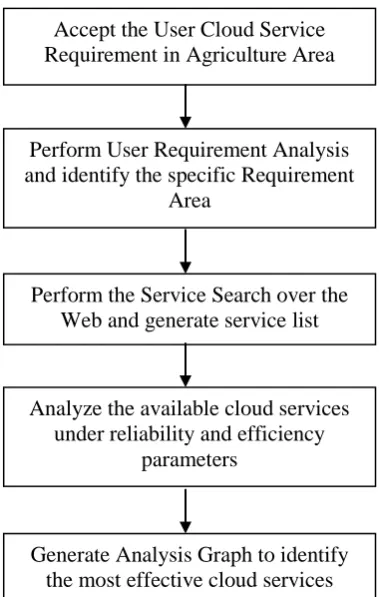
Figure 1.2: Proposed Model for Cloud Computing as Search Engine
The first stage is to work with cloud computing to build the cloud environment, where the cloud servers are defined in the environment. The available cloud servers are identified statistically along with relative web URL. These cloud servers are relative to weather forecasting, agriculture processing etc. Once a user will enter to the system, a service request will be performed in behalf of the user to the integrated environment. A process request is submitted as query content performed in the form of graphical interface. The single keyword based query is submitted here [4] [6].
Once the request is generated, the next work is to generate and identify the relative parameter such as the request time, request type, dead line criticality and the requirement specification.
Once the request is submitted, the available cloud servers are mapped with the input query and the cloud server search is performed. The content adaptive search is here performed to identify the most effective cloud server.
Once the weightage to each process is defined, these processes are scheduled based on the greedy algorithm. The objective function is to arrange the processes under the least cost ratio.
The processes are scheduled and cost estimation is done, then evaluation of the cloud serve will provide the process occurrence in the queue. This evaluation of the cloud server will be done respective to under the capacity and the request analysis. If the process get feasible to the cloud server capacity the process will be allocated to that particular cloud server [5].
The presented work is focused on agriculture application area. This application area requires the cloud services related to weather forecasting, rainfall prediction, temperature prediction, crop and disease based suggestion etc. The work will be here presented as middle layer architecture between the cloud environment and the user. This request can be entered in the form of keyword based specification or graphically. Once the framework will accept the request, it will identify the most appropriate cloud servers in the specific area. The framework will also define a comparative analysis among possible cloud services under different parameters. These parameters include availability, response time, process time, process type etc.
III.
IMPLEMENTED WORK AND RESULT
In cloud computing different tools have been used to make it more efficient. The main tool used is CloudSim which supports modelling of on-demand virtualization enabled resource and application management that has been chosen as a simulation platform as it is a modern simulation framework aimed at Cloud computing environments. It has the ability to simulate service applications with variable over time workload has been incorporated. Another tool is Java which provides the interface between the clients and the servers. To provide the user friendly environment java-swing will be selected as the language library in
Accept the User Cloud Service
Requirement in Agriculture Area
Perform User Requirement Analysis
and identify the specific Requirement
Area
Perform the Service Search over the
Web and generate service list
Analyze the available cloud services
under reliability and efficiency
parameters
which the graphical user and the code will be implemented. To write the code effectively, the NetBeans environment will be used. NetBeans will provide the user effective approach to generate the GUI. In the implemented work different stages are specified so that work is divided and being presented as
Cloud Server Specifications
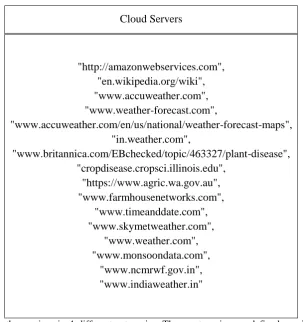
The first stage of this presented work is to define the cloud servers that are having the relative cloud services.
As we can see the list of the Cloud services that we found at initial stage. These Cloud services include the public cloud service providers. Some of these cloud servers are shown below in table 1.1
Table 1.1: List of Cloud Servers
Cloud Servers
"http://amazonwebservices.com",
"en.wikipedia.org/wiki",
"www.accuweather.com",
"www.weather-forecast.com",
"www.accuweather.com/en/us/national/weather-forecast-maps",
"in.weather.com",
"www.britannica.com/EBchecked/topic/463327/plant-disease",
"cropdisease.cropsci.illinois.edu",
"https://www.agric.wa.gov.au",
"www.farmhousenetworks.com",
"www.timeanddate.com",
"www.skymetweather.com",
"www.weather.com",
"www.monsoondata.com",
"www.ncmrwf.gov.in",
"www.indiaweather.in"
The cloud server provides the services in 4 different categories. These categories are defined specifically while forming the cloud service request. The service types considered as the request parameter are shown in table 1.2
Table 1.2: Service Request Categories
Cloud Service Categories
Temperature
Rainfall
Crop
Implemented Results
The results driven from the work are shown in this section
Figure 1.3
: Query Processing
In the beginning the number of requests is performed on the cloud server, the main interface to generate the user request. Based on this request, the multiple users can be processed. The overall load on cloud service environment is provided here. The user friendly model is here presented to generate the request query. The single keyword based query is here performed.As the query from the multiple users is submitted, the proposed cloud service architecture will accept this query and process. The query is here processed for individual query aspects. The query processing is here done to provide the effective service search and scheduling model.
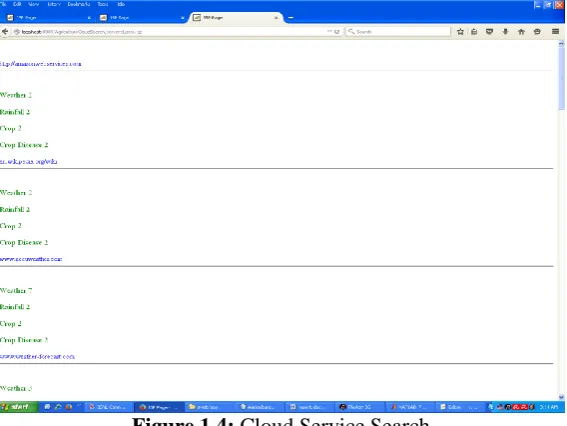
Once the request is processed, the next work is to divide the request respective to the request type. The request type is here in terms of registered and the free users. The associated request parameters are also obtained randomly from the work. These parameters include process time, request time and dead line criticality.Here figure 1.4 is showing the mapping of the particular cloud service for different keywords. The figure is showing the number of instances mapped of the particular query. Higher the instances of a keyword to the cloud server, more adaptive mapping is obtained. Based on this mapping analysis, the cloud service selection is here obtained from the work.
Analysis Results
Here figure 1.5 is showing the process time analysis obtained from multiple requests performed on the cloud server. These requests are performed based on the user specifications. As the number of user increases the time taken to process the requests is also increased. The figure showed the time adaptive analysis.
Figure 1.5:
Time Base Analysis
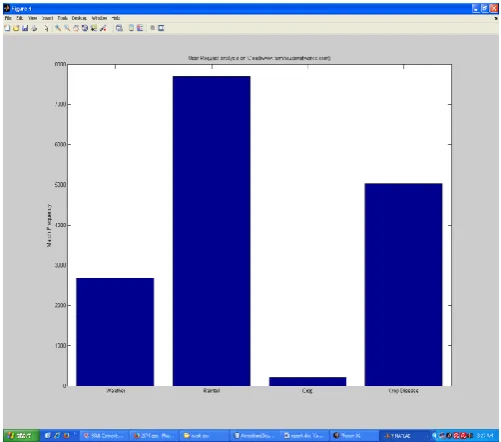
In the figure 1.6 the keyword adaptive mapping to the particular cloud server is shown. The number of instances mapped with the cloud counts is here shown. It shows the relevancy of the cloud contents. The figure shows that the cloud server is dedicatedly defined for rainfall.
IV.
CONCLUSION
In this present work, a real time service request analysis model is defined to perform the cloud server analysis under relevancy vector and identify the appropriate cloud server in accordance to client request. The work is here defined to perform the agriculture specific search. The keywords included here include weather, crop, crop disease, rainfall etc. The work is here divided as the two stage model. In first stage of this model, the service request analysis and scheduling is performed. In second stage, the cloud services are identified based on the service request. Based on the relevancy and the scheduling method, the service provided by cloud servers is allocated to requested clients. The work is implemented in CloudSim integrated java environment. The analytical results show that the work has provided the effective solution in effective time.
V.
FUTURE SCOPE
The work here is about to perform the scheduling with the allocation of the user requests to the real time cloud based on relevancy check. The work is defined specially for agriculture clouds. The Future enhancements of the work are possible in the following directions
1.
In present, the work has terms deadline and memory limit as overload conditions of the
2. Clouds. Some other parameters can also be used in deciding the migration condition.
3. The presented work is defined here for the public cloud environment, but the extension of work could be implemented in private and the hybrid Cloud environment.
![Figure 1.1: User Oriented Cloud Service Model [3]](https://thumb-us.123doks.com/thumbv2/123dok_us/1939859.1255007/2.595.114.483.119.506/figure-user-oriented-cloud-service-model.webp)