Cryptanalysis of the RSA Subgroup Assumption
from TCC 2005
?Jean-S´ebastien Coron1, Antoine Joux2,3, Avradip Mandal1, David Naccache4, and Mehdi Tibouchi1,4
1 Universit´e du Luxembourg
6, rue Richard Coudenhove-Kalergi l-1359 Luxembourg, Luxembourg
{jean-sebastien.coron,avradip.mandal}@uni.lu 2 Direction g´en´erale de l’armement (DGA) 3
Universit´e de Versailles–Saint-Quentin, Laboratoire PRISM 45, avenue des ´Etats-Unis,f-78035 VersaillesCedex, France
Ecole normale sup´erieure
D´epartement d’informatique, Groupe de cryptographie 45, rue d’Ulm,f-75230 ParisCedex 05, France
{david.naccache, mehdi.tibouchi}@ens.fr
Abstract. At TCC 2005, Groth underlined the usefulness of working in small RSA subgroups of hidden order. In assessing the security of the relevant hard problems, however, the best attack considered for a subgroup of size 22` had a complexity of O(2`). Accordingly, ` = 100 bits was suggested as a concrete parameter.
This paper exhibits an attack with a complexity of roughly 2`/2 opera-tions, suggesting that Groth’s original choice of parameters was overly aggressive. It also discusses the practicality of this new attack and various implementation issues.
Key-words:rsa moduli, hidden order, subgroup, cryptanalysis.
1 Introduction
In 2005, Jens Groth [6] proposed a collection of cryptographic primitives based on small RSA subgroups of Z∗N of hidden orders. The motivation behind these constructions is improved efficiency and tighter security re-ductions.
The RSA moduliN used in [6] are of the form:
N =p·q= (2p0r+ 1)·(2q0s+ 1)
?
where p, p0, q,q0 are prime integers and r, sare random integers. Then there exists a unique subgroup G of Z∗N of order p0q0. Letting g be a
random generator ofG, the pair (N, g) is made public whereas everything
else including the group orderp0q0 is kept secret.
The best attack considered in [6] has complexity O(p0). Therefore, when proposing concrete parameters, the author suggests to take the bit-lengths `p0 and `q0 of the primes p0 andq0 as`p0 =`q0 = 100.
This paper does not consider any specific scheme from [6]. Instead, it describes an attack that recovers the secret factors of N from the public data (N, g) in ˜O(√p0). This results in a 250 attack making the choice `p0 = `q0 = 100 potentially insecure. We analyze the practicality of our
attack with an implementation, for which we provide the source code in the Appendix.
Remark 1. In [6], Groth also considers RSA subgroups where r and s are smooth integers (i.e. all prime factors of r and s are smaller than some boundB). For this specific variant an attack in complexity O(√p0) is given in [6], and consequently larger parameters (`p0 = `q0 = 160) are
suggested. In this paper we do not consider this variant but directly focus on the general case.
Remark 2. Other works have proposed schemes based on small subgroups ofZ∗n. The attack introduced in this paper applies to some, but not all of them. In particular, the scheme proposed by Damg˚ardet al. in [5] uses a subgroup of prime order v of Z∗n, where v is a factor of both p−1 and q−1 (of around 160 bits). Since the group has the same order modulo p and q, the attack presented herein does not apply to this scheme. On the other hand, it does, in principle, apply to the subgroup variant of the Paillier cryptosystem [10]. The parameter choice from the original paper was more conservative than that of Groth, however (320-bit subgroup), making it out of reach of our new attack.
2 The New Attack
Using the notations above, we factor N in time ˜O(√p0) and memory
O(√p0) as follows. Recall that the RSA modulusN =pqis such that:
N =p·q= (2p0r+ 1)·(2q0s+ 1)
wherep0 and q0 are prime; besides,g is a generator of the subgroup Gof
order p0q0. Fromgp0q0 = 1 modN we get:
Let`denote the bit-length ofp0, which we assume is even without loss of generality, and write ∆= 2`/2. We then have
p0 =a+∆·b
with 0≤a, b <2`/2. From (1), we get:
ga= (g∆)−b mod p
If the prime factor p was known, one could carry out a baby-step giant-step attack by generating the following two lists:
Lp={gi modp: 0< i <2`/2}
L0p={(g∆)−j modp: 0≤j <2`/2}
and finding a collision between Lp and L0p, which would reveal a, b and thusp0 in total time and spaceO(2`/2).
Obviouslyp is unknown, so instead of computingLp and L0p, we gen-erate the two following lists modulo N:
L={xi =gi modN : 0< i <2`/2}
L0={yj = (g∆)−j modN : 0≤j <2`/2}
One could then compute gcd(xi−yj, N) for all xi ∈ L and all yj ∈ L0. Since we have
xa−yb = 0 mod p
this would reveal the factors of N for i = a and j = b. However, the complexity of this naive approach is quadratic in∆, and will thus require 2` computations, not 2`/2. Hence we proceed as follows instead:
1. Generate the polynomial:
f(x) = Y
xi∈L
(x−xi) mod N
2. For allyj ∈L0, evaluatef atyj and compute gcd(f(yj), N).
Since we have
f(yb) =
Y
xi∈L
(yb−xi) = (yb−xa)·R= 0 modp
computing gcd(f(yj), N) reveals the factors of N forj =b.
Algorithm 1 Attack overview.
1: Let∆←2`/2. 2: fori= 0 to∆−1do
3: xi←gi modN
4: yi←(g∆)−i modN
5: end for
6: Generate the polynomial
f(x)← ∆−1
Y
i=1
(x−xi) modN
7: fori= 0 to∆−1do
8: Evaluatef(yi)∈ZN
9: Attempt to factorN by computing gcd(f(yi), N).
10: end for
3 Attack Complexity
This attack involves the computation and evaluation of a polynomial of the form:
f(x) = d−1
Y
i=1
(x−xi) mod N
with d = 2`/2. It is a classical fact [1] that the coefficients of such a polynomial can be computed using a product tree, with a total number of operations inZN which is quasilinear ind(namelyO(M(d) logd), where M(d) is the complexity of the multiplication of two polynomials of degree d). Similarly, with a remainder tree, this polynomial can be evaluated at all points yj, 0≤j < dinO(M(d) logd) operations.
Since this approach is easy to follow, we provide the source code of an implementation using this technique in Appendix C in SAGE [12] for the reader’s convenience.
Thus, for typical parameter sizes, the attack is essentially linear in √
p0 both in time and space.
4 Algorithmic Details
As discussed above, we can break down the attack in two steps: first com-pute the coefficients of the polynomialf(x) =Qd−1
i=1(x−xi) modN, and then evaluatef mod N at each of the pointsyj. Since both (xi) and (yj) are geometric progressions, both of these steps reduce to a variant of the discrete Fourier transform, called the “chirp transform” (or its inverse) [11, 2]. In our implementation, we carry out these computations using the particularly efficient algorithms of Bostan and Schost [4], as described in [3, §5.5]. More precisely, Bostan gives pseudocode, reproduced as Algo-rithms 3 and 4 in Appendix A, to compute polynomial interpolation and polynomial evaluation at a geometric progression.
In our case, a number of futher simplifications are possible in the interpolation stage. Indeed, f(xi) = 0 for 1 ≤ i ≤ d−1 and f(1) =
Qd−1
i=1(1−xi), so with the notations of Algorithm 3, v0 = (−1)n
−1s n−1 andvi = 0 fori >0. This means in particular that the polynomial multi-plication of Algorithm 3, Step 9 reduces to a simple scalar multimulti-plication, and that the computations of Steps 10–12 can be carried out in the main loop. We can also have a slightly more conservative memory manage-ment, with only 4 polynomials of degree n−1 kept in memory for both the interpolation and the evaluation step. Finally, the multiplications by si in Algorithm 4, Step 14 can be skipped altogether as we search for a factor of N with GCD computations, since the si’s are prime to N by construction. We obtain the detailed procedure described in Algorithm 2. The attack can again be broken down in three stages: interpolation in Steps 2–18, evaluation in Steps 19–36 and factor search in Steps 37–40. Complexity is dominated by the three quasi-linear multiplication steps: the middle products of Steps 15 and 32, and the polynomial multiplication of Step 36.
5 Implementation
Algorithm 2 Detailed attack.
1: functionAttack(g, n, N)
2: p←1;q←1;s←1;u←1;z←1;w←1
3: InitializeU, Z, S, W as zero polynomials of degreen−1 4: U0←u;Z0←z;W0←w
5: fori= 1 ton−1do
6: p←p·gmodN
7: q←q·pmodN
8: s←s·(p−1) modN
9: u←u·p/(1−p) modN
10: z←(−1)iu/qmodN
11: w←q/(s·u) modN
12: Ui←u;Zi←z;Wi←w
13: end for
14: Z ←(−1)n−1sn−1·ZmodN
15: W ←mult(n−1, U, W) 16: fori= 0 ton−1do
17: Wi←Wi·ZimodN
18: end for
19: g←1/(p·g) modN . g←g−∆
20: p←1;q←1;s←1;u←1;z←1;w←1 21: U ←0;Z←0
22: U0←u;Z0←z;S0←s
23: fori= 1 ton−1do
24: p←p·gmodN
25: q←q·pmodN
26: s←s/(p−1) modN
27: u←u·p/(1−p) modN
28: z←(−1)iu/qmodN
29: Si←s;Ui←u;Zi←z
30: Wi←Wi/zmodN
31: end for
32: W ←mult(n−1, Z, W) 33: fori= 0 ton−1do
34: Wi←(−1)iWi·UimodN
35: end for
36: W ←W·S
37: fori= 0 ton−1do
38: if gcd(Wi, N)= 16 then returngcd(Wi, N) .Factor found!
39: end if
40: end for
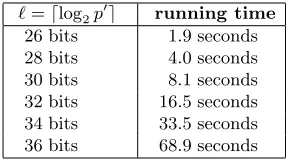
In Table 1, we provide the observed running time of our attack on an Intel Core2 Duo E8500 3.12 GHz, for 1024-bit RSA moduli. The program was linked to the following libraries: FLINT 1.6 (prerelease), MPIR 2.1.3 and MPFR 3.0, and ran on a single CPU core.
`=dlog2p0e running time
26 bits 1.9 seconds 28 bits 4.0 seconds 30 bits 8.1 seconds 32 bits 16.5 seconds 34 bits 33.5 seconds 36 bits 68.9 seconds
Table 1.Experimental attack running times for 1024-bit moduli.
From Table 1 we see that, as expected, running times are essentially linear in √p0. Direct extrapolation yields the following estimates:
`=dlog2p
0e
running time estimated number of clock cycles
60 bits 3 days 250
80 bits 9 years 260
100 bits 9000 years 270
Table 2.Estimated attack running times for 1024-bit moduli.
Thus, even the parameter ` = 100 suggested in Groth’s paper [6] would require a large but not unachievable amount of computation, even by academic standards. As a comparison, the recent factorization of RSA 768 [9] required about 2000 CPU-years.
Most importantly, it is difficult to deal with larger parameters because the attack is heavily memory-bound: theO(√p0) memory requirement is a serious hurdle. In experiments, we encountered memory problems as early as`≈38 for a 1024-bit modulus, and even with much more careful memory management and the use of mass storage rather than RAM, it seems unlikely that parameters larger than`≈60 can be attacked unless storage can be efficiently distributed as well.
6 Conclusion
We have described an attack against the RSA subgroup of hidden order described in [6] that works in time ˜O(√p0) while the best attack
consid-ered in [6] had complexity O(p0). We have implemented our attack and assessed its practicality. As expected, our attack exhibits a time com-plexity quasi-linear in √p0. In terms of CPU time alone, the parameters
suggested in [6] appear to be within reach for a resourceful attacker. How-ever, due to heavy memory requirements and parallelization problems, these parameters may remain unchallenged.
An interesting open question is to decrease the memory requirement: an algorithm similar to Pollard rho or Pollard lambda with constant mem-ory would be the most convenient type of attack on this problem if it exists. If not, a method for distributing the computation and storage effi-ciently would be the simplest way to make the attack practical for larger parameters.
Acknowledgments. We are grateful to Luca De Feo, Marc Mezzarobba and anonymous referees for useful comments. This work was partly sup-ported by the French ANR-07-TCOM-013-04 PACE Project and by the European Commission through the IST Program under Contract ICT-2007-216646 ECRYPT II.
References
1. D.J. Bernstein,Fast multiplication and its applications, Algorithmic number the-ory: lattices, number fields, curves and cryptography, MSRI Publications, vol. 44, Cambridge University Press, 2008, pp. 325–384.
2. L.I. Bluestein,A linear filtering approach to the computation of the discrete Fourier transform, IEEE Trans. Electroacoustics, vol. 18, 1970, pp. 451–455.
3. A. Bostan,Algorithmique efficace pour des op´erations de base en calcul formel(in English), Ph.D. thesis, ´Ecole polytechnique, 2003.
5. I. Damg˚ard, M. Geisler and M. Krøigaard, Efficient and secure comparison for on-line auctions, Proceedings of ACISP 2007, LNCS, vol. 4586, Springer-Verlag, 2007, pp. 416–430.
6. J. Groth,Cryptography in subgroups ofZ∗n, Proceedings of TCC 2005, LNCS, vol.
3378, Springer-Verlag, 2005, pp. 50–65.
7. G. Hanrot, M. Quercia and P. Zimmermann,The middle product algorithm, I., Ap-plicable Algebra in Engineering, Communication and Computing, vol. 14, Springer-Verlag, 2004, pp. 415–438.
8. W.B. Hart, D. Harveyet al.,Fast library for number theory,www.flintlib.org. 9. T. Kleinjung, K. Aoki, J. Franke, A.K. Lenstra, E. Thom´e, J.W. Bos, P. Gaudry,
A. Kruppa, P.L. Montgomery, D.A. Osvik, J.J. te Riele, A. Timofeev and P. Zim-mermann,Factorization of a 768-bit RSA modulus, Proceedings of CRYPTO 2010, LNCS, vol. 6223, Springer-Verlag, 2010, pp. 333–350.
10. P. Paillier and D. Pointcheval,Efficient public-key cryptosystems provably secure against active adversaries, Proceedings of ASIACRYPT 1999, LNCS, vol. 1716, Springer-Verlag, 2004, pp. 165–179.
11. L.R. Rabiner, R.W. Schafer and C.M. Rader,The chirpz-transform algorithm and its applications, Bell System Tech. J., vol. 48, 1969, pp. 1249–1292.
12. Sage Library, available athttp://www.sagemath.org/
A Bostan’s algorithms
Algorithm 3 Polynomial interpolation: compute the polynomial F of degree < n such thatF(pi) =vi, wherepi =qi, 0≤i≤n−1.
1: functionInterpGeom(p0, . . . , pn−1;v0, . . . , vn−1)
2: q0←1;s0←1;u0←1;z0←1;w0←v0
3: fori= 1 ton−1do
4: qi←qi−1·pi
5: si←si−1·(pi−1)
6: ui←ui−1·pi/(1−pi)
7: zi←(−1)iui/qi
8: end for
9: H ← Pn−1 i=0 vi/six
i
· Pn−1 i=0(−x)
i
qi/si
10: fori= 1 ton−1do
11: wi←(−1)iCoeff(H, i)/ui
12: end for
13: G←mult(n−1,Pn−1 i=0 uix
i,Pn−1 i=0 wix
i)
14: returnPn−1
i=0 ziCoeff(G, i)x i
15: end function
B Source code of the attack
Algorithm 4 Polynomial evaluation: evaluate the polynomial F at all pointspi=qi, 0≤i≤n−1.
1: functionEvalGeom(p0, . . . , pn−1;F)
2: q0←1;s0←1;u0←1;z0←1;g0←1
3: fori= 1 ton−1do
4: qi←qi−1·pi
5: si←si−1·(pi−1)
6: ui←ui−1·pi/(1−pi)
7: zi←(−1)iui/qi
8: end for
9: G←mult(n−1,Pn−1
i=0 zixi,Pn
−1
i=0 Coeff(F, i)/zixi)
10: fori= 1 ton−1do
11: gi←(−1)iuiCoeff(G, i)
12: end for
13: W ← Pn−1 i=0 gix
i
· Pn−1 i=0 s
−1 i x
i
14: returns0Coeff(W,0), . . . , sn−1Coeff(W, n−1)
15: end function
#include <time.h> #include <gmp.h>
#include "F_mpz_poly.h" #include "F_mpz.h"
void F_mpz_poly_set_coeff_F_mpz(F_mpz_poly_t, ulong, const F_mpz_t);
void attack(F_mpz_t q, F_mpz_t m, unsigned long n) {
F_mpz_poly_t polW, polU, polZ, polS; F_mpz_t pi, qi, si, ui, zi, wi, x; unsigned long i;
printf("Attack started.\n");
F_mpz_poly_init2(polW, n); F_mpz_poly_init2(polU, n); F_mpz_poly_init2(polZ, n); F_mpz_poly_init2(polS, n);
/* Step 1: interpolation */
F_mpz_init(si); F_mpz_set_ui(si, 1); F_mpz_init(ui); F_mpz_set_ui(ui, 1); F_mpz_init(zi); F_mpz_set_ui(zi, 1); F_mpz_init(wi); F_mpz_set_ui(wi, 1); F_mpz_init(x);
F_mpz_poly_set_coeff_F_mpz(polU, n-1, ui); F_mpz_poly_set_coeff_F_mpz(polZ, 0, zi); F_mpz_poly_set_coeff_F_mpz(polW, 0, wi);
for(i=1; i<n; i++) {
F_mpz_mulmod2(qi, qi, pi, m); F_mpz_mulmod2(pi, pi, q, m);
/* s_i = s_{i-1} * (p_i - 1) */ F_mpz_sub_ui(x, pi, 1);
F_mpz_mulmod2(si, si, x, m);
/* u_i = u_{i-1} * p_i/(1 - p_i) */ F_mpz_invert(x, x, m);
F_mpz_mul2(ui, ui, pi); F_mpz_mul2(ui, ui, x); F_mpz_neg(ui, ui); F_mpz_mod(ui, ui, m);
F_mpz_poly_set_coeff_F_mpz(polU, n-1-i, ui);
/* z_i = (-1)^i u_i / q_i */ F_mpz_invert(x, qi, m); F_mpz_mulmod2(x, x, ui, m); if(i & 1)
F_mpz_neg(zi, x); else
F_mpz_set(zi, x);
F_mpz_poly_set_coeff_F_mpz(polZ, i, zi);
/* w_i = q_i / (s_i * u_i) */ F_mpz_mul2(x, x, si);
F_mpz_poly_set_coeff_F_mpz(polW, i, wi); }
/* W *= (-1)^{n-1} s_{n-1} */ if(!(n & 1))
F_mpz_neg(si, si);
F_mpz_poly_scalar_mul(polW, polW, si); F_mpz_poly_scalar_smod(polW, polW, m);
F_mpz_poly_mul_trunc_left(polW, polU, polW, n-1); F_mpz_poly_right_shift(polW, polW, n-1);
for(i=0; i<n; i++) {
F_mpz_mulmod2(polW->coeffs + i, polW->coeffs + i, polZ->coeffs + i, m); }
printf("Polynomial interpolation complete.\n");
/* Step 2: evaluation */ F_mpz_mul2(q, q, pi); F_mpz_invert(q, q, m);
F_mpz_set_ui(pi, 1); F_mpz_set_ui(qi, 1); F_mpz_set_ui(si, 1); F_mpz_set_ui(ui, 1); F_mpz_set_ui(zi, 1); F_mpz_set_ui(wi, 1);
F_mpz_poly_zero(polU); F_mpz_poly_zero(polZ);
F_mpz_poly_set_coeff_F_mpz(polU, 0, ui); F_mpz_poly_set_coeff_F_mpz(polZ, n-1, zi); F_mpz_poly_set_coeff_F_mpz(polS, 0, si);
for(i=1; i<n; i++) {
/* s_i = s_{i-1} / (p_i - 1) */ F_mpz_sub_ui(x, pi, 1);
F_mpz_invert(x, x, m);
F_mpz_mulmod2(si, si, x, m);
F_mpz_poly_set_coeff_F_mpz(polS, i, si);
/* u_i = u_{i-1} * p_i/(1 - p_i) */ F_mpz_mul2(ui, ui, pi);
F_mpz_mul2(ui, ui, x); F_mpz_neg(ui, ui); F_mpz_mod(ui, ui, m);
F_mpz_poly_set_coeff_F_mpz(polU, i, ui);
/* z_i = (-1)^i u_i / q_i */ F_mpz_invert(x, qi, m); F_mpz_mulmod2(x, x, ui, m); if(i & 1)
F_mpz_neg(zi, x); else
F_mpz_set(zi, x);
F_mpz_poly_set_coeff_F_mpz(polZ, n-1-i, zi);
/* w_i /= z_i */
F_mpz_invert(x, zi, m);
F_mpz_mulmod2(polW->coeffs + i, polW->coeffs + i, x, m); }
F_mpz_poly_mul_trunc_left(polW, polZ, polW, n-1); F_mpz_poly_right_shift(polW, polW, n-1);
F_mpz_poly_clear(polZ);
for(i=0; i<n; i++) { if(i & 1)
F_mpz_neg(polU->coeffs + i, polU->coeffs + i);
}
F_mpz_poly_clear(polU);
F_mpz_poly_mul(polW, polW, polS); F_mpz_poly_clear(polS);
printf("Evaluation complete. Searching for a factor.\n"); for(i=0; i<n; i++) {
F_mpz_gcd(x, polW->coeffs + i, m); if(!F_mpz_is_one(x)) {
printf("Factor found!\n"); F_mpz_print(x);
printf("\n"); break;
} }
F_mpz_poly_clear(polW);
F_mpz_clear(pi); F_mpz_clear(qi); F_mpz_clear(si); F_mpz_clear(ui); F_mpz_clear(zi); F_mpz_clear(wi); F_mpz_clear(x); }
int main() {
F_mpz_t m, g; unsigned long d; clock_t c0, c1;
printf("Enter parameters N, g, d.\n"); F_mpz_init(m);
F_mpz_init(g);
F_mpz_read(g); scanf("%lu", &d);
printf("\nParameters:\nN = "); F_mpz_print(m);
printf("\ng = "); F_mpz_print(g);
printf("\nd = %lu\n\n", d);
c0 = clock();
attack(g, m, 1L<<d); c1 = clock();
printf("Elapsed time: %.3f seconds.\n", ((float)(c1-c0))/CLOCKS_PER_SEC); }
C Simpler, less efficient tree-based version in SAGE
import sys,time
def GenSubgroup(n=30,l=100):
"Generates a prime p=2*pp*r+1 of size l bits, with pp of size n bits" while True:
pp=random_prime(2^n,lbound=2^(n-1)) r=ZZ.random_element(2^(l-n))
if 2*pp*r+1 in Primes(): break return 2*pp*r+1,pp,r
def ProdPoly(X,xi):
"Computes \prod (X-x_i)" l=len(xi)
if l==1: return X-xi[0]
return ProdPoly(X,xi[:int(l/2)])*ProdPoly(X,xi[int(l/2):])
def ProdPolyTree(X,yi):
"Returns the multiplication tree for polymomial \prod (X-y_i)" l=len(yi)
t2=ProdPolyTree(X,yi[int(l/2):]) return (t1[0]*t2[0],t1,t2)
def EvaluationTree(f,tr):
"Evaluates polynomial f using the multiplication tree for \prod (X-y_i)" (p,t1,t2)=tr
if t1==False: return [f.quo_rem(p)[1]] f1=f.quo_rem(t1[0])[1]
f2=f.quo_rem(t2[0])[1]
return EvaluationTree(f1,t1)+EvaluationTree(f2,t2)
def Evaluation(X,f,yi):
return EvaluationTree(f,ProdPolyTree(X,yi))
def Attack(n=24,l=512): print "n=",n
print "Key generation"
p,pp,r=GenSubgroup(n,l); q,qq,s=GenSubgroup(n,l) NN=p*q
#print "NN=",NN,"\np=",p,"\nq=",q,"\npp=",pp,"\nqq=",qq g=ZZ.random_element(NN)
g=power_mod(g,2*r*s,NN) k=2^(n//2)
t0=time.time()
print "Generation of the x_i’s and y_i’s" t=time.time()
xi=[1]
for i in range(1,k-1):
xi.append(mod(xi[-1]*g,NN)) yi=[power_mod(g,2^n,NN)] h=power_mod(g,-k,NN) for i in range(1,k):
yi.append(mod(yi[-1]*h,NN))
print " Done in %.2f s" % (time.time()-t)
R=PolynomialRing(IntegerModRing(NN),’X’) X=R.gen()
f=ProdPoly(X,xi)
print " Done in %.2f s" % (time.time()-t)
print "Evaluation of f(x)" t=time.time()
fi=Evaluation(X,f,yi)
print " Done in %.2f s" % (time.time()-t)
for f in fi: u=gcd(f,NN)
if u!=1 and u!=NN:
print "Total running time: %.2f s\n" % (time.time()-t0) return u==p or u==q
def test(l=512):