Low-weight Pseudo Collision Attack on Shabal
and Preimage Attack on Reduced Shabal-512
Takanori Isobe and Taizo Shirai
Sony Corporation
1-7-1 Konan, Minato-ku, Tokyo 108-0075, Japan
{Takanori.Isobe,Taizo.Shirai}@jp.sony.com
Abstract. This paper studies two types of attacks on the hash function Shabal. The first attack is a low-weight pseudo collision attack on Shabal. Since a pseudo collision attack is trivial for Shabal, we focus on a low-weight pseudo collision attack. It means that only low-weight difference in a chaining value is considered. By analyzing the difference propagation in the underlying permutation, we can construct a low-weight (45-bits) pseudo collision attack on the full compression function with complexity of 284. The second attack is a preimage attack on variants of Shabal-512. We utilize a guess-and-determine technique, which is originally developed for a cryptanalysis of stream ciphers, and customize the technique for a preimage attack on Shabal-512. As a result, for the weakened variant of Shabal-512 using security parameters (p, r) = (2,12), a preimage can be found with complexity of 2497 and memory of 2400. Moreover, for the Shabal-512 using security parameters (p, r) = (1.5,8), a preimage can be found with complexity of 2497 and memory of 2272. To the best of our knowledge, these are best preimage attacks on Shabal variants and the second result is a first preimage attack on Shabal-512 with reduced security parameters.
Key words: Shabal, low-weight pseudo collision attack, preimage attack, guess-and-determine technique, SHA-3 competition
1 Introduction
Cryptographic hash functions play important roles in modern cryptology. Many cryptographic protocols require a secure hash function which holds several security properties classically in-cluding a preimage resistance, a second preimage resistance and a collision resistance. Due to the recent attacks on commonly used hash function (e.g. MD5, SHA-1) [13][14], NIST announced the SHA-3 competition to decide an advanced hash function standard [12]. In November 2008, NIST received 64 submissions, and 51 candidates proceed in the first round. In July 2009, NIST announced the 14 second round candidates.
Shabal, which is designed by E. Bresson et al. [5], is one of the second round candidates of the SHA-3 competition. Shabal employs an original mode of operation using a keyed permu-tation. The keyed permutation consist of an initial loop, a main loop and a final loop, and is parameterized by two security parameters (p, r):
Parameter p: The number of the main loop performed within one application of the keyed permutation. Large values ofp provide better security guarantees.
Parameter r: An integer used to determine the size of one of the internal state. The minimal value is 2.
A recommended set of the parameters by the designers of Shabal is (p, r) = (3,12), which is used for the version of Shabal submitted to the SHA-3 hash competition. Shabal supports 192, 224, 256, 384 and 512-bit digest.
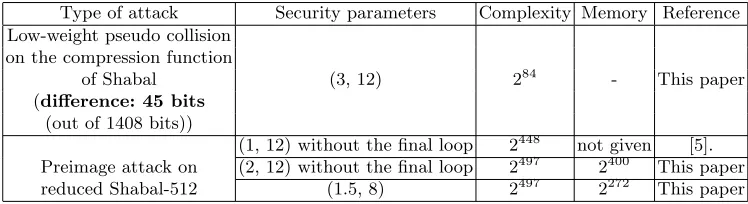
Table 1.Summary of Our Results
Type of attack Security parameters Complexity Memory Reference
Low-weight pseudo collision on the compression function
of Shabal (3, 12) 284 - This paper
(difference: 45 bits
(out of 1408 bits))
(1, 12) without the final loop 2448 not given [5].
Preimage attack on (2, 12) without the final loop 2497 2400 This paper
reduced Shabal-512 (1.5, 8) 2497 2272 This paper
compression function, and do not lead to an attack of Shabal hash function. Cryptanalysis of reduced Shabal has been reported only in a designer’s self evaluation so far.
In this paper, we show new results on two kinds of attacks on Shabal hash function, they are a low-weight pseudo collision attack and a preimage attack.
A low-weight pseudo collision attack is a variant of a pseudo collision attack. In a normal setting of the pseudo collision attack, an attacker inserts a difference not only into message blocks but also into a chaining value. Finding a pseudo collision is trivial for Shabal, because the compression function of Shabal is invertible.
In this paper, we focus on a low-weight pseudo collision which considers only a low-weight difference in a chaining value. In order to construct a low-weight pseudo collision on Shabal, we use the linearization technique to analyze behaviors of differences and search an differential path effectively. As a result, we can construct a low-weight (45-bits) pseudo collision attack on the full compression function of Shabal with complexity of 284. In other word, the input chaining value has 45-bit difference and other 1363 (= 512 + 512 + 384−45) bits do not have difference. Since a low-weight pseudo collision attack can also be seen as a near collision attack with respect to the inverse of the compression function, we consider that it reveals potential of the diffusion property of the Shabal. Although our result does not threat the claimed security of Shabal due to that this is a pseudo collision setting, this shows that the differential property of the compression function of Shabal is not ideal. The result of the attack is summarized in Table 1.
The other result is a preimage attack on Shabal’s variants. A preimage attack on the weakened variant, Shabal-512 without the final loop, have been analyzed by designers [5]. The weakened variant using security parameters (p, r) = (1,12) does not hold preimage resistance. The preimage attack utilizes the weakness of the compression function that a part of the output of the inverse of the compression function can be controlled by an input message block. Since the same attack is not successful on the weakened variant using (p, r) = (2,12), the current record of the preimage attack is only the weakened variant using (p, r) = (1,12).
In this paper, we propose a novel approach using a guess-and-determine technique for con-trolling a part of the output of the inverse of the compression function. The technique enable a preimage attack on the weakened variant using (p, r) = (2,12). Moreover, we show an attack on the Shabal-512 using (p, r) = (1.5,8) including the final loop. This result is a first preim-age attack on the Shabal-512 with reduced security parameters. The results of the attack are summarized in Table 1.
P P P P P P
Message rounds
A0
B0
C0
M1 M2 Mk Mk Mk Mk
W1 W2 Wk Wk Wk Wk
Final rounds
Hash=trunc(Ck+3)
Fig. 1.The Mode of Operation of Shabal
2 Description of Shabal
In this section, we provide a brief description of the hash function Shabal [5].
2.1 Mode of Operation
Shabal employs an original mode of operation based on a keyed permutation which is calledP. The mode of operation is shown in Fig 1. In the mode of operation, the internal state consists of three parts (A, B, C) whose sizes are 32×r, 512 and 512 respectively.r is one of the tunable security parameters. Let Ai, Bi, and Ci be the i-th internal states (0≤i), and A0,B0 and C0 are initialization vectors IV.Mi is thei-th message block of 512 bits (0< i).
When a message block Mi+1 and a internal state (Ai, Bi, Ci) are given, the compression
functionR computes a new internal state (Ai+1, Bi+1, Ci+1) as follows:
(Ai+1, Ci+1) =PMi+1,Ci(Ai⊕Wi+1, Bi+Mi+1),
Bi+1=Ci−Mi+1.
Wi is a 64-bit counter incremented at each compression function, and PMi+1,Ci denotes that
Mi+1 and Ci act as the key of P. Arithmetic operations + and − are wordwise ones with
respected to 32-bit words, and⊕is an XOR operation. The mode of operation of Shabal repeat this calculation until the last message block. After that, three additional compression functions using the last message block are repeatedly performed without incrementing the counter. Finally a hash value is output by truncatingC of the internal state.
2.2 Keyed Permutation P
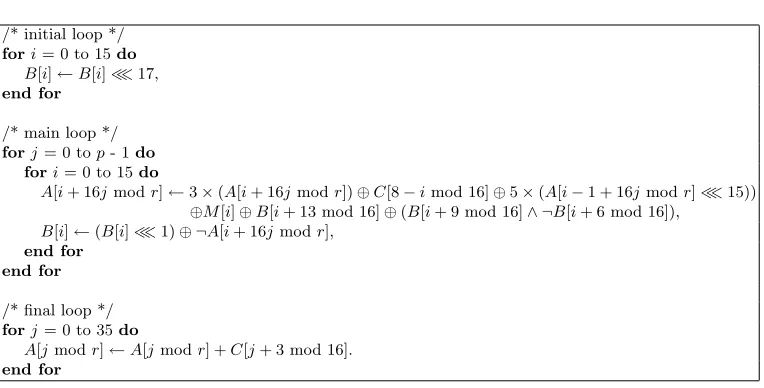
In each compression function, the keyed permutation P takes four inputs A,B,C and M, and outputs updatedAandB. In the permutationP,B,CandM are regarded as 16×32-bits words, and A is r×32-bit words, respectively. A[i] denotes thei-th word ofA. Then the definition of
P is shown as in Table 2.
In Table 2, ≪, ∧ and ¬ are a left rotation, a bitwise AND and a bitwise complement, respectively. The definition of the final loop in Table 2 is for the version ofr = 12. If a different value of the parameterr is used, the definition of the final loop is changed. The detailed rule is described in Appendix C. The recommended set of the parameters by the designers of Shabal is (p, r) = (3,12), which is used for the version of Shabal submitted to the SHA-3 competition.
3 Low-weight Pseudo Collision Attack on Shabal
Table 2.PermutationP
/* initial loop */
fori= 0 to 15do
B[i]←B[i]≪17,
end for
/* main loop */
forj= 0 top- 1do fori= 0 to 15do
A[i+ 16jmodr]←3×(A[i+ 16jmodr])⊕C[8−imod 16]⊕5×(A[i−1 + 16jmodr]≪15))
⊕M[i]⊕B[i+ 13 mod 16]⊕(B[i+ 9 mod 16]∧ ¬B[i+ 6 mod 16]), B[i]←(B[i]≪1)⊕ ¬A[i+ 16jmodr],
end for end for
/* final loop */
forj= 0 to 35do
A[jmodr]←A[jmodr] +C[j+ 3 mod 16].
end for
into a message and analyze propagation of the message difference through the inversion of the compression function. Let the inverse of the compression function be R−1. We need to search a differential path in which an output of R−1 is a low-weight difference to mount a low-weight pseudo collision attack. In the course of our study, we first show a near collision attack onR−1. After finding a near collision attack of R−1, it is converted into the low-weight pseudo collision attack on the compression function of Shabal.
3.1 Inverse of the Compression Function : R−1
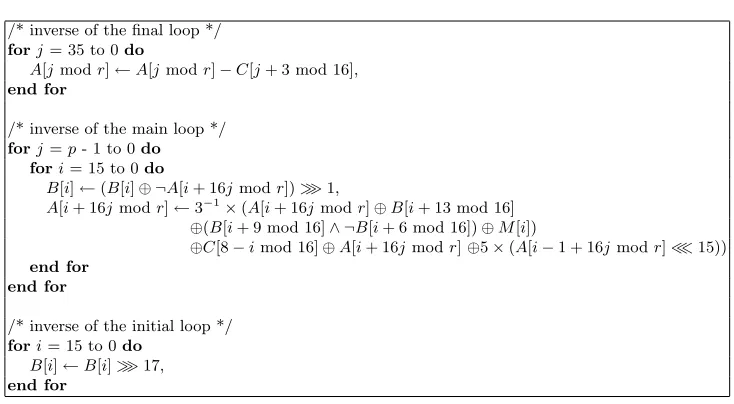
To begin with, since we need to analyze the compression function R backward, we use R−1 defined as follows:
Ci=Bi+1+Mi+1, (1)
(A0i, Bi0) =PM−1
i+1,Ci(Ai+1, Ci+1), (2)
(Ai, Bi, Ci) = (A0i⊕Wi+1, Bi0−Mi+1, Ci), (3)
where the inverse of the permutation P in Eq. (2) is defined as in Table 3, and A0i and Bi0 are intermediate values of Ai andBi, respectively. In Table 3,≫denotes a right rotation.
3.2 Linearization of Nonlinear Operations
In order to analyze propagation of differences, we study behaviors of differences through the nonlinear operations in R−1. Here we consider XOR differences in the analysis of R−1.
R−1 includes five nonlinear operations: a wordwise addition + , a wordwise subtraction−, a multiplication by 3−1, a multiplication by 5 and a bitwise AND. To search difference propagation path in R−1 effectively, we use a linear approximation technique for these operations except AND. Differential probability of an addition was studied by Lipmaa and Moriai [11], we use their result to calculate difference probabilities.
Table 3.Inverse of the PermutationP
/* inverse of the final loop */
forj= 35 to 0do
A[jmodr]←A[jmodr]−C[j+ 3 mod 16],
end for
/* inverse of the main loop */
forj=p- 1 to 0do fori= 15 to 0do
B[i]←(B[i]⊕ ¬A[i+ 16jmodr])≫1,
A[i+ 16jmodr]←3−1×(A[i+ 16jmodr]⊕B[i+ 13 mod 16]
⊕(B[i+ 9 mod 16]∧ ¬B[i+ 6 mod 16])⊕M[i])
⊕C[8−imod 16]⊕A[i+ 16jmodr]⊕5×(A[i−1 + 16jmodr]≪15))
end for end for
/* inverse of the initial loop */
fori= 15 to 0do
B[i]←B[i]≫17,
end for
Wordwise Addition and Subtraction: With respect to differences α and β for two inputs
x andy, we use the following equation of the linear approximation:
(x+y)⊕((x⊕α) + (y⊕β)) =α⊕β. (4)
The probability for Eq. (4) is 2−wt((α∨β)∧231−1), where wt(x) is the number of nonzero ele-ments ofx, and∨is a bitwise OR. The linear approximation holds when there is no difference in carries. The linear approximation and the probability of subtraction are same as addition, because the subtraction can be expressed as the addition by a bitwise complement.
Multiplication by 5: With respect to differenceαfor an inputx, we use the following equation of the linear approximation,
(x×5)⊕((x⊕α)×5) = (α2)⊕α. (5)
The probability for Eq. (5) is 2−wt((α2)∨α)∧011...10032). The linear approximation has the same linearization form as multiplication by 9 treated by Indesteege and Preneel [8]. As well as [8], the dependency betweenxand (x2) is ignored, because we suppose that the weight of differencesα is low.
Multiplication by 3−1: With respect to difference α , we use the following equation of the linear approximation,
(x×3−1)⊕((x⊕α)×3−1) =γ, (6)
The probability for Eq. (6) is 2−wt((γ1)∨γ)∧011...11032). In this equation, γ = g−1(α) and
g(γ) =γ⊕(γ 1).g−1(α) can be computed by determining from LSB to MSB ofγ in each bit as follows:γ0 =α0, γ1=α1⊕γ0, ..., γ31=α31⊕γ30, where γ0 is LSB ofγ, andα0 is LSB ofα, respectively.
difference pattern have the same probability, that is 2−wt(α∨β). Since we suppose thatα and β
are low weight, this probability is high enough. Hence, we consider that AND operation is useful to construct a differential path with high probability.
3.3 Path Search Methodology
In this section, we introduce a search method to find a differential path with high probability such that the output of R−1 has low-weight differences. As previously described, we insert a few differences into the message block and analyze difference propagation inR−1. Actually, we insert only 1-bit difference into MSB of M[0]i+1.
From Eq. (1), the 1-bit difference ofM[0]i+1propagates to the MSB ofCi[0] with probability
of 1. Thus, 2-bit differences go into PM,C−1 . In the inverse of the final loop, difference of C
propagates toA. LetA[48], ..., A[59] andB[48], ..., B[63] be inputsAandB of the inverse of the main loop, and A[0], ..., A[11] and B[0], ..., B[15] be the outputs of it. After the inverse of the final loop, MSBs of A[49] and A[53] have differences by MSB ofC[0] with probability of 1.
Then we start a path search from the start of the inverse of the main loop. By using the above notation of Aand B, operations of the inverse of the main loop are expressed as follows:
A[i] = 3−1×(A[i+ 12]⊕(¬B[i+ 6]·B[i+ 9])⊕B[i+ 13]⊕M[i])
⊕C[8−i]⊕(5×(A[i+ 11]≪15)), (7)
B[i] = (B[i+ 16]⊕ ¬A[i+ 12])≫1, (8)
The path search for the inverse of the main loop is divided into two phases : an automatic search phase and a manual search phase.
In the automatic search phase, we utilize an aforementioned linear approximation technique. The loop contains three nonlinear operations such as a multiplication by 3−1, a multiplication by 5, and AND. For a multiplication by 3−1, we use Eq. (6). For a multiplication by 5, we use Eq. (5) and additional difference patterns such that i-th input difference changes i,(i+ 1) and (i+ 2)-th differences, wherei= 12, 13, 14. Each probability is 2−3, which is calculated by [11]. For AND, we consider all possible difference patterns for each the input difference pattern. Using this method, we search the path automatically for the first 32 steps of the inverse of the main loop (in other view, it is the last 32 steps for the main loop) and find the path in which the weight of difference of Aand B at the 32nd step is the smallest.
After that, for the last 16 step, we search the path manually. In this phase, we use not only linear approximations used in the automatic search phase but also other linear approximations which have even low probabilities for 3−1 and 5 to minimize the weight of the differences at 48th step. The reason is that when it is converted to a pseudo collision attack, probability of this phase can be increased by a technique similar to the message modification [13][14]. We will explain the detail of the technique in Sect.3.5.
3.4 Near Collision Attack on R−1
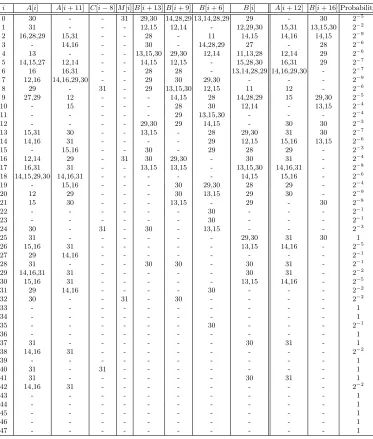
By using the above search methodology, we found a differential path which can be used for the near collision attack on R−1. Table 8 in Appendix A shows the obtained differential path. In the path, inputs A, C and M have 4 bits differences, that is, MSBs of A[49], A[53], C[0] and
2−28(=−(29−1)) due to Bi0 and Mi+1 with Eq. (4) and its probability. As a result, outputs ofR−1 have 45(= 15 + 29 + 1) bit differences.
This result can be seen as a near collision ofR−1. Thus, 1363(= 512 + 512−384−45)-bit near collision of R−1 with probability of 2−184(=−(156+28)) is obtained by this analysis.
3.5 Constructing a Low-weight Pseudo Collision Attack
Next, we construct a low-weight pseudo collision attack from the near collision of the R−1. Obviously, when we insert the above 45 bits difference into Ai, Bi and Ci, a colliding message
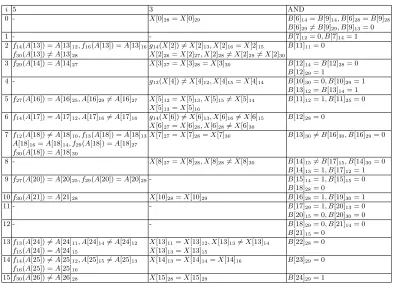
can be found with complexity of 2184. Moreover, we can improve the attack by the modification technique similar to [13][14]. Table 9 in Appendix B shows sufficient conditions in the first 16 steps of the main loop for the path of Table 8. In order to improve the attack, we choose Ai+1,
Bi+1,Ci+1 and Mi+1 which satisfy as many sufficient conditions as possible.
First, we choose theBi0(=Bi+Mi+1) satisfying conditions of AND. For AND, 21 conditions (out of 38) holds by choosing B0[6], ..., B0[15]. Next, we choose Mi+1 such that a difference act like Eq. (4) in the operation (Bi0−Mi+1). Since the weight of the difference of Bi0 is only 28,
the degree of freedom of Mi+1 remain sufficiently yet. After that, we choose A0i(= Ai ⊕Wi)
and Ci, and use the remaining freedom of Mi+1 to satisfy the conditions of ×3 and ×5. In particular, since each word of Ci and Mi+1 are used once in the first 16 steps, and Ai are used
once in the first 12 step, we choose each word to satisfy conditions step by step. Thus, by the modification, 72 condition holds (out of 89) in the first 16 steps, and differences act like Eq. (4) in the operations of (B0i−Mi+1).
Consequently, when we insert the obtained 45 difference into Ai, Bi and Ci, a colliding
message can be found with complexity of 284(=184−72−28).
3.6 Discussion
We summarize two results described in this section as:
1. 1363-bit (out of 1408 bits) near collision attack on the inverse of the compression function
R−1 with complexity of 2184.
2. Low-weight pseudo collision attack (45 bits) on the compression functionRwith complexity of 284.
The first result shows efficiency of the diffusion property of the inverse of compression function
R−1. We reveal that 1-bit message difference diffuses only 45 (out of 1408) bit through R−1 in a certain setting. We expect that this result might be useful to construct a collision attack with multi block setting as in [4]. But, we could not find such a differential path so far, thus this is an open problem. Although these result does not threat the claimed security of Shabal due to that this is a pseudo collision setting, these results show that the compression function of Shabal has the non-ideal differential property.
4 Preimage Attack on Reduced Shabal-512
In this section, we consider a preimage attack on variants of Shabal-512. In [5], preimage attacks on the weakened variants of Shabal-512 that is without the final loop inP have been analyzed1. The weakened variant of Shabal-512 using security parameter (p, r) = (1,12) does not hold the preimage resistance.
1
P P P P
k1 blocks k - k1 -2 blocks + final 3 blocks Forward process Backward process
A0
B0
C0
M1
W1
Ak1
Bk1
Ck1
Mk1+1 Mk1+2
Wk1+1 Wk2+1
Ak1+1
Bk1+1
Ck1+1
Ak1+2
Bk1+2
Ck1+2
Ak+2
Bk+2
Ck+2
Digest Mk
Meet point
Wk
Fig. 2.Outline of the Preimage Attack
The preimage attack utilizes the weakness of the inverse of the compression functionR−1: if
Ai+1,Bi+1andCi+1are given as inputs ofR−1, the attacker is able to find a messageMi+1such that Bi has any predetermined value. Since the same attack is not successful on the weakened
variant using (p, r) = (2,12), the current record of the preimage attack is only the weakened variant using (p, r) = (1,12).
In this section, two kinds of preimage attack are shown. First, we propose a novel preimage attack on the weakened variant of Shabal-512 using (p, r) = (2,12). Although this attack is based on the same weakness of R−1 as [5], we use an advanced technique to findMi+1such that
Bi has any predetermined value. Second, this technique can be applied to the Shabal-512 with
(p, r) = (1.5,8) including the final loop. This is the first preimage attack on Shabal-512 with reduced security parameters.
4.1 Basic Framework of the Preimage Attack
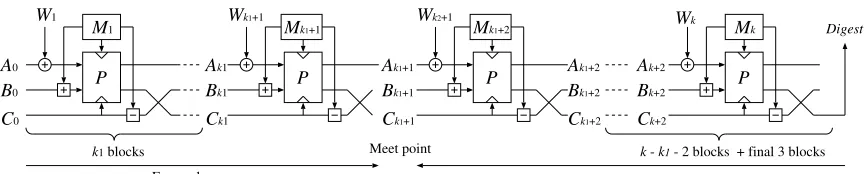
First, we explain a basic framework for a preimage attack on the variant of Shabal-512. This framework is same as [5]. Let digest be a given hash value and M be a k-block message as a preimage of the digest to be calculated, where k is an arbitrary integer more than 5. The outline of the preimage attack is shown in Fig 2. We split M into three parts : the first k1 blocks, the next two intermediate blocks, and the last (k −k1 −2) blocks. For the first k1 blocks, we randomly choose M1, ..., Mk1 and compute (Ak1, Bk1, Ck1). For the last (k−k1−2) block, we set digest asCk+3 part and choose the other partsAk+3 and Bk+3 randomly, where
Ak+3, Bk+3 and Ck+3 are values after final three compression functions. After that, similarly, we randomly choose Mk1+3, ..., Mk and compute (Ak1+2, Bk1+2, Ck1+2) backward. Then, for the two intermediate blocks, we use the meet-in-the-middle approach [9].
Since the size of the meet point (Ak1+1, Bk1+1, Ck1+1) is too large,e.g. forr=12, 1408 bits, the straight meet-in-the-middle approach does not work. Thus, we utilize these two intermediate message blocks, Mk1+1 and Mk1+2, to reduce the size of the meet point. In particular, we aim to fix Bk1+1 to an arbitrary value β to reduce the size of the meet point. In the forward process, it is noticed that Bk1+1 can be controlled easily by choosing Mk1+1 = Ck1 −β. In the backward process, if Bk1+1 can be also fixed to β, the size of the meet point is reduced to (Ak1+1, Ck1+1) from (Ak1+1, Bk1+1, Ck1+1). Therefore, more effective meet-in-the-preimage attack can be executed. Our goal is to find Mk1+2 such that Bk1+1 will be β in the backward process effectively.
4.2 Guess-and-Determine Technique
ciphers [7]. Since the permutation of Shabal is similar to a design of a wordwise NLFSR-type stream cipher, we customize the GD technique for finding such Mk1+2.
The GD technique is a technique for obtaining unknown values by using relations between known values and unknown values. As implied by the name of the GD technique, we first guess some of unknown values and then determine the other unknown values by using the equations between these values. In the case of Shabal, the unknown value is Mk1+2 and the known values are Ak1+2, Bk1+2,Ck1+2 and Bk1+1.
Basic attack steps are as follows:
Step 1: Construct equations describing relationships between Mk1+2,Ak1+2, Bk1+2,Ck1+2 and
Bk1+1,
Step 2: Guess some part of words in Mk1+2
Step 3: Determine the other words in Mk1+2 by using equations obtained in the step 1.
If we find Mk1+2 such that Bk1+1 is to be β in the backward process effectively by using the GD technique, we can construct a preimage attack using the attack framework in Sect. 4.1. Next, we are going to explain details of the steps of the GD technique for Shabal-512.
4.3 Preimage Attack on the Weakened Variant of Shabal-512 Using (p, r) = (2,12)
First, we show a preimage attack on the weakened variant of Shabal-512 using (p, r) = (2,12). For the variant, the number of the main loop is 32 (= 2×16), the size ofA is 384 (= 12×32) bits, and it does not include the final loop.
The steps of the GD approach are as follows.
Step 1: Construct equations between unknown value Mk1+2 and known values Bk1+1, Ak1+2,
Bk1+2 and Ck1+2. Let A[0], ..., A[11] and B[0], ..., B[15] be inputs and A[32], ..., A[43] and
B[32], ..., B[47] be outputs of the main loop of P. In the main loop, these values satisfy Eq. (7) and (8). Since this variant does not include the final loop in P, A[32], ..., A[43] correspond to known valuesAk1+2[0], ..., Ak1+2[11], andB[32], ..., B[47] correspond to known values Ck1+2[0], ..., Ck1+2[15]. In Eq. (7) and (8), other values M[i] and C[i] also appear.
M[0], ..., M[15] correspond to unknown values Mk1+2[0], ..., Mk1+2[15]. From Eq. (1),C[i] is expressed by using known valueBk1+2 and unknown value Mk1+2 as follows:
C[i] =Bk1+2[i] +Mk1+2[i]. (9)
The equation with respect to other known valueBk1+1 is
Bk1+1[i] = (B[i])≫17)−M[i]. (10)
This equation is obtained from Eq. (3) and the inverse of the initial loop.
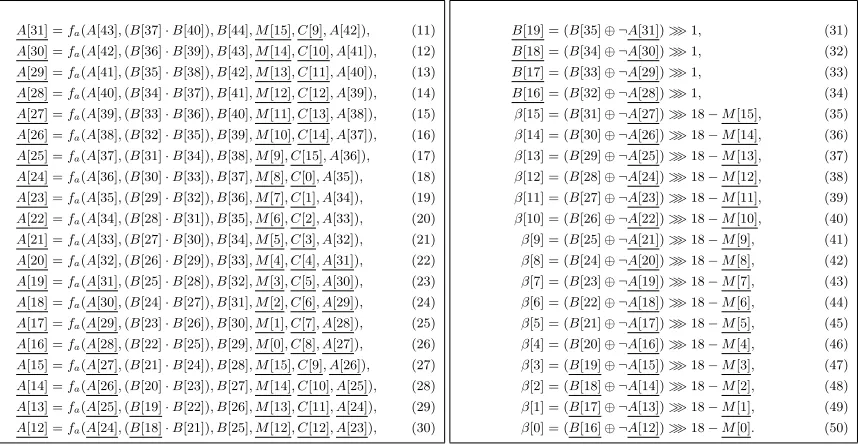
From (7)-(10), we construct equations as shown in Table 4, which includes all equations be-tween unknown valueMk1+2 and known valuesBk1+1,Ak1+2,Bk1+2 and Ck1+2. In Table 4, underlined values are unknown values and other values are known values, andβ[0], ..., β[15] correspond to known values Bk1+1[0], ..., Bk1+1[15]. From Eq. (8), B[20], ..., B[31] are com-puted with known valuesB[36], ..., B[47] andA[32], ..., A[43]. This is why thatB[20], ..., B[31] are known values.fa is a function defined as follows:
fa(A[i+ 12],(B[i+ 6]·B[i+ 9]), B[i+ 13], M[i], C[8−i], A[i+ 11])
= 3−1×(A[i+ 12]⊕(¬B[i+ 6]·B[i+ 9])⊕B[i+ 13]⊕M[i]).
Table 4.Equations for the Weakened Shabal Using (p, r) = (2,12)
A[31] =fa(A[43],(B[37]·B[40]), B[44], M[15], C[9], A[42]), (11)
A[30] =fa(A[42],(B[36]·B[39]), B[43], M[14], C[10], A[41]), (12)
A[29] =fa(A[41],(B[35]·B[38]), B[42], M[13], C[11], A[40]), (13)
A[28] =fa(A[40],(B[34]·B[37]), B[41], M[12], C[12], A[39]), (14)
A[27] =fa(A[39],(B[33]·B[36]), B[40], M[11], C[13], A[38]), (15)
A[26] =fa(A[38],(B[32]·B[35]), B[39], M[10], C[14], A[37]), (16)
A[25] =fa(A[37],(B[31]·B[34]), B[38], M[9], C[15], A[36]), (17)
A[24] =fa(A[36],(B[30]·B[33]), B[37], M[8], C[0], A[35]), (18)
A[23] =fa(A[35],(B[29]·B[32]), B[36], M[7], C[1], A[34]), (19)
A[22] =fa(A[34],(B[28]·B[31]), B[35], M[6], C[2], A[33]), (20)
A[21] =fa(A[33],(B[27]·B[30]), B[34], M[5], C[3], A[32]), (21)
A[20] =fa(A[32],(B[26]·B[29]), B[33], M[4], C[4], A[31]), (22)
A[19] =fa(A[31],(B[25]·B[28]), B[32], M[3], C[5], A[30]), (23)
A[18] =fa(A[30],(B[24]·B[27]), B[31], M[2], C[6], A[29]), (24)
A[17] =fa(A[29],(B[23]·B[26]), B[30], M[1], C[7], A[28]), (25)
A[16] =fa(A[28],(B[22]·B[25]), B[29], M[0], C[8], A[27]), (26)
A[15] =fa(A[27],(B[21]·B[24]), B[28], M[15], C[9], A[26]), (27)
A[14] =fa(A[26],(B[20]·B[23]), B[27], M[14], C[10], A[25]), (28)
A[13] =fa(A[25],(B[19]·B[22]), B[26], M[13], C[11], A[24]), (29)
A[12] =fa(A[24],(B[18]·B[21]), B[25], M[12], C[12], A[23]), (30)
B[19] = (B[35]⊕ ¬A[31])≫1, (31)
B[18] = (B[34]⊕ ¬A[30])≫1, (32)
B[17] = (B[33]⊕ ¬A[29])≫1, (33)
B[16] = (B[32]⊕ ¬A[28])≫1, (34)
β[15] = (B[31]⊕ ¬A[27])≫18−M[15], (35)
β[14] = (B[30]⊕ ¬A[26])≫18−M[14], (36)
β[13] = (B[29]⊕ ¬A[25])≫18−M[13], (37)
β[12] = (B[28]⊕ ¬A[24])≫18−M[12], (38)
β[11] = (B[27]⊕ ¬A[23])≫18−M[11], (39)
β[10] = (B[26]⊕ ¬A[22])≫18−M[10], (40)
β[9] = (B[25]⊕ ¬A[21])≫18−M[9], (41)
β[8] = (B[24]⊕ ¬A[20])≫18−M[8], (42)
β[7] = (B[23]⊕ ¬A[19])≫18−M[7], (43)
β[6] = (B[22]⊕ ¬A[18])≫18−M[6], (44)
β[5] = (B[21]⊕ ¬A[17])≫18−M[5], (45)
β[4] = (B[20]⊕ ¬A[16])≫18−M[4], (46)
β[3] = (B[19]⊕ ¬A[15])≫18−M[3], (47)
β[2] = (B[18]⊕ ¬A[14])≫18−M[2], (48)
β[1] = (B[17]⊕ ¬A[13])≫18−M[1], (49)
β[0] = (B[16]⊕ ¬A[12])≫18−M[0]. (50)
Step 2: Guess some part of words in M. In particular, we guess M[12], M[13] and M[14]. Generally, when the number of words to be guessed is fewer, the GD attack becomes more effective. By checking all words pattern of M to be guessed, we found that at least three words inM need to be guessed to determine all words ofM when using equations in Table 4. In other word, if the number of guessed words in M is smaller than 3, all words in M can not be determined from equations in Table 4. M[12], M[13] and M[14] are one of the least number of guessed words inM to determine all words in M obtained by our analysis.
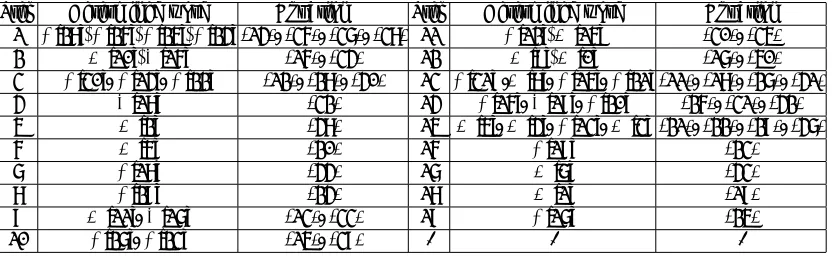
Step 3: Determine other words in M by using equations in Table 4. The procedure for deter-mining other word inM are summarized in Table 5. Table 5 indicates the relation between determined words and used equations at each step. For example, at step 1, A[28], A[26],
A[25] andA[24] are determined by using Eq. (14), (36), (37) and (38). In particular, Eq. (14) contain unknown value M[12] and C[12]. Since M[12] is guessed in the step 2, M[12] is known values and C[12] also becomes known value from Eq. (9). Therefore, A[28] can be determined by Eq. (14).
As Table 5, we determine all words inM step by step by using equations in Table 4. However, since Eq. (45), (46) and (49) are not used for determining all words inM, the obtained mes-sageM satisfies these equations with probability of 2−96, because each variables in equation are 32-bit. Consequently, the complexity of finding a messageM such that Bk1+1 isβ in the backward process is 296.
For the preimage attack, we compute 2400 sets of (Ak+1, β, Ck+1) and make a table in the backward process. In the forward process, we compute 2496sets of (Ak+1, β, Ck+1). Since the total
Table 5.Procedure of Determining all word inM for the Weakened Shabal Using (p, r) = (2,12)
Step Determined word Equation Step Determined word Equation
1 A[28], A[26], A[25], A[24] (14), (36), (37), (38) 11 A[12], M[15] (30), (35)
2 M[10], B[16] (16), (34) 12 M[9], M[0] (17), (50)
3 A[30],A[14],A[22] (12), (28), (40) 13 A[31] ,M[8],A[15],A[21] (11), (18), (27), (41)
4 B[18] (32) 14 A[16],B[19],A[20] (26), (31), (42)
5 M[2] (48) 15 M[5],M[4],A[13],M[3] (21), (22), (29), (47)
6 M[6] (20) 16 A[19] (23)
7 A[18] (44) 17 M[7] (43)
8 A[29] (24) 18 M[1] (19)
9 M[11],B[17] (13), (33) 19 A[17] (25)
10 A[27],A[23] (15), (39) - -
-4.4 Preimage attack on Shabal-512 Using (p, r) = (1.5,8)
Next, we apply the GD technique to Shabal-512 using (p, r) = (1.5,8). For the variant, the number of the main loop is 24 (= 1.5×16), the size ofA is 256 (= 8×32) bits. Since the value of r differ from 12, the final loop must be modified. In this attack, we define the final loop as follows:
for j = 0 to 24 do
A[j mod 8]←A[j mod 8] +C[j+ 3 mod 16]. end for
In Appendix C, the reason for the above modification is explained.
The attack method is same as the attack of the weakened variant using (p, r) = (2,12),
Step 1: Construct equations between unknown value Mk1+2 and known values Bk1+1, Ak1+2,
Bk1+2 and Ck1+2 Let A[0], ..., A[7] and B[0], ..., B[15] be inputs and A[24], ..., A[31] and
B[24], ..., B[39] be outputs of the main loop.B[24], ..., B[39] correspond toCk1+2[0], ..., Ck1+2[15]. In the main loop, these values satisfy following equations,
A[i] =fa(A[i+ 8],(B[i+ 6]·B[i+ 9]), B[i+ 13], M[i], C[8−i], A[i+ 7]), (51)
B[i] = (B[i+ 16]⊕ ¬A[i+ 8])≫1, (52)
whereM[0], ..., M[15] correspond to unknown valueMk1+2[0], ..., Mk1+2[15], andC[0], ..., C[15] can be also expressed by using known valueBk1+2 and unknown valueMk1+2 as Eq. (9). Due to the above redefined final loop,A[24], ..., A[31] are (Ak1+2[0]−2C[3]−C[11]), ...,(Ak1+2[7]− 2C[10]−C[2]). The equation with respect toBK1+2 is same as Eq. (10).
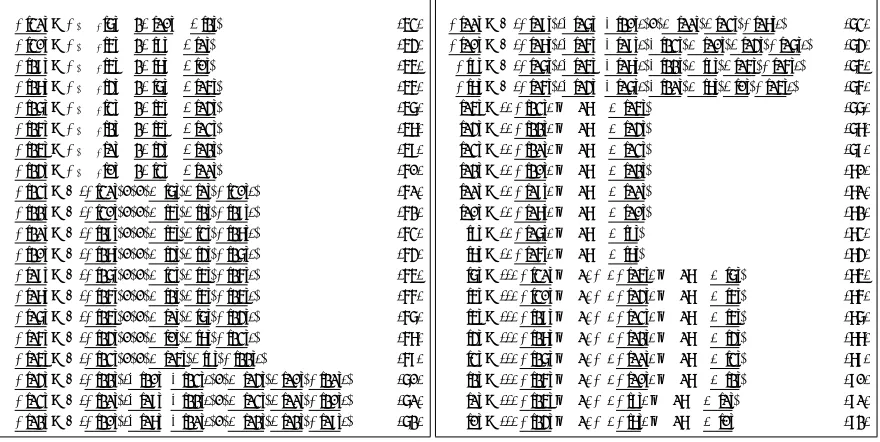
In order to simplify equations, we fixed all words ofCk1+2to 0 by choosingMk1+3asMk1+3 = −Bk1+3 in (k1 + 3) th compression function. From Eq. (10), (51) and (52), we construct equations as shown in Table 6. In Table 6, since B[24], ..., B[39] are 0, unknown values
B[8], ..., B[23] are expressed as (¬A[16]≫1), ...,(¬A[31]≫1) from Eq. (52).
Step 2: GuessM[1], M[2], M[6], M[7], M[8], M[9] andM[10], which are one of the least number of guessed words inM to determine all words inM.
Step 3: Determine other words inM from equations of Table 6. The procedure for determining
M is shown as Table 7. For example, at step 1 of the procedure, A[31] is determined from Eq (53) containing unknown valueC[10] andC[2]. SinceM[10] andM[2] are guessed,C[10] andC[2] become known values by Eq. (9). Therefore,A[31] can be determined from Eq (53). In this case, Eq. (80), (81), (88), (89), (90), (91), and (92) are not used, thus the obtained messageM satisfies these equations with probability of 2−224. Consequently, the complexity of finding messageM such thatBk1+1 isβ in the backward process is 2
Table 6.Equations for the Shabal Using (p, r) = (1.5,8)
A[31] =Ak1+2[7]−2C[10]−C[2], (53)
A[30] =Ak1+2[6]−2C[9]−C[1], (54)
A[29] =Ak1+2[5]−2C[8]−C[0], (55)
A[28] =Ak1+2[4]−2C[7]−C[15], (56)
A[27] =Ak1+2[3]−2C[6]−C[14], (57)
A[26] =Ak1+2[2]−2C[5]−C[13], (58)
A[25] =Ak1+2[1]−2C[4]−C[12], (59)
A[24] =Ak1+2[0]−2C[3]−C[11], (60)
A[23] =fa(A[31],0,0, M[7], C[1], A[30]), (61)
A[22] =fa(A[30],0,0, M[6], C[2], A[29]), (62)
A[21] =fa(A[29],0,0, M[5], C[3], A[28]), (63)
A[20] =fa(A[28],0,0, M[4], C[4], A[27]), (64)
A[19] =fa(A[27],0,0, M[3], C[5], A[26]), (65)
A[18] =fa(A[26],0,0, M[2], C[6], A[25]), (66)
A[17] =fa(A[25],0,0, M[1], C[7], A[24]), (67)
A[16] =fa(A[24],0,0, M[0], C[8], A[23]), (68)
A[15] =fa(A[23],0,0, M[15], C[9], A[22]), (69)
A[14] =fa(A[22],(B[20]·B[23]),0, M[14], C[10], A[21]), (70)
A[13] =fa(A[21],(B[19]·B[22]),0, M[13], C[11], A[20]), (71)
A[12] =fa(A[20],(B[18]·B[21]),0, M[12], C[12], A[19]), (72)
A[11] =fa(A[19],(B[17]·B[20]),0, M[11], C[13], A[18]), (73)
A[10] =fa(A[18],(B[16]·B[19]), B[23], M[10], C[14], A[17]), (74)
A[9] =fa(A[17],(B[15]·B[18]), B[22], M[9], C[15], A[16]), (75)
A[8] =fa(A[16],(B[14]·B[17]), B[21], M[8], C[0], A[15]), (76)
β[15] = (¬A[23])≫18−M[15], (77)
β[14] = (¬A[22])≫18−M[14], (78)
β[13] = (¬A[21])≫18−M[13], (79)
β[12] = (¬A[20])≫18−M[12], (80)
β[11] = (¬A[19])≫18−M[11], (81)
β[10] = (¬A[18])≫18−M[10], (82)
β[9] = (¬A[17])≫18−M[9], (83)
β[8] = (¬A[16])≫18−M[8], (84)
β[7] = ((¬A[31]≫1)⊕ ¬A[15])≫18−M[7], (85)
β[6] = ((¬A[30]≫1)⊕ ¬A[14])≫18−M[6], (86)
β[5] = ((¬A[29]≫1)⊕ ¬A[13])≫18−M[5], (87)
β[4] = ((¬A[28]≫1)⊕ ¬A[12])≫18−M[4], (88)
β[3] = ((¬A[27]≫1)⊕ ¬A[11])≫18−M[3], (89)
β[2] = ((¬A[26]≫1)⊕ ¬A[10])≫18−M[2], (90)
β[1] = ((¬A[25]≫1)⊕ ¬A[9])≫18−M[1], (91)
β[0] = ((¬A[24]≫1)⊕ ¬A[8])≫18−M[0]. (92)
Table 7.Procedure of Determining all word inM for the Shabal Using (p, r) = (1.5,8)
Step Determined word Equation Step Determined word Equation
1 A[31], A[30], A[18], (53), (54), (82), 10 A[9] (75)
A[17], A[16] (83), (84) 11 A[14] (86)
2 A[23],A[15] (61), (85) 12 A[21] (70)
3 M[15] (77) 13 M[13] (79)
4 A[28],A[22] (56), (69) 14 M[5] (58)
5 A[29],M[14] (62), (78) 15 M[3],A[13] (63), (87)
6 M[0],A[27] (55), (57) 16 M[11],A[19],A[20] (60), (65) (71)
7 A[24] (68) 17 M[4],A[11] (64), (73)
8 A[25],A[10] (67), (74) 18 M[12] (59)
9 A[26],A[8] (66), (76) 19 A[12] (72)
For the preimage attack, we compute 2272 sets of (Ak+1, β, Ck+1) and make a table in the backward process. In the forward process, we compute 2496 sets of (Ak+1, β, Ck+1). Since the
total size of Ak+1 and Ck+1 is 768 (= 256 + 512) bits, we can find a matching pair among 2768(=496+272) pairs using the meet-in-the-middle technique. Therefore, a preimage on Shabal-512 using security parameter (p, r) = (1.5,8) can be found with complexity of 2497 and memory of 2272.
5 Conclusion
We have shown two types of attacks on Shabal, they are a low-weight pseudo collision attack and a preimage attack.
of Shabal with complexity of 284. Although these result does not threat the claimed security of Shabal, these show that the compression function have the non-ideal differential property. In addition, these result might be useful for the further cryptanalysis.
For a preimage attack, we introduced the GD technique and applied it to two variants of Shabal-512. For the weakened variant of Shabal-512 without the final loop using the security parameters (p, r) = (2,12), a preimage can be found with complexity of 2497 and memory of 2400. For the Shabal-512 using security parameter (p, r) = (1.5,8), a preimage can be found with complexity of 2497 and memory of 2272. This is the first preimage attack on Shabal-512 with reduced security parameters. Since designer’s recommended security parameter is (3, 12), we claim that this attack does not lead to the security problem of the full Shabal hash function directly.
References
1. G. V. Assche, “A rotational distinguisher on Shabal’s keyed permutation and its impact on the security proofs.” Available :http://gva.noekeon.org/papers/ShabalRotation.pdf, 2010.
2. J-P. Aumasson, “On the pseudorandomness of Shabal’s keyed permutation.” Available :
http://131002.net/data/papers/Aum09.pdf, 2009.
3. J-P. Aumasson, A. Mashatan, and W. Meier, “More on Shabal’s permutation.” Available : http://131002.net/data/papers/AMM09.pdf, 2009.
4. E. Biham, R. Chen, A. Joux, P. Carribault, C. Lemuet, and W. Jalby, “Collisions of SHA-0 and reduced SHA-1.” inProceedings of EUROCRYPT’05 (R. Cramer, eds.), LNCS, vol. 3494, pp. 36–57, Springer-Verlag, 2005.
5. E. Bresson, A. Canteaut, B. Chevallier-Mames, C. Clavier, T. Fuhr, A. Gouget, T. Icart, J. Misarsky, M. Naya-Plasencia, P. Paillier, T. Pornin, J. Reinhard, C. Thuillet, and M. Videau, “Shabal, a submission to NIST’s cryptographic hash algorithm competition.” Submission to NIST, 2008.
6. E. Bresson, A. Canteaut, B. Chevallier-Mames, C. Clavier, T. Fuhr, A. Gouget, T. Icart, J. Misarsky, M. Naya-Plasencia, P. Paillier, T. Pornin, J. Reinhard, C. Thuillet, and M. Videau, “Indifferentiability with distinguishers: Why Shabal does not require ideal ciphers.” Cryptology ePrint Archive, Report 2009/199, 2009.
7. P. Hawkes and G. Rose, “Guess-and-determine attacks on SNOW.” inProceedings of SAC’02 (K. Nyberg and H. Heys, eds.), LNCS, vol. 2595, pp. 37–46, Springer-Verlag, 2003.
8. S. Indesteege and B. Preneel, “Practical collisions for EnRUPT.” inProceedings of FSE’09 (O. Dunkel-man, eds.), LNCS, vol. 5665, pp. 246–259, Springer-Verlag, 2009.
9. D. Khovratovich, I. Nikolic, and R. Weinmann, “Meet-in-the-middle attacks on SHA-3 candidates.” in
Proceedings of FSE’09 (O. Dunkelman, eds.), LNCS, vol. 5665, pp. 228–245, Springer-Verlag, 2009. 10. L. Knudsen, K. Matusiewicz, and S. Thomsen, “Observations on the Shabal keyed permutation.” Available
:http://www.mat.dtu.dk/people/S.Thomsen/shabal/shabal.pdf, 2009.
11. H. Lipmma and S. Moriai, “Efficient algorithms for computing differential properties of addition.” in
Proceedings of FSE’01 (M. Matui, eds.), LNCS, vol. 2355, pp. 336–350, Springer-Verlag, 2002.
12. National Institute of Standards and Technology, Announcing request for candidate algorithm nomina-tions for a new Cryptographic hash algorithm (SHA-3) family, Federal Register Notice, vol. 72(212), pp. 62212-62220, 2007.
13. X. Wang and H. Yu, “How to break MD5 and other hash functions.” in Proceedings of Eurocrypt’05
(R. Cramer, ed.), LNCS, vol. 3494, pp. 19–35, Springer-Verlag, 2005.
14. X. Wang, Y. L. Yin, and H. Yu, “Finding collisions in th full SHA-1.” in Proceedings of Crypto’05
A Differential Path in the Main Loop
We show the differential path in the main loop in Table 8. The first column is the step number of the main loop, and from the 2nd to the 9th columns indicate positions of difference bit in the words used for updating Aand B at thei-th step. The 11th and the 12th columns indicate positions of difference bit in the words updated at thei-th step. The 13th column is probability of difference propagation at thei-th step.
Table 8.Differential Path with High Probability in the Main loop
i A[i] A[i+ 11] C[i−8]M[i]B[i+ 13]B[i+ 9] B[i+ 6] B[i] A[i+ 12] B[i+ 16] Probability
0 30 - - 31 29,30 14,28,29 13,14,28,29 29 - 30 2−5
1 31 - - - 12,15 12,14 - 12,29,30 15,31 13,15,30 2−2
2 16,28,29 15,31 - - 28 - 11 14,15 14,16 14,15 2−9
3 - 14,16 - - 30 - 14,28,29 27 - 28 2−6
4 13 - - - 13,15,30 29,30 12,14 11,13,28 12,14 29 2−6
5 14,15,27 12,14 - - 14,15 12,15 - 15,28,30 16,31 29 2−7
6 16 16,31 - - 28 28 - 13,14,28,29 14,16,29,30 - 2−7
7 12,16 14,16,29,30 - - 29 30 29,30 - - - 2−9
8 29 - 31 - 29 13,15,30 12,15 11 12 - 2−6
9 27,29 12 - - - 14,15 28 14,28,29 15 29,30 2−5
10 - 15 - - - 28 30 12,14 - 13,15 2−4
11 - - - 29 13,15,30 - - - 2−4
12 - - - - 29,30 29 14,15 - 30 30 2−3
13 15,31 30 - - 13,15 - 28 29,30 31 30 2−7
14 14,16 31 - - - - 29 12,15 15,16 13,15 2−6
15 - 15,16 - - 30 - 29 28 29 - 2−3
16 12,14 29 - 31 30 29,30 - 30 31 - 2−4
17 16,31 31 - - 13,15 13,15 - 13,15,30 14,16,31 - 2−8
18 14,15,29,30 14,16,31 - - - 14,15 15,16 - 2−6
19 - 15,16 - - - 30 29,30 28 29 - 2−4
20 12 29 - - - 30 13,15 29 30 - 2−9
21 15 30 - - - 13,15 - 29 - 30 2−8
22 - - - 30 - - - 2−1
23 - - - 30 - - - 2−1
24 30 - 31 - 30 - 13,15 - - - 2−3
25 31 - - - 29,30 31 30 1
26 15,16 31 - - - 13,15 14,16 - 2−5
27 29 14,16 - - - 2−1
28 31 - - - 30 30 - 30 31 - 2−1
29 14,16,31 31 - - - 30 31 - 2−2
30 15,16 31 - - - 13,15 14,16 - 2−5
31 29 14,16 - - - - 30 - - - 2−2
32 30 - - 31 - 30 - - - - 2−2
33 - - - 1
34 - - - 1
35 - - - 30 - - - 2−1 36 - - - 1
37 31 - - - 30 31 - 1 38 14,16 31 - - - 2−2 39 - - - 1
40 31 - 31 - - - 1
41 31 - - - 30 31 - 1 42 14,16 31 - - - 2−2 43 - - - 1
44 - - - 1
45 - - - 1
46 - - - 1
B Sufficient Conditions in the First 16 steps of the Main Loop
We show sufficient conditions in the first 16 steps of the main loop in the Table 9.
In Table 9,A[i]j denotes thej-th bit ofA[i], thusA[i]31 is MSB ofA[i].fi(x[j]), gi(x[j]) and
X[i] are defined as follows:
fi(x[j]) =maj(x[j]i−1, x[j]i−3, fi−1(x[j])),
gi(x[j]) =maj(x[j]i−1, x[j]i−2, gi−1(x[j])),
X[i] =A[i]⊕(5×(A[i+ 11]≪15))⊕C[8−i],
where maj(x, y, z) = (x∧y)⊕(x∧z)⊕(y∧z), and X[i] is the intermediate value used for
×3.fi(x[j]) andgi(x[j]) imply carry ofi-th bit in computations of×5 (= (x2) +x) and ×3
(= (x1) +x), respectively.
Table 9.Sufficient Conditions in the First 16 steps of the Main Loop
i 5 3 AND
0 - X[0]28=X[0]29 B[6]14=B[9]14, B[6]28=B[9]28
B[6]296=B[9]29, B[9]13= 0
1 - - B[7]12= 0, B[7]14= 1
2f14(A[13]) =A[13]12, f16(A[13]) =A[13]16g14(X[2])6=X[2]13, X[2]16=X[2]15 B[11]11= 0
f30(A[13])6=A[13]28 X[2]26=X[2]27, X[2]286=X[2]296=X[2]30
3f29(A[14]) =A[14]27 X[3]27=X[3]28=X[3]30 B[12]14=B[12]28= 0
B[12]29= 1
4 - g13(X[4])6=X[4]12, X[4]15=X[4]14 B[10]30= 0, B[10]29= 1
B[13]12=B[13]14= 1
5f27(A[16]) =A[16]25, A[16]296=A[16]27 X[5]12=X[5]13, X[5]156=X[5]14 B[11]12= 1, B[11]25= 0
X[5]13=X[5]16
6f14(A[17]) =A[17]12, A[17]166=A[17]16 g14(X[6])6=X[6]13, X[6]166=X[6]15 B[12]28= 0
X[6]27=X[6]28, X[6]286=X[6]30
7f12(A[18])6=A[18]10, f13(A[18]) =A[18]13X[7]27=X[7]28=X[7]30 B[13]306=B[16]30, B[16]29= 0
A[18]16=A[18]14, f29(A[18]) =A[18]27
f30(A[18]) =A[18]30
8 - X[8]27=X[8]28, X[8]286=X[8]30 B[14]156=B[17]15, B[14]30= 0
B[14]13= 1, B[17]12= 1
9f27(A[20]) =A[20]25, f29(A[20]) =A[20]29- B[15]14= 1, B[15]15= 0
B[18]28= 0
10f30(A[21]) =A[21]28 X[10]28=X[10]29 B[16]28= 1, B[19]30= 1
11 - - B[17]29= 1, B[20]13= 0
B[20]15= 0, B[20]30= 0
12 - - B[18]29= 0, B[21]14= 0
B[21]15= 0
13f13(A[24])6=A[24]11, A[24]146=A[24]12 X[13]11=X[13]12, X[13]136=X[13]14 B[22]28= 0
f15(A[24]) =A[24]15 X[13]13=X[13]15
14f14(A[25])6=A[25]12, A[25]156=A[25]13 X[14]13=X[14]14=X[14]16 B[23]29= 0
f16(A[25]) =A[25]16
15f30(A[26])6=A[26]28 X[15]28=X[15]29 B[24]29= 1
C Final Loop for r = 8
Here we consider the final loop ofr= 8. If a different value ofris used, the final loop is changed. In 4.2.6 of [5], the method of the modification of the the final loop are described.
Since the final loop adds C to A, it is expressed as A+σ(C), where σ(C) is the vector including C.σ(C) is computed by a following simple loop of the form:
For ifrom 0 tos- 1,
e,sand offset are chosen to satisfy the condition. Forr = 12, e= 0, s= 36 andoffset = 3 are chosen andσ(C)[i] is as follows:
σ(C)[i] =C[i+ 3] +C[i+ 3 + 12] +C[i+ 3 + 24].
In the case of r = 12, eachA[i] depends on three words ofC that are different for differenti. However, the final loop of r = 8 is not defined explicitly. We choose e = 0 and offset = 3 that are same asr= 12. We also choose s= 24 to satisfy that eachA[i] depends on three words of C that are all difference for the differencei. This is the same condition for r= 12.
Thus we define σ(C)[i] of r= 8
σ(C)[i] =C[i+ 3] +C[i+ 3 + 8] +C[i+ 3 + 16],
= 2C[i+ 3] +C[i+ 11].