Available Online atwww.ijcsmc.com
International Journal of Computer Science and Mobile Computing
A Monthly Journal of Computer Science and Information Technology
ISSN 2320–088X
IMPACT FACTOR: 6.017
IJCSMC, Vol. 6, Issue. 3, March 2017, pg.222 – 227
CLUSTER BASED DYNAMIC
KEYING TECHNIQUE FOR
WIRELESS SENSOR NETWORK
1
P.B.Arun Prasad,
M.E.(CSE).,
2R.Ramanikumari,
3K.Raveena,
4K.Selva Bharathi,
5P.Siva Bharathi
ABSTRACT: In heterogeneous wireless sensor networks the mobility of sensor node become essential for various applications. There is a possibility for the malicious node to occur. This causes the cluster or the whole network to be controlled by the malicious node .The mobile sensor nodes need to be authenticated; further clustering of nodes improves scalability, energy efficient routing and data delivery. The nodes with high configuration are chosen as cluster head based on weight values which is estimated using parameters such as node degree, average distance, average speed and virtual battery power. The keys are generated using dynamic clustering efficiency algorithm. Hierarchical trust management protocol is used for finding the malicious node among the group of sensor nodes.
Keywords: Wireless Sensor, malicious node, Hierarchical trust, cluster and battery.
A. INTRODUCTION
Wireless sensor networks hold great promise as an enabling technology for a variety of
applications. Data collection and event detection are two such classes of applications that are
broadly representative and which have received considerable attention in the literature. While
wireless multi-hop data collection has achieved operational lifetimes on the order of a year,
we are unaware of lifetimes exceeding a few days or weeks for wireless multi-hop event
detection sensor networks. This project is that sensor networks for event detection are
constrained by two factors which do not similarly affect data collection sensor networks. The
architecture has been broadly implemented to support event detection in distributed systems
that are simultaneously energy, space, time, and message complexity-constrained. The second
factor is that middleware for services such as time synchronization, localization, and routing
are predominantly and unnecessarily proactive.
A comparison of data collection and event detection will serve to illustrate the subtle but
important differences between these applications. Fundamentally, data collection is a signal
reconstruction problem in which the objective is to centrally reconstruct observations of
distributed phenomena with high spatial and temporal fidelity. Performance metrics for such
applications include the accuracy and precision of the signal reconstruction, the correlation
between the observed signal and the underlying physical phenomena, and the lifetime of the
sensor network.
Physical phenomena such as light, temperature, humidity, and barometric pressure change at
very low frequencies and can be sampled faithfully at periods of a minute or more. System
performance can be adjusted by introducing compression and aggregation, or by varying the
duty-cycle, sampling and communication rates, allowing sensor lifetimes to approach a year
or more. In contrast with data collection, sensor network applications for event detection
must continuously observe noise for the rare presence of a burst of high-frequency signal.
B. EXISTING SYSTEM
All existing approaches in this category detect replicas based on finding conflicting location
claims. The first one is Node-To-Network Broadcasting. When executing the protocol, each
node broadcasts its location claim to the whole network, and all nodes store the location
claims of their neighbours only. Then if a node receives two conflicting claims of some node
ID, it can revoke that node by flooding the network with the two claims.
The second approach is Deterministic Multicast. A fixed mapping function is used to map
each node ID to g nodes (witness nodes), and then each node’s neighbours will forward the
node’s location claim to these g nodes.
In Randomized Multicast the neighbours of each node randomly select n nodes as that node’s
witnesses. Then if a node is replicated, according to the birthday paradox problem, at least
one witness will receive two conflicting location claims with high probability. LSM
In LSM the nodes in the paths from a node’s neighbours to the randomly selected witnesses are used; these nodes become the node’s witnesses too. Such change reduces the
communication cost.IN SDC Each node ID is mapped to one cell, and the location claim of
each node is forwarded to the mapped cell and broadcasted within the cell. Nodes in the cell
store the claim and become that node’s witnesses with some probability. However, the set of
possible mapped cells is still deterministic. In cloning attacks, an adversary captures a sensor
node, reprograms it, makes multiple copies, and inserts these copies, into the network. Cloned
nodes subvert sensor network processing from within. In a companion paper we show how to
detect and remove clones from sensor networks using random key predistribution security
measures. Keysthat are present on the cloned nodes are detected by using authentication
statistics based on key usage frequency. For consistency with existing random key
predistribution literature, and ease of explanation, the network in that paper used an
Erdos-Renyitopology.
In the Erdos-Renyi topology, the probability of connection between any two nodes in the
network is uniform. Since the communications ranges of sensor nodes are limited, this
topology is flawed. This article applies the clone detection approach from] to more realistic
network topologies. Grid and ad hoc topologies reflect the node connectivity patterns of
networks of nodes with range limits. We provide analytical methods for choosing detection
thresholds that accurately detect clones. We use simulations to verify our method. In
particular we find the limitations of this approach, such as the number of nodes that can be
inserted without being detected.
The low-cost, off-the-shelf hardware components in unshielded sensor-network nodes leave
them vulnerable to compromise. With little effort, an adversary may capture nodes, analyze
and replicate them, and surreptitiously insert these replicas at strategic locations within the
network. Such attacks may have severe consequences; they may allow the adversary to
corrupt network data or even disconnect significant parts of the network. Previous node
replication detection schemes depend primarily on centralized mechanisms with single points
of failure, or on neighbourhood voting protocols that fail to detect distributed replications. To
address these fundamental limitations, we propose two new algorithms based on emergent
properties [10], i.e., properties that arise only through the collective action of multiple nodes.
Randomized Multicast distributes node location information to randomly-selected witnesses,
exploiting the birthday paradox to detect replicated nodes, while Line-Selected Multicast uses
distributed node-replica detection, and Line-Selected Multicast displays particularly strong
performance characteristics. We show that emergent algorithms represent a promising new
approach to sensor network security; moreover, our results naturally extend to other classes
of networks in which nodes can be captured, replicated and re-inserted by an adversary.
C. PROPOSED SYSTEM
The proposed system shows that in order to avoid the drawbacks of existing approaches,
replica-detection protocols must be non deterministic and fulfill three security requirements
on witness selection. To our knowledge, Randomized Multicast is the only existing protocol
fulfilling the requirements, but it has very high communication overhead (i.e., O(n) per node).
Secondly, based on random walk, we propose two new protocols fulfilling the requirements,
while having only moderate communication and memory overheads. Our random walk
strategy outperforms previous strategies because it naturally distributes the responsibility of
witness node selection to every passed node of random walks, and then adversaries cannot
easily find out the critical witness nodes.
The protocol, RAndom WaLk (RAWL), starts several random walks randomly in the network
for each node a, and then selects the passed nodes as the witness nodes of node a. Our
analysis shows that walk steps are sufficient to detect clone attacks with high probability. The
second protocol, Table-assisted RAndom WaLk (TRAWL), is based on RAWL and adds a
trace table at each node to reduce memory cost. Usually the memory cost is due to the storage
of location claims; in TRAWL each node only stores O(1) location claims now (although the
size of the trace table is still, the size of a table entry is much smaller than the size of a
location claim).
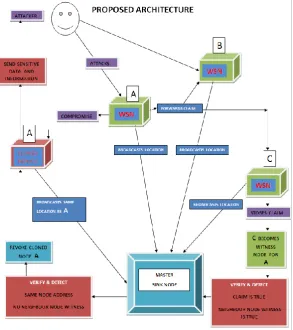
D. WORKING PRINCIPLE
Wireless Sensor nodes are setup with information collection and dissemination to the sink or
master node. The WSN are placed in a remote locations with a sink connected to the network.
According to the number of cluster heads, the nodes are randomly placed in a network. As
events occur randomly the WSNS transmit the data to the sink node or master node. AODV
protocol is used for event transmission it forwards the event to the next hop based on the
source and destination IP address. Each node is assumed to be calculating the energy
independently. The data transmission takes places. Whenever the particular node is used for
data transmission, an energy level should be reduced. The WSNs which act as relays also lose
energy when relaying the datas of the WSN’s. Thus each node is acting independently when
event occurs and transmits energy according to differing energy levels. When the event is
transmitted from one sensor node to another there is a possibility for the attacker to
compromise that specific node and snoop the information. When the attack is initiated, the
whole sensor nodes can be compromised and makes node to loss its energy and also loses its
lifetime(nodes dead). The proposed system shows that in order to avoid the drawbacks of
existing approaches, replica-detection protocols must be non deterministic and fulfill three
security requirements on witness selection. For security purpose using virtual key and
location coordinates protocols, this mechanism generates the dynamic key based on the node
degree and coordinates. Another protocol used is hierarchical trust management to prevent
the sensor nodes from the attacker. Trust-based IDS algorithm is based on selecting a system
minimum trust threshold, T th below which a node is considered compromised and needs to
be excluded from sensor reading and routing duties otherwise server will block the attacking
CONCLUSION
Randomized Multicast, fulfills the requirements; however it has very high communication
overhead which is only affordable in small networks than existing Another protocol
LSM(line selected multicast) has the lowest communication and memory overheads, but it
does not fulfill the security requirements. Our final protocols, RAWL(RAndom Walk) and
TRAWL(Table-assisted RAndom WaLk), which are based on random walk, fulfill the
requirements and have higher but comparable communication overhead than LSM. It
provides a better trade-off between the communication overhead and security properties than
previous protocols. We also gave theoretical analysis on the required number of random walk
steps. Finally, the mechanism TRAWL also reduces the memory overhead.
REFERENCES
[1] A. Mainwaring, J. Polastre, R. Szewczyk, D. Culler, J. Anderson. “Wireless Sensor Networks for Habitat Monitoring.” ACM WSNA'02, 2002.
[2] T. He, S. Krishnamurthy, J. A. Stankovic, T. Abdelzaher, L. Luo, R. Stoleru, T. Yan, L. Gu. Energy-Efficient Surveillance System Using Wireless Sensor Networks. Mobisys, 2004.
[3] D. Malan, T. Fulford-Jones, M. Welsh and S. Moulton. “CodeBlue: An Ad Hoc Sensor Network Infrastructure for Emergency Medical Care.” Intl. Workshop on Wearable and
Implantable Body Sensor Networks, April 2004.
[4] V. Raghunathan, C. Schurgers, S. Park, and M. B. Srivastava. “Energy Aware Wireless Sensor Networks”. IEEE Signal Processing 19, 2, 40--50.
[5] W. Yuan, S. V. Krishnamurthy, and S. K. Tripathi. “Improving the Reliability of Event Reports in Wireless Sensor Networks”. ISCC, 2004.
[6] S. Madden, M. J. Franklin, and J. M. Hellerstein. TAG: a Tiny AGgregation Service for Ad-Hoc Sensor Networks. OSDI, December 2002.
[7] D. Estrin, R. Govindan, J. S. Heidemann, S. Kumar. “Next Century Challenges: Scalable Coordination in Sensor Networks.” MOBICOM 1999: 263-270
[8] TinyOS – http://www.TinyOS.net
[9] P. Levis, N. Lee, M. Welsh and D. Culler. TOSSIM: Accurate and Scalable Simulation of Entire TinyOS Applications. ACM SenSys 2003.
[10] D. Gay, P. Levis and R.von Behren. “The nesC Language: A Holistic Approach to Networked Embedded Systems.”