© 2016, IJCSMC All Rights Reserved
65
Available Online atwww.ijcsmc.comInternational Journal of Computer Science and Mobile Computing
A Monthly Journal of Computer Science and Information Technology
ISSN 2320–088X
IMPACT FACTOR: 6.017
IJCSMC, Vol. 5, Issue. 11, November 2016, pg.65 – 72
Face Recognition Techniques: A Survey
B.S.Khade
1
, H.M.Gaikwad
2
, A.S.Aher
3
, K.K.Patil
4
Lecturer, Department Computer Technology K Wagh Women’s Polytechnic Nashik
1, 2, 3Assistant Professor, Department of Computer Engineering, PVG COE, Nashik
4___________________________________________________________________________
Abstract-
Face Recognition technique is generally used for real time application. Reliability is the
more important thing for security. Facial Recognition is rapidly becoming area of interest. Face
biometrics is useful for authentication that recognizes face. In this paper survey of face recognition
methods exhibit and discuss their pros and cons. The objective of this paper is to provide a survey of
face recognition methods that appeared in the previous literature over the past decade and also
differentiate them into meaningful approaches.
Keywords- Face Recognition, Knowledge-based, Feature-invariant, Template matching,
Appearance-based, PCA, LDA
___________________________________________________________________________
I.
INTRODUCTION
A system requires authenticity to recognition the identification of an individual entity. The reason is to
ensure that the services are accessed only by an authorized user and not else others. In Biometric, face
recognition is depend on their behavioral characteristics of individuals. A biometric recognition system consists
following four main Steps: [26]
1.
Capture a Image : Image capture of a biometric trait
2.
Feature Extraction: Module extracts the certain features from the biometric data
3.
System Database: It stores the features extracted from biometric data.
4.
Matching: module that matches the features extracted from the biometric imputed data with the features
stored in the system database.
II.
FACE RECOGNITION PROBLEM
However, the major Limitations of any facial Recognition algorithms are [10][37]
A.
Facial Aging
© 2016, IJCSMC All Rights Reserved
66
B.
Accessoriness Used during input images
In a few cases, Peoples uses many accessories on their faces like
goggles, specs, some type of nose ring, boys
can have beard etc. these factors can effect on the result.
C.
Pose Invariant
Face recognition with different facial poses that is known as pose problem. If face rotation made very big
changes in face appearance it reduce recognition rate. If person try to match same image with different facial
pose, it show the different result. [8] [52]
D.
Lighting Conditions
The lightening conditions like background light, brightness, contrast, shadow etc. are not always same for the
input. So the system must be smart enough to adjust these changes accordingly.
E.
Plastic Surgery
In some special cases, due to some accidental reasons or so, many peoples have gone through the
plastic or cosmetic surgery as a result of which the inputs of their faces can be unknown for the system
.
F.
Accidental Face Detection
Due to some emergency conditions or some accidents, the face of the victim damaged enough to lose his
identity.
III.
REVIEW OF FACE RECOGNITION METHODS
Face recognition methods divided into following four categories [5][14][29]
o
Knowledge-based methods
o
Feature-invariant methods
o
Template matching methods
o
Appearance-based methods
A.
Knowledge Based Method
These are rule-based methods. They try to capture our knowledge of faces and translate them into a set of
rules. It is simple to guess some easy rules. For example, a face usually has two symmetric eyes, and the eye area
is darker than the cheeks. Facial features could be the distance between eyes or the color intensity difference
between the eye area and the lower zone. The big problem with these methods is the difficulty in building an
appropriate set of rules. If the rules are general then they are false positive. Furthermore, if the rules were too
detailed then there false negatives. The solution is to make hierarchical knowledge-based methods to overcome
these problems. These methods show themselves efficient with simple inputs. After all this method is very
limited. It’s unable to find many faces in a complex image. But, what happens if a person is wearing glasses?
There are other features that can deal with that problem. For example, there are algorithms that detect face-like
textures or the color of human skin. [7][29] It is very important to select the best color model to detect faces. A
Few recent researchers use more than one color model. For example, RGB and HSV are used together
successfully.[47]
B.
Feature Invariant Method
© 2016, IJCSMC All Rights Reserved
67
of one of the eyes. Then, a set of rule is executed to determinate the potential pair of eyes. When eyes are
selected, the algorithm calculates the face area as a rectangle. The four vertexes of the face are determined by a
set
of
method.
So,
the
potential
faces
are
normalized
to
a
fixed size and orientation. Then, the face regions are verified using a back propagation neural network.
C.
Template Matching Method
This algorithm compares input images with stored template of faces or features. Template matching methods
try to define a face as a function. One can slap to search a standard pattern of all the faces. Each features can be
defined independently.
For example, a face can be divided into eyes, face contour, nose and mouth. Also a face model can be built by
edges.
But
this
method
is
limited
to
faces
that are anterior. A face can also be represented in the shape pattern. Other templates use the relation between
darkness and face regions in terms of brightness. These standard templates are compared to the input images to
detect faces. This method is easy to implement, but it is incomplete for face detection. It will not give good
results for variations in scale, shape and pose. However, deformable templates have been proposed to deal with
these problems. [29]
D.
Appearance-Based Methods
The models are learned from a set of training images that capture the representative variability of faces. The
templates in based methods are learned from the examples in the images. In general,
appearance-based methods rely on techniques from machine learning and statistical analysis to search the relevant features of
face images. These techniques are also used in feature extraction for face recognition
.
a)
Eigenface based Methods - PCA Algorithm
In this method, the original scheme for determination of the eigenfaces using PCA will be representing. A
detailed (and more theoretical) description of PCA can be found in [1] [11][16][18][43].
Step 1: Prepare the data
The faces constituting the training set (
) should be prepared for processing.
Step 2: Subtract the mean
Average matrix
has to be calculated, then subtracted from the original faces (
) and the result stored in the
variable
:
∑
(
)
Step 3: Calculate the covariance matrix
In step three, the covariance matrix C is calculated according to
∑
Step 4: Calculate the eigenvectors and eigenvalues of the co-variance matrix
© 2016, IJCSMC All Rights Reserved
68
Step 5: Select the principal components
From M eigenvectors (eigenfaces)
, only
should be chosen, which have the highest eigenvalues. The
higher
the
eigenvalue,
the
more
characteristic
features
of
a
face
does
the
particular
eigenvector describe. Eigenfaces with low eigenvalues can be omit-ted, as they explain only a small part of
characteristic features of the faces.
After
eigenfaces
are determined, the” training” phase of the algorithm is finished
b)
Distribution based Methods – LDA Algorithm [23]
LDA also called as Fisher’s Discriminant Analysis. This is another dimensionality reduction technique. It is an
example of a class specific method i.e. LDA maximizes the between – class scattering matrix measure while
minimizes the within – class scatter matrix measure, which make it more steady for classification.[23]. Lih-Heng
Chan [38] proposed a framework of facial biometric was designed based on two subspace methods i.e., Principal
Component Analysis (PCA) and Linear Discriminant Analysis (LDA). First, PCA is used for dimension
reduction, where original face images are projected into lower-dimensional face representations. Second, LDA
was proposed to provide a solution of better discriminant. Both PCA and LDA features were presented to
Euclidean distance measurement which is conveniently used as a benchmark. LDA-based methods outperform
PCA for both face identification and verification. Fisher faces are one the most successfully widely used method
for face recognition. It is based on appearance method. In 1930 Fisher developed linear/fisher discriminant
analysis for face recognition which shows successful result in face recognition process [52]. The limitation of
LDA is that within the class scatter matrix is always single, after all the number of pixels in images is larger than
the number of images so it can boost detection of error rate if there is a variation in pose and lighting condition
within same images. So to overcome this problem many algorithms has been proposed. Because the fisher faces
technique uses the advantage of within-class information so it minimizes the variation within class, so the
problem with variations in the same images such as lighting variations can be overcome [39].
IV.
COMPARATIVE STUDY OF DIFFERENT FACE RECOGNITION METHODS
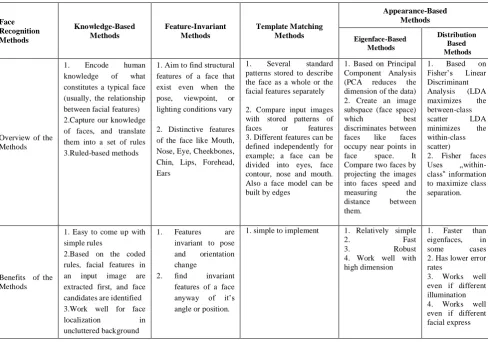
Table 1. Comparative Study of Different Face Recognition Methods
Face Recognition Methods Knowledge-Based Methods Feature-Invariant Methods Template Matching Methods Appearance-Based Methods Eigenface-Based Methods Distribution Based Methods
Overview of the Methods
1. Encode human knowledge of what constitutes a typical face (usually, the relationship between facial features) 2.Capture our knowledge of faces, and translate them into a set of rules 3.Ruled-based methods
1. Aim to find structural features of a face that exist even when the pose, viewpoint, or lighting conditions vary
2. Distinctive features of the face like Mouth, Nose, Eye, Cheekbones, Chin, Lips, Forehead, Ears
1. Several standard patterns stored to describe the face as a whole or the facial features separately
2. Compare input images with stored patterns of faces or features 3. Different features can be defined independently for example; a face can be divided into eyes, face contour, nose and mouth. Also a face model can be built by edges
1. Based on Principal Component Analysis (PCA reduces the dimension of the data) 2. Create an image subspace (face space)
which best
discriminates between faces like faces occupy near points in face space. It Compare two faces by projecting the images into faces speed and measuring the distance between them.
1. Based on Fisher’s Linear Discriminant Analysis (LDA maximizes the between-class scatter LDA minimizes the within-class scatter)
2. Fisher faces Uses „within-class‟ information to maximize class separation.
Benefits of the Methods
1. Easy to come up with simple rules
2.Based on the coded rules, facial features in an input image are extracted first, and face candidates are identified 3.Work well for face localization in uncluttered background
1. Features are invariant to pose and orientation change
2. find invariant features of a face anyway of it’s angle or position.
1. simple to implement 1. Relatively simple
2. Fast
3. Robust
4. Work well with high dimension
1. Faster than eigenfaces, in some cases 2. Has lower error rates
© 2016, IJCSMC All Rights Reserved
69
Limitation of the Methods
1. Difficulty in building an appropriate set of rules
2. Difficult to translate human knowledge into rules precisely: detailed rules fail to detect faces and general rules may find many false positives 3. Difficult to extend this approach to detect faces in different poses: implausible to enumerate all the possible cases.
1. Facial
expression
2.Difficult to locate facial features due to several corruption (illumination, noise, occlusion)
3. Difficult to detect features in complex background
1. Limited to faces that are frontal.
2. A face can also be represented as a shape. 3. Templates needs to be initialized near the face images
4.Difficult to enumerate templates for different poses (similar to knowledge-based methods) 5. It cannot achieve good results with variations in pose, scale and shape
1. Different head pose 2. Different alignment 3. Different facial expression
1. Small
databases 2. The face to classify must be in the DB 3. Can’t work well with high dimension
V.
BENEFITS OF BIOMETRIC FACIAL METHODS [7][8]
A.
No More Time Fraud
Due to face biometric systems in your Industry or organization is that you won’t have to worry about time
fraud. A person can be identified or rejected in a matter of seconds. It will be impossible for buddy punching to
occur, since everyone has to have their face scanned to clock in.
B.
Better Security
You’ll also enjoy better security with a facial biometrics system. Not only can you track employees, but any
visitors can be added to the system and tracked throughout the area too. Anyone that is not in the system will not
be given access.
C.
Automated System
Many companies like the fact that biometric imaging systems are automated. You won’t have to worry about
having someone there to monitor the system.
D.
Easy Integration
Biometric facial systems are also easy to integrate into your company. Usually they will work with existing
software that you have in place.
E.
High Success Rate
Facial biometrics technology today has a high success rate, especially with the emergence of 3d face
recognition. It is extremely difficult to fool the system, so you can feel secure knowing that your system will be
successful at tracking time and attendance while providing better security.
F.
User Friendly Systems
© 2016, IJCSMC All Rights Reserved
70
G.
Convenience
It’s considered to be a convenient security solution because you don’t have to remember passwords, or carry
extra badges, documents, or ID cards. People forget passwords and ID cards are lost, which can be a huge
headache with traditional security methods.
VI.
CONCLUSION
This paper has tryout to survey a significant number of papers to cover the recent development in face
recognition field. Present study exposes that face recognition algorithm can be enhanced using hybrid methods
for better performance. The list of references to provide more detailed understanding of the approaches described
is enlisted. We apologize to researchers whose important contributions may have been overlooked.
VII.
REFERENCES
[1] Comparitive Study on Face Recognition Using HGPP, PCA, LDA, ICA and SVM”, Global Journal of Computer Science and Technology Graphics & Vision Volume 12 Issue 15 Version 1.0 Year 2012 Type: Double Blind Peer Reviewed International Research Journal Publisher: Global Journals Inc. (USA) Online ISSN: 0975-4172 & Print ISSN: 0975-4350 By Hardik Kadiya , Merchant Engineering College.
[2] REAL TIME FACE RECOGNITION BY VARING NUMBER OF EIGENVALUES”, International Journal of Advanced Scientific and Technical Research Issue 3 volume 1, January-February 2013 Available online on http://www.rspublication.com/ijst/index.html ISSN 2249-9954, Prof. B.S PATIL1 Prof. A.R YARDI2, ,Dr Mrs Patil S B3
[3] “Blind Authentication: A Secure Crypto-Biometric Verification ProtocolManeesh Upmanyu, Anoop M. Namboodiri, Kannan Srinathan, and C. V. Jawahar”, IEEE TRANSACTIONS ON INFORMATION FORENSICS AND SECURITY, VOL. 5, NO. 2, JUNE 2010
[4] “Very Low Resolution Face RecognitionProblem” Wilman W. W. Zou, Student Member, IEEE, and Pong Yuen,SeniorMember,IEEE,IEEE TRANSACTIONS ON IMAGE PROCESSING, VOL. 21, NO. 1, JANUARY 2012
[5] “Color Local Texture Features for Color Face Recognition” Jae Young Choi, Yong Man Ro, Senior Member, IEEE, and Konstantinos N. Plataniotis, Senior Member, IEEE , IEEE TRANSACTIONS ON IMAGE PROCESSING, VOL. 21, NO. 3, MARCH 2012.
[6] A Framework for Analyzing Template Security and Privacy in Biometric Authentication Systems” Koen Simoens, Julien Bringer, Hervé Chabanne, and Stefaan Seys, IEEE TRANSACTIONS ON INFORMATION FORENSICS AND SECURITY, VOL. 7, NO. 2, APRIL 2012
[7] A Review Paper on Biometrics: Facial Recognition”Sakshi Goel1, Akhil Kaushik2, Kirtika Goel3, International Journal of Scientific Research Engineering & Technology (IJSRET) Volume 1 Issue 5 pp 012-017 August 2012 www.ijsret.org ISSN 2278 – 0882. [8] Face Recognition: A Literature Review by Thomas Heseltine DPhil Research Student University of York ,2012
[9] “Face Recognition Based on Principal Component Analysis” Ali Javed Faculty of Telecom & Information Engineering, University of Engineering & Technology, Taxila, I.J. Image, Graphics and Signal Processing, 2013, 2, 38-44 Published Online February 2013 in MECS (http://www.mecs-press.org/) DOI: 10.5815/ijigsp.2013.02.06
[10] “Face Recognition: Some Challenges in Forensics” Anil Jain, Brendan Klare and Unsang Park Department of Computer Science and
Engineering Michigan State University
East Lansing, MI, U.S.A {jain, klarebre,
[11] “Towards a Practical Face Recognition System: Robust Alignment and Illumination by Sparse Representation” Andrew Wagner, Student Member, IEEE, John Wright, Member, IEEE, Arvind Ganesh, Student Member, IEEE, Zihan Zhou, Student Member, IEEE, Hossein Mobahi, and Yi Ma, Senior Member, IEEE.
[12] Lih-Heng Chan, Sh-Hussain Salleh and Chee-Ming Ting. “Face Biometrics Based on Principal Component Analysis and Linear Discriminant Analysis.” J. Computer Sci., 6 (7): 693-699, 2010.
[13] Jyoti S. Bedre, Shubhangi Sapkal. “Comparative Study of Face Recognition Techniques: A Review.” Emerging Trends in Computer Science and Information Technology – 2012(ETCSIT2012) Proceedings published in International Journal of Computer Applications® (IJCA) 12.
[14] A.L. Yuille, D.S. Cohen, and P.W. Hallinan (19889) Feature extraction from faces using deformable templates proc. CVPR, San Diego, CA, June 1989.
[15] “REAL TIME FACE RECOGNITION BY VARING NUMBER OF EIGENVALUES” ,Prof. B.S PATIL1 Prof. A.R YARDI2, ,Dr Mrs Patil S B, International Journal of Advanced Scientific and Technical Research Issue 3 volume 1, January-February 2013 Available online on http://www.rspublication.com/ijst/index.html ISSN 2249-9954
[16] ANEFFICIENTMETHODFORFACE RECOGNITION USING PRINCIPAL COMPONENT ANALYSIS (PCA) Gunjan Dashore, Dr.
V.Cyril Ra, International Journal of
© 2016, IJCSMC All Rights Reserved
71
[18] “Eigenvectors of Covariance Matrix using Row Mean and Column Mean Sequences for Face Recognition ”International Journal of Biometrics and Bioinformatics (IJBB), Volume (4): Issue (2), Dr. H. B. Kekre, SAkshay Malooudeep D. Thepade, 2013
[19] Mrs. Kamini H. Solanki, Dr. Prashant P. Pittalia. Novel Approach for Robust Face Recognition using Principle Component Analysis (PCA) with Skewness, International Journal of Computer Engineering and Applications, Volume VI, Issue I April.14 www.ijcea.com ISSN 23213469.
[20] “Face Recognition Algorithms”, Proyecto Fin de Carrera , June 16, 2010 Ion Marques. [21] A tutorial on Principal Components Analysis by Lindsay I Smith February 26,2002.
[22] COMPARATIVE ANALYSIS OF FACE RECOGNITION ALGORITHMS by Mukesh Gollen , IJREAS Volume 2, Issue 2 (February
2012) ISSN: 2249-3905 International Journal of
Research in Engineering & Applied Sciences. http://www.euroasiapub.org
[23] An Efficient LDA Algorithm for Face Recognition Jie Yang, Hua Yu, William Kunz School of Computer Science Interactive Systems Laboratories Carnegie Mellon University Pittsburgh, PA 15213
[24] Automatic analysis of facial expressions: the state of the art, Pantic, M. ; Dept. of Media Eng. & Math., Delft Univ. of Technol., Netherlands ; Rothkrantz, L.J.M., Pattern Analysis and Machine Intelligence, IEEE Transactions on (Volume:22 , Issue: 12 )Dec 2000 [25] K. Kollreider, H. Fronthaler, and J. Bigun. Evaluating Liveness by Face Images and the Structure Tensor. In Proceedings of Fourth
IEEE Workshop on Automatic Identification Advanced Technologies, pages 75–80, Buffalo, USA, October 2005.
[26] H.-K. Jee, S.-U. Jung, and J.-H. Yoo. Liveness Detection for Embedded Face Recognition System. International Journal of Biomedical Sciences, 1(4):235– 238, 2006.
[27] A. Lanitis, C. J. Taylor, and T. F. Cootes, “Towards automatic simulation of ageing effectson face images,” IEEE Trans. Pattern Analysis and Machine Intelligence, vol. 24, no. 4, pp.442–455, 2002.
[28] N. Senthilkumaran and R. Rajesh, “A Study on Edge Detection Methods for ImageSegmentation”, Proceedings
[29] Deepika Dubey and Dr.G.S.Tomar,”Deepn persual of human face Recognition Algorithms from Facial Snapshots,InternationalJournal of Signal Processing,Image Processing and Pattern Recognition ”,Vol-9,No-9,(2016),pp.103-112
[30] “Blind Authentication: A Secure Crypto-Biometric Verification ProtocolManeesh Upmanyu, Anoop M. Namboodiri, Kannan srinathan, and C. V. Jawahar”, IEEE TRANSACTIONS ON INFORMATION FORENSICS AND SECURITY, VOL. 5, NO.2, JUNE 2010
[31] “Very Low Resolution Face Recognition Problem” Wilman W. W. Zou, Student Member, IEEE, and Pong Yuen,SeniorMember,IEEE,IEEE TRANSACTIONS ON IMAGE PROCESSING, VOL. 21, NO. 1, JANUARY 2012
[32] “Color Local Texture Features for Color Face Recognition” Jae Young Choi, Yong Man Ro, Senior Member, IEEE, and Konstantinos N. Plataniotis, Senior Member, IEEE , IEEE TRANSACTIONS ON IMAGE PROCESSING, VOL. 21, NO. 3, MARCH 2012
[33] “Multibiometric Cryptosystems Based on Feature-Level Fusion” Abhishek Nagar, Student Member, IEEE, Karthik Nandakumar, Member, IEEE, and AnilK. Jain, Fellow, IEEE, IEEE TRANSACTIONS ON INFORMATION FORENSICS AND SECURITY, VOL. 7, NO. 1, FEBRUARY 2012.
[34] “A Review Paper on Biometrics: Facial Recognition” Sakshi Goel1, Akhil Kaushik2, Kirtika Goel3, International Journal of Scientific Research Engineering & Technology (IJSRET) Volume 1 Issue 5 pp 012-017 August 2012 www.ijsret.org ISSN 2278 – 0882 [35] Face Recognition: A Literature Review by Thomas Heseltine DPhil Research Student University of York ,2012
[36] “ Face Recognition Based on Principal Component Analysis” Ali Javed Faculty of Telecom & Information Engineering, University of Engineering & Technology, Taxila, I.J. Image, Graphics and Signal Processing, 2013, 2, 38-44 Published Online February 2013 in MECS (http://www.mecs-press.org/) DOI: 10.5815/ijigsp.2013.02.06
[37] “ Face Recognition: Some Challenges in Forensics” Anil Jain, Brendan Klare and Unsang Park Department of Computer [38] Science and Engineering Michigan State University East Lansing, MI, U.S.A {jain, klarebre, parkunsa}@cse.msu.edu
[39] Lih-Heng Chan, Sh-Hussain Salleh and Chee-Ming Ting. “Face Biometrics Based on Principal Component Analysis and Linear Discriminant Analysis.” J. Computer Sci., 6 (7): 693-699, 2010.
[40] Jyoti S. Bedre, Shubhangi Sapkal. “Comparative Study of Face Recognition Techniques: A Review.” Emerging Trends in Computer Science and Information Technology 2012(ETCSIT2012) Proceedings published in International Journal of Computer Applications® (IJCA) 12.
[41] A.L. Yuille, D.S. Cohen, and P.W. Hallinan (19889) Feature extraction from faces using deformable templates proc. CVPR, San Diego, CA, June 1989.
[42] E. Mordini and S. Massari. Body, biometrics and identity. Bioethics, 22(9):488– 498, 2008.
[43] J.D. Woodward. Biometrics: privacy‟s foe or privacy‟s friend? Proceedings ofthe IEEE, 85(9):1480 – 1492, 1997.
[44] Mrs. Kamini H. Solanki, Dr. Prashant P. Pittalia. Novel Approach for Robust Face Recognition using Principle Component Analysis (PCA) with Skewness, International Journal of Computer Engineering and Applications, Volume VI, Issue I April.14 www.ijcea.co m ISSN 23213469.
[45] A complete and fully automated face verification system on mobile devices”, Jianfeng Ren a,n,XudongJiang b, JunsongYuan b, Pattern Recognition, www.elsevier.com/locate/pr
[46] Face Recognition Performance: Role of Demographic Information, Brendan F. Klare,Member, IEEE, Mark J. Burge, Senior Member, IEEE, Joshua C. Klontz, Richard Vorder Bruegge,Member, IEEE, and Anil K. Jain, Fellow, IEEE.
[47] Face Recognition Algorithms”, Proyecto Fin de Carrera,June 16,2010 Ion Marques. [48] A tutorial on Principal Components Analysis by Lindsay I Smith February 26,2002.
[49] COMPARATIVE ANALYSIS OF FACE RECOGNITION ALGORITHMS by Mukesh Gollen , IJREAS Volume 2, Issue 2 (February 2012) ISSN: 2249-3905 International Journal of Research in Engineering & Applied Sciences. http://www.euroasiapub.org
© 2016, IJCSMC All Rights Reserved
72
Gabor Phase Patterns (HGPP). A Novel Object Representation Approach for Face Recognition,IEEE Transactions on Image Processing, vol. 16, No.1, pp 57-68.
[51] On the Euclidean Distance of Images Liwei Wang, Yan Zhang, Jufu Feng Center for Information Sciences School of [52] Electronics Engineering and Computer Sciences, Peking University Beijing, 100871, China {wanglw, zhangyan, fjf}@cis.pku.edu.cn [53] H.-K. Jee, S.-U. Jung, and J.-H. Yoo. Liveness Detection for Embedded Face Recognition System. International Journal of Biomedical
Sciences, 1(4):235– 238, 2006.
[54] R. A. Fisher. “The Use of Multiple Measurements in Taxonomic Problems.”1936.