© 2018, IJCSMC All Rights Reserved 68 Available Online at www.ijcsmc.com
International Journal of Computer Science and Mobile Computing
A Monthly Journal of Computer Science and Information Technology
ISSN 2320–088X
IMPACT FACTOR: 6.017
IJCSMC, Vol. 7, Issue. 9, September 2018, pg.68 – 75
IMPROVING GEOGRAPHICAL
ENERGY AWARE ROUTING
PROTOCOL TO ENHANCE
LIFETIME OF WSNs
Solomon Aregawi
Cheru Haile
Adigrat University
Asosa University
College of Engineering and Technology
College of computing and Informatics
Department of Information Technology
Department of Information Technology
Abstract— Wireless sensor networks (WSNs) are com-posed of small battery-powered devices with limited energy
resources which are called wireless sensor nodes. Once the sensor node is deployed, the battery of the wireless
sensor node cannot be charged. Clustering algorithms are one of the main techniques used to minimize the
energy consumption of sensor nodes in wire-less sensor networks. However, how to choose a cluster head in a
clustering algorithm is a major challenge. In this work, we studied the expected transmission count for wireless
sensor networks and Modified geographical energy-aware routing protocol. We divide the wireless sensor node
into four logical regions based on the location area in the sensing field. We installed a gateway node at the center
of the sensing field and installed a base station away from the sensing field. If the distance of the wireless sensor
node from the gateway or base station is less than a predetermined distance threshold, the wireless sensor node
communicates directly. The remaining two areas are far from the gateway or base station, and choose the cluster
head independent of each area. These cluster heads are selected based on the same probability as LEACH,
remaining energy and expected transmission counts (ETX). We compare the performance of our proposed
protocol with the Modified geographical energy-aware routing protocol for wireless sensor networks.
Performance analysis and comparison of statistical results show that our proposed protocol performs well in
terms of throughput, packet transmission rate, energy consumption, and network lifetime by considering
Residual energy and ETX while selecting Cluster Head (CH).
© 2018, IJCSMC All Rights Reserved 69
I. Introduction
WIRELESS sensor networks (WSNs) are special types of ad hoc networks. WSNs are usually com-posed of many inexpensive wireless sensor nodes. The main function of the wireless sensor network is to perceive the physical world such as temperature, humidity, sound, fire and so on. Therefore, collecting, processing and forwarding data sensed by wireless sensor networks are very important tasks of wireless sensor networks. The architecture of WSN has different transceivers and interfaces to create connection and communicate among the sensor nodes. Each sensor node of wireless sensor network is composed of different types of modules as shown in Fig 1, i.e., a sensing unit, a processing unit, Communication unit, power unit, etc. [4], [5]. The sensing unit is integrated with different measurement of condition of the environment such as pressure, temperature, fire, vibration and so on. After the information is collected send data to the processing unit for further processing and interpreting by converting the digital to analog signal and analog signal to digital and finally send to the controller of processing unit. According to the authors in [6], the processing unit has two major functions of operating task and controlling the other parts of the sensor node. The performance of the processing unit depends on the factors speed, data rate, memory, and service loaded. These all factors are evaluated with energy utilization of the processor of the sensor. In communication unit the collected data is interchange between the source and destination of the sensor network. During the communication of the network the sensor nodes have different state to have various usage of energy. Power unit is the source of energy and used to calculate how much is energy used to accomplish the task. According to article [7], [8] the amount of energy consumption is distributed among three components such as processing, sensing and communication units of the sensor network. Considering the energy consumption of those parts communication unit has the highest percentage, since transmission and reception of the node consumed more. Power generator is the external source of the power for the battery sensor.
Fig. 1 Architecture of wireless sensor node [5]
Fig 1, illustrated that the architecture of sensor nodes and flow of information among the different architectural components. Location finding system is a device that used by the sensor network to find the location of node, sinks and target object in the environment. Sensor nodes may use GPS and other localization algorithm applied on the sensor networks. Transceiver is the combination of transmitter and receiver of the sensor nodes. This device performs transmission and reception at the same time on the wireless sensor nodes [2].
The energy efficient clustering and routing protocols are the challenging research issues in wireless sensor net-works due to low battery life, computational overhead, self-organization and limited transmission range of sensor nodes. The authors in [18] propose MOD-GEAR protocol by considering residual energy to select CH. But they did not consider the link quality metrics. Due to this, there is low packet delivery ratio and throughput.
II. Literature Review
© 2018, IJCSMC All Rights Reserved 70
life time of the network. The authors in [9] proposed LEACH for cluster based data aggregation routing in WSNs. Cluster formation is random, adaptive and self-clustering. The algorithm defines two rounds. First, set-up phase the period that includes and performs cluster formation, and CH selection. Second, steady state phase or reliable state phases which occurs information trans-mission. Nodes must send data within their particular time slot; perfect synchronization is essential which is not always possible. The size of the network is generally to be limited for the reason that algorithm assumes every node can communicate to BS or the CH directly. To transmit data, it needs more energy. Generally, this algorithm is not well suitable for large network. Energy conservation is achieved by reducing the number of control packets required for route establishment.
In articles [10], [11], [12], [13] they use clustering and data aggregation to minimize the energy consumption and reduce the redundancy of data; that is transmitted from sensor node to the cluster head and from the cluster head to the base station. And also, they use energy aware routing to minimize energy consumption, delay, and bandwidth consumption by finding the optimal path. Even though they use different mechanisms to minimize energy consumption, delay, bandwidth consumption still there is energy consumption, delay, and bandwidth consumption in routing establishment and in data transmission from source node to destination or base station.
Q. Nadeem et al. in [17] proposes new routing protocol Gateway-Based Energy-Aware Multi-Hop Routing Protocol (M-GEAR).In order to minimize or reduce the energy consumption of the sensor nodes, the network divides into four logical areas. The nodes of the first area communicate directly with the base station. The nodes in the second zone communicate directly with the gateway node. Nodes in the other two regions use their cluster-based hierarchy to transmit their sensed data. In these two regions, the cluster heads are independently selected. At the beginning of a round, all nodes in both regions have the same opportunity to become cluster heads because their energy levels are equal. The cluster head is responsible for managing the sensor nodes of the group members and aggregating the data received from the sensor nodes in the area and forwarding them to the gateway node. To avoid conflicts, the cluster head issues a time division multiple access (TDMA) schedule for all member nodes in the area. The gateway node publishes a TDMA schedule for cluster heads and sensor nodes that communicate directly with the gateway. Gateway nodes assist in defining the cluster and cluster head nodes. The base station or sink node issues a TDMA schedule for the sensor nodes and cluster heads directly transmitted to it. But there is still the problem of selecting cluster head with low remaining energy and low link quality.
R. Z. Ahmed et al. in [10] proposes Energy aware routing protocol in wireless sensor network for pest detection (ERWPD). This is a homogeneous cluster based energy-aware routing protocol. It is an energy-aware routing protocol in WSN for pest detection in coffee plantations. In this routing protocol, the sink node and sensor nodes are statically deployed in the sensing area, which means that the sensor deployment is a fixed topology. Cluster members in the selection network use the concept of inner and outer band. The placement of cluster heads and cluster members or neighbor nodes is single-hop or inner-band and double-hop or outer-band. Different sensor nodes can sense at the same or different locations in the network at the same time. In order to minimize the redundancy of the data cluster head uses Kolmogorov’s zero-one-law. But there is hot spot problem because of Multi-hop transmission from source node to destination nodes.
P. K. Singh et al. in [18] proposes Modified Geographical Energy-Aware Routing Protocol. In order to minimize or reduce the energy consumption of the sensor nodes, the network divides into four logical areas. The nodes of the first area communicate directly with the base station. The nodes in the second zone communicate directly with the gateway node. Nodes in the other two regions use their cluster-based hierarchy to transmit their sensed data. In these two regions, the cluster heads are independently elected. At the beginning of a round, all nodes in both regions have the same opportunity to become cluster heads because their energy levels are equal. After the first cluster head is selected based on the remaining energy of the sensor node and the probability p of the LEACH routing protocol. The cluster head is responsible for managing the sensor nodes of the group members and aggregating the data received from the sensor nodes in the area and forwarding them to the gateway node. To avoid conflicts, the cluster head issues a time division multiple access (TDMA) schedule for all member nodes in the area. The gateway node publishes a TDMA schedule for cluster heads and sensor nodes that communicate directly with the gateway. Gateway nodes assist in defining the cluster and cluster head nodes. The base station or sink node issues a TDMA schedule for the sensor nodes and cluster heads directly transmitted to it. While selecting cluster head they consider energy and probability but they didn’t consider link quality metrics of the node.
© 2018, IJCSMC All Rights Reserved 71
received from the sensor nodes in the cluster. The second phase is data transmission phase which performs data transmission from sensor node to cluster head or base station by predetermining Time division Multiple Access (TDMA) scheduling. In this phase the cluster head that is elected in the first phase after aggregating the data which is received from the cluster member transmits to the base station or sink node. But there is hot spot problem. According to the articles in [14], [15] Using only hop count without considering the link quality can lead to low network performances in terms of throughput and packet delivery rate in the networks.
III. Network Model
In this section, we discuss the general architecture of wireless sensor networks and the design of Enhanced Geographical Energy -aware routing protocols for wireless sensor networks. The main goal of ETX in our model is to choose the best cluster head with high throughput. ETX estimator is the best metric in static wireless networks [20]. Assumptions:
• The BS is deployed far away from the sensing network field area • Base station is stationary after deployment
• Sensor nodes are uniformly distributed in the network • Sensor nodes are stationary after deployment
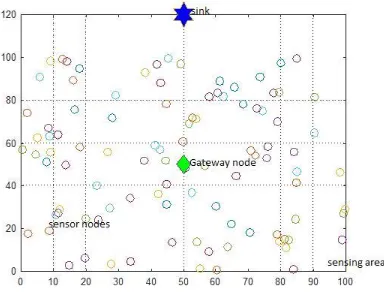
• The sensing area is divided into four region
• All sensor nodes are homogeneous sensor nodes and has same sensing capabilities • All sensor nodes have the same energy at the starting point
• A gateway node is deployed at the center of the network field area • Gateway node is stationary after deployment
• Gateway node is rechargeable
Fig. 2. Network model for the proposed system
We use the model which is first order radio model as used in [19], [18], [17]. The first order radio model represents the energy dissipation of all the sensor nodes for data aggregation, reception and transmission of data or packet. The energy consumed to send data of k bit packet over a distance d from a node to a cluster head or a base station is calculated according to equation (1)
ET x(k, d) = Eelec k + Efs ∗ k ∗ d2 , d < do (1)
Eelec ∗∗k + Emp ∗ k ∗ d4 , d ≥ do
To receive a data packet of k bits to a distance d the required energy is equation (2)
ERx(k) = Eelec ∗ k (2)
© 2018, IJCSMC All Rights Reserved 72
IV. Proposed Protocol
This section presents the detail of our proposed protocol. For our proposed protocol which is E-GEAR, to calculate TH(n) we use as mentioned in equation (3) [18].
Where p is the desired percentage of cluster head, r is current round, G= set of node not selected as cluster head in current round, Eni is remaining energy of node in current round, Einitial is initial energy of node, In current round. Once the CH have been chosen in each region CH broadcast an advertisement message to all nodes by using CSMA-MAC protocol. After receiving advertisement packet, each node transmits an acknowledgment message to the nearest CH using CSMA-MAC and joins that as member of the cluster. In wireless sensor network communication between sensor nodes is the most energy consuming process, ETX allows to reduce the energy consumed at each node [21]. According to the authors in [22] ETX is calculated based on packet loss rate collected from MAC layer. It is the predicted value of data transmissions that deliver a packet successfully over a wireless link. The calculation is based on the probability that the packets are successfully transmitted between sender and receiver in a bidirectional manner or in both directions. Forward delivery ratio or df is the probability that a packet is received successfully at the receiver side. Reverse delivery ratio or dr is the probability that a packet is received successfully at the sender side is called. Reverse delivery ratio is calculated based on reception of ACK packets that receiver sends to sender to acknowledge that a packet was successfully received. The probability that a packet is sent to receiver and receivers acknowledgment is received by sender is df * dr. to calculate ETX we use the following equation as they use in [24]
ET X = (4)
1
______________ (1 − pf) ∗ (1 − pr)
Where pf is the probability of packet lost in forward direction, pr is the probability of packet lost in reverse direction.
V. Simulation and Result
To compare with the existing protocol we use the following simulation parameters as they use in [18].
TABLE I
Simulation Parameters for proposed system
Parameters Value
R 3000
N 100
P 0.1
Eo 0.5 joule
Efs 10*0.000000000001 joules Etx 50*0.000000000001 joules Erx 50*0.000000000001 joules EDA 5*0.000000000001 joules
A. Performance Evaluation
The performance of proposed protocol is compared with existing protocol Modified Geographical energy-aware routing protocol in wireless sensor network.
B. Simulation setting
© 2018, IJCSMC All Rights Reserved 73 C. simulation parameters and result
In this thesis we use mainly the following performance parameters are evaluated which are given below.
Network Lifetime: It is the amount of time until theLast node of network runs out of energy. According to Fig 3, in 3000 round the graph shows in the first one thousand rounds they have the same alive nodes. After 1000 rounds the numbers of alive nodes are decreased in the MOD-GEAR Protocol than the proposed work. In both MOD-GEAR protocol and proposed protocol until the round becomes 2500 there are alive nodes. There for the proposed work has high performance.
Fig. 3. Comparison of number of Alive nodes MOD-GEAR and PROPOSED
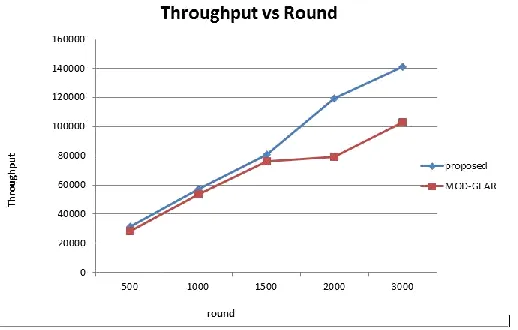
• Throughput: The throughput is calculated from the ratio of total packets received divided by total time of simulation equation (9) [25].
throughput = Total received packets (5)
Simulation time
According to fig 4, in 3000 round the graph shows the number of packets to base station in the proposed work is increased by 37.57% than the GEAR Protocol. There for the proposed work has high performance than MOD-GEAR Protocol.
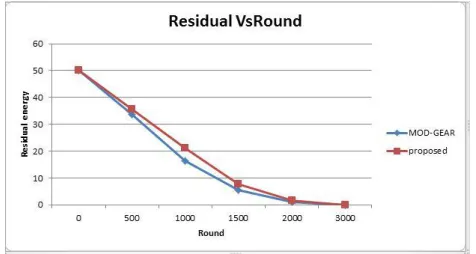
• Residual Energy: It is battery energy of network to analyze the network energy consumption in each round. Initially all
wireless sensor nodes has the same energy capacity. After the first round the energy of each node is varied because they consume different types of energy for different types of purposes. Based on the above graph in Fig 5, the energy consumption of the network is increased in the MOD-GEAR Protocol than the proposed work. In both MOD-GEAR protocol and our proposed work the remaining energy the network becomes zero at 2500 rounds. Because all nodes which communicates directly to the Gateway node and base station has no effect while the two regions selects cluster head. There for the proposed work has high performance.
© 2018, IJCSMC All Rights Reserved 74
VI. CONCLUSION and FUTURE WORK
An energy efficient and high throughput geographical routing protocol to minimize the energy consumption of sensor network by using gateway node and approach of cluster head selection based on probability, ETX, and residual energy of nodes has been shown. In this thesis the network is divided into four logical regions. In which two regions use direct communication and rest two regions use clustering hierarchy. This shows the better distribution of sensor nodes in network. We implement and evaluate our system (Improved Modified energy aware Routing protocol for wireless sensor networks) using MATLAB tool. Our proposed work shows the better performance as compared to modified geographical energy aware routing protocol in terms of residual energy, packets to base station, packet delivery ratio, throughput, first dead nod, and last dead node. Our proposed work is only for homogeneous wireless sensor network which means all the sensor nodes have the same initial energy, memory capacity and sensing range. In future we will investigate this system to be used for heterogeneous wireless sensor network. Secondly, since our work uses ETX link metric in future we will study and investigate more link quality metrics which can improve high throughput. Lastly but not least, different types of optimization algorithms will be incorporated while selecting Cluster Head nodes.
Fig. 5. comparison of residual energy MOD-GEAR and PROPOSED
TABLE II
Simulation comparison result for MOD-GEAR and Proposed.
Operation MOD-GEAR Proposed
First node dead in cluster one 1121 1355 First node dead in cluster two 1167 1356 First node dead in cluster dir-BS 1555 1555 First node dead in cluster dir-GW 2188 2188 Packet delivery ratio 0.6993 0.7026 All dead in cluster one 1581 1839 All dead in cluster two 1526 1785 All dead in cluster dir-BS 2302 2302 All dead in cluster dir-GW 2500 2500
According to Table II the comparisons of the proposed work with Modified Geographical Energy-Aware Routing Protocol. When the initial energy of each node is 0.5 joule in 3000 rounds the proposed work has high network life time (first dead node in cluster one and cluster two, last dead node in cluster one and cluster two than the Modified Geographical Energy-Aware Routing Protocol and also in terms of the packets to base station and packet.
References
[1]Yu, Yan and Govindan, Ramesh and Estrin, Deborah, “Geo-graphical and energy aware routing: A recursive data dissemi-nation protocol for wireless sensor networks,” Citeseer, 2001.
[2]Karl, Holger and Willig, Andreas, Protocols and architectures forwireless sensor networks, John Wiley & Son,2007. [3]Jamil, Rehan and Jamil, Irfan and Jinquan, Zhao and Ming, Li and Dong, Wei Ying and Jamil, Rizwan, Control and
Configu-ration of Generator Excitation System as Current Mainstream Technology of Power
Systemvolume=1,number=1,Citeseer,2013,
[4]Singh, Amarpreet and Kaur, Ramandeep, Weighted ClusteringAlgorithm based on O-Leach (WC-OLEACH) in Wireless Sensor Network,
© 2018, IJCSMC All Rights Reserved 75
[6]Yeh, Lun-Wu and Pan, Meng-Shiuan, Beacon scheduling for broadcast and convergecast in ZigBee wireless sensor networks, Elsevier, 2014.
[7]Bhattacharyya, Debnath and Kim, Tai-hoon and Pal, Subhajit, A comparative study of wireless sensor networks and their routing protocols, Molecular Diversity Preservation International, 2010.
[8]Zaman, Noor and Tang Jung, Low and Yasin, Muhammad Mehboob, Enhancing energy efficiency of wireless sensor networkthrough the design of energy efficient routing protocol, Hindawi,2016.
[9]Gao, Shan and Piao, Yong, DRRP: A dynamically reconfigurablerouting protocol for WSN, IEEE, 2014.
[10]Ahmed, Roshan Zameer and Biradar, Rajashekhar C, Energyaware routing in WSN for pest detection in coffee plantation,
Advances in Computing, Communications and Informatics (I-CACCI), 2016 International Conference on ,IEEE, 2016. [11]Ahmed, Roshan Zameer and Biradar, Rajashekhar C, Dataaggregation for pest identification in coffee plantations using
WSN: A hybrid model, Computing and Network Communications (CoCoNet), 2015 International Conference on,IEEE,
2015.
[12]Ahmed, Roshan Zameer and Biradar, Rajashekhar C, Redun-dancy aware data aggregation for pest control in coffee plantation using wireless sensor networks, Signal Processing and Integrated Networks (SPIN), 2015 2nd International Conference on,IEEE, 2015.
[13]Ahmed, Roshan Zameer and Biradar, Rajashekhar C and Chaudhari, Shilpa Shashikant, Cluster-based data aggregationfor pest identification in coffee plantations using wireless sensor networks,Computers & Electrical Engineering,Elsevier, 2016. [14]Kunavut, Kunagorn, Link quality aware routing based on effec-tive estimated throughput for mobile ad hoc networks,
IEEE, 2013.
[15]Kisara, Vineeth, A new routing metric for wireless mesh net-works Digital Repository@ Iowa State University, 2010. [16]Bongale, Anupkumar M and Swarup, Anand and Shivam, Shashank, EiP-LEACH: Energy influenced probability based
LEACH protocol for Wireless Sensor Network, IEEE, 2017.
[17]Nadeem, Qureshi and Rasheed, Muhammad Babar and Javaid, Nadeem and Khan, Zahoor Ali and Maqsood, Yousaf and Din, A-hamad, M-GEAR: Gateway-based energy-aware multi-hop rout-ing protocol for WSNs, IEEE, 2013.
[18]Singh, Praveen Kumar and Prajapati, Atul Kumar and Singh, Arunesh and Singh, RK, Modified geographical energy-awarerouting protocol in wireless sensor networks, IEEE, 2016.
[19]Heinzelman, Wendi Rabiner and Chandrakasan, Anantha and Balakrishnan, Hari, Energy-efficient communication protocol forwireless microsensor networks, IEEE, 2000.
[20]Draves, Richard and Padhye, Jitendra and Zill, Brian, Com-parison of routing metrics for static multi-hop wireless
networks, volume=34,number=4,pages=133–144,ACM, 2004.
[21]Lassouaoui, Lilia and Rovedakis, Stephane and Sailhan, Françoise and Wei, Anne, Evaluation of energy aware routing metrics for RPL, IEEE, 2016.
[22]Entezami, Fariborz and Politis, Christos, Routing protocol met-rics for wireless mesh networks, Wireless World Research Forum,2013.
[23]Tran, Anh Tai and Mai, Dinh Duong and Kim, Myung Kyun, Link quality estimation in static wireless networks with high traffic load, IEEE, 2015.
[24]Nadeem Javaid, Akmal Javaid’ and Khan, Imran Ali and D-jouani, Karim, Performance Study of ETX based Wireless Rout-ing Metrics,
[25]Mohamed, Bouyahi and Amira, Zrelli and Houria, Rezig and Tahar, Ezzedine, Impact Of Energy And Link Quality
IndicatorWith Link Quality Estimators In Wireless Sensor Networks, Academy & Industry Research Collaboration Center
![Fig. 1 Architecture of wireless sensor node [5]](https://thumb-us.123doks.com/thumbv2/123dok_us/1898893.1248462/2.612.182.429.317.498/fig-architecture-wireless-sensor-node.webp)