A preliminary version appears in: Security and Cryptography for Networks (SCN) 2012, Lecture Notes in Computer Science, Vol.7485, pp.113– 130, Springer-Verlag, 2012.
History-Free Sequential Aggregate Signatures
Marc Fischlin
1Anja Lehmann
2Dominique Schr¨
oder
31
Darmstadt University of Technology, Germany
2
IBM Research Zurich, Switzerland
3
University of Maryland, USA & Saarland University, Germany
Abstract. Aggregation schemes allow to combine several cryptographic values like message authentication codes or signatures into a shorter value such that, despite compression, some no-tion of unforgeability is preserved. Recently, Eikemeier et al. (SCN 2010) considered the nono-tion of history-free sequential aggregation for message authentication codes, where the sequentially-executed aggregation algorithm does not need to receive the previous messages in the sequence as input. Here we discuss the idea for signatures where the new aggregate does not rely on the pre-vious messages and public keys either, thus inhibiting the costly verifications in each aggregation step as in previous schemes by Lysyanskaya et al. (Eurocrypt 2004) and Neven (Eurocrypt 2008). Analogously to MACs we argue about new security definitions for such schemes and compare them to previous notions for history-dependent schemes. We finally give a construction based on the BLS signature scheme which satisfies our notion.
1
Introduction
Aggregate signature schemes [BGLS03] allow to combine multiple signatures from different senders for possibly different messages, such that the aggregate has roughly the same size as a single sig-nature. This helps to reduce the communication overhead in settings where authenticated infor-mation is forwarded from one party to another, such as the S-BGP routing protocol or certificate chains [BGLS03, LOS+06, BNN07, BGOY08]. As in the case of regular signature schemes, the
valid-ity of aggregates can be publicly verified given all messages and public keys.
The original proposal of Boneh at al. [BGLS03] supports aggregation of the data independently of the order of the parties and, furthermore, the aggregating algorithm only relies on the aggregates and public data. In contrast, most other solutions today like [LMRS04, LOS+06, BGOY08, BNN07, Nev08, Sch11] aresequential aggregate schemes where each party derives the next aggregate by taking the private key, the previous aggregate, and all the previous messages together with the corresponding keys in the sequence into account. For instance, in all1 known sequential signature schemes the aggregation algorithm first checks with the public keys that the current aggregate is a valid signature for the preceding message sequence. Often, they also incorporate these messages in the computation of the new aggregate. Thus, so far, the aggregation in sequential signature schemes seems to be much more expensive than in the non-sequential setting, which might render sequential schemes impractical for resource-constraint devices. Another issue, pointed out in [BGR11], is that the verification requires also obtaining and checking the public keys of the users in the sequence.
1.1
History-Free Sequential Aggregation
Recently, Eikemeier et al. [EFG+10] introduced the notion ofhistory-freeness in the context of aggre-gate MACs, which aims to preserve the “lightweight” aggregation approach from general aggreaggre-gate schemes also in the sequential setting. More precisely, in a history-free MAC a new aggregate is derived only from the aggregate-so-far and the local message, but does not rely on (explicit) access to the previous messages. Note that, strictly speaking, the aggregate-so-far certainly contains some in-formation about the previous messages; this inin-formation, however, is limited due to the size restriction for aggregates.
In this work we adopt the notion of history-freeness to the case of sequential aggregatesignatures, only allowing the aggregate-so-far, the local message, and signing key to enter the computation, but not the previous messages and public keys in the sequence. For signatures this property is especially worthwhile, because it means that the costly signature verifications for each aggregation step are suppressed. In fact, since the security of previous schemes strongly relies on such checks, omitting them indicates the hardness of finding history-free schemes. Eikemeier et al. [EFG+10] achieve this,
to some extent, for the case of MACs by using an underlying pseudorandom permutation to encrypt parts of the data. This is usually not an admissible strategy for the case of signatures.
At first, history-free sequential aggregation might seem to be the second best solution compared to non-ordered aggregation (with history-free aggregation quasi built in). However, sequential ag-gregation is required for many applications such as for authenticating routing information or for certificate chains, and in these applications the verifiability of the order of signing steps is usually important, whereas general aggregate schemes do not allow this. Following the terminology for multi-signatures [BGOY08] we call such schemes ordered sequential-aggregate schemes. We also remark that all known sequential aggregate schemes are ordered, except for the one by Lu et al. [LOS+06],
and that we usually consider history-freeness only in connection with such ordered schemes.
1.2
New Security Models
Introducing the idea of history-freeness affects known security definitions for sequential signature schemes. Since the history of previously signed messages is not available to the aggregation algorithm, an adversary can now initiate aggregation chains “from the middle”, without specifying how the initial message sequence looks like. The starting aggregate for such a truncated iteration does not even need to be valid, as checking the validity of the aggregate with respect to the preceding message sequence is impossible for the aggregation algorithm.
Our security notions for history-free schemes, adopted from the work by Eikemeier et al. [EFG+10],
follow the well-known approach for (regular and aggregate) signatures that an adversary can re-quest data via oracles and is supposed to eventually output a valid but non-trivial forgery. In the original LMRS security model for sequential aggregation with full information about preceding mes-sages [LMRS04], the adversary is considered to win if it produces a valid aggregate for a non-trivial sequence, where trivial sequences are previously queried sequences and, since appending some itera-tions for controlled parties is easy for the adversary, such extended sequences thereof.
Specifying the trivial combinations in our history-free model is more delicate because the adver-sary now gets to query partial chains and can potentially glue several of these data together. We resolve this by following the approach of Eikemeier et al., that is, by defining a transitive closure of trivial sequences, consisting of matching combinations of (possibly many) previously seen aggregates and contributions by corrupt parties. We define two versions of this closure, depending on whether intermediate values of partial chains are available to the adversary or not, yielding two security notions (one being stronger and implying the other). Intuitively, due to the additional adversarial power, one would expect our new security models to be weaker than the original ones for sequential aggregation. Interestingly, though, both our security notions for history-freeness are strictly stronger than the se-curity model for sequential aggregation due to Lu et al. [LOS+06], but incomparable to the one of
the requirement for history-freeness, we can easily achieve the [LMRS04] security property (on top of our aggregation-unforgeability notion) if we simply prepend the hash value of all previous public keys and messages in the sequence to the message to be signed next. By this we get a strongly secure sequential aggregate signature which does not need verification of all preceding signatures!
We also briefly revisit the case of non-ordered aggregates. Here, adapting the idea of the closure yields strictly stronger security guarantees than in previous definitions for non-sequential schemes. Our models, both for sequential and for non-ordered schemes, reflect the resistance of aggregate schemes against “mix-and-match” attacks, where an attacker is already considered successful if it can recombine learned aggregates into a “fresh” aggregate that it has not seen before, or is able to remove parts of the aggregates. This is opposed to the common approach of reducing the unforgeability of aggregation schemes to the unforgeability of individual messages, where combining aggregates or removing a party’s contribution are not deemed to be successful attacks (because they do not forge an individual signature). This is discussed for the symmetric setting in more detail in [EFG+10]. Yet, we
are not aware if that high security standard can be achieved for aggregate signatures. Nonetheless, as a side effect of our approach, we point out that the scheme by Boneh et al. [BGLS03] allows attacks which are not covered by their security models. The discussion appears in Section 5.
1.3
Building History-Free Schemes
We finally provide a solution meeting our requirements in Section 4. We give a construction based on the signature scheme of Boneh et al. [BLS01], which has already been successfully transformed into the BGLS scheme for non-sequential aggregation [BGLS03]. By this we derive a scheme for history-free sequential aggregation. Observe again that the resulting scheme also comes with the verifiability of the aggregation order.
Our construction chains the aggregates with the help of a collision-resistant hash function, i.e., instead of signing only the local message, we first compute the hash value of this message together with the previous aggregate.2 Hence, instead of verifying a chain of signatures our aggregation algorithm
only needs to compute bilinear mappings. The aggregates of our scheme are slightly larger than the ones of the original BGLS scheme and the construction satisfies our weaker security notion.
1.4
Concurrent Work
Recently, Brogle et al. [BGR11] proposed a notion of sequential aggregate signatures with so-called lazy verification, resembling the idea of history-freeness as defined in [EFG+10] and also used here
closely. They designed and implemented a history-free scheme based on trapdoor permutations, with a special focus on the BGPsec protocol [Lep11]. Their security model, albeit appropriate for the BGPsec case, is a relaxation of the LMRS model which is implied by (even the weaker version of) our security notion. The reason is roughly that this relaxation merely demands that the message in the forgery has not been signed by the honest user before, implying that it cannot be in the closure and therefore also constitutes a breach of security in our model. We note that the relaxed LMRS notion does not cover the class of mix-and-match attacks discussed in [EFG+10] and here. The construction
in [BGR11] produces signatures proportional to the number of signers and explicitly relies on the random oracle model. In contrast, our scheme generates signatures of size independent of the number of signers, only implicitly relies on the random oracle model through the currently best proof for the underlying BLS signature scheme in the random oracle model. Our solution comes with stronger unforgeability guarantees (under reasonable cryptographic assumptions).
2The tricky part here is that we do not use the aggregate as it is, but first apply the underlying bilinear mapping to
2
Preliminaries
2.1
Sequential Aggregate Signature Schemes
An aggregate signature [BGLS03] is a single signature of different signers on different messages such that this aggregate has roughly the same size as an ordinary signature. In the sequential case the aggregation algorithm gets as input a sequence of public keys pk = (pk1, . . . ,pki) and messages M = (M1, . . . , Mi), an aggregate σ0 for this sequence, a message M and the secret signing key
sk (with corresponding public key pk). It returns the new aggregate σ for the sequence pk||pk := (pk1, . . . ,pki,pk) andM||M := (M1, . . . , Mi, M). More formally:
Def inition 2.1 (Sequential Aggregate Signature Scheme) A sequential aggregate signature scheme is a tuple of efficient algorithmsSAS= (SeqKg,SeqAgg,SeqAggVf), where
Key Generation. SeqKg(1n)generates a key pair (sk,pk)where pk is recoverable from sk.
Signature Aggregation. The aggregation algorithmSeqAgg(sk, M, σ0,M,pk)takes as input a secret key sk, a message M ∈ {0,1}∗, an aggregateσ0 and sequences M = (M1, . . . , M
i) of messages
and pk = (pk1, . . . ,pki) of public keys and computes the aggregate σ for message sequence
M||M = (M1, . . . , Mi, M)and key sequence pk||pk= (pk1, . . . ,pki,pk). (We assume that there
is a special “starting” symbol σ0 =∅ for the empty aggregate, different from all other possible aggregates.)
Aggregate Verification. The algorithm SeqAggVf(pk,M, σ) takes as input a sequence of public keys pk= (pk1, . . . ,pki), a sequence of messages M= (M1, . . . , Mi)as well as an aggregate σ.
It returns a bit.
The scheme is complete if for any sequence of key pairs (sk,pk),(sk1, pk1), . . .←SeqKg(1n), for any sequence M of messages, any M ∈ {0,1}∗, for any signature σ ← SeqAgg(sk, M, σ0,M,pk) with
SeqAggVf(pk,M, σ0) = 1 orσ0=∅, we haveSeqAggVf(pkkpk,MkM, σ) = 1.
Note that we do not define “pure” signing and verification algorithms but only the aggregate counterparts. We can specify such algorithms in a straightforward way via the aggregation algorithm run on the starting aggregate σ0. In fact, this is often how, vice versa, the aggregation algorithm works on this empty sequence. Second, we do not put any formal restriction on the size of aggregates, in the sense that aggregates must be smaller than individual signatures. Such restrictions can be always met by first “inflating” regular signatures artificially. We thus leave it to common sense to exclude such trivial examples. Finally, throughout the paper we assume that public keys of parties are unique, say, they include the identity and a sequence number as common in certificates.
2.2
LMRS
Security of Sequential Aggregate Schemes
Lysyanskaya et al. [LMRS04] propose a security model for sequential aggregate signature schemes based on the chosen-key model of [Bol03, BGLS03]. The adversary gets as input a challenge public keypkc and has access to a sequential aggregate signing oracleSeqAgg(skc,· · ·) which takes a message
M, an aggregateσ0and sequencesMandpkas input and returns the new aggregateσ. The adversary wins if it manages to output a valid sequential aggregate signature for a sequenceM∗= (M1∗, . . . , Mi∗) under public keys pk∗ = (pk∗1, . . . ,pk∗i) and pk∗ contains the challenge key pkc and the sequence (M1∗, . . . , Mi∗c) with (pk
∗
1, . . . ,pk∗ic) has never been queried to oracle SeqAgg, where ic denotes the
index ofpkc in pk
∗
.
For the sake of distinctiveness with the unforgeability notion for regular signature schemes we call schemes being immune against such adversariessequentially unforgeable:
Def inition 2.2 A sequential aggregate signature scheme SAS = (SeqKg,SeqAgg,SeqAggVf) is se-quentially unforgeableif for any efficient algorithmAthe probability that the experimentSeqForgeSASA
ExperimentSeqForgeSASA (n) (skc,pkc),←SeqKg(1n)
(pk∗,M∗, σ∗)← ASeqAgg(skc,···)(pk
c)
Letic be the index of pkc in pk∗= (pk∗1, . . . ,pk∗`)andM∗= (M1∗, . . . , M`∗).
Return1iffSeqAggVf(pk∗,M∗, σ∗) = 1
and pkc∈pk
∗
and pki6=pkj for1≤i < j≤` and
A never queriedSeqAgg(skc,· · ·) about(M1∗, . . . , Mi∗c),(pk
∗ 1, . . . ,pk
∗
ic).
3
Security of History-Free Sequential Signatures
3.1
History-Freeness
So far, sequential aggregate schemes usually include the previous messages and public keys when deriving the new aggregate. This is a crucial disadvantage compared to the “lightweight” aggrega-tion in non-sequential schemes, where the aggregaaggrega-tion only depends on the previous signatures. To circumvent this issue we now apply the recently proposed notion of history-freeness [EFG+10] which
restricts the input for the aggregation algorithm to the aggregate-so-far and the local message, i.e., the aggregation does not get access to the previous messages and keys. More formally:
Def inition 3.1 (History-Freeness) A sequential aggregate signature schemeSAS= (SeqKg,SeqAgg,
SeqAggVf)is calledhistory-freeif there exists an efficient algorithmSeqAgghfsuch thatSeqAgghf(·,·,·) =SeqAgg(·,·,·,M,pk)for allM,pk.
To save on notation we will often identifySeqAgghfwithSeqAggand simply omitM,pkfrom the input ofSeqAgg.
Note that history-free sequential signature schemes are not the same as non-sequential aggregate signatures as defined by Boneh et al. [BGLS03]. As mentioned in the introduction, the security requirement for (history-free) sequential schemes often allows to check the order of the signers, in contrast to non-sequential schemes.
3.2
Security Model
When considering history-free signature schemes the LMRS security model for sequential schemes [LMRS04] does not fully reflect the new conditions of the adversary and the desired security guarantees. This stems from the fact that in the history-free setting the previously signed messages are not available to the aggregation algorithm, which allows an adversary to trigger new aggregation chains “from the middle” without knowing the previous message sequence. To capture those attacks we modify the aggregation oracle such that it returns aggregates for sequences of messages, starting now with an arbitrary aggregate-so-far. Thus, we also incorporate some ideas of the aggregation-unforgeability
notion [EFG+10] into our new model.
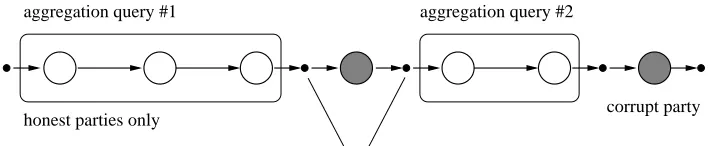
Aggregation-unforgeability here demands that the adversary cannot output a valid chain, unless its a trivial combination of previous aggregation queries and values by corrupt parties. An example of such a trivial combination is depicted in Figure 1, where the adversary computes the final value by simply iterating through the sequence with the help of the aggregation oracle and local computations by corrupt players. Note that each aggregation query is for a sequence of honest parties and this requires several public keys.
Attack Scenario. As in the aggregation-unforgeability model of Eikemeier et al. for aggregated
MACs, we also grant the adversary in our model an aggregation oracle returning aggregates for (ordered) sets of messages. To allow reasonable aggregation queries we hand the adversary now t
aggregation query #1
honest parties only
aggregation query #2
aggregates available to the adversary (through aggregation queries or local computations) corrupt party
Figure 1: Example of a trivial combination of replies to aggregation queries and local computations by corrupt parties.
The adversary’s attack is divided into two phases. In the first phase, the adversary has access to a corruption and a key-setting oracle, both initialized with the t key pairs ((sk1,pk1). . . ,(skt,pkt)).
By querying the corruption oracle the adversary can obtain at most t−1 secret keys of his choice. We denote byQCor the set of corrupted keys. To model rogue-key attacks we also provide an oracle
SetKeywhich allows the adversary to change the public key of a previously corrupted party, i.e., on
inputpk,pk∗ the oracle replaces the public keypkof a corrupt party bypk∗. Recall that we assume that public keys must be unique. Any modifications of corrupted keys are captured by the set QCor as well.
The adversary starts the second phase by interacting with the sequential aggregate signature oracle
OSeqAggbut is denied access to the corruption or key-setting oracle in this phase (reflecting static
corruptions3). On input of an aggregate-so-far σ0, a sequence of new messagesM for public keyspk
theOSeqAggoracle checks whether all public keys inpkare distinct and belong to honest parties. If
an invalid public key appearsOSeqAgganswers ⊥, otherwise it responds with a new valid aggregate
σ derived by running the aggregation algorithm stepwise for all input data. We remark that the aggregation oracle only aggregates for honest parties, i.e., where the corresponding keys were neither corrupted nor modified; for corrupt players the adversary, holding the secret key, must add the values herself.
Eventually the adversary A halts, outputting a tuple (pk∗,M∗, σ∗). The forgery must be valid according to our definition of history-free sequential aggregate signature schemes. In addition, the signature must be non-trivial which is quantified by defining the closure of all query/answer pairs of A. Here, we denote by QSeq the set of all query/answer tuples ((σ0,M,pk), σ) that occur in A’s interaction with the OSeqAgg oracle. Recall that QCor denote the sets of all keys that were corrupted and possibly modified by the adversary. The closure contains all admissible combinations of aggregated data for the queried sequences together with all possible values by corrupted parties.
Closure. For history-free sequential aggregate signatures, defining the closure is more complex as
in the general case that we discuss in Section 5. Here, an adversary can query partial chains and later possibly combine several of them by using corrupted keys or chains with matching starting/end points. Thus, we define the closure recursively through a functionTrivialQSeq,QCorwhich, for parameters (pk,M, σ) describes all sequences that can be derived trivially starting from message sequenceMand aggregate-so-farσ, i.e., where one can append (recursively expanded) trivial sequences via aggregation queries or local computations by corrupt players. For example, if we have an aggregation query (σ0,pk,M) with answer σ in QSeq and another query (σ,pk0,M0) with the answer from the first query as the starting aggregate, then the sequence (pk||pk0,M||M0) is in the trivial set. So is any extension of this sequence for corrupt players. We note that, if the final aggregate of a chain and the starting aggregate do not match, then the combined sequence is not in the closure, neither are subsequences of previous queries (unless either sequence appears in another query).
The closure is then defined to contain all trivial sequences starting from the information available to the adversary at the beginning, namely, the empty message sequence, the starting keypk0=∅and
3We observe that the standard strategy to lift security against static corruptions to security against adaptive
the starting tagσ0=∅. Note that the closure here is now a set of tuples where each tuple represents
a sequential aggregation.
Def inition 3.2 (Sequential Closure ofA’s queries) LetQCor andQSeqbe the sets corresponding
to the different oracle responses and letTrivialQSeq,QCor be a recursive function of trivial combinations
defined as
TrivialQSeq,QCor(pk,M, σ)
:= {(pk,M)} ∪ [
((σ,M,pk),σ)∈QSeq
TrivialQSeq,QCor(pk||pk,M||M, σ)
∪ [
∀M ,σ
∧pki∈QCor
TrivialQSeq,QCor(pk||pki,M||M , σ).
The closureClosureof A’s queriesQSeq and QCor is then defined by recursively generating the trivial
combinations starting from the empty tuple as described above:
Closure(QSeq, QCor) :=TrivialQSeq,QCor(∅,∅,∅).
As an example consider an attack on a regular (non-aggregate) signature scheme, with a single honest party and no corrupt players. Then the closure contains all queries to the signing oracle and renders these values as trivial. Note that we do not treat the case of concatenating answers for the same public key in any special way.
A more important example are the mix-and-match attacks in which the adversary sees several aggregation chains (of honest parties) but is able to combine them into a new sequence. This new sequence would then be not in the closure and thus constitute a legitimate forgery attempt. In other words, any secure scheme according to our notion must prevent such mix-and-match attacks.
Aggregation Unforgeability. With the definition of the sequential closure, we propose the
following security model for history-free sequential aggregate signatures.
Def inition 3.3 (Aggregation Unforgeability) A history-free sequential aggregate signature scheme
SAS= (SeqKg,SeqAgg,SeqAggVf)isaggregation-unforgeableif for any efficient algorithmA(working
in modescorrupt,forge)the probability that the experimentSeqForgeSASA evaluates to1is negligible (as a function ofn), where
ExperimentSeqForgeSASA (n)
(sk1,pk1), . . . ,(skt,pkt)←SeqKg(1n)
K0←((sk1,pk1), . . . ,(skt,pkt))
st← ACorrupt(K0,·),SetKey(K0,·,·)(
corrupt,pk1, . . . .pkt)
// it is understood that Akeeps statest
LetK be the set of the updated keys of all parties
(pk∗,M∗, σ∗)← AOSeqAgg(K,···)(
forge,st)
Return1iff pki6=pkj for alli6=j andSeqAggVf(pk∗,M∗, σ∗) = 1and
(pk∗,M∗)6∈Closure(QSeq, QCor).
Relaxed Security Notion. Our definition is very demanding in the sense that prefixes of
aggre-gation sequences are considered to be non-trivial. In particular, this means that intermediate values in such a chain cannot be available to the adversary, or else successful attacks according to our model are straightforward. This model corresponds to the case that the forwarded data between honest parties are for instance encrypted.
aggregates available to the adversary (through aggregation queries or local computations)
Figure 2: Relaxed Security Notion: In comparison to the stronger notion (Figure 1) the adversary can only make aggregation queries of length 1. The closure potentially allows more combinations now and thus rules out more sequences as trivial.
propose a relaxed definition of history-free unforgeability that takes the possibility of obtaining the
intermediate signatures into account, inciting the namemezzo aggregation unforgeability.
We also remark that a simple approach like having the first party in a sequence create some unique identifier or nonce, which is used by all subsequent players, usually does not facilitate the design of schemes because the adversary can always put a corrupt player upfront. Similarly to the case of non-ordered aggregation we can have a solution with counters or time stamps but this again requires synchronization between the parties.
We can easily cast the weaker notion in our model by allowing only aggregation queries for se-quences of length one, i.e., where the adversary has to compute longer chains itself by iterating through the sequence manually. Clearly, this adversary is a special case of our adversary above and the security guarantee is therefore weaker (in other words, the closure now contains more trivial elements). It is also very easy to prove this formally by considering a scheme where the new aggregate contains the previous aggregate. For the stronger notion this allows to obtain a valid aggregate of a prefix easily, whereas for the weaker notion the extra aggregate is already been input by the adversary and thus provides no additional information. The difference between the models is depicted in Figure 2.
Def inition 3.4 (Mezzo Aggregation Unforgeability) A history-free sequential aggregate signa-ture schemeSAS= (SeqKg,SeqAgg,SeqAggVf)is mezzo aggregation-unforgeableif it is aggregation-unforgeable for any efficient algorithmAthat only calls oracle OSeqAggfor sequences of length one.
We note that mix-and-match attacks are still ruled out by the above definition. For this observe that any “manually iterated” sequence can only interfere with other sequences if intermediate signa-tures collide. Such collisions are, however, unlikely and can only happen with negligible probability. Else, such collisions would easily allow to forge individual signatures of honest parties and would constitute a successful forgery in the above sense.
3.3
Relationship to the
LMRS
-Model
It is easy to see that our security model is strictly stronger than the one by Lu et al. [LOS+06] because
successful attacks according to their definition involve individual forgeries for fresh messages against a single challenge key (which thus cannot belong to our closure). At the same time their approach does not allow to verify the order of aggregation steps, whereas changing the order constitutes a successful attack according to our definition. We therefore focus on the comparison to theLMRS-model.
On one hand our model gives the adversary more power than in the LMRS-model for secure se-quential aggregation, because it does not need to specify the starting message sequence for aggregation queries. On the other hand we allow the adversary less freedom when it comes to values of corrupt players in the forgery attempt. Hence, the possibilities in the attack are somewhat compensated for and this makes the models incomparable, as we show by the following separating examples.
succesful attack according to LMRS but not according to our model forgery
succesful attack according to our model but not according to LMRS model
forgery
Figure 3:Comparison of the LMRS security model and our (strong) model: Prepending any values by corrupt parties is not considered a successful attack in our model (left part), whereas branching into a different sequence from some intermediate value is not considered a successful attack in the LMRS model (right part).
enable collisions on the intermediate values. Since the information about the starting sequence then does not enter the further computations preventing such attacks in our setting seems impossible. The right side shows a successful attack in our model which takes advantage of a prefix of an aggregation subsequence; this is by definition not a successful attack in the LMRS model. A similar separation holds for our relaxed notion. We discuss these cases in more detail in Appendix A.
Adding LMRS Security to (Mezzo) Aggregation Unforgeability. We briefly discuss how to add the LMRS security property to our (mezzo) aggregation unforgeability, if now all preceding public keyspkand messagesMin a sequence are known. The idea is to use a collision-resistant hash functionhand, for each signature creation, to prepend the hash value c=h(pk,M) to the message to be signed. For verification one does the same. Note that, while this is formally not a history-free scheme anymore, signing still does not require verification of preceding signatures.
Aggregation unforgeability still holds in the modified scheme if we consider each hash value to be an integral part of the message to be signed. But the collision resistance of the hash functionhnow also ensuresLMRSsecurity, because we can assume that all hash values of sequences are unique. This implies that in anLMRS forgery attempt the message with the prepended hash value has not been signed by the honest user in question (either the prefix is new and thus the hash value, or the message in combination with this sequence is). This means that the forgery sequence is not in the closure and would thus constitute a breach of (mezzo) aggregation unforgeability.
4
Construction
We derive a history-free sequential aggregate signature scheme based on the BLS signature scheme that is secure in the random oracle model [BLS01]. This scheme has already been successfully applied to derive the non-sequential BGLS aggregate signature scheme [BGLS03]. Below we assume that we have an efficient, non-degenerate bilinear mape : G1×G2 → G3 for system-wide available groups,
whereg1is a generator ofG1andg2is a generator ofG2. We assume thate(·, g2) is one-to-one. Also,
letH :{0,1}∗7→
G1be a public hash function.
In the BLS signature scheme the key generation algorithm Kg(1n) picks an elementx ← Zp at
random and computesv←g2x. It returns (pk,sk)←(v, x). The signing algorithmSign(x, M) takes as
input a messageM ∈ {0,1}∗ and a secret keyx. It computesσ←H(M)x and returns the signature
σ∈G1. The verification algorithmVf(v, M, σ) outputs 1 iffe(σ, g2) =e(H(M), v).
4.1
Construction based on BLS Signatures
c←h(e(σ0, g2), M,pk0, c0) for its messageM. Note that using the value under the bilinear mapping
instead of σ0 is necessary for the verification the whole sequence without knowing the individual aggregates and is a specific property of theBLS scheme. The signer next computes a non-aggregated signaturesforcand aggregatesstoσ0 to deriveσ, and finally forwards (σ,pk, c, s) to the next signer.
Construction 4.1 Let DS= (Kg,Sig,Vf) be the BLS signature scheme andh:{0,1}∗7→ {0,1}n be
a hash function. Define the following efficient algorithms:
Key Generation. The key generation algorithm is identical toKg.
Sequential Signature Aggregation. Algorithm SeqAgg gets as input a pair of keys (sk,pk) = (x, v), a messageM ∈ {0,1}∗, and a sequential aggregate signature(σ0,pk0, c0, s0). The algorithm sets c ← h(e(σ0, g2), M,pk0, c0), where e(∅, g2) = 1 by definition, checks that Vf(pk0, c0, s0) = 1
or that pk0, c0, s0 =∅ are the starting symbols, and stops if not. Else it computes the signature s=H(c)x←Sig(sk, c)oncand the valueσ←σ0·s. It outputs the sequential aggregate signature
(σ,pk, c, s).
Aggregate Verification. The input of algorithm SeqAggVf(pk,M, σ) is a sequence of public keys
pk= (pk1, . . . ,pk`), a sequence of messages M= (M1, . . . , M`) as well as an aggregateσ(with
pk, c, s). It parses pki=gxi
2 , sets
c0← ∅ and pk0← ∅ and ci←h i−1
Y
j=0
e(H(cj),pkj), Mi,pki−1, ci−1
fori= 1, . . . , `, wheree(H(∅),pkj) = 1by definition, and outputs 1 if
e(σ, g2) =
`
Y
i=1
e(H(ci), g2xi).
Completeness follows inductively, as for honest parties each intermediate aggregate σi is a valid
signature forc1, . . . , ci and therefore the next output also satisfiese(σi, g2) =e(H(cj), g2xi).
4.2
Security
Our security proof basically follows by reduction to the security to the BLS signature scheme and the collision resistance of h. We note that we do not explicitly rely on the random oracle model, only implicitly through the (currently best) security proof for the BLS scheme. Instead, we could give a straight reduction to the co-Diffie-Hellman problem [BLS01], but then we would need to program the random oracle. The main idea of the proof is that we either break the underlyingBLSscheme (in case C∗ computed in the verification of the adversary’s forgery attempt contains a new valuec∗i), or that the adversary has to forge a (regular) signature for an honest party or to find a collision forh(if all values inC∗ have appeared during the attack).
Theorem 4.2 Lethbe a collision-resistant hash function. If theBLSsignature scheme is unforgeable, then the scheme defined in Construction 4.1 is a history-free, mezzo aggregation-unforgeable sequential aggregate signature scheme.
Proof. We prove this theorem assuming towards contradiction that there exists an adversary A breaking aggregation-unforgeability with non-negligible probability(n). Assume that this adversary eventually outputs a valid forgeryM∗, pk∗ andσ∗. Let C∗ = (c∗1, . . . , c∗`) denote the values derived during the verification, and assume that the sequenceM∗ does not belong to the closure.
Setup. AlgorithmBgets as input a public keypkc, it pickst−1 key pairs (ski,pki)←SeqKg(1n) and
inserts the keypkc at a random position,pk←(pk1, . . . ,pkj−1,pkc,pkj+1. . . ,pkt). Bsimulates Ain a black-box way on inputpk(if we assumeH to be a random oracle thenBgrantsAdirect access toH).
Key Oracles. During the simulation,Ais allowed to corrupt keys and to change them. IfAinvokes the corruption oracle Corrupt(sk,·) on input pk, then B returns ski if pki =pk, for some i ∈
{1, . . . , t} \j, and otherwisefailed. In the case thatAwishes to substitute a certain public key
pk∈pkand queries its key-modification oracleSetKey(sk,·) about a pair (pk,pk0), thenBsets
pki =pk
0
ifpki =pkfor an index i∈ {1, . . . , t} \j. It returns succif such a public key exists
and substitution succeeded, otherwisefailed.
Aggregate Signing. WheneverAasks the aggregate signing oracleSeqAggto build a new sequential aggregate signature for an aggregate-so-far σ0, a messageM, and a public keypk, algorithmB answers this query in the following way. It first checks if the public key pk has never been corrupted nor substituted (if so, it returns ⊥). Adversary B either computes the aggregate invoking its external signing oracle (in the case where pk = pkc), or else by executing the signing algorithm itself (for the corresponding secret keysk). In both cases all other steps of the aggregation algorithm besides the signing step can be computed easily. B outputs the full aggregate toA.
Output. At the end of the simulationAoutputs a tuple (M∗,pk∗, σ∗). Algorithm BcomputesC∗ as in the description of the verification procedure and returns these values together with pk∗ andσ∗. AlgorithmB checks ifpkc ∈pk
∗
and, if so, computes the valuesc∗i as for verification, and outputsc∗
c together withσ∗·
Q
i6=cH(ci)−xi as the signature (for the known secret keysxi
belonging to the other parties inpk∗).
For the analysis note that, in the case that some newc∗i for some honest party is inC∗our algorithm Bloses only a factor 1/tfor guessing the right public key. But then, for a valid forgery ofAwe have e(σ∗, g2) =Q`
i=1e(H(c∗i), g xi
2 ). Dividing out
Q
i6=cH(c∗i)
xi of σ∗ yields e(σ∗·Q
i6=cH(c∗i)−
xi, g2) =
e(H(c∗c),pkc) and therefore a valid forgery for the BLS scheme under public keypkc. Hence, this case
ofAwinning cannot have non-negligible probability.
Next assume that all thec∗i’s of honest parties have appeared in aggregation requests before (and are answered without failure), butA still wins. In the forgery attempt consider the leftmost honest party at positioni such that the leading sequence (M∗
1, . . . , Mi∗) of M∗ does not lie in the closure.
Since we assume thatc∗i has appeared in some aggregation query to party ibefore, we must have a query (σ0,pk0, c0), M with
h(e(σ0, g2), M,pk0, c0) =c∗i =h(Y
j<i
e(H(c∗j),pkj), Mi∗,pki−1, ci−1).
By the collision-resistance ofhwe conclude thatM =Mi∗,pk0 =pki−1and c0 =c∗i−1 ande(σ0, g2) = Q
j<ie(H(c∗j),pkj). By assumption, the leading sequence (M1∗, . . . , Mi∗) is not in the closure. There
are three cases:
• Our “target” party at positioniis the first one in the sequence (M1∗, . . . , Mi∗), i.e.,i= 1. Since
it then only computes an aggregate ifσ0,pk0, c0 =∅we derive the contradiction that the sequence is in fact in the closure, due to the aggregation query (σ0,pk0, c0), M =M∗
i yieldingc∗i. This,
however, contradicts our assumption.
again makes (M1∗, . . . , Mi∗) per definition also part of the closure. This is so since corrupt parties can “link” any trivial sequences.
• The final case is if there is an honest party at position i−1. Note that our party at i only returns an aggregate if the signatures0 is a valid signature for the incoming valuec0=c∗i under the same key pk0 =pki−1 of the honest party at position i−1. We conclude again that the adversary needs to make the honest party at some step signc∗i (or needs to forge a signature for honest party ati−1, which would again contradict the security of the BLS signature scheme). However, by the collision resistance of hand noting that the function e(·, g2) is one-to-one, it follows that this requires the same input (σ00,pk00, c00), M0 to the party at position i−1 as on the “closure path”. Furthermore, the valid signaturess00 forc00 and s0 forc0 are unique, and it therefore follows again that the closure extends to the party at positioni, contradicting again our assumption.
This shows that the adversary can win in this case with negligible probability only, and concludes the
proof.
We again note that, following the discussion in Section 3.3, we can easily get a (non history-free) signature scheme which is simultaneously alsoLMRS secure without the verification of signatures in the sequence, This is achieved by inserting the sequence of messages and public keys into the evaluation of the hash functionh.
5
Security of Non-Sequential Aggregation Schemes
The common security model for non-sequential aggregate signatures of Boneh et al. [BGLS03] only considers limited attacks (akin to our weaker security notion), even though stronger notions may be desirable for some applications (similar to our strong notion). For the case of symmetric authentication this was already discussed in [EFG+10] by presenting an attack against an aggregate MAC scheme,
that was outside of the previous security model. Here we show that a similar argumentation holds for aggregate signatures as well.
Mix-and-Match Attacks. We first recall the example of an “mix-and-match” attack that was
given for aggregate MACs by Eikemeier et al. From an abstract point of view, the attack uses three aggregates for message sets{M1, M2},{M3, M2}and{M1, M4}to derive a valid aggregate for a fourth pair{M3, M4}. The attack is not considered a security breach according to the model by [BGLS03]. Roughly, the shortcoming is due to the definition of “trivial” attacks: an adversary is usually not considered to succeed if the messages in the forgery have been authenticatedindividually during the attack. In the example above this means thatanycombination of the messagesM1, M2, M3, M4cannot be used for a successful forgery, although only three of these combinations have actually appeared before. Ideally, however, an aggregation scheme should be considered insecure if an adversary is able to transform several aggregates into anew combinationthat has not been authenticated before.
More concretely, recall that an aggregate in the scheme by Boneh et al. is of the formσ =Qσ
i
for regular BLS signaturesσi =H(Mi)xi for random oracle H, messageMi and secret key xi. The
public key is given bygxi and verification is performed with the help of the pairing operation. Given
the replies
σ1=H(M1)x1·H(M2)x2, σ2=H(M3)x1·H(M2)x2, σ3=H(M1)x1·H(M4)x2
to three aggregation queries for message sets {M1, M2}, {M3, M2} and {M1, M4}, the adversary is able to compute a valid aggregate
for the set {M3, M4}. According to the definition of [BGLS03] this, however, does not constitute a
security breach.
We discuss further attacks.
Deletion. Given two aggregates
σ1=H(M1)x1·H(M2)x2·H(M3)x3, σ2=H(M2)x2
for queried message sets{M1, M2, M3}, and{M2}respectively, an adversary against the BGLS scheme candelete the elementH(M2)x2 =σ2 from the first aggregate by computing
σ∗1=σ1·σ2−1=H(M1)x1·H(M3)x3
and thereby obtains a valid aggregate on the “fresh” set{M1, M3}.
Re-Ordering. A re-ordering attack is an attack where an adversary learnsa single aggregateσ1 on
a sequence of messages M1, M2, M3 and outputs an aggregate on a new sequence of messages M1, M3, M2. More precisely, given the reply
σ1=H(M1)x1·H(M2)x2·H(M3)x3
to the aggregation query for message sets {M1, M2, M3}, the adversary is able to reorder the elements inside the aggregate:
σ∗2=H(M1)x1·H(M3)x3·H(M2)x2
and obtains a valid “fresh” aggregate on the setIn particular, this attack cannot be prevented by assuming a synchronized state among signers.
Extension. This attack holds by definition for any scheme that comes with a keyless aggregation
algorithm, i.e., where even an untrusted party can aggregate signatures (or aggregates) together. However, in our model we consider such extensions of aggregates as valid forgeries. For BGLS the attack works as follows: Given the aggregates
σ1=H(M1)x1·H(M2)x2·H(M3)x3 σ2=H(M4)x4·H(M5)x5
for queried message sets {M1, M2, M3} and {M4, M5}, the adversary is able to extend the aggregates into
σ∗3=σ1·σ2=H(M1)x1·H(M2)x2·H(M3)x3·H(M4)x4·H(M5)x5
which is a valid aggregate on the “fresh” set{M1, M2, M3, M4, M5}.
Relation to Boneh’s et al. Aggregate Extraction Problem. Our mix-and-match attack
on the scheme of Boneh et al. [BGLS03] benefits from the fact that we can remove some signatures from the aggregate. Interestingly, the authors in [BGLS03] already address the question whether it is possible to extract any subset of (unknown) signatures from the aggregate or not. This problem is called aggregate-extraction-problem. Extracting even a single (unknown) signature from such an aggregate is equivalent to solving the computational Diffie-Hellman problem, as subsequently shown by Coron and Naccache [CN03]. Thus, in a sense, our result can also be seen as a generalization of the aggregate extraction problem with respect to the BGLS aggregate signature scheme, to a more general context where we not only consider the extraction of single signatures, but also the(re-)combination
Defining Stronger Aggregation Unforgeability. To derive a stronger security notion
Eike-meier et al. adapt their notion and attack model for the sequential case, except that the aggregation oracle now takes unordered sets of messages and public keys. The definition of the closure for our signature case simplifies and is then given by
Closure(QAgg, QCor) = (
S
MA∈A
MA ∪ MC
A⊆QAgg, MC⊆ S
pk∗∈Q
Cor
{(pk∗, M)|M ∈ {0,1}∗} )
.
We remark again that it is unknown whether this notion can indeed be satisfied.
Synchronized Aggregate Signatures. A line of research studies aggregate signatures where signers share a synchronized clock [GR06, BJ10, AGH10], showing that efficient constructions under well known computational assumptions are possible in this model, even for unordered aggregation. Following this line, Eikemeier et al. [EFG+10] discuss how to derive MAC schemes secure according to a relaxed notion similar to the one above, and their ideas transfer to signatures as well. However, their solution still does not cover deletion attacks. Furthermore, it is of course preferable to avoid such synchronization assumptions.
Acknowledgments
We thank Leo Reyzin for discussions and clarifications about [BGR11], especially about the (un)suitability of different security notions for the secure routing problem.
This work was supported by the Emmy Noether Program Fi 940/2-1 and the Heisenberg Program Fi 940/3-1 of the German Research Foundation (DFG) and by CASED (www.cased.de). This work was partially supported by the US Army Research Laboratory and the UK Ministry of Defense under Agreement Number W911NF-06-3-0001. The views and conclusions contained in this document are those of the authors and should not be interpreted as representing the official policies, either expressed or implied, of the US Army Research Laboratory, the US Government, the UK Ministry of Defense, or the UK Government. The US and UK Governments are authorized to reproduce and distribute reprints for Government purposes, notwithstanding any copyright notation herein. This work was also supported by the German Ministry for Education and Research (BMBF) through funding for the Center for IT-Security, Privacy and Accountability (CISPA —www.cispa-security.de). Part of the work of the second and third author done while being at Darmstadt University.
References
[AGH10] Jae Hyun Ahn, Matthew Green, and Susan Hohenberger. Synchronized Aggregate Sig-natures: New Definitions, Constructions and Applications. Proceedings of the Annual Conference on Computer and Communications Security (CCS), pages 473–484. ACM Press, 2010.
[BGLS03] Dan Boneh, Craig Gentry, Ben Lynn, and Hovav Shacham. Aggregate and Verifiably Encrypted Signatures from Bilinear Maps. Advances in Cryptology — Eurocrypt’03, Lecture Notes in Computer Science, pages 416–432. Springer-Verlag, 2003.
[BGR11] Kyle Brogle, Sharon Goldberg, and Leonid Reyzin. Sequential Aggregate Signa-tures with Lazy Verification. Cryptology ePrint Archive: Report 2011/222, 2011.
http://eprint.iacr.org/2011/222l.
[BJ10] Ali Bagherzandi and Stanislaw Jarecki. Identity-Based Aggregate and Multi-Signature Schemes Based on RSA. Public-Key Cryptography (PKC)’10, Volume 6056 of Lecture Notes in Computer Science, pages 480–498. Springer-Verlag, 2010.
[BLS01] Dan Boneh, Ben Lynn, and Hovav Shacham. Short Signatures from the Weil Pairing. Advances in Cryptology — Asiacrypt2001, Volume 2248 of Lecture Notes in Computer Science, pages 514–532. Springer-Verlag, 2001.
[BNN07] Mihir Bellare, Chanathip Namprempre, and Gregory Neven. Unrestricted Aggregate Signatures. ICALP 2007, Volume 4596 of Lecture Notes in Computer Science, pages 411–422. Springer-Verlag, 2007.
[Bol03] Alexandra Boldyreva. Efficient Threshold Signatures, Multisignatures and Blind Sig-natures Based on the Gap-Diffie-Hellman-Group Signature Scheme. Public-Key Cryp-tography (PKC)’03, Volume 2567 of Lecture Notes in Computer Science, pages 31–46. Springer-Verlag, 2003.
[CN03] Jean-S´ebastien Coron and David Naccache. Boneh et al.’s k-Element Aggregate Extrac-tion AssumpExtrac-tion Is Equivalent to the Diffie-Hellman AssumpExtrac-tion. Advances in Cryptol-ogy — Asiacrypt’03, Lecture Notes in Computer Science, pages 392–397. Springer-Verlag, 2003.
[EFG+10] Oliver Eikemeier, Marc Fischlin, Jens-Fabian Goetzmann, Anja Lehmann, Peter Schroeder, Dominique Schroeder, and Daniel Wagner. History-Free Aggregate Message Authentication Codes. Security and Cryptography for Networks (SCN) 2010, Volume 6280 of Lecture Notes in Computer Science, pages 309–328. Springer-Verlag, 2010.
[GR06] Craig Gentry and Zulfikar Ramzan. Identity-Based Aggregate Signatures. Public-Key Cryptography (PKC)’06, Volume 3958 of Lecture Notes in Computer Science, pages 257–273. Springer-Verlag, 2006.
[Lep11] Matthew Lepinski. BGPSEC Protocol Specification. IETF Internet-Draft, 2011.
[LMRS04] Anna Lysyanskaya, Silvio Micali, Leonid Reyzin, and Hovav Shacham. Sequential Aggre-gate Signatures from Trapdoor Permutations. Advances in Cryptology — Eurocrypt’04, Lecture Notes in Computer Science, pages 74–90. Springer-Verlag, 2004.
[LOS+06] Steve Lu, Rafail Ostrovsky, Amit Sahai, Hovav Shacham, and Brent Waters. Sequential Aggregate Signatures and Multisignatures Without Random Oracles. Advances in Cryp-tology — Eurocrypt’06, Lecture Notes in Computer Science, pages 465–485. Springer-Verlag, 2006.
[MOR01] Silvio Micali, Kazuo Ohta, and Leonid Reyzin. Accountable-subgroup multisignatures: extended abstract. ACM Conference on Computer and Communications Security’01, pages 245–254. ACM Press, 2001.
[Nev08] Gregory Neven. Efficient Sequential Aggregate Signed Data. Advances in Cryptology — Eurocrypt’08, Lecture Notes in Computer Science, pages 52–69. Springer-Verlag, 2008.
A
(Mezzo) Aggregation Unforgeability vs.
LMRS
A.1
Aggregation Unforgeability vs.
LMRS
We give separating examples starting from secure schemes in both models and show that we can derive schemes which are secure only according to one of the two definitions.
Separating Example #1. In the first example we show that unforgeability according to LMRS
does not imply history-free security. Assume that there exist a sequential aggregate signature scheme
SAS = (SeqKg,SeqAgg,SeqAggVf) that is secure in both models. Then there exists a sequential
aggregate signature which is sequentially unforgeable but not aggregation unforgeable.
We modifySAStoSAS∗such that it loses its free security while the corresponding history-dependent scheme stays secure. We defineSAS∗ as follows:
• SeqKgremains unchanged
• SeqAgg∗(sk, M, σ0,M,pk) outputs (σ0, σ) withσ←SeqAgg(sk, M, σ0,M,pk).
• SeqAggVf∗(pk,M,(σ0, σ)) outputsSeqAggVf(pk,M, σ).
The adversary in the LMRSmodel gets a single challenge key pkc and has access to a sequential aggregate signing oracle only on that challenge key. On querying the oracle about ((pk0,M0, σ0), M,pkc) the adversary now obtains the pair (σ0, σ) whereσis the new aggregate andσ0 the provided aggregate-so-far. Thus, compared to the signature schemeSAS which we assumed to be secure, the adversary does not learn any new information, since the additional output valueσ0 is the same value that the adversary used when invoking the oracle.
However, in the security-model of history-free schemes, the adversary is given access to an ora-cle that outputs an aggregate signature even for a sequence of additional messages and public keys. Thereby, the intermediate signatures are not issued by the oracle, such that computing a valid signa-ture for a prefix of the queried sequence is already deemed a successful forgery. When using the mod-ified schemeSAS∗and querying the oracle about some sequence (σ0,M,pk) with|M|=|pk|=i≥2 the adversary always obtains the second-to-last signatureσi−1“for free”. Thus, by simply outputting
the prefix of the queried sequence, i.e.,M∗ = (M1, . . . , Mi−1),pk∗ = (pk1, . . . ,pki−1) together with σi−1, the adversary in the history-free model always wins.
Separating Example #2. In the second example we show that for a specific sequential aggre-gate signature scheme, there exist a successful adversary against theLMRS unforgeability, while any attacker against the history-free notion of unforgeability fails.
Assume that SAS= (SeqKg,SeqAgg,SeqAggVf) is an unforgeable sequential aggregate signature scheme in both models Then we can construct a schemeSAS∗ where
• SeqKg∗ works asSeqKgbut appends the bit ’1’ to the issued public key, i.e.,pk∗=pk||1
• SeqAgg∗((pk,M, σi−1), Mi,pk∗i) parses the public key as pk
∗
i =pki||b. For b = 0, it computes
σi ← SeqAgg((pk,M, σi−1),0n,pki) for the message 0n and the shortened key. For b = 1, it
outputsσi ←SeqAgg((pk,M, σi−1),1||Mi,pki).
• SeqAggVf∗(pk,M, σ) proceeds as follows: fori= 1. . .|M|
– it parses the public key aspk∗i =pki||band setspk0i=pki
– ifb= 0 setm0i= 0n, else m0i= 1||Mi
and outputsSeqAggVf(pk0,M0, σ) for the modified messagesM0= (m01, . . . , m0i) and public keys
The modification basically creates colliding signatures when the public key, for which the signatures are issued, ends with ’0’. However, honestly generated public keys always ends with the bit ’1’, where the signature scheme operates exactly like the original secure scheme.
An adversary in theLMRSmodel is allowed to choose all public keys except for the challenge key
pkc. Hence it can create a keypk||0 and compute an aggregate signatureσon some arbitrary message
M. The aggregate σ is then valid for all possible messages under the key pk||0. By querying the sequential aggregate signing oracle on the aggregate-so-far (pk||0, M, σ) and the additional message
Mc to be signed for the keypkc it receives the new aggregateσ0. The adversary can now choose any
messageM 6=M and output ((pk||0)||pkc, M||Mc, σ0) as its forgery. TheLMRSdefinition only requires
that the sequence of messages was not queried to the signature oracle before, thus the combination
M||Mcis considered non-trivial. SinceM andM have the same intermediate signatureσ the aggregate
σ0 is a valid signature forM||M
c, too.
It is not possible to translate this attack into an successful attack in the model of history-free schemes. Therein, in order to exploit the colliding signatures, an adversary has to corrupt an honestly generated key-pair, and then substitute the public key by using the key-setting oracle. However, prepending any message/signature tuples of corrupted signers to an queried aggregate is considered as trivial in our model. Thus all possible messages forM under some keypk||0 are contained in the closure and can not be used to create a forgery. For honestly generated keys, the security transfers from the original scheme.
A.2
Mezzo Aggregation Unforgeability vs.
LMRS
We next show that also the weaker notion of mezzo aggregation unforgeability is incomparable to the model ofLMRS. In contrast to aggregation unforgeability, we consider signatures for prefixes of queried sequences in the weaker model as trivial, which is modeled by an oracle that adds only single messages to an aggregate, such that all intermediate aggregated data is contained in the closure ofA’s queries. Thus, the first separating example described above does not carry over to our weaker notion. However, the second example exploits the different handling of messages of corrupted users, which is the same in both variants of history-free unforgeability and thus transfers to the mezzo aggregation unforgeability as well. In a further example we can construct a scheme that is mezzo aggregation unforgeable but not sequential unforgeable.
Separating Example #3. LetSAS= (SeqKg,SeqAgg,SeqAggVf) be a sequential aggregate
signa-ture scheme that is unforgeable according to both definitions. Then we can construct a schemeSAS∗
where
• SeqKgremains unchanged
• SeqAgg∗cuts off the last bit of the given aggregate-so-farσ’ and runsSeqAggon the shortened
aggregate and the other input data. It then appends ’0’ to the obtained new aggregate, i.e.
σ∗=σ||0 whereσ←SeqAgg.
• SeqAggVf∗ deletes the last bit of the given aggregate signatureσ∗and invokesSeqAggVf on the
shorten signature and the input data.
In the modified scheme one can easily derive from any valid aggregate signatureσ∗a second valid
signature by flipping the last bit.
The adversary in the history-free model benefits from that modification, when it uses its signing oracle to compute an aggregate for some sequence of messages Mi under public keys pki step by
step. When it receivesσi∗−1=σi−1||0←SeqAgg∗(σi∗−2, Mi−1,pki−1) it flips the last bit ofσ∗i−1 before
querying the oracle on the subsequent messageMi. The adversary then obtains the aggregate σi∗ for
Mi−1||Mi as trivial. Hence, the adversary simply outputs (σi∗,Mi,pki) which is obviously a valid
tuple.