..
..
...
~...
..
"II'
~
--- --- --- ---
---
-
-=
~:::
---
Systems
Network
Architecture
Transaction Programmer's
Reference Manual For
LU Type 6.2
GC30-3084-2
Third Edit;on (November 1985)
This edition, GC30-3084-2, is a major revision of the previous edition, GC30-3084-1, and obsoletes that edition.
Changes are periodically made to the information in IBM systems publications. Before using this publication in connection with the operation of IBM systems, consult your IBM representative to find out which editions are applicable and current. For a sum-mary of the changes in this book, see page v.
Any reference to an IBM program product in this document is not intended to state or imply that only IBM's program product may be used. Any functionally equivalent pro-gram may be used instead.
It is possible that this material may contain references to, or information about, IBM products (machines and programs), programming, or services that are not announced in your country. Such references or information must not be construed to mean that IBM
intends to announce such products, programming, or services in your country.
This book is not intended for production use and is furnished as is. IBM assumes no responsibility for the use of the functions as described in this book in any pro-duction manner.
Publications are not stocked at the address below; requests for IBM publications should be made to your IBM representative or to the IBM branch office serving your locality.
A form for reader's comments is provided at the back of this pUblication. If the form has been removed, comments may be addressed to IBM Corporation, Information Develop-ment, Department E02, P.O. Box 12195, Research Triangle Park, Horth Carolina 27709,
U.S.A. IBM may use or distribute any of the information you supply in any way it believes appropriate without incurring any obligation whatever. You may, of course, continue to use the information you supply.
(£)
Copyright International Business Machines Corporation 1982, 1983, 1985PREFACE
CHAPTERS
This book presents detailed information on the functions that Systems Network Architecture (SNA) logical unit type 6.2 (LU 6.2) provides to system and application programs. This book is written for individuals that design system or application programs for use on an implementa-tion of LU 6.2. The information in this book applies to all IBM pro-ducts that implement LU 6.2, not to any specific IBM product.1 This
book should be used with the applicable product pUblications for the IBM products that implement LU 6.2.
LU 6.2 provides for interprogram communication between two or more programs# such that:
• The programs can be di stri buted among mul t i pIe SNA nodes wi thi n an SNA network.
• The SNA products that make up the network can be different from one another.
• The programs ~~r. be designed independently of where in the network they arp located and of the SNA products on whi ch they are run. This book describes the functions that allow programs to communica~o
with each other independent of the underlying SNA network configura-tion.
The processing of transact.ons typically involves several programs distributee; over a network communicating with each other. When used in conjunction with applicable IBM product publications, this book is especially useful to those who design trans~ctions and the programs that process the transactions.
This book assumes that the reader is familiar with the SNA concepts presented in Systems Network Archi tecture Concepts and Products, GC30-3072. The related publications, listed at the end of the pre-face, are also helpful in understanding the material in this book. The material in the first three chapters of this book is organized so that one may read the material straight through. Successive sections in these chapters bu ild on the materi al presented in precedi ng sections. The material in the remaining chapters is organized for ease of reference. These chapters contain the detailed descriptions of the functions, called verbs, used to invoke LU 6.2 services.
The chapters of thi s book are:
"Chapter 1. Introduction" provides an introduction to LU type 6.2 and its servi ces.
"Chapter 2. LU 6.2 Protocol Boundary" presents a general description of the LU 6.2 protocol boundary.
"Chapter 3. Transaction Program Verbs" gives an overview of the func-tions available to the programmer for interacting with resources.
1 This book provides a general description of LU 6.2 functions.
Implementation of some of the functions is optional. Optional functions may not be available on all IBM products that implement
LU 6.2. All IBM products implementing a particular LU 6.2 func-tion provide that funcfunc-tion as described in this book; however, the programmi ng interface that a product provi des to invoke that function may differ in syntax from the syntax represented in this book.
APPENDIXES
"Chapter 4. Conversation Verbs" contains a detailed description of the conversation verbs.
"Chapter S. Control-Operator Verbs" contains a detailed description of the control operator verbs.
The appendixes to this book are:
"Appendix A. Base and Option Sets for Product Support" gives a break-down of the product-support requirements for implementing the verbs. "Appendix B. Examples Using Basic Conversation Verbs" provides exam-ples of the use of some of the basic conversation verbs. These are examples only; they represent no specific application.
"Appendix C. Symbol String Conventions" defines the symbol strings referred to throughout the manual.
"Appendix D. list of SNA Service Transaction Programs" contains a list of SNA service transaction programs.
"Appendix E. Conversation State Matrices" provides matrix represent-ations of the state transitions and state-check conditions that occur at the conversation protocol boundary for programs using the basic and type-independent conversation verbs.
PREREQUISITE PUBLICATION
Systems Network Architecture Concepts and Products, GC30-3072
RELATED PUBLICATIONS
Systems Network Architecture Ref~r~oce Sc~m3r~, GAl7-3136 Systems Network Ar~h!~~cture Technical Overview, GC30-3073
SY5t~ms Network Architecture Format and Protocol Reference Manual: A£chitecture Logic for LU Type 6.2, SC30-3269.
Systems Netwoc~ Architecture Fermat and eCgtesel Reference ~!nY!l:
Distribution Servici5, SC30-3098.
Systems Network Architectu[~ Format and Protocol B~f~r~nc~ ~anual: ArchitectYral Logic, SC30-3112.
Systems Hetwor~ Architecture Session! B~t~~en Logical Unit!. GC20-1868.
Document Interchange Architecture: Technical Referenc~, SC23-0781. Dosument Interchange Architecture: Interchange Document erefile Ref-erence, SC23-0764.
Document Interchange Architectyre: Transaction Programmer's Gujde, SC23-0763.
SUMMARY OF AMENDMENTS
This edition includes the following new functions# technical changes# and editorial changes:
New Funct;ons:
• Session-level LU-LU verification has been added to LU 6.2 securi-ty.
• The SECURITY_USER_ID and SECURITY_PROFILE parameters have been added to the MC_GET_ATTRIBUTES and GET_ATTRIBUTES verbs.
• The MC_RECEIVE_IMMEDIATE and MC_TEST mapped conversation verbs have added.
• The RECEIVE_IMMEDIATE and TEST basic conversation verbs have been added.
• The CONFIRM argument has been added to the TYPE parameter of the MC_DEALLOCATE, MC_PREPARE_TO_RECEIVE# DEALLOCATE, and PRE-PARE_TO_RECEIVE verbs.
• The DATA_TRUNCATED and FMH_DATA_TRUNCATED indications have been added to the WHAT_RECEIVED parameter of the MC_RECEIVE_AND_WAIT and MC_RECEIVE_IMMEDIATE verbs.
• The FORCE parameter has been added to the RESET_SESSION_LIMIT verb.
Techn;cal Changes:
• Conversation-level security has been enhanced for LU 6.2 securi-ty.
• The definition of the base and option sets for product support of the verbs, parameter# return codes, and what-received indications has been changed.
• The character set used for SNA-defined transaction program names has been changed.
• The list of return codes for the MC_TEST, TEST, and WAIT verbs has been expanded.
• The way in which the CLU,mode) session limit for single-session connections is specified on the INITIALIZE_SESSION_LIMIT verb has been changed.
• The DEFINE and DISPLAY verbs have been expanded into a set of four DEFINE verbs and four DISPLAY verbs# and a DELETE verb has been added.
Edjtor;al Changes:
• The material in this book has been reorganized:
The verb syntax diagrams have been modified to express cer-tain parameters as syntactically optional.
The mapped and basic conversation verbs have been combined into a single chapter, and the verbs that apply to both con-versation types have heen sep~~~~~~ tnto their own section of the chapter.
The aescriptions of the conversation states for all of the conversation verbs have been consolidated into one section of the chapter.
The descriptions of the return codes for all of the conversa-ti on verbs have been consol i dated into one secconversa-ti on of the chapter.
The bass- and option-set definition for product support of all the verbs--conversation verbs and control operator verbs--has been consolidated into an appendix.
• A clarification has been added to the list of product option sets to di fferentiate between those for whi ch only local support is needed for their use, and those for which both local and remote support is needed.
• A list is added showing the SMA-defined transaction program names assigned for use by LU 6.2 products.
• A chart is added showing the hexadecimal codes for character sets A and AE.
• An appendix has been added containing a matrix representation of the state transi t ions that occur at the conversati on protocol boundary for programs using the basic and type-independent con-versation verbs.
• Other less significant editorial improvements have been made.
All these addi ti ons and changes, excludi ng the reorgani zati on of . material, are indicated in the left margin with a vertical line.
CONTENTS
Chapter 1. Introduction
• • • • • • • • • ••
• •• •
• • •Systems Network Architecture Logical Unit Type 6.2
Transaction Program Protocol Boundary • Interprogram Communicati~n
Chapter 2. LU 6.2 Protocol Boundary
Interprogram Communication Protocol Boundary Structure
• • • • • • • • • •
Chapter 3. Transaction Program Verbs
. . .
.
. . .
. .
Transaction Program Structure and Execution Verb Overview • • • • • • • • • • • •
Conversation Verbs • • • • • • • • • Mapped Conversation Verbs • • • • Type-Independent Conversation Verbs Basic Conversation Verbs
Control-Operator Verbs • • • • • Change Number of Sessions Verbs Session Control Verbs
LU Definition Verbs ABEND Conditions • • • • • Product-Support Subsetting Verb Description Format
Chapter 4. conversation Verbs
.
. . .
.
. . .
.
. . .
Verb Descri pti ons • • • • • • Mapped Conversation Verbs
MC_ALLOCATE MC_CONFIRM MC_CONFIRMED MC_DEALLOCATE
MC_FLUSH • • • • • • • MC_GET_ATTRIBUTES MC_POST_ON_RECEIPT
~g:~:~~~~~:I~D~~~~~VE
MC_RECEIVE_IMMEDIATE MC_REQUEST_TO_SEND MC_SEND_DATA MC_SEND_ERROR.
.
MC_TEST • • • • • • • • • Type-Independent Conversation Verbs
BACKOUT
GET_TYPE • • • • • • • • SYNCPT • • • •
WAIT •• • • • • • •
Basic Conversation Verbs • • • • ALLOCATE
CONFIRM • • • •
CONFIRMED • • • •
DEALLOCATE • • • • • • • • FLUSH • • • • • • • • • • GET_ATTRIBUTES • • • • • • POST_ON_RECEIPT • • • • PREPARE_TO_RECEIVE RECEIVE_AND_WAIT RECEIVE_IMMEDIATE REQUEST_TO_SEND SEND_DATA SEND_ERROR
TEST
. .
. .
Conversation States
Return Codes • • • •
. . .
.
. . . .
. .
.
Chapter 5. control-operator Verbs
.
.
.
. .
.
.
.
LU-LU Sessions • • • . • • • Single and Parallel Sessions Contention-Winner Polarity
Verb Descriptions • • • • ' . . . . • • . • . •
Change Number of Sessions Verbs • • . • • • • • • • . • . CHANGE_SESSION_LIMIT •• • • • • •
INITIALIZE_SESSION_LIMIT • . • • • • • • • • • • • • • . RESET_SESSION_LIMIT • • • . • • • • • •
PROCESS SESSION LIMIT • . . • • . • .
Session Control Verbs • • • • • • • • • ACTIVATE_SESSION • • • •
DEACTIVATE_SESSION LU Definition Verbs
DEFINE_LOCAL_LU DEFINE_REMOTE_LU
DEFINE_MODE . • • • • • • • • • • • . • • • • • • DEFINE_TP
DISPLAY_LOCAL_LU DISPLAY_REMOTE_LU
DISPLAY_MODE . . • • • . DISPLAY_TP
DELETE Return Codes
Appendix A.
Base and option sets for Product support
• • •4-97 4-99 5-1 5-1 5-1 5-2 5-3 5-4 5-5 5-8 5-12 5-16 5-18 5-19 5-21 5-22 5-23 5-26 5-30 5-34 5-40 5-42 5-44 5-47 5-49 5-51 A-1
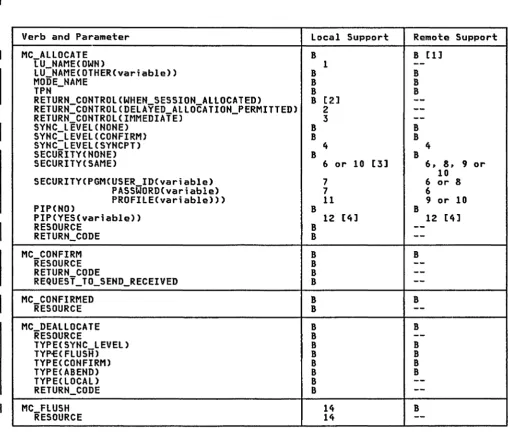
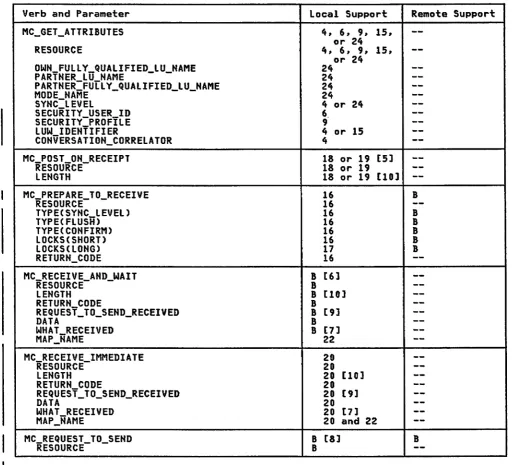
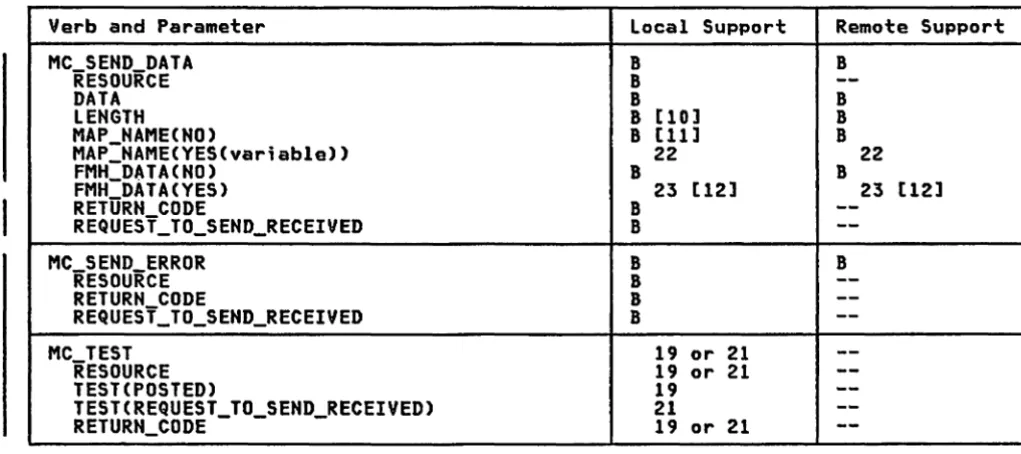
Support for Mapped Conversation Verbs and Parameters . . • • A-5 SUpport for Type-Independent Conversation Verbs and Parameters A-8 Support for Basic Conversation Verbs and Parameters A-9 Support for Conversation Return Codes and What-Received
Indications • . . • • . • • • . • • • • • . • • • A-12 Support for Control-Operator Verbs and Parameters for CNOS A-14 Support for Control-Operator Verbs and Parameters for Session
Control . • • . • • . . . • . . • • . . • . A-15 SUpport for Control-Operator Verbs and Parameters for LU
Definition • • . • • • • • • • . A-16
Support for Control-Operator Return Codes • • . . A-19 Notes on Implementation Details . • . . . . • . . • • • • • A-20
Appendix B.
Examples using Basic conversation Verbs
Appendix c. symbol string conventions
Symbol String Type Symbol String Length
. .
.
.
. .
.
.
.
APpendix D.
List of SNA Service Transaction Programs
SNA Service Transaction Program Names
Scheduler • • • . . • • • • • • • • • • Queue . . . • . . • • .
DLl'l . . . • . . . . • • .
Change Number of Sessions Resynchronization
Distributed Data Management . Document Interchange Architecture SNA Distribution Services • • • .
Product Oriented . . . • . • • •
APpendix E. conversation state "atrices
Index
• •.
.
.
. .
.
.
. . . .
.
.
.
.
.
vi;; SNA Transaction Programmer's Reference Manual for LU Type 6.2
LIST OF FIGURES
Chapter 1. Introduction
Figure 1-1. Transaction Programs and SNA Resources 1-2
Chapter 2. LU 6.2 Protocol Boundary
Figure 2-1. Program-to-Program Connection Through the SNA
Network . . . • . . • • . • 2-1 Figure 2-2. Effective Program-to-Program Connection 2-2 Figure 2-3. A Configuration of Interconnected Programs 2-2
Chapter 3. Transaction Program Verbs
Figure 3-1. Format Box for Representing Verb Syntax
Chapter 4. conversation Verbs
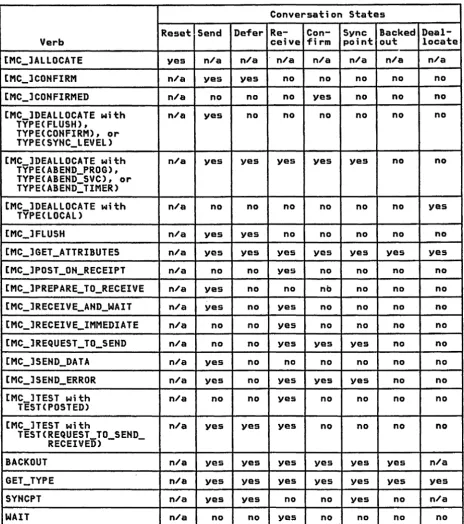
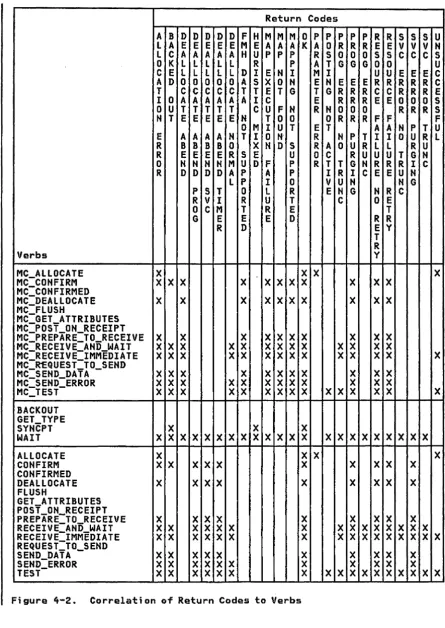
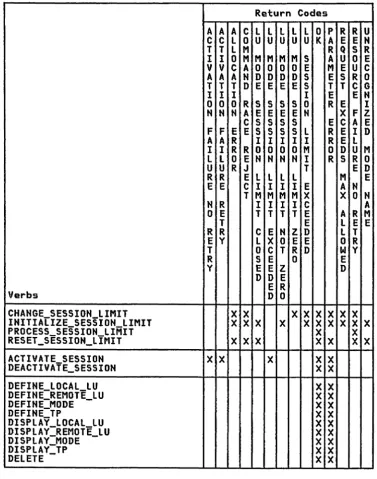
Figure 4-1. Correlation of Conversation Verbs to the Conversation States Allowing Their Issuance Figure 4-2. Correlatio~ of Return Codes to Verbs
Chapter
s.
control-Operator VerbsFigure 5-1. Correlation of Return Codes to Verbs
APpendix A. Base and option sets for Product Support
Fi gure A-I. Figure A-2. Figure A-3. Figure A-it. Figure A-5. Figure A-6. Figure A-7.
Figure A-8. Figure A-9. Figure A-I0.
Fi gure A-ll. Figure A-12. Fi gure A-13. Figure A-14. Figure A-15.
Support for Mapped Conversation Verbs and Parameters (Part 1 of 3)
Support for Mapped Conversation Verbs and Parameters (Part 2 of 3)
Support for Mapped Conversation Verbs and
Parameters (Part 3 of 3) • • • Support for Type-Independent Conversation Verbs and Parameters . . • • . • . • . • . . Support for Basic Conversation Verbs and Par'ameters (Part 1 of 3) • • . . • . . Support for Basic Conversation Verbs and Parameters (Part 2 of 3) . . • . • • • Support for Basic Conversation Verbs and
Parameters (Part 3 of 3) . . • • . • . • • • Support for Conversation Return Codes
Support for Conversation What-Received Indications . . • . . . . • . • . . . Support for Control Operator Verbs and
Parameters for CNOS . • . . . • . • Support for Control Operator Verbs and
Parameters for Session Control . • • • Support for Control Operator Verbs and
Parameters for LU Definition (Part 1 of 3)
Support for Control Operator Verbs and Parameters for LU Definition (Part 2 of 3) Support for Control Operator Verbs and
Parameters for LU Definition (Part 3 of 3) Support for Control Operator Return Codes
APpendix B. Examples Using BaSic Conversation Verbs
Figure B-1. ALLOCATE. SEND_DATA, DEALLOCATE
SYNC_LEVEL(NONE) • . . . • • • • •
3-10 4-98 it-lOS 5-54 A-5 A-6 A-7 A-8 A-9 A-lO A-ll A-12 A-13 A-14 A-IS A-16 A-17 A-18 A-19 B-2
Figure 8-2. ALLOCATE, SEND_DATA, DEALLOCATE SYNC_LEVELCCONFIRM)
·
.
. .
·
Figure 8-3. RECEIVE_AND_WAIT, DEALLOCATE--SYNC_LEVELCCONFIRM)
· ·
· · ·
·
Figure 8-4. PREPARE_TO_RECEIVE -- SYNC_LEVELCNONE) Figure 8-5. PREPARE_TO_RECEIVE -- SYNC_LEVELCCOHFIRM) Figure 8-6. CONFIRM·
· ·
· ·
·
· · ·
Figure 8-7. SEND_ERROR in Send State Figure 8-8. SEND_ERROR in Receive state Figure 8-9. REQUEST_TO_SEND
·
Figure 8-10. POST_ON_RECEIPT, WAIT Figure 8-11. POST_ON_RECEIPT, TEST Figure 8-12. SYNCPT·
· · ·
Figure B-13. SYNCPT, BACKOUTAppendix C. symboi string Com,entions
Figure r.-l. Character Sets A and AE
~~gure C-2. ~ymbol-String Types Figure C-3. Symbol-String Lengths
· ·
·
·
· ·
·
· · · ·
·
·
· · ·
·
Appendix D. List of SNA service Transaction Programs Appendix E. Conversation state Matrices
Figure E-l. Conversation State Transition Matrix 3)
·
·
· · ·
·
· ·
·
· ·
·
· · ·
·
Figure E-2. Conversation State Transition Matrix3)
·
·
·
·
· · ·
·
· · ·
· · · ·
·
Figure E-3. Conversation State Transition Matrix
3)
·
·
· · ·
·
·
·
·
· · ·
· ·
Figure E-4. Conversation State Check Matrix
· ·
x SHA Transaction Programmer's Reference Manual for LU Type 6.2
CHAPTER 1. INTRODUCTION
This chapter introduces the reader to general concepts used through-out the book.
SYSTEMS NETWORK ARCHITECTURE
Systems Network Architecture (SNA) is the description of the logical structure, formats, protocols, and operational sequences for trans-mitting information units through networks and for controlling the configuration and operation of networks. A formal description of SNA is provided in SNA Format and Protocol Reference Manual: Architec-tural Logic. The description of SNA in this book is limited to the services that SNA logical-unit type 6.2 (LU 6.2) provides to trans-action programs. A formal description of LU 6.2 is provided in ~
Format and Protocol Reference Manual: Archjtecture Logic for LU Type
L,Z.
LOGICAL UNIT TYPE 6.2
In SNA, the physical network consists of actual processors, called nodes, and data links between the nodes. The logical network consists of logical processors, called logical units (LUs),1 and logical con-nections, called sessions. One or more sessions connect one LU to another LU. Information is transmitted from one LU to another LU over a session.
LU 6.2 is a particular type of SHA logical unit. LU 6.2 provides a connecti on, or port, between its transacti on programs and network resources. Each LU 6.2 makes a set of resources avai lable to its transact i on programs. The exact set is product- and configuration-dependent; examples are processor machine cycles and main storage, files on magnetic disk or tape, input.loutput devices such as keyboard and display terminals, and logical resources such as sessions, queues, and data-base records. Some of these resources are local to a program, that is, attached to the same LU as the program. Other resources are remote, that is, attached to other LUs (remote is defined in terms of the logical configuration of the network; the LUs can be within the same physical node).
Resource allocation and control is a central function of LU 6.2. Pro-grams can request the LU for access to a resource. The LU schedules allocati on to seri ally-reusable resources, creati ng new copi es of logical resources, such as sessions, when necessary. The LU provides resource control in order to nsure integrity of the program's access to the resource. For example, the LU maintains a state2
represen-tation of the resource, allowing the program to perform an operation on the resource only when the resource is in the appropriate state for that operation. The LU may also provide other resource-related serv-ices to its programs, such as resource synchronization-point process-ing that synchronizes committed changes to resources.
TRANSACTION pROGRAM
Transaction programs process transactions. A transaction hi a type of application. It usually involves a specific set of input data and triggers the execution of a specific process or job. One example is
1 Other logical prOC~9sors, such as physical units (PUs) and system services ec~~rol points (SSCPs), also exist and are described in
~NA Concepts and Products.
4 A specific operating condition of the resource as it appear~ to
the program at a particular time of access. Over time, the resource changes f~om one state to another in accord with the pro-gram's operations on the resource.
the entry of a customer's deposit and the updating of the customer's balance. A second example is the process of recording item sales, arriving at the amount to be paid by or to a customer, verifying checks before accepting them as tender, and receiving payment for the merchandise. A third example is the transfer of a message to one or more destination points.
A transaction program, as the term is used in this pUblication, is a program that is executed by or within lU 6.2 and performs services related to the processing of a transaction. For example, the program may be an application program that processes a transaction or is one of several programs that make up a transacti on processi ng appl i ca-tion, or it may be a system program that performs system services for an application program processing a transaction.
Distributed processing of a transaction within an SNA network occurs when transaction programs communicate by exchanging information over the sessions between their LUs, treating the sessiori as a resource that is shared between the programs. Figure 1-1 illustrates the con-nection of two programs to SNA resources, including a session between thei r lUs.
1
Program A·1
I
••• I
• Other • • Resources. • for • • Program A.SNA Network
Session ---~
• Other • • Resources. • for • .Program B.
•
••
1
l~
6.2I
I
Program 81
Figure 1-1. Transaction Programs and SNA Resources
The "other resources" shown in the figure may include other sessions as well as local files and devices. The other sessions allow program A or program B to communicate with other programs. During the commu-nication between two programs, one program may send a message over the session to another program, requesting access to a local resource of the other program. In this way, a local resource of program B, for example, may become a remote resource of program A.
PROTOCOL BOUNDARY
The LU 6.2 protocol boundary, as the term is used in this pUblication, is the generi c descri pti on of the transacti on program's logi cal interface to an SNA network, from the perspective of the transaction
program~ LU 6.2 provides the protocol boundary between the program and the network. The description is generic in the sense that it provides a syntactical representation of the functions common to all IBM pro-ducts that implement LU 6.2; the syntactical descriptjon is not neces-sarily of any specific IBM product. IBM products implementing LU 6.2 may provide a programming interface that differs in syntax from the protocol boundary described herein~ however, the results achieved are functionally equivalent to the results described in this book. For information about the functional correspondence between the product's programmi ng interface and the protocol boundary descri bed in thi s book, refer to the IBM product publication describing the product's programming interface.
The generi C: protocol boundary descri bed herei n represents the
trans-action program's logical interface to SNA and its services, and is the primary subject of this book. The value of a generic description is that the transacti on program desi gner may plan an appl i cati on that spans many different products using a single generic interface, and then map the design to the individual product-dependent interfaces. Nota: Prod4cts may provide additional functions for their trans-acti on programs, that is, product-uni que functi ons that are not descri bed in thi 5 book. A gi ven product-uni que functi on may cause
information to be sent on an LU 6.2 session, depending on the func-tion; however, the formats and protocols used on the LU 6.2 session are unchanged. (See SNA Format and Protocol Reference Manual: Archi-tecture Logic for LU Type 6,2 for a definition of the formats and pro-tocols associated with LU 6.2 sessions.) When designing an appli cati on that may be executed on di fferent prodUcts, the trans-act i on program desi gner should not depend on the product-speci fi c functions being available across the different products.
INIERpROGRAM COMMUNICATION
Among the services that SNA and, in particular, LU 6.2 provides is interprogram communication. IBM products implementing LU 6.2 provide thi s servi ce as Advanced Program-to-Program Communj cati on (APPC). Refer to the individual IBM product pUblications for details of their APPC implementations.
Interprogram communication permits distribution of the processing of a transaction among multiple programs within a network. The programs coordinate the distributed processing by exchanging control informa-tion or data. The protocol boundary provides the structure for pro-grams to communicate with one another in order to process a transaction. This structure meets the following requirements, described in terms of their SNA realization:
Simultaneous activatian--. Many distributed applications require their component programs to be active simultaneously. If the sender of a request waits for the reply, the sending program is depending upon timely execution by its partner. SNA achieves this by simply carrying the program name in the request and letting the receiving LU create an instance of the desired partner program. This concept is recognizably that of transactions. 50 in SNA the
communicating programs are called transaction programs. Itfol-lows that distributed transactions are executed by distributed transaction programs.
Efficient allacation--. Just as programs use local resources by asking the LU for access to them, programs ask the LU for access to sessi ons for use as i nterprogram communi cati on resources. However, the program is not really concerned with the session, which is (usually) a long-term connection between LUs. Nor is the program concerned with the possibility of other programs using the session before or after its own use. What the program asks the LU for is a period of exclusive use of a session, that is, for an abstract resource that is the unit of sharing of the session
resource. This resource is called a conversation.
Conversation overhead --. Conversations should be efficient in allocation, data transfer, and deallocation. For instance, what the programs see as two short messages, perhaps an inquiry and its reply, should result in two short messages flowing in the network. The LU achieves this by multiplexing conversations over a pool of sessions, scheduling each session as a serially reusable resource.
Conversation Ufatime --. Conversati ons last for a time that is determined only by the communicating programs. So, conversations vary from a single, short message to many exchanges of long or short messages. A conversation could continue indefinitely, ter-minated only by failures.
Two-way alternate data transfer --. Conversati ons use two-way alternate (half duplex) data transfer. This makes it easiar to
write transaction programs, in contrast to two-way simultaneous (full duplex) transfer of data whi ch experi ence shows leads to more complicated and error-prone programs.
Attention mechanism -- Conversations include an attention mech-anism to handle asynchronous, but non-error, events.
Error notification -- Conversati ons provi de each program wi th a method to noti fy its partner of errors when they are detected. commitment control -- When errors occur, recovery is greatly sim-pli fi ed if the changes that a program has been mak i ng to its resources can be made to appear atomic; for example, if resources A and B are changed, then after a failure, B will be observed to have changed if and only if A is also observed to have changed. Commi tti ng changes atomi cally is a servi ce that SNA extends to distributed transaction programs. SNA calls this the sync point3
service. Conversations are defined to the sync point service in each LU as either being protected by sync point or as being unpro-tected. In the latter case, the transaction programs are them-selves responsible for error recovery synchronization.
symmetry -- Conversati ons are allocated by one acti ve program, but all other protocols (data transfer, attention, error notifi-cation, and deallocation) are fully symmetric.
Mode of service -- The program allocating the conversation names the desired mode of transmission service, such as "interactive" or "batch," to be provi ded by the network.
Levels of conversations -- In order to adequately serve the needs of system programs and application. transactions, two levels of conversations exist: basic conversations, for system transaction programs, and mapped conversations, for application transaction programs.
subset definition -- A subsetting is defined for LU 6.2 by a base set of functions and a limited number of option sets. IBM pro-ducts that implement LU 6.2 all provide the base set of functions, and may provide any of the option sets.
Sync point is a shortened term for synchronization point.
CHAPTER 2. LU 6.2 PROTOCOL BOUNDARY
The LU 6.2 protocol boundary is a generic interface between trans-action programs and the SNA network. The protocol boundary permits access to SNA servi ces and resources, especi ally tha sarvl cas and resources associ ated wi th i nterprogram communi cati on. By means of interprogram communication, distributed transactions can be designed and implemented.
The distributed processing of a transaction also requires access to system services and resources not related to interprogram communi-cation; however, such services and resources are product-dependent. The reader should refer to the individual product publications for i nformat 1 on about a parti cular product's programmi ng interface to resources such as di sk or tape fi les, input/output devi ces, and processor main storage, and to non-SNA services that the product pro-vides.
INTER pROGRAM COMMUNICATION
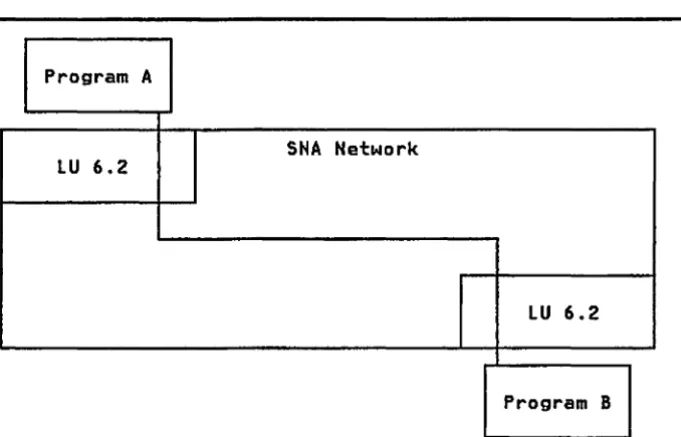
The protocol boundary permi ts transacti on programs to commun i cate with one another without being involved in the interactions that take place within the network. Figure 2-1 shows two programs connected through the SNA network. The lUs are connected by an LU-lU session, and the programs are connected by a conversation allocated on the ses-sion. For each LU-lU session, one lU is the contention winner of the session and the other lU is the contention loser of the session. These terms relate to how contenti on is resolved when the two LUs attempt to allocate a conversation on the session at the same time. Specific details are given in SNA Format and Protocol Reference Manu-al: Architecture logjc for lU Type 6.2.
Program A
SNA Network LU 6.2
lU 6.2
[image:16.615.176.517.404.623.2]Program B
Figure 2-1. Program-to-Program Connection Through the SNA Network
From the programs' view, only the conversation is visible. The acti-vation of the session and actual messages that the lUs exchange on that session are hidden from the programs. Only the dalays associated with the buffering and transmission of information within the network are apparent to the programs. The program-to-program connection can therefore be represented as shown in Figure 2-2.
Program A Program B
Figure 2-2. Effective Program-to-Program Connection
This view of program-to-program connection can be extended to a more general configuration of interconnected programs. Figure 2-3 shows an example of one way in which seven programs can be interconnected. The interconnection is logical; the physical configuration- of the network is not apparent to the programs.
r
Program EProgram B
I
Program FProgram A Program C
Program D Program G
Figure 2-3. A Configuration of Interconnected Programs
The configuration of interconnected programs changes over time. In the example shown in Figure 2-3, the configuration may have evolved as follows:
1. Program A connects to Program B, then to Program C, and then to Program D.
2. Program B connects to Program E and then to Program F. 3. Program D connects to Program G.
This configuration may have evolved in other ways, as well, and it may be an interim configuration that ultimately grows to a much larger confi gurati on of interconnected programs. All confi gurati ons of interconnected programs, however large, are made UP of
program-to-program connections between pairs of program-to-programs. One program-to-program initiates the interconnection process; in Figure 2-3. the initiating program is Program A.
PROTOCOL BOUNDARY STRUCTURE
The protocol boundary is a structured interface. It is defined by means of formatted functions. called ~, and the protocols for the verbs. The protocols are the allowed sequences of verbs. that is, the order in which a transaction program can issue verbs. The protocols are defined in terms of resource states. A transaction program can issue a particular verb only when the the resource to which that verb applies 15 in the appropriate state for that verb.
The verbs and states that represent the lU 6.2 protocol boundary ena-ble the user to desi gn di stri buted transacti ons, processed by di s-tri buted transact i on programs. The number of transact i on programs can be small, involving only two programs, or large, involving many programs. The transaction can have a fixed structure in which the processing by all programs is predetermined at design time, such as a si ngle i nqui ry and reply between two programs. In contrast, the transacti on can have a flexi ble structure in whi ch the programs involved and the processing are determined at execution time, possi-bly varying from one invocation of the transaction to the next; an example is the updating of information in a distributed data base. An overview description of the verbs is given in "Chapter 3. Trans-action Program Verbs". The detailed descriptions of the verbs are gi ven in "Chapter 4. Conversati on Verbs" and "Chapter 5. Control-Operator Verbs". Resource states associated with the conver-sation verbs are described in "Chapter 4. Converconver-sation Verbs".
This page intentionallY left blank
CHAPTER 3, TRANSACTION PROGRAM VERBS
The LU 6.2 protocol boundary is defined by verbs that request the LU to perform services. The verbs are described from the transaction programmer's view of the LU 6.2 protocol boundary. Events occurring below the protocol boundary and not apparent at the boundary are not described. Refer to SNA Format and Protocol Reference Manual: Archi-tecture logic for LU Tvpe 6.2 for details of events that occur below the protocol boundary.
TRANSACTION PROGRAM STRUCTURE AND EXECUTION
All transaction programs h~ve the following general structure:
name: PROCEDURE ( resource-;d t,p;pl t"" t,p;pn] J ] )J
: } yerbs and .ther pr •• ra. statement.
RETURN; END name;
The elements of the transaction program structure are:
1
name is the name of the transaction program. The transaction pro-gram name is carried in the allocation request sent by a partner program. The LU receiving the request locates the program by name and creates a new instance,l or executable copy, of the program. The location of the program, such as in a program library, is product-dependent.
PROCEDURE begins the main procedure of the transaction program. resource-;d is the name of the variable in which the LU places the resource ID of the conversation on which the allocation request was received. The conversation connects this transaction program to the partner program that sent the allocation request.
Nate: The description in this book assumes that transaction pro-grams are always started by means of an allocati on request received on a conversation. The manner in which a product starts the first program of an interconnected configuration of programs is product-dependent. For example, the fi rst program may be started in response to a "load" request from an operator.
p;pl, ••• ,p;pn are the names of the variables in whi ch the LU places program initialization parameters (PIPs) 1 through n. Product send and receive support of PIPs is optional; see Fig-ure C-3 in "Appendix C. Symbol String Conventions" for details. The PIPs are 5uppli ed by the allocati ng program. The contents of the PIPs have meaning only to the transaction programs---they are not examined or acted upon by the LU.
verbs and ather program statements represent the combi nati on of verbs, descri bed in thi s book, and other programmi ng-Ianguage statements that make up the transaction-processing portion of the program. Thus, the program's processing of a transaction begins
When it i s "~ambi guous to do so, a program instance is si mply
referrp~ to as a program.
with the first verb or other program statement after the PROCEDURE statement. It ends with the last verb or other program statement preceding the RETURN statement. or with the processing implied by the RETURN statement (discussed next).
RETURN ends execution of the program by returning control to the LU. As part of the LU's processing of the RETURN statement. it deallocates all conversations (and other resources) that the pro-gram has not. itself. deallocated. Depending on the product. the LU may perform other resource-related functions. including the execution of verb functions for conversations still allocated. before deallocating the resources.
END nama identifies the physical end of the program. It is the last statement in the program.
Nata: The PROCEDURE, RETURN. and END statements are not described elsewhere in this book. They are presented here only to illustrate the general structure of all transacti on programs. IBM products implementing LU 6.2 may provide programming language statements that differ in syntax from this description. However. the functions of the product programming language statements are equivalent to the functions described here.
Program execution. in terms of the verbs. occurs when the transaction program issues a verb and the LU executes it; verbs are issued and executed one at a time. When the program issues a verb. the program's processing is suspended while the LU executes the verb. The program resumes processing when the LU returns control to the program. The program may then issue another verb.
Conversations use two-way alternate data transfer. Once a conversa-tion is allocated. send-receive relaconversa-tionship is established between the programs connected to the conversation. One program issues verbs to send data and the other program issues verbs that receive the data. When the sending program finishes sending data. it transfers control of sending data to the other program.
The LUs at each end of a conversation have a buffer for sending and receiving the data on the conversation. When the program issues a verb that sends data. it specifies an area containing the data. The LU moves the data to its send buffer. accumUlating the data behind any data from previous verbs. The LU transmits the data. or flushes its send buffer, when either it accumulates a sufficient amount for trans-mission. or the program issues a verb that explicitly causes the LU to transmit the accumulated data. The amount of data sufficient for transmission is determined by the maximum size request unit that can be sent on the session on which the conversation is allocated. The amount can vary f~om one session to another. and therefore from one conversation to another.
As incoming data arrives on a conversation. the LU places the data in its receive buffer. accumUlating the data behind any it previously received. When the program issues a verb that receives data. it spec-ifies an area in which the LU is to place the data. The LU moves the requested amount of data from the front of its receive buffer to the area specified by the program. In this way. the LU can accumulate incoming data in its receive buffer in advance of the program issuing the verb. or verbs. that receive the data.
Verbs are defi ned that send i nformati on other than data. These verbs cause the LU to flush its send buffer and then place the information at the front of the buffer. behind which it accumUlates data from sub-sequent verbs. The receiving LU accumulates this information in its receive buffer in the order it is received. with reference to other information including data.
Program execution ends when the program returns control to the LU at the completion of the transaction. This is accomplished by the RETURN statement.
VERB OVERVIEW
This section presents an overview of the verbs in terms of their indi-vidual functions. The verbs are divided into categories. These cate-gori es are:
Conversation verbs Control-operator verbs
Each category defines a major subdivision of the lU 6.2 protocol boundary. The conversati on verbs defi ne the means for program-to-program communication. The control-operator verbs define the means for program or operator control of the lU's resources.
In the following overview, and in the remaining chapters of this book, the verbs are described from the perspective of the transaction pro-gram issuing the verb. From this point of view, the propro-gram issuing the verb is referred to as the local program, and the program at the other end of the conversation is referred to as the remote program. Similarly, the lU processing the local program is referred to as the local lU, and the lU processing the remote program is referred to as the remote lU.2 The overview description of the conversation verbs and control-operator verbs follows.
CONVERSATION VERBS
The conversati on verbs provi de program-to-program communi cati on by means of conversations between programs. The following conversation types are defi ned:
Mapped Basic
The verbs defining the conversation protocol boundary are divided into subcategories based on the conversation type. The subcategories of verbs are:
Mapped conversation verbs
Type-independent conversation verbs Basic conversation verbs
An overview of the conversation verbs follows.
Mapped CDnversatiDn Verbs
The mapped conversat i on verbs are intended for use by appli cati on transaction programs. These verbs provide functions that are suit-able for application programs written in high-level programming lan-guages. A brief description of the mapped conversation verbs follows.
2
MC_ALLOCATE allocates a mapped conversation connecting the local transaction program to a remote transaction program. A unique resource ID is assigned to the mapped conversation. This verb is issued prior to any verbs that refer to the mapped conversation. MC_CONFIRM sends a.confirmation request to the remote transaction program and waits for a reply, in order for the two programs to synchronize their proce~~~~g.
MC_CONFIRMF~ ~ends a confirmation reply to the remote transaction program, in order for the two programs to synchronize their proc-essing. The program issues the verb in response to receivin2 a confirmation request.
MC_DEALLOCATE deallocates a mapped conversation resource from the transaction program. The program issues this verb when it is fin-ished using the mapped conversation.
When it is unambiguous to do so, the local program is simph' referred to as the program, and the local lU is simply referred to as the lU.
MC_FLUSH transmits all information that the lU has buffered, such as data records from preceding MC_SEND_DATAs.
MC_GET_ATTRIBUTES returns information pertaining to a mapped con-versation. Examples of information that may be requested are the mode name, the name of the lU at which the remote transaction pro-gram is located, or the synchronization level allocated for the mapped conversation.
MC_POST_ON_RECEIPT requests posting of the specified mapped con-versation when information is available for the program to receive. The information can be a data record, mapped conversa-tion status, or a request for confirmaconversa-tion or sync point.
MC_PREPARE_TD_RECEIVE changes the mapped conversation from send state to receive state in preparation to receive data. A SEND indication is sent to the remote program. The remote program's end of the mapped conversation changes to send state when the pro-gram receives the SEND indication.
MC_RECEIVE~AND_WAIT waits for information to arrive on the mapped conversation and then receives the information. If information is alreadY available, the program receives it without waiting. The information can be a data record, mapped conversation status, or a request for confirmation or sync point. Control is returned to the program with an indication of the type of information. The verb can be issued when the mapped conversation is in send state. In this case, the verb first sends a SEND indication to the remote program, changing the mapped conversation to receive state, and then waits for information to arrive.
MC_RECEIVE_It'lMEDIATE recei ves any i nformati on that is avai lable from the specified mapped conversation, but does not wait for information to arrive. The information (if any) can be a data record, mapped conversation status, or a request for confirmation or sync point. Control i5 returned to the program with an indi-cation of whether any information was received and, if so, the type of information.
MC_REQUEST_TO_SEND noti fi es the remote program that the local program is requesting to enter send state for the mapped conversa-tion. The mapped conversation will be changed to send state when the local program subsequently recei ves a SEND i ndi cati on from the remote program.
MC_SEND_DATA sends one data record to the remote transaction pro-gram. The data record consists entirely of data. The program can specify data mapping as a function of the verb, or it can indicate that the data record includes FM headers.
t'lC_SEND_ERROR informs the remote transacti on program that the local program has detected an a~plication error. For example, the local program can issue this verb to inform the remote program of an error it detected in a data record it received, or to reject a confirmation request. Upon successful completion of the verb, the local program is in send state for the mapped conversation and the remote program is in receive state.
MC_TEST tests the mapped conversation to determine whether it has been posted, as a result of a preceding MC_POST_ON_RECEIPT verb, or whether a request-to-send notification has been received.
Type-Independent Canversat;on Verbs
The type-i ndependent conversati on verbs are intended for use wi th both mapped and basic conversations. These verbs provide functions that span both conversat i on types. A br i ef descr i pt i on of the type-independent verbs follows.
BACKDUT restores all protected resources throughout a distributed transaction to their status as of the last synchronization point. Protected resources are those that are protected by the sync point service of lU 6.2.
GET_TYPE returns the type of resource. For mapped conversations the type is MAPPED_CONVERSATION, and for basic conversations the type is BASIC_CONVERSATION.
SYNCPT advances all protected resources throughout a distributed transaction to the next synchronization point.
WAIT waits for posting to occur on any mapped or basic conversa-tion from among a list of mapped and basic conversaconversa-tions. The posting of mapped conversations is performed as a result of a pre-ceding MC_POST_ON_RECEIPT verb issued for each of the mapped con-versati ons. Si mi larly, the posti ng of basi c conversati ons is performed as a result of a preceding POST_ON_RECEIPT verb issued for each of the basic conversations.
Basie Conversation Verbs
The basic conversation verbs are intended for use by LU services grams. The LU services programs can provide end-user services or pro-tocol boundaries for end-user application transaction programs. For example, the mapped conversation LU services component issues basic conversat i on verbs dur i ng its processi ng of mapped conversat i on verbs. A brief description of the basic conversation verbs follows.
ALLOCATE allocates a conversati on connecti ng the local trans-action program to a remote transtrans-action program. The conversation type can be basic or mapped. A unique resource ID is assigned to the conversati on. Thi s verb is issued pri or to any verbs that refer to the conversation.
CONFIRM sends a confi rmation request to the remote program and waits for a reply, in order for the two programs to synchronize their processing.
CONFIRMED sends a confi rmati on reply to the remote program, in order for the two programs to synchronize their processing. The program issues this verb in response to receiving a confirmation request.
DEALLOCATE deallocates a conversation from the transaction pro-gram. The program issues this verb when it is finished using the conversation.
FLUSH transmits all information that the LU has buffered, such as data from preceding SEND_DATAs.
GET ATTRIBUTES returns information pertaining to a conversation. Examples of information that may be requested are the mode name, the name of the LU at whi ch the remote transacti on program is located, or the synchronization level allocated for the conversa-tion.
POST_ON_RECEIPT requests posting of the specified conversation when information is available for the program to receive. The information can be data, conversation status, or a request for confirmation or sync point.
PREPARE_TO_RECEIVE changes the conversati on from send state to receive state in preparation to receive data. A SEND indication is sent to the remote program. The remote program's end of the conversation changes to send state When the program receives the SEND indication.
RECEIVE_AND_WAIT waits for information to arrive on the conversa-tion and then receives the informaconversa-tion. If informaconversa-tion is alreadY available, the program receives it without waiting. The informa-tion can be data, conversainforma-tion status, or a request for confirma-tion or sync point. Control is returned to the program with an indication of the type of information. The verb can be issued when the conversati on is in send state. In thi s case, the verb first sends a SEND indication to the remote program, changing the conversation to receive state, and then waits for i~formation to arrive.
RECEIVE_IMMEDIATE receives any information that is available from the specified conversation, but does not wait for information to arrive. The information (if any) can be data, conversation sta-tus, or a request for confirmation or sync point. Control is returned to the program with an indication of whether any informa-tion was received and, if so, the type of informainforma-tion.
REQUEST_TO_SEND notifies the remote program that the local pro-gram is requesting to enter send state for the conversation. The conversation will be changed to send state when the local program subsequently receives a SEND indication from the remote program.
SEND_DATA sends data to a remote program. The data format con-sists of logical records. The amount of data is specified inde-pendently of the data format. A logical record contains a length field and a data field. The length field is 2 bytes long; the data field can be any length within the range of 0 to 32765 bytes.
SEND_ERROR informs the remote program that the loc'al program has detected an error. For example, the local program can issue this verb to truncate an incomplete logical record it is sending, to inform the remote program of an error it detected in data it received, or to reject a confirmation request. Upon successful completion of the verb, the local program is in send state for the conversation and the remote program is in receive state.
TEST tests the conversati on to determi ne whether it has been posted, as a result of a preceding POST_aN_RECEIPT verb, or wheth-er a request-to-send notification has been received.
CONTROL-OPERATOR VERBS
The control-operator verbs are intended for use by control-operator transaction programs, that is, programs that assist the control oper-ator in performing functions related to the control of an lU. The verbs defi ni ng the control-operator protocol boundary are di vi ded
into subcategories based on their functions. The subcategories are: Change number of sessions verbs
Session control verbs lU definition verbs
An overview of the control-operator verbs follows.
Change Number of Sess;ons Verbs
Thi s subcategory of control-operator verbs consi sts of four verbs called the change-number-of-sessions, or CNOS, verbs. The CNOS verbs change the (lU,mode) session limit, which controls the number of lU-LU sessions per mode name that are available between two lUs for allo-cation to conversations. In conjunction with changing the (LU,mode) session limit, the eNOS verbs change related operating parameters of the two LUs.
The two lUs may cooperate in the execution of the CNOS verbs by means of a eNOS request and eNOS reply. The lU executing the control-oper-ator transaction program sends a eNOS request to the partner lU. The partner LU invokes an SNA service transaction program called the "CNOS service transaction program" (see "Appendix D. list of SNA Service Transaction Programs"), which causes the partner LU to process the eNOS request and send back a CNOS reply.
The CNOS verbs that a control-operator transaction program may issue are:
CHANGE_SESSION_LIMIT changes the (LU,mode) session limit from one nonzero value to another nonzero value.
INITIALIZE_SESSION_LIMIT changes the (LU,mode) session limit from
o
to a value greater than O.RESET_SESSION_LIMIT changes the (lU.mode) session limit from a value greater than 0 to O.
The eNOS verb that the eNOS service transaction program issues is: PROCESS_SESSION_LIMIT causes the lU receiving the eNOS request to process the request and send back a CNOS reply to the partner lU.
Session Control Verbs
This subcategory of control-operator verbs consists of two verbs used for session control. one that activates an lU-lU session and one that deactivates an lU-lU session. These verbs are:
ACTIVATE_SESSION activates an lU-lU session between the local lU and a specified lU.
DEACTIVATE_SESSION deactivates a speci fi ed lU-LU sessi on. The type of deactivation can be cleanup or normal.
LU
Definition Verbs
ABEND CONDITIONS
This subcategory of control-operator verbs is used to define or modify the local lU' 5 operati ng parameters. exami ne the parameters, and
delete the parameters. These verbs are:
DEFINE_LOCAL_LU i ni ti ali zes or modi fi es parameter values that control the operation of the local lU.
DEFINE_REMOTE_LU in i ti ali zes or modi fi es parameter values that control the operation of the local LU in conjunction with a remote LU.
DEFINE_MODE initializes or modifies parameter values that control the operation of the local lU in conjunction with a group of ses-sions with a remote LU, the group being identified by a mode name. DEFINE_TP initializes or modifies parameter values that control the operation of the local lU in conjunction with a local trans-act i on program.
DISPLAY_LOCAL_LU returns parameter values that control the opera-tion of the local lU.
DISPLAY_REMOTE_LU returns parameter values that control the oper-ation of the local lU in conjunction with the remote lU.
DISPLAY_HODE returns parameter values that control the operation of the local lU in conjunction with a group of sessions with a remote LU, the group being identified by a mode name.
DISPLAY_TP returns parameter values that control the operation of the local lU in conjunction with a local transaction program. DELETE deletes the local lU's operating-parameter values that have been defi ned by means of the DEFINE verbs.
Certain errors related to the execution of the verbs can cause an abnormal ending (ABEND) of the transaction program. These ABEND con-ditions are a direct consequence of an invalid specification or exe-cution of a verb. When the lU terminates a program because of an ABEND condition. it deal locates all of the program's active conversa-tions. Depending on the product. the LU may abnormally deallocate the conversations. or deallocate the conversations in the same way it does for the RETURN statement (see the RETURN statement under "Transaction Program Structure and Execution" on page 3-1).
The ABEND conditions are:
Parameter Check
occurs when the program issues a verb for whi ch local support is not available, or when the program specifies a verb parameter with an invalid argument. The source of the inval-id argument is consinval-idered to be part of the program definition. (Contrast this definition with the definition of the return code, PARAMETER_ERROR, in the secti on "Return Codes" in Chapter 4.) The detailed verb descriptions list the applicable parameter checks. The omi ssi on of a requi red parameter, the speci fi cati on of an undefined parameter, and the specification of an undefined argu-ment on a parameter that requires one of a defined set of keywords are also parameter check conditions. The parameter checks for the omission of a required parameter and for the specification of an undefined parameter apply to all verbs. The parameter check for an undefined keyword argument applies to all verbs that specify one or more parameters with keyword arguments. These parameter checks are not explicitly listed with each detailed verb description.state Check
occurs when the program attempts to issue a verb for a conversation that is in a state in which the verb is not allowed. The section "Conversation states" in Chapter 4 defines the allow-able states for each conversation verb. The control-operator verbs do not have states associated with them and therafnre do not have any state checks defined~The individual verb aescriptions list the applicable ABEND condi-tions.
Note:
In lieu of treating these ABEND conditions as described here, products may provide a different method for handling the ABEND condi-tions. For example, a product may return" an error indication to the program when it attempts to issue a verb in a state in which the verb is not permitted. allowing the program to continue processing, or a product may provide a compile-time check for the specification of opti onal verbs and parameters that the product doe'S not support. Refer to the individual product's publications for details about how it treats these conditions.PRODUCT-SUPPORT SUBSETTING
Product-support subsetting of the verbs is defined by means of func-ti onal groups, or sets. A set consi sts of all the functi ons that together represent an indivisible group for products to implement. That is, a product implementing a particular set implements all of the functions within that set.
All products implement a subset of LU
6.2
functions called the base set. The functions that are not part of the base set are optional. The base set and option sets are defined in terms of the LU6.2
proto-col boundary, as follows:Base set
is the set of LU6.2
verbs, parameters, return codes, and what-received indications that all products support.Opt;on sets
are the sets of LU6.2
verbs, parameters. return codes, and what-received indications that a product may support, depending on the product. A product may support any number of option sets, or none. For each option set supported, all verbs, parameters, return codes, and what-received indications in that set are supported.The base set and option sets are further defined in terms of local support and remote support.
LOcal support
is the support of LU6.2
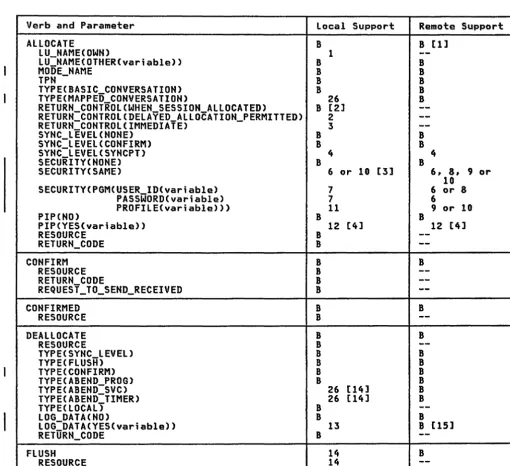
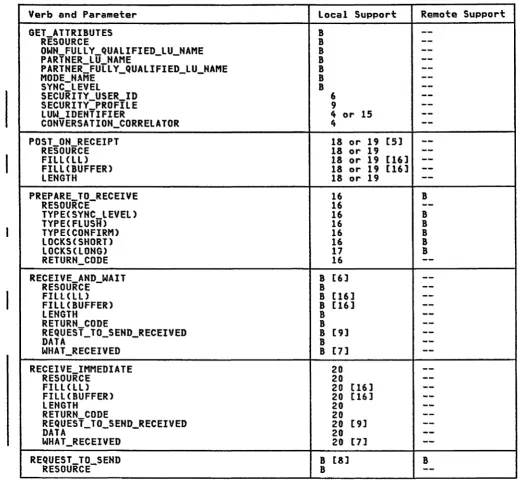
verbs, parameters, return codes, and what-received indications that the product provides at the local end of a conversation, as seen by the local transaction program. The program may issue an optional verb or parameter only when the local product supports the option set. An attempt by the program to issue an optional verb or parameter for which local support is not available is considered an ABEND condition (see"ABEND Condi ti ons" on page 3-7). An opti onal return code or what-received indication can be reported to the program only when the local product supports the option set.
Remote support is the support of verbs and parameters that the product provides at the remote end of a conversation# as seen by the local transaction program. (Remote support does not apply to the return codes and what-received indications.) Only certain verbs and parameters invoke processing at the remote end of the conversation; the other verbs and parameters are processed entirely at the local end of the conversation. When the program issues a verb or parameter that invokes remote processi ng# and the remote product does not provide remote support for the verb or parameter# a return code i ndi cati ng the lack of support is reported to the program. The return code can be reported on the verb for whi ch remote support is not ava i lable or on a later verb# depending on the verb.
The base and optional support for the conversation verbs and control-operator verbs is defined in "Appendix A. Base and Option Sets for Product Support".
Note: The base- and option-set definition for product support
described in this boo~ applies only to LU 6.2 products that provide an appl i cati on programml ng interface (API) for user-wri tten programs that is equivalent to the conversation verbs. The definition does not apply to LU 6.2 products that are not user-programmable# or to pro-ducts that are user-programmable but do not provide an API equivalent to the conversation verbs; such products need support only the LU 6.2 functions required for their applications.
VERB DESCRIPTION FORMAT
This section explains the format used to describe the verbs in the following chapters. The verb descriptions are presented alphabet-ically# by name# in terms of each verb's fUnction# syntactic format# parameters# state changes# ABEND conditions# and usage notes.
The description of each verb begins with a brief explanation of its function.
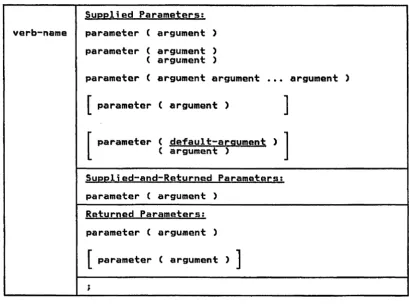
The verb's syntax is described next using a format box. The general representation of the format box is shown in Figure 3-1 on page 3-10.
3-10
Sueelied Parametet~: verb-name parameter ( argument )
parameter ( argument ) ( argument )
parameter ( argument argument
...
argument )[
parameter ( argument )]
[
parameter ( default-argument )]
( argument )
Sueeljgg-and-Re