Noun-Noun Compound Machine Translation:
A Feasibility Study on Shallow Processing
Takaaki Tanaka
Communication Science Laboratories Nippon Telephone and Telegraph Corporation
Kyoto, Japan
Timothy Baldwin CSLI Stanford University Stanford, CA 94305 USA
Abstract
The translation of compound nouns is a ma-jor issue in machine translation due to their frequency of occurrence and high produc-tivity. Various shallow methods have been proposed to translate compound nouns, no-table amongst which are memory-based machine translation and word-to-word com-positional machine translation. This paper describes the results of a feasibility study on the ability of these methods to trans-late Japanese and English noun-noun com-pounds.
1 Introduction
Multiword expressions are problematic in machine translation (MT) due to the idiomaticity and overgen-eration problems (Sag et al., 2002). Idiomaticity is the problem of compositional semantic unpredictabil-ity and/or syntactic markedness, as seen in expres-sions such as kick the bucket (=die) and by and large,
respectively. Overgeneration occurs as a result of a system failing to capture idiosyncratic lexical affini-ties between words, such as the blocking of seemingly equivalent word combinations (e.g. many thanks vs.
*several thanks). In this paper, we target the
particu-lar task of the Japanese
English machine translation of noun-noun compounds to outline the various tech-niques that have been proposed to tackle idiomaticity and overgeneration, and carry out detailed analysis of their viability over naturally-occurring data.
Noun-noun (NN) compounds (e.g. web server, car
park) characteristically occur with high frequency and
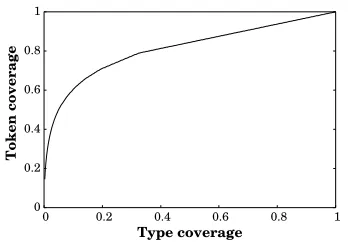
high lexical and semantic variability. A summary ex-amination of the 90m-word written component of the British National Corpus (BNC, Burnard (2000)) un-earthed over 400,000 NN compound types, with a combined token frequency of 1.3m;1 that is, over 1% of words in the BNC are NN compounds. More-over, if we plot the relative token coverage of the most frequently-occurring NN compound types, we find that the low-frequency types account for a
sig-1
Results based on the method described in 3.1.
nificant proportion of the type count (see Figure 12). To achieve 50% token coverage, e.g., we require cov-erage of the top 5% most-frequent NN compounds, amounting to roughly 70,000 types with a minimum token frequency of 10. NN compounds are especially prevalent in technical domains, often with idiosyn-cratic semantics: Tanaka and Matsuo (1999) found that NN compounds accounted for almost 20% of en-tries in a Japanese-English financial terminological dictionary.
Various claims have been made about the level of processing complexity required to translate NN com-pounds, and proposed translation methods range over a broad spectrum of processing complexity. There is a clear division between the proposed methods based on whether they attempt to interpret the semantics of the NN compound (i.e. use deep processing), or sim-ply use the source language word forms to carry out the translation task (i.e. use shallow processing). It is not hard to find examples of semantic mismatch in NN compounds to motivate deep translation methods: the Japanese idobatakaigi “(lit.) well-side meeting”,3e.g., translates most naturally into English as “idle gossip”, which a shallow method would be hard put to predict. Our interest is in the relative oc-currence of such NN compounds and their impact on the performance of shallow translation methods. In particular, we seek to determine what proportion of NN compounds shallow translation translation meth-ods can reasonably translate and answer the question: do shallow methods perform well enough to preclude the need for deep processing? The answer to this question takes the form of an estimation of the upper bound on translation performance for shallow transla-tion methods.
In order to answer this question, we have selected the language pair of English and Japanese, due to the high linguistic disparity between the two lan-guages. We consider the tasks of both English-to-Japanese (EJ) and English-to-Japanese-to-English (JE) NN pound translation over fixed datasets of NN com-pounds, and apply representative shallow MT meth-ods to the data.
2
The graph for Japanese NN compounds based on the Mainichi Corpus is almost identical.
3
0 0.2 0.4 0.6 0.8 1
0 0.2 0.4 0.6 0.8 1
Token coverage
[image:2.595.88.262.84.205.2]Type coverage
Figure 1: Type vs. token coverage (English)
While stating that English and Japanese are highly linguistically differentiated, we recognise that there are strong syntactic parallels between the two lan-guages with respect to the compound noun construc-tion. At the same time, there are large volumes of sub-tle lexical and expressional divergences between the two languages, as evidenced between
jiteNshaseNshu “(lit.) bicycle athelete” and its trans-lation competitive cyclist. In this sense, we claim that English and Japanese are representative of the inher-ent difficulty of NN compound translation.
The remainder of this paper is structured as follows. In 2, we outline the basic MT strategies that exist for translating NN compounds, and in 3 we describe the method by which we evaluate each method. We then present the results in 4, and analyse the results and suggest an extension to the basic method in 5. Finally, we conclude in 6
2 Methods for translating NN compounds
Two basic paradigms exist for translating NN com-pounds: memory-based machine translation and dy-namic machine translation. Below, we discuss these two paradigms in turn and representative instantia-tions of each.
2.1 Memory-based machine translation
Memory-based machine translation (MBMT) is a
simple and commonly-used method for translating NN compounds, whereby translation pairs are stored in a static translation database indexed by their source language strings. MBMT has the ability to produce consistent, high-quality translations (condi-tioned on the quality of the original bilingual dictio-nary) and is therefore suited to translating compounds in closed domains. Its most obvious drawback is that the method can translate only those source language strings contained in the translation database.
There are a number of ways to populate the transla-tion database used in MBMT, the easiest of which is to take translation pairs directly from a bilingual dic-tionary (dicdic-tionary-driven MBMT or MBMTDICT). MBMTDICT offers an extremist solution to the
id-iomaticity problem, in treating all NN compounds as
being fully lexicalised. Overgeneration is not an issue, as all translations are manually determined.
As an alternative to a precompiled bilingual dic-tionary, translation pairs can be extracted from a
parallel corpus (Fung, 1995; Smadja et al., 1996;
Ohmori and Higashida, 1999), that is a bilingual doc-ument set that is translation-equivalent at the sentence or paragraph level; we term this MT configuration
alignment-driven MBMT (or MBMTALIGN). While this method alleviates the problem of limited scalabil-ity, it relies on the existence of a parallel corpus in the desired domain, which is often an unreasonable requirement.
Whereas a parallel corpus assumes translation equivalence, a comparable corpus is simply a crosslingual pairing of corpora from the same domain (Fung and McKeown, 1997; Rapp, 1999; Tanaka and Matsuo, 1999; Tanaka, 2002). It is possible to extract translation pairs from a comparable corpus by way of the following process (Cao and Li, 2002):
1. extract NN compounds from the source language corpus by searching for NN bigrams (e.g.
kikaihoNyaku “machine translation”)
2. compositionally generate translation candidates for each NN compound by accessing transla-tions for each component word and slotting these into translation templates; example JE transla-tion templates for source Japanese string [N
N ]Jare [N N ]Eand [N of N ]E, where the nu-meric subscripts indicate word coindexation be-tween Japanese and English (resulting in, e.g.,
machine translation and translation of machine)
3. use empirical evidence from the target language corpus to select the most plausible translation candidate
We term this process word-to-word compositional
MBMT (or MBMTCOMP). While the coverage of MBMTCOMP is potentially higher than MBMTALIGN
due to the greater accessibility of corpus data, it is limited to some degree by the coverage of the simplex translation dictionary used in Step 2 of the translation process. That is, only those NN compounds whose component nouns occur in the bilingual dictionary can be translated.
Note that both MBMTALIGNand MBMTCOMP lead
to a static translation database. MBMTCOMP is also
subject to overgeneration as a result of dynamically generating translation candidates.
2.2 Dynamic machine translation
Word-to-word compositional DMT (or
DMTCOMP) differs from MBMTCOMP only in
that the source NN compounds are fed directly into the system rather than extracted out of a source language corpus. That is, it applies Steps 2 and 3 of the method for MBMTCOMP to an arbitrary source
language string.
Interpretation-driven DMT (or DMTINTERP) of-fers the means to deal with NN compounds where strict word-to-word alignment does not hold. It gen-erally does this in two stages:
1. use semantics and/or pragmatics to carry out deep analysis of the source NN compound, and map it into some intermediate (i.e. inter-lingual) semantic representation (Copestake and Lascarides, 1997; Barker and Szpakowicz, 1998; Rosario and Hearst, 2001)
2. generate the translation directly from the seman-tic representation
DMTINTERP removes any direct source/target
lan-guage interdependence, and hence solves the prob-lem of overgeneration due to crosslingual bias. At the same time, it is forced into tackling idiomaticity head-on, by way of interpreting each individual NN com-pound. As for DMTCOMP, DMTINTERP suffers from
undergeneration.
With DMTINTERP, context must often be called
upon in interpreting NN compounds (e.g. apple
juice seat (Levi, 1978; Bauer, 1979)), and minimal
pairs with sharply-differentiated semantics such as
colour/group photograph illustrate the fine-grained
distinctions that must be made. It is interesting to note that, while these examples are difficult to interpret, in an MT context, they can all be translated word-to-word compositionally into Japanese. That is, apple
juice seat translates most naturally as
appurujuusunoseki “apple-juice seat”, 4 which retains the same scope for interpretation as its English counterpart; similarly, colour photograph translates trivially as karaashashiN “colour photograph” and group photograph as
daNtaishashiN “group photograph”. In these cases, therefore, DMTINTERPoffers no advantage over
DMTCOMP, while incurring a sizeable cost in
produc-ing a full semantic interpretation.
3 Methodology
We selected the tasks of Japanese-to-English and English-to-Japanese NN compound MT for evalua-tion, and tested MBMTDICT and DMTCOMP on each
task. Note that we do not evaluate MBMTALIGN as
results would have been too heavily conditioned on the makeup of the parallel corpus and the particular alignment method adopted. Below, we describe the data and method used in evaluation.
4
Here, no is the genitive marker.
3.1 Testdata
In order to generate English and Japanese NN com-pound testdata, we first extracted out all NN bigrams from the BNC (90m word tokens, Burnard (2000)) and 1996 Mainichi Shimbun Corpus (32m word to-kens, Mainichi Newspaper Co. (1996)), respectively. The BNC had been tagged and chunked using fnTBL (Ngai and Florian, 2001), and lemmatised using morph (Minnen et al., 2001), while the Mainichi Shimbun had been segmented and tagged using ALT-JAWS.5For both English and Japanese, we took only those NN bigrams adjoined by non-nouns to ensure that they were not part of a larger compound nomi-nal. In the case of English, we additionally measured the entropy of the left and right contexts for each NN type, and filtered out all compounds where either en-tropy value was .6 This was done in an attempt to, once again, exclude NNs which were embedded in larger MWEs, such as service department in social
service department.
We next extracted out the 250 most common NN compounds from the English and Japanese data, and from the remaining data, randomly selected a further 250 NN compounds of frequency 10 or greater (out of 20,748 English and 169,899 Japanese NN com-pounds). In this way, we generated a total of 500 NN compounds for each of English and Japanese. For the Japanese NN compounds, any errors in segmenta-tion were post-corrected. Note that the top-250 NN compounds accounted for about 7.0% and 3.3% of the total token occurrences of English and Japanese NN compounds, respectively; for the random sample of 250 NN compounds, the relative occurrence of the English and Japanese compounds out of the total to-ken sample was 0.5% and 0.1%, respectively.
We next generated a unique gold-standard transla-tion for each of the English and Japanese NN com-pounds. In order to reduce the manual translation overhead and maintain consistency with the output of MBMTDICT in evaluation, we first tried to translate
each English and Japanese NN compound automati-cally by MBMTDICT. In this, we used the union of two
Japanese-English dictionaries: the ALTDIC dictio-nary and the on-line EDICT dictiodictio-nary (Breen, 1995). The ALTDIC dictionary was compiled from the ALT-J/E MT system (Ikehara et al., 1991), and has approx-imately 400,000 entries including more than 200,000 proper nouns; EDICT has approximately 150,000 en-tries. In the case that multiple translation candidates were found for a given NN compound, the most ap-propriate of these was selected manually, or in the case that the dictionary translations were considered
5
http://www.kecl.ntt.co.jp/icl/mtg/resources/altjaws. html
6
Templates (JE) Examples #
[N N ]J
[N N]E
shijoukeizai “market economy” 83
[N N ]J
[Adj N ]E iryoukikaN “medical institution” 71
[N N ]J
[N Np ]E
chousakekka “survey results” 14
[N N ]J
[N of (the) N ]E
seikeNkoutai “change of government” 11
[N N ]J
[N of (the) Np ]E
ikeNkoukaN “exchange of ideas” 8
[N N ]J
[Adj Np ]E
keizaiseisai “economic sanctions” 8
Templates (EJ) Examples #
[N N ]E
[N N ]J exchange rate "! “kawasereeto” 192
[N N ]E
[N no N ]J hotel room#$&% (' *)&+ “hoterunoheya” 20
[N N ]E
[N N ]J carbon dioxide,-&. /0 “nisaNkataNso” 1
Table 1: Example translation templates (N = noun (base), Np = noun (plural), and Adj = adjective)
to be sub-optimal or inappropriate, the NN compound was put aside for manual translation. Finally, all dictionary-based translations were manually checked for accuracy.
The residue of NN compounds for which a trans-lation was not found were translated manually. Note that as we manually check all translations, the accu-racy of MBMTDICT is less than 100%. At the same
time, we give MBMTDICTfull credit in evaluation for
containing an optimal translation, by virtue of using the dictionaries as our primary source of translations.
3.2 Upper bound accuracy-based evaluation
We use the testdata to evaluate MBMTDICT and
DMTCOMP. Both methods potentially produce
mul-tiple translations candidates for a given input, from which a unique translation output must be selected in some way. So as to establish an upper bound on the feasibility of each method, we focus on the transla-tion candidate generatransla-tion step in this paper and leave the second step of translation selection as an item for further research.
With MBMTDICT, we calculate the upper bound
by simply checking for the gold-standard translation within the translation candidates. In the case of DMTCOMP, rather than generating all translation
can-didates and checking among them, we take a pre-determined set of translation templates and a sim-plex translation dictionary to test for word align-ment. Word alignment is considered to have been achieved if there exists a translation template and set of word translations which lead to an isomor-phic mapping onto the gold-standard translation. For 132
5476 ryoudomoNdai “territorial dispute”, for example, alignment is achieved through the word-level translations
182
ryoudo “territory” and 496
moNdai “dispute”, and the mapping conforms to the
[N N ]J : [Adj
N
]E translation template. It is thus possible to translate
1;2
<4=6 by way of DMTCOMP. Note here that derivational morphology is used to con-vert the nominal translation of territory into the adjec-tive territorial.
On the first word-alignment pass for DMTCOMP,
the translation pairs in each dataset were automati-cally aligned using only ALTDIC. We then manual inspected the unaligned translation pairs for
transla-tion pairs which were not aligned simply because of patchy coverage in ALTDIC. In such cases, we manu-ally supplemented ALTDIC with simplex translation pairs taken from the Genius Japanese-English dic-tionary (Konishi, 1997),7 resulting in an additional 178 simplex entries. We then performed a second pass of alignment using the supplemented ALTDIC (ALTDIC> ). Below, we present the results for both the original ALTDIC and ALTDIC> .
3.3 Learning translation templates
DMTCOMP relies on translation templates to map the
source language NN compound onto different con-structions in the target language and generate trans-lation candidates. For the JE task, the question of what templates are used becomes particularly salient due to the syntactic diversity of the gold standard En-glish translations (see below). Rather than assuming a manually-specified template set for the EJ and JE NN compound translation tasks, we learn the tem-plates from NN compound translation data. Given that the EJ and JE testdata is partitioned equally into the top-250 and random-250 NN compounds, we cross-validate the translation templates. That is, we perform two iterations over each of the JE and EJ datasets, tak-ing one dataset of 250 NN compounds as the test set and the remaining dataset as the training set in each case. We first perform word-alignment on the train-ing dataset, and in the case that both source language nouns align leaving only closed-class function words in the target language, extract out the mapping schema as a translation template (with word coindices). We then use this extracted set of translation templates as a filter in analysing word alignment in the test set.
A total of 23 JE and 3 EJ translation templates were learned from the training data in each case, a sample of which are shown in Table 1.8 Here, the count for each template is the combined number of activations over each combined dataset of 500 compounds.
7
The reason that we used Genius here is that, as an edited dictionary, Genius has a more complete coverage of translations for simplex words.
8
TOP 250 RAND 250 TOTAL
Cov Acc F Cov Acc F Cov Acc F
JE 83.6 93.8 88.4 27.2 82.4 40.9 55.4 91.0 68.9
[image:5.595.58.294.85.128.2]EJ 94.4 94.5 94.5 60.0 91.3 72.4 77.2 93.3 84.5
Table 2: Results for MBMTDICT(F = F-score)
3.4 Evaluation measures
The principal evaluatory axes we consider in compar-ing the different methods are coverage and accuracy:
coverage is the relative proportion of a given set of
NN compounds that the method can generate some translation for, and accuracy describes the propor-tion of translated NN compounds for which the gold-standard translation is reproduced (irrespective of how many other translations are generated). These two tend to be in direct competition, in that more accurate methods tend to have lower coverage, and conversely higher coverage methods tend to have lower accuracy. So as to make cross-system comparison simple, we additionally combine these two measures into an
F-score, that is their harmonic mean.
4 Results
We first present the individual results for MBMTDICT
and DMTCOMP, and then discuss a cascaded system
combining the two.
4.1 Dictionary-driven MBMT
The source of NN compound translations for MBMTDICT was the combined ALTDIC and EDICT
dictionaries. Recall that this is the same dictionary as was used in the first pass of generation of gold standard translations (see 3.1), but that the gold-standard translations were manually selected in the case of multiple dictionary entries, and an alternate translation manually generated in the case that a more appropriate translation was considered to exist.
The results for MBMTDICT are given in Table 2,
for both translation directions. In each case, we carry out evaluation over the 250 most-commonly occurring NN compounds (TOP 250), the random sample of 250 NN compounds (RAND 250) and the combined 500-element dataset (ALL).
The accuracies (Acc) are predictably high, although slightly lower for the random-250 than the top-250. The fact that they are below 100% indicates that the translation dictionary is not infallible and contains a number of sub-optimal or misleading translations. One such example is kyuusaikikiN “relief fund” for which the dictionary provides the unique, highly-specialised translation lifeboat.
Coverage (Cov) is significantly lower than accu-racy, but still respectable, particularly for the random-250 datasets. This is a reflection of the inevitable emphasis by lexicographers on more frequent expres-sions, and underlines the brittleness of MBMTDICT.
An additional reason for coverage being generally
lower than accuracy is that dictionaries tend not to contain transparently compositional compounds, an observation which applies particularly to ALTDIC as it was developed for use with a full MT system. Cov-erage is markedly lower for the JE task, largely be-cause ALTJAWS—which uses ALTDIC as its sys-tem dictionary—tends to treat the compound nouns in ALTDIC as single words. As we used ALTJAWS to pre-process the corpus we extracted the Japanese NN compounds from, a large component of the com-pounds in the translation dictionary was excluded from the JE data. One cause of a higher coverage for the EJ task is that many English compounds are trans-lated into single Japanese words (e.g. interest rate vs.
riritsu) and thus reliably recorded in bilingual
dictionaries. There are 127 single word translations in the EJ dataset, but only 31 in the JE dataset.
In summary, MBMTDICT offers high accuracy but
mid-range coverage in translating NN compounds, with coverage dropping off appreciably for less-frequent compounds.
4.2 Word-to-word composional DMT
In order to establish an upper bound on the perfor-mance of DMTCOMP, we word-aligned the source
language NN compounds with their translations, us-ing the extracted translation templates as described in
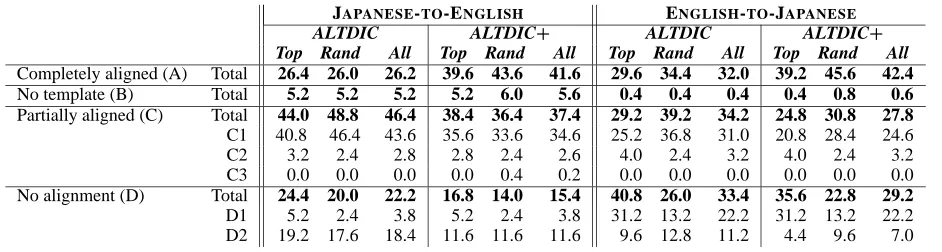
3.3. The results of alignment are classified into four mutually-exclusive classes, as detailed below:
(A) Completely aligned All component words align according to one of the extracted translation templates.
(B) No template The translation does not corre-spond to a known translation template (irrespective of whether component words align in the source com-pound).
(C) Partially aligned Some but not all component words align. We subclassify instances of this class into: C1 compounds, where there are unaligned words in both the source and target languages; C2 com-pounds, where there is an unaligned word in the source language only; and C3 compounds where there are unaligned words in the target language only.
(D) No alignment No component words align be-tween the source NN compound and translation. We subclassify D instances into: D1 compounds, where the translation is a single word; and D2 compounds, where no word pair aligns.
The results of alignment are shown in Table 3, for each of the top-250, random-250 and combined 500-element datasets. The alignment was carried out us-ing both the basic ALTDIC and ALTDIC> (ALTDIC with 178 manually-added simplex entries). Around 40% of the data align completely using ALTDIC> in both translation directions. Importantly, DMTCOMP
JAPANESE-TO-ENGLISH ENGLISH-TO-JAPANESE
ALTDIC ALTDIC ALTDIC ALTDIC
Top Rand All Top Rand All Top Rand All Top Rand All
Completely aligned (A) Total 26.4 26.0 26.2 39.6 43.6 41.6 29.6 34.4 32.0 39.2 45.6 42.4
No template (B) Total 5.2 5.2 5.2 5.2 6.0 5.6 0.4 0.4 0.4 0.4 0.8 0.6
Partially aligned (C) Total 44.0 48.8 46.4 38.4 36.4 37.4 29.2 39.2 34.2 24.8 30.8 27.8
C1 40.8 46.4 43.6 35.6 33.6 34.6 25.2 36.8 31.0 20.8 28.4 24.6 C2 3.2 2.4 2.8 2.8 2.4 2.6 4.0 2.4 3.2 4.0 2.4 3.2 C3 0.0 0.0 0.0 0.0 0.4 0.2 0.0 0.0 0.0 0.0 0.0 0.0 No alignment (D) Total 24.4 20.0 22.2 16.8 14.0 15.4 40.8 26.0 33.4 35.6 22.8 29.2
[image:6.595.65.536.83.209.2]D1 5.2 2.4 3.8 5.2 2.4 3.8 31.2 13.2 22.2 31.2 13.2 22.2 D2 19.2 17.6 18.4 11.6 11.6 11.6 9.6 12.8 11.2 4.4 9.6 7.0
Table 3: Alignment-based results for DMTCOMP
JE EJ
Cov Acc F-score Cov Acc F-score
MBMTDICT 55.4 91.0 68.9 77.2 93.3 84.5
DMTCOMP 96.4 43.1 59.6 87.0 48.7 62.5
[image:6.595.71.361.85.293.2]Cascaded 96.4 71.6 82.2 95.6 87.0 91.1
Table 4: Cascaded translation results
than top-250, in terms of both completely aligned and partially aligned instances. This contrasts with MBMTDICT which was found to be brittle over the
less-frequent random-250 dataset.
4.3 Combination of MBMTDICTand DMTCOMP
We have demonstrated MBMTDICT to have high
ac-curacy but relatively low coverage (particularly over lower-frequency NN compounds), and DMTCOMP to
have medium accuracy but high coverage. To com-bine the relative strengths of the two methods, we test a cascaded architecture, whereby we first attempt to translate each NN compound using MBMTDICT, and
failing this, resort to DMTCOMP.
Table 4 shows the results for MBMTDICT and
DMTCOMP in isolation, and when cascaded (Cas-cade). For both translation directions, cascading
re-sults in a sharp increase in F-score, with coverage constantly above 95% and accuracy dropping only marginally to just under 90% for the EJ task. The cascaded method represents the best-achieved shallow translation upper bound achieved in this research.
5 Analysis and extensions
In this section, we offer qualitative analysis of the un-aligned translation pairs (i.e. members of classes B, C and D in Table 3) with an eye to improving the coverage of DMTCOMP. We make a tentative step in
this direction by suggesting one extension to the basic DMTCOMPparadigm based on synonym substition.
5.1 Analysis of unaligned translation pairs
We consider there to be 6 basic types of misalignment in the translation pairs, each of which we illustrate with examples (in which underlined words are aligned and boldface words are the focus of discussion). In
listing each misalignment type, we indicate the corre-sponding alignment classes in 4.2.
(a) Missing template (B) An example of misalig-ment due to a missing template (but where all compo-nent words align) is:
(a1)
kesshoushiNshutsu “advancement to finals”
Simply extending the coverage of translation tem-plates would allow DMTCOMP to capture examples
such as this.
(b) Single-word translation (C2,D1) DMTCOMP
fails when the gold-standard translation is a single word:
(b1) jouhoukaiji “(lit.) information disclo-sure”: disclosure
(b2) shunoukaidaN “(lit.) leader meet-ing”: summit
(b3) interest rate:
riritsu
In (b1), the misalignment is caused by the English
dis-closure default-encoding information; a similar case
can be made for (b2), although here summit does not align with kaidaN. DMTCOMP could potentially cope with these given a lexical inference module inter-facing with a semantically-rich lexicon (particularly in the case of (b1) where translation selection at least partially succeeds), but DMTINTERP seems the more
natural model for coping with this type of translation. (b3) is slightly different again, in that
riritsu can
be analysed as a two-character abbreviation derived from
risoku “interest” and
ritsu “rate”, which
aligns fully with interest rate. Explicit abbreviation expansion could unearth the full wordform and facili-tate alignment.
(c) Synonym and association pairs (C1) This class contains translation pairs where one or more pairs of component nouns does not align under exact transla-tion, but are conceptually similar:
(c1) budget deficit:
(c2) kameikoku “affiliation state”
:
mem-ber state
In (c1), although zaisei “finance” is not an ex-act translation of budget, they are both general finan-cial terms. It may be possible to align such words us-ing word similarity, which would enable DMTCOMPto
translate some component of the C1 data. In (c2), on the other hand, kamei “affiliation” is
lexically-associated with the English membership, although here the link becomes more tenuous.
(d) Mismatch in semantic explicitness (C1) This translation class is essentially the same as class (b) above, in that semantic content explicitly described in the source NN compound is made implicit in the translation. The only difference is that the translation is not a single word so there is at least the potential for word-to-word compositionality to hold:
(d1) shuuchijiseNkyo “(lit.) state-governor election”: state election
(e) Concept focus mismatch (C1-2,D2) The source NN compound and translation express the same con-cept differently due to a shift in semantic focus:
(e1) shuushokukatsudou “(lit.) activity for getting new employment”: job hunting.
Here, the mismatch is between the level of directed participation in the process of finding a job. In Japanese, katsudou “activity” describes simple involvement, whereas hunting signifies a more goal-oriented process.
(f) Lexical gaps (C3,D2) Members of this class cannot be translated compositionally as they are either non-compositional expressions or, more commonly, there is no conventionalised way of expressing the de-noted concept in the target language:
(f1) zokugiiN “legistors championing the causes of selected industries”
These translation pairs pose an insurmountable obsta-cle for DMTCOMP.
Of these types, (a), (b) and (c) are the most real-istically achievable for DMTCOMP, which combined
account for about 20% of coverage, suggesting that it would be worthwhile investing effort into resolving them.
5.2 Performance vs. translation fan-out
As mentioned in 5.1, there are a number of avenues for enhancing the performance of DMTCOMP. Here,
we propose synonym-based substitution as a means of dealing with synonym pairs from class (c).
The basic model of word substitution can be ex-tending simply by inserting synonym translations as well as direct word translations into the translation
Configuration Cov Acc F-score Fan-out
MBMTDICT(orig) 55.4 91.0 68.9 2 DMTCOMP(orig) 96.4 43.1 59.6 74 DMTCOMP(6 TTs sim) 95.6 41.4 57.8 20
DMTCOMP(6 TTs sim) 95.6 47.1 63.1 6,577
DMTCOMP(13 TTs sim) 96.6 43.2 59.7 43
DMTCOMP(13 TTs sim) 96.6 48.1 64.1 13,911
Table 5: Performance vs. translation fan-out (JE)
templates. We test-run this extended method for the JE translation task, using the Nihongo Goi-taikei the-saurus (Ikehara et al., 1997) as the source of source language synonyms, and ALTDIC> as our translation dictionary. The Nihongo Goi-taikei thesaurus clas-sifies the contents of ALTDIC into 2,700 semantic classes. We consider words occurring in the same class to be synonyms, and add in the translations for each. Note that we test this configuration over only C1-type compounds due to the huge fan-out in transla-tion candidates generated by the extended method (al-though performance is evaluated over the full dataset, with results for non-C1 compounds remaining con-stant throughout).
One significant disadvantage of synonym-based substitution is that it leads to an exponential increase in the number of translation candidates. If we anal-yse the complexity of simple word-based substitution to be "!
where is the average number of trans-lations per word, the complexity of synonym based substitution becomes#$&%
>
!
!
where% is the average number of synonyms per class.
Table 5 shows the translation performance and also translation fan-out (average number of translation candidates) for DMTCOMPwith and without
synonym-based substitution (' sim) over the top 6 and 13 trans-lation templates (TTs). As baselines, we also present the results for MBMTDICT (MBMTDICT (orig)) and
DMTCOMP (DMTCOMP (orig)) in their original
con-figurations (over the full 23 templates and without synonym-substitution for DMTCOMP). From this,
the exponential translation fan-out for synonym-based substitution is immediately evident, but accuracy can also be seen to increase by over 4 percentage points through the advent of synonym substitution. Indeed, the accuracy when using synonym-substitution over only the top 6 translation templates is greater than that for the basic DMTCOMP method, although the number
of translation candidates is clearly greater. Note the marked difference in fan-out for MBMTDICT vs. the
various incarnations of DMTCOMP, and that
consider-able faith is placed in the ability of translation selec-tion with DMTCOMP.
achieves appreciable gains in accuracy.
6 Conclusion and future work
This paper has used the NN compound translation task to establish performance upper bounds on shal-low translation methods and in the process empirically determine the relative need for deep translation meth-ods. We focused particularly on dictionary-driven MBMT and word-to-word compositional DMT, and demonstrated the relative strengths of each. When cascaded these two methods were shown to achieve 95%> coverage and potentially high translation accu-racy. As such, shallow translation methods are able to translate the bulk of NN compound inputs success-fully.
One question which we have tactfully avoided an-swering is how deep translation methods perform over the same data, and how successfully they can han-dle the data that shallow translation fails to produce a translation for. We leave these as items for future re-search. Also, we have deferred the issue of translation selection for the methods described here, and in future work hope to compare a range of translation selection methods using the data developed in this research.
Acknowledgements
This material is based upon work supported by the National Sci-ence Foundation under Grant No. BCS-0094638 and also the Research Collaboration between NTT Communication Science Laboratories, Nippon Telegraph and Telephone Corporation and CSLI, Stanford University. We would like to thank Emily Ben-der, Francis Bond, Dan Flickinger, Stephan Oepen, Ivan Sag and the three anonymous reviewers for their valuable input on this re-search.
References
Ken Barker and Stan Szpakowicz. 1998. Semi-automatic recog-nition of noun modifier relationships. In Proc. of the 36th
An-nual Meeting of the ACL and 17th International Conference on Computational Linguistics (COLING/ACL-98), pages 96–102,
Montreal, Canada.
Laurie Bauer. 1979. On the need for pragmatics in the study of nominal compounding. Journal of Pragmatics, 3:45–50. Jim Breen. 1995. Building an electronic Japanese-English
dic-tionary. Japanese Studies Association of Australia Conference
Lou Burnard. 2000. User Reference Guide for the British
Na-tional Corpus. Technical report, Oxford University
Comput-ing Services.
Yunbo Cao and Hang Li. 2002. Base noun phrase translation us-ing Web data and the EM algorithm. In Proc. of the 19th
Inter-national Conference on Computational Linguistics (COLING 2002), Taipei, Taiwan.
Ann Copestake and Alex Lascarides. 1997. Integrating symbolic and statistical representations: The lexicon pragmatics inter-face. In Proc. of the 35th Annual Meeting of the ACL and
8th Conference of the EACL (ACL-EACL’97), pages 136–43,
Madrid, Spain.
Pascale Fung and Kathleen McKeown. 1997. Finding terminol-ogy translations from non-parallel corpora. In Proc. of the
5th Annual Workshop on Very Large Corpora, pages 192–202,
Hong Kong.
Pascale Fung. 1995. A pattern matching method for finding noun and proper noun translations from noisy parallel corpora. In
Proc. of the 33rd Annual Meeting of the ACL, pages 236–43,
Cambridge, USA.
Satoru Ikehara, Satoshi Shirai, Akio Yokoo, and Hiromi Nakaiwa. 1991. Toward an MT system without pre-editing – effects of new methods in ALT-J/E–. In Proc. of the Third Machine
Translation Summit (MT Summit III), pages 101–106,
Wash-ington DC, USA.
Satoru Ikehara, Masahiro Miyazaki, Satoshi Shirai, Akio Yokoo, Hiromi Nakaiwa, Kentaro Ogura, Yoshifumi Ooyama, and Yoshihiko Hayashi. 1997. Nihongo Goi-Taikei – A Japanese
Lexicon. Iwanami Shoten.
Tomoshichi Konishi, editor. 1997. Genius English-Japanese and
Japanese-English Dictionary CD-ROM edition. Taishukan
Publishing Co., Ltd.
Judith N. Levi. 1978. The Syntax and Semantics of Complex
Nominals. Academic Press, New York, USA.
Mainichi Newspaper Co. 1996. Mainichi Shimbun CD-ROM 1996.
Guido Minnen, John Carroll, and Darren Pearce. 2001. Applied morphological processing of English. Natural Language
En-gineering, 7(3):207–23.
Grace Ngai and Radu Florian. 2001. Transformation-based learning in the fast lane. In Proc. of the 2nd Annual Meeting of
the North American Chapter of Association for Computational Linguistics (NAACL2001), pages 40–7, Pittsburgh, USA.
Kumiko Ohmori and Masanobu Higashida. 1999. Extracting bilingual collocations from non-aligned parallel corpora. In
Proc. of the 8th International Conference on Theoretical and Methodological Issues in Machine Translation (TMI99), pages
88–97, Chester, UK.
Reinhard Rapp. 1999. Automatic identification of word trans-lations from unrelated English and German corpora. In Proc.
of the 37th Annual Meeting of the ACL, pages 1–17, College
Park, USA.
Barbara Rosario and Marti Hearst. 2001. Classifying the seman-tic relations in noun compounds via a domain-specific lexical hierarchy. In Proc. of the 6th Conference on Empirical
Meth-ods in Natural Language Processing (EMNLP 2001),
Pitts-burgh, USA.
Ivan A. Sag, Timothy Baldwin, Francis Bond, Ann Copestake, and Dan Flickinger. 2002. Multiword expressions: A pain in the neck for NLP. In Proc. of the 3rd International Conference
on Intelligent Text Processing and Computational Linguistics (CICLing-2002), pages 1–15, Mexico City, Mexico.
Frank Smadja, Kathleen R. McKeown, and Vasileios Hatzivas-siloglou. 1996. Translating collocations for bilingual lex-icons: A statistical approach. Computational Linguistics,
22(1):1–38.
Takaaki Tanaka and Yoshihiro Matsuo. 1999. Extraction of trans-lation equivalents from non-parallel corpora. In Proc. of the
8th International Conference on Theoretical and Methodolog-ical Issues in Machine Translation (TMI-99), pages 109–19,
Chester, UK.
Takaaki Tanaka. 2002. Measuring the similarity between com-pound nouns in different languages using non-parallel corpora. In Proc. of the 19th International Conference on
Computa-tional Linguistics (COLING 2002), pages 981–7, Taipei,