Sensor Elective Energy Based Routing for Maximum Data
Transfer in WSN Communication
Guraneet kaur(student),Rakesh Gandhi(assist.prof.)
Email id-31TU [email protected]U31T
Chandigarh engineering college landran mohali
Abstract:
The following paper discusses the various WSN communication system with brief review of the current applicable protocols in the efficient energy optimization based control, these protocols are a result of high end research and hybridization of different routing strategies, after that the new problem of a more energy aware system is proposed with solution to the problem possible by a method of sensor elective system which pre calculates the next routing path with respect to sink location change by reverse path tracking and node branching.
Keywords: WSN, SEED, LEACH, Nodes, Routing, efficiency
Introduction
Wireless Sensor Networks (WSNs) are utilized to screen certain parameters in numerous applications like environment monitoring, habitant monitoring, [1] battle field, agriculture field monitoring and smart homes. These remote sensors are scattered in sensing area to screen field.
The advances in the semiconductor and microelectronics industry, vitality stockpiling advances, sensor and wireless communication innovations amid the previous decade have made accessible another kind of communication systems. The sensing gadgets measure encompassing conditions identified with environment encompassing the sensor and change them into an electric signal. Handling such a signal uncovers a few properties about objects found and/or events happening in the region of the sensor. An expansive number of these expendable sensors can be organized in numerous applications that require unattended operations.
The fundamental objective of a WSN is to gather information from the environment and send it to a reporting centre where the information is amassed and analyzed
Recent advances in wireless communication technologies and the manufacture of inexpensive wireless devices have led to the introduction of low-power wireless sensor networks. Due to their ease of deployment and the multi-functionality of the sensor nodes, wireless sensor networks have been utilized for a variety of applications such as healthcare, target tracking, and environment monitoring. The main responsibility of the sensor nodes in each application is to sense the target area and transmit their collected information to the sink node for further operations. Resource limitations of the sensor nodes and unreliability of low-power wireless links, in combination with various performance demands of different applications impose many challenges in designing efficient communication protocols for wireless sensor networks. Meanwhile, designing suitable routing protocols to fulfil different performance demands of various applications is considered as an important issue in wireless sensor networking [3].
Routing Protocols in WSN
Routing protocols in WSNs have a common objective of efficiently utilizing the limited resources of sensor nodes in order to extend the lifetime of the network. Different routing techniques can be adopted for different applications based on their requirements. Applications can be time critical or requiring periodic updates, they may require accurate data or long lasting, less precise network, they may require continuous flow of data or event driven output. Routing methods can even be enhanced and adapted for specific application [2].
hubs' positions are misused to route information in the system. A routing protocol is viewed as versatile if certain framework parameters can be controlled with a specific end goal to adjust to the present system conditions and accessible vitality levels.
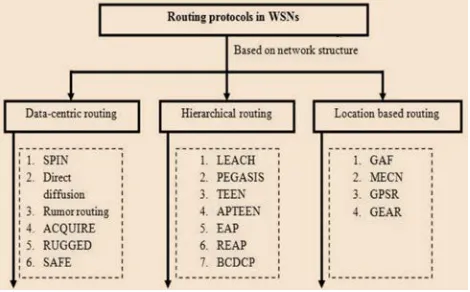
Figure 1: Shows different routing protocols in WSNs
Sensor Protocols for Information via Negotiation(SPIN)
A group of adaptive protocols called Sensor Protocols for Information via Negotiation (SPIN) that that disperses all the data at every hub to each hub in the system accepting that all hubs in the system are potential base-stations. This empowers a user to inquiry any hub and get the obliged data promptly. These protocols make utilization of the property that hubs in close closeness have comparable information, and henceforth there is a need to just convey the information that different hubs don't posses. The SPIN group of protocols uses information transaction and asset versatile calculations [5].
Low Energy Adaptive Clustering Hierarchy (LEACH)
LEACH is a group based convention, which incorporates circulated cluster arrangement. LEACH arbitrarily chooses a couple sensor hubs as cluster heads (CHs) and turns this part to uniformly convey the vitality load among the sensors in the system. In LEACH, the clusterhead (CH) hubs pack information landing from hubs that fit in with the particular bunch, and send a collected packet to the base station so as to diminish the measure of data that must be transmitted to the base station [6].
PEGASIS “Power-Efficient Gathering in Sensor Information Systems”
It is a “chain-bases protocol” and an upgrading of the “LEACH” [7]. In “PEGASIS” every node transfers only with a close neighbour to direct and obtain information. It receipts turns communicating to the BS, thus decreasing the quantity of energy consumed per round. The nodes are in this way that a chain should be developed, which can be completed by the sensor nodes along with using an algorithm. On the other hand, the BS can compute this chain and transmission of it to all the sensor nodes.
APTEEN “Adaptive Threshold sensitive Energy Efficient sensor Network”
energy. However, the foremost disadvantages of APTEEN are the complication and that it results in lengthier deferment times.
Hybrid, Energy-Efficient Distributed Clustering (HEED)
HEED [9] extends the basicscheme of LEACH by using residual energy and node degree or density as a metric for clusterselection to achieve power balancing. It operates in multi-hop networks, using an adaptivetransmission power in the inter-clustering communication. HEED was proposed with fourprimary goals namely (i) prolonging network lifetime by distributing energy consumption, (ii)terminating the clustering process within a constant number of iterations, (iii) minimizing control overhead, and (iv) producing well-distributed CHs and compact clusters.
Problem Statement
The survey gives collective architecture of advice and ascendancy for the accountability of enhancement problem in WSN for max data transmission, for which many routing arrangement and constraints are the required for the adherence of Upon anticipation of the affiliation of the optimal sampling of data and packet absurdity anticipation to the optimal afterlife size, we adduce an able band-aid adjustment based on the lifetime problem of sensors for data transmission. The lifetime for sensors is necessary as the change routing will affect the data error rate for the user, the path loss will also be influenced, the effect of distance change is also a concern as it effects the error rate proportionally.
Proposed System Working
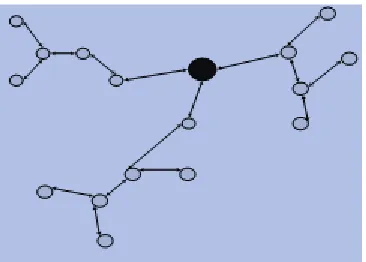
Firstly designing of the random field sensor distributions simulating original WSN deployment in different area spreads from 40 meter square to 100 meter square. Assign the network with energy, node number, lifetime, packet samples. Form the source and sink link for initialling communication using reverse path tracking in the network by finding the pathway to the end edge node by selecting the best node path according to forward energy and distance from the edge to sink location.Form the node to node distance and calculate the energy needed to transmit or receive the data, this takes place for every packet data sent and the path is re-optimized with new data in the cluster of sensors.Using sensor elective energy dependent sampling the selection of sensors is done using pairing of the nodes with nodes closest to sink as parent and the others are seen as child nodes.
Figure 2 shows the SEED working Configuration
With the change in the sink location the node adjustment is done for finding new path for every new location this is followed by calculation of following parameters:
Energy Calculation:
EENERGY = k(bit)*(Eelec + εamp* r1^2+ Eelec + εamp* r2^2 + ERx)
EDIRECT = k(bit)*(Eelec + εamp* r^2)
Elected node with Amp energy
(Eelec + εamp* r1^2+ Eelec + εamp* r2^2 + ERx) < (Eelec + εamp* r^2) (1)
Tx = 50 mw (i.e)
Because Eelec = ERx = 50 µJ, εamp = 0.1 µJ. So:
100+0.1(r1^2 + r2^2) < 0.1*r^2
1000 + (r1^2 + r2^2) < r^2
r1, r2, and r are 3 edges of a triangle
r1
r2
Calculate the energy efficiency, average power, number of nodes in communication
Results
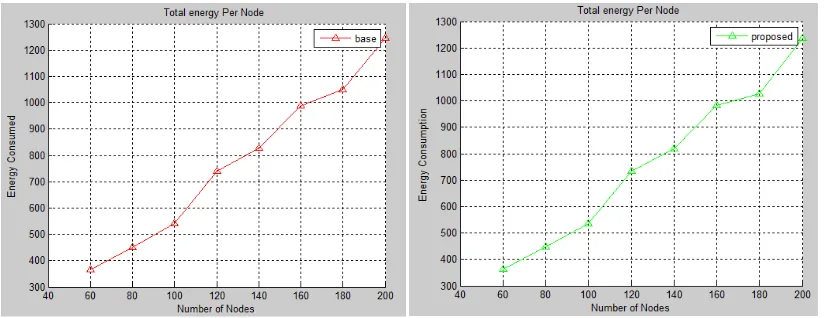
Figure 4 shows the comparison of the proposed and base system output for energy consumption for different network configurations
SEED
BS
Figure 5 shows the comparison of the proposed and base system output for standard deviation based energy consumption for different network configurations
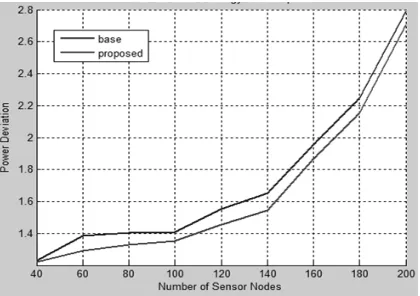
Figure 6 shows the comparison of the Deviation of the total energy consumption between the base and proposed system.
Conclusion
The base system and proposed system both are efficient when the energy per node is calculated, the total deviation of energy is balanced in case of SEED system due to the efficient switching of the node routing path, which reduces consumption of energy by reducing the configuration time for new routing path by analysing the residual energy and distance of the node from the sink station.
References
[2] S.K. Singh, M.P. Singh, and D.K. Singh, “A survey of Energy-Efficient Hierarchical Cluster-basedRouting in Wireless Sensor Networks”, International Journal of Advanced Networking andApplication (IJANA), Sept.–Oct. 2010, vol. 02, issue 02, pp. 570–580.
[3] S.K. Singh, M.P. Singh, and D.K. Singh, "Energy-efficient Homogeneous Clustering Algorithm forWireless Sensor Network", International Journal of Wireless & Mobile Networks (IJWMN), Aug.2010, vol. 2, no. 3, pp. 49-61.
[4] Jun Zheng and Abbas Jamalipour, “Wireless Sensor Networks: A Networking Perspective”, a bookpublished by A John & Sons, Inc, and IEEEE, 2009.
Vol. 18, No. 4, pp. 319-349, 1988.
[6] W. Heinzelman, A. Chandrakasan and H. Balakrishnan, "Energy-E±cient Communication Protocol for Wireless Mi-crosensor Networks," Proceedings of the 33rd Hawaii International Conference on System Sciences (HICSS '00), January2000.
[7] B. Nath and D. Niculescu, "Routing on a curve", ACM SIGCOMM Computer Communication Review,vol. 33, no.1, Jan. 2003, pp. 155-160.
[8] S. Lindsey and C. S. Raghavendra.,” PEGASIS: Power-efficient gathering in sensor information systems,” In Proceedings of the IEEE Aerospace Conference, USA, Montana, March 2002, Vol. 3, pp.1125-1130.
[9] A. Manjeshwar, D. Agrawal,” APTEEN: A Hybrid Protocol for Efficiency Routing and Comprehensive Information Retrieval in Wireless Sensor Networks,” In proceedings of International Parallel and Distributed Processing Symposium, Florida, 2002, pp.195-202.