A Named Entity Recognition Method based on
Decomposition and Concatenation of Word Chunks
Tomoya Iwakura†Hiroya Takamura‡Manabu Okumura‡ †Fujitsu Laboratories Ltd.
‡Precision and Intelligence Laboratory, Tokyo Institute of Technology
{takamura,oku}@pi.titech.ac.jp
Abstract
We propose a Named Entity (NE) recog-nition method in which word chunks are repeatedly decomposed and concatenated. We can obtain features from word chunks, such as the first word of a word chunk and the last word of a word chunk, which can-not be obtained in word-sequence-based recognition methods. However, each word chunk may include a part of an NE or mul-tiple NEs. To solve this problem, we use the following operators: SHIFT for sepa-rating the first word from a word chunk, POP for separating the last word from a word chunk, JOIN for concatenating two word chunks, and REDUCE for assigning an NE label to a word chunk. We evalu-ate our method on a Japanese NE recog-nition data set that includes about 200,000 annotations of 191 types of NEs from over 8,500 news articles. The experimental re-sults show that the training and processing speeds of our method are faster than those of a linear-chain structured perceptron and a semi-Markov perceptron while high ac-curacy is maintained.
1 Introduction
Named Entity (NE) recognition is a process by which the names of particular classes and nu-meric expressions are recognized in text. NEs include person names, locations, organizations, dates, times, and so on. NE recognition is one of the basic technologies used in text processing, in-cluding Information Extraction (IE), Question An-swering (QA), and Information Retrieval (IR).
Supervised learning algorithms have been ap-plied successfully to create NE recognizers. In the early stages, algorithms for training classi-fiers, including Maximum Entropy Models (Uchi-moto et al., 2000), AdaBoost (Carreras et al.,
2002), and Support Vector Machines (Yamada, 2007) were widely used. Recently, learning al-gorithms for structured prediction, such as linear-chain Conditional Random Fields (CRFs) (Laf-ferty et al., 2001), linear-chain structured per-ceptron (Collins, 2002a), semi-Markov perper-ceptron (Cohen and Sarawagi, 2004), and semi-Markov Conditional Random Fields (Sarawagi and Cohen, 2004), have been widely used because of their good performances in terms of accuracy.
However, the computational cost of using these algorithms for structured prediction can become problematic when we handle a large number of types of NE classes. The computational cost of learning first-order-Markov models with linear-chain CRFs or structured perceptron isO(K2N),
where K is the number of types of classes and N is the length of the sentence. Semi-Markov-based algorithms, such as semi-Markov percep-tron and semi-Markov CRFs, enumerate NE can-didates represented by word chunks in advance for capturing features such as the first word of a chunk and the last word of a chunk. Therefore, the computational cost of a semi-Markov perceptron is O(KLN), where Lis the upper bound length of the entities.
The computational cost might not be a big prob-lem, when we use these learning algorithms to recognize a small number of types of NEs, such as the seven types in MUC (Grishman and Sund-heim, 1996), the eight types in IREX (Committee, 1999), and the four types in the CoNLL shared task (Tjong Kim Sang and De Meulder, 2003). However, the computational cost will be higher than ever, when we recognize a large types of classes like Sekine’s extended NE hierarchy that includes about 200 types of NEs for covering sev-eral types of needs of IE, QA, and IR (Sekine et al., 2002).
This paper proposes a word-chunk-based NE recognition method for creating fast NE
nizers while high accuracy is maintained by cap-turing rich features extracted from word chunks. Our method recognizes NEs from word-chunk se-quences identified by a base chunker. When we use a base chunker with a computational cost of O(KN) or lower than it, we can maintain the
computational cost of our method as O(KN).
This is because the length of the word-chunk se-quences is less than or equal to the sentence length N. In addition, our method can use features ex-tracted from word chunks that cannot be obtained in word-based NE recognitions.
However, each word chunk may include a part of an NE or multiple NEs. To solve this problem, we use the following operators: SHIFT for sepa-rating the first word from a word chunk, POP for separating the last word from a word chunk, JOIN for concatenating two word chunks, and REDUCE for assigning an NE class label to a word chunk. Therefore, we call our method SHIFT-POP-JOIN-REDUCE parser (SPJR for short).
We demonstrate experimentally that the train-ing and processtrain-ing speeds of SPJR-based NE rec-ognizers can be considerably faster than those of a linear-chain-perceptron and a semi-Markov-perceptron, while high accuracy is maintained.
2 SHIFT-POP-JOIN-REDUCE Parser This section describes our method that recognizes NEs from word chunk sequences. We assume word chunk sequences are given by a base chunker which is described in Section 3.4.
2.1 Operators for Word Chunks
To recognize NEs from word chunks, we use SHIFT and POP for decomposing word chunks, JOIN for concatenating two word chunks, and RE-DUCE for assigning one of the defined NE class labels. In the following, C = hC1, ..., C|C|i de-notes a word chunk sequence. cbwj is the first word ofCj, andcewj is the last word ofCj.
• REDUCE: This operator assigns one of the NE labels to a word chunk.
• POP: This operator separates the last word from a word chunk, and the separated word is treated as a new word chunk. POP is only applied to a word chunk consisting of more than one word. When POP is applied toCj, the last wordcewj is separated from Cj. Indices of the following word chunksCk
(j + 1 ≤ k ≤ |C|) are incremented by 1, and the separated word cewj becomes new Cj+1. There is one exceptional procedure for POP to use as much initial chunk information as possible. If POP is successively applied to the j-th chunk, the separated words are concatenated and regarded as the(j + 1)-th
chunk. For example, ifCj consists of words “w x y z” and POP is applied to both y and z, then theCj+1will be considered to be “y z”.
• SHIFT: This operator separates the first word
from a word chunk, and the separated word is treated as a new word chunk. SHIFT is only applied to a word chunk consisting of more than one word. When SHIFT is applied to Cj, the first wordcbwj is separated fromCj. Indices of the word chunksCk(j≤k≤ |C|) are incremented by 1, and the separated word cbwjbecomes newCj.
• JOIN: This operator concatenates two adja-cent word chunks. When JOIN is applied to Cj and Cj+1, Cj andCj+1 are concate-nated for creating new Cj. Indices of the word chunks Ck (j + 2 ≤ k ≤ |C|) are decremented by 1. To avoid an end-less loop by generating previously processed word chunks, we forbid JOIN from occurring immediately after POP or SHIFT.
2.2 Training an NE Recognizer
The input to our training procedure is the word chunks of a base chunker along with the NE la-bels on those correct word chunks. To train an NE recognizer, we first generate training samples, and then run a machine-learning algorithm over the training samples. Figure 1 shows a pseudo-code of the procedure for generating training samples from thei-th input.{T1,...TM}is a set of training data consisting ofMsentences.
Ti = hTi,1, ..., Ti,Mii (1 ≤ i ≤ M) is the i
-th training input. Ti,j (1 ≤ j ≤ Mi) is the j-th chunk ofTi, andl(Ti,j)is the NE label ofTi,j. If Ti,jis not an NE,l(Ti,j)isO. The procedure runs as follows:
#Ti ={Ti,1, ...Ti,Mi}: an input
#Ti,j (1≤j ≤Mi): a word chunk #l(Ti,j):Ti,j’s NE label
#Wi: words inTi
#C={C1, ... C|C|}: word chunks
#l(cbwj): the NE label of the last word ofCj #l(cewj): the NE label of the first word ofCj #gen(Cj, OP): generate a training sample # for OPERATOR (OP) applied toCi # (S0) to (S5) correspond to those of Sec. 2.2.
GenerateTrainingSample(Ti)
# (S0) Generate a word chunk-sequence # with a base chunker.
C=Chunking(Wi); j= 1;
while j≤Mi do
ifCj==Ti,jthen# (S1)
gen(Cj, REDU CE=l(Ti,j));j+ +;
else ifl(cewj)==Othen# (S2) gen(Cj, P OP); C=P OP(C, j);
else ifl(cbwj)==Othen# (S3)
gen(Cj, SHIF T); C=SHIF T(C, j);
else if( a word or words included inCj are not the constituents ofTj)then# (S4) gen(Cj, P OP);C=P OP(C, j);
else# (S5)
gen(Cj, JOIN);C=JOIN(C, j);
end if end while
Figure 1: A pseudo code of the generation of train-ing samples.
• (S1) If the current chunkCj is equivalent to the correct chunkTi,j, we generate a training sample for REDUCE=l(Ti,j). This means REDUCE for annotating a word chunk with l(Ti,j). Then we move to the next word chunk. (j+ +)
• (S2) If the label of the last word of the cur-rent chunkcewjis “O”, a training sample for applying POP toCj is generated. Then POP is applied toCj.
• (S3) If the label of the first word of the cur-rent chunkcbwj is “O”, a training sample for applying SHIFT to Cj is generated. Then SHIFT is applied toCj.
• (S4) If a word or words included in Cj are not the constituents ofTi,j, a training sample for applying POP toCj is generated.
• (S5) If all the above steps are not executed, the correct NE exists across more than one chunk. Therefore, we generate a sample of current word chunk for JOIN.
After generating training samples for all the in-puts, we train a model from the training samples with a machine-learning algorithm.
2.3 An Example of Training
Consider the following training dataTi.
- [Mr.]O [Ken Ono]P ER [went]O [skiing]O
We first identify base chunks, and the result is as follows:
-[Mr. Ken] [Ono went] [skiing] We denote this base chunking result asC. Word chunks are indicated by bracketing, and a current chunk is underlined.
We first compareTi,1 andC1. C1 is not equiv-alent toTi,1, and the NE label of the first word of C1, “Mr.”, is “O”. Therefore, we generate a train-ing sample for applytrain-ing SHIFT toC1by (S3), and apply SHIFT toC1. The currentC would be the following.
-[Mr.] [Ken] [Ono went] [skiing] We compareC1andTi,1again, andC1is equiv-alent to Ti,1. Therefore, we generate a training sample for applying REDUCE=O toC1 by (S1), and move to the next word chunk.
-[Mr.] [Ken] [Ono went] [skiing] C2 is not equivalent to Ti,2, and C2 does not satisfy (S1) to (S4). We generate a training sample of JOIN forC2by (S5), and apply JOIN toC2and C3.
-[Mr.] [Ken Ono went] [skiing] C2 is still not equivalent toTi,2, and the NE la-bel of the last word “went” is “O”. Therefore, we generate a training sample for applying POP toC2 by (S2), and apply POP toC2.
-[Mr.] [Ken Ono] [went] [skiing] C2 is equivalent to Ti,2, and a training sam-ple for REDUCE=P ER is generated. The re-mainingC3andC4are also equivalent toTi,3and Ti,4, respectively. Thus, two training samples for REDUCE=Oare generated.
2.4 NE Recognition
#W: an input word-sequence #C={C1, ... C|C|}: word chunks
#L ={L1, ... L|C|}: NE class labels of word chunks
#M odel: a trained model
NERecognition(W,M odel) # Generate a word chunk-sequence # with a base chunker.jis forC. C=Chunking(W); j= 1;
while j≤ |C|do
# Select an operation. If REDUCE is # selected, selectOP returns an NE labell. (op,l) = selectOP(Cj,M odel);
ifop == REDUCEthen
Lj =l# keepCj’s NE label
j+ +# Move to the next word chunk
else ifop == POPthen
C=P OP(C, j);
else ifop == SHIFTthen
C=SHIF T(C, j);
else ifop == JOINthen
C=JOIN(C, j);
end if end while returnCandL
Figure 2: A pseudo code of NE recognition.
chunk sequence of the input with a base chunker as in the training.
Then we process each word chunk from the be-ginning of the sentence to the end of the sentence. An operator to use on the current word chunk is decided upon with a trained model, and each word chunk is processed according to the selected op-erator. If all the word chunks are processed, we return word chunks with their NE labels.
2.5 An Example of Recognition
Consider the following input data: -Mr. Jim Ji goes to U.K
We identify base chunks of the input as follows. -[Mr. Jim Ji] [goes] [to] [U.K]
We denote this base NE chunking result asC. An operator for each word chunk inCis selected with a trained model M odel. Here, we assume SHIFT is selected and apply SHIFT toC1. After applying SHIFT toC1,C1 becomes [Mr.], andC2 becomes [Jim Ji].
-[Mr.] [Jim Ji] [goes] [to] [U.K] We start to select an operator for the new C1,
and REDUCE=O is selected. We keep O as the NE class ofC1, and move to the next chunkC2. -[Mr.] [Jim Ji] [goes] [to] [U.K]
Next, we select an operator for theC2, and RE-DUCE=PER is selected. We keep PER as the NE class ofC2, and move to the next chunkC3. We continue this NE recognition process for the re-maining word chunks. When we process all the word chunks, we returnCwith their NE labels.
3 Experimental Settings
3.1 Data Set and Evaluation Metrics
We used an extended NE corpus for our evalua-tion (Hashimoto et al., 2008). This Japanese cor-pus consists of about 8,500 articles from 2005 Mainichi newspaper. NE tags on this corpus is based on the extended NE hierarchy introduced by Sekine et al (Sekine et al., 2002). The corpus includes 240,337 tags for 191 types of NEs. To segment words from Japanese sentences, we used ChaSen.1 We created the following sets for this
experiment.
• training data: news articles from January to October 2005 in the corpus. The training data includes 1,806,772 words and 205,876 NEs.
• development data: news articles from November 2005 in the corpus. The de-velopment data includes 145,635 words and 15,405 NEs.
• test data: news articles from December 2005 in the corpus. The test data includes 177,159 words and 19,056 NEs.
Recall, precision, and F-measure are our evalua-tion metrics. Recall is defined to be the number of correctly recognized NEs divided by the number of all NEs. Precision is defined to be the number of correctly recognized NEs divided by the num-ber of all recognized NEs. F-measure (FM) is de-fined as follows:
FM = 2×recall×precision/( recall+ preci-sion).
1We use ChaSen-2.4.2 with Ipadic-2.7.0. ChaSen’s web
3.2 Algorithms to be Compared
The following algorithms are compared with our method.
• Linear-chain structured perceptron (
Linear-Chain, for short) (Collins, 2002a): This is a perceptron-based algorithm for labeling tags to word-sequences. In this algorithm, fea-tures are only generated from each word and its surrounding words.
• Semi-Markov perceptron (Semi-Markov, for
short) (Cohen and Sarawagi, 2004): This al-gorithm is based on sequentially classifying chunks of several adjacent words, rather than single words. Ideally, all the possible word chunks of each input should be considered for this algorithm. However, the training of this algorithm requires a great deal of memory. Therefore, we limit the maximum length of the word-chunks. We use word chunks con-sisting of up to five or ten words.2
• NE Chunking and Classification (NECC, for
short) (Carreras et al., 2002): This method consists of two parts. The first part is a base NE recognition as in our method. The second part is NE classification. Unlike in our method, this method just classifies given word chunks without decomposing and con-catenating them. This method was used in the best system of the shared task of CoNLL 2002 (Tjong Kim Sang, 2002).
• Shift-Reduce Parser for NE Recognition (SR, for short) (Yamada, 2007): This algorithm is based on shift-reduce parsing for word-sequences. It uses two operators. The first one is shift which concatenates a word and its following word chunk. The other is re-duce for annotating an NE label to current word chunk.3 The algorithm is different from
ours in that the initial inputs of their method are word sequences. Thus, each word chunk is constructed little by little. Therefore, the algorithm cannot use features obtained from word chunks at the early stage.
2This is because when we ran Semi-Markov without the
chunk length constraint, it used 72GB memory, which is our machine memory size, and 1 GB swap region on its hard disc.
3To compare the performance under the same conditions,
we did not use the operator to separate characters from words to recognize partial NEs in words.
We use the multiclass perceptron algorithm for NECC, SR and SPJR. Thus all of the algorithms are based on perceptron (Rosenblatt, 1958). We apply the averaged perceptron (Collins, 2002a) for all the training algorithms. All the learn-ers and NE recognizlearn-ers were implemented with C+ +. We used perceptron-based algorithms
be-cause perceptron-based algorithms usually show the faster training speed and lower usage of mem-ory than training algorithms, such as MEMM (Mc-Callum et al., 2000), CRFs (Lafferty et al., 2001), and so on. Actually, when we applied a CRFs im-plementation based on LBFGS (Liu and Nocedal, 1989) to the training data, the implementation con-sumed 72GB memory which is our machine mem-ory size.
We select the number of the iteration that shows the highest F-measure in the development data for each NE recognizer. We set the maximum itera-tion number at 50.
3.3 Features
The features used in our experiment are shown in Table 1. As features for Linear-Chain percep-tron, we used the following. Here, kdenotes the current word position. wk is the k-th word, and pk is the Part-Of-Speech (POS) tag ofk-th word. We used the word and the POS of thek-th word and the words in 2-word windows before and af-ter thek-th word with the current NE-tag tk and the NE tag tk−1 of the previous word. Each NE tag is represented as IOB1 (Ramshaw and Marcus, 1995). This representation uses three tags I, O and B, to represent the inside, outside and beginning of a chunk. B is only used at the beginning of a chunk which immediately follows another chunk that NE class is the same. Each tag is expressed with NE classes, like I-CL, B-CL, where CL is an NE class.4 To realize a fast training speed for
Linear-Chain, we only used the valid combination oftk andtk−1 in terms of the chunk representa-tion.
4We compared five types of chunk representation: IOB1
Table 1: Features. kdenotes a word positions for Linear-Chain. wkis thek-th word surface, andpk is the POS tag of the k-th word. tk is the tag of thek-th word. T Tkistkor the combination oftk and tk−1. bp is the position of the first word of the current chunk. epindicates the position of the last word of the current chunk. ipis the position of words inside the current chunk. (bp < ip < ep). If the length of the current chunk is 2, we use features that indicate there is no inside word as the features of ip-th words. tj is the NE class label of j-th chunk. CLj is the length of the current chunk, whether it be 1, 2, 3, 4, or longer than 4. W Bj indicates word bigrams, andP Bj indicates POS bigrams inside the current chunk.
Without chunk (Linear-Chain)
[T Tk, wk],[T Tk, wk−1],[T Tk, wk−2],
[T Tk, wk+1],[T Tk, wk+2],[T Tk, pk],
[T Tk, pk−1],[T Tk, pk−2],[T Tk, pk+1],
[T Tk, pk+2],[T Tk, pk−2, pk−1],
[T Tk, pk+1, pk+2],[T Tk, pk−2, pk−1, pk+],
[T Tk, pk, pk+1, pk+2]
With chunk (Semi-Markov, NECC, SR, SPJR)
[tj, CLj],[tj, W Bj],[tj, P Bj],
[tj, wbp],[tj, pbp],[tj, wep],[tj, pep],
[tj, wip],[tj, pip],[tj, wbp, wep],[tj, pbp, pep],
[tj, wbp, pep],[tj, pbp, wep],
[tj, wbp−1],[tj, pbp−1],[tj, wbp−2],[tj, pbp−2],
[tj, wep+1],[tj, pep+1],[tj, wep+2],[tj, pep+2],
[tj, pbp−2, pbp−1],[tj, pep+1, pep+2],
[tj, pbp−2, pbp−1, pbp],[tj, pep, pep+1, pep+2]
Semi-Markov, NECC, SR, and SPJR, using word chunks, used features extracted from words in a word chunk and the words in two-word win-dows before and after the word chunk. The fea-tures extracted from chunks differ from those of Linear-Chain.
3.4 Base Chunkers
NECC and SPJR require a base chunker. To com-pare performances obtained with different base chunkers, we used a rule-based chunker and a machine-learning-based chunker.
We used a chunker that concatenates successive words with noun or unknown POS tags, or words existing in brackets, for the rule based chunker (RC, for short). This identification is fast because the chunker only checks POS tags.
Our machine-learning-based base chunker is the
SR-based chunker trained to distinguish just two chunks: NE and non-NE. To train a machine-learning-based chunker, we first converted the given training data into a training data for base chunkers. There are only two classes for the train-ing data used for base chunktrain-ing: NE or not.
For example, the following labeled input, Dr. [Toru Tanaka]P ER goes to [Kyoto]LOC
is converted as follows.
[Dr.]O [Toru Tanaka]BN E [goes]O [to]O [Kyoto]BN E
BN Eindicates that the word chunk becomes NE, andOindicates non-NE.
The converted training data are used for training a base NE chunker that identifies base NEs and non-NEs. Words identified as non-NEs are treated as word chunks consisting of a word.
Then we split the converted training data into five portions. To obtain a training set for recogniz-ing NEs, we repeated the followrecogniz-ing process for all the five portions. We trained a base NE chunker with four out of five the portions of the converted training data. The base NE chunker identified base NEs from the remaining portion. After all the portions were processed, we trained the SPJR- or NECC-based NE recognizer from the five portions along with the NE labels on those correct word chunks.
For recognizing NEs in the test phase, we used a base NE chunker trained with all the given train-ing data converted by the method. To examine whether we can attain high accuracy while main-taining fast training and processing speed, we used SR, the fastest algorithm among our compared al-gorithms, for training base NE chunkers.
4 Experimental Results
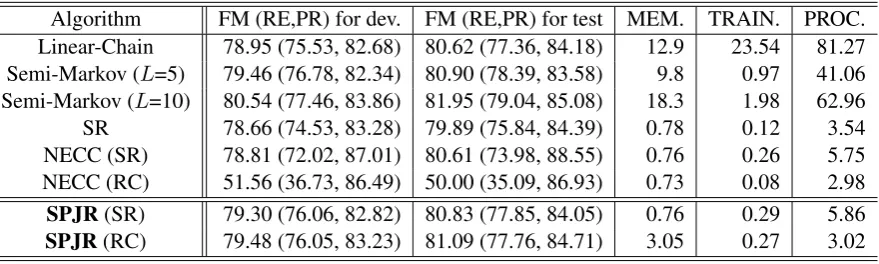
Table 2 shows the experimental results.5 The NE
recognizers based on our method showed good performance. SPJR with RC is the second, and SPJR with SR is the fourth best F-measure on test data. The best and the third systems are Semi-Markov-based ones. These results indicate that features extracted from word chunks contributed to improved accuracy.
To compare the results of SPJR (RC) with the others, we employed a McNemar paired test on the labeling disagreements as was done in (Sha and
5We used a machine with Intel(R) Xeon(R) CPU X5680
Table 2: Experimental results. FM, RE, and PR indicate F-measure Recall, and Precision, obtained with each algorithm, respectively. The dev. and test indicate the results for the development data, and the results for the test data. MEM. indicates the amount of memory size (GB) for the training of each algo-rithm. TRAIN. indicates the training time for each algorithm (in hours). PROC. indicates the processing speed of the development data for each algorithm (in seconds). (SR) and (RC) indicate NECC or SPJR that uses a SR-based chunker or RC, respectively. The numbers afterL= indicate the maximum length of the word-chunks for Semi-Markov perceptron.
Algorithm FM (RE,PR) for dev. FM (RE,PR) for test MEM. TRAIN. PROC. Linear-Chain 78.95 (75.53, 82.68) 80.62 (77.36, 84.18) 12.9 23.54 81.27 Semi-Markov (L=5) 79.46 (76.78, 82.34) 80.90 (78.39, 83.58) 9.8 0.97 41.06 Semi-Markov (L=10) 80.54 (77.46, 83.86) 81.95 (79.04, 85.08) 18.3 1.98 62.96 SR 78.66 (74.53, 83.28) 79.89 (75.84, 84.39) 0.78 0.12 3.54 NECC (SR) 78.81 (72.02, 87.01) 80.61 (73.98, 88.55) 0.76 0.26 5.75 NECC (RC) 51.56 (36.73, 86.49) 50.00 (35.09, 86.93) 0.73 0.08 2.98
SPJR(SR) 79.30 (76.06, 82.82) 80.83 (77.85, 84.05) 0.76 0.29 5.86
SPJR(RC) 79.48 (76.05, 83.23) 81.09 (77.76, 84.71) 3.05 0.27 3.02
Pereira, 2003). We compared results on test data by character units because the ends or beginnings of Japanese NEs do not always correspond with word boundaries. All the results except for Semi-Markov (L=10) indicate that there is a significant difference (p <0.01). This result shows that SPJR (RC) showed high accuracy.
Our method also showed faster training and pro-cessing speeds than those of Linear-Chain and Semi-Markov. Specifically, our proposed method with RC showed about a 87 times faster train-ing speed and about a 27 times faster processtrain-ing speed than those of Linear-Chain. Our method showed about a 7 times faster training speed and about a 21 times faster processing speed than those of Semi-Markov (L=10). In addition, our algo-rithm requires a lower maximum memory size than Linear-Chain and Semi-Markov.
5 Discussion
5.1 Comparison with Linear-Chain
Our algorithm showed much faster speed than Linear-Chain. This is because the difference of computational procedure. Linear-Chain-based ones run Viterbi algorithm to select the best la-beled sequence in terms of the scores assigned by a trained model for each input in both training and testing. When running Viterbi algorithm, Linear-Chain-based ones have to check the connections of class labels. The number of connections is up toK2, whereKis the number of types of class la-bels. On the other hand, SPJR-based ones greedily
recognize NEs.
5.2 Comparison with Semi-Markov
Since the maximum length of the word-chunks af-fects the performance of Semi-Markov, we eval-uated Semi-Markov using two types of the max-imum lengths of the word-chunks. Semi-Markov (L=5) showed faster training and processing speed than Semi-Markov (L=10). However, SPJR-based ones still showed much faster training and pro-cessing speed than Semi-Markov (L=5). In ad-dition, compared with Semi-Markov (L=5), SPJR (RC) showed higher accuracy and SPJR (SR) showed competitive accuracy. This result indi-cates that SPJR-based ones show faster speed than Semi-Markov giving up accuracy for improving speed.
5.3 Comparison with SR
5.4 Comparison with NECC
SPJR with RC showed much higher accuracy than NECC with RC. This is because the accuracy of RC-based NEs recognition is low. The SR-based base NE chunker identifies 86.56% of word chunks that become NEs in development data. However, RC identified only 50.75%. NECC can only identify correct NEs from correct chunks. Therefore, NECC with RC showed low accuracy. These results indicate our method based on de-composition and concatenation of word chunks contributed to improving accuracy.
However, SPJR (RC) showed more memory usage than SPJR (SR) and NECC-based ones. This is also related to the accuracy of each base chunker. To correctly recognize NEs from word chunks wrongly identified by the rule-based chun-ker, more training samples for decomposition or concatenation were generated. NECC showed slightly faster training and processing speeds than SPJR. This may be because NECC identifies the NE class of each word chunk without decomposi-tion or concatenadecomposi-tion.
5.5 Computational Efficiency
Our algorithm showed faster training and process-ing speeds than Linear-Chain and Semi-Markov. Formally, the computational cost of Semi-Markov is O(KLN), where L is the upper bound length of word chunks, N is the length of the sentence and K is the size of the label set. As for Semi-Markov,Lis 10 andKis 191 in this experiment. And that of the first order Linear-Chain perceptron isO(K2N), andK is 202 in this experiment. In contrast, the computational cost of NECC, SR, and SPJR isO(KN)andKis 191.
Semi-Markov required more memory usage than the other algorithms. The number of word chunks of each sentence in Semi-Markov is roughly LN. In contrast, the number of word chunks or words of each sentence for Linear-Chain, NECC, SR, and SPJR are up to N. This indicates that Semi-Markov handles aboutLtimes larger space than the other algorithms in terms of the number of nodes. Therefore, it requires more memory usage than the others.
6 Related Work
There have been methods proposed to improve the training speed for semi-Markov-based mod-els and perceptron-based methods. With regard
to reducing the space of lattices built into the Semi-Markov-based algorithms, a method was proposed to filter nodes in the lattices with a naive Bayes classifier (Okanohara et al., 2006). To improve training speed of the structured per-ceptron, distributed training strategies and conver-gence bounds for a particular mode of distributed the structured perceptron training are provided in (McDonald et al., 2010).
While the formulation is different, SPJR shares similar idea with transformation based learning (Brill, 1995). For example, a transformation-based POS tagging alters the POS tag of each word with an ordered list of transformations. These transformations alter the POS tag of each word based on contextual cues.
Methods using rich information other than semi-Markov-based algorithms are proposed as well. Previous works use N-best outputs to ob-tain rich features. For example, a boosting-based algorithm and a perceptron-based algorithm for re-ranking N-best outputs were proposed (Collins, 2002b). Another approach uses feature forests generated from N-best outputs (Huang, 2008). This method merges N-best outputs into a single lattice. In contrast with these methods, which re-quire a computational cost for processing N-best outputs, our method only handles an output.
Our proposed method showed good perfor-mance in this experiment, however, there is a drawback due to our recognizing strategy. Since NE recognizers based on our proposed method recognizes NEs greedily, only a mistake may af-fect later recognition process. In the future, we consider methods to incorporate techniques used in shift-reduce parsing (Huang and Sagae, 2010), like beam search or dynamic programming, into our recognition method for solving the problem.
7 Conclusion
References
Eric Brill. 1995. Transformation-based error-driven learning and natural language processing: A case study in part-of-speech tagging.Computational Lin-guistics, 21(4):543–565.
Xavier Carreras, Llu´ıs M`arques, and Llu´ıs Padr´o. 2002. Named entity extraction using adaboost. In
Proc. of CoNLL’02, pages 167–170.
William W. Cohen and Sunita Sarawagi. 2004. Ex-ploiting dictionaries in named entity extraction: combining semi-markov extraction processes and
data integration methods. In Proc. of KDD’04,
pages 89–98.
Michael Collins. 2002a. Discriminative training meth-ods for Hidden Markov Models: theory and
ex-periments with perceptron algorithms. InProc. of
EMNLP’02, pages 1–8.
Michel Collins. 2002b. Ranking algorithms for
named-entity extraction: Boosting and the voted perceptron. InIn Proc. of ACL’02, pages 489–496.
IREX Committee. 1999.Proc. of the IREX workshop.
Ralph Grishman and Beth Sundheim. 1996. Message understanding conference- 6: A brief history. In
Proc. of COLING’06, pages 466–471.
Taiichi Hashimoto, Takashi Inui, and Koji Murakami. 2008. Constructing extended named entity
anno-tated corpora.IPSJ SIG Notes, 2008(113):113–120.
Liang Huang and Kenji Sagae. 2010. Dynamic pro-gramming for linear-time incremental parsing. In
Proc. of ACL’10, pages 1077–1086.
Liang Huang. 2008. Forest reranking: Discriminative parsing with non-local features. InProc. of ACL’08, pages 586–594.
John D. Lafferty, Andrew McCallum, and Fernando C. N. Pereira. 2001. Conditional random fields: Probabilistic models for segmenting and labeling se-quence data. InProc. of ICML’01, pages 282–289. Dong C. Liu and Jorge Nocedal. 1989. On the limited
memory bfgs method for large scale optimization.
Mathematical Programming, 45:503–528.
Andrew McCallum, Dayne Freitag, and Fernando C. N. Pereira. 2000. Maximum entropy markov mod-els for information extraction and segmentation. In
ICML, pages 591–598.
Ryan McDonald, Keith Hall, and Gideon Mann. 2010. Distributed training strategies for the structured
per-ceptron. InProc. of NAACL HLT’10, pages 456–
464.
Daisuke Okanohara, Yusuke Miyao, Yoshimasa
Tsu-ruoka, and Jun ichi Tsujii. 2006. Improving
the scalability of semi-markov conditional random
fields for named entity recognition. In Proc. of
ACL’06.
Lance Ramshaw and Mitch Marcus. 1995. Text chunking using transformation-based learning. In
Proc. of the Third Workshop on Very Large
Cor-pora, pages 82–94. Association for Computational
Linguistics.
Frank Rosenblatt. 1958. The perceptron: A probabilis-tic model for information storage and organization in the brain. 65(6):386–408.
Sunita Sarawagi and William W. Cohen. 2004. Semi-markov conditional random fields for information extraction. InProc. of NIPS’04.
Satoshi Sekine, Kiyoshi Sudo, and Chikashi Nobata.
2002. Extended named entity hierarchy. InProc. of
LREC’02.
Fei Sha and Fernando Pereira. 2003. Shallow parsing
with conditional random fields. InProc. of NAACL
HLT’03, pages 134–141.
Erik F. Tjong Kim Sang and Fien De Meulder. 2003. Introduction to the conll-2003 shared task: Language-independent named entity recognition. In
Proc. of CoNLL-2003, pages 142–147.
Erik Tjong Kim Sang and Jorn Veenstra. 1999. Rep-resenting text chunks. InProc. of EACL ‘99, pages 173–179.
Erik F. Tjong Kim Sang. 2002. Introduction to
the conll-2002 shared task: Language-independent
named entity recognition. In Proc. of CoNLL’02,
pages 155–158.
Kiyotaka Uchimoto, Qing Ma, Masaki Murata, Hiromi Ozaku, Masao Utiyama, and Hitoshi Isahara. 2000. Named entity extraction based on a maximum
en-tropy model and transformation rules. In Proc. of
ACL 2000, pages 326–335.
Hiroyasu Yamada. 2007. Shift-reduce chunking for
japanese named entity extraction. IPSJ SIG Notes,