Evaluating a Deterministic Shift-Reduce Neural Parser for Constituent Parsing
Hao Zhou
†
, Yue Zhang
‡
, Shujian Huang
†
, Xinyu Dai
†
, Jiajun Chen
†
†State Key Laboratory for Novel Software Technology, Nanjing University, China,
‡Singapore University of Technology and Design, Singapore
{zhouh, huangsj, daixy, chenjj}@nlp.nju.edu.cn, yue [email protected]
Abstract
Greedy transition-based parsers are appealing for their very fast speed, with reasonably high accuracies. In this paper, we build a fast shift-reduce neural constituent parser by using a neural network to make local decisions. One challenge to the parsing speed is the large hidden and output layer sizes caused by the number of constituent labels and branching options. We speed up the parser by using a hierarchical output layer, inspired by the hierarchical log-bilinear neural language model. In standard WSJ experiments, the neural parser achieves an almost 2.4 time speed up (320 sen/sec) compared to a non-hierarchical baseline without significant accuracy loss (89.06 vs 89.13 F-score).
Keywords:Hierarchical Model, Neural Networks, Parsing
1.
Introduction
With the growth of demands for processing massive amounts of web data, the speed of NLP systems has be-come a key practical performance.
Transition-based parsers build outputs by using a sequence of shift-reduce actions (Sagae and Lavie, 2005; Zhang and Nivre, 2011; Bohnet and Nivre, 2012; Zhou et al., 2015). They are attractive by their fast speed, offering linear time complexity with deterministic decoding algorithms. Linear classifiers have traditionally been used to build very fast deterministic parsers (Nivre, 2008; Goldberg and Nivre, 2013).
Recently, Chen and Manning (2014) proposed a transition-based dependency parser, which adopts a neural network as the classifier. It has two advantages compared to the tra-ditional linear model (Nivre, 2008), namely fast speed and automatic feature combination. In particular, the speed of a neural dependency parser can be 1000 sentences per second on a single CPU, which is significant faster than traditional parsers.
In this paper, we explore the method of Chen and Manning (2014) for fast deterministic transition-based constituent
parsing. This is a more challenging task compared with neural dependency parsing (Table 1). First, due to unary actions and temporary nodes caused by binarization, the number of actions in a transition-based constituent parser is much larger than in a dependency parser, resulting in a large output layer for the neural network. Second, we find empirically that the neural constituent parser needs a much larger hidden layer (i.e. 800) to obtain reasonable perfor-mance compared to the neural dependency parser (i.e. 200). As a result, the speed of neural constituent parser is much slower than the dependency counterpart.
Motivated by hierarchical log-bilinear neural language models (Morin and Bengio, 2005; Mnih and Hinton, 2009), we propose a hierarchical-output neural model to speed up the parser. A hierarchical neural language model divides a huge vocabulary into a hierarchy of clusters, and con-structs a binary tree upon the word clusters. Each word corresponds to a leaf node, and can be uniquely specified by the path from the root.
Hidden Action Computation
Dependency 200 27 5,400
Constituent 800 131 104,800
Table 1: Comparison between neural constituent and de-pendency parsing. Computation: the product of hidden size and action number.
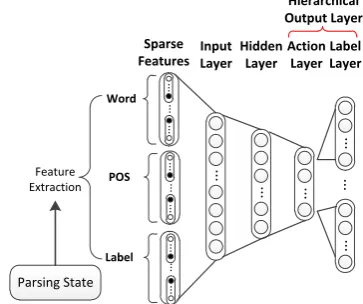
The actions of constituent parsing are natively hierarchi-cal based on the action structure. We decompose the out-put layer of the neural network into a two-layer hierarchical softmax, the action layer and the label layer. In determin-istic parsing, we first find the optimal shift-reduce action type, which resolves structural ambiguities, and then find the optimal constituent label given the action type. With this hierarchical neural network, the computation cost from the hidden layer to the output layer is effectively reduced. In our experiments, the hierarchical neural constituent parser achieves almost 2.4 times the speed of the baseline non-hierarchical neural parser, without significant accuracy loss. Our final parser runs at 320 sentences per second on a Intel(R) Core(TM) i7-4790 CPU, giving an accuracy of 89.06 on the standard Penn Treebank benchmark.
2.
Shift-Reduce Constituent Parsing
Transition-based parsers parse a sentence by performing a sequence of shift-reduce actions. At each step, the action to be taken is determined by a statistical classifier. We adopt the model of Sagae and Lavie (2005), which uses a stack to hold partial outputs, and a queue to maintain the next incoming words in the input sentence.
Formally, a parsing state is hS, Qi, where S is the stack of partial outputs [. . . , s2, s1, s0] andQis the queue of
in-coming words [q0, q1, q2, . . .]. A shift-reduce constituent
parser starts with an initial state and makes transitions from one state to another by taking actions. Parsing stops when Qis empty andS contains only one tree. Given an input sentence W, the initial state ishφ, Wiand the final state ish[s0], φi. At each step, one of the following actions is
Feature
Figure 1: Hierarchical softmax neural network parser.
• SHIFT: remove the first wordq0from the queue and
push it onto the stack.
• UNARY-X: pop the top nodes0 off the stack;
gen-erate a unary-branching node with constituent label X whose child iss0; push the new node back onto the
stack.
• LEFT/RIGHT-X: pop the top two nodes s1, s0 off
the stack; generate a binary-branching node with con-stituent label X whose left child iss1and right child
iss0, with the left (LEFT)/right (RIGHT) child as its
head; push the new node back to the stack.
The shift-reduce actions only build binarized trees. As a re-sult, a binarization process is necessary to convert the Penn Treebank into binarized trees. During this process, tem-porary nodes are constructed. To accommodate for bina-rization, we follow Zhang and Clark (2009), adding coun-terparts to LEFT/RIGHT-X for temporary nodes, namely LEFT/RIGHT-TEMP-X.
3.
Vanilla Neural Network Parsing
Following Chen and Manning (2014), we use a three-layer feed-forward neural network for deterministic parsing. At each step of deterministic parsing, the neural model extracts n atomic features from a parsing state, which consists of head words, POS-tags and constituent labels from the stack and queue. Embeddingsare used to represent atomic fea-tures. Each embedding is ad-dimensional vectorei ∈ R.Therefore, the full embedding matrix isE∈Rd×V, where V is the number of distinct features.
Once each sparse feature is extracted, we retrieves its fea-ture embedding ei fromE by indexi. Aninput layer is used to concatenate the nfeature embeddings into a vec-tor x = [ei1;ei2. . . ein], where x ∈ Rd·n. Then x is
mapped to a dh-dimensional hidden layer by a mapping matrixW1 ∈ Rdh×d·n and a cube activation function for
feature combination:
h= (W1x+b1)3 (1)
Finally,his mapped into a output layer:
o=W2h (2)
Table 2: Feature templates.
Here,W2 ∈Rdo×dh andd
ois the number of shift-reduce actions.
Given the neural networks parameterθ, the probability of each candidate shift-reduce actionaiis calculated by a
soft-max functionover the output layero:
p(ai|θ) = turns the valid actions according to the history actionsActs, θis the set of all parameters.
We employ the features used in Zhang and Clark (2009), but remove the features about brackets and separators (Ta-ble 2). Heresiis theithnode on top of the stackSandqjis thejthnode in the queueQ.s
0l,s0rrepresent the left and
right child for a binary branchings0, ands0urepresents the
single child for a unary branchings0. w,candtrepresent
the lexical head token, constituent label and lexical head’s POS tag for a node, respectively.
Given a set of training examples, the training objective is to minimize the cross-entropy loss, plus al2-regularization
term:
Here Ais the set of all gold labeled actions in the train-ing data. Mini-bached AdaGrad (Duchi et al., 2011) and dropout (Srivastava et al., 2014) are used for optimization.
4.
Hierarchical Output Neural Network
Due to its large hidden and output layer sizes, the vanilla neural constituent parser is much slower than the depen-dency counterpart. The main computation cost is the map-ping from hidden layer to output layer.Motivated by the hierarchical neural language model (Mnih and Hinton, 2009), we adjust the neural constituent parser by using a hierarchical output layer.
The structure is shown in Figure 1. We decompose the out-put layer of the baseline in two layers: the action layer and the label layer. The action layer is a six-way class between SHIFT, UNARY, LEFT, RIGHT, LEFT-TEMP and RIGHT-TEMP. A label layer selects constituent labels, such asNP, for the LEFT-NP, LEFT-TEMP-NP, RIGHT-NP and RIGHT-TEMP-RIGHT-NP actions. Except SHIFT, differ-ent action types have differdiffer-ent label output layers.
Given the hidden layerh(Equation 1), the action type out-put layeroactand the label output layerolabel(ai)of action typeaiare computed as
oact =W2h (5)
200 500 800 baseline 85.38 86.91 87.28 hierarchical 84.70 86.82 87.23
Table 3: Results against hidden layer sizes.
W2 ∈ Rda×dh is the mapping matrix from hidden layer
to the action layer and da is the number of action types. Wi
3 ∈ Rdlabel×dh is the mapping matrix from the hidden
layer to the label layer.
The probability of a labeled action yi,j, given its history Actsand inputx, is computed as:
p(yi,j|x, Acts) label in the label layer.
We adopt a greedy decoding strategy in the hierarchical parsing process. In each parsing step, the action type ai with the highest probability is first selected, and then the constituent labellj with the highest probability is selected given the optimal action typeai.
As in the baseline parser, we adopt the cross-entropy loss as our training objective:
L(θ) =− X
We conduct our experiments on the Wall Street Journal (WSJ) corpus of the Penn Treebank (Marcus et al., 1993). Following the standard splits of WSJ, sections 2–21 are used as the labeled training data, section 24 is used as the development data and section 23 is used as the evaluation data. Ten-fold jackknifing (Collins, 2000) is used to auto-matically assign POS tags to the training data. The SVM-Tool is used as the POS-tagger1.
5.2.
Parameters
We carry out a development experiment to measure the cor-relation between hidden layer size and constituent pars-ing accuracies. From Table 3, we can see that both the baseline neural parser and the hierarchical neural parser achieve higher parsing accuracies with increasing hidden larger sizes. The two neural parsers obtain converging per-formances with the hidden size of 800, which is larger than 200 in the dependency case.
1
http://www.lsi.upc.edu/?nlp/SVMTool/
Model F1 Speed
Linear
Collins (1999) 88.2 3.5
Charniak (2000) 89.6 5.7
Charniak and Johnson (2005)‡ 91.1
Huang (2008)‡ 91.7
McClosky et al. (2006)‡ 92.1
Shindo et al. (2012) 92.4
Sagae and Lavie (2005) 86.0 3.7 Petrov and Klein (2007) 90.1 6.2 Carreras et al. (2008) 91.1
Zhu et al. (2013) 89.9 100.7
Zhu et al. (2013) +padding 90.4 89.5
Neural
Henderson (2004)‡ 90.1
Titov and Henderson (2007) 90.0
Collobert (2011) 87.9 31.7
Billingsley and Curran (2012) 84.9 Socher et al. (2013)‡ 90.4 6.1 Legrand and Collobert (2014) 88.3 22.0 Watanabe and Sumita (2015) 90.7 1.8
This Work 89.13 133.6
This Work +hierarchical 89.06 320.2
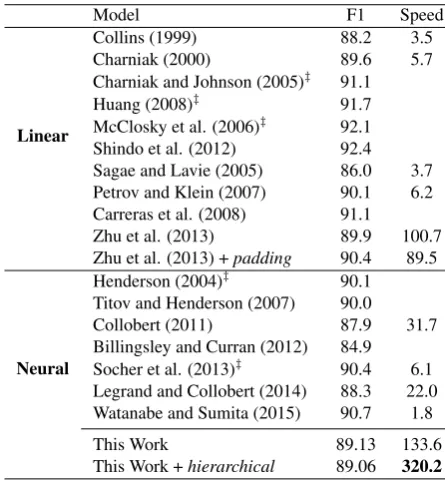
Table 4: Comparisons with previous work. ‡: reranking model. Speed: sentences per second.
We also tune the other hyper parameters on the develop-ment data. For the final test, we set the parameters as fol-lows: embedding sized= 50, regularization parameterλ=
10−8, initial learning rate of Adagradα= 0.01, batch size
b= 10000.
5.3.
Final Results
The final parsing result is shown in Table 4, which are grouped into 2 classes, the traditional linear parsers ( Lin-ear) and the neural parsers (Neural).
Our deterministic neural constituent parser obtains an racy of 89.13. Besides the reranking neural parsers, accu-racy of our parser falls behind the parser of Titov and Hen-derson (2007), who give a high parsing accuracy by using a dynamic sigmoid belief network, and the parser of Watan-abe and Sumita (2015), who use a beam search decoding. However, their parsers are much more time consuming than our parser.
The baseline neural parser runs at a speed of 133 sentences per second. The hierarchical neural constituent parser achieves a 2.4 times parsing speed up (320 sen/sec) without significant accuracy loss.
6.
Acknowledgements
We would like to thank the anonymous reviewers for their insightful comments.
This work was partially founded by the Natural Sci-ence Foundation of China (61223003, 61300158), the Jiangsu Provincial Research Foundation for Basic Research (BK20130580).
7.
Conclusion
The hierarchical neural parser runs at a speed of 320 sen-tences per second on a single CPU, with a reasonable accu-racy. To our knowledge, this is the best speed result in the literature for constituent parsing.
The source code of our system could be found at:
github.com/zhouh/StructNNConParser.
8.
Copyrights
The The Language Resource and Evaluation Conference (LREC) proceedings are published by the European Lan-guage Resources Association (ELRA). They are available online from the conference website.
ELRA’s policy is to acquire copyright for all LREC contri-butions. In assigning your copyright, you are not forfeiting your right to use your contribution elsewhere. This you may do without seeking permission and is subject only to normal acknowledgement to the LREC proceedings. The LREC 2016 Proceedings are licensed under CC-BY-NC, the Creative Commons Attribution-NonCommercial 4.0 In-ternational License.
9.
Bibliographical References
Billingsley, R. J. and Curran, J. R. (2012). Improvements to training an rnn parser.
Bohnet, B. and Nivre, J. (2012). A transition-based sys-tem for joint part-of-speech tagging and labeled non-projective dependency parsing. In Proceedings of the 2012 Joint Conference on Empirical Methods in Nat-ural Language Processing and Computational NatNat-ural Language Learning, pages 1455–1465. Association for Computational Linguistics.
Carreras, X., Collins, M., and Koo, T. (2008). Tag, dy-namic programming, and the perceptron for efficient, feature-rich parsing. InProceedings of the Twelfth Con-ference on Computational Natural Language Learning, pages 9–16. Association for Computational Linguistics. Charniak, E. and Johnson, M. (2005). Coarse-to-fine
n-best parsing and maxent discriminative reranking. In
Proceedings of the 43rd Annual Meeting on Association for Computational Linguistics, pages 173–180. Associa-tion for ComputaAssocia-tional Linguistics.
Charniak, E. (2000). A maximum-entropy-inspired parser. InProceedings of the 1st North American chapter of the Association for Computational Linguistics conference, pages 132–139. Association for Computational Linguis-tics.
Chen, D. and Manning, C. D. (2014). A fast and accurate dependency parser using neural networks. InEmpirical Methods in Natural Language Processing (EMNLP). Collins, M. (1999). HEAD-DRIVEN STATISTICAL
MOD-ELS FOR NATURAL LANGUAGE PARSING. Ph.D. the-sis, University of Pennsylvania.
Collobert, R. (2011). Deep learning for efficient discrimi-native parsing. InAISTATS.
Duchi, J., Hazan, E., and Singer, Y. (2011). Adaptive sub-gradient methods for online learning and stochastic op-timization. The Journal of Machine Learning Research, 12:2121–2159.
Goldberg, Y. and Nivre, J. (2013). Training determinis-tic parsers with non-determinisdeterminis-tic oracles. Transactions of the Association for Computational Linguistics, 1:403– 414.
Henderson, J. (2004). Discriminative training of a neural network statistical parser. In Proceedings of the 42nd Annual Meeting on Association for Computational Lin-guistics, page 95. Association for Computational Lin-guistics.
Huang, L. (2008). Forest reranking: Discriminative pars-ing with non-local features. InACL, pages 586–594. Legrand, J. and Collobert, R. (2014). Recurrent greedy
parsing with neural networks. InProceedings of the Eu-ropean Conference on Machine Learning and Princi-ples and Practice of Knowledge Discovery in Databases (ECML-PKDD).
Marcus, M. P., Marcinkiewicz, M. A., and Santorini, B. (1993). Building a large annotated corpus of en-glish: The penn treebank. Computational linguistics, 19(2):313–330.
McClosky, D., Charniak, E., and Johnson, M. (2006). Ef-fective self-training for parsing. In Proceedings of the main conference on human language technology confer-ence of the North American Chapter of the Association of Computational Linguistics, pages 152–159. Association for Computational Linguistics.
Mnih, A. and Hinton, G. E. (2009). A scalable hierarchi-cal distributed language model. In Advances in neural information processing systems, pages 1081–1088. Morin, F. and Bengio, Y. (2005). Hierarchical
probabilis-tic neural network language model. In Proceedings of the international workshop on artificial intelligence and statistics, pages 246–252. Citeseer.
Nivre, J. (2008). Algorithms for deterministic incre-mental dependency parsing. Computational Linguistics, 34(4):513–553.
Petrov, S. and Klein, D. (2007). Improved inference for unlexicalized parsing. InHLT-NAACL, pages 404–411. Sagae, K. and Lavie, A. (2005). A classifier-based parser
with linear run-time complexity. InProceedings of the Ninth International Workshop on Parsing Technology, pages 125–132. Association for Computational Linguis-tics.
Shindo, H., Miyao, Y., Fujino, A., and Nagata, M. (2012). Bayesian symbol-refined tree substitution grammars for syntactic parsing. In Proceedings of the 50th Annual Meeting of the Association for Computational Linguis-tics: Long Papers-Volume 1, pages 440–448. Association for Computational Linguistics.
Socher, R., Bauer, J., Manning, C. D., and Ng, A. Y. (2013). Parsing with compositional vector grammars. In
In Proceedings of the ACL conference. Citeseer.
Srivastava, N., Hinton, G., Krizhevsky, A., Sutskever, I., and Salakhutdinov, R. (2014). Dropout: A simple way to prevent neural networks from overfitting. The Journal of Machine Learning Research, 15(1):1929–1958. Titov, I. and Henderson, J. (2007). Constituent
ANNUAL MEETING-ASSOCIATION FOR COMPUTA-TIONAL LINGUISTICS, volume 45, page 632.
Watanabe, T. and Sumita, E. (2015). Transition-based neu-ral constituent parsing. InProceedings of the 53rd An-nual Meeting of the Association for Computational Lin-guistics and the 7th International Joint Conference on Natural Language Processing (Volume 1: Long Papers), pages 1169–1179, Beijing, China, July. Association for Computational Linguistics.
Zhang, Y. and Clark, S. (2009). Transition-based pars-ing of the chinese treebank uspars-ing a global discriminative model. InProceedings of the 11th International Confer-ence on Parsing Technologies, pages 162–171. Associa-tion for ComputaAssocia-tional Linguistics.
Zhang, Y. and Nivre, J. (2011). Transition-based depen-dency parsing with rich non-local features. In Proceed-ings of the 49th Annual Meeting of the Association for Computational Linguistics: Human Language Technolo-gies: short papers-Volume 2, pages 188–193. Associa-tion for ComputaAssocia-tional Linguistics.
Zhou, H., Zhang, Y., Huang, S., and Chen, J. (2015). A neural probabilistic structured-prediction model for transition-based dependency parsing. InProceedings of the 53rd Annual Meeting of the Association for Com-putational Linguistics and the 7th International Joint Conference on Natural Language Processing (Volume 1: Long Papers), pages 1213–1222, Beijing, China, July. Association for Computational Linguistics.