Investigating the cross-linguistic potential of VerbNet -style classification
Lin Sun and Anna Korhonen Computer Laboratory University of Cambridge ls418,[email protected]
Thierry Poibeau LaTTiCe, UMR8094
CNRS & ENS [email protected]
C´edric Messiant LIPN, UMR7030 CNRS & U. Paris 13 [email protected]
Abstract
Verb classes which integrate a wide range of linguistic properties (Levin, 1993) have proved useful for natural language pro-cessing (NLP) applications. However,
the real-world use of these classes has been limited because for most languages, no resources similar to VerbNet (Kipper-Schuler, 2005) are available. We apply a verb clustering approach developed for English to French – a language for which no such experiment has been conducted yet. Our investigation shows that not only the general methodology but also the best performing features are transferable be-tween the languages, making it possible to learn useful VerbNet style classes for French automatically without language-specific tuning.
1 Introduction
A number of verb classifications have been built to support natural language processing (NLP) tasks
(Grishman et al., 1994; Miller, 1995; Baker et al., 1998; Palmer et al., 2005; Kipper-Schuler, 2005; Hovy et al., 2006). These include both syntactic and semantic classifications, as well as ones which integrate aspects of both. Classifications which in-tegrate a wide range of linguistic properties can be particularly useful forNLPapplications
suffer-ing from data sparseness. One such classification is VerbNet (Kipper-Schuler, 2005). Building on the taxonomy of Levin (1993), VerbNet groups verbs (e.g. deliver, post, dispatch) into classes (e.g. SEND) on the basis of their shared
mean-ing components and syntactic behaviour, identi-fied in terms of meaning preserving diathesis al-ternations. Such classes can be identified across the entire lexicon, and they may also apply across
languages, since their meaning components are said to be cross-linguistically applicable (Jack-endoff, 1990).
Offering a powerful tool for generalization, ab-straction and prediction, VerbNet classes have been used to support many important NLP
tasks, including e.g. computational lexicography, parsing, word sense disambiguation, semantic role labeling, information extraction, question-answering, and machine translation (Swier and Stevenson, 2004; Dang, 2004; Shi and Mihalcea, 2005; Abend et al., 2008). However, to date their exploitation has been limited because for most languages, no Levin style classification is avail-able.
Since manual classification is costly (Kipper et al., 2008) automatic approaches have been pro-posed recently which could be used to learn novel classifications in a cost-effective manner (Joanis et al., 2008; Li and Brew, 2008; ´O S´eaghdha and Copestake, 2008; Vlachos et al., 2009; Sun and Korhonen, 2009). However, most work on Levin type classification has focussed on English. Large-scale research on other languages such as German (Schulte im Walde, 2006) and Japanese (Suzuki and Fukumoto, 2009) has focussed on se-mantic classification. Although the two classifica-tion systems have shared properties, studies com-paring the overlap between VerbNet and WordNet (Miller, 1995) have reported that the mapping is only partial and many to many due to fine-grained nature of classes based on synonymy (Shi and Mi-halcea, 2005; Abend et al., 2008).
they showed that features extracted from Chinese translations of English verbs can improve English classification. These results are promising, but those from a later experiment by Ferrer (2004) are not. Ferrer applied a clustering approach de-veloped for English to Spanish, and evaluated it against the manual classification of V´azquez et al. (2000), constructed using criteria similar (but not identical) to Levin’s. This experiment involving 514 verbs and 31 classes produced results only slightly better than the random baseline.
In this paper, we investigate the cross-linguistic potential of Levin style classification further. In past years, verb classification techniques – in par-ticular unsupervised ones – have improved con-siderably, making investigations for a new lan-guage more feasible. We take a recent verb clus-tering approach developed for English (Sun and Korhonen, 2009) and apply it to French – a ma-jor language for which no such experiment has been conducted yet. Basic NLP resources
(cor-pora, taggers, parsers and subcategorization ac-quisition systems) are now sufficiently developed for this language for the application of a state-of-the-art verb clustering approach to be realistic.
Our investigation reveals similarities between the English and French classifications, support-ing the lsupport-inguistic hypothesis (Jackendoff, 1990) and the earlier result of Merlo et al. (2002) that Levin classes have a strong cross-linguistic basis. Not only the general methodology but also best performing features are transferable be-tween the languages, making it possible to learn useful classes for French automatically without language-specific tuning.
2 French Gold Standard
The development of an automatic verb classifi-cation approach requires at least an initial gold standard. Some syntactic (Gross, 1975) and se-mantic (Vossen, 1998) verb classifications exist for French, along with ones which integrate as-pects of both (Saint-Dizier, 1998). Since none of these resources offer classes similar to Levins’, we followed the idea of Merlo et al. (2002) and translated a number of Levin classes from English to French. As our aim was to to investigate the cross-linguistic applicability of classes, we took
an English gold standard which has been used to evaluate several recent clustering works – that of Sun et al. (2008). This resource includes 17 fine-grained Levin classes. Each class has 12 member verbs whose predominant sense in English (ac-cording to WordNet) belongs to that class.
Member verbs were first translated to French. Where several relevant translations were identi-fied, each of them was considered. For each can-didate verb, subcategorization frames (SCFs) were
identified and diathesis alternations were consid-ered using the criteria of Levin (1993): alterna-tions must result in the same or extended verb sense. Only verbs sharing diathesis alternations were kept in the class.
For example, the gold standard class 31.1
AMUSE includes the following English verbs: stimulate, threaten, shock, confuse, upset, over-whelm, scare, disappoint, delight, exhaust, in-timidate and frighten. Relevant French transla-tions were identified for all of them: abattre, accabler, briser, d´eprimer, consterner, an´eantir, ´epuiser, ext´enuer, ´ecraser, ennuyer, ´ereinter, inon-der. The majority of these verbs take similarSCFs
and diathesis alternations, e.g.Cette affaire ´ecrase Marie (de chagrin), Marie est ´ecras´ee par le cha-grin, Le chagrin ´ecrase Marie. However, stim-uler (stimulate) and menacer (threaten) do not, and they were therefore removed.
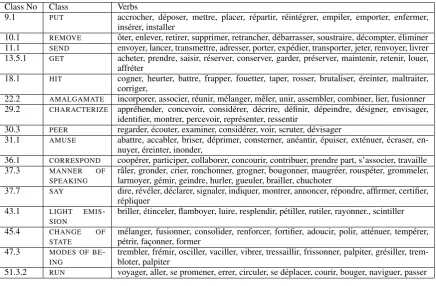
40% of translations were discarded from classes because they did not share the same aler-nations. The final version of the gold stan-dard (shown in table 1) includes 171 verbs in 16 classes. Each class is named according to the original Levin class. The smallest class (30.3) in-cludes 7 verbs and the largest (37.3) 16. The aver-age number of verbs per class is 10.7.
3 Verb Clustering
We performed an experiment where we
• took a French corpus and a SCF lexicon
au-tomatically extracted from that corpus,
Class No Class Verbs
9.1 PUT accrocher, d´eposer, mettre, placer, r´epartir, r´eint´egrer, empiler, emporter, enfermer, ins´erer, installer
10.1 REMOVE ˆoter, enlever, retirer, supprimer, retrancher, d´ebarrasser, soustraire, d´ecompter, ´eliminer 11.1 SEND envoyer, lancer, transmettre, adresser, porter, exp´edier, transporter, jeter, renvoyer, livrer 13.5.1 GET acheter, prendre, saisir, r´eserver, conserver, garder, pr´eserver, maintenir, retenir, louer,
affr´eter
18.1 HIT cogner, heurter, battre, frapper, fouetter, taper, rosser, brutaliser, ´ereinter, maltraiter, corriger,
22.2 AMALGAMATE incorporer, associer, r´eunir, m´elanger, mˆeler, unir, assembler, combiner, lier, fusionner 29.2 CHARACTERIZE appr´ehender, concevoir, consid´erer, d´ecrire, d´efinir, d´epeindre, d´esigner, envisager,
identifier, montrer, percevoir, repr´esenter, ressentir
30.3 PEER regarder, ´ecouter, examiner, consid´erer, voir, scruter, d´evisager
31.1 AMUSE abattre, accabler, briser, d´eprimer, consterner, an´eantir, ´epuiser, ext´enuer, ´ecraser, en-nuyer, ´ereinter, inonder,
36.1 CORRESPOND coop´erer, participer, collaborer, concourir, contribuer, prendre part, s’associer, travaille
37.3 MANNER OF
SPEAKING
rˆaler, gronder, crier, ronchonner, grogner, bougonner, maugr´eer, rousp´eter, grommeler, larmoyer, g´emir, geindre, hurler, gueuler, brailler, chuchoter
37.7 SAY dire, r´ev´eler, d´eclarer, signaler, indiquer, montrer, annoncer, r´epondre, affirmer, certifier, r´epliquer
43.1 LIGHT EMIS -SION
briller, ´etinceler, flamboyer, luire, resplendir, p´etiller, rutiler, rayonner., scintiller
45.4 CHANGE OF
STATE
m´elanger, fusionner, consolider, renforcer, fortifier, adoucir, polir, att´enuer, temp´erer, p´etrir, fac¸onner, former
47.3 MODES OF BE -ING
trembler, fr´emir, osciller, vaciller, vibrer, tressaillir, frissonner, palpiter, gr´esiller, trem-bloter, palpiter
51.3.2 RUN voyager, aller, se promener, errer, circuler, se d´eplacer, courir, bouger, naviguer, passer
Table 1: A Levin style gold standard for French
• clustered the features using a method which
has proved promising in both English and German experiments: spectral clustering,
• evaluated the clusters both quantitatively
(us-ing the gold standard) and qualitatively,
• and compared the performance to that
re-cently obtained for English in order to gain a better understanding of the cross-linguistic and language-specific properties of verb clas-sification
This work is described in the subsequent sections.
3.1 Data: the LexSchem Lexicon
We extracted the features for clustering from LexSchem (Messiant et al., 2008). This large sub-categorization lexicon providesSCFfrequency
in-formation for 3,297 French verbs. It was acquired fully automatically from Le Monde newspaper corpus (200M words from years 1991-2000) us-ing ASSCI – a recent subcategorization acquisi-tion system for French (Messiant, 2008). Systems similar to ASSCI have been used in recent verb classification works e.g. (Schulte im Walde, 2006;
Li and Brew, 2008; Sun and Korhonen, 2009). Like these other systems, ASSCI takes raw corpus data as input. The data is first tagged and lemma-tized using the Tree-Tagger and then parsed us-ing Syntex (Bourigault et al., 2005). Syntex is a shallow parser which employs a combination of statistics and heuristics to identify grammati-cal relations (GRs) in sentences. ASSCI considers GRs where the target verbs occur and constructs SCFs from nominal, prepositional and adjectival
phrases, and infinitival and subordinate clauses. When a verb has no dependency, its SCFis
con-sidered as intransitive. ASSCI assumes no pre-defined list of SCFs but almost any combination
of permitted constructions can appear as a candi-dateSCF. The number of automatically generated SCFtypes in LexSchem is 336.
Many candidateSCFs are noisy due to
process-ing errors and the difficulty of argument-adjunct distinction. Most SCF systems assume that true
filter-ing its F-measure was 69 – which is similar to
that of other currentSCFsystems (Messiant et al.,
2008) We used the unfiltered version of the lexi-con because English experiments have shown that information about adjuncts can help verb cluster-ing (Sun et al., 2008).
4 Features
Lexical entries in LexSchem provide a variety of material for verb clustering. Using this material, we constructed a range of features for experimen-tation. The first three include basic information aboutSCFs:
F1: SCFs and their relative frequencies with
indi-vidual verbs.SCFs abstract over particles and
prepositions.
F2: F1, with SCFs parameterized for the tense
(thePOStag) of the verb.
F3: F2, withSCFs parameterized for prepositions
(PP).
The following six features include informa-tion about the lexical context (co-occurrences) of verbs. We adopt the best method of Li and Brew (2008) where collocations (COs) are
ex-tracted from the window of words immediately preceding and following a lemmatized verb. Stop words are removed prior to extraction.
F4, F6, F8: COs are extracted from the window
of 4, 6 and 8 words, respectively. The relative word position is ignored.
F5, F7, F9: F4, F6 and F8 with the relative word position recorded.
The next four features include information about lexical preferences (LP) of verbs in
argu-ment head positions of specific GRs associated
with the verb:
F10: LP(PREP): the type and frequency of
prepo-sitions in the preposition (PREP) relation.
F11: LP(SUBJ): the type and frequency of nouns
in the subject (SUBJ) relation.
F12: LP(IOBJ): the type and frequency of nouns
in the object (OBJ) and indirect object (IOBJ)
relation.
F13: LP(ALL): the combination of F10-F13.
The final two features refineSCFfeatures with LPs and semantic information about verb
selec-tional preferences (SP):
F14-F16: F1-F3 parameterized forLPs.
F17: F3 refined withSPs.
We adopt a fully unsupervised approach to SP
acquisition using the method of Sun and Korho-nen (2009), with the difference that we determine the optimal number of SP clusters automatically
following Zelnik-Manor and Perona (2004). The method is introduced in the following section. The approach involves (i) taking theGRs (SUBJ, OBJ, IOBJ) associated with verbs, (ii) extracting all the
argument heads in theseGRs, and (iii) clustering
the resultingN most frequent argument heads into M classes. The empirically determined N 200 was used. The method produced 40SPclusters.
5 Clustering Methods
Spectral clustering (SPEC) has proved promising
in previous verb clustering experiments (Brew and Schulte im Walde, 2002; Sun and Korho-nen, 2009) and other similar NLP tasks
involv-ing high dimensional feature space (Chen et al., 2006). Following Sun and Korhonen (2009) we used the MNCut spectral clustering (Meila and Shi, 2001) which has a wide applicability and a clear probabilistic interpretation (von Luxburg, 2007; Verma and Meila, 2005). However, we ex-tended the method to determine the optimal num-ber of clusters automatically using the technique proposed by (Zelnik-Manor and Perona, 2004).
Clustering groups a given set of verbs V =
{vn}Nn=1 into a disjoint partition of K classes. SPEC takes a similarity matrix as input. All our
features can be viewed as probabilistic distribu-tions because the combination of different fea-tures is performed via parameterization. Thus we use the Jensen-Shannon divergence (JSD) to
two feature vectors v and v0 is djsd(v, v0) =
1
2D(v||m)+12D(v0||m)whereDis the
Kullback-Leibler divergence, andmis the average of thev andv0.
The similarity matrix W is constructed where Wij = exp(−djsd(v, v0)). In SPEC, the
simi-laritiesWij are viewed as the connection weight ij of a graph G over V. The similarity matrix W is thus the adjacency matrix for G. The de-gree of a vertexi isdi = PNj=1wij. A cut
be-tween two partitions A and A0 is defined to be Cut(A, A0) =Pm∈A,n∈A0Wmn.
The similarity matrix W is normalized into a stochastic matrixP.
P =D−1W (1)
The degree matrix Dis a diagonal matrix where Dii=di.
It was shown by Meila and Shi (2001) that ifP has the K leading eigenvectors that are piecewise constant1 with respect to a partitionI∗ and their eigenvalues are not zero, then I∗ minimizes the multiway normalized cut(MNCut):
MNCut(I) =K−PKk=1Cut(Ik,Ik)
Cut(Ik,I)
Pmn can be interpreted as the transition
proba-bility between vertices m, n. The criterion can thus be expressed as MNCut(I) = PKk=1(1 −
P(Ik → Ik|Ik))(Meila, 2001), which is the sum
of transition probabilities across different clusters. This criterion finds the partition where the random walks are most likely to happen within the same cluster. In practice, the leading eigenvectors ofP are not piecewise constant. But we can extract the partition by finding the approximately equal ele-ments in the eigenvectors using a clustering algo-rithm likeK-Means.
As the value ofKis not known beforehand, we use Zelnik-Manor and Perona (2004)’s method to estimate it. This method finds the optimal value by minimizing a cost function based on the eigen-vector structure ofW.
Like Brew and Schulte im Walde (2002), we compare SPEC against a K-Means baseline. We
used the Matlab implementation with euclidean distance as the distance measure.
1The eigenvectorvis piecewise constant with respect to Iifv(i) =v(j)∀i, j∈Ikandk∈1,2...K
6 Experimental Evaluation 6.1 Data and Pre-processing
The SCF-based features (F1-F3 and F14-F17)
were extracted directly from LexSchem. The CO
(F4-F9) andLPfeatures (F10-F13) were extracted
from the raw and parsed corpus sentences, respec-tively, which were used for creating the lexicon. Features that only appeared once were removed. Feature vectors were normalized by the sum of the feature values before clustering. Since our clus-tering algorithms have an element of randomness, we repeated clustering multiple times. We report the results that minimize the distortion (the dis-tance to cluster centroid).
6.2 Evaluation Measures
We employ the same measures for evaluation as previously employed e.g. by ´O S´eaghdha and Copestake (2008) and Sun and Korhonen (2009).
The first measure is modified purity (mPUR) – a global measure which evaluates the mean preci-sion of clusters. Each cluster is associated with its prevalent class. The number of verbs in a cluster K that take this class is denoted bynprevalent(K).
Verbs that do not take it are considered as errors. Clusters wherenprevalent(K) = 1 are disregarded
as not to introduce a bias towards singletons:
mPUR=
P
nprevalent(ki)>2nprevalent(ki)
number of verbs
The second measure is weighted class accuracy (ACC): the proportion of members of dominant clusters DOM-CLUSTiwithin all classesci.
ACC=
PC
i=1verbs in DOM-CLUSTi number of verbs
mPUR and ACC can be seen as a measure of pre-cision(P) and recall(R) respectively. We calculate F measure as the harmonic mean of P and R:
F= 2·mPUR·ACC
mPUR+ACC
The random baseline (BL) is calculated as fol-lows: BL= 1/number of classes
7 Evaluation
7.1 Quantitative Evaluation
of 150 times. We did this because English exper-iments had shown that due to the Zipfian nature of SCF distributions, 150 corpus occurrences are
typically needed to obtain a sufficient number of frames for clustering (Sun et al., 2008).
Table 2 showsF-measure results for all the
fea-tures. The 4th column of the table shows, for com-parison, the results of Sun and Korhonen (2009) obtained for English when they used the same fea-tures as us, clustered them usingSPEC, and
evalu-ated them against the English version of our gold standard, also usingF-measure2.
As expected, SPEC (the 2nd column)
outper-formsK-Means (the 3rd column). Looking at the
basicSCFfeatures F1-F3, we can see that they
per-form significantly better than the BLmethod. F3
performs the best among the three features both in French (50.6 F) and in English (63.3 F). We
therefore use F3 as the SCF feature in F14-F17
(the same was done for English).
In French, most CO features (F4-F9)
outper-form SCF features. The best result is obtained
with F7: 55.1 F. This is clearly better than the
bestSCFresult 50.6 (F3). This result is interesting
since SCFs correspond better than COs with
fea-tures used in manual Levin classification. Also,
SCFs perform considerably better thanCOs in the
English experiment (we only have the result for F4 available, but it is considerably lower than the re-sult for F3). However, earlier English studies have reported contradictory results (e.g. Li and Brew (2008) showed that CO performs better than SCF
in supervised verb classification), indicating that the role of CO features in verb classification
re-quires further investigation.
Looking at the LP features, F13 produces the
best F (52.7) for French which is slightly better
than the best SCF result for the language. Also
in English, F13 performs the best in this feature group and yields a higher result than the bestSCF
-based feature F3.
Parameterizing the bestSCFfeature F3 withLPs
(F14-16) andSPs (F17) yields better performance
2Note that the results for the two languages are not
mu-tually comparable due to differences in test sets, data sizes, and feature extraction systems (see Section 8 for discussion). The results for English are included so that we can compare the relative performance of individual features in the two lan-guages in question.
in French. F15 and F17 have the F of 54.5 and
54.6, respectively. These results are so close to the result of the bestCOfeature F7 (55.1 – which
is the highest result in this experiment) that the differences are not statistically significant. In En-glish, the results of F14-F17 are similarly good; however, only F17 beats the already high perfor-mance of F13.
On the basis of this experiment, it is difficult to tell whether shallowCOfeatures or more
sophisti-catedSCF-based features are better for French. In
the English experiment sophisticated features per-formed better (the SCF-SP feature was the best).
However, the English experiment employed a much larger dataset. These more sophisticated features may suffer from data sparseness in our French experiment since although we required the minimum of 150 occurrences per verb, verb clus-tering performance tends to improve when more data is available, and given the fine-grained nature of LexShemSCFs it is likely that more data is
re-quired for optimal performance.
We therefore performed another experiment with French on the full set of 147 verbs, using
SPEC, where we investigated the effect of instance
filtering on the performance of the best features from each feature group: F3, F7, F13 and F17. The results shown in Table 3 reveal that the perfor-mance of the features remains fairly similar until the instance threshold of 1000. When 2000 occur-rences per verb are used, the diffeoccur-rences become clearer, until at the threshold of 4000, it is obvious that the most sophisticatedSCF-SPfeature F17 is
by far the best feature for French (65.4F) and the SCFfeature F3 the second best (60.5F). TheCO
-feature F7 and theLPfeature F13 are not nearly as
good (53.4 and 51.0F).
Although the results at different thresholds are not comparable due to the different number of verbs and classes (see columns 2-3), the results for features at the same threshold are. Those re-sults suggest that when 2000 or more occurrences per verb are used, most features perform like they performed for English in the experiment of Sun and Korhonen (2009), withCObeing the least
in-formative3 and SCF-SP being the most
informa-3However, it is worth noting thatCOis not a useless
SPEC K Eng.
BL 6.7 6.7 6.7
F1 SCF 42.4 39.3 57.8
F2 SCF(POS) 45.9 40.3 46.7
F3 SCF(PP) 50.6 36.9 63.3
F4 CO(4) 50.3 38.2 40.9
F5 CO(4+loc) 48.8 26.3
-F6 CO(6) 52.7 29.2
-F7 CO(6+loc) 55.1 33.8
-F8 CO(8) 54.2 36.4
-F9 CO(8+loc) 54.6 37.2
-F10 LP(PREP) 35.5 32.8 49.0
F11 LP(SUBJ) 33.7 23.6
-F12 LP(OBJ) 50.1 33.3
-F13 LP(ALL) 52.7 40.1 74.6 F14 SCF+LP(SUBJ) 50.3 40.1 71.7 F15 SCF+LP(OBJ) 54.5 35.6 74.0 F16 SCF+LP(SUBJ+OBJ) 53.4 36.2 73.0
F17 SCF+SP 54.6 39.8 80.4
Table 2: Results for all the features for French (SPEC and K-means) and English (SPEC)
THR Verbs Cls F3 F7 F13 F17
0 147 15 43.7 57.5 43.3 50.1 50 137 15 47.9 56.1 44.8 49.1 100 125 15 49.2 54.3 44.8 49.5 150 116 15 50.6 55.1 52.7 54.6 200 110 15 54.9 52.9 49.7 52.5 400 96 15 52.7 52.9 43.9 53.2 1000 71 15 51.4 54.0 44.8 54.5 2000 59 12 52.3 45.9 42.7 53.5 3000 51 12 55.7 49.0 46.8 59.2 4000 43 10 60.5 53.4 51.0 65.4
Table 3: The effect of verb frequency
tive feature. The only exception is the LPfeature
which performed better thanCOin English.
7.2 Qualitative Evaluation
We conducted qualitative analysis of the clusters for French: those created using SPEC with F17
and F3. Verbs in the gold standard classes 29.2, 36.1, 37.3, 37.7 and 47.3 (Table 1) performed particularly well, with the majority of member verbs found in the same cluster. These verbs are ideal for clustering because they have distinc-tive syntactic-semantic characteristics. For exam-ple, verbs in 29.2CHARACTERIZEclass (e.g. con-cevoir, consid´erer, d´epeindre) not only have a very specific meaning but they also take high frequency
SCFs involving the prepositioncomme (Eng.as)
available for a verb,COoutperforms all the other features in French, compensating for data sparseness.
which is not typical to many other classes. Inter-estingly, Levin classes 29.2, 36.1, 37.3, and 37.7 were among the best performing classes also in the supervised verb classification experiment of Sun et al. (2008) because these classes have dis-tinctive characteristics also in English.
The benefit of sophisticated features which integrate also semantic (SP) information (F17)
is particularly evident for classes with non-distinctive syntactic characteristics. For example, the intransitive verbs in 43.1 LIGHT EMISSION
class (e.g. briller, ´etinceler, flamboyer) are diffi-cult to cluster based on syntax only, but semantic features work because the verbs pose strong SPs
on their subjects (entities capable of light emis-sion). In the experiment of Sun et al. (2008), 43.1 was the worst performing class, possibly because no semantic features were used in the experiment. The most frequent source of error is syntac-tic idiosyncracy. This is particularly evident for classes 10.1 REMOVE and 45.4 CHANGE OF STATE. Although verbs in these classes can take
similarSCFs and alternations, only some of them
are frequent in data. For example, theSCF ˆoter X `a Y is frequent for verbs in 10.1, but not ˆoter X de Y. Although class 10.1 did not suffer from this problem in the English experiment of Sun et al. (2008), class 45.4 did. Class 45.4 performs par-ticularly bad in French also because its member verbs are low in frequency.
Some errors are due to polysemy, caused partly by the fact that the French version of the gold stan-dard was not controlled for this factor. Some verbs have their predominant senses in classes which are missing in the gold standard, e.g. the most fre-quent sense ofretenirismemorize, notkeepas in the gold standard class 13.5.1.GET.
Finally, some errors are not true errors but demonstrate the capability of clustering to learn novel information. For example, the CHANGE OF STATE class 45.4 includes many antonyms
(e.g. weaken vs. strenghten). Clustering (us-ing F17) separates these antonyms, so that verbs
adoucir, att´enuerandtemp´ererappear in one clus-ter andconsolider andrenforcer in another. Al-though these verbs share the same alternations, theirSPs are different. The opposite effect can be
which are semantically and syntactically related (e.g. 36.1CORRESPOND and 37.7SPEAK). Such
classes are distinct in Levin and VerbNet, al-though should ideally be related. Cases such as these show the potential of clustering in discover-ing novel valuable information in data.
8 Discussion and Conclusion
When sufficient corpus data is available, there is a strong correlation between the types of features which perform the best in English and French. When the best features are used, many individ-ual Levin classes have similar performance in the two languages. Due to differences in data sets direct comparison of performance figures for En-glish and French is not possible. When consid-ering the general level of performance, our best performance for French (65.4F) is lower than the
best performance for English in the experiment of Sun and Korhonen (2009). However, it does com-pare favourably to the performance of other state-of-the-art (even supervised) English systems (Joa-nis et al., 2008; Li and Brew, 2008; ´O S´eaghdha and Copestake, 2008; Vlachos et al., 2009). This is impressive considering that we experimented with a fully unsupervised approach originally de-veloped for another language.
When aiming to improve performance further, employing larger data is critical. Most recent ex-periments on English have employed bigger data sets, and unlike us, some of them have only con-sidered the predominant senses of medium-high frequency verbs. As seen in section 7.1, such dif-ferences in data can have significant impact on performance. However, parser and feature ex-traction performance can also play a big role in overall accuracy, and should therefore be inves-tigated further (Sun and Korhonen, 2009). The relatively low performance of basic LP features
in French suggests that at least some of the cur-rent errors are due to parsing. Future research should investigate the source of error at different stages of processing. In addition, it would be in-teresting to investigate whether language-specific tuning (e.g. using language specific features such as auxiliary classes) can further improve perfor-mance on French.
Earlier works most closely related to ours are
those of Merlo et al. (2002) and Ferrer (2004). Our results contrast with those of Ferrer who showed that a clustering approach does not trans-fer well from English to Spanish. However, she used basic SCF and named entity features only,
and a clustering algorithm less suitable for high dimensional data. Like us, Merlo et al. (2002) cre-ated a gold standard by translating Levin classes to another language (Italian). They also applied a method developed for English to Italian, and re-ported good overall performance using features developed for English. Although the experiment was small (focussing on three classes and a few features only) and involved supervised classifica-tion, the results agree with ours.
These experiments support the linguistic hy-pothesis that Levin style classification can be cross-linguistically applicable. A clustering tech-nique such as the one presented here could be used as a tool for investigating whether classifications are similar across a wider range of more diverse languages. From theNLPperspective, the fact that
an unsupervised technique developed for one lan-guage can be applied to another lanlan-guage with-out the need for substantial tuning means that au-tomatic techniques could be used to hypothesise useful Levin style classes for further languages. This, in turn, could facilitate the creation of mul-tilingual VerbNets in the future.
9 Acknowledgement
Our work was funded by the Royal Society Uni-versity Research Fellowship (AK), the Dorothy Hodgkin Postgraduate Award (LS), the EPSRC grants EP/F030061/1 and EP/G051070/1 (UK) and the EU FP7 project ’PANACEA’.
References
Omri Abend, Roi Reichart, and Ari Rappoport. A supervised algorithm for verb disambiguation into VerbNet classes. InProc. of COLING, pages 9–16, 2008.
Collin F. Baker, Charles J. Fillmore, and John B. Lowe.
The Berkeley FrameNet Project. InCOLING-ACL,
pages 86–90, 1998.
Didier Bourigault, Marie-Paule Jacques, C´ecile Fabre,
C´ecile Fr´erot, and Sylwia Ozdowska. Syntex,
12`emes journ´ees sur le Traitement Automatique des Langues Naturelles, 2005.
Chris Brew and Sabine Schulte im Walde. Spectral clustering for German verbs. In Proc. of EMNLP, pages 117–124, 2002.
Jinxiu Chen, Dong-Hong Ji, Chew Lim Tan, and Zheng-Yu Niu. Unsupervised relation disambigua-tion using spectral clustering. In Proc. of COL-ING/ACL, pages 89–96, 2006.
Hoa Trang Dang. Investigations into the Role of Lexi-cal Semantics in Word Sense Disambiguation. PhD thesis, CIS, University of Pennsylvania, 2004. Eva Esteve Ferrer. Towards a semantic classification of
Spanish verbs based on subcategorisation informa-tion. InProc. of ACL Student Research Workshop, 2004.
Ralph Grishman, Catherine Macleod, and Adam Mey-ers. Comlex syntax: building a computational lexi-con. InProc. of COLING, pages 268–272, 1994. Maurice Gross.M´ethodes en syntaxe. Hermann, Paris,
1975.
Eduard Hovy, Mitch Marcus, Martha Palmer, L. Ramshaw, and R. Weischedel. Ontonotes: The
90% solution. InHLT/NAACL, 2006.
Ray Jackendoff. Semantic Structures. The MIT Press, Cambridge, MA, 1990.
Eric Joanis, Suzanne Stevenson, and David James. A general feature space for automatic verb classifica-tion. Nat. Lang. Eng., 14(3):337–367, 2008. Karin Kipper, Anna Korhonen, Neville Ryant, and
Martha Palmer. A large-scale classification of En-glish verbs. Language Resources and Evaluation, 42:21–40, 2008.
Karin Kipper-Schuler. VerbNet: A broad-coverage,
comprehensive verb lexicon. University of Pennsyl-vania, PA, 2005.
Beth. Levin. English verb classes and alternations: A preliminary investigation.Chicago, IL, 1993. Jianguo Li and Chris Brew. Which Are the Best
Fea-tures for Automatic Verb Classification. InProc. of ACL, pages 434–442, 2008.
Marina. Meila. The multicut lemma. Technical report, University of Washington, 2001.
Marina Meila and Jianbo Shi. A random walks view of spectral segmentation. InAISTATS, 2001.
Paola Merlo, Suzanne Stevenson, Vivian Tsang, and Gianluca Allaria. A multilingual paradigm for auto-matic verb classification. InProc. of ACL, 2002. C´edric Messiant. ASSCI : A subcategorization frames
acquisition system for French. InProc. of ACL Stu-dent Research Workshop, pages 55–60, 2008. C´edric Messiant, Thierry Poibeau, and Anna
Korho-nen. LexSchem: a Large Subcategorization Lexicon for French Verbs. InProc. of LREC, 2008.
George A. Miller. WordNet: a lexical database for En-glish.Communications of the ACM, 1995.
Diarmuid ´O S´eaghdha and Ann Copestake. Semantic classification with distributional kernels. InProc. of COLING, pages 649–656, 2008.
Martha Palmer, Daniel Gildea, and Paul Kingsbury. The proposition bank: An annotated corpus of se-mantic roles. Computational Linguistics, 3(1):71– 106, 2005.
Patrick Saint-Dizier. Verb Semantic Classes Based on ’alternations’ and WordNet-like criteria . In P. Saint-Dizier, editor, Predicative Forms in Natural
lan-guage and lexical Knowledge Bases , pages 247–
279. Kluwer Academic, 1998.
Sabine Schulte im Walde. Experiments on the Auto-matic Induction of German Semantic Verb Classes. Computational Linguistics, 2006.
Lei Shi and Rada Mihalcea. Putting pieces together: Combining FrameNet, VerbNet and WordNet for ro-bust semantic parsing. InProc. of CICLing, pages 100–111, 2005.
Lin Sun and Anna Korhonen. Improving verb cluster-ing with automatically acquired selectional prefer-ences. InProc. of EMNLP, pages 638–647, 2009. Lin Sun, Anna Korhonen, and Yuval Krymolowski.
Verb class discovery from rich syntactic data.LNCS, 4919:16, 2008.
Yoshimi Suzuki and Fumiyo Fukumoto. Classify-ing Japanese Polysemous Verbs based on Fuzzy C-means Clustering. InProc. of TextGraphs-4, pages 32–40, 2009.
Robert Swier and Suzanne Stevenson. Unsupervised semantic role labelling. InProc. of EMNLP, 2004. Gloria V´azquez, Ana Fern´andez, Irene Castell´on, and
M. Antonia Mart´ı. Clasificaci´on verbal: Alternan-cias de di´atesis. InQuaderns de Sintagma. Univer-sitat de Lleida, 2000.
Deepak Verma and Marina Meila. A comparison of spectral clustering algorithms. Technical report, De-partment of CSE University of Washington Seattle, 2005.
Andreas Vlachos, Anna Korhonen, and Zoubin Ghahramani. Unsupervised and Constrained Dirich-let Process Mixture Models for Verb Clustering. In Proc. of the Workshop on on GEMS, pages 74–82, 2009.
Ulrike von Luxburg. A tutorial on spectral clustering. STAT COMPUT, 17:395 – 416, 2007.
Piek Vossen. EuroWordNet: A Multilingual Database with Lexical Semantic Networks. Kluwer Academic Publishers, Dordrecht, 1998.