Searching for Grammaticality: Propagating Dependencies in the Viterbi
Algorithm
Stephen Wan
12Robert Dale
1Mark Dras
11
Centre for Language Technology
Div. of Information Communication Sciences
Macquarie University
Sydney, Australia
swan,rdale,[email protected]
C´ecile Paris
22
Information and Communication
Technologies
CSIRO
Sydney, Australia
Abstract
In many text-to-text generation scenarios (for in-stance, summarisation), we encounter human-authored sentences that could be composed by re-cycling portions of related sentences to form new sentences. In this paper, we couch the generation of such sentences as a search problem. We in-vestigate a statistical sentence generation method which recombines words to form new sentences. We propose an extension to the Viterbi algorithm designed to improve the grammaticality of gener-ated sentences. Within a statistical framework, the extension favours those partially generated strings with a probable dependency tree structure. Our preliminary evaluations show that our approach generates less fragmented text than a bigram base-line.
1 Introduction
In abstract-like automatic summary generation, we often re-quire the generation of new and previously unseen summary sentences given some closely related sentences from a source text. We refer to these asNon-Verbatim Sentences. These sentences are used instead of extracted sentences for a variety of reasons including improved conciseness and coherence.
The need for a mechanism to generate such sentences is supported by recent work showing that sentence extraction is not sufficient to account for the scope of written human sum-maries. Jing and McKeown [1999] found that only 42% of sentences from summaries of news text were extracted sen-tences. This is also supported by the work of Knight and Marcu [2002] (cited by [Daum´e III and Marcu, 2004]), which finds that only 2.7% of human summary sentences are ex-tracts. In our own work on United Nations Humanitarian Aid Proposals, we noticed that only 30% of sentences are extracted from the source document, either verbatim or with trivial string replacements.
While the figures do vary, it shows that additional mecha-nisms beyond sentence extraction are needed. In response to this, our general research problem is one in which given a set of related sentences, a single summary sentence is produced by recycling words from the input sentence set.
In this paper, we adopt a statistical technique to allow easy portability across domains. The Viterbi algorithm [Forney, 1973] is used to search for the best traversal of a network of words, effectively searching through the sea of possible word sequences. We modify the algorithm so that it narrows the search space not only to those sequences with a semblance of grammaticality (vian-grams), but further still to those that are grammatical sentences preserving the dependency structure found in the source material.
Consider the following ungrammatical word sequence typ-ical of that produced by an n-gram generator, “The quick brown fox jumped over the lazy dog slept by the log”. One diagnosis of the problem is that the worddog is also used as the subject of the second verb slept. Ideally, we want to avoid such sequences since they introduce text fragments, in this case “slept by the log”. We could, for example, record the fact thatdogis already governed by the verbjumped, and thus avoid appending a second governing wordslept.
To do so, our extension propagates dependency features during the search and uses these features to influence the choice of words suitable for appending to a partially gener-ated sentence. Dependency relations are derived from shal-low syntactic dependency structure [Kittredge and Mel’cuk, 1983]. Specifically, we use representations of relations be-tween a head and modifier, ignoring relationship labels for the present.
Within the search process, we constrain the choice of fu-ture words by preferring words that are likely to attach to the dependency structure of the partially generated sentence. Thus, sequences with plausible structures are ranked higher.
The remainder of the paper is structured as follows. In Sec-tion 2, we describe the problem in detail and our approach. We outline our use of the Viterbi algorithm in Section 3. In Section 4, we describe how this is extended to cater for de-pendency features. We compare related research in Section 5. A preliminary evaluation is presented and discussed in Sec-tion 6. Finally, we conclude with future work in SecSec-tion 7.
2 Narrowing the Search Space: A Description
of the Statistical Sentence Generation
Problem
However, this constitutes an enormous space which requires efficient searching. Whilst reducing a vocabulary to a suit-able subset narrows this space somewhat, we can use statis-tical models, representing properties of language, to prune the search space of word sequences further to those strings that reflect real language usage. For example,n-gram models limit the word sequences examined to those that seem gram-matically correct, at least for small windows of text.
However, n-grams alone often result in sentences that, whilst near-grammatical, are often just gibberish. When com-bined with a (word) content selection model, we narrow the search space even further to those sentences that appear to make sense. Accordingly, approaches such as Witbrock and Mittal [1999] and Wan et al. [2003] have investigated models that improve the choice of words in the sentence. Witbrock and Mittal’s content model chooses words that make good headlines, whilst that of Wan et al. attempts to ensure that, given a short document like a news article, only words from sentences of the same subtopic are combined to form a new sentences. In this paper, we narrow the search space to those sequences that conserve dependency structures from within the input text.
Our algorithm extension essentially passes along the long-distance context of dependency head information of the pre-ceding word sequence, in order to influence the choice of the next word appended to the sentence. This dependency struc-ture is constructed statistically by an O(n) algorithm, which
is folded into the Viterbi algorithm. Thus, the extension is in an O(n4) algorithm. The use of dependency relations
fur-ther constrains the search space. Competing paths through the search space are ranked taking into account the proposed dependency structures of the partially generated word se-quences. Sentences with probable dependency structures are ranked higher. To model the probability of a dependency re-lation, we use the statistical dependency models inspired by those described in Collins [1996].
3 Using The Viterbi Algorithm for Sentence
Generation
We assume that the reader is familiar with the Viterbi al-gorithm. The interested reader is referred to Manning and Schutze [1999] for a more complete description. Here, we summarise our re-implementation (described in [Wanet al., 2003]) of the Viterbi algorithm for summary sentence gener-ation, as first introduced by Witbrock and Mittal [1999].
In this work, we begin with a Hidden Markov Model (HMM) where the nodes (ie, states) of the graph are uniquely labelled with words from a relevant vocabulary. To obtain a suitable subset of the vocabulary, words are taken from a set of related sentences, such as those that might occur in a news article (as is the case for the original work by Witbrock and Mittal). In this work, we use the clusters of event related sen-tences from the Information Fusion work by Barzilay et al. [1999]. The edges between nodes in the HMM are typically weighted using bigram probabilities extracted from a related corpus.
The three probabilities of the unmodified Viterbi algorithm are defined as follows:
Transition Probability(using the Maximum Likelihood Esti-mate to model bigram probabilities)1:
ptrngram(wi+1|wi) =
count(wi, wi+1)
count(wi)
Emission Probability: (For the purposes of testing the new transition probability function described in Section 4, this is set to 1 in this paper):
pem(w) = 1
Path Probabilityis defined recursively as:
ppath(w0, . . . , wi+1) =
ptrngram(wi+1|wi)×pem(w)×ppath(w0. . . wi)
The unmodified Viterbi algorithm as outlined here would generate word sequences just using a bigram model. As noted above, such sequences will often be ungrammatical.
4 A Mechanism for Propagating Dependency
Features in the Extended Viterbi Algorithm
In our extension, we modify the definition of the Transition Probability such that not only do we consider bigram prob-abilities but also dependency-based transition probprob-abilities. Examining the dependency head of the preceding string then allows us to consider long-distance context when append-ing a new word. The algorithm ranks highly those words with a plausible dependency relation to the preceding string, with respect to the source text being generated from (or sum-marised).However, instead of considering just the likelihood of a dependency relation between adjacent pairs of words, we can consider the likelihood of a word attaching to the dependency tree structure of the partially generated sentence. Specifically, it is the rightmost root-to-leaf branch that can still be modified or governed by the appending of a new word to the string. This rightmost branch is stored as a stack. It is updated and propagated to the end of the path each time we add a word.
Thus, our extension has two components: Dependency TransitionandHead Stack Reduction. Aside from these mod-ifications, the Viterbi algorithm remains the same.
In the remaining subsections, we describe in detail how the dependency relations are computed and how the stack is re-duced. In Figure 3, we present pseudo-code for the extended Viterbi algorithm.
4.1 Scoring a Dependency Transition
Dependency Parse Preprocessing of Source Text
The Dependency Transition is simply an additional weight on the HMM edge. The transition probability is the average of the two transition weights based on bigrams and dependen-cies:
ptr(wi+1|w1) =
average(ptrngram(wi+1|w1), ptrdep(wi+1|w1))
Before we begin the generation process, we first use a depen-dency parser to parse all the sentences from the source text to
1Here the subscripts refer to the fact that this is a transition
obtain dependency trees. A traversal of each dependency tree yields all parent-child relationships, and we update an adja-cency matrix of connectivity accordingly. Because the status of a word as a head or modifier depends on the word order in English, we consider relative word positions to determine if a relation has a forward or backward2direction. Forward and backward directional relations are stored in separate matri-ces. The Forward matrix stores relations in which the head is to the right of modifier in the sentence. Conversely, the Back-ward matrix stores relations in the head to left of the modifier. This distinction is required later in the stack reduction step.
As an example, given the two strings (using characters in lieu of words) “d b e a c” and “b e d c a” and the corresponding dependency trees:
a b
d e
c
c d
b
e a
we obtain the following adjacency matrices: Forward (or Right-Direction) Adjacency Matrix
0 a b c d e
a 0 1 0 0 0
b 0 0 0 1 0
c 0 0 0 1 0
d 0 1 0 0 0
e 0 0 0 0 0
Backward (or Left-Direction) Adjacency Matrix
0 a b c d e
a 0 0 1 0 0
b 0 0 0 0 2
c 1 0 0 0 0
d 0 0 0 0 0
e 0 0 0 0 0
We refer to the matrices asAdjrightandAdjlef trespectively.
The cell value in each matrix indicates the number of times wordi(that is, the row index) governs wordj (that is, the column index).
Computing the Dependency Transition Probability
We define the Dependency Transition weight as:
ptrdep(wi+1|wi) =
p(Depsym(wi+1, headStack(wi))
where Depsym is the symmetric relation stating that some dependency relation occurs between a word and any of the words in the stack, irrespective of which is the head. Intu-itively, the stack is a compressed representation of the depen-dency tree corresponding to the preceding words. The prob-ability indicates how likely it is that the new word can attach itself to this incrementally built dependency tree, either as a modifier or a governer. Since the stack is cumulatively passed on at each point, we need only consider the stack stored at the preceding word.
This is estimated as follows:
p(Depsym(wi+1, headStack(wi))) =
max
h∈headStack(wi)
p(Depsym(wi+1, h))
2These are defined analogously to similar concepts in
Combina-tory Categorial Grammar [Steedman, 2000].
the quick brown fox jumps
jumps over the lazy dog .
£ the ¤
h quick
the i
· brown quick the
¸
£ f ox ¤
£
jumps ¤
h over
jumps i
· the
over jumps
¸
" lazy
the over jumps
#
· dog
over jumps
[image:3.595.316.557.54.179.2]¸
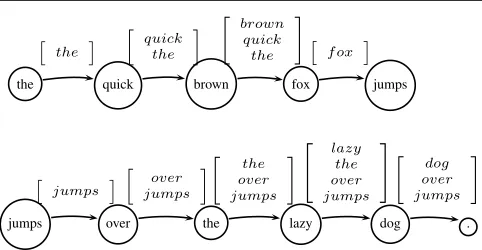
Figure 1: A path through a lattice. Although separated on two lines, it represents a single sequence of words. The stack (oriented upwards) grows and shrinks as we add words. Note that the modifiers todogare popped off before it is pushed on. Note also that modifiers of existing items on the stack, such asoverare merely pushed on. Words with no connection to previously seen stack items are also pushed on (eg.quick) in the hope that a head will be found later.
Here, we assume that a word can only attach to the tree once at a single node; hence, we find the node that max-imises the probability of node attachment. The
relation-shipDepsym(a, b)is modelled using a simplified version of
Collins’ [1996] dependency model.
Because of the status of word as the head relies on the preservation of word order, we keep track of the direction-ality of a relation. For two wordsaandbwhereaprecedesb
in the generated string,
p(Depsym(a, b))≈
Adjright(a, b) +Adjlef t(b, a)
cnt(co-occur(a, b))
whereAdjrightandAdjlef tare the right and left adjacency
matrices. Recall that row indices are heads and column in-dices are modifiers.
4.2 Head Stack Reduction
Once we decide that a newly considered path is better than any other previously considered one, we update the head stack to represent the extended path. At any point in time, the stack represents the rightmost root-to-leaf branch of the dependency tree (for the generated sentence) that can still be modified or governed by concatenating new words to the string.3 Within the stack, older words may be modified by newer words. Our rules for modifying the stack are designed to cater for a projective4dependency grammar.
There are three possible alternative outcomes of the reduc-tion. The first is that the proposed top-of-stack (ToS) has no dependency relation to any of the existing stack items, in which case the stack remains unchanged. For the second and third cases, we check each item on the stack and keep a record
3Note that we can scan through the stack as well as push onto
and pop from the top; this is thus the same type of stack as used in, for example, Nested Stack Automata.
4That is, ifw
idepends onwj, all words in betweenwiandwj
reduceHeadStack(aN ode, aStack) returns aStack N odenew ←aN ode
Stack ←aStack # duplicate
N odemax ←N U LL
Edgeprob ←0
# Find best chunk While notEmpty(aStack)
Head ←pop(aStack)
if p(depsym (N odenew, Head)) > Edgeprob
N odemax ←Head
Edgeprob ←depsym(N odenew, Head)
# Keep only best chunk While top(aStack) 6= N odemax
pop(aStack)
# Determine new head of existing string if isReduced(N odenew,N odemax)
pop(aStack) else
push(N odenew, aStack)
Figure 2: Pseudocode for the Head Stack Reduction operation
only of the best probable dependency between the proposed ToS and the appropriate stack item. The second outcome, then, is that the proposed ToS is the head of some item on the stack. All items up to and including that stack item are popped off and the proposed ToS is pushed on. The third out-come is that it modifies some item on the stack. All stack items up to (but not including) the stack item are popped off and the proposed ToS is pushed on. The pseudocode is sented in Figure 2. An example of stack manipulation is pre-sented in Figure 1. We rely on two external functions. The first function,depsym/2, has already been presented above. The second function, isReduced/2, relies on an auxiliary function returning the probability of one word being governed by the other, given the relative order of the words. This is in essence our parsing step, determining which word governs the other. The function is defined as follows:
isReduced(w1, w2) =
p(isHeadRight(w1, w2))> p(isHeadLef t(w1, w2))
wherew1precedesw2, and:
p(isHeadRight(w1, w2))
≈ Adjright(w1, w2)
cnt(hasRelation(w1, w2,wherei(w1)<i(w2)))
and similarly,
p(isHeadLef t(w1, w2))
≈ Adjlef t(w2, w1)
cnt(hasRelation(w1, w2,wherei(w1)<i(w2)))
where hasRelation/2 is the number of times we see the two words in a dependency relation, and where i(wi)
returns a word position in the corpus sentence. The function isReduced/2 makes calls to p(isHeadRight/2)
andp(isHeadLef t/2). It returns true if the first parameter
viterbiSearch(maxLength, stateGraph) returns bestPath
numStates ←getN umStates(stateGraph)
viterbi ←a matrix[numStates+2,maxLength+2]
viterbi[0,0].score ←1.0
for each time step t from 0 to maxLength do
# Termination Condition
if ((viterbi[endState, t].score 6= 0) AND isAcceptable(endState.headStack))
# Backtrace from endState and return path
# Continue appending words
for each state s from 0 to numStates do for each transition s0
from s newScore←
viterbi[s,t].score × ptr(s0|s) × pem(s0) if ((viterbi[s0,
t+1].score = 0) OR (newScore > viterbi[s0,
t+1]))
viterbi[s0
,t+1].score ←newScore viterbi[s0,
t+1].headStack ←
reduceHeadStack(s0
,viterbi[s,t].headStack)
backP ointer[s0,
t+1] ←s
Backtrace from viterbi[endState,t] and return path
Figure 3: Extended Viterbi Algorithm
is the head of the second, and false otherwise. In the com-parison, the denominator is constant. We thus need only the numerator in these auxiliary functions.
Collins’ distance heuristics [1996] weight the probability of a dependency relation between two words based on the distance between them. We could implement a similar strat-egy by favouring small reductions in the head stack. Thus a reduction with a more recent stack item which is closer to the proposed ToS would be less penalised than an older one.
5 Related Work
There is a wealth of relevant research related to sentence gen-eration. We focus here on a discussion of related work from statistical sentence generation and from summarisation.
Research in summarisation has also addressed the prob-lem of generating non-verbatim sentences; see [Jing and McKeown, 1999], [Barzilayet al., 1999] and more recently [Daum´e III and Marcu, 2004]. Jing presented a HMM for learning alignments between summary and source sentences trained using examples of summary sentences generated by humans. Daume III also provides a mechanism for sub-sentential alignment but allows for alignments between multi-ple sentences. Both these approaches provide models for later recombining sentence fragments. Our work differs primarily in granularity. Using words as a basic unit potentially offers greater flexibility in pseudo-paraphrase generation since we able to modify the word sequence within the phrase.
It should be noted, however, that a successful execution of our algorithm is likely to conserve constituent structure (ie. a coarser granularity) via the use of dependencies, whilst still making available a flexibility at the word level. Addition-ally, our use of dependencies allows us to generate not only a string but a dependency tree for that sentence.
6 Evaluation
In this section, we outline our preliminary evaluation of gram-maticality in which we compare our dependency based gener-ation method against a baseline. To study any improvements in grammaticality, we compare our dependency based gener-ation method against a baseline consisting of sentences gen-erated using bigram model.
In the evaluation, we do not use any smoothing algorithms for dependency counts. For both our approach and the base-line, Katz’s Back-off smoothing algorithm is used for bigram probabilities.
For our evaluation cases, we use the Information Fusion data collected by [Barzilayet al., 1999]. This data is made up of news articles that have been first grouped by topic, and then component sentences further clustered by similar-ity of events. There are 100 sentence clusters and on average there are 4 sentences per cluster. Each sentence in the cluster is initially passed through the Connexor dependency parser (www.connexor.com) to obtain dependency relations. Each sentence cluster forms an evaluation case in which we gener-ate a single sentence. Example output and the original text of the cluster is presented in Figure 4.
To give both our approach and the baseline the greatest chance of generating a sentence, we obtain our bigrams from our evaluation cases.5 Aside from this preprocessing to col-lect input sentence bigrams and dependencies, there is no training as such. For each evaluation case, both our system and the baseline method generates a set of answer strings, from 3 to 40 words in length.
For each generated output of a given sentence length, we count the number of times the Connexor parser resorts to re-turning partial parses. This count, albeit a noisy one, is used as our measure of ungrammaticality. We calculate the aver-age ungrammaticality score across evaluation cases for each sentence length.
5Note that this is permissible in this case because we are not
making any claims about the coverage of our model.
Original Text
A military transporter was scheduled to take off in the afternoon from Yokota air base on the outskirts of Tokyo and fly to Osaka with 37,000 blankets .
Mondale said the United States, which has been flying in blankets and is sending a team of quake relief experts, was prepared to do more if Japan requested .
United States forces based in Japan will take blankets to help earthquake survivors Thursday, in the U.S. military’s first disaster relief operation in Japan since it set up bases here.
Our approach with Dependencies and End of Sentence Check 6: united states forces based in blankets
8: united states which has been flying in blankets
11: a military transporter was prepared to osaka with 37,000 blankets
18: mondale said the afternoon from yokota air base on the united states which has been flying in blankets
20: mondale said the outskirts of tokyo and is sending a military transporter was pre-pared to osaka with 37,000 blankets
23: united states forces based in the afternoon from yokota air base on the outskirts of tokyo and fly to osaka with 37,000 blankets
27: mondale said the afternoon from yokota air base on the outskirts of tokyo and is sending a military transporter was prepared to osaka with 37,000 blankets
29: united states which has been flying in the afternoon from yokota air base on the outskirts of tokyo and is sending a team of quake relief operation in blankets 31: united states which has been flying in the afternoon from yokota air base on the out-skirts of tokyo and is sending a military transporter was prepared to osaka with 37,000 blankets
34: mondale said the afternoon from yokota air base on the united states which has been flying in the outskirts of tokyo and is sending a military transporter was prepared to osaka with 37,000 blankets
36: united states which has been flying in japan will take off in the afternoon from yokota air base on the outskirts of tokyo and is sending a military transporter was pre-pared to osaka with 37,000 blankets
1 1.5 2 2.5 3 3.5 4 4.5 5
3 4 5 6 7 8 9 10 11 12 13 14 15 16 17 18 19 20 21 22 23 24 25 26 27 28 29 30 31 32 33 34 35 36 37 38
Ungrammaticality Score
Sentence Length
Ungrammaticality Errors across Sentence Lengths
Baseline System
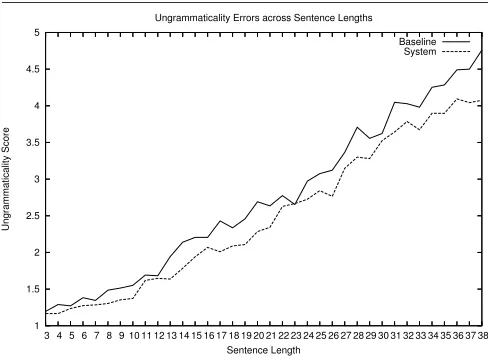
Figure 5: Ungrammaticality scores for generated output. Higher scores indicates worse performance.
The results are presented in Figure 5. Our approach almost always performs better than the baseline, producing less er-rors per sentence length. Using the Wilcoxon Signed Rank Text (alpha = 0.5), we found that for sentences of length greater than 12, the differences were usually significant.
7 Conclusion and Future Work
In this paper, we presented an extension to the Viterbi al-gorithm that statistically determines dependency structure of partially generated sentences and selects of words that are likely to attach to this structure. The resulting sentence is more grammatical than that generated using a bigram base-line. In future work, we intend to conduct experiments to see whether the smoothing approaches chosen are successful in parsing without introducing spurious dependency relations. We would also like to re-integrate the emission probability (that is, the word content selection model). We are also in the process of developing a measure of consistency. Finally, we intend to provide a comparison evaluation with Barzilay’s Information Fusion work.
8 Acknowledgements
This work was funded by the Centre for Language Technol-ogy at Macquarie University and the CSIRO Information and Communication Technology Centre. We would like to thank the research groups of both organisations for useful com-ments and feedback.
References
[Bangalore and Rambow, 2000] Srinivas Bangalore and Owen Rambow. Exploiting a probabilistic hierarchical model for generation. In Proceedings of the 18th Con-ference on Computational Linguistics (COLING’2000), July 31 - August 4 2000, Universit¨at des Saarlandes, Saarbr¨ucken, Germany, 2000.
[Barzilayet al., 1999] Regina Barzilay, Kathleen R. McKe-own, and Michael Elhadad. Information fusion in the con-text of multi-document summarization. InProceedings of the 37th conference on Association for Computational Lin-guistics, pages 550–557, Morristown, NJ, USA, 1999. As-sociation for Computational Linguistics.
[Collins, 1996] Michael John Collins. A new statistical parser based on bigram lexical dependencies. In Arivind Joshi and Martha Palmer, editors, Proceedings of the Thirty-Fourth Annual Meeting of the Association for Com-putational Linguistics, pages 184–191, San Francisco, 1996. Morgan Kaufmann Publishers.
[Daum´e III and Marcu, 2004] Hal Daum´e III and Daniel Marcu. A phrase-based hmm approach to docu-ment/abstract alignment. In Dekang Lin and Dekai Wu, editors, Proceedings of EMNLP 2004, pages 119–126, Barcelona, Spain, July 2004. Association for Computa-tional Linguistics.
[Forney, 1973] G. David Forney. The viterbi algorithm. Pro-ceedings of The IEEE, 61(3):268–278, 1973.
[Jing and McKeown, 1999] Hongyan Jing and Kathleen McKeown. The decomposition of human-written sum-mary sentences. InResearch and Development in Infor-mation Retrieval, pages 129–136, 1999.
[Kittredge and Mel’cuk, 1983] Richard I. Kittredge and Igor Mel’cuk. Towards a computable model of meaning-text relations within a natural sublanguage. In IJCAI, pages 657–659, 1983.
[Knight and Marcu, 2002] Kevin Knight and Daniel Marcu. Summarization beyond sentence extraction: a probabilis-tic approach to sentence compression. Artif. Intell., 139(1):91–107, 2002.
[Langkilde and Knight, 1998] Irene Langkilde and Kevin Knight. The practical value of N-grams in derivation. In Eduard Hovy, editor, Proceedings of the Ninth Interna-tional Workshop on Natural Language Generation, pages 248–255, New Brunswick, New Jersey, 1998. Association for Computational Linguistics.
[Manning and Sch¨utze, 1999] Christopher D. Manning and Hinrich Sch¨utze. Foundations of Statistical Natural Lan-guage Processing. The MIT Press, Cambridge, Mas-sachusetts, 1999.
[Steedman, 2000] Mark Steedman. The syntactic process. MIT Press, Cambridge, MA, USA, 2000.
[Wanet al., 2003] Stephen Wan, Mark Dras, Cecile Paris, and Robert Dale. Using thematic information in statistical headline generation. InThe Proceedings of the Workshop on Multilingual Summarization and Question Answering at ACL 2003, Sapporo, Japan, July 2003.
[image:6.595.53.297.53.232.2]