Incremental Dependency Parsing Using Online Learning
Richard Johansson and Pierre Nugues
Department of Computer Science, Lund University, Sweden
{richard, pierre}@cs.lth.se
Abstract
We describe an incremental parser that was trained to minimize cost over sen-tences rather than over individual parsing ac-tions. This is an attempt to use the advan-tages of the two top-scoring systems in the CoNLL-X shared task.
In the evaluation, we present the perfor-mance of the parser in the Multilingual task, as well as an evaluation of the contribution of bidirectional parsing and beam search to the parsing performance.
1 Introduction
The two best-performing systems in the CoNLL-X shared task (Buchholz and Marsi, 2006) can be clas-sified along two lines depending on the method they used to train the parsing models. Although the parsers are quite different, their creators could re-port near-tie scores. The approach of the top sys-tem (McDonald et al., 2006) was to fit the model to minimize cost over sentences, while the second-best system (Nivre et al., 2006) trained the model to maximize performance over individual decisions in an incremental algorithm. This difference is a nat-ural consequence of their respective parsing strate-gies: CKY-style maximization of link score and in-cremental parsing.
In this paper, we describe an attempt to unify the two approaches: an incremental parsing strategy that is trained to maximize performance over sentences rather than over individual parsing actions.
2 Parsing Method
2.1 Nivre’s Parser
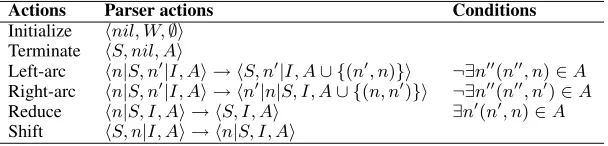
We used Nivre’s algorithm (Nivre et al., 2006), which is a variant of the shift–reduce parser. Like the regular shift–reduce, it uses a stackS and a list
of input words W, and builds the parse tree
incre-mentally using a set of parsing actions (see Table 1). It can be shown that Nivre’s parser creates projec-tive and acyclic graphs and that every projecprojec-tive de-pendency graph can be produced by a sequence of parser actions. In addition, the worst-case number of actions is linear with respect to the number of words in the sentence.
2.2 Handling Nonprojective Parse Trees
While the parsing algorithm produces projective trees only, nonprojective arcs can be handled using a preprocessing step before training the model and a postprocessing step after parsing the sentences.
The projectivization algorithm (Nivre and Nils-son, 2005) iteratively moves each nonprojective arc upward in the tree until the whole tree is projective. To be able to recover the nonprojective arcs after parsing, the projectivization operation replaces the labels of the arcs it modifies with traces indicating which links should be moved and where attach to at-tach them (the “Head+Path” encoding). The model is trained with these new labels that makes it pos-sible to carry out the reverse operation and produce nonprojective structures.
2.3 Bidirectional Parsing
Shift-reduce is by construction a directional parser, typically applied from left to right. To make bet-ter use of the training set, we applied the algorithm in both directions as Johansson and Nugues (2006) and Sagae and Lavie (2006) for all languages except Catalan and Hungarian. This, we believe, also has the advantage of making the parser less sensitive to whether the language is head-initial or head-final.
We trained the model on projectivized graphs from left to right and right to left and used a vot-ing strategy based on link scores. Each link was as-signed a score (simply by using the score of thela orraactions for each link). To resolve the conflicts
Table 1: Nivre’s parser transitions where W is the initial word list; I, the current input word list; A, the graph of dependencies; andS, the stack.(n′, n)denotes a dependency relations betweenn′andn, wheren′
is the head andnthe dependent.
Actions Parser actions Conditions
Initialize hnil, W,∅i
Terminate hS, nil, Ai
Left-arc hn|S, n′|I, Ai → hS, n′|I, A∪ {(n′, n)}i ¬∃n′′(n′′, n)∈A
Right-arc hn|S, n′|I, Ai → hn′|n|S, I, A∪ {(n, n′)}i ¬∃n′′(n′′, n′)∈A
Reduce hn|S, I, Ai → hS, I, Ai ∃n′(n′, n)∈A
Shift hS, n|I, Ai → hn|S, I, Ai
between the two parses in a manner that makes the tree projective, single-head, rooted, and cycle-free, we applied the Eisner algorithm (Eisner, 1996).
2.4 Beam Search
As in our previous parser (Johansson and Nugues, 2006), we used a beam-search extension to Nivre’s original algorithm (which is greedy in its original formulation). Each parsing action was assigned a score, and the beam search allows us to find a bet-ter overall score of the sequence of actions. In this work, we used a beam width of 8 for Catalan, Chinese, Czech, and English and 16 for the other languages.
3 Learning Method
3.1 Overview
We model the parsing problem for a sentencex as finding the parse yˆ = arg maxyF(x, y) that max-imizes a discriminant functionF. In this work, we
consider linear discriminants of the following form:
F(x, y) =w·Ψ(x, y)
where Ψ(x, y) is a numeric feature representation of the pair(x, y)andwa vector of feature weights. Learning F in this case comes down to assigning
good weights in the vectorw.
Machine learning research for similar prob-lems have generally used margin-based formula-tions. These include global batch methods such as SVMstruct (Tsochantaridis et al., 2005) as well as online methods such as the Online Passive-Aggressive Algorithm (OPA) (Crammer et al., 2006). Although the batch methods are formulated very elegantly, they do not seem to scale well to the large training sets prevalent in NLP contexts –
we briefly considered using SVMstruct but train-ing was too time-consumtrain-ing. The online methods on the other hand, although less theoretically ap-pealing, can handle realistically sized data sets and have successfully been applied in dependency pars-ing (McDonald et al., 2006). Because of this, we used the OPA algorithm throughout this work.
3.2 Implementation
In the online learning framework, the weight vector is constructed incrementally. At each step, it com-putes an update to the weight vector based on the current example. The resulting weight vector is fre-quently overfit to the last examples. One way to reduce overfitting is to use the average of all suc-cessive weight vectors as the result of the training (Freund and Schapire, 1999).
Algorithm 1 shows the algorithm. It uses an “aggressiveness” parameterC to reduce overfitting,
analogous to the C parameter in SVMs. The
algo-rithm also needs a cost function ρ, which describes how much a parse tree deviates from the gold stan-dard. In this work, we definedρas the sum of link
costs, where the link cost was 0 for a correct depen-dency link with a correct label, 0.5 for a correct link with an incorrect label, and 1 for an incorrect link. The number of iterations was 5 for all languages.
For a sentence x and a parse treey, we defined the feature representation by finding the sequence hhS1, I1i, a1i,hhS2, I2i, a2i . . .of states and their corresponding actions, and creating a feature vector for each state/action pair. The discriminant function was thus written
Ψ(x, y)·w=
X
i
ψ(hSi, Iii, ai)·w
Algorithm 1The Online PA Algorithm inputTraining setT ={(xt, yt)}T
t=1
Number of iterationsN
Regularization parameterC
Cost functionρ
Initializewto zeros
repeatN times for(xt, yt)inT
lety˜t= arg maxyF(xt, y) +pρ(yt, y)
letτt= min
C,F(xt,yt˜)−F(xt,yt)+√ρ(yt,yt˜)
kΨ(x,yt)−Ψ(x,yt˜)k2
w←w+τt(Ψ(x, yt)−Ψ(x,y˜t))
returnwaverage
vector to a statehSi, Iii and the actionai taken in
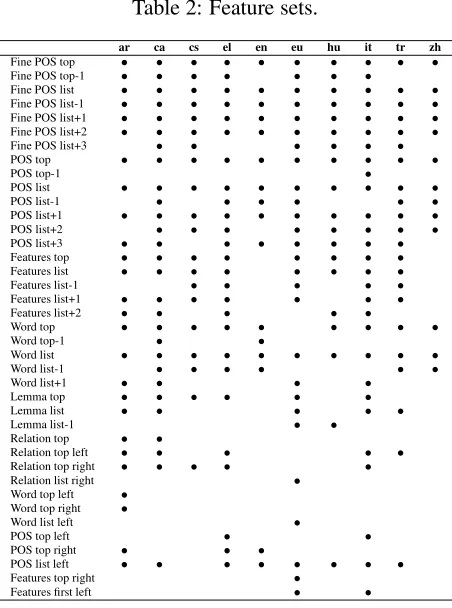
that state. Table 2 shows the feature sets used in
ψ for all languages. In principle, a kernel could
also be used, but that would degrade performance severely. Instead, we formed a new vector by com-bining features pairwisely – this is equivalent to us-ing a quadratic kernel.
Since the history-based feature set used in the parsing algorithm makes it impossible to use inde-pendence to factorize the scoring function, an ex-act search to find the best-scoring ex-action sequence (arg maxy in Algorithm 1) is not possible.
How-ever, the beam search allows us to find a reasonable approximation.
[image:3.612.69.297.67.255.2]4 Results
Table 3 shows the results of our system in the Mul-tilingual task.
4.1 Compared to SVM-based Local Classifiers
We compared the performance of the parser with a parser based on local SVM classifiers (Johansson and Nugues, 2006). Table 4 shows the performance of both parsers on the Basque test set. We see that what is gained by using a global method such as OPA is lost by sacrificing the excellent classifica-tion performance of the SVM. Possibly, better per-formance could be achieved by using a large-margin batch method such asSVMstruct.
Table 2: Feature sets.
ar ca cs el en eu hu it tr zh
Fine POS top • • • • • • • • • • Fine POS top-1 • • • • • • •
Fine POS list • • • • • • • • • • Fine POS list-1 • • • • • • • • • • Fine POS list+1 • • • • • • • • • • Fine POS list+2 • • • • • • • • • • Fine POS list+3 • • • • • • POS top • • • • • • • • • •
POS top-1 •
POS list • • • • • • • • • • POS list-1 • • • • • • POS list+1 • • • • • • • • • • POS list+2 • • • • • • • • POS list+3 • • • • • • • • Features top • • • • • • • • Features list • • • • • • • • Features list-1 • • • • • Features list+1 • • • • • • • Features list+2 • • • • •
Word top • • • • • • • • • Word top-1 • •
Word list • • • • • • • • • • Word list-1 • • • • • • Word list+1 • • • •
Lemma top • • • • • • Lemma list • • • • • Lemma list-1 • • Relation top • •
Relation top left • • • • • Relation top right • • • • • Relation list right •
Word top left • Word top right •
Word list left •
POS top left • • POS top right • • •
POS list left • • • • • • • • Features top right •
[image:3.612.314.540.88.392.2]Features first left • •
Table 3: Summary of results.
Languages Unlabeled Labeled
Arabic 80.91 71.76 Basque 80.41 75.08 Catalan 88.34 83.33 Chinese 81.30 76.30
Czech 77.39 70.98
English 81.43 80.29
Greek 79.58 72.77
Hungarian 75.53 71.31 Italian 81.55 77.55 Turkish 84.80 78.46 Average result 81.12 75.78
Table 4: Accuracy by learning method.
Learning Method Accuracy
OPA 75.08
[image:3.612.346.508.457.581.2]4.2 Beam Width
To investigate the influence of the beam width on the performance, we measured the accuracy of a left-to-right parser on a development set for Basque (15% of the training data) as a function of the width. Ta-ble 5 shows the result. We see clearly that widening the beam considerably improves the figures, espe-cially in the lower ranges.
Table 5: Accuracy by beam width.
Width Accuracy
2 72.01
4 74.18
6 75.05
8 75.30
12 75.49
4.3 Direction
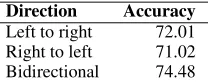
[image:4.612.135.241.413.454.2]We also investigated the contribution of the bidirec-tional parsing. Table 6 shows the result of this exper-iment on the Basque development set (the same 15% as in 4.2). The beam width was 2 in this experiment.
Table 6: Accuracy by parsing direction.
Direction Accuracy
Left to right 72.01 Right to left 71.02 Bidirectional 74.48
Time did not allow a full-scale experiment, but for all languages except Catalan and Hungarian, the bidirectional parsing method outperformed the uni-directional methods when trained on a 20,000-word subset. However, the gain of using bidirectional parsing may be more obvious when the treebank is small. For all languages except Czech, left-to-right outperformed right-to-left parsing.
5 Discussion
The paper describes an incremental parser that we trained to minimize the cost over sentences, rather than over parsing actions as is usually done. It was trained using the Online Passive-Aggressive method, a cost-sensitive online margin-based learn-ing method, and shows reasonable performance and received above-average scores for most languages.
The performance of the parser (relative the other teams) was best for Basque and Turkish, which were two of the smallest treebanks. Since we found that the optimal number of iterations was 5 for Basque (the smallest treebank), we used this number for all languages since we did not have time to investigate this parameter for the other languages. This may have had a detrimental effect for some languages. We think that some of the figures might be squeezed slightly higher by optimizing learning parameters and feature sets.
This work shows that it was possible to combine approaches used by Nivre’s and McDonald’s parsers in a single system. While the parser is outperformed by a system based on local classifiers, we still hope that the parsing and training combination described here opens new ways in parser design and eventually leads to the improvement of parsing performance.
Acknowledgements
This work was made possible because of the anno-tated corpora that were kindly provided to us: (Hajiˇc et al., 2004; Aduriz et al., 2003; Martí et al., 2007; Chen et al., 2003; Böhmová et al., 2003; Marcus et al., 1993; Johansson and Nugues, 2007; Prokopidis et al., 2005; Csendes et al., 2005; Montemagni et al., 2003; Oflazer et al., 2003)
References
A. Abeillé, editor. 2003.Treebanks: Building and Using Parsed Corpora. Kluwer.
I. Aduriz, M. J. Aranzabe, J. M. Arriola, A. Atutxa, A. Diaz de Ilarraza, A. Garmendia, and M. Oronoz. 2003. Construction of a Basque dependency treebank. InProc. of the 2nd Workshop on Treebanks and Lin-guistic Theories (TLT), pages 201–204.
A. Böhmová, J. Hajiˇc, E. Hajiˇcová, and B. Hladká. 2003. The PDT: a 3-level annotation scenario. In Abeillé (Abeillé, 2003), chapter 7, pages 103–127.
S. Buchholz and E. Marsi. 2006. CoNLL-X shared task on multilingual dependency parsing. InCoNLL-X.
K. Crammer, O. Dekel, J. Keshet, S. Shalev-Schwartz, and Y. Singer. 2006. Online passive-aggressive algo-rithms. JMLR, 2006(7):551–585.
D. Csendes, J. Csirik, T. Gyimóthy, and A. Kocsor. 2005.
The Szeged Treebank. Springer.
J. Eisner. 1996. Three new probabilistic models for de-pendency parsing: An exploration. InProceedings of ICCL.
Y. Freund and R. E. Schapire. 1999. Large margin clas-sification using the perceptron algorithm. Machine Learning, 37(3):277–296.
J. Hajiˇc, O. Smrž, P. Zemánek, J. Šnaidauf, and E. Beška. 2004. Prague Arabic dependency treebank: Develop-ment in data and tools. InProc. of the NEMLAR In-tern. Conf. on Arabic Language Resources and Tools,
pages 110–117.
R. Johansson and P. Nugues. 2006. Investigating multi-lingual dependency parsing. InCoNLL-X.
R. Johansson and P. Nugues. 2007. Extended constituent-to-dependency conversion for English. In
Proc. of the 16th Nordic Conference on Computational Linguistics (NODALIDA).
M. Marcus, B. Santorini, and M. Marcinkiewicz. 1993. Building a large annotated corpus of English: the Penn Treebank.Computational Linguistics, 19(2):313–330.
M. A. Martí, M. Taulé, L. Màrquez, and M. Bertran. 2007. CESS-ECE: A multilingual and multilevel annotated corpus. Available for download from: http://www.lsi.upc.edu/∼mbertran/cess-ece/.
R. McDonald, K. Lerman, and F. Pereira. 2006. Multi-lingual dependency parsing with a two-stage discrimi-native parser. InCoNLL-X.
S. Montemagni, F. Barsotti, M. Battista, N. Calzolari, O. Corazzari, A. Lenci, A. Zampolli, F. Fanciulli, M. Massetani, R. Raffaelli, R. Basili, M. T. Pazienza, D. Saracino, F. Zanzotto, N. Nana, F. Pianesi, and R. Delmonte. 2003. Building the Italian Syntactic-Semantic Treebank. In Abeillé (Abeillé, 2003), chap-ter 11, pages 189–210.
J. Nivre and J. Nilsson. 2005. Pseudo-projective depen-dency parsing. InProceedings of ACL-05.
J. Nivre, J. Hall, J. Nilsson, G. Eryi˘git, and S. Marinov. 2006. Labeled pseudo-projective dependency parsing with support vector machines. InCoNLL-X.
K. Oflazer, B. Say, D. Zeynep Hakkani-Tür, and G. Tür. 2003. Building a Turkish treebank. In Abeillé (Abeillé, 2003), chapter 15, pages 261–277.
P. Prokopidis, E. Desypri, M. Koutsombogera, H. Papa-georgiou, and S. Piperidis. 2005. Theoretical and practical issues in the construction of a Greek depen-dency treebank. InProc. of the 4th Workshop on Tree-banks and Linguistic Theories (TLT), pages 149–160.
K. Sagae and A. Lavie. 2006. Parser combination by reparsing. InProceedings of the HLT-NAACL.